It is well established that early disruptive behaviors in children (i.e., aggressiveness, opposition, hyperactivity) predict violence and substance use during adolescence and adulthood (for violence, see Patterson, Capaldi, & Bank, 1991; White, Moffitt, Earls, Robins, & Silva, 1990; for alcohol and drug use, see Dobkin, Tremblay, Mâsse, & Vitaro, 1995; Hawkins, Catalano, & Miller, 1992). There is also evidence that two processes involving peer relationships play a role in the pathway from early disruptiveness to later violence and substance use: rejection by normative peers and affiliation with deviant peers (Deater-Deckard, 2001; Rubin, Bukowski, & Parker, 1998; Vitaro, Tremblay, & Bukowski, 2001). Peer rejection may deprive disruptive children of opportunities to learn social norms. The conflictual and coercive peer interactions that accompany such rejection may also aggravate disruptive children's use of aggression. In some cases, it may also foster the use of alcohol or other substances to cope with the accompanying stress of these negative peer experiences (Luthar & D'Avanzo, 1999). In contrast, affiliation with deviant peers may expose disruptive children to modeling and reinforcement of problem behaviors. Further, given the often low quality of disruptive children's relationships with deviant peers, deviant peer affiliation may also serve as a favorable ground for conflict and coercive interactions (Criss, Pettit, Bates, Dodge, & Lapp, 2002; Deptula & Cohen, 2004).
Although prior research suggests that both peer rejection and affiliation with deviant peers are mediators of the link between childhood disruptiveness and adolescent violence and substance use, the literature has not established the degree to which these two risky experiences are interrelated. Do rejection by normative peers and affiliation with deviant peers represent parallel processes influencing later behavioral adjustment? In other words, does early disruptiveness contribute independently and directly to both peer rejection and affiliation with deviant peers, which in turn contribute directly and independently to delinquency? Alternatively, are these mediating processes sequential and interrelated? Specifically, does early disruptiveness directly lead to peer rejection, which in turn, predicts affiliation with deviant peers and, subsequently, delinquency? Building upon prior theoretical and empirical work in this area, this study will attempt to answer these questions by examining the combined role of peer rejection and deviant peer involvement in the processes linking early disruptiveness to later delinquent behaviors (i.e., delinquency related violence and substance use, in particular).
Two Integrated Models of Peer Experiences
More than 15 years ago Patterson and his colleagues (Dishion, Patterson, Stoolmiller, & Skinner, 1991; Patterson, DeBaryshe, & Ramsey, 1989) proposed an integrated model according to which rejection by normative peers and affiliation with deviant friends mediate in a sequential manner (i.e., successively) the link between early disruptiveness and later delinquent behaviors. Specifically, disruptive children are rejected by normative peers; in turn, rejection by normative peers fosters association of disruptive children with each other; finally, deviant peers influence disruptive children to commit delinquent acts. Recently, Hay, Payne, and Chadwick (2004) proposed a similar model with only minor modifications. In the Hay et al. model, peer rejection and deviant friends mediate the link between early disruptiveness and later delinquency as in the Patterson et al. model. Hay et al., however, proposed that this mediation is only partial, with residual links from early disruptiveness and peer rejection to later delinquency.
Although the Patterson et al. model has rarely been tested in its entirety, the results of prior studies provide evidence in support of each of the pathways within that model. For example, a number of researchers have found that peer rejection partially mediates the link between early disruptiveness and later conduct problems (Miller-Johnson, Coie, Maumary-Gremaud, Bierman, & Conduct Problems Prevention Research Group, 2002; Snyder, Prichard, Schrepferman, Patrick, & Stoolmiller, 2004). Other researchers have reported that peer rejection predicts affiliation with deviant peers, above and beyond children's personal characteristics (Brendgen, Vitaro, & Bukowski, 1998; Dishion et al., 1991; Fergusson, Woodward, & Horwood, 1999). Finally, affiliation with deviant peers has been found to contribute to later delinquency and drug use, either by mediating or adding to the effect of early disruptiveness (Dishion, Andrews, & Crosby, 1995; Elliott, Huizinga, & Ageton, 1985; Wilks, Callan, & Austin, 1989).
Only one study has tested the full Patterson et al. model, examining whether peer rejection during the early grades and association with antisocial peers in early adolescence sequentially mediate the link between early disruptiveness and adolescent behavior problems (Laird, Jordan, Dodge, Pettit, & Bates, 2001). Laird et al. (2001) did not find support for Patterson et al.'s (1989) sequential mediational model, however. First, no direct link between early disruptiveness and later antisocial peer involvement was found that could be mediated by peer rejection. Second, the relation between childhood peer rejection and adolescent behavior problems was not mediated by early adolescent antisocial peer involvement, probably as a consequence of an initial weak link between peer rejection and antisocial peer involvement. This weak link, however, contradicts the results of the studies cited above in which a relation between peer rejection and children's affiliation with deviant friends was established (Brendgen et al., 1998; Dishion et al., 1991; Fergusson et al., 1999).
As acknowledged by Laird et al. (2001), a weak measurement of antisocial peer involvement may account for their results and render their findings inconclusive with respect to the sequential mediational model. To illustrate, Laird et al. (2001) used a cumulative index comprising the number of years that a child had been rejected between kindergarten and third grade (i.e., over a 4-year period) as a measure of peer rejection. For antisocial peer involvement, however, the authors relied on only one self-reported measure collected at age 13. In addition, Laird et al. (2001) used a global measure of externalizing problems that included aggression, theft, drug use and lying as their outcome. The use of this multidimensional delinquency measure may be inappropriate because the role played by peer experiences may depend on the type of delinquent behavior under scrutiny. For example, there is ample evidence that peer rejection is positively correlated with children's and adolescents' aggressive behaviors (for reviews, see Coie, 2004; Hymel, Vaillancourt, McDougall, & Renshaw, 2002; Rubin et al., 1998; Saunders & Chambers, 1996). The few studies that do not report a positive link between peer rejection and aggressive behaviors used samples where the norms were favorable to the use of aggression (Boivin, Dodge, & Coie, 1995). There is also evidence that peer rejection during the elementary years, especially if stable, contributes to increases in aggressive–antisocial behavior both in the short (Dodge et al., 2003) and the long term (Nelson & Dishion, 2004), even when children's personal characteristics are carefully controlled. In contrast, the evidence with respect to the predictive link between childhood peer rejection and adolescent substance use is more mixed, with some studies reporting no link (Dishion, Capaldi, Spracklen, & Li, 1995) or a negative link when substances such as tobacco, alcohol, and marijuana are involved (Alexander, Piazza, Mekos, & Valente, 2001; Allen, Porter, McFarland, Marsh, & McElhaney, 2005).
Overall, these results suggest a differential relationship between peer rejection and behaviors that become increasingly prevalent and approved by peers during adolescence (i.e., use of substances such as tobacco, alcohol, and marijuana) versus behaviors that do not become increasingly prevalent or approved by peers during adolescence (i.e., physical aggression and violence; Luthar & McMahon, 1996; Nagin & Tremblay, 1999). As for deviant friends, their role has been found to be important both in regard to violent behavior and in regard to substance use (see reviews by Vitaro et al., 2001, with respect to violence, and by Kandel, 1985, with respect to substance use). In sum, peer rejection and friends' deviancy may contribute in different ways to the process linking early disruptiveness to later violence and substance use. Moreover, their role may vary according to the children's gender because (a) violence but not substance use is more prevalent in boys than girls, and (b) differences between boys and girls have been found in the past with respect to the link between peer rejection or friends' deviancy, on the one hand, and later aggression or substance use, on the other hand (Luthar & D'Avanzo, 1999; Miller-Johnson et al., 2002; van Lier, Vitaro, Wanner, Vuijk, & Crijnen, 2005), although many studies included only boys.
Despite the putative specific contribution of peer rejection and affiliation with deviant friends, it is still possible that both peer experiences play a mediating role in this process, either in a sequential or a parallel model. Although the sequential model received most theoretical attention, the plausibility of a parallel model remains high for at least three reasons. First, contrary to Sullivan's (1953) suggestions that acceptance by the peer group is the most important experience during childhood whereas friendship takes this place during early adolescence, there are theorists who advocate the importance of both processes throughout childhood and adolescence (Buhrmester & Furman, 1986). Second, friends' deviancy has been found to predict an increase already in young children's disruptive behaviors, at least in the short term (Snyder, Horsch, & Childe, 1997; Snyder et al., 2005). Third, a link between peer rejection and deviant friends is not always hypothesized (Sullivan, 1953) and is not always found (Bagwell, Coie, Terry, & Lochman, 2000; Dishion, Andrews, et al., 1995; Laird et al., 2001). This link is necessary to the sequential model but not to the parallel model.
Alternative Models of Peer Experience
The sequential and parallel pathways are two versions of a mediational model (known as the “causal” model) whose validity has been challenged by theorists who propose that peer rejection and deviant peer involvement are byproducts of underlying child characteristics such as disruptiveness (for peer rejection: Caspi, Elder, & Bem, 1987; Dunn & McGuire, 1992; for deviant friends: Cairns, Cairns, Neckerman, Gest, & Gariépy, 1988; Gottfredson & Hirschi, 1990). As a result, the two versions of the mediational model can be tested in comparison to a third possible model. In this model, neither peer rejection nor affiliation with deviant friends are expected to play a causal role in the process leading young disruptive children to later violence and substance use. This model, known as the “incidental” model with respect to peer rejection and the “selection” or “individual characteristics” model with respect to deviant friends (see Vitaro et al., 2001), gives priority to a direct link between disruptiveness and later outcomes.
There is evidence to support the incidental model (with respect to peer rejection) and the individual characteristics/selection model (with respect to deviant friends). For example, in some studies, peer rejection failed to predict criminal offending in adolescence after controlling for family risk factors and children's cognitive and behavioral characteristics (Kupersmidt & Coie, 1990; Woodward & Fergusson, 1999). As for deviant friends, at least three groups of researchers found that friends' characteristics neither added to nor mediated the link between early aggressiveness/antisociality and later violence or substance use (Coie, Terry, Abriski, & Lochman, 1995; Dobkin et al., 1995; Laird et al., 2001; Tremblay, Mâsse, Vitaro, & Dobkin, 1995). As a result, the incidental or individual characteristics model cannot be ruled out and serves as the basis for the null hypothesis.
The Current Study
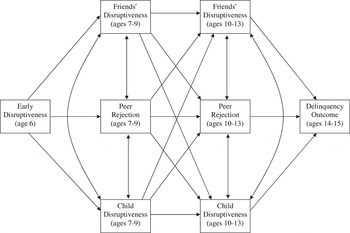
The primary objective of the present study was to test whether peer rejection and affiliation with deviant friends from age 7 through age 13 mediated the link between early (i.e., age 6) disruptiveness and later violence and substance use (collected when the participants were 14 and 15 years old) according to a sequential or a parallel pathway. To reflect the possible dynamic interplay between peer rejection and deviant peers throughout childhood without making the model too complex, peer rejection and deviant peers were grouped together in a two-phase temporal sequence. The first phase covered ages 7, 8, and 9 years, whereas the second phase covered ages 10, 11, 12, and 13 years. The first developmental phase thus covers the same age period as in the Laird et al. (2001) study. In addition, it covers the childhood period during which group acceptance has been suggested to play a more important role than dyadic friendships with respect to children's development (Sullivan, 1953), in contrast to the early adolescence period, which usually covers the period from age 10 through age 13 years (Steinberg, 2002). Child disruptiveness throughout childhood was also included and grouped together in a two-phase sequence for control purposes. This made it possible to examine the role of the two peer experiences (i.e., peer rejection and affiliation with deviant friends) over and above children's concurrent behavior problems.
In addressing these objectives, our study contributes to the current literature in four ways. First, we examine two types of peer experiences (i.e., peer rejection at the group level and affiliation with deviant friends) that, until now, have mostly been examined separately. Investigating both types of peer experiences simultaneously is important, however, to determine their respective contributions according to the parallel or the sequential versions of the mediational model. The results of several recent studies that tested peer rejection and friends' deviance separately suggest that both experiences contribute to the explanation of delinquency involvement. However, given the concurrent and longitudinal links between peer rejection and affiliation with deviant friends, it is not clear whether it was peer rejection per se that influenced later delinquency or whether deviant friends were the true driving force behind this link. The same limitation is true for studies that examined only the role of deviant friends without considering rejection by normative peers. Second, the accumulating evidence that homophily between friends with respect to disruptiveness is already underway by early childhood, with at least short-term detrimental effects, suggests that disruptive friends may be influential long before early adolescence. Third, affiliation with deviant friends as well as peer rejection were monitored in the present study over several years in a two-phase sequence (i.e., childhood: 7 to 9 years, and pre/early adolescence: 10 to 13 years), to capture the duration of each type of peer experience. Past studies suggest that this aspect is more determining of later adjustment problems than whether children have been rejected or affiliated with deviant peers at single points in time (Brendgen, Vitaro, & Bukowski, 2000; DeRosier, Kupersmidt, & Patterson, 1994; Ladd & Troop-Gordon, 2003; Laird et al., 2001). The two-phase strategy also allowed examining whether the role of peer rejection and friends' deviancy varied according to the developmental period when they were measured. Fourth and finally, the present study builds upon prior research in this area by examining whether the combined role of peer rejection and deviant friends varies according to the type of outcome (i.e., violence or substance use) and children's gender.
Method
Participants and procedure
The participants were 375 children (212 boys and 163 girls) whose mean age was 6.17 years (SD = 0.30) at the initial data collection (i.e., at the end of kindergarten) and 15.30 years (SD = 0.30) at the last data collection (i.e., at the end of Grade 9 for the majority of the participants). Participants attended five elementary schools from kindergarten up to age 12 and then transferred to one small school for their first year of high school (i.e., age 13) and one large high school thereafter. All children attended regular classrooms although, by the end of the study, 12% of the children in the study were in classrooms with younger classmates because of grade retention.
The 375 participants were part of an initial sample of 469 children who represented 92.5% of all French-speaking kindergarten children of a small community in northwestern Quebec, Canada (population 30,000), during the academic year 1986–1987. Ninety-six percent of the children were European Canadian. At kindergarten entry, 80% of children lived in intact families with two biological parents, 6% lived in blended family households, 12% in single parent families (predominantly with their mothers), and 2% lived in other family configurations. The percentage of intact families was 71% at the end of the study. Participants' socioeconomic status according to the Blishen, Carroll, and Moore (1987) occupational prestige scale (described later; M = 43.97, SD = 10.36) was similar to the average score for a representative sample of kindergarten children throughout the Province of Quebec (M = 43.63, SD = 14.54). Finally, 18% of the parents completed high school, 47% had post high school education, and 35% had less than a high school education.
To be included in the present study, children needed to have a minimum of two valid data points. Ninety-four children did not meet this criterion and were not included in the analyses. Three reasons were responsible for this attrition: parental permission was not available for a second round of assessment (54 children out of 94), children had moved out of the school district (32 out of 94), or they were absent on the day of data collection. On average, the children received lower social preference scores from peers and higher teacher ratings of disruptiveness in kindergarten compared to the 375 children who were part of the final sample. However, only 188 of the 375 children in the final sample had complete data across all 10 years of data collection. For the others, occasional missing values were estimated by using a full information maximum likelihood method (Arbuckle & Wothke, 1999).
Each spring (in April or May), participants spent 2 hr of classroom time, divided by a 20-min break, answering questionnaires. After the children were informed about the purpose of the study, they were told that all of their answers would be confidential and that they did not have to answer any of the questions if they did not want to. The children were encouraged to keep their answers confidential and not to talk with classmates about their answers. Trained research assistants administered and collected the questionnaires. Teachers were asked to leave the classroom during the assessment time to emphasize that participants' answers would not be revealed to their teachers. Teachers also completed questionnaires during this period. Parents (mostly mothers) also completed questionnaires sent to them by mail around the same time that the data were collected at school.
Measures
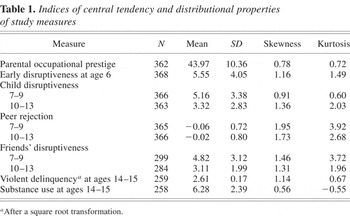
All instruments were administered in French. Instruments that were written originally in English were translated into French and then translated back into English. English-speaking judges verified the semantic similarity between the backtranslated items and the original items in the questionnaire. The University of Montreal ethics committee approved the measures for every year of the study (see Table 1 for descriptive information for all study variables).
Indices of central tendency and distributional properties of study measures

Sociodemographic information
Mothers reported on family structure and occupation of the parent or parents with whom the child was living for each year of the study during which they participated (i.e., from ages 6 through 13). Parental occupations were scored on a continuous scale using the Blishen et al. (1987) occupational prestige scale. These scores are based on the average income and average education level associated with occupations in Canada. Parental occupation scores were first averaged across the two parents (for two parent families) and next across the years the data were collected.
Disruptive behavior
Teachers and mothers rated the children's behavior from ages 6 through 13 years using 13 disruptiveness items from the Social Behavior Questionnaire (SBQ; Tremblay et al., 1991). The disruptiveness items covered physical aggression, opposition, hyperactivity, and antisociality (i.e., lying, cheating, and stealing). Exploratory and confirmatory factor analysis with samples of primary school children suggested that these items belonged to a single factor (i.e., disruptiveness; Rubin, Moller, & Emptage, 1986; Rutter, 1967; Tremblay, Vitaro, Gagnon, Piché, & Royer, 1992). Teachers and mothers indicated whether each item did not apply (0), applied sometimes (1), or applied often (2). For each time separately, a total disruptiveness score for mother and teacher ratings, respectively, was computed by summing the individual item scores. Internal consistency (i.e., Cronbach's alpha) was high, with α = .86 to .90 for teachers and α = .82 to .89 for mothers. A combined early disruptiveness variable was then computed by taking the mean of teachers' and mothers' age 6 total disruptiveness ratings. Values for the age 7–9 child disruptiveness variable were computed by taking the mean of teachers' and mothers' ratings obtained at each of those ages. Values for the age 10–13 child disruptiveness variable were computed in a similar manner. Correlation coefficients between mother and teacher ratings ranged between .42 and .29, depending on children's age.
Peer rejection
Children's sociometric status was assessed from age 7 through age 13 through peer nominations. Specifically, names (or photographs at age 7) of all children in a given class were handed out to the participants. Two research assistants ensured that all participants recognized the names (or photographs) of all their classmates by reading them out aloud in front of the class. The children were then asked to circle the names (or photographs) of three children they liked most (positive nominations) and three children they liked least (negative nominations). One research assistant read the instructions out loud, while the other made sure that each participant understood the instructions. Throughout the procedure, the children were reminded to keep their responses confidential. Criteria similar to those outlined by Coie, Dodge, and Coppotelli (1992) were used to compute the sociometric status for each participant in each year. Following Laird et al. (2001), the number of years children were in the rejected category between the ages of 7 and 9 and of 10 and 13 was computed. To account for occasional missing data, the final scores were a proportion of years children were rejected between 7 and 9 and between 10 and 13 with respect to the number of years their sociometric status was available. The mean proportion scores were 0.14 (SD = 0.30) between ages 7 and 9 and 0.16 (SD = 0.32) between ages 10 and 13.
To use a second source for peer rejection, as for disruptiveness, we also asked teachers to rate each child in the classroom with respect to the following item: “According to you, how much do other children dislike this child?” A 3-point scale was used to collect the teacher ratings: 0 = not at all, 1 = somewhat, 2 = a lot. The mean value of this item across children was 0.20 (SD = 0.38) at ages 7–9 and 0.23 (SD = 0.40) at ages 10–13. The peer-rated and teacher-rated rejection variables were standardized and averaged within age group. The two scores correlated between .46 and .32, depending on children's age.
Friends' disruptiveness
From age 7 through age 13, participants were asked to nominate up to four best friends in the classroom. Classroom size varied between 20 and 27 participants, with an average of 24.5 participants. Friendship nomination was restricted to the classroom at all assessment times because classroom composition remained stable throughout the year, and participants spent all of their in-school time within the same classroom. Limiting friendship nominations to the classroom probably did not overly restrict selection of friends because Parker and Asher (1993) as well as Kupersmidt, Burchinal, and Patterson (1995) have shown that a vast majority of elementary school children select a best friend from among their classmates even when given the opportunity to nominate a friend from outside the classroom. For the purposes of this study, only reciprocal friendships (when the nominated friend, in turn, also nominated the participant as one of his or her four best friends; Bukowski & Hoza, 1989) were used to compute friends' disruptiveness. Because the friends were also rated by the teachers and the mothers using the SBQ, it was possible to assess the reciprocal friends' disruptiveness using the same measure as for participants themselves. When a participant had more than one mutual friend in a given year, the friends' disruptiveness scores were averaged to gain a more complete picture of the characteristics of a participant's friendship network (Berndt & Keefe, 1995). To capture reciprocal friends' disruptiveness, average scores across the years between age 7 and age 9 and between age 10 and age 13 were computed. This strategy minimized the amount of missing data on this variable. Although between 20 and 34% of children had no reciprocated friendships at any given time point, only 5% of children had no reciprocated friendships at any wave of data collection in which they participated. Mean scores of teacher-rated and mother-rated friends' disruptiveness were computed for ages 7–9 and 10–13. One outlier was removed from the age 10–13 variable to improve its distribution.
Delinquent behaviors
Participants' delinquent behaviors were assessed at ages 14 and 15 years by means of the Self-Reported Delinquency Questionnaire (SRDQ; LeBlanc & Fréchette, 1989). At each time of assessment, the participants reported whether they had been involved in a variety of delinquent behaviors, such as interpersonal violence (six items, e.g., “used a weapon during a fight with another person,” “beat someone for no reason,” “engaged in a fistfight”) or drug-alcohol use (three items, e.g., “used marijuana,” “used alcohol,” “got drunk”) over the past 12 months. They also answered questions pertaining to vandalism and theft but only interpersonal violence and substance use were used in this study. They indicated how frequently they had engaged in each act, with the following possible responses: 1 = never, 2 = rarely, 3 = sometimes, or 4 = often. Responses were summed within each subscale at each time point. Interpersonal violence scores ranged from 6 to 20, whereas the drug use scores ranged from 3 to 12 over the 2 years of assessment.
LeBlanc and McDuff (1991) reported satisfactory internal consistency, test–retest reliability, and convergent, discriminant, and predictive validity of the SRDQ for early adolescents of both genders. Other researchers have also documented the validity of self-reported measures of delinquency and drug use (Hindelang, Hirschi, & Weiss, 1981; Klein, 1989). The mean of the interpersonal violence subscale of the delinquency measure across ages 14 and 15 was used in the current study as an indicator of the violent delinquency variable. Similarly, the mean of the drug use scale across ages 14 and 15 was used as an indicator of the substance use variable. The Cronbach α values for the violent delinquency scale were .89 and .91 at ages 14 and 15, respectively. As for the substance use scale, the α values were .81 and .86 at ages 14 and 15, respectively. The violent delinquency variable was transformed using a square root transformation and nine univariate outliers were removed to improve its distribution. Violent delinquency and drug use were correlated at r = .41, p < .01.
Results
Bivariate correlations
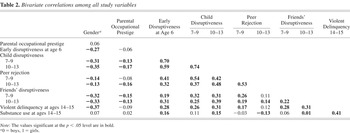
We first examined the bivariate correlations among all study variables (see Table 2). Although unrelated to each other, gender and parental occupational prestige were associated with most other study variables. At all ages, girls were rated as less disruptive than boys. Girls were also less likely to be chronically rejected by their peers and to have disruptive friends between ages 7 and 9 and ages 10 and 13. Finally, in adolescence, girls reported lower rates of violent delinquency than boys, although girls and boys reported similar rates of substance use. Parental occupational prestige was unrelated to early disruptiveness but negatively associated with disruptiveness from ages 7 to 9 and ages 10 to 13. Parental occupational prestige was also negatively related to peer rejection (ages 10–13 only) and friends' disruptiveness (ages 7–9 and 10–13). Parental occupational prestige was not, however, associated with self-reported adolescent violent delinquency or substance use. In all of the structural equation models tested for the current study, gender and parental occupational prestige were included as covariates.
Bivariate correlations among all study variables

Early disruptiveness1
We calculated intraclass correlations (ICCs) for teacher-rated disruptiveness scores collected every year to see whether there were differences between classrooms, in addition to differences between individuals. The only time point at which there is substantial clustering of disruptiveness within classroom is age 13. At this age, the percent of the total variance in disruptiveness that occurs between classrooms is 25%. At all other ages, the percent of the total variance in the disruptiveness that is between classrooms is much smaller, varying from 3 to 14%. Still, even at age 13, the vast majority (75%) of the variance occurs between children, not between classrooms. It should also be noted that, at age 13, the estimate of the between-class variance was nonsignificant (despite the relatively large ICC, estimate = 2.49, SE = 1.62, Z = 1.53, ns).
We tested whether the relations among the study variables differed between the two genders. Specifically, using the Mplus 3.11 software (Muthén & Muthén, 2004), we tested a two-group model in which the correlations among all study variables except gender were assessed and constrained to be the same for boys and girls. Means and variances were allowed to vary across groups, however. The model fit the data well, χ2 (45) = 55.78, ns, comparative fit index (CFI) = 99, Tucker–Lewis index (TLI) = .98, root mean square error of approximation (RMSEA) = .04, and did not significantly differ from the fully saturated model in which all correlations were free to vary across the two groups. This finding indicates that the relations among the study variables are the same for boys and girls. As a result, we combined boys and girls into a single group and included gender as a covariate for model testing purposes.
We also examined our data for any differences in the patterns of associations among the study variables by socioeconomic status (SES; assessed in this study using parental occupational prestige). We split the sample into two groups (high and low SES) using the median parental occupational prestige score. We then tested the equivalence of the variance–covariance matrix across these two groups using a procedure similar to that used for gender. The model was significant, indicating that at least one correlation significantly differs between the two prestige groups, χ2 (45) = 69.23, p < .05. The modification indices suggested freeing a single correlation to improve the fit of the model: the one between early disruptiveness and friends' disruptiveness at ages 7–9. This correlation was freed and the model rerun with all other correlations still constrained to be the same across SES groups. The model with this single freed correlation fit the data well, χ2 (44) = 57.84, ns. The chi-square difference test indicates that the freeing of the correlation lead to a significant improvement in model fit, χ2 (1) = 11.39, p < .01. The results indicate that, for high-prestige children, early disruptiveness was positively and significantly related to age 7–9 friends' disruptiveness (r = .31). This association was positive but nonsignificant for low-prestige children (r = .04). Because these findings do not suggest a pervasive pattern of differences among children from high- and low-SES backgrounds, we did not examine the moderating role of SES. However, SES was included as a control variable in all of the following analyses.
Model testing
The Mplus 3.11 software (Muthén & Muthén, 2004) was also used to estimate a series of structural equation models that assessed the mediated pathways between early disruptiveness and two adolescent outcomes: violent delinquency and substance use.2
We also tested a dual model in which both outcomes (i.e., violent delinquency and substance use) were included in the same analysis. The fit for the full dual model was acceptable, χ2 (11) = 23.80, p < .05, CFI = .99, TLI = .95, RMSEA = .06. In addition, all significant indirect paths were nearly identical as those produced by the full and final single-outcome models presented in the manuscript. For ease of presentation, we describe the results separately by outcome.
To make sure the results were not dependent on the specific measures used here, we repeated all analyses using the proportion of years with disruptive friends (i.e., above the 70th percentile) during each time period instead of an average score for friends' disruptiveness. We also reran all the analysis using an averaged social preference score instead of the proportion of years with a rejected status. The results remained virtually the same no matter what specific measure was used.

The full cross-lagged model illustrating possible links between child's disruptiveness, peer rejection, deviant friends, and delinquency related outcomes.
Violent delinquency
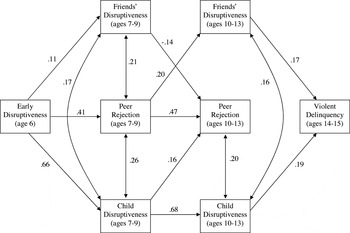
The full cross-lagged model for violent delinquency showed acceptable fit to the data. The chi-square statistic was significant, χ2 (7) = 22.48, p < 01; and, although the CFI was .98, the TLI (.91) and RMSEA (.08) were outside the recommended boundaries for good fit (i.e., .95 or higher for CFI and TLI and .06 or below for RMSEA; Hu & Bentler, 1999). Estimating the trimmed model improved the fit. Although the chi square was still significant, the CFI and TLI were above the recommended guideline of .95 and the RMSEA was within the recommended guideline of .06 and below, χ2 (16) = 31.72, p < .05, CFI = .99, TLI = .96, RMSEA = .05. Because this model showed no evidence of parallel mediation through friends' disruptiveness or peer rejection, the nonsignificant paths linking (a) friends' disruptiveness 7–9 to friends' disruptiveness 10–13, and (b) peer rejection 10–13 to violent delinquency, respectively, were also set to zero. The elimination of these paths resulted in a more parsimonious model but minimal changes to the fit statistics, χ2 (18) = 33.46, p < .05, CFI = .99, TLI = .96, RMSEA = .06. We also conducted a chi-square difference test to determine whether the final model represents an improvement in fit over the full model. The results indicate no significant difference in fit between the full and final model, χ2 (11) = 10.98, ns. The relative fit indices, however, did reflect an improvement in fit of the final model over the full model. As the final model is also more parsimonious, we present the results of the final model below (see also Figure 2).

Results of the model predicting violent delinquency (standardized estimates). The correlations among the endogenous variables actually reflect correlations among the residual variances of these variables. The residual terms have been excluded from the figure for parsimony.
The final model revealed that early disruptiveness was positively associated with the child's disruptiveness, friends' disruptiveness, and peer rejection at ages 7–9. All of these variables were also positively interrelated at ages 7–9. Further, child disruptiveness and peer rejection appeared to be fairly stable between the ages 7–9 and 10–13. In contrast, little stability was observed in friends' disruptiveness across this time period. Friends' disruptiveness at ages 7–9 was, however, negatively associated with later peer rejection. Child disruptiveness at ages 7–9 was positively associated with later peer rejection and peer rejection at ages 7–9 was positively associated with later friends' disruptiveness. Only the child's disruptiveness and friends' disruptiveness at ages 10–13 predicted violent delinquency in adolescence. Both associations were positive.
Overall, some evidence for the sequential mediation hypothesis was observed. Each of the individual paths comprising this indirect pathway was significant and the indirect path linking early disruptiveness to violent delinquency via peer rejection (7–9) and friends' disruptiveness (10–13) was significant at the trend level (estimate = 0.01, Z = 1.79, p < .10). In contrast, no evidence for parallel mediation through friends' disruptiveness or peer rejection was observed. Further, because the path linking peer rejection and violent delinquency was nonsignificant, no evidence for the alternate sequential mediation pathway was observed. The sequential mediation model did not entirely explain violent delinquency, however, as early disruptiveness was significantly associated with violent delinquency through middle childhood disruptiveness (estimate = 0.09, Z = 2.62, p < 05).
Substance use
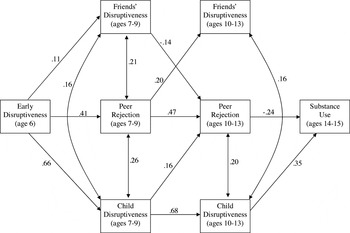
The full cross-lagged model for substance use exhibited acceptable fit to the data. The chi-square statistic was significant, χ2 (7) = 18.22, p < .05, and although the CFI was .99, the TLI (.93) and RMSEA (.07) were outside Hu and Bentler's (1999) recommended boundaries for good fit. Estimating the trimmed model improved the fit. Although the chi square was still significant, the CFI and TLI were above .95 and the RMSEA was below .06, χ2 (16) = 26.74, p < .05, CFI = .99, TLI = .97, RMSEA = .04. Because this model showed no evidence of stability in friends' disruptiveness over time or of an association between friends' disruptiveness and substance use, the nonsignificant paths linking (a) friends' disruptiveness 7–9 to friends' disruptiveness 10–13, and (b) friends' disruptiveness 10–13 to substance use, respectively, were also set to zero. Similar to the analysis with the violent delinquency outcome, the elimination of these paths resulted in a more parsimonious model but only minimal changes in the fit statistics, χ2 (18) = 28.13, ns, CFI = .99, TLI = .98, RMSEA = .04. An additional chi-square difference test was conducted to assess whether the final model represents an improvement in fit over the full model. The results indicate no significant difference in fit between the full and final model, χ2 (11) = 9.91, ns. The relative fit indices, however, do reflect an improvement in fit over the full model. As the final model is also more parsimonious, we present the results of the final model below (see also Figure 3).

Results of the model predicting substance use (standardized estimates). The correlations among the endogenous variables actually reflect correlations among the residual variances of these variables. The residual terms have been excluded from the figure for parsimony.
The final model revealed similar associations among early disruptiveness, age 7–9 disruptiveness, peer rejection, and child disruptiveness, and among these same variables at ages 10–13 as those observed in the violent delinquency analysis. The proximal predictors of substance use differed somewhat from those of violent delinquency, however. Similar to the analysis predicting to violent delinquency, child disruptiveness at ages 10–13 was positively associated with substance use, but friends' disruptiveness was unrelated to substance use and peer rejection was significantly but negatively related to substance use.
Overall, no evidence for the sequential mediation hypothesis was observed. Despite evidence for the first two paths comprising this indirect pathway (early disruptiveness to peer rejection and peer rejection to friends' disruptiveness), friends' disruptiveness was unrelated to substance use. Some evidence for the alternate sequential mediation hypothesis was observed, however. Although the overall indirect pathway was not statistically significant (estimate = 0.004, ns), each of the paths comprising the alternate sequential mediation pathway (i.e., early disruptiveness to friends' disruptiveness, friends' disruptiveness to peer rejection, and peer rejection to substance use) was significant. Even stronger evidence was observed for a sequential, albeit not mediational, model from early disruptiveness to substance use through peer rejection, but not through friends' disruptiveness. Specifically, early disruptiveness was significantly and indirectly associated with substance use through peer rejection (estimate = −0.05, Z = −2.94, p < .01) above and beyond the consistent positive effects of child disruptiveness on substance use. Because age 10–13 peer rejection was negatively related to substance use, however, the early disruptiveness–peer rejection–substance use pathway did not mediate the initial positive link between early disruptiveness and later substance use.
Discussion
The dynamic interplay between peer rejection and deviant friends
The goal of the present study was to test whether rejection by normative peers and affiliation with deviant friends during childhood could mediate the link between early disruptiveness and violence or substance use, respectively, during adolescence. Two theoretical models were tested: (a) a sequential mediation model in accordance with a theoretical perspective proposed by several groups of researchers (e.g., Dishion et al., 1991; Hay et al., 2004; Patterson et al., 1989), and (b) a parallel mediation model that would be compatible with recent data suggesting that exposure to deviant peers, as well as rejection by normative peers, both play important but independent roles throughout childhood (Snyder et al., 2005). The only other empirical test of a sequential mediation pathway (Laird et al., 2001) failed to support a mediational model but was plagued by some methodological limitations that the current study tried to overcome.
When violence was the outcome, age 7–9 peer rejection and age 10–13 involvement with deviant friends sequentially, albeit only partially, mediated the link between early disruptiveness and violent delinquency, thus supporting the Patterson et al. (1989) sequential model as amended by Hay et al. (2004). Hence, young disruptive children are in part at risk of violence first because they are rejected by their normative peers, which may deprive them of normative socialization experiences while exacerbating their negative view of peers and their hostile attributions of peers' behaviors (Dodge et al., 2003). Next, peer rejection puts disruptive children at risk of affiliating with other disruptive children, who, either through deviancy training or through coercive interactions, may reinforce the use of aggressive strategies to dominate others or to solve conflicts (Dishion, Capaldi, et al., 1995; Snyder et al., 2004). The active role of peer rejection and deviant friends in predicting violent delinquency is noteworthy in light of the fact that children's disruptive behaviors during childhood were controlled in the overall predictive model. Disruptiveness at age 6 also predicted age 7–9 friends' disruptiveness, which in turn, negatively predicted age 10–13 peer rejection. However, this pathway was not consequential with respect to the violent delinquency outcome, first because of a lack of stability of friends' disruptiveness from age 7–9 to age 10–13, and second because of the absence of a link between age 10–13 peer rejection and later violent delinquency. Hence, in line with recent findings from Snyder and his colleagues (Snyder et al., 1997, 2004, 2005), children tend to affiliate with each other already at a young age (see also Boivin, Vitaro, & Poulin, 2005). However, contrary to Snyder et al., who found that these affiliations may have short-term consequences by increasing children's disruptive behavior over periods of 3 to 12 months, they do not seem to have long-term consequences according to the present data. Conversely, early rejection by normative peers (from 7 to 9 years of age) and affiliation with deviant friends by late childhood and early adolescence seem to matter in regard to long-term violence-related consequences.
The present results are in sharp contrast to those reported by Laird et al. (2001), who found no evidence that deviant friends play a role in explaining the pathway leading from disruptiveness to later delinquency. These contradictory results may be explained by differences between the Laird et al. (2001) study and the current study in regard to the measurement of involvement with deviant friends and of the delinquency construct. Specifically, the current study used a measure of involvement with deviant friends over several years and at two different periods of development, rather than involvement at a single time point, thereby enhancing the reliability of our measure and its developmental sensitivity. In addition, the use of a global delinquency measure in the Laird et al. (2001) study may have masked the differential relations among early disruptiveness, peer rejection, deviant friends' involvement, and the various dimensions of delinquency that we were able to capture by examining violent behavior and substance use separately.
The importance of distinguishing between violence and substance use
The importance of distinguishing between violence and substance use is evident in the present study because a different set of results applied to the latter outcome. For substance use we found that peer rejection rather than deviant friends mediated, albeit only in part, the link between disruptiveness and substance use. However, rejection by normative peers kept adolescents away from substance use. In other words, it is acceptance rather than rejection by peers that seems to open the door to substance use. Hence, well-accepted disruptive early adolescents are more at risk for early substance use than their unpopular disruptive counterparts possibly because they have access to substances through peer networks and partying in groups. The use of substances may even be a way to maintain their positive status within the peer group. In contrast, the unpopular disruptive early adolescents who are more likely to be withdrawn, isolated from peers, and victimized are less at risk for early substance use because they are less part of the peer culture (Bierman, 2004; Boivin, Hymel, & Bukowski, 1995). This tentative explanation, which may apply only during adolescence, is based on the assumption that norms toward the use of substances such as alcohol and marijuana are positive during early adolescence and that alcohol and marijuana use during this period involve the company of peers. In support of this notion, two-thirds of the adolescents in Western countries aged 14–15 years old have used alcohol, and nearly half of them do not disapprove of marijuana (Adlaf, Paglia, & Ivis, 2000; Bauman & Phongsavan, 1999; Institut de la Statistique du Québec, 2003; Johnston, O'Malley, & Bachman, 1999; Observatoire Européen des Drogues et des Toxicomanies, 2000). In addition, young substance users have been found to participate in more peer activities and to be more oriented to their peers than nonusers (Kandel & Davies, 1996; Mason & Windle, 2002).
As noted in the introductory section, other researchers found similar results when their outcome was alcohol and marijuana use during midadolescence, regardless of whether popularity measures were based on preference, as in the present study (Allen et al., 2005), or based on reputation (Prinstein & Cillessen, 2003; Prinstein, Meade, & Cohen, 2003). Hence, because the general norms during adolescence are positive toward the use of substances such as alcohol and marijuana, adolescents do not need to be part of specific cliques to be tempted to use them. In contrast, more severe forms of delinquent behaviors such as interpersonal violence, which is declining overall throughout childhood and adolescence (Broidy et al., 2003; Lacourse et al., 2002), thrive only if they receive support from peers who are part of marginalized antisocial cliques. In sum, the present results suggest that the role of peer experiences may vary depending on the type of problem behavior examined (i.e., nonnormative violence vs. almost “normative” behaviors such as the use of alcohol and marijuana).
Support for the confluence model
The path to age 10–13 friends' disruptiveness was mediated by age 7–9 peer rejection, but not by age 7–9 friends' disruptiveness, and the link between age 6 child disruptiveness and age 7–9 friends' disruptiveness was weak although significant. As such, it seems likely that affiliation with deviant friends in childhood is not based on behavioral homophily (i.e., mutual attraction between children who manifest similar behavioral dispositions), as is the case during adolescence (Cairns et al., 1988). Instead, affiliation with deviant peers during elementary school seems to result from disruptive children's low acceptance in the peer group, and consequently, the lack of available normative peers. This suggests that disruptive children do not actively seek out other disruptive children as friends, but nevertheless end up in friendships or cliques that involve other disruptive children because they have few opportunities to befriend less disruptive peers. This “by-default” process may, however, apply only at ages when children share adults' norms about disruptive–antisocial behaviors (i.e., before age 10). As children grow older, however, some of them may distance themselves from adult norms. By early adolescence (i.e., during the age 10–13 period), peer rejection is no longer linked to friends' deviancy. Instead, disruptive children seek the company of behaviorally similar peers, despite the fact that some deviant behaviors become more accepted by peers, which, paradoxically, may give disruptive adolescents access to normative peers. This line of reasoning is compatible with the confluence model proposed by Dishion, Patterson, and Griesler (1994), according to which disruptive children during early adolescence progressively come together through a process of assortative affiliations driven by behavioral homophily. However, the homophily driven process may be limited to adolescence whereas a by-default process seems to be operative during childhood for disruptive children. Whatever the underlying motivation for affiliating with other disruptive peers during childhood, the current study's findings add to the accumulating evidence that peer experiences in childhood may explain, at least in part, the persistence or the aggravation of behavior problems of the overt-aggressive type (Hartup, 1983; Snyder et al., 2004).
Support for the sequential mediational–causal model
Overall, the present findings support the sequential mediational–causal model with respect to peer rejection and deviant friends' involvement, at least for violent behavior as the outcome. In addition, because of the presence of residual links between early disruptiveness and violent delinquency, our findings also provide partial support for the incidental model (unless other nontested mediating variables can account for this residual path). According to the incidental model, early personal dispositions are the true determinants of later adjustment problems, mostly because of the stability of these dispositions throughout the course of development. Overall, this study's findings thus support a “hybrid” model whereby both personal dispositions and peer experiences play an additive and complementary role. The model suggested by our data is thus similar to the hybrid model proposed by Hay et al. (2004), but with respect to violent delinquency only. The pattern of results for substance use (i.e., alcohol and marijuana) also support a sequential model, although they do not provide evidence for a mediational pathway in the strict sense of the term. Indeed, for substance use, popularity, not rejection, in the normative peer group seems to replace friends' deviancy as the crucial element of the sequential chain that begins with own disruptiveness.
Limitations
Like many other studies, the present study has some limitations that need to be considered when interpreting the findings. First, only peers from within the classroom were included. However, this may not be a major problem in light of evidence that most of the friends of elementary school children are in the same classroom (Ennett & Bauman, 1994). Second, the present study used a multidimensional measure for delinquency but a global measure to reflect children's and friends' repertoire with respect to disruptiveness. More specific measures of children's and friends' characteristics tapping into different subtypes of aggressive behaviors (e.g., physical vs. relational aggression or reactive vs. proactive aggression) and into the use of specific substances may have revealed more specific patterns of results, as some researchers have reported with respect to violence (Espelage, Holt, & Henkel, 2003; Werner & Crick, 2004) and substance use (Dishion, Capaldi, et al., 1995; Urberg, Luo, Pilgrim, & Degirmencioglu, 2003).
Third, the present study did not examine the microsocial processes that may account for the role of peer rejection or affiliation with deviant friends in predicting delinquent behavior. Observational work by Dishion and his colleagues (Dishion, Nelson, Winter, & Bullock, 2004; Dishion, Spracklen, Andrews, & Patterson, 1996) and by Snyder and his colleagues (2004) with adolescents and young children revealed that processes such as deviancy training or coercive interactions could account for the links between peer rejection or friends' disruptiveness and later adjustment problems. Socialization processes by the peer group of pro-substance use norms have also been observed (Bot, Engels, & Knibbe, 2005; Dishion et al., 1996). Fourth, the present study included an unusual school transition pattern (i.e., elementary school through age 12, then transition to one small high school by age 13, and then to a large high school for age 14 and beyond), which might limit the generalizability of its findings.
Fifth and finally, the present study did not use an ethnically diverse sample of children and, consequently, could not assess whether the present findings apply to children from different cultures or ethnic origins. Future studies should overcome this limitation by examining ethnicity as a potential moderator of the sequential–mediational link between early disruptiveness, peer experiences, and later outcomes. Other potential moderators should be considered as well. For example, as suggested by earlier studies, children's personal characteristics or family processes may moderate the link between early disruptiveness, peer experiences, and later externalizing problems (Berndt & Keefe, 1995; DeRosier & Thomas, 2003; Vitaro, Brendgen, & Tremblay, 2002). Moreover, although the present results suggest that the developmental pathways to delinquent behavior do not differ for boys and girls, the relatively small sample size may have precluded the detection of potential moderating effects of gender in this context. Despite these and other limitations, the present study nonetheless illustrates the combined power of two peer experiences during childhood (i.e., peer rejection and friends' disruptiveness) to explain, at least partially, how early disruptiveness and later adjustment problems are related.