Introduction
To what extent do processes of Europeanization facilitate the political mobilization and influence the strategies of Lesbian, Gay, Bisexual, and Transgender (LGBT) activists in the European Union (EU)? This question is central to the analysis below, which emphasizes that European integration changes the ramifications and tactics of LGBT activism by altering political opportunity structures (POS) for mobilization both vertically and horizontally. As a result, transnational European networks of LGBT activists are formed, which in turn employ mechanisms of socialization to push for the social and legal visibility of LGBT people in various member states.
I engage the above question with a focus on the EU, looking at both vertical opportunities provided by European institutions and horizontal ones provided by certain EU member states. The EU's multi-level system offers a host of political opportunities for advocacy groups to mobilize around social issues, but these opportunities, which are crucial for an understanding of LGBT activism in the EU, are more complex than traditionally theorized. I argue that the Europeanization of LGBT activism is indeed facilitated by a vertical interaction between domestic states and Brussels (top-down and bottom-up), but also functions horizontally by facilitating networks of actors across member states. I demonstrate this by focusing on the discrepancies in opportunity for LGBT mobilization in two member states, to posit that the access to one (an open, norm entrepreneur) facilitates mobilization in the other (a closed, target state). This phenomenon occurs in a type of activism similar to what Imig and Tarrow call ‘cooperative transnationalism,’ where the actors involved are transnational but the foreign target of contention is domestic (2001: 17). Furthermore, I contend that vertical and horizontal opportunities for mobilization bring together different types of actors, but that most of these actors rely on mechanisms of socialization and frame their demands in a European discourse.
My argument proceeds in three steps. First, I recognize that the Europeanization of LGBT rights begins primarily as a vertical process in which the EU imposes formal rules on member states and builds the capacities of civil society organizations to lobby domestic institutions. This engenders new domestic discourses and generates media attention around the LGBT issue, which domestic groups then use to draw attention from outside actors. Second, I make a case for looking at the Europeanization of LGBT mobilization horizontally. I argue that Europeanization facilitates transnational activism around LGBT issues through the free movement of peoples and through transnational advocacy networks, granting actors from ‘target’ states access to important mobilizing structures in other member states. The abundance of social spaces and organizational resources in a ‘norm entrepreneur’ member state were critical variables for bringing together the main actors and empowering them with the resources for transnational activism in another, providing the mobilizing structures to engender a process that was not available in the target state. Third, in arguing that much LGBT activism is mobilized among member states, I show that socialization through EU-level frames and elites almost always accompanies such mobilization. Employing socialization mechanisms that highlight appropriate behavior, actors tactically frame their demands in a European discourse by making the issue of LGBT acceptance one of human rights and democratic responsibilities as members of the EU community.
In developing these arguments, I focus on the case of cross-border German–Polish LGBT activism within the EU framework. The EU provides an ideal setting for analysis because we observe a norm of protecting sexual minorities and the only internationally binding legal protections for such minorities (Swiebel, Reference Swiebel2009). At the same time, it houses states at both ends of the ‘LGBT tolerance’ spectrum.Footnote 1 Hence the focus on the member states of Germany and Poland: they make explicit the connections between ‘norm entrepreneur’ and ‘target’ state, with Polish and German activists using resources available to them in Germany to mobilize in Poland.Footnote 2
Next I provide a brief phenomenological account of the 2005 Warsaw Equality March, which sets the stage for the analysis in the first, second, third, and fourth sections. The first section lays out the theoretical framework, argument, and methods by engaging literatures on Europeanization and POS for mobilization. The second section discusses the varying contextual settings of German and Polish gay life and how the resources and networks in Berlin were used to horizontally mobilize for the recognition of sexual minorities in Poland. In the third section, I present the set of transnational actors involved in Polish LGBT activism and how they came together. The actors mobilized in Germany and other member states are more numerous and different from those elite actors mobilized vertically with the support of the EU. The fourth section describes the tactics and processes behind transnational LGBT activism and reflects on how activists use EU-level discursive frames and mechanisms of socialization to achieve their goals. The paper closes by reflecting on the strengths and limitations of Europeanization processes concerning LGBT mobilization, as well as implications for future research, which need to explore the effects of anti-gay transnational activism – acknowledging that EU standards of appropriate behavior concerning sexual minorities smack of outside imposition to some and welcome modernity to others.
Cooperative transnationalism in Poland, the Warsaw Equality March
The central case revolves around German–Polish LGBT activism and the highly publicized, illegal Warsaw Parada Równości (Equality March) in 2005, which was largely composed of expatriate Poles and German citizens. The illegal march provided the political opportunity to link the social situation of Polish sexual minorities to Poland's recent accession to the EU through the frames of democratic values and human rights. Many activists remember it as the most important public assembly for the rights of LGBT Poles and a turning point for Polish LGBT activism amidst an oppressive political environment. A plethora of analogous German–Polish examples exists, making the involvement of groups across the Oder–Neisse valuable for the study of the Europeanization of LGBT movements.
The difficult social situation for LGBT Poles made headlines in Europe, as activists and media highlighted the paradox that Poland's successfully democratizing state and society was struggling to recognize sexual minorities. Despite some institutional changes associated with accession, like passing the anti-discrimination in employment directive, Poland showed itself resistant to many protective policy measures, societal attitudes toward sexual minorities remained largely negative, and cases of state-sponsored discrimination abounded (Bączkowski, Reference Bączkowski2008; O'Dwyer and Schwartz, Reference O'Dwyer and Schwartz2010). Furthermore, several city governments violated the freedom of assembly for LGBT marches, despite the fact that the march has a long history within the tactical repertoire for expressing political grievances in Poland.Footnote 3 Alongside more formal advocacy work, LGBT activists stress the importance of mobilization in the public sphere as an important type of Europeanization, because LGBT activism is geared toward both society and state. Although other EU countries (old and new) also experienced troubles with recognizing sexual minorities, a homophobic government, coupled with an emerging civil society and several engaged LGBT organizations made Catholic Poland a poster boy for improving the situation of sexual minorities in the EU (cf. European Parliament Resolutions, 2006, 2007; Chetaille, Reference Chetaille2011). Polish LGBT activists made progress in the 3 years leading up to accession by implementing innovative campaigns and founding a new national LGBT organization, Kampania Przeciw Homofobii (KPH).Footnote 4 The euphoria associated with EU membership was not long lived, however, as hostile political and social opposition began forming in response (interview nos. 9 and 140). In large part, allies from abroad aided local Polish activism by organizing demonstrations and placing demands on the Polish state from foreign contexts during this time.
When the former mayor of Warsaw, Lech Kaczynski, banned marches for LGBT equality in 2004 and 2005, LGBT organizations began generating press by contacting international authorities and media outlets to organize and hold the event illegally in 2005 (Bączkowski, Reference Bączkowski2008). What was unique about this event, compared with similar gay pride events in other major cities where LGBT visibility has become common, was that a transnational group of activists organized the event from both Poland and neighboring Germany. Many of these activists were expatriate Poles who used resources made available to them in Berlin. Of the 5000 illegal marchers in the streets of Warsaw, almost half of those demanding the right of assembly for sexual minorities in Poland came from foreign contexts and included prominent European politicians (interview no. 125). In 2007, an expatriate Pole working from Berlin brought a case against Poland (for prohibiting the protest) before the European Court of Human Rights (ECtHR), which decided in his favor and made similar parades legal in all Polish cities. According to Tomasz Bączkowski, the activist who organized the march and later took the case to Strasbourg:
It was organized in Berlin because I lived there … I had a lot of experiences in Germany, I knew how to do this – or how one should do it – and I thought, in these times … it shouldn't be a problem organizing from the outside. Naturally, through the personal contacts with Claudia Roth and others, it was much easier for me to organize it from [Germany] then for Polish activists in Poland, where the environment in general is very hostile. In retrospect, these international political pressures were much more important than if I would have just done this in Poland (interview no. 124).
Polish LGBT activism – one experience within a larger campaign for LGBT rights in Europe – illustrates the increasing importance of the Europeanization of political mobilization and transnational social movements.
Europeanization and political opportunities for transnational LGBT activism
Europeanization
The aim of this paper is to contribute to the literature on Europeanization and political opportunities for transnational movements by looking the mobilization of LGBT activists across borders in Europe. Scholars broadly define Europeanization as ‘processes of (a) construction, (b) diffusion, and (c) institutionalization of formal and informal rules, procedures, policy paradigms, styles, “ways of doing things,” and shared beliefs and norms, which are first defined and consolidated in the EU policy process and then incorporated in the logic of domestic discourse, political structures, and public policies’ (Radaelli, Reference Radaelli2004 cited in Krizsan and Popa, Reference Krizsan and Popa2010: 382). Most research emphasizes vertical interactions between Brussels and the member states, focusing on processes of formal institutional politics between elites at both levels. Theories based on both rational and sociological institutionalism are used to explain the process of outcomes in policy changes across European member states. Rational institutionalism advances a logic of consequences, whereby domestic actors make cost-benefit calculations based on external incentives provided in Brussels. Sociological institutionalism purports a logic of appropriateness, according to which actors internationalize EU norms and rules as part of their identity as members of an international society (Checkel, Reference Checkel1997, Reference Checkel2005). Both mechanisms are top-down processes, with the EU facilitating change by imposing sanctions and/or through persuasion, capacity building, and promotion of transnational cooperation.
Indeed, as in most other realms of European policy, both rational and sociological mechanisms are at play in furthering LGBT rights (Börzel and Risse, Reference Börzel and Risse2003; Schimmelfennig and Sedelmeier, Reference Schimmelfennig and Sedelmeier2005). A series of European actors – the EU institutions, the ECtHR, and a transnational network of activists – have fostered change by propagating an international norm on LGBT rights and diffusing the issue into the domestic discourses of various European states.Footnote 5 European institutions have actively championed the norm of protecting sexual minorities directly through accession requirements. Examples of this include Article 13 of the Amsterdam Treaty, the 2000 Employment Anti-Discrimination Directive, the European Charter for Fundamental Rights, the 1993 Copenhagen Criteria for accession, and various official statements. Although European institutions contribute to a minimum level policy change across all member states directly (i.e. decriminalization of adult same-sex relations, anti-discrimination in employment, and asylum), most other changes come about indirectly through the facilitation of transnational advocacy networks.
As Featherstone and Radaelli (Reference Featherstone and Radaelli2003) make clear, Europeanization as a process is not always directly tied to the EU institutions. In line with Krizsan and Popa's (Reference Krizsan and Popa2010) work on the Europeanization of policies against domestic violence, I observe ‘a logic of consequences [that] dominates before accession, while appropriateness becomes the predominant logic post-accession’ (p. 384). The EU does require states to make changes to accompany accession, but it becomes cautious about ‘embarrassing its own members’ once they are in (interview no. 15), bringing into question the successful implementation and promotion of new LGBT policies (O'Dwyer, Reference O'Dwyer2010; interview nos. 10, 11, and 14). Instead, the brunt of the effort to induct ‘actors into the norms and rules of a given community… [so] that an agent switches from a logic of consequences to a logic of appropriateness’ is left to a transnational network of European activists (Checkel, Reference Checkel2005: 804).
As scholars of the European woman's movement have observed, transnational advocacy networks play a central role in Europeanization because EU competences in sanctioning states for infringing upon the rights of LGBT peoples remain limited (Krizsan and Popa, 2010; Kollman, Reference Kollman2009; Montoya, Reference Montoya2010). ‘The formation of transnational advocacy networks links actors in civil societies, states, and international organizations in a way that can multiply the opportunities for marginalized groups to mobilize’ (Keck and Sikkink, Reference Keck and Sikkink1998; Montoya, Reference Montoya2008: 360). A European network of LGBT activists exists, composed of transitionally linked domestic NGOs, international human rights NGOs, and sympathetic policy elites. ILGA (International Lesbian, Gay, Bisexual, and Intersex Association) Europe – the largest and richest of ILGA International's six regional organizations – connects 291 domestic and local organizations across the EU and Council of Europe member states. It ‘serves as a conduit for knowledge and best practice for national LGBT groups and, perhaps more importantly, lobbying European institutions to adopt decisions and policies that enhance the legal standing of LGBT people in European law and policy’ (Kollman, Reference Kollman2009: 42). With the Treaty of Amsterdam, the Brussels-based organization became an official partner of the European Commission and has received its core funding from that EU institution since then (cf. Paternotte, Reference Paternotte2012 for the ILGA's history). Similarly, the European Parliament's Intergroup on LGBT rights grew out of the cooperation between ILGA-Europe and sympathetic members of the European Parliament (MEPs), providing an elite EU response to LGBT issues around Europe. These advocacy networks share resources and pool information to develop tactics for promoting the visibility of LGBT people in Europe. Kollman's (Reference Kollman2009) work on the diffusion of same-sex marriage polices in Germany and Austria attributes influence to transnational advocacy networks and soft law processes of Europeanization. O'Dwyer's (Reference O'Dwyer2010) study of LGBT recognition in Poland also highlights soft mechanisms of Europeanization. Similarly, my approach, while acknowledging rationalist arguments, emphasizes that transnational LGBT advocacy networks employ socialization mechanisms post-accession.
These networks are brought together via new political opportunities provided by the EU's multi-level framework. For LGBT mobilization, my understanding of Europeanization departs from the traditional literature above in some respects, as it is less concerned with elite-driven processes concerning (non-)compliance and policy outcomes. Most research has a top-down, vertical understanding of Europeanization, which neglects the fact that Europeanization also facilitates a space for horizontal interaction.Footnote 6 By horizontal, I mean the pressures and actors mobilized across member states, using European frames. For LGBT actors, who have long relied on safe spaces to express their identity, such horizontal interaction is an important pre-condition for their mobilization because the EU does not directly offer such public spheres. Furthermore, despite the higher level of legitimacy that the EU often holds on the issue, some member states are more advanced than others in their experience and legal understanding of LGBT rights. A useful theoretical lens to think about horizontal and vertical processes of Europeanization is that of political opportunities, which social movement scholars have explored at various levels.
Political opportunities of transnational mobilization
POS are broadly defined as the circumstances surrounding a political system, in particular, the availability of alliances and the strength of opponents in a given context (McAdam et al., Reference McAdam, Tarrow and Tilly2001). Most opportunities, however, are not structural, but rather subject to attribution and situational in that they need to be both perceived and visible to potential actors (p. 43). As Princen and Kerremans (Reference Princen and Kerremans2008) synthesize, ‘the actual effects of political opportunities on social movements depend on (1) the identification of those opportunities, (2) the existence of collective identities and frames that are favorable to specific forms of political activity, and (3) organizational resource and capabilities that allow social movements to take advantage of those opportunities’ (p. 1132).
Although the foundational social movement literature treats the nation state as its natural arena, Europeanization has implications for POS. Recent literature on transnational social movements suggests that social movement actors in one state increasingly have ties to those in another and that actors in one state can target another's government (Smith, Reference Smith1997; della Porta et al., Reference della Porta, Kriesi and Rucht1999: 5; Tarrow, Reference Tarrow2005b). Furthermore, scholars have explored how the political opportunities and constraints provided by the EU affect movement mobilization and tactics at local, national, and supranational levels (Imig and Tarrow, Reference Imig and Tarrow2001; della Porta and Caiani, Reference della Porta and Caiani2007).
As with Europeanization literature, many of these studies are vertical in nature, exploring the presence (or absence) of transnational mobilization targeting Brussels. For LGBT activism, the assumption that ‘the growth of the EU as an important political center is likely to provoke political activities against it’ does not hold (Marks and McAdam, Reference Marks and McAdam1996: 251). By most accounts, the relationship between the EU and LGBT activists is harmonious, where activists see Brussels as an ally in a struggle against sometimes-hostile domestic governments (Keck and Sikkink, Reference Keck and Sikkink1998). As previous research would expect, LGBT activists use formal avenues of insider lobbying to address EU institutions rather than protest it (Marks and McAdam, Reference Marks and McAdam1996). Indeed, the European Commission generously funds ILGA-Europe with the primary purpose of lobbying EU institutions. Where Europeanized POS become interesting for LGBT mobilization is the effect they have on the types of transnational actors mobilized at various levels and the strategies these actors implement in various member states.
LGBT advocacy groups operate in an interactive environment that requires one to account for the openness of POS at both the domestic and international levels. Sikkink's (Reference Sikkink2005) understanding of openness is receptiveness to NGO activity. For instance, when the domestic level is closed and interacting with an open international POS, she expects Boomerang or Spiral Model patterns, wherein domestic actors sidestep their governments to pressure from above (Risse et al., Reference Risse, Ropp and Sikkink1999). If both domestic and international levels are open (e.g. Germany), activists will ‘privilege domestic political change, but will keep international activism as a complementary and compensatory option’ (Sikkink, Reference Sikkink2005: 165). This forms what she calls insider–outsider coalitions, where activists in an open domestic context can aid those in a closed one. While Poland, Germany, and the EU are all open to advocacy groups, Sikkink's framework is useful if we think of openness in terms of the social and legal acceptance of LGBT people. The discrepancies in visibility for LGBT people across Europe has led other observers to re-conceptualize open and closed POS for LGBT people. Holzhacker (Reference Holzhacker2012), for example, has argued that the openness of POS for LGBT mobilization should be measured in terms of a context's legal standing toward LGBT people, and its societal and elite opinion of them. In turn, the LGBT POS need to be re-conceptualized, since the group is often invisible and fears both social and political costs associated with mobilization.
Argument, case selection, and methods
Taking all the above considerations on Europeanization and POS into account, I pursue a twofold approach, according to which I explore both vertical and horizontal opportunities for the Europeanization of political mobilization by transnational actors. I will contend that horizontal and vertical Europeanization have differing effects on LGBT mobilization, but come together to make it effective. The former provides access to social spaces and organizational resources in open member states that mobilize LGBT masses (both elite and ordinary citizens) from one member state to another. Horizontal opportunities are particularly useful for non-institutionalized mobilization in a target state's public sphere. Vertical opportunities provide the legitimacy and institutional clout to mobilize European political elites and socialize authorities in the target state as well as the frames and socialization mechanisms that activists use to make their message effective there.
For the purposes of this analysis, I conceive of the POS for LGBT mobilization around the time of Polish accession (2004) as closed in Poland and open in Germany and at the macro EU-level. Poland emerged from transition having had little discourse on the LGBT issue prior to beginning the EU accession process, during which the state was subjected to new EU standards on LGBT rights. In contrast, the 1960s sexual revolution and the 1980s HIV/AIDS epidemic politicized LGBT issues much earlier throughout the Federal Republic of Germany.
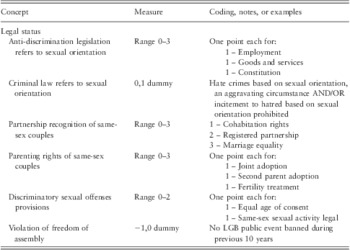
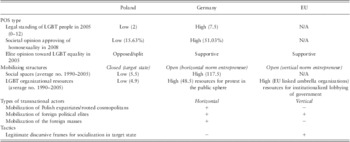
I use three measures based on Holzhacker (Reference Holzhacker2012) to compare legal standing and societal and elite opinion in Germany and Poland. To measure legality at the state level, I collected data the LGBT laws adopted in each state by 2005. These protective and equality laws go beyond decriminalization and score countries on six measures of LGBT legal standing, such as the status of recognized partnerships, anti-discrimination protections, and adoption rights (cf. Appendix Table 1A). With all 27 EU states scoring between 2 and 12 points, Poland (2 points) scores comparatively low, and Germany (7.5) scores comparatively high, in the top-third.Footnote 7 To compare the societal situation, I use available survey data on social attitudes toward sexual minorities (EVS, 2008, 4th Wave).Footnote 8 The percentage of Poles who approve of homosexuality (by selecting 1–5 on a scale of 1–10) was 15.63% in 2008, compared with 51.03% of Germans surveyed that same year (EVS).
Legislation coding summarized

LGB = Lesbian, Gay, Bisexual; ILGA = International Lesbian, Gay, Bisexual, and Intersex Association; EU = European Union.
Sources: ILGA-Europe: ‘ILGA State Homophobia (May 2009)’, Waaldijk (Reference Waaldijk2009), Amnesty International, The Palm Center, GayLawNet.
Note 1: A half-point can be scored if some states in a federal system pass a law, but others do not (e.g. Germany).
Note 2: See online supplementary data for Figure S1, which includes a comparison of all EU member states.
For elite opinion, I rely on interviews with politicians and national LGBT experts in Poland, Germany, and at the EU institutions. Here again I recognize discrepancies in elite opinion between Germany and Poland. In Germany, all five federal political parties have LGBT committees that represent LGBT constituencies. Although some members of these parties clearly hold homo/trans-phobic views, a taboo exists against expressing them. In Poland the situation is changing, but all interviewees explicitly cite openly hostile rhetoric among political parties in 2005 (Bączkowski, Reference Bączkowski2008; interview nos. 8, 9, 129, 131, 132, 133, 139, 140). Political elites went so far as to propose a bill to remove homosexual schoolteachers from schools because of their supposed threat to children – this type of discourse has no credibility among elites in Germany.
Since the EU, as an international organization, has different competences than nation states, the measures do not apply. That said, there is evidence that the EU is the most LGBT progressive organization of nation states, when compared with the UN (Swiebel, Reference Swiebel2009). As in Germany, a taboo against elite homophobic rhetoric exists – this was particularly evident in 2004, when the prospects of a favored Commission Presidential candidate were scuppered after expressing religious views that conflicted with the acceptance of homosexuality. The EU institutions have a clear mandate to promote LGBT rights in member states and abroad. Table 1 provides a sketch of what will follow.
POS for LGBT mobilization, mobilizing structures, types of transnational actors, and tactics

POS = political opportunity structures; LGBT = Lesbian, Gay, Bisexual, and Transgender; EU = European Union.
The research methods employed include expert interviews, archival research, and participant observation. I conducted over 50 semi-structured interviews with key players in Polish LGBT activism in Germany, Poland, and Brussels, primarily with activists and politicians who were asked about their motivations and the strategies behind their mobilization, as well as their perception of the outcomes of that mobilization. Archival research uncovered organizational documents, mission statements, grant applications, and press releases relating to transnational activism in Poland. Finally, participant observation at various LGBT marches, prides, street fairs, and strategic activist meetings in Poland and Germany since 2005 informed this analysis.Footnote 9
Mobilizing structures: differing opportunities for gay life in the EU and the importance of access to ‘horizontal’ social spaces and organizational capacities
This section makes the case that the abundance of social spaces and organizational resources in neighboring Germany were critical variables for bringing together the main actors, defining their common identity, and empowering them with the necessary resources for transnational activism in Poland. By LGBT social spaces, I refer to the centers for gay life that make the community visible and serve as safe spaces where LGBT people can meet and express their identity. Traditionally these spaces take the forms of cafes, bars, and clubs.Footnote 10 Organizational capacity refers to the presence of LGBT organizations that endow LGBT communities with resources and capabilities, including ‘money, expertise, legitimacy, and (pre-)existing networks’ (Princen and Kerremans, Reference Princen and Kerremans2008: 1131–1132). Organizational capacity also exists at the European level (e.g. ILGA-Europe), but it serves a different function, as these umbrella organizations are more likely to pursue formal lobbying than domestic organizations who are often devoted public sphere work (Lang, Reference Lang2009). Social spaces and organizational capacity in open EU member states provided the mobilizing structures – which ‘include family units, friendship networks, voluntary associations, work units, and elements of the state structure itself’ – that engendered a process not available in Poland (McCarthy, Reference McCarthy1996: 141).
The topography of LGBT recognition – both socially and legally – is complex, with stark variation from one state to another and within states from rural to urban areas.Footnote 11 In Europe, Europeanization processes facilitate the access to nodes of gay life through the free movement of people, goods, and services, making established gay communities, such as those in Berlin, more accessible to non-nationals. This creates dense nodes of gay social spaces and activist kinships in certain national contexts and urban areas that outpace their surroundings – for example, Amsterdam, London, and Berlin became known as ‘gay capitals’ at various points in the 1970s, 1980s, and 1990s.Footnote 12 European integration accelerates access to such spaces, where openly gay populations and social spaces are more visible. This is especially true for post-socialist countries, where social spaces and organizational resources are comparatively less developed. Thus, the POS for transnational LGBT mobilization lies not only in Brussels, but also in member states’ centers of gay life.
Berlin, in particular, became a hotbed for activism focused on Poland, providing a host of opportunities for mobilization absent in Poland that were also different from those available at the EU level.Footnote 13 Berlin's large Polish expatriate community, its geographic proximity to the Polish border, and its status as an LGBT-friendly European city (which endows the city with dozens of LGBT social spaces and organizations) provided fertile ground for transnational activism to take root there beginning in the late 1990s. First, a long history of immigration by Polish workers to Germany has left a visible mark on German demography. Berlin's second largest immigrant group is Polish, numbering nearly 41,000 registered Polish citizens (Amt für Statistik Berlin-Brandenburg, 2011). The estimated population of Berliners of Polish descent is estimated to be 130,000, counting both undocumented Polish immigrants and those who were born and raised in Poland but have since taken German citizenship. In particular, Berlin is appealing to Polish sexual minorities who seek it out as a destination to reside and travel because of the comparatively high level of LGBT visibility within the city (interview no. 5). A Polish presence – for example, flags, pamphlets, information booths – is renowned and visible at all of Berlin's major LGBT events, including the annual Christopher St Day Parade and the Gay–Lesbian Street Fair. Second, geographic proximity is a critical factor, since Berlin is just over 60 km from the Polish border, and train connections such as the Berlin–Warszawa Express make travel between the two capitals quick and affordable – the 5.5-hour journey costs 39 euros.
Alongside Berlin's Polish population and geographic convenience, a third factor for LGBT mobilization is the city's long history as a center of gay life. Magnus Hirschfeld's Wissenschaftlich-humanitäre-Komitee (Scientific Humanitarian Committee) and the Weltliga für Sexualreform (World League for Sexual Reform) – founded in Berlin in 1897 and 1928, respectively – were the earliest precursors to modern LGBT organizations (Kollman and Waites, Reference Kollman and Waites2009: 3). Especially after German reunification, ‘Berlin has developed…into a gay Mecca in which the richness of ideas and diversity is hardly able to be surpassed’ (Spartacus, 2003: 323). In 2001, the newly elected mayor, Klaus Wowereit, ended speculation by saying, ‘Ich bin schwul und das ist auch gut so’ (‘I am gay, and it's alright that way’). In sum, the LGBT issue is highly visible, both socially and politically. The city's gay history has led to an abundance of LGBT social spaces and organizations, which I will argue are mobilizing structures for local, nation, and transnational activism.
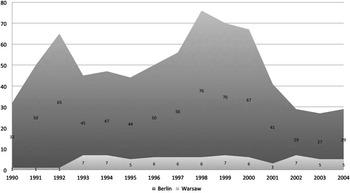
Compared with Warsaw, the center of gay life and activism in Poland, the differences in social spaces and organizational capacity are sharp (see Figures 1 and 2). I use 15 years of Spartacus issues, an international gay travel guide, to measure the number of gay social spaces and organizations leading up to the 2005 Equality March (cf. Frank et al., Reference Frank, Camp and Boutcher2010).Footnote 14 The Spartacus guides have appeared yearly since 1970 and provide a systematic way to measure the presence of gay life across cities in over 160 countries, because they use the same categories to list the presence of LGBT organizations and businesses. I code ‘LGBT social spaces’ by counting the presence of LGBT restaurants, cafes, bars, and clubs in each city. I code ‘LGBT Organizations’ broadly by counting all political, religious, and health/counseling LGBT organizations and groups in each city.
Number of Lesbian, Gay, Bisexual, and Transgender (LGBT) social spaces (restaurants, cafes, bars, clubs).

Number of Lesbian, Gay, Bisexual, and Transgender (LGBT) organizations (political, religious, health groups).

The figures show the cleft between two European member states in terms of potential for LGBT mobilization.Footnote 15 In the last 20 years, Europeanization has reduced this cleft by increasing the mobility of European citizens and by providing new channels to access foreign contexts within the EU's institutional framework. As a result, the above variables – available social spaces and organizational capacity in some member states – have established the necessary personal networks that brought together a new group of transnational actors involved in Polish LGBT activism.
Types of transnational actors: who and how Europeanization mobilizes actors
I define transnational activists ‘as individuals and groups who mobilize domestic and international resources and opportunities to advance claims on behalf of external actors, against external opponents, or in favor of goals they hold in common with transnational allies’ (Tarrow, Reference Tarrow2005b: 8–9). Although European institutions have established norms on LGBT rights, these norms do not float freely, they need actors and channels to carry them (Soule, Reference Soule2004). This section discusses the transnational activists that have aided this process across channels that function vertically and horizontally. Different channels mobilized different types of actors involved in the Equality March. First, it discusses those mobilized horizontally (primarily between Germany and Poland), which include expatriate Poles and masses of German activists, celebrities, and ordinary citizens. Second, it discusses those who were mobilized both horizontally and vertically, which include European and German parliamentarians.
Especially among the non-political elite actors, the transnational activists interviewed cited the importance of horizontal spaces and resources since they connect European LGBT people, solidifying a transnational dimension of their identity. This phenomenon aligns with a body of research that posits that many openly LGBT people share a common experience – such as ‘coming out’ to family – that connects them across borders (Altman, Reference Altman1996; Binnie, Reference Binnie2004; Tremblay et al., Reference Tremblay, Paternotte and Johnson2011). At times, this connection is stronger than national identity and can transcend class and race to connect otherwise disparate actors. For example, Allen (Reference Allen1996) argues that shared ‘life experiences and innate personality traits … connect gays more closely with gays from other countries than with … heterosexual citizens of their own country.’ (Allen Reference Allen1996, cited in Binnie, Reference Binnie2004: 37). According to Allen, an openly gay German may identify more with an openly gay Pole, than s/he does with a heterosexual German. The horizontal opportunities described above are important for giving LGBT people, who remain invisible in many domestic contexts, a space for interaction.Footnote 16
Horizontal mobilization of expatriate poles
Expatriate Polish activists discussed the strength they felt to become politically active after leaving Poland. According to one activist from the Fundacja Równosci/Stiftung für Gleichberechtigung (Equality Foundation), she now holds hands with her girlfriend when she visits Warsaw, which she attributes to socialization in Berlin and the comfort she takes in knowing that she can ‘escape’ back to Berlin (interview no. 5). ‘When you leave a country, you suddenly feel more brave – to show yourself’ (5). Like her, many of the actors involved were expatriate Poles who used mobilizing structures available to them in Berlin. The role of expatriate Poles and their interactions with German allies is crucial because they provide a competent understanding of the Polish domestic context – through their personal experiences, language competence, and associational ties to Polish activists – and draw attention to the Polish situation by putting it on the agenda of German LGBT organizations.
In line with the argument that horizontal opportunities mobilize a distinct type of actor, I use Tarrow's definition of rooted cosmopolitans to elaborate that:
the special characteristic of these activists is … their relational links to their own societies, to other countries, and to international institutions … What is “rooted” in the concept … is that, as individuals move cognitively and physically outside their spatial origins, they continue to be linked to place, to the social networks that inhabit that space, and to the resources, experiences and opportunities that place provides them with … Most rely on domestic resources and opportunities to launch their transnational activities and return home afterwards (Hannerz, Reference Hannerz1996; della Porta and Tarrow, Reference della Porta and Tarrow2005: 237–238; Tarrow, Reference Tarrow2005a: 1, 8).
One such activist, Bączkowski, came to Berlin in the 1990s to continue his studies in economics, international relations, and European law. At this time, the NGO field in Poland was weak and offered little in terms of LGBT rights (interview no. 125). By contrast, the visibility of LGBT life in Berlin fueled his engagement there, with ‘the background thought that these skills can be … transported to Poland later’ (interview no. 124). His partner, a volunteer at Maneo (a local Berlin LGBT organization that focuses primarily on community issues), introduced Bączkowski to the organization's president. At this point in the late 1990s, Maneo's president – who had previously worked as part of a transnational campaign to combat violence in Northern Ireland – was looking to deepen the organization's political cooperation abroad, and Bączkowski's volunteer work brought Poland to the forefront of the discussion (interview no. 125). In 1998, Maneo organized its first roundtable meeting in Warsaw with Polish activists, establishing a lasting transnational network of LGBT organizations in five European capitals called Tolerantia.Footnote 17
As Maneo expanded its realm of activities to address Poland-related issues, it acted as a magnet for the involvement of Berlin's expatriate Poles. ‘Roughly 100,000 Poles live in Berlin and then, if roughly 5–10% are gay, there should be 5000 to 10,000 gay Poles … as Maneo started having more contacts to Poland, expatriate Poles approached us wanting to be involved’ (interview no. 124). What emerged in 2005 was Tolerancja po Polsku/Toleranz auf Polnisch, a subsidiary of Maneo, which provided both a social space for expatriate Poles to gather and a mobilizing structure for using resources in Berlin to address LGBT politics in Poland. It encouraged ‘[g]ays and lesbians from both countries to meet regularly to cooperate against violence and discrimination towards homosexuals in Germany and Poland, and to exchange information and develop projects’ (Maneo-Tolerancja, 2005). Similar projects fostering transnational dialogue and cooperation between Germany and Poland have been organized since 1998. Alongside the personal and symbolic support provided by expatriate networks, they generate material support for transnational activism. Through Maneo's organizational connections to Berlin's Gay–Lesbian Street Fair, for example, Fondacja Równosci was given rent-free spaces to sell beverages and raise funds for the marches. This type of material support began in the 1990s and continues today.
Horizontal mobilization of German transnational actors
Expatriate Poles were connected to allies in Germany. In 2006, roughly 2000 of the 5000 participants at the Warsaw March were foreign nationals – of those, most were German (Bączkowski, Reference Bączkowski2008: 37; interview nos. 5, 16, and 125).Footnote 18 In Berlin, personal networks garnered the involvement of various German celebrities who aided Polish activism, such as the Warschauerpakt (Warsaw Pact) organization. This group was founded in 2005 by German media personalities – Thomas Herrmanns, Georg Uecker, Wolfgang Macht, and Holger Wicht – who knew the organizers through their personal networks and wanted to support their cause by increasing awareness and collecting material funds for Polish demonstrations. Their mission statement reads:
The Warschauerpakt is a consortium of convinced Europeans, who volunteer to support the Equality March in Warsaw. We stand for the emancipation of LGBT Poles, whose chartered rights are continually ignored by the Administration. Since 2005 we successfully support the Polish movement by building solid networks, which remain strong today. Through this network we foster the partnership and cooperative engagement of institutions between Germany and Poland (Warschauerpakt, 2007).
From 2006 to 2009, the group grew to include the support of over 300 German celebrities who sponsored activism in Poland through (1) press work in the German media, (2) fundraising for the Warsaw Marches, (3) organizing the participation of Germans at those marches, and (4) collecting signatures for various petitions of solidarity with LGBT Poles (Warschauerpakt, 2007). These efforts included printing T-shirts and hosting concerts to generate funds, as well as organizing buses to take Berliners to attend Polish marches. They promoted their campaign to Berlin's LGBT community. Posters calling for involvement in Poland were visible at many of the social spaces described above, including gay bars and clubs, LGBT heath and social service centers, and at the yearly Gay–Lesbian Street Fair and the Christopher Street Day (CSD) Parade – where floats and information booths were adorned with flyers calling for action in Poland (interview nos. 2, 4, 6). Berlin's LGBT community is also connected and accessible through free magazines, such as Die Siegessäule and Blu, which published interviews and press releases on the Polish situation. Such press releases, framed in a language of European solidarity, are explicit in their call for action. For example:
On the occasion of President Kaczynski's visit, we invite all brave and engaged persons who care about German–Polish relations and European solidarity in the struggle for equality for all, to come to Cracow and Warsaw with us. Polish NGOs are organizing CSDs and need international support. Marches will be held in Cracow on April 28th, 2006 and in Warsaw on June 10th, 2006 (Maneo-Tolerancja, 2006).
When asked what fueled the involvement of prominent Germans, and if they had connections to Poland, an organizer responded: ‘No, they were simply gay’ (interview no. 124). Above, I emphasized that social spaces bring LGBT people together and can introduce a political dimension to LGBT identity. The remark on personal networks above supports this: ‘The most important role from my experiences are personal contacts, and in Poland they would not have been possible’ (124). These personal contacts resulted in continued funding opportunities and enduring organizational ties between Germany and Poland.
Vertical and horizontal mobilization of elite actors
The organizers of the equality marches explained their connections to the prominent European politicians who supported them through networks of European LGBT organizations and friendships that were formed at social events in Germany (interview nos. 124 and 125). Connections to German politicians, such as Claudia Roth, Volker Beck, Renate Künast, and Klaus Wowereit, were established first because of their accessibility to the organizers, who were based in Berlin and Warsaw. According to Beck, a German Green Party parliamentarian who attended Warsaw marches in 2005, 2006, and 2010, he first became involved in the Polish equality marches after a friend at the German Lesbian and Gay Union (LSVD) contacted him (interview nos. 1 and 127). Activists said shared ideas on LGBT rights brought them into contact with Beck and Roth: ‘We have similar political ideas. They knew what [we were] working on … We became friends over beers and dinner’ (interview no. 124). They went on to describe the peculiar ease of such interactions, saying that ‘… it is very easy in Berlin to meet people…you get in all over, there is less security, gay parties are open. You can meet ministers in the street; this is very different in Poland’ (124).
In turn, these politicians had connections to sympathetic colleagues at the European level and in other EU member states. Alongside the German parliamentarians, representatives from Ireland, Norway, Sweden, and the United Kingdom attended the march. This support was organized through the contacts of German parliamentarians (Roth was active on LGBT issues as a member of the European Parliament from 1985–1998) and activists within the network of European LGBT organizations, such as ILGA-Europe's umbrella network (interview no. 124). ILGA-Europe regularly writes letters to authorities in states where marches will take place, to ‘point out safety problems and to let them know they will be watched from the outside’ (interview no. 143). The EU Parliament's Intergroup, which has 115 members, can also financially support the attendance of some MEPs at LGBT marches (interview no. 126). Although the efforts of groups connected to EU institutions primarily involve lobbying, they can be active in mobilizing a political elite – especially after the 2005 Equality March generated so much attention among domestic LGBT organizations. By 2006, 32 representatives from 15 different European parliaments attended the Warsaw Equality March (interview no. 124).
This section has shown that transnational actors involved in Polish LGBT activism are diverse. Where vertical EU networks provided elite political support, horizontal networks – in this case, primarily from Germany – mobilized expatriate Poles and masses of Germans (activists, politicians, celebrities, and ordinary citizens). This was possible because the EU provides the social spaces necessary to connect expatriate Poles and German allies. The transnational network of the above actors has created enduring transnational constellations. Domestic Polish organizations remain well connected in Europe, both horizontally and vertically. The majority of the funding for KPH (the largest Polish LGBT organization) is international, and foreign embassies in Poland fund many of the campaigns organized by local LGBT groups (interview no. 129).
Tactics: European frames and socialization in the target state
Transnational and local Polish activists rely heavily on European frames and mechanisms of European socialization to press for LGBT recognition in Poland. This section describes the tactical frames and socialization mechanisms used by the transnational activists and emphasizes that activists legitimized the LGBT issue through the constitutive effect of shared EU membership, not through their ties to advanced member states (even if their legal standing surpasses EU competences). The first half of the section discusses the discursive frame used by transnational actors at the Polish LGBT events. The second half explores how the transnational LGBT mobilization, and the discourse it uses, begins a process of European socialization that engages Polish state authorities and the domestic media.
EU framing
The actors involved in Polish LGBT activism had to develop innovative and appealing frames in order to deliver a coherent message on LGBT recognition to state and society (cf. Snow and Benford, Reference Snow and Benford1992; Kuhar, Reference Kuhar2011).Footnote 19 For LGBT activists, my research shows that such appeal remains predominately with the EU and the values it disseminates on LGBT rights. The literature assumes it is possible to make frames resonate with dominant cultural values or to ‘graft’ the new idea to pre-existing norms. Although LGBT activists usually use agreed-upon human rights frames (Seckinelgin, Reference Seckinelgin2009; Waites, Reference Waites2009), finding resonance is exponentially more difficult for a norm that is for a large part of most societies unnatural and associated with disgust (Nussbaum, Reference Nussbaum2010). This critical distinction alters the strategies LGBT activists use to approach the issue, since they have to be highly cognizant of the domestic context.
Transnational activists involved in Poland faced a dual challenge: both sexual deviance and German influence resonate poorly in Poland because Polish nationalism is largely grounded in Catholic values and anti-German sentiment.Footnote 20 According to organizers, ‘In 2005 and 2006 we were afraid that too many Germans would come. And we would again have the same propaganda, that the Germans want to come here and destroy [Polish] values’ (interview no. 124). A central concern for LGBT activists is that transnational demonstrations bring together a community that is accustomed to different types of expression in other member states, which can be counterproductive in societies where sexual minorities are largely invisible. According to the chairman of Lambda-Warszawa, local activists were worried that Germans would bring the same level of public sexual expression to Warsaw that they were accustomed to at the CSD in Berlin (interview no. 139). In Poland, she says, ‘we are not looking to throw a party, but a political demonstration’ (Kostrzewa in Götsch, Reference Götsch2006). Open expressions of sexuality are easily stigmatized by the right-wing opposition – from political parties, for example, the League of Polish Families, and right-wing media, such as the Catholic Radio Maria (Ramet, Reference Ramet2006) – and some Polish activists find them counterproductive to their goals, fuelling a debate about the effect of cultural misunderstandings between Poles and Germans (Götsch, Reference Götsch2006).
Despite the usual right-wing critics, however, activists were able to successfully reframe the message as one of European responsibility, purposely shifting attention away from the fact that Germans were protesting for LGBT rights by highlighting that Europeans were protesting for democratic values. The idea of the EU does not carry the same type of historical baggage as bilateral relations between Poland and its neighbors; instead Poland's ‘return to Europe’ is often associated with security and independence from communist oppression and a role as a modern partner within the society of EU states. European regulations are clear about how European societies ‘should’ think about LGBT issue. Although the topic is often domestically opposed on the grounds of rejecting the imposition of foreign states’ values, Poland's membership in the EU makes the issue less foreign. The ability to persuade is increased when ‘the socializing agency or individual is an authoritative member of the in-group to which the target belongs or wants to belong’ (Checkel, Reference Checkel2006: 364).
When the Polish-Right criticized Beck's involvement – as a German – his response was that Germany is a member of one of the most democratic clubs in the world and thus has an obligation to promulgate those values in a fellow EU member state (interview no. 127). Similarly, Roth says that conservative ‘governments [were] naturally critical of [her] traveling into their country to demonstrate for the equal treatment of LGBT people, which has … [involved her] being denied a visa from Russia to attend a march in 2006’ (interview no. 128). Within the EU, however, her engagement is about responsibilities associated with EU membership: ‘this has nothing to do with the German–Polish friendship, among friends one must say what does not work, especially among member states of the EU’ (128).
Framing LGBT activism in the language of ‘European’ democratic values was employed because it resonated in Poland (interview no. 125). Examples of this frame include the t-shirts printed by the Warschauerpakt and worn at demonstrations, which read ‘Europa = Tolerancja’. The Warsaw Marches’ themes also strategically used vertical Polish and European frames. For example, the 2007 and 2008 themes have biblical references: ‘Love your Neighbor’ and ‘Culture of Love’. The 2006 and 2010 themes were European: ‘Culture of Diversity’ and ‘Liberté, Egalité, Fraternité’ (alluding to the French Revolution). Although European framing is effective in the Polish context, it should be noted that the frame is contingent on historically repeated phases of Euro-optimism/skepticism. Nonetheless, a vertical frame of LGBT issues as European, and thus indirectly also Polish, is evident.
The same frame is used in the norm entrepreneur states. Within Germany, the call for engagement was also framed in a language of human rights responsibilities based on European citizenship. Leading up to former President Lech Kaczynski's visit to Berlin in March 2006, Tolerancja po Polsku called on Chancellor Merkel, then Foreign Minister Steinmeier, and all representatives of Germany's political parties to address the human rights situation in Poland, with the premise that the ‘EU is not only a federation of states, but also a community of citizens with equal rights’ (Maneo-Tolerancja, 2006). Although only German politicians and citizens were addressed, their duties were always labeled as European: ‘For this reason it is imperative that all European politicians must protect and defend human and citizen rights – even if for those outside their national borders’ (1). Across the board, transnational activists predominantly call for mobilization of support and recognition of LGBT peoples in a language of European values and responsibilities.
EU socialization
Framing LGBT issues in a European discourse is used as part of a socialization mechanism in processes of Europeanization. European socialization refers to the process of inducting actors to the norms of the EU community. In large part, the effort of mobilization is undertaken to generate a discourse about LGBT issues, which functions by inducting members to EU norms and establishing their appropriateness. European institutions champion the norm of protecting sexual minorities, but these norms do not flow freely. They require actors – and the channels that connect them – to mobilize and to validate the norms that need to be learned. According to Brake and Katzenstein (Reference Brake and Katzensteinforthcoming), ‘We learn when we change our beliefs or alter the confidence we have in our beliefs because of new observations, interpretations, or repertoires of practice’ (p. 36). The mobilization of actors in the EU framework – both horizontally and vertically – and their interaction with actors in the target state triggers the learning mechanism of socialization, which plays a key role in this process by introducing domestic actors to the LGBT issue. The remainder of the section explores the socialization engendered by the interaction between transnational actors and actors in the target state. In particular, I look at how the dialogue on LGBT issues engages Polish state authorities – politicians, police forces, and foreign officers – and the media.
Polish political elites and political parties
Transnational mobilization aids the socialization of the Polish political elite through the presence of European colleagues and directly from the EU and the representation of political parties in the European Parliament. The presence of European colleagues who promote the European norm on LGBT rights in Poland encouraged supportive Polish parliamentarians – such as early supporters, Kazimierz Kutz and Izabela Jaruga-Nowacka – to march in the demonstrations, because marching with other EU representatives legitimized their own involvement. A key example of socialization is the emerging support of the Democratic Left Alliance (SLD) – about 20 members of the party marched in the 2010 EuroPride. The SLD's support is puzzling, because surveys show that supporters of the party – many of whom live in rural areas – are more homophobic than the constituents of the conservative Law and Justice party. Activists attribute the SLD position to EU socialization:
Outside influence [from institutions like the European Parliament] is motivational. These politicians read the outside stances of their parties, and whether or not they are convinced, they know what it means to be a Social Democrat [in Europe], which includes being open to LGBTs … [Polish political parties now] have to know about the topic not to embarrass themselves at international congresses (interview no. 124).
This marks a change from ‘the early 2000s, [when] it was obvious that Polish politicians did not know how to talk about it’ (124; interview no. 8). Similarly, a new political party, Ruch Palikota – which garnered 10% of the vote in the October 2011 elections on a platform of representing ‘modern Poland’ – made LGBT issues a central theme of its campaign.
Polish police forces
The presence of international diplomats – from member states or directly from the EU parliament – also attracts police protection for the protesters and international and domestic media attention. This was the case when the German parliamentarians attended the illegal Warsaw march in 2005. The Polish government's secret service was obliged to protect the foreign parliamentarians, despite the fact that the illegal parade was originally denied any police protection. The confirmed attendance of Beck, Roth, Künast, and others motivated the organizers because they knew ‘in advance that nothing terrible could happen’ in terms of safety (interview nos. 124, 132), safety being a common reason for canceled attempts at LGBT mobilization. ‘The idea was having many parliamentarians there to protect [the March]…[and] because embassies were present, the Polish government had to react to prohibit attacks on foreign diplomats’ (interview no. 125). Beck describes the same process when he marched in Poland, Latvia, Lithuania, and Russia:
It is not just about creating media attention, but also about concrete support from the authorities. When the ambassadors from Sweden or France, for example, decide to join the march too – as was the case in Vilnius last year – the authorities at local level have to react differently. Then they authorize Pride marches and the police protect the participants instead of protecting counter-demonstrations organized by the extreme right. Of course the presence of prominent international figures also help[s] to create media attention for the causes of the gay and lesbian movement (interview no. 127).
As authorities of the state, police protection bestows a shield of state legitimacy on LGBT mobilization. Horizontal socialization among European police forces – for example, the presence of London police forces at training sessions on how to protect demonstrators’ human rights in Warsaw – is an important outcome of cooperation that furthers future LGBT mobilization and visibility (interview no. 129).
Polish foreign ministry
Tactics of European socialization guided many of the decisions expatriate activists made outside Poland as well. Even demonstrations that took place in Germany were organized to create a diplomatic dialogue. In 2005, for example, Tolerancja po Polsku organized a demonstration in front of the Polish Embassy in Berlin to protest a repressed equality march in Poznan and call on the German government to condemn the Polish Government's reaction to the march (Maneo-Tolerancja, 2005).Footnote 21 The idea behind the demonstration, however, was not to attract large crowds or employ confrontational tactics – only 20 to 30 peaceful protestors attended and the Polish Embassy was informed 3 weeks prior (interview no. 124). Instead, the strategy was to generate a dialogue about Poland among high-ranking German political authorities that would then provoke a response by the Polish Foreign Ministry; if pressure came from external diplomatic authorities, it would be more likely to provoke a Polish reaction (Bączkowski, Reference Bączkowski2008: 36; interview nos. 133, 127, 125). Connections between LGBT organizations and LGBT-friendly politicians enabled a platform to make issues public when they arose. Berlin activists described the process, which began by contacting their allies in the German government. ‘First the ones that you know personally.. [who] formulate an official inquiry and send it to the party docket’ (interview no. 124). Activists thought that the Polish administration would ignore grievances they themselves voiced, but if inquiries came from representatives of foreign governments, they would be obliged to react.
Alongside generating statements from some German parliamentarians, the Polish Ambassador in Berlin addressed the demonstration with the Foreign Ministry in Warsaw (124). Without an official protocol on the stance of the Polish government on LGBT public assembly, the Foreign Ministry had to formulate a response, and articulate its general commitment to human rights and democratic values (interview no. 133). ‘So from the back door, [the activists] reached [their] goal, which was that everyone would know about the demonstration,’ even if the demonstration itself was unspectacular and ended with a friendly coffee invitation at the Polish embassy (interview no. 124). The central motivation of such demonstrations ‘was not to demonstrate, not to riot, but simply to create the right environment through dialogue’ (124). Creating the right environment meant obliging the Polish Foreign Ministry to formulate a response, and transnational activists achieved this by involving the Polish Ambassador and German political authorities (interview no. 133).
Polish domestic media
Finally, the presence of guest marchers also generated media attention, which is effectual by making the issue visible. Domestically this engendered a discourse within Polish society and internationally it drew outside attention to the social situation of LGBT Poles (interview no. 128). Polish LGBT organizations confirm that the LGBT issue has become increasingly visible in Poland since a series of campaigns began at the turn of the century, when the issue was virtually invisible (interview nos. 8 and 9). According to the former President of KPH, even the left Polish media did not know how to write about homosexuality and the media response to early campaigns was largely negative (8). Even the liberal newspapers responded with a naïve discourse that questioned the campaign's break with traditional societal structures. This was ‘because there were no norms of conduct on the issue, there was no popular discussion of homosexuality before then’ (8). Since 2005, press reports have changed their discourse and media have become more objective (8).
Domestically, the equality marches started an internal dialogue that made LGBT issues visible. ‘In Poland, the parades are just a symbol. We know we won't have a large [parade] in Poland. But we know that once a year we will have a discussion about tolerance, about homo-marriage’ (interview no. 124). Although this dialogue is often initially hostile – and some argue counterproductive as a result – Polish LGBT activists say that the Polish media's reporting on LGBT issues has dramatically improved in the last 10 years, in large part because of the visibility of the issue and the attention it generated in other EU member states. Internationally, press on the situation of LGBT Poles generates interest and heightens political pressure from the EU and other international institutions. It also increases awareness and further fuels the involvement of foreign LGBT persons, like those discussed above. International press coverage rose from a few dozen articles after the 2005 march, to over 300 articles after the 2010 march – with coverage ranging from Gazeta Wyborcza to Al-Jazeera (Equality Foundation Archives). According to Beck, ‘In Poland…the debate on these issues has changed dramatically since 2005’ (interview no. 127).
Conclusion
The transnational mobilization on behalf of LGBT people has become truly European in scope. After the 2005 Equality March, Bączkowski brought a case against Poland (for prohibiting the protest) before the Council of Europe's Court of Human Rights. With the volunteer help of a network of lawyers in Berlin and Warsaw, and legal resources provided by the Warsaw office of the Helsinki Human Rights Foundation, he filed the bilingual 500-page complaint. The court decided in his favor, making LGBT demonstrations in Poland legal and obliging the state to provide police protection. Although the ruling applies to all demonstrations – including the extreme right – activists see it as a fundamentally important step for democratization in Poland. The ruling has further transnational implications, because Russian LGBT activists filed a similar compliant in Strasbourg. They worked closely with Bączkowski, who says the group used the successful complaint, ‘simply changing names and locations’ (interview no. 124). Based on Russia's membership in the Council of Europe and the Polish precedent, Russian activists won a similar case in 2011, though ILGA activists point out that implementation will be harder in Russia, which is not subject to the norms of EU membership (interview no. 143). This legal avenue for change, along with the socialization process described above, provide concrete examples of outcomes associated with the Europeanization of LGBT mobilization.
This paper has described the transnational nature of European LGBT activism. It provides an empirical analysis of how Europeanization creates opportunities for mobilization by bringing together networks of distinct actors. The focus on the 2005 Warsaw Equality March and the use of extensive interview and archival data lend a more nuanced understanding to Europeanization and POS. I argued that Europeanization offers both vertical and horizontal political opportunities for the political mobilization of transnational LGBT actors. Horizontal and vertical Europeanization provide differing types of mobilizing structures for LGBT mobilization, which come together to mobilize transnational actors to make claims for LGBT recognition in target states.
Since the geography of LGBT acceptance is so varied, the paper has emphasized the importance of horizontal transnational mobilizing structures – social spaces and organizational resources – that were scarce in Poland and readily available in Germany. Horizontal opportunities are particularly useful for non-institutionalized mobilization in a target state's public sphere and bring together a wide range of transnational actors, including expatriate Poles, politicians, and celebrities, and ordinary LGBT populations and their allies. Vertical opportunities provide the legitimacy and institutional clout to mobilize European political elites to the target state. Alongside obliging governments to introduce some LGBT protection, they also provide the frames and socialization mechanisms that activists use to make their message resonate among state (i.e. Polish politicians and parties, police forces, and the foreign ministry) and media authorities in the target state.
In discussing tactical European frames and socialization mechanisms, the paper describes the complexity of transnational LGBT mobilization. It emphasized that cooperative transnationalism comes with cultural misunderstandings that trigger hostile reactions from some domestic groups, who see such activism in the light of outside imposition from historically unwelcome neighbor states. Despite Europeanization, archaic views on LGBT issues are still expressed in the state and social spheres (as they are elsewhere), and political action to oppose the recognition of LGBT minorities reoccurs. Activists compensate by framing the issue as an inevitable process associated with ‘European’ standards of acceptability.
Although there is no rapid change associated with sexual minority rights in Poland as a result of transnational activism, the analysis here has highlighted the importance of European socialization on the tactical outcomes linked to transnational activism, such as the support of some political elites, police protection of protestors, media visibility, and some domestic legal changes. However small these steps may be in repainting the broader picture, they are fundamentally important steps towards recognition nonetheless, and it is clear that the debate in Poland on sexual minorities is changing. Although the objective of this analysis is not to draw a causal arrow between mobilization and broader social and legal developments in Poland, it is worth noting that Poland recently elected Robert Biedroń and Anna Gordzka, its first openly LGBT parliamentarians – both activists and former presidents of Polish LGBT organizations (KPH and Trans-Fuzja).
Future research should better explore the ambivalences of transnational mobilization. This article does not explore the transnational groups that have mobilized against the recognition of LGBT Poles, nor has it problematized the ethical concerns apparent in some forms of transnational activism nor the internal divisions (e.g. Islamophobia) inherent in some German LGBT organizations. Existing scholarship often conceptualizes transnational actors as ‘good’ moral entrepreneurs, while remaining silent about transnational counter-movements as an element of domestic and international opportunity structures and overlooking the fact that many issues come with sets of competing advocacy networks. Such phenomena are central to LGBT movements, however. Although Europeanization has engendered progress in the political and social realms by facilitating support for the work started by Polish activists, the financial support from foreign Evangelical groups to Polish organizations that demonize LGBT people has not (interview no. 8). In Poland, American money from religious organizations is funding a ‘treatment center’ for homosexuals in Lublin and an anti-gay campaign in Cracow that sends residents homophobic leaflets highlighting the ‘homosexual threat’ to children in schools (8). The Vatican is also an influential transnational player in Polish anti-gay politics and uses Poland as a vehicle for blocking EU initiatives that aim to expand the rights of LGBT Europeans (Ramet, Reference Ramet2006).Footnote 22 Transnational activism, then, is a double-edged sword, whose effects we must delimit cautiously.
Finally, transnational LGBT mobilization offers a unique platform from which to study contentious politics, as it has truly ‘emerged at the heart of global political struggles over culture and identity’ (Kollman and Waites, Reference Kollman and Waites2009: 1). Despite the extensive research on transnational activism and POS, however, few political scientists have studied the transnational LGBT movement or normative changes concerning sexual minorities. From a theoretical perspective, such research will broaden the scope of research in international and comparative politics by looking closely at an often invisible group and its international interactions. On a practical level, the results contribute to our understanding of how advocacy groups strategically function in multi-level Europe. All societies include a sizeable population of sexual minorities, and the study of their advocacy has powerful analytical and normative implications.
Acknowledgments
Helpful comments have been received from Peter Katzenstein, Sid Tarrow, Sarah Soule, Matthew Evangelista, David Paternotte, Allsion Woodward, Emilie Mathieu, Nathan Fronk, and three anonymous reviewers. I also thank participants at the 21 April 2010 Cornell Government Department Research Colloquium and the 27 April 2011 Atelier Genre(s) et Sexualité(s) conference for helpful suggestions. The Alexander von Humboldt Foundation, the Fulbright Association, and the Cornell Center for European Studies helped fund this research. Errors are my own.
Supplementary material
For Supplementary material referred to in this article. Please visit http://journals.cambridge.org/epr/doi:10.1017/S1755773912000161
Appendix: Sources of interview quotations
1. Lesben und Schwulen Verband Deutschland (LSVD) [in German], Lobbyist, 20 June 2009.
2. Queer Nations [in German], Activist, 15 June 2009.
5. Fundacja Równosci [in German], Activist, 2 July 2009.
4. Berliner CSD e.V. [in German], Pride Organizer, 15 June 2009.
6. Bündnis 90/Die Grünen [in German], Representative for LGBT Issues, 22 June 2009.
8. Kampania Przeciw Homofobii (KPH), Former President, 17 July 2009.
9. Kampania Przeciw Homofobii (KPH), Activist, 17 July 2009.
10. EU Commission, Cabinet Member of Commissioner for Employment, Social Affairs, and Equal Opportunities, 8 July 2009.
11. EU Commission, Directorate, 8 July 2009.
12. EU Commission/ALDE – Civil Liberties, Justice and Home Affairs, Policy Advisor, 8 June 2009.
14. ILGA Europe, Executive Director and former Policy Director, 9 July 2009.
15. EU Commission – Agency on Fundamental Rights, Policy Officer, 9 July 2009.
16. Lambda: Berlin-Brandenburg [in German], President, 29 June 2009.
103. Ogólnopolskie Porozumienie Związków Zawodowych, Activist, 29 October 2010.
124. Fundacja Równosci [in German], President, 21 February 2011.
125. Maneo/LSVD: Berlin Bradenburg [in German], President, March 24, 2011.
126. European Parliament's Intergroup on LGBT Rights, Secretary, 26 April 2011.
127. Die Grünen, Parliamentarian, 4 April 2011.
128. Die Grünen, Parliamentarian and Party Chair, 1 June 2011.
129. Kampania Przeciw Homofobii (KPH), Project Coordinator, 12 October 2011.
131. Kampania Przeciw Homofobii (KPH) ̡ódź, Local Chapter Coordinator, 23 October 2011.
132. US Embassy to Poland, Public Affairs Officer, 24 October 2011.
133. Foreign Ministry of the Republic of Poland, Chief Specialist, 25 October 2011.
139. Lambda Warszawa, Chairman, 15 November 2011.
140. Kampania Przeciw Homofobii (KPH), President, 16 November 2011.
141. All Polish Youth, Former Chairman, 25 November 2011.
143. ILGA Europe, Senior Policy Coordinator, 3 March 2012.