Neuromuscular conditions are rare as individual diseases, but taken together the overall prevalence for neuromuscular conditions from 30 published reports is between 1 and 10 per 100 000 population (Deenen, Horlings, Verschuuren, Verbeek, & van Engelen, Reference Deenen, Horlings, Verschuuren, Verbeek and van Engelen2015).The Australasian Neuromuscular Network (2019) has reported lack of data on the prevalence of neuromuscular disorders. Estimates indicated that there are around 274 700 persons with neuromuscular conditions or some 6.4% of all those with a long-term disability (Australian Bureau of Statistics [ABS], 2017). Just over 111 000 Australasians reported a profound or severe core activity restriction(i.e., communication, self-care, or mobility) and 139 800 reported a schooling or employment restriction. Diseases of the nervous system ranked ninth highest out of the 30 long-term chronic health conditions in terms of schooling or employment restrictions, exceeded only by conditions such as intellectual and developmental disorders, depression and mood affective disorders, nervous tension and stress, back problems, and congenital disorders (ABS, 2017).
Although there are studies examining the relationship between neuromuscular conditions and employment, there has not been an overall review despite its practical importance (Mpofu, Smedama, & Athanasou, in press). For instance, in the case of myotonic dystrophy, employment was rated as the most affected component of life even compared with mobility, housing, fitness, nutrition, personal care, communication, recreation, community life, responsibility, interpersonal relationships, education, or recreation (Gagnon, Mathieu, & Noreau, Reference Gagnon, Mathieu and Noreau2007). Given the importance of employment for quality of life and also as a measure of recovery, review aimed to determine the work participation rate of persons with neuromuscular conditions.
Method
Inclusion and exclusion criteria for neuromuscular disorders
Although the categorizations vary, the neuromuscular conditions that are covered in this paper encompass: (a) peripheral nerve disorders (e.g., Charcot-Marie-Tooth disease); (b) motor neuron diseases – lower motor neuron (e.g., spinal muscular atrophy) or upper motor neuron disease (e.g., primary lateral sclerosis, amyotrophic lateral sclerosis); (c) disease of the neuromuscular junction (e.g., myasthenia gravis); and (d) muscle diseases such as hereditary myopathies (e.g., Duchenne muscular dystrophy, limb-girdle muscular dystrophy, facioscapulohumeral muscular dystrophy, myotonic dystrophy) (Shor, Lolis, & Beric, Reference Shor, Lolis, Beric, Moroz, Flanagan and Zaretsky2017). The neurodegenerative conditions of Parkinsonism, Huntington’s disease, or Alzheimer’s disease as well as post-polio syndrome are excluded, together with the inflammatory demyelinating conditions such as multiple sclerosis (Falvo & Holland, Reference Falvo and Holland2018).
Search process
A Medline search using the term “neuromuscular diseases” yielded 11 604 citations separate from “employment” (75 697 citations) and “work” (739 167 citations). The combined “neuromuscular diseases and employment” yielded 21 references whilst “neuromuscular diseases and work” yielded 305 references. Only one paper was not published in English. The titles and abstracts of the references were first searched yielding seven and six relevant articles after eliminating duplicates, respectively. The content of these papers were further examined and after following-up citations, a total of 14 relevant studies that reported unequivocally on work and neuromuscular conditions eventuated. The second phase of the literature search involved combining each of the seven major neuromuscular conditions with “employment” or “work.” There were 1016 citations for facioscapulohumeral dystrophy, which resulted in two references (one non-English); the 681 citations for hereditary motor and sensory neuropathy resulted in one reference; the 5219 citations for spinal muscular atrophy resulted in no relevant references as did the 915 citations for limb-girdle syndrome and the 1471 citations for amyotrophic lateral sclerosis; and the 4985 citations for dystrophia myotonica provided one reference. In total 38 references were gleaned from an initial pool of over 26 000 citations on neuromuscular conditions in general and seven specific conditions and around 75 000 citations on employment or 74 000 citations on work.
Quantitative review of studies
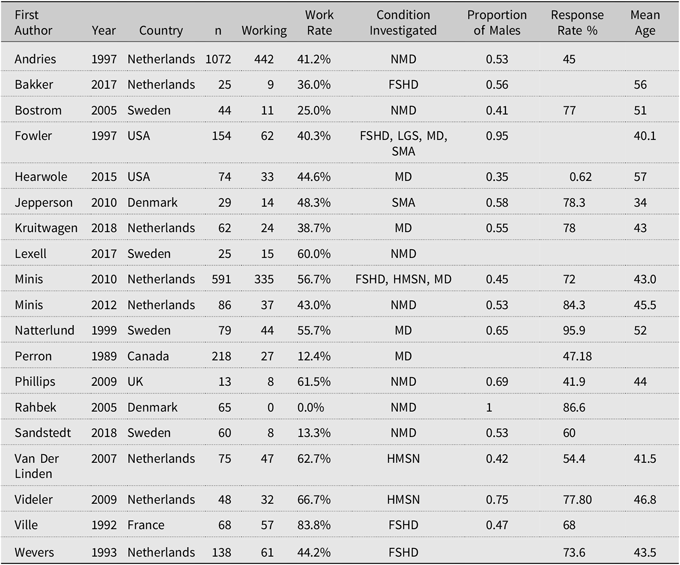
In order to complement the narrative review, a quantitative summary of the outcomes from the studies reviewed earlier was also undertaken. These studies are listed in Table 1. The essential criterion for the inclusion of a reference was that it cited the number of persons working. The proportion working was also evaluated in terms of (a) year of publication; (b) country of the study; (c) type of neuromuscular condition; (d) proportion of males; (e) the mean age of the participants, and (f) the extent to which the paper satisfied the following eight validity criteria – (i) focused on a specific neuromuscular condition, (ii) had a participation rate greater than 80%, (iii) indicated the proportion of males, (iv) showed the number of participants who never worked, (v) indicated the number who were deceased, (vi) indicated the mean age of participants, (vii) whether there was a follow-up, and (viii) reported the proportion of participants who were ambulatory.
Summary of studies reviewed

FSHN, Facioscapulohumeral muscular dystrophy; HMSN, Hereditary motor and sensory neuropathy; SMA, Spinal muscular atrophy; LGS, Limb-girdle syndrome; MD, Muscular dystrophy; ALS, Amyotrophic lateral sclerosis; Neuromuscular diseases not elsewhere classified.
Literature review
Neuromuscular disorders in general and the ability to work
Whilst it is possible for some persons with neuromuscular disorders to work, the proportion who have never been employed plus those who are not currently working is more than half. For example, Bostrom, Netterlund, and Ahlstrom (Reference Bostrom, Natterlund and Ahlstrom2005) undertook a longitudinal study and followed 44 people with muscular dystrophy over a 10-year period (1991 and 2001). The number of people who were working dropped from 21 in 1991 to 11 in 2001. In 2001, six were working full-time and five were working part-time. Fowler et al. (Reference Fowler, Abresch, Koch, Brewer, Bowden and Wanlass1997) compared employment outcomes with the perceptions of 175 rehabilitation counselors and 76 physicians. Counselors (95%) thought that clients with neuromuscular conditions could work in the open labor market and just over half of the counselors estimated success rate at 30% or less. Almost all physicians (98%) thought that persons with neuromuscular conditions had vocational potential, but in that study, 92 out of 154 individuals (approximately 60%) were not working.
The broad outline of a picture of quasi-employment potential is confirmed by other studies. Andries et al. (Reference Andries, Wevers, Wintzen, Busch, Howeler, de Jager and Wokke1997) analyzed the work situation of 1072 Dutch patients with a neuromuscular disorder. They reported that “a labour career is in reach of most NMD [neuromuscular disorder] patients” (p. 255), but labor force participation decreases after age 34. The conditions selected were dystrophia myotonic, hereditary motor and sensory neuropathy, spinal muscular atrophy, and myasthenia gravis. In Phase 1 of the study (n = 1072), 41% were currently working, 50% had worked previously, and 9% had no previous work experience (p. 260). In Phase 2 of the study, adaptation to the workplace was studied. Amongst those who retired (n = 499), 22% had some work adaptation, 30% needed some work adaptation, and 32% met with no acceptance of the disorder in their workplace. For those in Phase 2 who were presently working (n = 410), work adaption or accommodation was provided for 42%, but another 27% still expressed the need for workplace adaptation. Adverse physical labor conditions affected 18% of those currently working and sadly some 30% reported no acceptance of their disorder in work (p. 265). The authors concluded that “…for NMD patients presently working, a labour career of 31 years duration (male patients) and 26 years duration (female patients), is quite probable” (Reference Andries, Wevers, Wintzen, Busch, Howeler, de Jager and Wokke1997, p. 270).
The nature of employment conditions was examined from the reports of 86 patients visiting a neuromuscular center (Minis et al., Reference Minis, Cup, Heerkens, Engels, van Engelen and Oostendorp2012). Less than half were employed (43%) and most of them (80%) were working in clerical-administrative work. It was reported that the most frequent adjustments involved “working conditions, terms of employment and task content” (Minis, Reference Minis, Cup, Heerkens, Engels, van Engelen and Oostendorp2012, p. 2279).
Other studies have reported employment rates of 44.5% amongst 119 persons with mixed neuromuscular conditions (Natterlund & Ahlstrom, Reference Natterlund and Ahlstrom1999); or 39% out of 46 patients from a 10-year follow-up from an initial group of 58 in which 10 had died (Bostrom & Ahlstrom, Reference Bostrom and Ahlstrom2005). In a small-scale study of physical activity, 8 out of 13 ambulatory people with neuromuscular disease worked compared with all 18 in the control group (Phillips, Fleming, & Tsintzas, Reference Phillips, Flemming and Tsintzas2009). A particularly low rate of working was that of Baumann, Newman, and Diserens (Reference Baumann, Newman and Diserens2013). They evaluated the medical records of 267 patients aged 16–25 years, 43 of whom had neuromuscular diseases. In the final analysis, only 1 out of the 43 persons with neuromuscular diseases was working. These results must be qualified as it excluded those studying.
Whilst the reports on working across neuromuscular conditions in general indicate that there is limited vocational potential, it is reasonable to ask whether the grouping together of neuromuscular conditions may mask substantial differences between the specific disorders (this issue is taken up in the following section).
Specific neuromuscular disorders and their relationship to work
Specific neuromuscular disorders and their relationship to employment have been investigated. In one of the earliest studies of social identity, Ville, Ravaud, Marchal, Paicheler, and Fardeau (Reference Ville, Ravaud, Marchal, Paicheler and Fardeau1992) surveyed 100 patients with facioscapulohumeral muscular dystrophy, of whom 68 agreed to participate in a study and 83.8% of the 68 were currently working. In a study on job perspectives of 126 adult patients with facioscapulohumeral muscular dystrophy, Wevers, Brouwer, Padberg, and Nijboer (Reference Wevers, Brouwer, Padberg and Nijboer1993) reported that 44% were working, 47% were no longer employed, and 9% had no work experience at all. The average female and male career was 15–30 years, respectively. It was noted that those who entered the workforce after the onset of their illness tended to choose office work. Just over half (51.5%) with an employment history had retired and the mean age was 50 years. The study emphasized that only 9 out of 61 jobs were adjusted to the disabilities of the patient. Bakker, Schipper, Geurts, and Abma (Reference Bakker, Schipper, Geurts and Abma2017) followed up the qualitative experiences of 25 people with facioscapulohumeral muscular dystrophy and reported only 2 out of 9 were working full-time and 10 had taken early retirement, but equally importantly, they reported that 32% were wheelchair dependent.
Fowler et al. (Reference Fowler, Abresch, Koch, Brewer, Bowden and Wanlass1997) noted significant differences when they examined the employment rates across four conditions of 154 individuals with neuromuscular conditions. Those with limb-girdle syndrome and myotonic muscular dystrophy had the lowest rates of employment. For limb-girdle syndrome, 7 out of 27 were employed, 9 out of 16 for facioscapulohumeral dystrophy, 5 out of 9 for Becker’s muscular dystrophy, 10 out of 17 for spinal muscular atrophy, 18 out of 43 for hereditary moor sensory neuropathy, and 13 out of 42 for myotonic muscular dystrophy. They reported a link between age and unemployment but no relationship between sex and employment status.
A relevant distinction that takes into account those with ambulatory disabilities was made by van der Linden et al. (Reference van der Linden, Kalkman, Hendricks, Schillings, Zwarts, Bleijenberg and van Engelen2007) in a study of patients with hereditary motor and sensory neuropathy type 1. The return to work rate for those with an ambulatory disability (n = 54) was 51.9% compared with 71% for those with no ambulatory disability (n = 21). At the same time, the age of the two cohorts was also significantly different (44.6 and 36.5 years, respectively).
Jeppesen, Madsen, Marquardt, and Rahbek (Reference Jeppesen, Madsen, Marquardt and Rahbek2010) conducted a mixed methods design of the conditions of living for 29 adults with spinal muscular atrophy type 2, and in the process reported that 14 (48%) were employed, 4 had been employed (14%), and 11 (38%) had never been employed. They stated that “The majority were financially supported by the public early retirement pension, while half of the participants supplemented their income with a part time job” (p. 12).
In a secondary analysis of data, Minis et al. (Reference Minis, Kalkman, Akkermans, Engels, Huijbregts, Bleijenberg and van Engelen2010) contacted 591 patients with neuromuscular conditions (facioscapulohumeral muscular dystrophy, n = 138; hereditary motor and sensory neuropathy, n = 135; and myotonic dystrophy n = 318). The largest proportion of those employed were in the facioscapulohumeral muscular dystrophy group (70.3%), followed by hereditary motor and sensory neuropathy group (63.7%) and 47.8% for myotonic dystrophy. Voluntary work also followed the same monotonic pattern. Patients’ reports of the impact of symptoms routinely mentioned fatigue (Hearwole et al., Reference Hearwole, Johnson, Bode, Dekdebrun, Dilek, Hilbert and Moxley2015), and in the case of myotonic dystrophy type 2 meant that only 33 (44.6%) out of a sample of 74 from a national registry were employed. This outcome is affected first by the participation rate in that only 74 out of 120 responded and by the advanced age vis-à-vis employment (mean = 57.0, SD = 12 years).
Amongst those with spinal muscular atrophy (Kruitwagen-Van Reenen et al., Reference Kruitwagen-Van Reenen, Van der Pol, Schroder, Wadman, Van Den Berg, Visser-Meily and Post2018), only 24 out of 62 had paid employment and only 10 had full-time work (36 h per week). From 48 patients with hereditary motor and sensory neuropathy 1a, Videler, Beelen, van Schaik, de Visser, and Nollet (Reference Videler, Beelen, van Schaik, de Visser and Nollet2009) reported 32 were working.
In the case of amyotrophic lateral sclerosis, Sandstedt et al. (Reference Sandstedt, Littorin, Johansson, Gottberg, Ytterberg and Kierkegaard2018) undertook 6-month follow-ups of a group of 60 patients over 3 years. They indicated that 8 out of 60 were working at Time 1, but by Time 5 none were employed. Equally poor outcomes were reported by Rahbek et al. (Reference Rahbek, Werge, Madsen, Marquardt, Steffensen and Jeppesen2005). They interviewed 65 adult males aged 18–42 years with Duchenne Muscular Dystrophy. They described graphically the functional ability of a typical adult patient:
The ordinary adult DMD patient is mechanically ventilated, severely limited in his ability to move his hands and fingers and to sit unsupported, often experiences physical pains and frequently fatigue as well. Still, he operates his wheelchair, writes and plays on the computer and seems only moderately restrained in his activities by pains and fatigue. (p. 20)
There were problems in the area of education with only 23.1% completing high school. Only eight persons had work experience and none were employed at the time of interview.
Quantitative summary of work rate from previous studies
There were 19 relevant studies of neuromuscular conditions comprising a total of 2926 participants of whom 1266 or 43.26% were working. These outcomes came from seven nations (Canada 1, Denmark 2, France 1, Netherlands 8, Sweden 4, UK 1, and USA 2). As most nations had reported only one or two studies, the most meaningful comparison might be between the overall 47.0% work rate for Netherlands (n = 8 studies) and the overall 37.5% for Sweden (n = 4 studies). The difference in proportions is statistically significant (z = 2.64, P < 0.005), but there are no a priori theoretical justifications for this difference in proportions.
Methodological factors played no role in the outcomes. The correlation between the year of publication and the work rate was −0.034, meaning that neither the earlier nor the later studies had a better employment rate. The size of the study and the work rate were also unrelated (r = −0.019) as was the response rate for a study (r = −0.028).
Demographic factors did not play a significant role in the outcomes. The number of males is important as males have a higher rate of labor force participation (70.6% participation rate) compared with females (60.2%; Australian Bureau of Statistics, 2018). Overall, there was a negative correlation (−0.303) between the proportion of males and the work rate (i.e., studies with lower proportions of males had higher work rates). The mean age of the sample correlated −0.262 with work rate (i.e., studies with younger participants had a higher work rate).
Seven studies reported unambiguously that 36.1% were working, 18.1% had never worked, and 45.6% had worked previously at some time. This breakdown into three categories gives a more specific description of labor market participation than the overall work rate. The work rate of 36.1% for these seven studies differs markedly from that reported for the other 12 outcomes (63.9%), which did not evaluate those who had never worked and those who had worked previously. It suggests that the proportions who are working might well be overestimated when one does not take into account those who had never worked or who had worked at some time and dropped out of the labor market.
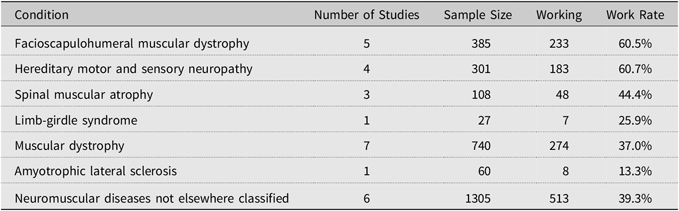
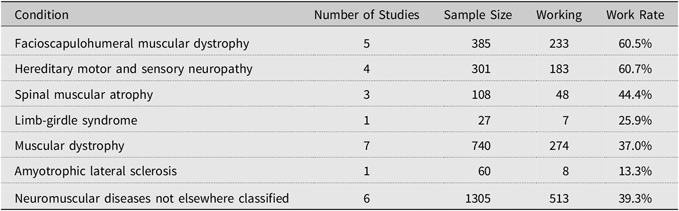
The breakdown according to the specific conditions is relevant and provided in Table 2. The conditions with more than reasonable likelihood of working were facioscapulohumeral muscular dystrophy and hereditary motor and sensory neuropathy, whereas amyotrophic lateral sclerosis and limb-girdle syndrome recorded very low rates; but these were all based on single studies. The mixed group of neuromuscular disorders based on six results had an overall work rate of 39.3%, which is around the median of the specific disorders.
Work rates for specific neuromuscular conditions
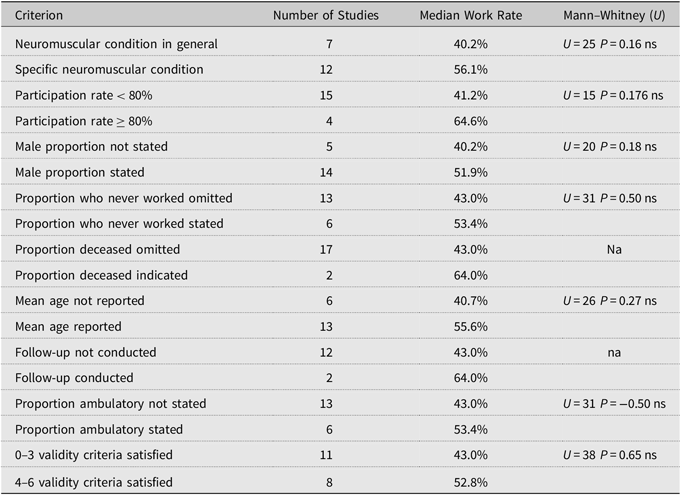
The relationship between particular validity criteria and work rate was also examined, and the results are summarized in Table 3. There was no a priori hypothesis as to how the application of a validity criterion would impact on the resulting work rate, but it seemed reasonable to consider that studies with fewer methodological controls might report higher work rates.
Specific validity criteria and the work rate

na, Kruskal-Wallis not calculated for sample sizes less than 5; ns, not significant two-tail test.
Eight criteria were examined. In every instance, the application of a methodological control (e.g., follow-up, the participation rate greater than 80%) or the reporting of a feature (e.g., the proportion of males in a study, the number who were ambulatory) resulted in a lower work rate. In simple terms, the better controlled the study the lower the work rate that was reported. No study satisfied all eight criteria, but studies that met 4–6 criteria had a median work rate of 52.8% compared with a median of 43.0% for those that satisfied 0–3 criteria (Mann–Whitney test U = 38, P = 0.652, z = −0.454, ns).
Specifically, seven findings from the studies did not distinguish between neuromuscular conditions and reported a median work rate (40.2%) that was below the 56.1% for those 12 studies that examined a particular condition (e.g., ALS, FHSN, DM); but this difference was not statistically significant (Mann–Whitney test U = 25, P = 0.164, z = 1.39). Studies with participation or response rate of less than 80% had a much lower work rate 41.2% (n = 15) compared with 64.4% for those four studies that had a participation rate of more than 80%. The six studies that did not report the mean age of the sample had a lower median work rate (40.7%) compared with a median of 55.6% for those 13 studies that indicated the mean age. Only a small number of studies took into account those that had died, those that were ambulatory or undertook a follow-up, and when they did lower work rates were reported.
Discussion and conclusion
Neuromuscular conditions might be rare as individual diseases but they take their toll in terms of employment restrictions. The findings of this review help to map the employment domain and confirm (a) that there is a likelihood of working but there is (b) considerable variability in findings and (c) difficulty in making specific conclusions. Some aspects of the methodology are worthy of comment.
First, whilst the grouping together of different neuromuscular conditions facilitated sample size, there are serious questions about the validity or generalizability of such findings to each of the 160 or more neuromuscular conditions. There is considerable variability that is masked by combining diverse conditions. This is illustrated in Table 3 in which amyotrophic lateral sclerosis had an employment rate of 13.33% compared with 60.7% for hereditary motor and sensory neuropathy. As a rule, in the future it may be more productive to focus on the employment outcomes for specific conditions.
A second consideration in any evaluation of work or employment in relation to neuromuscular disease is that of mortality. For instance, Sandstedt et al. (Reference Sandstedt, Littorin, Johansson, Gottberg, Ytterberg and Kierkegaard2018) reported that 22 out of 102 patients with amyotrophic lateral sclerosis were excluded at the outset due to being at a terminal stage. In the follow-up of 60 patients over 3 years, a further 25 were reported as deceased. This means that the proportion of those employed needs to be compared against the initial size of a cohort rather than the number of participants in the study.
The year of publication and the size of the study were not related to the rate of working. However, there is a decided bias in the distribution of countries from which results have been obtained to date. Just over 84% of the results came from Northern Europe (Netherlands, Sweden, Denmark), but there was no relationship between location of study and the results of working.
Eight validity criteria were examined and there appear to be subtle influences of methodology in the studies, but none reached statistical significance when comparisons were made. Higher work rates were reported for studies where (a) the focus was on specific disorders rather than neuromuscular conditions in general or (b) where the participation rate was greater than 80%. Lower work rates were reported for studies where (a) the proportion of males was not indicated, (b) those who had worked previously or never worked were omitted, (c) the mean age of the sample was not indicated, (d) follow-up was not undertaken, (e) the proportion of ambulatory patients was not recorded, and (f) allowance was not made for those who were deceased.
The limitations of this review relate to any publication bias in the studies that were analyzed. Presumably, studies with low employment rates would not garner attention or recognition. There is also a publication bias in the fact that only English publications were retrieved and the geographic bias of the studies that have been reported. There are inherent limitations in combining results across divergent methodologies and studies with unknown difficulties in justifying the combination of overall work rates.
Overall work rate is a broad-brush yardstick. For instance, there may be persons with neuromuscular conditions who were not working or employed but who did have employment potential. Another limitation is that working at a point in time does not indicate the hours worked, the duration of employment in years, the pattern of employment and unemployment across age groups and sexes, the necessity to leave work, or the characteristics of the work undertaken. In addition, there are moderating factors such as lower educational achievement associated with some neuromuscular conditions and even diminished cognitive abilities (Johnson et al., Reference Johnson, Abresch, Carter, Kilmer, Fowler, Sigford and Wanlass1995) that are not controlled.
This review does, however, provide useful starting point and a framework for investigating work outcomes. For the moment, it can be stated that persons with neuromuscular conditions have the capacity to work, with possibly around 40–50% on the basis of the research reviewed to date. There are some methodological concerns that have been highlighted relating to follow-up, allowing for mortality, taking into account ambulatory status, reporting those who never worked, and those who had worked at some time, together with increasing the level of response rates to surveys and reporting demographic information in greater detail; but the important consideration is that there is vocational potential that can be exploited to give someone further meaningful life.
Author ORCIDs
James A. Athanasou 0000-0002-4743-4098
Acknowledgments
The helpful comments of two anonymous reviewers are also acknowledged.
Financial support
None.
Conflicts of interest
The author has no conflict of interest to report.