Across West European countries the past few decades have seen an increase in the electoral importance of a range of new issues, such as abortion, immigration and criminal justice – all of which are related to the same underlying dimension often labelled authoritarian–libertarian values (Flanagan Reference Flanagan1987; Flanagan and Lee Reference Flanagan and Lee2003; Kitschelt Reference Kitschelt1994, 1995; Kriesi et al. Reference Kriesi, Grande, Lachat, Dolezal, Bornschier and Frey2008; Stubager Reference Stubager2010). This development has been paralleled by an ongoing scholarly debate about the relevance of individuals’ social backgrounds and social identities to their political behaviour. One side in the debate has argued that the new values have replaced social class and other traditional cleavages as fundamental drivers of electoral behaviour (see, for example, Dalton Reference Dalton2002; Inglehart Reference Inglehart1997), while others have argued for a continuing relevance of factors such as class (Evans Reference Evans1999), related to the economic conflict that dominated politics in Western countries for most of the twentieth century (Ionescu Reference Ionescu1975).
While many, although certainly not all, analysts agree that class voting is on the decline (Clark and Lipset Reference Clark and Lipset1991), this does not imply that social background and identity have become irrelevant to electoral politics. Not only may class voting continue to exist on a (possibly) smaller scale than previously (see Best Reference Best2011), but other features of individuals’ backgrounds such as race may also continue to play important roles (McDermott Reference McDermott2009) just as hitherto neglected social groupings may assume increasing influence. It is the latter possibility that is explored in this article.
Research in a multitude of countries has repeatedly shown that education is the strongest single predictor of individuals’ positions on authoritarian–libertarian values, with higher levels of education leading to more libertarian positions and vice versa (Bovens and Wille Reference Bovens and Wille2010; Houtman et al. 2008; Stephens and Long Reference Stephens and Long1970; Stubager Reference Stubager2008; van der Waal et al. Reference van der Waal, Achterberg and Houtman2007; Weakliem Reference Weakliem2002; van de Werfhorst and de Graaf Reference van de Werfhorst and de Graaf2004). In addition, recent research (Stubager Reference Stubager2009a) has shown that the objective value conflict between educational groups is reflected at the subjective level in the form of a development of identity and consciousness around those groups. Given the rising electoral importance of authoritarian–libertarian values, this suggests that education and the social identity and consciousness associated with it may constitute an important new social anchor for electoral behaviour – an anchor that has not been properly explored so far.
Based on cleavage theory and using a unique data set, this article addresses this shortcoming and demonstrates that education and education-based social identity and consciousness do play such anchoring roles not only at the level of (authoritarian–libertarian) values, but also in relation to individuals’ electoral behaviour with regard to parties that mobilize the opposing groups. In other words, the conflict over authoritarian–libertarian values has its roots in a fully fledged education cleavage.
Thereby, this analysis adds to existing knowledge in two ways. First, the investigation of the importance of education and, for the first time, education-based identity and consciousness for people's electoral choices constitutes new evidence that social structure is still important for electoral behaviour in advanced Western societies. Second, the identification of a structural anchor to the authoritarian–libertarian conflict provides a deeper understanding of the conflict, its content and likely duration. The results presented below indicate that the conflict is of a fairly stable nature. It looks set, in other words, to influence politics in Western countries for years to come (see also Casal Bértoa Reference Casal Bértoa2013).
The analyses are conducted on a specially collected representative survey of the Danish electorate, which makes an interesting case in the present context. On the one hand, Henjak (Reference Henjak2010) argues that Danish history constitutes an unfavourable setting for the development of an education cleavage. This is due to the encompassing social democratic welfare state, which alleviates the conflict between winners and losers of globalization that gives rise to a cultural cleavage in other countries, and to the weak pre-existing cultural cleavages (such as centre–periphery) from which a new cultural cleavages could develop. On the other hand, the level of social development in combination with the open political system with a threshold of only 2 per cent for entering parliament means that Danish society is open to new social and political influences (Stubager Reference Stubager2010). Given this background, Denmark constitutes a critical case for the establishment of such a cleavage in the sense that, if the cleavage has not materialized here, it becomes difficult to see it developing in other contexts.
In what follows, I first briefly discuss the content of the authoritarian–libertarian value dimension as well as the cleavage model that gives rise to a set of expectations regarding the relationship between education, authoritarian–libertarian values and electoral behaviour. These expectations are then subjected to testing, before the concluding discussion returns to the implications of the results.
The Core of the Conflict: Authoritarian–Libertarian Values
The definition of authoritarian–libertarian values remains somewhat contested. In this context I rely on a definition that has been applied by a range of different scholars (Feldman Reference Feldman2003; Flanagan Reference Flanagan1987; Flanagan and Lee Reference Flanagan and Lee2003; Kitschelt Reference Kitschelt1994). To all of these authors, thus, the core concept is that of hierarchy. Authoritarians favour social hierarchy – the rank ordering of individuals in a system with a clear distinction between superior and inferior groups or persons (Flanagan and Lee Reference Flanagan and Lee2003: 237–43; Kitschelt Reference Kitschelt1994: 10). Such hierarchies are both natural and right to authoritarians (Jenssen Reference Jenssen1993: 122). Libertarians, on the other hand, dislike social hierarchies and prefer the free and equal interaction of people without regard to social positions.
Along with these attitudes to hierarchy go attitudes concerning tolerance for nonconformity (Heatherington and Weiler Reference Heatherington and Weiler2009). Implicit in libertarians’ preference for free and equal interaction among people, hence, is a basic respect for and tolerance of other people – including those who deviate from one's own norms or the norms of society. Quite the opposite for authoritarians: those who deviate from conventional norms or who stand outside society should first and foremost be made to comply with the norms of the majority.
Thus, hierarchy and tolerance form the core of the conflict. However, the concrete manifestation of the conflict may vary from one country to another. This means that the underlying values may play out in relation to different issues, depending on the sociopolitical and historical context as well as the parties’ mobilization efforts. This point has to be kept in mind when constructing measures of the dimension as the measures need to tap into issues that are contested in a given context (see Evans Reference Evans2010). But, whether the conflict turns on moral issues such as abortion or homosexuality, as in the US, or on immigration, as in much of Northern Europe, the fundamental conflict is the same (Heatherington and Weiler Reference Heatherington and Weiler2009).
The Education Cleavage: a Set of Expectations
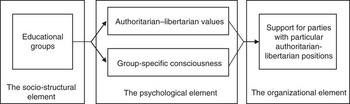
The cleavage concept stands at the centre of classical political sociology and was popularized by the seminal work of Lipset and Rokkan (Reference Lipset and Rokkan1967). At present, most scholars in the field (see Deegan-Krause Reference Deegan-Krause2007; Knutsen and Scarbrough Reference Knutsen and Scarbrough1995; Mair Reference Mair2006) draw on Bartolini's and Mair's (Reference Bartolini and Mair1990) three-pronged cleavage definition, according to which cleavages consist of three levels of layered conflict: socio-structural, psychological (comprising values and identities; that is, it takes place in people's minds) and organizational (typically in the form of political parties).
When applying the cleavage model in the context of education and authoritarian–libertarian values, the requirements are, hence, that different educational groups hold different value positions as well as group-specific consciousness, and that the groups vote for specific parties – the parties that mobilize on group interests or values. But what are the mechanisms that tie the three levels together for these particular groups?
A starting point can be found in Franklin's conjecture (Reference Franklin2010) that socialization constitutes the core of the cleavage model. This squares well with existing research into the relationship between education and authoritarian–libertarian values. Here it is argued that students undergoing organized education in an institutional setting are socialized into accepting the values prevalent within the given institution – not primarily through the curriculum, but more by informal interaction, with peers and teachers, for example. Thus, the content of the socialization will depend on the values dominating the institutions of higher education (see Weil Reference Weil1985).
While evidence is scant outside the US, the clear findings in that country (see, for example, Dey Reference Dey1996: 543; Gross and Fosse Reference Gross and Fosse2012) as well as similar tendencies observed across a range of other countries (Brooks Reference Brooks2013; Gross and Fosse Reference Gross and Fosse2012: 160; Jacobsen Reference Jacobsen2001: 366; Nakhaie and Brym Reference Nakhaie and Brym2011: 23) regarding the political values (authoritarian–libertarian ones in particular) of academic teachers and researchers – combined with the tendency for former and active students to possess libertarian values (Pascarella and Terenzini Reference Pascarella and Terenzini1991: 279; see also the references given above) – indicate that the values dominating institutions of higher education tend to be of the libertarian kind across the Western world.Footnote 1 This, then, is what is reflected in the finding that those who have spent more time in educational institutions – that is, the more highly educated – are more libertarian than those who have spent less time in these institutions – people with lower levels of education (Stubager Reference Stubager2008; see also Emler and Frazer Reference Emler and Frazer1999; van de Werfhorst and de Graaf Reference van de Werfhorst and de Graaf2004). Regarding the connection between the socio-structural element and the value aspect of the psychological element, it can therefore (in line with previous research) be hypothesized that the level of education stands out as the main predictor of authoritarian–libertarian values (H1).Footnote 2
Along with the socialization to certain values goes the development of a certain identity and consciousness. Basically, the possession of education at a given level is likely to lead people to develop some measure of identification with other individuals with similar levels of education, as opposed to individuals with other educations (see also Tajfel Reference Tajfel1974). When adding to this identification the value differences between the educational groups as well as the increasing salience of the conflict over these values in political debate (see also Houtman et al. 2008), we might expect that the members of the educational groups develop a consciousness entailing the valuation of the ingroup over the outgroup (Brown Reference Brown2000). The identity and consciousness factors constitute the second half of the psychological element of the cleavage, implying that individuals with high or low levels of education are hypothesized to identify with their group and side with it in the intergroup conflict – that is, possess group-based consciousness (H2).
Regarding the third element of the cleavage, the expectation is that members of the conflicting educational groups vote for parties that represent their values in the political arena. Because of their configuration of values and consciousness, members of the high-education group are hypothesized to vote for parties with a libertarian value position, while members of the low-education group are hypothesized to vote for parties with an authoritarian position (H3). In analytical terms, this implies that the effect of education on voting is mediated by the values and the consciousness factors. The expectations are depicted in Figure 1, which also serves as an outline of the empirical tests.Footnote 3
The Education Cleavage at the Individual Level

Data, Measurement and Analytical Approach
Measures of all elements of the proposed cleavage are available in a postal survey of Danish voters (between the ages of 18 and 75) conducted by the author in spring 2004. Of 2,000 respondents randomly drawn from the civil register of all Danish citizens, 1,192 returned completed questionnaires, thus yielding a response rate of 60 per cent. The resulting sample for analysis is representative as regards the relevant population on age, gender and geographical origin.Footnote 4
MeasurementFootnote 5
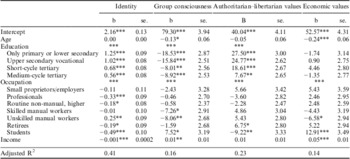
Education is measured in five categories ranging from elementary schooling to MA-level and beyond. The variable is, thus, roughly comparable to the United Nations Educations, Scientific and Cultural Organization's (UNESCO) international standard classification of education (ISCED) scheme (see Braun and Müller Reference Braun and Müller1997; see Table 1 for the exact categories). Authoritarian–libertarian values are measured by four Likert-scale items that tap into the core issues of the conflict in the Danish context at the time of the survey: immigration, criminal justice and support for democracy during crises. A confirmatory factor analysis (not shown) clearly supports a one-dimensional structure (just as it differentiates authoritarian and libertarian values from the economic values discussed below), and the responses have therefore been summed to form a scale ranging from 0 to 100, with 100 being the most authoritarian position.
The Socio-Structural Origins of Education-based Identity and Group Consciousness, Authoritarian–Libertarian Values and Economic Values: Unstandardized OLS Regression Coefficients, Standard Errors and Explained Variance

Note: ***: significant at the 0.001 level; **: significant at the 0.01 level; *: significant at the 0.05 level. Asterisks for the categorical variables indicate the significance of the entire variable in F-tests. Identity runs from 1 to 4, with 4 being the low-education extreme. The other dependent variables run from 0 to 100, with 100 being the most positive evaluation of the high-education group, or the most authoritarian or capitalist position, respectively. Reference categories are: education: long-cycle tertiary; occupation: routine non-manuals, lower. N is 966 for identity and 1.026 for all others.
Education-based identity is tapped by a simple question inspired by traditional measures of partisan and class identification (see, for example, Campbell et al. Reference Campbell, Converse, Miller and Stokes1960; Goul Andersen Reference Goul Andersen1997), asking people whether they feel (strongly or somewhat) attached to the high- or low-education group, or to neither. Owing to the low number of respondents identifying strongly with the low-education group, the ‘somewhat’ and ‘strongly’ categories for the low-education group have been combined in the analyses while ‘don't knows’ have been excluded.Footnote 6
Research into class consciousness (Butler and Stokes Reference Butler and Stokes1969: 92–3) has documented an asymmetry in the consciousness of dominated and dominating groups. Thus, their study ‘certainly shows that the working class is much more prone than the middle class to see politics in class terms’. Similarly, Dahrendorf (Reference Dahrendorf1959: 284) finds that ‘those “above” visualize society as a comparatively ordered continuous hierarchy of positions; those “below” are, above all, struck by the gap between them and “the others”’. Similar patterns have been found for education (Stubager Reference Stubager2009a). Thus, being the dominant of the groups, the stance of the high-education group is where things can be at stake in the conflict, in the sense that members of the group want to preserve its position, while members of the low-education group may want to challenge it. Education-based consciousness is assessed by three Likert-scale questions focusing on the role of the high-education group in society. The answers were summed to form a scale ranging from 0 to 100, with 100 being the most positive evaluation of the role of the high-education group – that is, an acceptance of its participation in social life and so on (see the Appendix for question wordings).
In order to control for rival explanations (see below), the analyses also included measures of age (in years), income (in thousands of kroner), occupation (measured by a version of the EGP-scheme (Erikson, Goldthorpe, and Portocarero Reference Erikson, Goldthorpe and Portocarero1979) with seven categories).Footnote 7Economic values were measured by three Likert-scale items tapping into taxation, (in)equality and government control of private investments. The items were summed to form a scale running from 0 to 100, with 0 as the most socialist position.
Finally, six parties were included on the measure of party choice (percentage respondents in parentheses): the Social Democrats (26.8), the Social Liberals (10.9), the Conservatives (9.6), the Left Wing (a combination of the Socialist People's Party and the Red–Green Alliance, 9.3), the Liberals (27.7) and the Danish People's Party (11.5).Footnote 8 The parties are on different positions on the authoritarian–libertarian dimension, thereby allowing voters to choose between them on that basis. As shown by Stubager (Reference Stubager2010) using the Comparative Manifestoes DatasetFootnote 9 (Budge et al. Reference Budge, Klingemann, Volkens, Bara and Tanebaum2001) – and unsurprising to observers of Danish politics – the Social Liberals and, to a somewhat lesser extent, the Left Wing, take up libertarian positions; the Social Democrats, the Conservatives and the Liberals form a centre group, while the Danish People's Party takes an authoritarian position. This implies that, ceteris paribus, highly educated voters should prefer the Social Liberals or – to a lesser extent – the Left Wing, while the Danish People's Party should be favoured by voters with low levels of education.
Analytical Approach
The expectations are tested by means of a set of regression models. First, the relationship between education and the variables constituting the psychological element of the proposed cleavage can be examined in a set of OLS regressions – one for each of the variables authoritarian–libertarian values, identityFootnote 10 and consciousness. To investigate the independence of the education cleavage from the historically dominant class cleavage centred on the (re)distribution of wealth, these models will also include measures of income and occupation in order to control for the effect that is due to the economic aspects of education. Likewise, in order to demonstrate the different origin of economic values, these are separately regressed on the set of independent variables included in the other analyses.Footnote 11
The next step in the analyses consists of linking the structural and psychological elements to the organizational. Analytically, this is accomplished by means of a set of block-recursive multinomial logit models (see Dow and Endersby Reference Dow and Endersby2004) with party choice as the dependent variable. The models are developed in four steps based on a simple causal ordering of the variables: Model I includes the socio-structural variables; in Model II identity is included; while Model III enters group consciousness as well as economic values to control for economic aspects of the conflict between educational groups. Finally, authoritarian–libertarian values are entered in Model IV. In the presentation, the focus will be on Models I to III, which contain the variables neglected by previous research.
Structure and Psychology: The Influence of Education on Identity, Consciousness and Values
The analyses of the connection between the socio-structural and the different aspects of the psychological cleavage elements are presented in Table 1. From the first two columns it can be noted that education is clearly the most important single factor influencing the development of identity. Thus, as expected, members of the educational groups possess some measure of identity in connection with their group membership. This provides support for H2.
Similarly, in columns three and four the strong effect of education on consciousness immediately stands out. Thus, there is a difference of more than 18 scale points between the extreme educational categories, with respondents with lower levels of education being clearly less positive in their evaluations than those with higher levels of education (the relationship is almost monotone in shape). This is entirely as expected (H2) and shows the existence of a certain level of animosity between the educational groups.
The final four columns of Table 1 pertain to the authoritarian–libertarian and economic value dimensions. Focusing on the former, the expected influence of education comes out very clearly even when the effects of age, occupation and income have been taken into account. And, as expected, the highly educated are the most libertarian (that is, they have lower scale scores) – a result that has also been found in previous research (see above) and that supports H1. With income being insignificant and the effect of occupation driven mainly by the student category, the results also show the independence of authoritarian–libertarian values from economic factors, thus supporting the view that the values form part of a separate education cleavage.
This view is further supported when inspecting the results for economic values – particularly in contrast to those for authoritarian–libertarian values. Thus, while education is strongly related to the latter, it has no effect on the former. The opposite configuration is found for income, which has a positive relationship with economic values (higher income leads to a more capitalist position), but no effect on authoritarian–libertarian values. In other words, authoritarian–libertarian values are driven mainly by education, while economic values are driven by income and, to some lesser extent, occupation. These results document the structural independence of the two value dimensions, meaning that the authoritarian–libertarian conflict does not represent a new version of the class cleavage. It may be added that with a Pearson correlation of −0.04 (p = 0.14) the dimensions themselves are also independent.
All in all, in line with previous research, the results of this first set of analyses support the expectations regarding the existence of an education cleavage. The question which is taken up next, however, is whether the variables of the socio-structural and psychological elements also influence electoral behaviour.
Structure, Psychology and Voting: The Influence of Education, Identity, Consciousness and Values on Electoral Behaviour
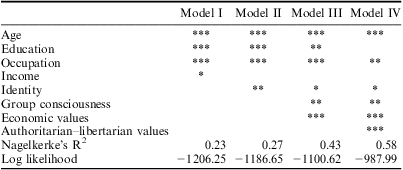
In order to facilitate the interpretation of the results of the multinomial logit analyses of this section I rely on predicted probabilities when presenting the results of the analysis.Footnote 12 Predictions are presented only for the core theoretical variables: education, identity and consciousness. However, Table 2 provides an overview of the results by showing the level of significance of all variables included in the three models.
Determinants of Party Choice: Significance of Variables in Multinomial Logistic Regression Models and Model Fit
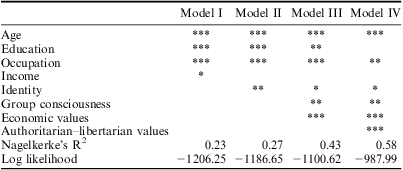
Note: ***: significant at the 0.001 level; **: significant at the 0.01 level; *: significant at the 0.05 level. Significance levels are based on likelihood ratio tests of the combined influence of the variables across all six parties. N = 776.
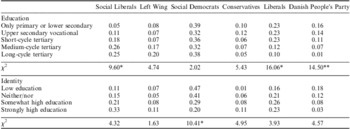
Looking first at Model I, Table 2 shows that all four variables are significant, albeit income less clearly so than age, education and occupation. In more detail, the upper half of Table 3 reveals that, as expected, the highly educated vote more for the Social Liberals and the Left Wing than do the electorate as a whole, and they clearly shy away from the Danish People's Party. At the other end of the table an almost equally clear pattern can be found among respondents with less than tertiary education. Members of these groups clearly vote less often for the Social Liberals and the Left Wing and more for the Danish People's Party than is the case among all voters. In other words, the attractiveness of the three parties differs strongly across the educational groups (even if it misses statistical significance for the Left Wing).
Education, Identity and Party Choice after Controls for Age, Occupation and Income: Predicted Probabilities

Note: **: significant at the 0.01 level; *: significant at the 0.05 level. N = 776. Entries are predicted probabilities calculated from Models I (education) and II (identity) in Table 2 of voting for each party by lower routine non-manuals with a short-cycle tertiary education (only for identity) and average age (46 years) and income (280,000 kroner). Significance tests are χ 2 tests of equality in the predicted probability of support for a given party across the educational categories.
When, in Model II, identity is introduced, education remains significant, thereby implying that identity does not completely mediate the effect of education (see Table 2). On the other hand, identity is clearly significant and thereby has an important contribution to explaining voting (see also the increase in the value of Nagelkerke's R 2 from Model I to II). Further, the lower half of Table 3 shows that, after controlling for the structural variables, the difference in the predicted probability of voting for the Social Liberals between people with a low-education identity and people with a strong high-education identity is 0.22 while it is 0.15 for the Danish People's Party – only in the opposite direction (the differences between the extreme categories are significant at p < 0.05 for both parties). These results support the expectations entailed in H3 and show that education-based social identity does indeed play a role in influencing voting.
For the Left Wing, however, the differences between the levels of identity are much smaller, while for the Social Democrats they are fairly large, just as there also seem to be (albeit insignificant) effects for the Conservatives and the Liberals. These effects (or lack thereof) are somewhat surprising from the education cleavage perspective and they indicate that education-based identity has other facets than those related to the conflict over authoritarian–libertarian values.
Thus, irrespective of the disassociation between authoritarian–libertarian values and economic factors, the measure of education-based identity (and evaluations of the high-education group – see below) taps into both economic and non-economic aspects. The non-economic aspects are related to the education cleavage. The economic aspects arise due to the economic consequences associated with differences of education (see Harrits et al. Reference Harrits, Prieur, Rosenlund and Skjott-Larsen2009). That is, higher education often leads to higher incomes. As demonstrated, this is not the reason for the association between education and authoritarian–libertarian values, but it may manifest itself in other ways. Thus, the answers to the identity (and group evaluation) question by voters for the Left Wing, the Social Democrats, the Conservatives and the Liberals may be explained in light of the positions – as also perceived by the voters (Stubager Reference Stubager2009b) – of these parties on the parallel economic conflict dimension on which education also plays a role through its effect on income. The Left Wing and the Social Democrats, that is, have traditionally adopted a position of defending the interests of the less well-off against those of more wealthy groups. In the economic perspective this accords with the uncovered relationship between identity and party choice. The situation is likewise, only reversed, for the Liberals and the Conservatives, who have traditionally fought for the interests of more wealthy groups.
These considerations are supported by the analysis of Model III, where the evaluations of the high-education group are included along with economic values to control for the economic aspects of the relationship between the educational groups.Footnote 13 As can be seen in the third column of Table 2, the two new variables reduce the significance of education and identity (that is, their effect is mediated), just as they are both clearly significant and add to the explanatory power of the model. While these results come as little surprise for economic values, they provide new and interesting information with regard to the consciousness variable, which has not been included in voting models before. In itself it is, thus, important to note that, like identity, education-based consciousness has a significant influence on voting.
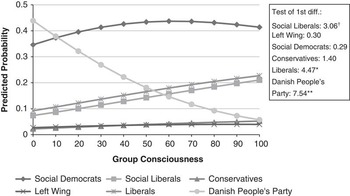
The precise content of the effect of group consciousness is depicted in Figure 2, which shows the predicted probabilities of voting for each party across varying levels of consciousness while the remaining variables are held constant. To provide a sense of the significance of the results, the figure also presents significance tests of the first derivative of the predicted probabilities as consciousness varies between its empirical minimum and maximum.
Education-based Group Consciousness and Voting: Predicted Probabilities of Voting for Each Party
Note: **: significant at the 0.01 level; *: significant at the 0.05 level; †: significant at the 0.10 level. The figure shows the predicted probabilities of voting for each party for lower routine non-manuals with a short-cycle tertiary education, who do not identify with either the high- or the low-education group and who have average age (46 years), income (280,000 kroner) and an average position on economic values (scale score=58). Test of 1st differences are χ 2 tests of the significance of the change in the predicted probabilities as group consciousness changes from its empirical minimum to maximum.

The first point to note is that, as expected, the Danish People's Party and the Social Liberals are favoured by voters at opposite ends of the evaluation scale: those with negative evaluations prefer the Danish People's Party, while the Social Liberals are more popular among those with positive evaluations of the high-education group. As can be seen, the effects are significant (albeit only at the 0.10 level for the Social Liberals due to the relatively low number of respondents preferring this party). This is entirely in accordance with H3.
Just as was the case with identity, however, support for other parties is also affected by the evaluations. This primarily applies to the Liberals, who get strongest support among voters with positive evaluations of the high-education group. This might reflect uncontrolled aspects of the economic side of the intergroup relationship, but might also stem from a preference among competition-minded liberal voters to side with ‘the winners’ or the dominant group – the high-education group in this case. While a precise examination of this lies outside the bounds of this article, the results for the Social Liberals and the Danish People's Party document that education – also through the voters’ consciousness – does play the expected role in relation to electoral behaviour, thereby establishing the connection between the consciousness aspect of the psychological cleavage element and the organizational element.
In Model IV, finally, authoritarian–libertarian values are introduced. As could be expected from previous research, this renders education insignificant. The variable is completely mediated by identity, consciousness and the values, in other words. The other variables exhibit no major changes in their significance. When examining in more detail the effect of authoritarian–libertarian values on voting, the familiar effect emerges (not shown), with large marginal effects for the Danish People's Party (+61 percentage points) and the Social Liberals (−51 percentage points) as the values vary from the libertarian to the authoritarian extreme; no other parties show such clear effects. As noted, these results are not new, but should be mentioned to complete the picture of the education cleavage, just as the fact that they come out as expected serves to reinforce confidence in the other results presented.
Conclusion
In summary, the first set of analyses showed how education is of primary importance in the formation of education-based identity and consciousness as well as authoritarian–libertarian values, thereby documenting a link between the first and second cleavage elements. In contrast, education does not play a significant role for economic values, just as income and occupation play only minor roles as regards the identity, consciousness and authoritarian–libertarian values in focus here. The implications are clear: the education cleavage is something qualitatively different from the economic dimension and the factors behind it such as class. This conclusion was further underscored in the second analytical section where the connections between the socio-structural and psychological elements, on the one hand, and the organizational, on the other, were established. As should be expected from the positions of the parties on the authoritarian–libertarian dimension, high-education respondents prefer the Social Liberals, while low-education respondents have stronger preferences for the Danish People's Party. Likewise, education-based identity and consciousness as well as authoritarian–libertarian values also influence electoral behaviour in accordance with the expectations, thereby for the first time providing evidence for the importance of education-based identity and group consciousness to voting. All in all, the analyses have thus demonstrated the existence of overlapping conflicts at all three levels and, hence, the existence of the individual-level aspect of an education cleavage.
As noted in the introduction to this article, Denmark should be seen as a critical case for the education cleavage hypothesis in the sense that a failure to identify the cleavage in Denmark would cast serious doubt on its existence in other countries. But the relevance of the results outside Denmark might be questioned. Two points stand out as possible answers. First, the results show that, contrary to some claims (such as Dalton Reference Dalton2002; Inglehart Reference Inglehart1997), social structure can continue to play an important role for electoral behaviour in Western countries. The existence of the education cleavage indicates that – to the extent that social class is of diminishing importance to electoral behaviour (this point is itself debated: see, for example, the contributions in Evans Reference Evans1999) – education may be providing an alternative form of structural anchoring to contemporary politics.
Second, it should be noted that the relationship between education and authoritarian–libertarian values has been found in many countries and with increasing strength, just as the value dimension plays an important role in the politics of a number of countries (see Bovens and Wille Reference Bovens and Wille2010; Kriesi et al. Reference Kriesi, Grande, Lachat, Dolezal, Bornschier and Frey2008). Further, the comprehensive comparative study of Austria, France, Switzerland, Germany, the UK and the Netherlands by Kriesi et al. (Reference Kriesi, Grande, Lachat, Dolezal, Bornschier and Frey2008) shows how the electoral importance of education has increased over the past few decades. While in the 1970s there was only a weak effect of education, ‘in more recent elections . . . we observe that the voters’ preferences are more clearly structured by their education level . . . We observe here the emergence of a similar potential for a new cleavage across different contexts’ (Kriesi et al. Reference Kriesi, Grande, Lachat, Dolezal, Bornschier and Frey2008: 250). A similar developmental pattern has, incidentally, been found for the Danish case (Stubager Reference Stubager2010).Footnote 14
Given this background, the results presented are useful in pointing to the roots of the conflict in the differing socialization experiences of the educational groups – including their identity development. These roots provide part of the explanation for the intensity of the conflict: they touch on aspects that are deeply ingrained in the individual, aspects that are part of what defines individuals in their own minds. Further, since the socialization mechanisms underlying the cleavage as well as the broader social developments defining the conflicting groups are fairly stable processes, it seems likely that the conflict over authoritarian–libertarian values will continue to have an impact on electoral politics across Western countries for a long time (see also Casal Bértoa Reference Casal Bértoa2013), particularly as the group of high-education voters seems to continue to grow (van Deth Reference van Deth1995), thereby making the group more visible to its own members as well as providing a sufficient basis for organizational development and the achievement of political power through elections (compare this with the mobilization of the working class in the late nineteenth and early twentieth centuries).
Although rooted in stable processes, the education cleavage may result in all but stable political conditions since the gradual establishment of the cleavage may give rise to challenges to the parties that have dominated in the previous cleavage structure (see, for example, Albertazzi and Mueller Reference Albertazzi and Mueller2013; Best Reference Best2013; Kitschelt Reference Kitschelt1994, Reference Kitschelt1995). By identifying the root of such challenges in a new cleavage, however, we stand a much better chance of understanding them.
The impact of the cleavage may vary over time, depending on the salience of authoritarian–libertarian issues. Hence, during economic crises such as the one ravaging large parts of the (Western) countries at the time of writing, the economic conflict may regain strength and diminish the importance of the education cleavage.Footnote 15 Similarly, the impact may vary depending on the mobilization efforts of the parties. Thus, the parties’ appeals to the educational groups either directly or through their values (see Mair Reference Mair2006: 372) are an integral part of the cleavage, and variation therein therefore influences its strength (see, for example, the corroborating comparative evidence in Ivarsflaten and Stubager Reference Ivarsflaten and Stubager2012).Footnote 16
The socialization basis of the conflict also provides a basis for speculation about the development of an education cleavage outside the Western countries that have been the focus here. Looking to Eastern Europe, for example, the identification of a similar configuration would seem to presuppose the widespread existence of similar socialization experiences. Following Weil (Reference Weil1985) and Brooks (Reference Brooks2013: 30), one might speculate on this point that the dominant authoritarian pre-1989 value structure in these countries has meant that significant numbers of highly educated individuals have not experienced the socialization to libertarian values characteristic of similar groups in Western countries. Consequently, the conflict between high- and low-educated groups is possibly not as pronounced in Eastern as in Western Europe. Until generational replacement has exchanged the pre-1989 cohorts with sufficient numbers of individuals socialized under the more libertarian post-1989 regimes, therefore, we should not expect to see the development of similar cleavages in the former communist countries. So far, at least, the analyses of Casal Bértoa (Reference Casal Bértoa2013) suggest that the electoral politics of East European countries does not (yet?) display the degree of stability that would be expected had it been based on cleavages such as the one on education that has been in focus in this article.
Appendix
The variables in the analysis are operationalized as follows:
Education is measured in five categories (with short descriptions and percentage respondents in parentheses): only primary or lower secondary (elementary schooling; 16.5), vocational upper secondary (for example, craftsmen; 36.4), short-cycle tertiary (further vocational education; 18.2, including respondents with a general upper secondary – high school – exam), medium-cycle tertiary (BA-level; 17.8) and long-cycle tertiary (MA-level and beyond; 11.1).
Authoritarian–libertarian values are measured by four Likert-scale items:
– ‘Immigration constitutes a serious threat to our national culture’;
– ‘Violent crimes should be punished far more strictly than they are today’;
– ‘It would be very sensible to let a strong man seize power in a situation of economic crisis’; and
– ‘Islam constitutes a serious threat to Danish culture’.Footnote 17
The response categories were ‘completely disagree’, ‘mostly disagree’, ‘neither/nor’, ‘mostly agree’, ‘completely agree’ and ‘don't know’. The answers have been summed to form a scale running from 0 to 100, with 100 as the most authoritarian position (Cronbach's α of 0.69, M = 58.7, SD = 24.0). In the construction of this and all other scales used, missing values (including ‘don't knows’) on the original variables have been replaced with the mean of the other respondents. This decision does not affect the results of the analyses.
Education-based identity is tapped by the following item:
‘People regularly say that there are two groups of people in Danish society: those with high education and those with low education. Would you say that you . . .
Feel highly attached to people with high education;
Feel somewhat attached to people with high education;
Don't feel attached to any of the groups;
Feel somewhat attached to people with low education;
Feel highly attached to people with low education;
Don't know’.
Respondents were distributed with 8.1 per cent in the first category, and 29.3, 42.9, 13.6, 2.2 and 4.0 in the following five.
Education-based consciousness is assessed by the following three Likert-scale questions (with the same response categories as above):
– ‘People with high education often want to lead society in a wrong direction’;
– ‘If people with high education decided more we would have many more problems in society’; and
– ‘People with high education don't know how society really works’.
The answers were summed to form a scale ranging from 0 to 100, with 100 being the most positive evaluation of the high-education group (α = 0.71, M = 64.0, SD = 22.4).
Occupation was measured by a version of the EGP-scheme (Erikson, Goldthorpe and Portocarero Reference Erikson, Goldthorpe and Portocarero1979) containing the following categories (with percentage respondents in parentheses): small proprietors/employers (6.3), professionals (15.9), routine non-manuals, higher (20.4), routine non-manuals, lower (13.6), skilled manual workers (7.5), unskilled manual workers (10.0), retirees (18.7) and students (7.7). The two last categories were included in order to retain all voter segments in the analysis; the results are, however, robust to their exclusion.
Economic values were measured by three Likert-scale items (response categories as above):
– ‘The government has too little control over private investments’;
– ‘Higher incomes ought to be taxed more than they are today’; and
– ‘In politics, one should strive to give everybody the same economic conditions no matter what their education and employment is’.
The items were summed to form a scale running from 0 to 100, with 0 as the most socialist position (α = 0.59, M = 57.3, SD = 24.2).
Acknowledgements
Previous versions of this article have been presented at the IPSA conference in Santiago, June 2009, the annual meeting of the Danish Political Science Association in Vejle, November 2009, and the ECPR Joint Sessions of Workshops in Münster, March 2010 as well as at the Department of Political Science, University of Gothenburg, the Department of Comparative Politics, University of Bergen and at Nuffield College, University of Oxford. The article has also benefited from the generous comments of Hanspeter Kriesi, Clem Brooks, Catherine Bolzendahl as well as of the participants in the Government and Opposition workshop in London, April 2012. I am very grateful for all of these contributions to improving the article; all errors and omissions remain my responsibility.