


1. INTRODUCTION
The energy loss of ions in plasmas is a topic of relevance to understand the beam-target interaction in the contexts of particle driven fusion (Deutsch, Reference Deutsch1984, Reference Deutsch1992; Roth et al., Reference Roth, Cowan, Key, Hatchett, Brown, Fountain, Johnson, Pennington, Snavely, Wilks, Yasuike, Ruhl, Pegoraro, Bulanov, Campbell, Perry and Powell2001). But actually if an ion beam interacts with target plasma, not all of the ions of the beam slow down in the same way, as the electronic energy loss is a stochastic process. It depends on many parameters, for example, the target electron density could not be uniform. Thus, it is convenient to define the energy loss straggling, which describes the statistical fluctuations of the energy loss of the ion (Bohr, Reference Bohr1948). To be consistent with the usual definition of the energy loss S = −ΔE/Δl, as the magnitude of the mean energy loss Δ E per unit of path length Δ l, we define the energy loss straggling Ω2 as the variance of the energy loss per unit of path length

where 〈…〉 denotes the mean value. Thus, the final electronic energy loss S p, suffered by a proton during the path length Δl can be obtained from a draw of a Gaussian distribution whose mean value is S and whose variance is Ω2/Δ l, then

As well, the mean energy loss, the energy loss straggling can be calculated through the dielectric formalism. We shall use the random phase approximation (RPA), which consists of considering the effect of the particle as a perturbation, so that the energy loss is proportional to the square of the particle charge. Then the theory of slowing-down is simplified to a treatment of the properties of the medium only, and a linear description of these properties may then be applied. The RPA is usually valid for high-velocity projectiles and when plasma electron collisions are not considered (Barnes & Luck, Reference Barnes and Luck1990).
In this work, we will study all kind of plasmas so electron collisions in the target gas have to be taken into account. RPA predicts an infinite lifetime for target electron collisions, whereas it is well-known that in real materials these collisions must be considered. Mermin (Reference Mermin1970) derived an expression for the dielectric function caring for the plasma electron collisions and also preserving the local particle density. Mermin dielectric function has been successfully applied to solids (dense degenerate electron gas) (Barriga-Carrasco & Garcia-Molina, Reference Barriga-Carrasco and Garcia-Molina2004), for classical plasmas (nondegenerate electron gas) (Selchow & Morawetz, Reference Selchow and Morawetz1999; Gerike, Reference Gerike2002; Barriga-Carrasco et al., Reference Barriga-Carrasco2006), and also for partially degenerate plasmas (Barriga-Carrasco, Reference Barriga-Carrasco2007). For solids, Mermin dielectric function was used obtaining the electron collision frequency from experiments (Ashley & Echenique, Reference Ashley and Echenique1987; Abril et al., Reference Abril, Garcia-Molina, Denton, Pérez-Pérez and Arista1998), but this frequency must be calculated a priori for plasmas. Many works have been devoted to calculating this frequency, (Lampe, Reference Lampe1968a, Reference Lampe1968b; Flowers & Itoh, Reference Flowers and Itoh1976; Urpin & Yakovlev, Reference Urpin and Yakovlev1980), others treat it as a free parameter (Ashley & Echenique, Reference Ashley and Echenique1985; Nersisyan & Das, Reference Nersisyan and Das2004), but in the present investigation this value is taken from a previous calculation (Barriga-Carrasco, Reference Barriga-Carrasco2008).
The aim of this work is to calculate proton energy loss straggling using a full conserving dielectric function (FCDF) for plasmas at any degeneracy. Toward this goal, the paper is divided into three main sections. In Section 1, the RPA and Mermin dielectric functions of plasmas at any degeneracy are calculated, but, as said before, Mermin function only obeys the density conservation law. Then in Section 2, a new dielectric function is established where the electron collision events are constrained by all the conservation laws: the full conserving dielectric function. Finally in Section 3, we use this latter dielectric function to calculate proton energy loss straggling in plasmas at any degeneracy.
2. RPA AND MERMIN DIELECTRIC FUNCTIONS AT ANY DEGENERACY
The RPA dielectric function is developed in terms of the wave number k and of the frequency ω provided by a consistent quantum mechanical analysis. We use atomic units (a.u.), e = ℏ = m e = 1, to simplify formulas.
The RPA analysis yields to the expression (Lindhard, Reference Lindhard1954)

where  . The temperature dependence is included through the Fermi-Dirac function

where β = 1/k BT, and μ is the chemical potential of the plasma with electron density n e and temperature T. In this part of the analysis, we assume the absence of collisions so that the damping constant tends to zero, υ → 0.
Analytic RPA dielectric function (DF) for plasmas at any degeneracy can be obtained directly from Eq. (1) (Gouedard & Deutsch, Reference Gouedard and Deutsch1978; Arista & Brandt, Reference Arista and Brandt1984)

where g(x) corresponds to

u = ω/kv F and z = k/2k F are the common dimensionless variables (Lindhard, Reference Lindhard1954). D = E Fβ is the degeneracy parameter and  is the Fermi velocity in a.u.
As mentioned in the Introduction, the RPA is not satisfactory for partially coupled plasmas and the target electron interactions have to be taken into account. The first corrective effect taken to rectify this situation was carried out by Mermin (Reference Mermin1970) who was able to derive a DF, which conserves electron number during collisions

where ɛRPA (k, ω) is the RPA dielectric function from Eq. (3). Electron collisions are considered through their collision frequency, υ. It is easy to see that when υ → 0, the Mermin function reproduces the RPA one.
3. FULL CONSERVING DIELECTRIC FUNCTION
Mermin dielectric function violates the two remaining conservation laws, momentum and energy, thus we need to introduce a new model: the one-component system of electrons whereby electrons are only scattered by other electrons. Consequently the dynamics of such scattering events are constrained by all the conservation laws. The one-component model has the additional virtue of allowing us to calculate dynamical local field corrections of the dielectric function arising entirely from electron-electron correlation effects (Morawetz & Fuhrmann, Reference Morawetz and Fuhrmann2000). Here, the expression for the FCDF is obtained by an extension of the relaxation-time approximation (Atwal & Ashcroft, Reference Atwal and Ashcroft2002)

where V C (k) = 4π/k 2 is the Fourier -transformed Coulomb potential and

and

are the conserving damping corrections. B n is the nth momentum of the integrand of the static Lindhard polarizability function,

and related dynamic functions

and

From the general form of Eq. (5) we can obtain the other models revised in this work. The RPA dielectric function, Eq. (1), corresponds to the choices E = 0, F = 0, and υ → 0; when υ is not zero we get the damped RPA one. The Mermin dielectric function, Eq. (4), is retrieved for E = 0, nonzero υ and
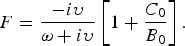
Finally the FCDF is given by Eq. (5) with non zero υ.
Then we can calculate the real and imaginary parts of these dielectric functions for plasma at any degeneracy. For example, we choose T = 10 eV and n e = 1023 cm−3, i.e., with degeneracy parameter D = 0.785 (see Fig. 1). Solid lines represent RPA dielectric function from Eq. (3). To include electron-electron collisions in the calculations, we need the exact relaxation frequency, υ = 0.252ωp, where  is the plasma frequency. This value is obtained from Barriga-Carrasco (Reference Barriga-Carrasco2008) regarding only electron-electron collisions. Then, we can include this frequency in the Mermin DF. Now, the values are damped but we recover the same results as in the RPA case for the static limit, ω → 0. But we know that the Mermin DF only conserves the number density violating the two remaining conservation laws. If we consider three conservation laws, through the FCDF, we expect an important variation of all values approaching the RPA values. It is not surprising that as we include more conservation laws the behavior of the DFs resembles more closely to the RPA, a model where all the conservation laws are enforced.
(Color online) Real and imaginary parts of different DF as a function of ω/E F for a partially degenerate plasma, T = 10 eV and n e = 1023 cm−3 (D = 0.785). The wave vector is k/k F = 0.2 and the finite relaxation frequency is υ = 0.252ωp.

4. ENERGY LOSS STRAGGLING
In the dielectric formalism, the energy loss straggling rate is (Arista & Brandt, Reference Arista and Brandt1981)

where  is the energy transfer

in terms of the incident velocity  and the mass M of the projectile.
 is the momentum transfer, which applies to the energy loss of a ion of charge Z with initial momentum
 and final momentum
 .
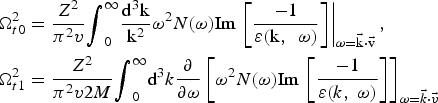
 is the Planck function. For incident ion with M≫m e recoil effects are small and we can expand Eq. (6) in terms of Δω = k 2/2M to obtain

where the two first terms are
.
The integrals take into account the contribution from both negative frequencies (ω < 0, emission processes) and positive frequencies (ω > 0, absorption processes), but here it is more instructive to transform them into integrals over positive frequencies only. We can simplify Ωt02 term, making use of the relations N(−ω) = −[N(ω) + 1] and  , then this leads to

where the temperature dependence is contained in the dielectric function  and in the Planck function N(ω). Finally, the energy loss straggling per unit of path length is

where ɛ (k, ω) is any of the dielectric functions stated before.
Figures 2 to 4 represent proton energy loss straggling for different plasma degeneracies and different dielectric functions, normalized to the Bohr straggling  , as a function of its energy. The first case analyzed is a plasma with the same temperature and electronic density values as in Figure 1, these features correspond to a partially degenerate plasma, D = 0.785 (see Fig. 2). Solid line corresponds to the calculation with the RPA dielectric function, i.e., not considering target electron-electron collisions, Eq. (3). Dashed line is the result considering the electron collisions through the Mermin dielectric function, Eq. (4) and dotted line refers to the result considering the electron collisions through the full conserving dielectric function, Eq. (5). This plasma has a large enough collision frequency, υ = 0.252ωp, to discriminate between the various dielectric functions. When target electron collisions are taken into account through Mermin dielectric function, the straggling values decrease a great deal. Then if we include momentum and energy conservation laws in the dielectric function, FCDF, the result becomes similar, but a bit larger, than in the RPA model, where plasma electron collisions are not considered.
(Color online) Proton energy loss straggling, as a function of its energy, normalized to the Bohr straggling ΩB2 = 4πn eZ 2. The plasma target is the same as in Figure 1. Solid line corresponds to the result with RPA DF, dashed line is the one with Mermin DF and dotted line is the one with FCDF.

(Color online) The same as Figure 2 but for a degenerate plasma, T = 0.056 eV and n e = 6 × 1022 cm−3 (D = 99.727). The relaxation frequency is υ = 0.039 ωp.

(Color online) The same as Figure 2 but for a nondegenerate plasma, T = 1 eV and n e = 2 × 101 cm−3 (D = 5.8 × 10⁻³). The relaxation frequency is υ = 2 × 10⁻³ ωp.

To check the reliability of our model at any degeneracy, we can repeat the calculation of the straggling of the former dielectric functions for other plasma parameters. First, we examine a degenerate plasma with T = 0.056 eV and n e = 6 × 1023 cm−3, i.e., with degeneracy parameter D = 99.727 (see Fig. 3). As we see all results look very similar, this is due to a rather small relaxation frequency, υ = 0.039ωp. Then, there are no large discrepancies among dielectric functions. But the behavior is the same as in the partially degenerate case; when we care for collisions with the Mermin dielectric function, the stopping values are slightly damped. On the other hand, when momentum and energy conservation laws are included in the full conserving dielectric function these values feature the RPA ones as in the partially degenerate case.
Finally, we study the straggling using the same dielectric functions as before but this time for nondegenerate plasma (see Fig. 4). The plasma parameters are T = 1 eV and n e=2 × 1018 cm−3, with degeneracy parameter D = 5.8 × 10⁻³. In this case, the relaxation frequency is even smaller than for the degenerate case, υ = 2·10−3ωp, so we expect minimal discrepancies among the calculations with different dielectric functions. Using the Mermin dielectric function results in a remote relaxation of the stopping values while using the FCDF results in similar, or a little bit higher, values than in the RPA case.
5. CONCLUSIONS
In conclusion, first, we have been able to calculate a dielectric function that includes the three conservation laws (density, momentum, and energy) when we take into account plasma electron-electron collisions for plasmas at any degeneracy. This full conserving dielectric function reproduces the former and very well known dielectric functions mentioned in the bibliography, the RPA and Mermin ones, which confirms our outcome.
Then we applied this full conserving dielectric function to the determination of the proton energy loss straggling. We must remark that it is the first time that a full dielectric function is used to estimate the proton energy loss straggling in plasmas at any degeneracy. This estimation has been compared with the same calculation derived from other dielectric functions. Discrepancies in the straggling calculation are not very relevant if the plasma collision frequency is not high enough. We have seen that only in the partially degenerate plasma, D = 0.785, the collision frequency is sufficiently large to produce important variations in the straggling calculation. These discrepancies for degenerate and nondegenerate plasmas follow the same pattern as for the partially degenerate case. Then we can assert that pertaining variations do not depend on the plasma degeneracy. They essentially rely on the value of the plasma collision frequency.
Differences in applying various dielectric functions are around 5% between FCDF values and the Mermin ones, and around 2% between the FCDF ones and RPA ones at maximum straggling value for plasmas with high enough collision frequency. It is not surprising that as we include more conservation laws the behavior of the dielectric functions yields back the RPA, a model with every conservation laws enforced. The meaning of the fact that FCDF results are similar to the RPA ones, a dielectric function which does not consider electron-electron collisions, is that latter collisions are not important for energy loss straggling calculations. Whether from previous investigations it was inferred the opposite, this was because electron collisions were usually taken into account through a Mermin dielectric function which does not consider momentum and energy conservation.
ACKNOWLEDGMENTS
This work was financed by the Spanish Ministerio de Ciencia e Innovación (under contract No. ENE2009-09276) and the Consejería de Educación, Ciencia y Cultura de la Junta de Comunidades de Castilla-La Mancha (under contract No. PAI08-0182-3162).



