1. INTRODUCTION
Designers once conceptualized and collaborated exclusively using tangible means such as paper and pen. However, the recent penetration of digital media into mainstream culture has introduced a new set of nontangible tools to the product development process; advanced imaging and modeling tools let designers virtually create and modify their designs; digital cameras are now ubiquitous, allowing designers to easily take snapshots to document their process; tablet PCs and digital pens directly translate freehand notes and drawings into digital format.
Despite these advances in technology, designers' tangible interactions with paper and pen have not disappeared. Much like the myth of a paperless office (Sellen & Harper, Reference Sellen and Harper2002), the paperless design studio is also a myth. Although computational technology has taken over more formal aspects of the design process, such as in the case of computer-aided design (CAD) and word processing, it has not been able to fully dominate informal design processes. Instead, many designers resort to mixed-use practices of both tangible and digital media (Henderson, Reference Henderson1999). A prime example of this phenomenon is the evolving practice of keeping a design journal.
Most designers keep a design journal in which they externalize their ideas, jot down their thoughts, sketch design concepts, and record other relevant data. The design journal is a focal point for the designer's individual thinking, both visual and textual, and plays an important role in helping both the individual and the team reach successful design solutions.
In this paper we explore issues of tangibility in design journals, in three parts. In the first section we review previous work exploring medium in design journals, highlighting common motivations for enhancing design journals with digital media. We also review current digital technology that designers are using to support their informal design practice. In the second section we examine the results of quantitative and qualitative analyses of design journals from students in a multidisciplinary graduate-level product design course, comparing journaling media with disciplinary background and overall sketching behavior. In the final section we take a closer look at a selection of unusual “boundary cases” from the student design journals, and explore how today's up and coming designers are redefining the traditional, tangible “textbook definition” of a design journal.
2. RELATED WORK
2.1. What is an engineering design journal?
Generally, a design journal is a place where designers keep their reflections, observations, and ideas as relevant to a project. Various textbooks refer to the “design journal” (Hyman, Reference Hyman2003), “design notebook” (Ullman, Reference Ullman1997), “engineer's logbook” (McAlpine et al., Reference McAlpine, Hicks, Huet and Culley2006), or an “engineering notebook” (Bystrom & Eisenstein, Reference Bystrom and Eisenstein2005). Some of these terms assume or overtly state that the design journal should take the form of a physical, tangible notebook. Hyman (Reference Hyman2003) defines a design journal as “a permanently bound (no three-ring or spiral) notebook or “diary” which contains dated entries of all your notes, sketches, doodles, and any other record of your thoughts and activities related to your design projects.” McAlpine et al. (Reference McAlpine, Hicks, Huet and Culley2006) describes engineer's logbooks as “typically paper-based notebooks used by individuals to record personal, informal notes and information relating to a particular task or activity.” The rest of this section summarizes both descriptive and prescriptive prior work associated with design journals.
2.2. Motivations for keeping design journals
2.2.1. Documentation for intellectual property
Hyman (Reference Hyman2003) notes that some companies require design journals to be signed and dated by a manager, or in some cases officially notarized. In applying for patents or defending intellectual property in court, design journals are often collected as official evidence of the “birth and development of an idea” (Hyman, Reference Hyman2003). This legal precedent is what often prompts a company-wide policy mandating that the entire organization adopt formal design journal practices.
2.2.2. Mobility
Bellotti and Bly (Reference Bellotti and Bly1996) found that product designers are not, in fact, bound to their CAD stations and instead regularly engage in mobile collaboration with their peers. Hyman notes that “the journal serves as a basis for communicating with other engineers, your supervisor, and your client” (2003), all of which are activities that occur away from the designer's desk. User-centered designers also engage directly with their users through contextual inquiry and fieldwork resembling that of an anthropologist. In some ways, the design journal needs to also resemble an anthropologist's field notes, allowing for mobile data capture in all environments.
2.2.3. Centralized personal information storage
McAlpine et al. (Reference McAlpine, Hicks, Huet and Culley2006) notes that the classes of content in engineer's logbooks include textual information (such as calculations, written notes, or contact details), graphical information (such as sketches, charts, or CAD), and text and graphical information (such as annotated drawings and memoranda). When describing the design journal's content, Bystrom and Eisenstein (Reference Bystrom and Eisenstein2005) encourage including “a list of all resources used, all Web pages visited, all patents or books read, and all people consulted,” and in addition, mention documenting phone numbers and URLs. The design journal must therefore accommodate the designer inputting a wide range of information, everything from freehand sketches and phone numbers to URLs, so that it can be recalled at a later point in time.
2.2.4. Support for reflection
Reflection is significant in any professional practice, although it is particularly important in design. Schön (Reference Schön1983) uses designers as an example in his discussion of the importance of the “reflective practitioner,” and as reflection goes hand in hand with informal thought, design journals should support reflection as well. Lin et al. (Reference Lin, Hmelo, Kinzer and Sewles1999) lists features for technology that support reflection, including
1. process displays: displaying problem solving and thinking processes, and
2. reflective social discourse: creating community-based discourse to provide multiple perspectives and feedback.
Therefore, to support reflection, it is important to allow the designer to transparently view their own problem-solving and thinking processes, as well as allow for “reflective social discourse” by enabling their collaborators to provide feedback and perspectives on their thinking. Many technologies that designers use today have these features, despite not explicitly being designed to support these qualities.
Rooted in this basic definition and traditional practice, design researchers have experimented with innovative interpretations of design journals, and design practitioners have adopted a wide variety of technologies to informally document their design process. In the following sections we review this prior work and their implications for future directions.
3. DESIGN JOURNALS IN RESEARCH
Both design and human–computer interaction researchers have investigated new tools that computationally augment design journals. This research can be clustered into three main motivations for “going digital”: archiving and information management, sharing and collaboration, and engaging multimedia.
3.1. Archiving and information management
One of the main appeals of having an electronic design journal was the idea of having it digitally archived. Among the first research projects on innovative design journals was the Electronic Design Notebook (Lakin et al., Reference Lakin, Wambaugh, Leifer, Cannon and Sivard1989). The Electronic Cocktail Napkin (Gross & Do, Reference Gross and Do1996) provided an initial sketch-management platform for future extensions, including the Digital Design Sketchbook (Gross et al., Reference Gross, Do, McCall, Citrin, Hamill, Warmack and Kuczun1998), a system that allows designers to remotely access a centralized archive of sketches, annotate archived drawings, and contribute additional content to the archive all from a remote, on-site location. Human–computer interaction researchers have since included the integration of both tangible, paper-based notes and digital artifacts into a single, unified archive through the use of digital pens (Yeh et al., Reference Yeh, Liao, Klemmer, Guimbretière, Lee, Kakaradov, Stamberger and Paepcke2006).
3.2. Sharing and collaboration
Because digital media are easily copied and sent over large distances, many research projects bring digital media to design journals to facilitate sharing or distributed collaboration. The Personal Electronic Notebook With Sharing (Hong et al., Reference Hong, Toye and Leifer1995) was developed to facilitate sharing design knowledge over the Internet with remote collaborators.
Human–computer interaction researchers have created several tangible user interface tools for informal design tasks (Klemmer et al., Reference Klemmer, Newman, Farrell, Bilezikjian and Landay2001), as well as to support synchronous collaborative note taking (Kam et al., Reference Kam, Wang, Iles, Tse, Chiu, Glaser, Tarshish and Canny2005). Recently, iDeas (Lee, Reference Lee2006) has approached the development of design tools from a “design ecology” perspective, including the iDeas notebook. Based on Butterfly Net (Yeh et al., Reference Yeh, Liao, Klemmer, Guimbretière, Lee, Kakaradov, Stamberger and Paepcke2006), the iDeas notebooks for a design team are digitally linked to allow collaborators to share pages from their design journals with each other.
3.3. Engaging with multimedia
While conducting user research, designers will often record conversations or interviews with users to reference later during group meetings. The Audio Notebook (Stifelman et al., Reference Stifelman, Arons and Schmandt2001) and Dynomite (Wilcox et al., Reference Wilcox, Schilit and Sawhney1997) were developed to enable users to both capture audio data and navigate through it by interacting with their written notes from the interview. These research projects extend the abilities of paper to capture not only written or graphic information but also multimedia information that was otherwise only exclusively available in digital media.
These three themes of archiving and information management, sharing and collaboration, and engaging with multimedia are all driving factors behind the development of digital design tools that support informal documentation. Although many of these tools developed in research were never fully adopted into mainstream design practice, these themes motivating their development did drive designers to build their own unique design journal systems from various existing and widely available technologies. In the next section, we will examine a selection of available technology being used to support design, and examine both their strengths and their failings in satisfying the requirements of a design journal.
4. DESIGN JOURNALS IN PRACTICE: EXISTING TECHNOLOGY AND GROWING TRENDS
Unlike the early 1990s, when design researchers began to explore the experimental idea of an “electronic design notebook,” designers today use cell phones, digital cameras, computers, the Internet, and other sophisticated technology in their everyday lives, often modified to support their personal design practices. The technological infrastructure has changed drastically in the past few decades, and so have designers' practices and expectations relative to these technological changes. It is therefore important to understand designers' existing practices in applying new forms of technology to informal design so that new tools can seamlessly fit in with existing practices. The features we focus on below include mobility, range of input, types of interactions, and facility for reflection.
The wide range of digital technology now available to designers includes both locally hosted “offline” systems and remote-hosted “online” systems. We define offline digital systems as those that do not require an Internet connection to be used or viewed, although these systems often collect data and information from Internet-based resources. One example of this is a file folder that is locally hosted on the designer's personal computer or laptop, containing the full range of heterogeneous design content: word-processing documents for verbal thoughts, sketches from a tablet PC's sketching program, images, video, or audio from digital cameras or online sources, and digital artifacts such as CAD models, HTML, or other programming files. Designers could also opt for an independent program that helps centralize and manage all of these various data types. One example of this is Curio, a software package that promotes mind mapping, brainstorming, project management, and visual thinking.
Online digital tools allow the designer to have access to their informal information regardless of what computer they may be using to access it. It also facilitates more immediate information sharing with their collaborators. Examples of online tools are the following:
1. Wikis and Weblogs, collaborative content generation platforms that designers use to capture reflections and, if made public to a wider audience, to share content relevant to the design process (Chen et al., Reference Chen, Cannon, Gabrio and Leifer2005);
2. E-mail, a primary mode of communication that consequently provides a means for design teams to store and share design information; and
3. Online storage and sharing tools, such as Flickr, Picasa, or YouTube.
There are also several digital hardware technologies that combine tangible and digital interactions. Some designers use tablet PCs, similar to those used with Livenotes (Kam et al., Reference Kam, Wang, Iles, Tse, Chiu, Glaser, Tarshish and Canny2005), to sketch freehand using a painting or drawing program. Digital pens, such as LiveScribe and others that use Anoto technology, use the more natural interaction of pen and paper, but also offer a few of the amenities of digital information.
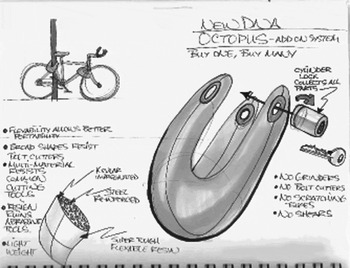
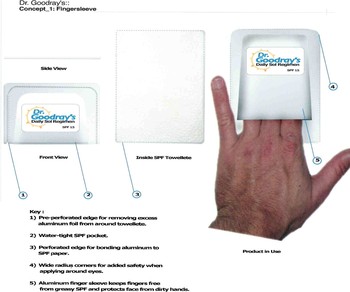
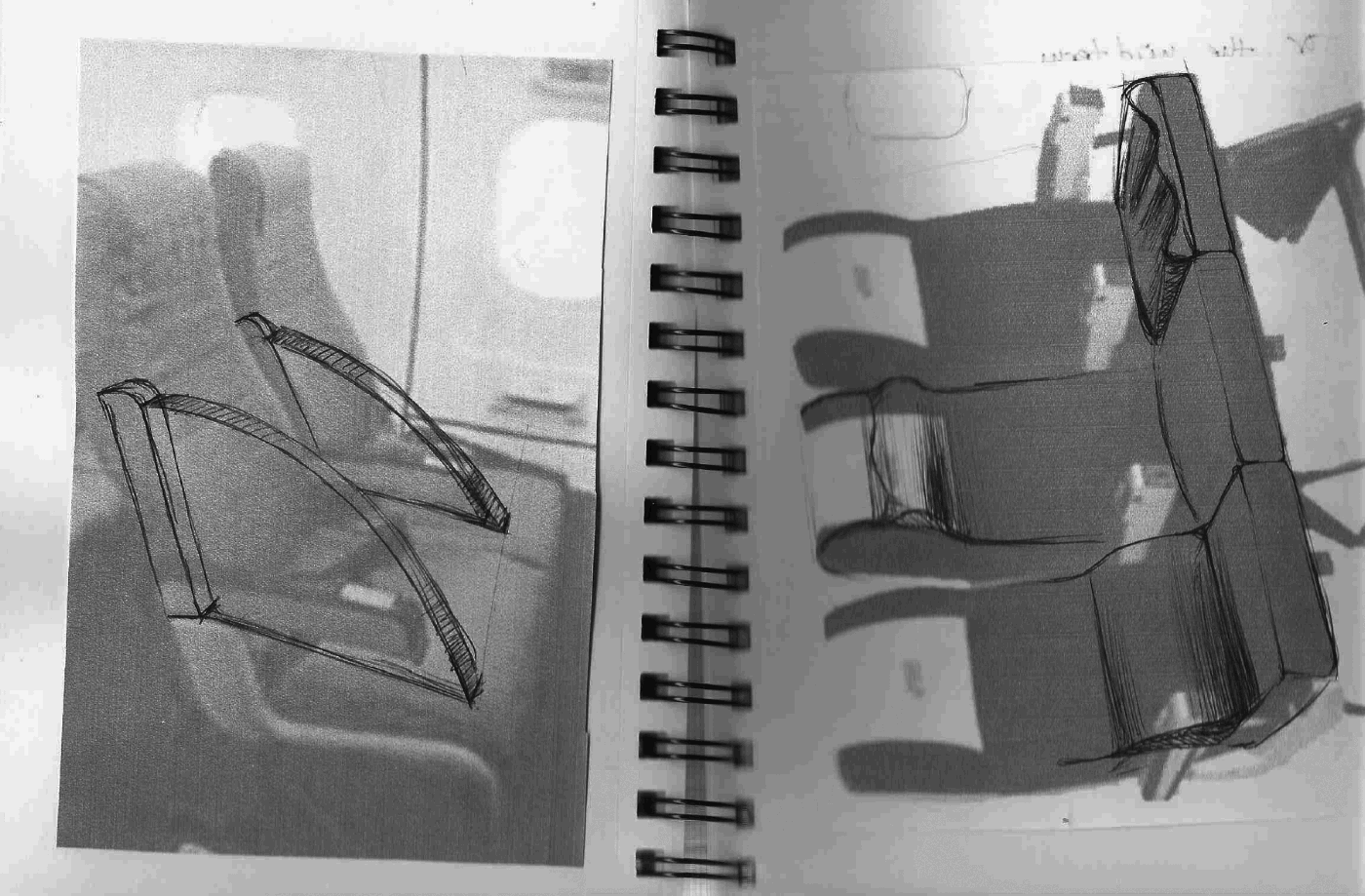
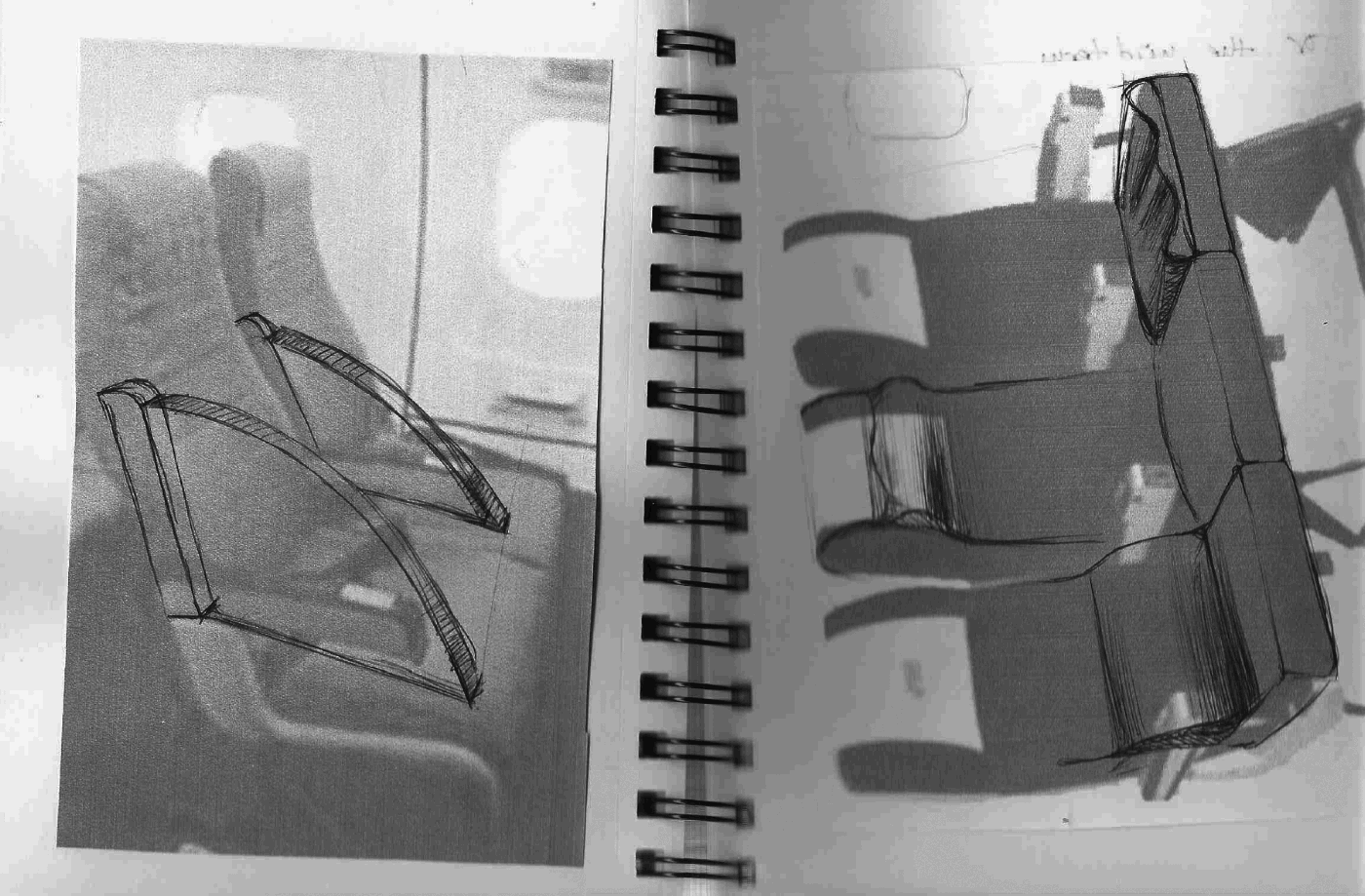
For our evaluation, “tangible” or “traditional” journals and content refer to pen and paper design journals, often as a bound sketchbook or a file folder of loose-leaf papers with freehand notes and sketches (e.g., Fig. 1). “Digital” or “electronic” refers to design journals that require a computer or microprocessor (e.g., Fig. 2). “Hybrid” refers to journals that have both tangible and digital content (e.g., Fig. 3). Our motivation is to understand the designer's individual behavior as it relates to design journals, recognizing trends over time, and to identify prescriptive patterns and limitations with different media.
An example of a page from a tangible design journal. [A color version of this figure can be viewed online at journals.cambridge.org/aie]

An example of a page from a digital design journal. [A color version of this figure can be viewed online at journals.cambridge.org/aie]

An example of a page from a hybrid design journal. Note the simultaneous use of freehand sketches over top a digital photograph. [A color version of this figure can be viewed online at journals.cambridge.org/aie]
Tangible notebooks have a striking advantage over many forms of digital media. For instance, tangible notebooks have greater visibility under direct sunlight, low power consumption, can accommodate various input methods, and support reflection. However, with distinct weaknesses in allowing for multimedia input and facilitating collaborative discussion, it is no surprise that designers would turn to digital alternatives that allow for richer input and collaborative reflection. Even so, these digital tools cannot serve as a realistic replacement because of their failings in the significant categories of mobility and transparency of process.
By looking at related research and commercially available technology, it is obvious that there are some affordances that only digital tools can provide. However, many designers may not be willing to sacrifice the benefits of tangibility just to gain the few benefits of digital tools. What still remains unexamined is whether or not these new tools are changing traditional, tangible design practice. In the next section, we will shift into a more quantitative analysis of medium and design journal use, and see whether there are any indications of media type making a difference in a designer's sketching behavior.
5. DESCRIPTIVE STUDY
5.1. Test bed
The data used for this descriptive study comes from UC Berkeley's ME 290P, a graduate-level, multidisciplinary product design course titled “Managing the New Product Development Process: Design Theory and Methods.” This course employs a project-based learning method, where graduate-level engineering and business students from UC Berkeley form teams with industrial design students from the California College of the Arts to design a marketable product within a 15-week semester. Their final project can be a physical product, software, or a service. The faculty assigns teams based on each student's indicated interest in the project, with a limit of four to six students per team and at least one representative from each disciplinary field. Teams also receive coaching from faculty and industry consultants. The students were college seniors and graduate students with industrial experience.
The goal of this course is for students to learn first hand about the principles and techniques of product development through their own design project. The major assignment deadlines divide the semester into three design stages: preliminary investigation and user needs analyses, concept generation and development, and prototyping and testing. The final group deliverables are a working prototype, a presentation, and a poster or demo for a tradeshow booth. Students are expected to keep a design journal during the process, with the following prompt for the assignment:
This journal should include your individual thinking (both imagery and words) pertaining to your project. Think of it as a diary of sorts. You may sketch pictures, paste in pictures or business cards, write words, create mind maps, or choose any other approach that works for you to capture your ideas, thoughts, and reflections about your product and your project. The journal should be used both to capture ideas about the product itself as you move through the process, but also to document thoughts, reflections and insights on the process of product development, group dynamics, project process, etc. … You can tailor your journal to your own working style and your unique role within your project team.
It is important to note that the students are given complete freedom to dictate the journal's form and content, and that they are aware that they must submit the journal at the end of the process to be graded by their instructors.
This research focuses on the individual design journals, in two main areas: journal medium and visual representations of their ideas. The journal medium pertains to the form of the journal (tangible vs. digital) and the overall form of the content (freehand/tangible vs. digital). Visual representations are defined as freehand sketches, CAD drawings, or photographs. These data allow us to evaluate each designer's overall sketching behavior.
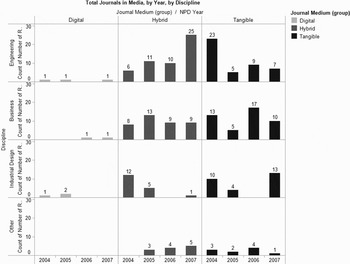
A summary of the journal types in our test bed is included in Figure 4. We analyzed journal medium data from four semesters of this design course from 2004 to 2007. This journal analysis included a total of 255 journals for 63 design teams. We performed an in-depth sketch analysis of the journals from Fall 2004 and Fall 2006. A total of 3450 sketches were analyzed based on the protocol described in Section 5.2.1. Note that design journals from industrial designers were only available for the 2004 analysis.
The number of journals of each medium for each discipline, NPD 2004–2007. (Note: design journals were not available from the industrial designers in 2006.)

5.2. Sketch and journal medium analysis protocol
5.2.1. Sketch protocol
Much research has been done to examine how designers record their ideas and thoughts throughout the design process. Ullman et al. (Reference Ullman, Wood and Craig1990) emphasizes the importance of drawing in design. McAlpine et al. (Reference McAlpine, Hicks, Huet and Culley2006) takes a close look at engineers and how they ideate and create in their logbooks. Yang and Cham (Reference Yang and Cham2007) use design journals as a data source when analyzing sketching behavior in design teams and found correlations with team performance.
This research performs a retroactive analysis of the design journals and sketches generated by the teams. The protocol used to characterize the design sketches is an extension of that used by Song and Agogino (Reference Song and Agogino2004). In particular, this research focused on the level of detail of each drawing. This metric, adapted from the “level of complexity” measure by McGown et al. (Reference McGown, Green and Rodgers1998) and the “idea categorization” in Shah et al. (Reference Shah, Vargas-Hernandez and Smith2003), measures the level of conceptual detail of a sketch, with level 1 representing the simplest sketches and level 5 representing the most detailed.
During our analysis, we specified that as the level of detail increases, we can refer to the sketch to answer the following questions:
level 1: Is there a sketch present?
level 2: What does the concept do?
level 3: What does the concept look like? What is the concept's form?
level 4: How does the concept work?
level 5: How will the concept be built?
5.2.2. Journal medium protocol
Metrics were also added to the sketching protocol to capture journal and content media. A journal can be of tangible medium (paper based) or of digital medium (computer based). The content can be tangible (freehand sketched), digital (computer drawn), or both (i.e., freehand on a computer sketch).
Many of these permutations exist in theory but are rare in practice. For example, a “digital–tangible” journal would require the designer to keep a digital journal with exclusively tangible content (e.g., scanned images of tangible content). It is unlikely that a student would make the effort to scan in pages of tangible content without adding any digital annotations or content, although it is not an impossible scenario. Therefore, for our analysis, we combined any mixed-media journal into a hybrid category. Figures 1 to 3 show examples of content in tangible, digital, and hybrid journals, respectively.
The sketch protocol factors and journal metrics are compared across time and over the quantity of sketches to capture individual sketching behavior.
6. DATA ANALYSIS AND RESULTS
6.1. 2004–2007 Journal medium analysis
From the journal data, we were able to determine if there were any patterns in the choices individual designers made for their design journal's form across 4 years of the course, and whether there were any patterns between designers' journal medium, disciplinary background, and Meyers–Briggs Personality Type Indication.
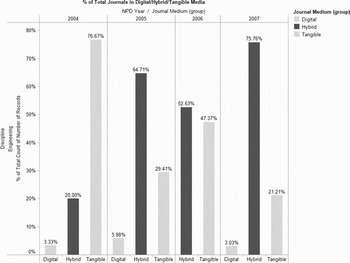
Over the 4-year period of this study, there is an overall trend for an increasing percentage of hybrid design journals over time (Fig. 4), particularly with the engineering students; there was no noticeable trend for the other students. Figure 5 shows how the percentage of hybrid journal use among engineering students has increased dramatically between 2004 and 2007. Conversely, tangible journal use experienced a nearly equal decrease among engineering students in the same period. Although the trends are less drastic for the other disciplines such as industrial design or business, the data still show that hybrid design journals have been consistently present for the past 4 years and are not a one-time fad. One hypothesis for this effect is that engineers, as practitioners of a discipline that generates new technology, are more eager to adopt hybrid design journal practices that integrate digital and print media into their design process.
The percentage of total journals of each medium for each engineering student, NPD 2004–2007.

When comparing students' Meyers–Briggs Personality Type Indicator (extravert/introvert, sensing/intuitive, thinking/feeling, judging/perceiving) to the journal medium, we found that each side of the indicator had a consistent pattern of medium adoption. We found no statistically significant evidence that medium and personality type are correlated.
6.2. 2004 and 2006 Sketch analysis with medium
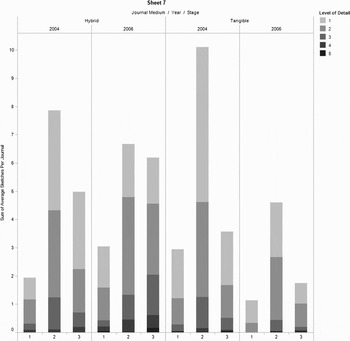
In this section we provide a more in-depth analysis of the 2004 and 2006 data sets. Figure 6 illustrates the average number of sketches produced by designers with tangible and hybrid journals at each stage of the design process: preliminary investigation and user needs analyses, concept generation, and development; and prototyping and testing. In 2004 the average number of sketches per journal is generally lower in hybrid journals than for tangible journals; this trend reverses in 2006, where hybrid journals had an increased average number of sketches per journal. The overall pattern of total number of sketches over each design stage for each medium is consistent with the results of Song and Agogino (Reference Song and Agogino2004); the second design stage contains the maximum number of sketches, followed by the third design stage.
The percentage of total sketches of each medium for each design stage, 2004 and 2006. Significant differences between the averages (p < 0.05) were found in 2004 at design stage 1 and level of detail 4, design stage 2 and level of detail 5, and design stage 3 and level of detail 5. Significant results were also found in 2006 at design stage 1 and level of detail 1, 3, and 5; design stage 2 and level of detail 5; and design stage 3 and level of detail 4 and level of detail 5.

Figure 6 also highlights the level of detail per sketch at each design stage, for tangible and hybrid journals in 2004 and 2006. From this we can see that the hybrid journals have a higher distribution across all levels of detail than compared with the tangible journals, whose level of detail profile is dominated by low-detail level 1 sketches.
More importantly, hybrid journals reflect an increase in higher levels of detail in later design stages (2 and 3), which Yang and Cham (Reference Yang and Cham2007) have shown to correlate with increased team performance. This trend appears to be increasing to a much larger percentage in 2006 compared to 2004. Our statistical analyses found a significant increase in hybrid versus tangible means (p < 0.05) in both 2004 and 2006 for levels 4 or 5. Unfortunately, the journals for the industrial design students were not available in 2006. As the industrial design students had a higher percentage of tangible journals and seldom worked at the highest level of detail, we expect that these trends would have been even more pronounced if this data were available.
6.3. Discussion of journal and sketch analysis
From our descriptive analyses of designers' journals and their sketching behavior, we present the following overall observations:
Hybrid design journals are the current trend, but tangibility does not disappear: over the course of 4 years, the number of hybrid design journals has steadily increased, while tangible journals have decreased. This trend is particularly striking in the engineering discipline, where hybrid journal use increased from 20% in 2004 to 75% in 2007. However, the majority of the hybrid journals are tangible notebooks with both tangible and digital content.
Design journal use varies over time. Although designers are using their journals to support all steps of the design process, these journals are not being used in the same manner at each stage. Song and Agogino (Reference Song and Agogino2004) demonstrate that factors including generation and level of detail vary from design stage to design stage. In our study, we both confirmed the increase of sketches in the second design stage, and extended this concept of design journal user variation to both tangible and hybrid design journals.
Hybrid journals generally contain more detail. This indicates that hybrid users are including more of their detailed thinking in their journals in all stages of the design process. The digital component of the hybrid approach seems to enable achievement of the highest level of detail in the final design stage.
Hybrid journal users generally embed more context into their documented design thinking. Drawings with a higher level of detail are capturing a more complete representation of the designers' thinking and concept development on paper. This additional documented context allows the design journal to be used by a wider audience, and for design archiving and decision rationale for future reference.
By looking at a few unusual examples of design journals, we can get a better sense of the range of journals in our sample and better understand the effect medium choice had in how designers represent their informal thinking and perhaps develop a few hypotheses as to why designers chose to use a hybrid journal medium.
7. CASE STUDIES
For the last section of our exploration of design journals, we dive into three particularly unusual case studies from students in the New Product Development class. Although the majority of the design journals fell into the tangible or hybrid categories, these case studies stood out as unusual or insightful, challenging the assumptions of how designers can and should interact with their design journals.
7.1. Multimodal and redundant record keeping
One student turned in a sparse hybrid design journal with few entries and sketches. However, the owner did make the following note in their journal:
• I didn't use my journal as much as some of my other team members. I have a few other habits for organizing my thoughts that I wasn't willing to change just for this project: e-mail/wiki: this is where most of my communication takes place.
• my own journal: where I track To-Dos and notes for ALL of my commitments.
• in group meetings: [another team member] often took notes, so I always felt like she could refresh our memories.
Although the design journal itself may have not contained extensive entries or sketches, this quotation does lead to many interesting insights. Although our data are being collected from a graduate-level design course that simulates professional design work, there are still some salient constraints to this model, most notably the fact that design journals are explicitly collected and evaluated at the end of the semester. Although submitting journals to intellectual property lawyers is not uncommon for designers in industry, the idea of external evaluation changes the nature of the designer's interaction with his or her journal.
There is significant redundancy of information between tangible and digital media, and among team members. If everyone is keeping a design journal for all relevant actions, then group activities such as meetings, paired interviewing, prototyping, and so forth, will result in redundant note taking. There is also the issue of whether or not the design journal should be collecting communications of the team member with respect to the project; if the designer already has a written record of communications in the form of an email account or wiki, it is less urgent to in addition, keep a tangible account.
7.2. Embedded prototypes
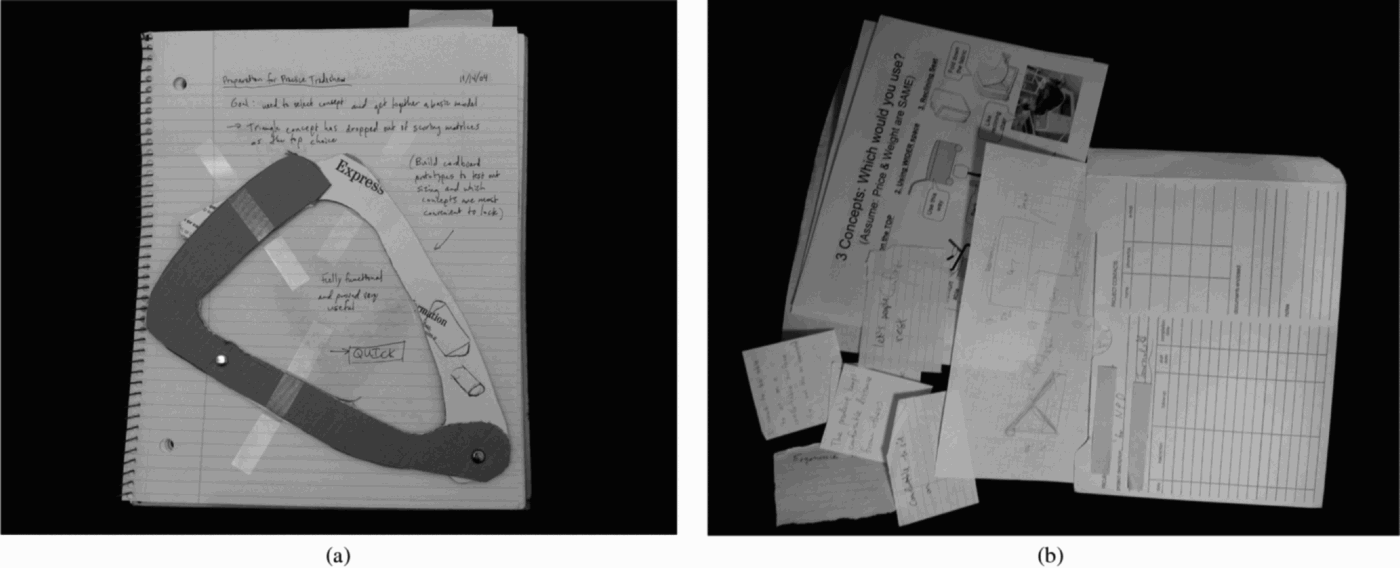
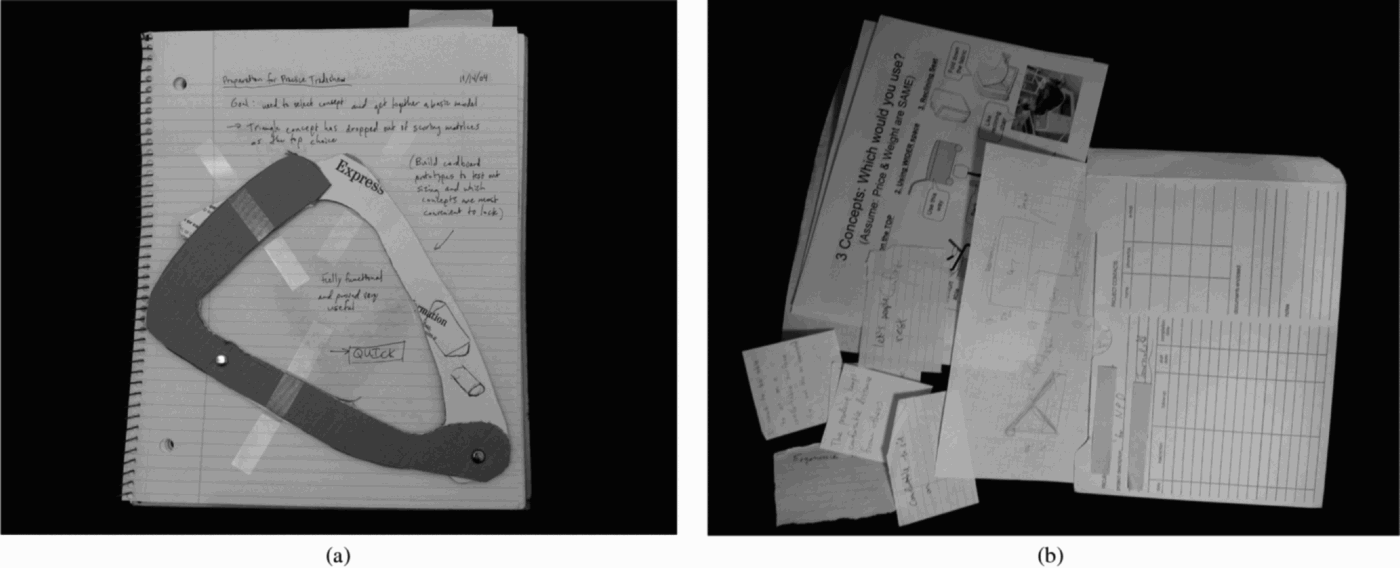
In one example, the student taped in a cardboard prototype of their product (e.g., Fig. 7a). In another example, a student included a fold-out, pop-up version of their prototype in their design journal. Although these prototypes did not fit in the sketch protocol analysis, it does serve as an example of multimedia content that cannot be captured by digital media: three-dimensional physical artifacts. This is one example of a direct connection between a drawing surface and a prototype, similar to the links between prototyping and sketching observed in Yang and Cham (Reference Yang and Cham2007).
(a) A page from a tangible journal that included a cardboard prototype taped inside. (b) A rather “chaotic” tangible journal, consisting of a file folder with a stack of loose-leaf sheets of paper inside. Contents include freehand sketches, digital drawings, and small scraps of paper with loose ideas. [A color version of this figure can be viewed online at journals.cambridge.org/aie]
7.3. Tangible “chaotic” journal
One student submitted a messy folder crammed with undated freehand sketches, jotted notes, digital photo printouts, and more (e.g., Fig. 7b). This journal follows no obvious order, and the lack of context in the designer's visualizations makes it difficult to understand and appreciate the content.
7.4. Digital-hybrid “curated” journal
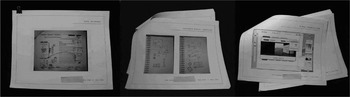
Another student submitted a journal that contained both pure digital content (e.g., Website screenshots, text typed in a word processor, and printed) and digital photos of a tangible journal (e.g., Fig. 8). In creating this supplementary journal that was submitted to the instructors, the student carefully selected and curated what content to share and how to contextualize it with titles such as “Initial Ideation,” “Mentor Meetings,” and “Prototype Development.” As such, the journal follows a clear path in the product development process, because all the “unnecessary” information is filtered out. However, it also lacks much of the “process display” considered necessary for reflection; although the curation process probably involved a lot of reflection, it is unclear whether this journal would be as effective in promoting reflection after the designer leaves the immediate context of the project.
A highly curated hybrid design journal, including scanned digital documents with tangible annotations, freehand sketches from another tangible notebook, and digital images and screenshots of interface prototypes. [A color version of this figure can be viewed online at journals.cambridge.org/aie]

8. DESIGN RECOMMENDATIONS/GUIDELINES
Through our evaluation of existing design tools, journal and sketch analyses, and case studies, we have observed several themes of how designers use journals and other design tools to support their thinking. From these observations, we propose several recommendations for the design of the next generation of design journals.
8.1. Enable hybrid journaling
Many designers are simultaneously using both digital and tangible forms of communication to capture their informal thoughts. Although we discovered that many of the current design tools primarily support either tangible or digital interaction, more designers are beginning to use hybrid design journals to record information. We recommend that future design tools take a cue from hybrid journals and engage designers through tangible interfaces that blend digital and tangible interactions and information.
8.2. Adapt interaction to design stage
In our sketch analyses, we confirmed the results from Song and Agogino (Reference Song and Agogino2004), which demonstrated the overall variation in design sketch volume throughout the different design stages. This variation held true for both hybrid and digital journals; regardless of medium, designers are increasing their sketch volume in the second design stage. We recommend that future design tools be versatile enough to adapt to the designer's changing information capture behaviors throughout the design process to continue to be applicable throughout the process.
8.3. Support both sketch volume and detail
Different journal media support different tendencies in information capture. We have observed that hybrid journals favor sketches with more detail, and there appears to be a trend of increased total number as well. Each of these practices lends valuable results, as more detailed drawings may lead to a more finalized concept faster, whereas more sketches may facilitate better concept generation. A future design tool must offer an interface for quick and easy sketching, and also allow users to easily modify and enhance previous drawings with more detail.
8.4. Facilitate teamwork and sharing
Throughout the design process, team members frequently engage in collaborative conversations to trade information, share ideas, iterate designs, and more. These sessions take place over any media that provide a common channel for communication, be it a whiteboard, a Website, or a design journal. In our in-depth analyses of sketches, we often discovered “talking” sketches in the journals similar to those described by Ferguson (Reference Ferguson1992), drawings that were made during a meeting to help convey concept ideas to the design team. If a future design tool is to support multifunctional teamwork, it must allow users from all disciplines to easily share information and reflection across both tangible and hybrid media.
8.5. Allow for varying levels of curation
The chaotic and curated journals in our case study illustrate the variation of curation in design journals; the highly curated digital journal resembled finished, refined, and formalized design documentation, even though the design journal is intended to capture raw thought. However, the chaotic folder full of undated, unordered loose-leaf papers provides no clues as to how to follow the narrative of the designer's thought process. This idea of curation also illustrates a tension in supporting reflection; whereas the uncurated journal does a very good job of displaying the raw thought process, it is also difficult to engage collaborators in discussion about its contents. Although the curated journal is very good at presenting its contents to an outside audience, some of the thought process is lost or not openly displayed.
One metaphor to illustrate the difference between these curation styles is the difference between visiting a zoo and going on a safari. The curated journal resembles a zoo; a curated setting where animals are presented to an outside audience, with helpful information nearby to provide some context as to what the creature's natural environment is actually like. In contrast, the chaotic journal resembles a safari, a wild setting where the animals may not be aware of an outside audience. As a result, the audience experiences the animal's natural environment first hand; however, there is no guarantee that the audience will understand the overall narrative of the life of that animal.
The two hybrid journals in our case study capture the full range of the “informal” side of the formality spectrum; the uncurated journal is only well-understood by the designer, at the time of its creation, while the highly curated journal is well understood by any audience, even out of the context of the design project. We recommend that future design journals be flexible enough to be used at any level of formality or curation, as some users will want to curate its contents more than others.
9. FUTURE WORK
Although this paper helped illuminate many issues surrounding a designer's use of media type in design journals and it relation to journal content, it also revealed several areas of future research.
9.1. Level of curation
In our case studies we highlighted two journals with opposite levels of curation. Future work includes studying how curation affects the collaborative design process, and developing a measure for the level of curation in a design journal.
9.2. Design journals in the designer's broader information world
Future research will also investigate how media type plays a role in how designers record information overall. This would include some of the communication paths mentioned in our case study, such as e-mail, online collaboration programs, and alternative note-keeping schemes. In our test bed, student teams used an online course management system that contained several collaboration tools, such as a mail tool, wiki, and the ability to submit group project deliverables and share information among the team. By tracking a designer's overall communication patterns across different tools and different media, we can get a better sense of how designers are currently interacting with both digital and tangible media.
9.3. Implement new methodology for studying design journals
This paper has explored several methods of researching the topic of design journals; however, there still remain several approaches that would be useful to establish a deeper understanding of designers' interactions with their journals. By performing qualitative interviews with designers throughout the design process, researchers could determine their interactions and attitudes toward their current design journal. By having the journal on hand during the interview to be used as a prop, researchers could also better understand the context of specific journal pages, as well as potentially pinpoint journal content that the owner considers significant enough to share in such an interview.
9.4. Teams in design journals
Team members may choose different media for their journals, or the entire team may favor one medium over others. Another future area of research is to investigate how design journals are used in collaborative settings, and how a designer's choice of design journal medium or interactions with their design journals may or may not connect with their team role among their collaborators.
10. CONCLUSION
In this paper, we have thoroughly explored variations in media type and content in the practice of design journals. First, we explored related research and existing technologies to understand different motivations for the shift to digital technology use in design journals. Second, we performed a comprehensive descriptive study of student journals in mixed multifunctional undergraduate and graduate design teams over a 4-year period. From these data we were able to understand patterns between media selection and discipline, as well as how different media produce different sketching behavior patterns. The results highlight trends and affordances associated with tangible, digital, and hybrid journal media types. They provide the foundation for future research in developing a new generation of design journals that enable interactive hybrid journaling, support personal ideation as well as collaboration, and allow for curation. We look forward to the future, when designers can fluidly interact with both tangible and digital design information.
ACKNOWLEDGMENTS
The authors acknowledge the foundation research and feedback from Dr. Shuang Song at Intel. The authors gratefully acknowledge the partial funding for this research from NSF Grant DUE 0428935.
Lora Oehlberg is a doctoral student in mechanical engineering at UC Berkeley. She has an MS in mechanical engineering from UC Berkeley and a BS in mechanical engineering from Stanford University. She is interested in how new media can be used to help designers in new product development teams document their design process. Her background includes both corporate product design and development and human–computer interaction research.
Kimberly Lau is a doctoral student in mechanical engineering at UC Berkeley, where she also acquired MS and BS degrees in mechanical engineering. She is interested in how formal and informal team roles have an affect on informal design documentation behavior, including sketching and journaling. Her background includes both design and project management.
Alice M. Agogino is the Roscoe and Elizabeth Hughes Professor of Mechanical Engineering at UC Berkeley and has held several industry appointments as well, all of which are in some aspect of integrated engineering design. She teaches classes in human-centered design, sustainable product design, multimedia in design, and artificial intelligence.