1. Introduction
Priming has been used extensively to study the organization of the linguistic system in both monolinguals and multilinguals alike, within and across languages at the orthographic (Ferrand & Grainger, Reference Ferrand and Grainger1994; Bijeljac-Babic, Biardeau & Grainger, Reference Bijeljac-Babic, Biardeau and Grainger1997; van Heuven, Dijkstra, Grainger & Schriefers, Reference van Heuven, Dijkstra, Grainger and Schriefers2001), lexico-semantic (Dehaene, Naccache, Le Clec'H, Koechlin, Mueller, Dehaene-Lambertz, van de Moortele & Le Bihan, Reference Dehaene, Naccache, Le Clec'H, Koechlin, Mueller, Dehaene-Lambertz, van de Moortele and Le Bihan1988; Neely, Reference Neely, Besner and Humphreys2012), and structural levels (Pickering & Branigan, Reference Pickering and Branigan1999; Hartsuiker, Pickering & Veltkamp, Reference Hartsuiker, Pickering and Veltkamp2004). Studies of lexical priming, the focus of the present study, have revealed much about the time course of visual word recognition and processing, particularly with monolingual populations; with respect to bilingualism, priming has proven useful in our understanding of how a bilingual's two languages interact with one another. Most of these studies focus on priming of individual words: that is, the facilitation of processing that occurs on a given word (the target) when preceded by a related or identical word (the prime) in isolation. However, language users rarely encounter single words devoid of context. To date, little work has been done on lexical priming in sentential contexts. The present study aims to address this gap in the literature by investigating the role of sentential contexts on lexical access in bilinguals. Specifically, this study will explore early orthographic effects (through within-language identity priming) and later semantic effects (by means of across-language translation priming) in codeswitched sentences using eye-tracking while reading.
1.1 Lexical access and priming of words in isolation
In processing written words, there is a general consensus that orthographic processing precedes semantic processing: early stages of processing have been found to show higher susceptibility to visual and orthographic characteristics of stimuli, while later stages of processing are largely dominated by lexico-semantic information (Hauk, Davis, Ford, Pulvermüller & Marslen-Wilson, Reference Hauk, Davis, Ford, Pulvermüller and Marslen-Wilson2006; Grainger & Holcomb, Reference Grainger and Holcomb2009; Carreiras, Armstrong, Perea & Frost, Reference Carreiras, Armstrong, Perea and Frost2014; Vergara-Martínez, Gómez, Jiménez & Perea, Reference Vergara-Martínez, Gómez, Jiménez and Perea2015). In addition, orthographic and lexico-semantic information have been found to influence one another in both bottom-up and top-down manners. For example, Holcomb and Grainger (Reference Holcomb and Grainger2006) found that partial non-word repetitions (e.g., teble – TABLE) primed targets not only at earlier stages of processing, as would be expected given the orthographic overlap between the prime and the target, but also at later stages of processing in ways congruent with semantic priming. In this example, orthographic overlap between the partial non-word repetition and the target was enough to activate the semantic information of the corresponding real-word target (e.g., the non-word teble activating the meaning of table). Carreiras and colleagues (Reference Carreiras, Armstrong, Perea and Frost2014) argue that, based on a review of numerous studies investigating visual word recognition, higher-level linguistic information also modulates the processing of lower-level, primarily visual and orthographic, information (see also Assadollahi & Pulvermüller, Reference Assadollahi and Pulvermüller2003; Carreiras, Vergara & Barber, Reference Carreiras, Vergara and Barber2005; Dambacher, Kliegl, Hofmann & Jacobs, Reference Dambacher, Kliegl, Hofmann and Jacobs2006). Specifically, the authors state that information such as “how some letters correlated with phonology and meaning, and how letter clusters are constrained by lexical, morphological, and phonological structure” tune the word recognition system to facilitate reading (e.g., by modulating low-level predictions on word form and orthography).
Similar effects have been found among bilinguals. Geyer, Holcomb, Midgley and Grainger (Reference Geyer, Holcomb, Midgley and Grainger2011) conducted an ERP study on both within- and across-language priming in Russian–English bilinguals and found that modulation of components in earlier time windows (150–300 ms post-stimulus onset) was only found for within-language identity priming; in later time windows (300–500 ms post-stimulus onset), robust effects were found for both within-language identity priming and across-language translation priming. Given that the Russian and English stimuli were presented in different scripts, the authors argue that the earlier effects could only have been due to orthographic repetition on within-language trials, hence their absence on across-language trials which only showed semantic effects. A similar time course was reported by Meade, Midgley and Holcomb (Reference Meade, Midgley and Holcomb2018), such that orthographic effects tended to surface before semantic effects, though some semantic effects were also observed in an early time window (200–350 ms post-stimulus onset, consistent with the N250 component). In sum, the effects of orthographic processing are assumed to be early, short-lived, and easily masked by later semantic processing (Vergara-Martínez et al., Reference Vergara-Martínez, Gómez, Jiménez and Perea2015).
One of the primary mechanisms by which priming occurs is argued to be the automatic spreading of activation between related features (Rossell, Price & Nobre, Reference Rossell, Price and Nobre2003). Of particular importance is the automaticity of spreading activation: it surfaces as a property of the lexical network and the connections between related items or features of items (Sánchez-Casas, Ferré, García-Albea & Guasch, Reference Sánchez-Casas, Ferré, García-Albea and Guasch2006, p. 162). This automatic spreading activation, however, “is believed to have a brief time span and to contribute predominantly to when words are separated by short temporal intervals” (Rossell et al., Reference Rossell, Price and Nobre2003, p. 550). Nonetheless, recent literature has demonstrated that priming effects can persist beyond this brief period. For example, Was, Woltz, and Hirsch (Reference Was, Woltz and Hirsch2019, p. 321) found that “a form of semantic priming…persisted over an average of seven unrelated, intervening trials”. Rodd, Curtin, Kirsch, Millar, and Davis (Reference Rodd, Curtin, Kirsch, Millar and Davis2013, p. 190) found that “a single encounter with a particular meaning of an ambiguous word in context is sufficient to bias a listener's interpretation of that word after a delay of up to 20 min[utes]”.
The persistence of priming, or long-term priming, results from further co-activation that can itself result from other, less automatic processes such as retrospective processing (Neely, Keefe & Ross, Reference Neely, Keefe and Ross1989; Neely & Keefe, Reference Neely and Keefe1989) and expectancy generation (Becker, Reference Becker1980; Sánchez-Casas et al., Reference Sánchez-Casas, Ferré, García-Albea and Guasch2006; Carreiras et al., Reference Carreiras, Armstrong, Perea and Frost2014). Taken together, the studies reviewed above suggest that while short-term priming is driven primarily by automatic spreading activation, which proceeds via implicit or bottom-up processes, long-term priming results from explicit or top-down processes that modulate future expectations (Rodd et al., Reference Rodd, Curtin, Kirsch, Millar and Davis2013, p. 191). It thus follows that priming via the automatic route is not susceptible to changes in cognitive demands (Bodner & Stalinski, Reference Bodner and Stalinski2008; Perea, Marcet, Lozano & Gómez, Reference Perea, Marcet, Lozano and Gómez2018). One question that then arises is if increasing cognitive load – particularly between the appearance of the prime and the target – weakens such explicit or top-down processes or if they are immune to change in cognitive demands.
With respect to bilingual lexical priming, the debate centers not upon whether priming can occur across languages via mechanisms such as those discussed above, but whether priming is equally strong in both directions (from L1 to L2, and from L2 to L1). In one recent study, Smith, Walters and Prior (Reference Smith, Walters and Prior2019) examined both within- and across-language semantic and identity priming in a group of Hebrew-dominant L1 Hebrew–L2 English bilinguals. The authors found that within-language semantic and identity priming were equally strong in both the L1 and the L2, but that across-language semantic priming was much weaker, with marginal effects for L1 to L2 semantic priming and no effects for L2 to L1 semantic priming. Basnight-Brown and Altarriba (Reference Basnight-Brown and Altarriba2007) found similar effects in a group of English-dominant L1 Spanish–L2 English bilinguals, who only exhibited priming effects from the L1 to the L2. This is not always the case, however; Duñabeitia, Perea and Carreiras (Reference Duñabeitia, Perea and Carreiras2010b) found that highly proficient and balanced early Basque–Spanish bilinguals exhibited equally strong semantic priming effects in both directions. Lastly, the degree of semantic similarity between the prime and the target has also been found to influence the strength of semantic priming (Sánchez-Casas et al., Reference Sánchez-Casas, Ferré, García-Albea and Guasch2006).
With respect to translation priming, the effects have proven similarly mixed, but with a slightly clearer though nonetheless variable outcome: numerous studies have reported bidirectional translation priming effects in various bilingual populations (Meade et al., Reference Meade, Midgley and Holcomb2018; Basnight-Brown & Altarriba, Reference Basnight-Brown and Altarriba2007; Duñabeitia et al., Reference Duñabeitia, Perea and Carreiras2010b; Duñabeitia, Dimitropoulou, Uribe-Etxebarria, Laka & Carreiras, Reference Duñabeitia, Dimitropoulou, Uribe-Etxebarria, Laka and Carreiras2010a; Geyer et al., Reference Geyer, Holcomb, Midgley and Grainger2011; Schoonbaert, Holcomb, Grainger & Hartsuiker, Reference Schoonbaert, Holcomb, Grainger and Hartsuiker2011), but this is not necessarily found across all bilingual populations and the strength of the effects vary. Nonetheless, a recent meta-analysis of 64 masked priming lexical decision experiments conducted by Wen and van Heuven (Reference Wen and van Heuven2017) confirms a consistent, though heterogeneous, L1 to L2 translation priming effect and a variable but nonetheless significant L2 to L1 translation priming effect. The present study takes direction from the findings on translation priming in bilinguals described above to examine orthographic and semantic effects during sentence reading in a group of highly proficient Spanish–English bilinguals. Codeswitching (the alternation of two languages in bilingual discourse) was used as a tool to investigate this question because it provides a propitious and natural bilingual context for translation priming at the sentence level to arise.
1.2 Lexical access in sentential contexts
The literature reviewed above, along with most of the literature on lexical access and priming, has focused on single words presented in isolation. However, words are rarely devoid of context, and the presence of this context may modulate how bilinguals process words in their two languages. For example, Libben and Titone (Reference Libben and Titone2009) found that the surrounding semantic context modulates cross-linguistic activation and, in turn, lexical access. In this eye-tracking study, French–English bilinguals read sentences that could either be preceded by a high semantically constraining context or a low semantically constraining context. The authors found that interlingual homographsFootnote 1 incurred interference effects in earlier measures of processing for both the high- and low-constraint contexts; however, effects in the later measures of processing only surfaced in the low-constraint contexts. Why this discrepancy? The earlier measures chosen (first fixation duration and gaze duration) were argued to be more affected by visual and orthographic information while the later measures (go-past time and total reading time) tapped more into semantic information. Thus, a high-constraint context nullified the conflict between the two meanings, as only one meaning was viable; this was not true of the low-constraint context as it did not bias the reader towards one meaning or the other. Global context, such as the amount of each language present in the immediate environment, has also been found to influence cross-language activation and lexical processing during reading. Titone, Libben, Mercier, Whitford and Pivneva (Reference Titone, Libben, Mercier, Whitford and Pivneva2011) found greater cognate facilitation when French filler sentences were included alongside English experimental sentences compared to a block where all sentences appeared in only one language. Similar findings were attested on the processing of interlingual homographs in German–English bilinguals by Elston-Güttler, Gunter and Kotz (Reference Elston-Güttler, Gunter and Kotz2005). This cross-linguistic co-activation and the modulation thereof have been a key finding in understanding bilingual language processing and production alike.
Given the influential role of context, both local and global, in the modulation of cross-linguistic effects, the present study seeks to expand upon the literature on lexical priming in bilinguals by examining identity and translation priming in sentential contexts. It has been widely replicated in word level studies on the time course of lexical priming that orthographic effects tend to precede semantic effects. Our first goal is to investigate whether this also applies in sentential contexts. Second, we seek to better understand the nature of long-term priming and whether priming effects persist in the presence of an intervening task between the prime and the target. Our research questions are thus as follows:
1a. Upon encountering a target word in a sentential context, what information becomes active and when?
2a. In the presence of an intervening task, does long-term priming persist?
To accomplish this, we examine both within-language identity priming and across-language translation priming using both unilingual and codeswitched sentences. We likewise compare priming both with and without an intervening task between the presentation of the prime and the target. This task – solving simple math problems – is designed to temporarily increase cognitive demands, which have been argued to interfere with less automatic priming mechanisms, such as those that drive long-term priming (Becker, Reference Becker1980; Sánchez-Casas et al., Reference Sánchez-Casas, Ferré, García-Albea and Guasch2006; Rodd et al., Reference Rodd, Curtin, Kirsch, Millar and Davis2013; Carreiras et al., Reference Carreiras, Armstrong, Perea and Frost2014). Lastly, by presenting the primes and targets asynchronously within sentential contexts, rather than presenting masked primes or using simultaneous cross-modal priming, our goal is to more closely how participants encounter language in their daily lives (thereby potentially increasing the ecological validity of our findings) and to investigate priming effects in the presence of greater linguistic context.
Our hypotheses concerning the time course of lexical priming and its persistence in the presence of an intervening task are thus as follows:
1b. The earliest effects will be orthographic in nature while semantic effects will surface later; that is, we expect to observe the effects of within-language identity priming in measures reflecting earlier stages of processing while those of across-language translation priming will be reflected in more cumulative measures encompassing later stages of processing.
2b. If long-term priming effects are less automatic and more susceptible to top-down influences, then the presence of an intervening task will diminish these effects; however, if the processes underlying long-term priming effects are (at least partially) robust to top-down influences, then these effects are expected to strengthenFootnote 2 in the presence of the intervening task due to more time being available for semantic expectancy generation (e.g., Rossell et al., Reference Rossell, Price and Nobre2003).
2. Methodology
2.1 Participants
A total of 42 participants (mean age 21; 29 women) completed the eye-tracking portion of the experiment; two participants’ data were excluded due to insufficient items per condition (due to tracking loss, data collection errors, or outlier removal), leaving a total of 40 participants. All participants were recruited from the San Juan, Puerto Rico or surrounding area at the University of Puerto Rico, Río Piedras. Participants began learning both Spanish and English during childhood and were highly proficient in both languages. Participants completed a language history questionnaire to gather information about language use and proficiency by self-report. In order to assess language proficiency in Spanish and English, participants also completed a picture naming task, a verbal fluency task, and a lexical decision task in both languages. For these tasks, the order of presentation of the languages was always Spanish before English in order to mitigate any effects of the L2 (i.e., inhibition) on the L1 (Linck, Kroll & Sunderman, Reference Linck, Kroll and Sunderman2009; Misra, Guo, Bobb & Kroll, Reference Misra, Guo, Bobb and Kroll2012). Each is described below.
Language history questionnaire
To assess language experience, participants completed a modified version of the LEAP-Q (Marian, Blumenfeld & Kaushanskaya, Reference Marian, Blumenfeld and Kaushanskaya2007) administered through Qualtrics. The questionnaire asked about participants’ self-rated proficiency across different domains and included numerous questions about participants’ codeswitching habits. Responses to the questionnaire revealed that all participants were native Spanish speakers (average AoA: 1.3 years) who acquired English during early childhood (average AoA: 3.6 years). Participants reported using and being exposed to Spanish more often than English but were nonetheless highly proficient in both languages (see Table 1). Lastly, participants indicated engaging in codeswitching or other forms of language mixing frequently in their daily lives, providing an average rating of 7.7/9 across all domains, where 9 is “Always Codeswitches”. Specifically, participants engaged in codeswitching most frequently in their free time (8.2/9), followed by school (7.6/9) and home (7.4/9); the least amount of codeswitching was reported at work (3.6/9).
Language proficiency in English and Spanish.

Picture naming task
Participants completed a picture naming task in both Spanish and English. In this task, participants named aloud 120 simple black-and-white line drawings from the Multilingual Naming Task (Gollan, Weissberger, Runnqvist, Montoya & Cera, Reference Gollan, Weissberger, Runnqvist, Montoya and Cera2012) that appeared onscreen one at a time. Pictures reflected a range of frequencies. Half of the pictures were presented in a Spanish block and the other half were presented in an English block, with each block preceded by an 8-item practice. Participants initiated each trial by pressing the spacebar, after which a fixation cross (‘+’) appeared in the middle of the screen for 500 ms, immediately followed by the presentation of a picture. The picture remained onscreen until the voice key was triggered or an interval of 3000 ms had passed. Participants were instructed to name each picture as quickly and as accurately as possible in the appropriate language and to avoid false starts, hesitations, and making noises (coughs, laughs, etc.) and each was coded for accuracy. A response was considered accurate if it matched the intended target name or, where appropriate, an alternative dialectal variation that correctly identified the picture was provided by the participant.
Category fluency task
Participants also completed a verbal category fluency task in both Spanish and English. In this task, participants were asked to generate as many exemplars as possible belonging to a given semantic category in 30 seconds. This task was chosen as there is some recent evidence suggesting a strong correlation between the verbal fluency task and objective measures of language proficiency (Beatty-Martínez, Navarro-Torres, Dussias, Bajo, Guzzardo Tamargo & Kroll, Reference Beatty-Martínez, Navarro-Torres, Dussias, Bajo, Guzzardo Tamargo and Kroll2019). The task included eight categories (the same as in Baus, Costa & Carreiras, Reference Baus, Costa and Carreiras2013 and Linck et al., Reference Linck, Kroll and Sunderman2009) that were split into two blocks: animals, clothing, musical instruments, and vegetables; or body parts, colors, furniture, and fruits. One block was named in Spanish and the other in English with the categories counterbalanced by participant across languages. Each block began with a practice category (tools, herramientas). The name of the category appeared onscreen for 3000 ms, after which a chime indicated that they should name as many exemplars in that category as possible; after 30 seconds, participants would hear the chime again and see a stop sign appear onscreen, signaling the end of the category. Participants were asked to avoid producing repetitions and proper nouns (such as people, place, or brand names). Participants were given 1 point per word named, and alternative dialectal variations were accepted. Final scores for each participant were calculated as the average number of exemplars per language across all four categories.
Lexical decision task
The final proficiency measure was a lexical decision task, wherein participants were instructed to indicate via button press whether the letter string that appeared onscreen was a real word. The task was split into two blocks, with one block conducted in Spanish and the other in English. Fifty Spanish words and fifty English words were selected, with fifty non-words generated for each language using Wuggy (Keuleers & Brysbaert, Reference Keuleers and Brysbaert2010). Non-words were matched to real words as closely as possible in number of characters and syllabic structure. Before each word, a fixation cross (‘+’) appeared onscreen for 500 ms, after which the letter string appeared and remained onscreen until a button press was registered or an interval of 3000 ms had passed. While both accuracy and RT data were collected, we report only on the D-prime score calculated using the accuracy data.
Table 1 provides the self-rated proficiency measures from the language history questionnaire as well as the results of the objective measures administered to assess language proficiency. Paired t-tests were conducted to compare participants’ Spanish scores to their English scores for each measure. For the self-rated proficiency measures, participants rated their speaking abilities significantly higher in Spanish (x = 9.53/10, sd = 1.02) than in English (x = 8.97/10, sd = 1.19; p < .01), but they did not differ in their self-rated reading, writing, or understanding abilities. For the objective measures, participants were significantly more accurate when naming pictures in Spanish (x = 77%, sd = 9%) than in English (x = 67%, sd = 18%; p < .01), but they did not differ in the total number of exemplars produced in the verbal fluency task nor did they differ in their D-prime scores in the lexical decision task. Given both their high self-rated scores in both languages and their high performance in the three behavioral measures, we argue that these participants are highly proficient in both Spanish and English. Since participants were living in a largely Spanish-dominant environment (Puerto Rico), more frequent use of Spanish may have resulted in higher self-rated speaking abilities in Spanish. Similarly, lexical access in Spanish may have been facilitated (e.g., Linck et al., Reference Linck, Kroll and Sunderman2009; see also Beatty-Martínez et al., Reference Beatty-Martínez, Navarro-Torres, Dussias, Bajo, Guzzardo Tamargo and Kroll2019), resulting in greater accuracy in Spanish in the picture naming task.
2.2 Stimuli
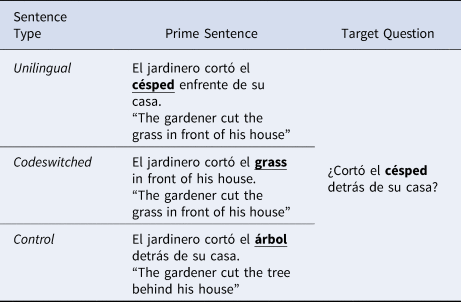
The stimuli consisted of 120 sentence triplets, each paired with a comprehension question (see Supplementary Materials). The sentences contained the primes, while the comprehension questions contained the targets; all analyses are thus on the targets presented in the comprehension questions. One hundred and twenty Spanish nouns (60 masculine, 60 feminine) were selected as targets using the EsPal database (Duchon, Perea, Sebastián-Gallés, Martí & Carreiras, Reference Duchon, Perea, Sebastián-Gallés, Martí and Carreiras2013). Target nouns were selected to be as similar as possible in frequency, imageability, familiarity, and concreteness within Spanish. When translated into English, frequencies of the English words did not significantly differ from the frequencies of the Spanish words (p > .1). Each sentence triplet consisted of the following three Sentence Types:
1. A unilingual Spanish sentence which contained the prime in Spanish (identical to the target), allowing us to examine within-language identity priming.
2. A codeswitched sentence which began in Spanish but switched into English at the prime, such that the prime was the English translation equivalent of the target, allowing us to examine across-language translation priming.
3. A unilingual Spanish control sentence which contained neither the Spanish nor English versions of the prime but was still thematically related to the comprehension question.
An example of one triplet and its associated comprehension question are given in Table 2 (for expository purposes, the target word appears in bold). Sentences were blocked by language: unilingual Spanish sentences (Sentence Types 1 and 3 above) were presented in separate blocks than codeswitched sentences (Sentence Type 2 above). Sentences and questions were presented in a single line, left-justified and in the middle of the screen, in 16-pt Consolas font. On average, sentences were 9.5 words long (sd = 1.8) and questions were 6.9 words long (sd = 1.4).
Example experimental stimuli.

To manipulate the time between the presentation of the prime in the sentence and the presentation of the target in the question, items could also be presented in one of two Block Types: No Delay and Math Delay. In the No Delay block, participants read each sentence and then pressed a button to read and answer the comprehension question. In the Math Delay block, participants read each sentence and then, before reading and answering the comprehension question, performed a simple math verification task. This resulted in six conditions in a 3 (Sentence Type) by 2 (Block Type) design. With this design, six lists were created to counterbalance the items across all six conditions: each list contained 40 unilingual, 40 codeswitched, and 40 control items, as well as 120 filler items. These 240 items were then divided into four sub-blocks of 60 items each, with the distribution of items per sub-block detailed in Table 3. Because the control items were also presented in unilingual Spanish, they were presented in the same sub-blocks as the unilingual experimental items with the number of fillers adjusted appropriately such that the number of sentences in each block was always 60. As such, there were 20 fillers per block in the unilingual blocks and 40 fillers per block in the codeswitched blocks. Items were counterbalanced such that each participant would see only one of the sentences from each triplet in either the No Delay or Math Delay block. All factors were manipulated within participants, such that each participant saw all six conditions.
Items per condition by sub-block.

As mentioned above, sentences were blocked such that all of the sentences in each sub-block, including filler items, were either unilingual or codeswitched; unilingual and codeswitched items were not presented together within the same block. This was done for two reasons: first, previous research investigating the role of mixing and blocking on the processing of codeswitched stimuli has suggested that mixing unilingual and codeswitched stimuli within the same block may actually facilitate processing overall (Johns, Valdés Kroff & Dussias, Reference Johns, Valdés Kroff and Dussias2019). What effects this overall facilitation may (or may not) have on the priming effects in the present study are as of yet unknown, and as such a simpler, more controlled design was used that allowed for the isolation of translation and identity priming effects. In addition, control sentences were presented in unilingual Spanish for a similar reason: namely, that the comprehension questions containing the targets were also in unilingual Spanish. This, we argue, allows for optimal comparison among our conditions as the control sentences contain unrelated ‘primes’ and do not introduce any effects of codeswitching into the baseline condition. That control sentences were presented in unilingual Spanish and that the design was blocked rather than mixed leaves open the question as to the role of differing degrees of language coactivation and its effects on translation and identity priming in sentential contexts.
2.3 Procedure
Participants began the session by giving informed consent, after which they completed the eye-tracking task. Data were collected on an EyeLink Portable Duo eye-tracker (SR Research) running at 1000 Hz in head-stabilized monocular mode (right eye). Before each block, calibration was performed such that the average error was below .5° (maximum of 1.0°). Blocks were counterbalanced such that a participant could complete the unilingual blocks before the codeswitched blocks, or vice versa; within each of these two sentence types, however, participants always began with the No Delay block followed by the Math Delay block.
Each trial began with a drift check, with the fixation point located where the start of the sentence would appear. After the drift check, the sentence appeared onscreen, and participants were instructed to read the sentences naturally and then press any button on the keyboard to continue. At this point, the two blocks differed: in the No Delay block, the participant continued on to the comprehension question; in the Math Delay block, participants were presented with a simple math problem for 3000 ms, after which a number appeared onscreen and the participant indicated via a button press whether the number was the answer to the math problem they had just seen. Participants were given up to 2000 ms to respond, making the maximum possible delay between the sentence and the question 5000 ms. In both blocks, the trial ended with the comprehension question, to which participants responded ‘yes’ or ‘no’ via button press after having read the question to themselves. Figure 1 details the trial procedures for both the No Delay and Math Delay blocks.
Trial proceduresFootnote 4.

2.4 Analysis
Partially following Libben and Titone (Reference Libben and Titone2009), three reading measures were calculated for the target noun presented in the comprehension question: 1) first fixation duration, 2) gaze duration, and 3) total duration (see also Rayner, Chace, Slattery & Ashby, Reference Rayner, Chace, Slattery and Ashby2006). First fixation duration is the duration of the first fixation within an interest area (Rayner, Reference Rayner1998). Gaze duration is defined as the sum of all the fixations within an interest area starting with the first fixation into that interest area until the first time the participant's gaze leaves the region either to the left (previous word) or to the right (following word; Inhoff, Reference Inhoff1984; Rayner & Pollatsek, Reference Rayner and Pollatsek1989; Rayner, Reference Rayner1998). Total duration is the sum of all fixation durations on the region of interest and includes both initial readings and re-readings of the target word. Following Rayner (Reference Rayner1998 pp. 377–378; see also Inhoff & Radach, Reference Inhoff, Radach and Underwood1998), we examine this constellation of factors to better understand the processing of individual words to disambiguate effects of lexical and orthographic information from effects of semantic access and, in particular, the accessing of a word's translation equivalent. While first fixation duration and gaze duration are more sensitive to ‘faster’ processes related to lexical access and lexical processing (Rayner, Reference Rayner1998, p. 377), total duration captures more integrative, cumulative effects (Van Assche, Duyck & Hartsuiker, Reference Van Assche, Duyck and Hartsuiker2012, p. 4; see also Cop, Dirix, Van Assche, Drieghe & Duyck, Reference Cop, Dirix, Van Assche, Drieghe and Duyck2017, p. 754). We thus look to first fixation and gaze duration for evidence of identity priming, and total duration for both evidence of translation priming as well as effects of the delay between the prime and the target.
Data cleaning
Of the 5,040 total trials that participants saw, 638 trials (12.7%) were missing due to software errors resulting in missing interest areas that could not be recovered; in addition, 715 trials (14.2%) were removed due to the target word being skipped entirely, yielding missing values for all three measures. This resulted in 3,687 eligible trials. Next, following Traxler, Williams, Blozis and Morris (Reference Traxler, Williams, Blozis and Morris2005), values for all three reading measures where the gaze duration was less than 120 ms or greater than 2000 ms were excluded. Of the eligible trials, 744 trials (20.2%) where the target was skipped during first-pass reading (resulting in a value of 0 for gaze duration) as well as 159 trials (4.3%) with gaze durations that fell outside of these cutoff values were removed (24.5% altogether). This yielded 2,784 trials for the analyses of first fixation, total, and gaze duration.
Outliers for reaction time data were determined using the median absolute deviation method (MAD; see Leys, Ley, Klein, Bernard & Licata, Reference Leys, Ley, Klein, Bernard and Licata2013) based only on trials where the participant correctly answered the comprehension question. A Z-score based on the MAD was calculated for each data point using the normalize function in the Rling package (v. 1.0; Levshina, Reference Levshina2015, p. 60). These Z-scores were calculated by-participant and indicated the normalized distance of each point from each participant's median reaction time. A cutoff of 3 deviations away from the median was chosen to remove outliers. Of the 5,040 trials that participants saw, 360 trials (7.1%) were removed due to inaccurate responses to the comprehension question and a further 383 trials (7.6%) were excluded as outliers yielding 4,297 observationsFootnote 3.
Modelling
Linear mixed-effects models were fit using the buildmer function in the buildmer package (v. 1.3, Voeten, Reference Voeten2019) in the statistical software R (v. 3.6.1, R Core Team, 2019). This function uses (g)lmer from the lme4 package (v 1.1-21, Bates, Maechler, Bolker & Walker, Reference Bates, Maechler, Bolker and Walker2015) but allows for a systematic and replicable way of simplifying random effects structures and testing fixed effects. The function starts by attempting to fit the most maximal model possible. If the model fails to converge, the function then simplifies the random effects structure via backwards stepwise elimination; in other words, it attempts to find the maximal random effects structure that still allows the model to converge. Once the maximally converging model has been identified, the function calculates p-values for all fixed effects based on Satterthwaite denominator degrees of freedom using the lmerTest package (v. 3.1-0, Kuznetsova, Brockhoff & Christensen, Reference Kuznetsova, Brockhoff and Christensen2017). The resulting models were the maximally converging models that the data were able to support (Bates, Kliegl, Vasishth & Baayen, Reference Bates, Kliegl, Vasishth and Baayen2015). For all models, the maximal model submitted to buildmer predicted the dependent variable by Block Type (No Delay [reference level] or Math Delay), Sentence Type (Control, Unilingual, or Codeswitched), and their interaction. By-participant and by-item random effects were also included, and the random slopes were initially maximally specified as the main effect of Block Type, the main effect of Sentence Type, and their interaction. Models were first run with the Control condition as the reference level of Sentence Type in order to compare this condition to the Unilingual and Codeswitched conditions, and then all models were run again with the Unilingual condition as the reference level allowing for the comparison between the unilingual and codeswitched conditions. All final models selected by buildmer are presented in Appendix A in the supplementary materials (Supplementary Materials).
3. Results
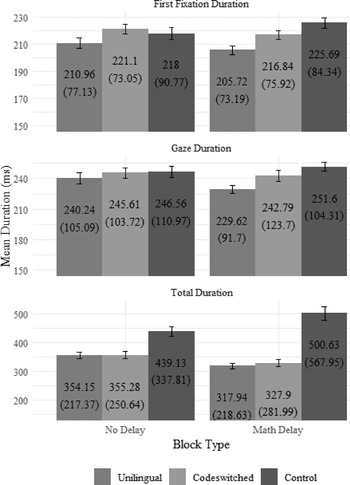
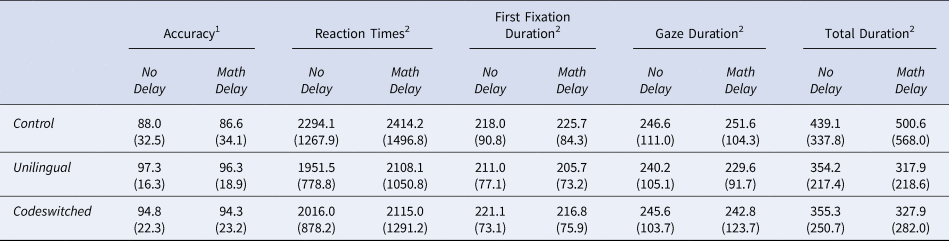
Figure 2 below shows the durations for first fixation, gaze, and total duration. Table 4 below provides the means and standard deviations for accuracy to the comprehension questions, reaction times to the comprehension question, first fixation duration, gaze duration, and total duration by Block Type and Sentence Type. Model summaries are presented alongside the final models selected by buildmer in Appendix A in the supplementary materials (Supplementary Materials).
Mean reading durations on target noun (note: measures on different scales).

Means and standard deviations for all measures.

1 Given in percent.
2 Given in milliseconds.
3.1 Accuracy to comprehension questions
Accuracy data are presented in Figure S1 (Supplementary Materials). The model revealed that accuracy to the comprehension questions was significantly higher in the unilingual (Z = 10.0, p < .01) and codeswitched (Z = 7.55, p < .01) conditions compared to the control condition. Likewise, accuracy was significantly higher in the unilingual condition compared to the codeswitched condition (Z = -3.5, p < .01) There were no other significant main effects or interactions.
3.2 Reaction times to comprehension questions
Reaction time data are presented in Figure S2 (Supplementary Materials). The maximal model revealed that reaction times to the comprehension questions were significantly faster in the unilingual (t = -5.22, p < .01) and codeswitched (t = -4.10, p < .01) conditions compared to the control condition. There was no significant difference between the unilingual and codeswitched conditions (t = 0.7, p = .49). There were no other significant main effects or interactions.
3.3 First fixation duration
The maximal model revealed that first fixation durations on the target were significantly shorter in the unilingual condition compared to both the control condition (t = -4.15, p < .01) and the codeswitched condition (t = 3.08, p < .01), but there was no difference between the codeswitched and control conditions (t = -1.06, p = .29). In addition, the interaction between Sentence Type and Block Type was marginally significant (t = -1.82, p = .07. There were no other significant main effects or interactions. To further investigate the marginal interaction between Sentence Type and Block Type, follow-up models were created examining each Block Type individually and using the same criteria described above. In the No Delay block, first fixation durations in the unilingual and codeswitched conditions did not differ from the control condition (p = .19, p = .57, respectively); however, durations in the codeswitched conditions were marginally slower than those in the unilingual condition (p = .06). In the Math Delay block, first fixation durations in the unilingual condition were significantly faster than those in the control condition (p < .01), and durations in the codeswitched condition were marginally faster than those in the control condition (p = .07); durations in the codeswitched conditions were also significantly slower than those in the unilingual condition (p = .02).
3.4 Gaze duration
The maximal model revealed that gaze durations on the target were significantly shorter in the unilingual condition compared to both the control condition (t = -3.26, p < .01) and the codeswitched condition (t = 2.23, p =.03), but there was no difference between the codeswitched and control conditions (t = -1.03, p = .3). In addition, the interaction between Sentence Type and Block Type was marginally significant when the unilingual condition was the reference level (t = -1.71, p = .09), suggesting that the difference between the unilingual and control conditions was numerically greater in the Math Delay (22ms) than in the No Delay (6ms) block. There were no other significant main effects or interactions. To further investigate the marginal interaction between Sentence Type and Block Type, follow-up models were created examining each Block Type individually and using the same criteria described above. In the No Delay block, gaze durations in the unilingual, codeswitched, and control conditions did not significantly differ from one another (all p's > .36). In the Math Delay block, gaze durations in the unilingual condition were significantly faster than both the codeswitched (p = .03) and control (p < .01) conditions; the codeswitched condition did not significantly differ from the control condition (p = .17).
3.5 Total duration
The maximal model revealed that total durations on the target were significantly shorter in both the unilingual (t = -9.58, p < .01) and codeswitched (t = -8.88, p < .01) conditions compared to the control condition, but there were no significant differences between the unilingual and codeswitched conditions (t = 0.75, p = .45). Total durations on the target were significantly longer in the Math Delay block compared to the No Delay block (t = 2.88, p < .01). In addition, the interaction between Sentence Type and Block Type was significant for both the unilingual (t = -3.14, p < .01) and codeswitched (t = -2.86, p < .01) conditions compared to the control condition. To further investigate the interaction between Sentence Type and Block Type, follow-up models were created examining each Block Type individually and using the same criteria described above. In the No Delay block, total durations in both the unilingual (p < .01) and codeswitched (p < .01) conditions were faster than in the control condition; there was no difference between the unilingual and the codeswitched conditions (p = .87). In the Math Delay block, total durations in both the unilingual (p < .01) and codeswitched (p < .01) conditions were faster than in the control condition; there was no difference between the unilingual and the codeswitched conditions (p = .68). Lastly, while total durations decreased significantly for the unilingual condition (t = -2.48, p = .01) and marginally in the codeswitched condition (t = -1.71, p = .09) in the Math Delay block compared to the No Delay block, total durations increased for the control condition (t = 2.04, p = .04).
4. Discussion
The present study examined bilingual lexical access and priming in unilingual and bilingual sentential contexts, modulating the delay between the presentation of the prime in a sentence and the presentation of the target in a comprehension question. Similar effects of within-language identity priming were observed in first fixation duration and gaze duration, such that durations were faster for targets in the unilingual condition compared to the codeswitched and control conditions. Likewise, in line with previous literature arguing the automaticity of priming (e.g., Sánchez-Casas et al., Reference Sánchez-Casas, Ferré, García-Albea and Guasch2006), we see no significant effect of the delay between the prime and the target on the presence of within-language identity priming. If priming at the lexical level were not automatic, then the presence of an intervening task would have weakened or even negated the priming effect; rather, we see a numerical trend in both first fixation and gaze duration for this effect to strengthen. The effects of across-language translation priming and of the delay between the prime and the target, however, surface only in total duration, a reading measure that captures more cumulative, integrative aspects of processing. In total duration, the magnitude of the priming effect does not differ between targets in the unilingual and codeswitched conditions when compared to the control condition. Likewise, while total durations become longer for the control condition in the Math Delay block, the unilingual and codeswitched conditions show increased facilitation in the form of faster total durations in this block.
In the present study, we explored the time course of lexical priming in sentential contexts in addition to the persistence of priming in the presence of an intervening task. We found evidence of within-language identity priming but not across-language translation priming for first fixation duration and gaze duration, both of which are argued to tap into early stages of lexical processing. In total duration, the more cumulative measure encompassing later stages of processing, across-language translation priming surfaces and, importantly, is as strong as within-language identity priming. While these different reading measures do not necessarily reflect discrete stages of processing, they do suggest a gradual transition from lexical effects to primarily semantic effects at higher levels of processing. Indeed, this transition is likewise reflected in the behavioral data. As with the findings of total duration, mean accuracy and mean reaction times to the comprehension questions in the unilingual and codeswitched conditions patterned together: participants were faster to respond and more accurate in these conditions compared to the control condition, suggesting strong and equal facilitation effects even in these behavioral measures.
This transition is perhaps best exemplified in the differential effects of Block Type observed for each level of Sentence Type: for example, we find that at earlier stages of processing, reflected in first fixation and gaze duration, within-language identity priming surfaces most strongly in the presence of the intervening task, while across-language translation priming effects are scarce and largely unattested regardless of Block Type. However, at later stages of processing, reflected in the more cumulative measure of total duration, strong effects of both identity and translation priming are attested, with no difference between them. Lastly, the effects of priming at this stage appear to strengthen in the presence of an intervening task, with shorter total durations for the unilingual and codeswitched conditions but not for the control condition. Such a pattern suggests that earlier stages of priming are dominated primarily by lexical and orthographic effects while later stages of priming reflect strengthening semantic effects and, potentially, also residual lexical and orthographic effects.
A similar pattern of transition from earlier lexical effects to later semantic effects was attested by Hauk and colleagues (Reference Hauk, Davis, Ford, Pulvermüller and Marslen-Wilson2006) using an event-related potential paradigm, who found that “Word length and Letter n-gram frequency were reflected…shortly before 100ms” while in later time windows, “simultaneous and topographically similar effects were seen for Word length, Lexical frequency, Lexicality, and Semantic coherence” (p. 1396). In other words, while orthographic effects dominated the earlier stages of processing, later stages of processing captured the cumulative effects of both orthographic and lexico-semantic information. In sum, the findings of the present study align with previous literature and replicate findings on lexical access at the single-word level but do so within sentential contexts.
With respect to the effect of an intervening task between the prime and the target, we see effects of long-term priming in all three reading measures for both within-language identity priming and across-language translation priming, though the former is stronger than the latter. In addition, priming effects appear to strengthen in the Math Delay blocks compared to the No Delay blocks. For example, gaze durations in the No Delay block do not significantly differ across the three Sentence Types; in the Math Delay block, however, we see a significant within-language identity priming effect with faster gaze durations in the unilingual condition compared to the control condition. Likewise, faster total durations are observed for the unilingual and codeswitched conditions in the Math Delay block compared to the No Delay block, while total durations increase for the control condition. Recall that automatic spreading activation is argued to drive the early stages of priming, while less automatic processes such as expectancy generation tend to drive long-term priming effects. In the present study, the presence of an intervening task that increases both the time between the prime and the target as well as cognitive load does not impede these long-term priming effects; on the contrary, priming effects tend to strengthen with the added task and delay. This finding is in line with prior work at the single-word level showing that the more time that elapses (up to a certain point) between the prime and the target, the stronger the effects of semantic priming (Rossell et al., Reference Rossell, Price and Nobre2003, p. 560).
4.1 Implications for accounts of priming
The present findings mirror those of previous studies investigating lexical access and priming at the single-word level, showing that the effects of lexical and semantic information on online processing are largely congruent both in isolation and in sentential contexts. These findings also contribute to recent work on structural priming and the mechanisms underlying it. Two different accounts have been proposed to explain structural priming: the first is rooted in residual activation, arguing that the prime increases the mental activation level of the target which momentarily persists; thus when the target is activated following the prime, its activation level is already elevated, facilitating its access and retrieval (Pickering & Branigan, Reference Pickering and Branigan1998). The second account is based on implicit learning (e.g., Bock & Griffin, Reference Bock and Griffin2000; Chang, Dell & Bock, Reference Chang, Dell and Bock2006). Under these accounts, “processing a structure leads to unconscious learning of its associated representation, and the amount of exposure determines the strength of learning and ease of subsequent processing” (Myslín & Levy, Reference Myslín and Levy2016, p. 30).
Recently, however, dual mechanism accounts have been proposed whereby short-term priming is driven largely by residual activation and long-term priming stems from implicit learning (Hartsuiker, Bernolet, Schoonbaert, Speybroeck & Vanderelst, Reference Hartsuiker, Bernolet, Schoonbaert, Speybroeck and Vanderelst2008; Reitter, Keller & Moore, Reference Reitter, Keller and Moore2011; Myslín & Levy, Reference Myslín and Levy2016). Such a dual mechanism account could also be extended to the different types of priming seen in the present study. Residual activation of the target in the within-language identity condition can explain the robust priming effects seen in first fixation and gaze duration: the previous encounter with the word results in persistent activation and facilitation upon subsequent processing. In the cumulative measure (total duration) across-language translation priming surfaces as a result of the shared semantic representations between the English and Spanish words, a result which may lie partially in the spreading of activation via implicitly learned connections in the mental lexicon, specifically those acquired during early simultaneous bilingual acquisition. Given this, the strengthened priming in the codeswitched condition block lends credence to priming via spreading activation, in particular via semantic connections made between translation equivalents during acquisition. Likewise, that this priming strengthens with a greater delay and intervening task suggests that short-lived mechanisms are not sufficient to explain the translation priming observed in the present study.
But what of the persistent effects of priming that surface in the presence of an intervening task? Is this persistence due merely to orthographic repetition? Such a finding would be unexpected if priming proceeded purely via the residual activation of the lexical item, which is argued to rapidly decay and be easily masked by semantic effects (Rodd et al., Reference Rodd, Curtin, Kirsch, Millar and Davis2013; Vergara-Martínez et al., Reference Vergara-Martínez, Gómez, Jiménez and Perea2015). The addition of the codeswitched condition may give us the answer. Given the parallel effects in total duration observed for targets in both the unilingual and the codeswitched conditions, as well as the strengthened priming effect in the Math Delay block, it may be deduced that the priming effect seen in the unilingual condition is being driven primarily by semantic information, with the only commonality between these two conditions being their shared semantic representations. This would suggest that, for within-language identity priming, there is a gradual transition from orthographic to semantic effects that then proceeds in a similar manner as in across-language translation priming.
4.2 Implications for priming and persistence in spontaneous speech
While the effects of priming appear to be robust under strict experimental circumstances, the necessarily artificial nature of these studies coupled with the lack of greater linguistic context suggests that these findings may not extend to spontaneous speech. Specifically, spontaneous speech data is considerably ‘noisier’, meaning that subtle effects such as the repetition of orthographic (or phonetic) form and semantic meaning may be washed out by greater discourse effects. Nonetheless, numerous recent studies of both monolingual and bilingual corpora have shown that priming – also referred to as persistence – is robust in both written and spoken speech (Gries, Reference Gries2005; Gries, Reference Gries and Schönefeld2011; Gries & Kootstra, Reference Gries and Kootstra2016; Torres Cacoullos & Travis, Reference Torres Cacoullos, Travis and E2016; Travis, Torres Cacoullos & Kidd, Reference Travis, Torres Cacoullos and Kidd2017). As Gries (Reference Gries2005) attested and replicated in further analyses, structural priming in corpus data is robust and decays in much the same way that, for example, identity priming decays in laboratory experiments (see also Reitter et al., Reference Reitter, Keller and Moore2011 for a computational approach).
The findings of the present study, which examine lexical priming in sentential contexts and at time scales much larger than previous studies of lexical priming at the single-word level, lend support to these corpus-based approaches to priming, and suggests that the underlying mechanisms driving priming in laboratory experiments may also be at play in spontaneous speech. In other words, we find evidence of both automatic short-term priming effects and less automatic long-term priming effects in a more ecologically valid context that better approximates actual language use. Coupled with other effects such as speaker alignment (Pickering & Garrod, Reference Pickering and Garrod2004) and even lexical cohesion (Myslín & Levy, Reference Myslín and Levy2015), our results suggest that the automatic spreading of activation that forms the basis of priming in experimental contexts extends beyond the lab. This finding opens up future avenues of research in lexical and structural priming that encourages the integration of corpus-based and sociolinguistic data with experimental data (Gullberg, Indefrey & Muysken, Reference Gullberg, Indefrey, Muysken, Bullock and Toribio2009; Gries & Kootstra, Reference Gries and Kootstra2016:236).
5. Conclusion
The present study shows that lexical access and priming in sentential contexts mirrors what has been found in studies of single words presented in isolation, thus extending the literature to a domain more representative of language users’ experience. By manipulating the language of the prime through the use of codeswitched sentences, we were likewise able to investigate both within-language and across-language priming in the same population of bilingual speakers. Nonetheless, the present study only examined across-language priming in one direction: from English to Spanish. Given that the bidirectionality of priming effects between the first and second languages has been contested and has proven highly variable (e.g., Wen & van Heuven, Reference Wen and van Heuven2017), future studies should investigate the bidirectionality of priming effects – be they identity, translation, or semantic in nature – within sentential contexts and with bilingual populations with varying degrees of proficiency in the first and second languages. Lastly, comparing the effect of orthographic priming without semantics, such as with orthographic neighbors, would likewise be a fruitful avenue of research to examine the persistence of orthographic priming in the absence of semantic priming.
The present findings are compatible with dual mechanism accounts normally attributed to structural priming but nonetheless applicable to other types of priming, as we have argued here. One limitation of the study, however, is in determining the exact nature of the persistent priming observed in the within-language condition. While we posit that this persistent priming may be due to a gradual transition from form-based priming to meaning-based priming, such a claim would be strengthened by examining semantic priming, both within (e.g., cat priming dog) and across (e.g., gato priming dog) languages, in addition to the identity and translation priming studied here. The results of the present study suggest that the priming effects attested in single-word studies are robust even within sentential contexts.
Acknowledgements
We would like to thank the reviewers for their insightful comments and feedback on this manuscript. An earlier version of this work was presented at the 12th International Symposium on Bilingualism. This material is based upon work supported by the National Science Foundation Graduate Research Fellowship Program under Grant No. DGE1255832 to Michael A. Johns, as well as National Science Foundation Grant Nos. OISE 1545900 and BCS 15351251 and the National Institutes of Health Grant No. 5R21HD071758 to Paola E. Dussias.
Supplementary Material
For supplementary material accompanying this paper, visit https://doi.org/10.1017/S1366728921000080.
S1: List of Experimental Stimuli
S2: Final Models Selected by buildmer
Figure S1: Mean Accuracy to Comprehension Questions
Figure S2: Mean Reaction Time to Comprehension Questions