A large body of literature on the acquisition of relative clauses (RCs) in English (as well as other European languages) as a second language (L2) reports that subject-gap RCs are easier than object-gap RCs, both in production and comprehension (e.g., Doughty, 1991; Gass, 1980; Hamilton, 1994). This finding not only parallels the implicational universals captured by the noun phrase accessibility hierarchy (NPAH; Keenan & Comrie, 1977), it is also consistent with findings from first language (L1) processing studies, whose results show that subject-gap RCs are processed faster than object-gap RCs (King & Just, 1991; King & Kutas, 1995; Traxler, Morris, & Seely, 2002).
These findings raise the question of why typological markedness should manifest itself in this particular way in the course of processing and acquisition. A configurational explanation has been offered by some researchers (e.g., Collins, 1994; Hamilton, 1995; Hawkins, 1999; O'Grady, 1999), who have suggested that the asymmetry is due to the difference in the structural distance between the gap and the head of the RC in the two types of construction. Although different ideas have been put forward about how distance should be measured, for the sake of exposition I will adopt the idea embodied in O'Grady's (2001) structural distance hypothesis (SDH). The SDH states that the relative complexity of a RC is determined by the depth of the relativized element (i.e., the gap). A gap is indicated by “__” in the RCs presented in (1a) and (1b):

As seen here, the path between the gap and its filler—in this case, the noun phrase (NP) the man—traverses just one node, subject (S), in the case of the subject relative, but two nodes, S and verb phrase (VP), in the case of the object relative. Because of the asymmetry in the structural position of subjects and direct objects, a configurational account such as the SDH predicts that subject-gap RCs are universally easier than object-gap RCs.
In contrast to English, however, the picture that emerges from previous studies of Japanese does not seem to be as clear, in that some studies report that subject-gap RCs are easier than object-gap RCs, whereas other studies report the opposite result—at least for SLA.1
Miyamoto and Nakamura (2003) reported that adult NSs of Japanese found subject RCs easier to process than their direct object counterparts.
FINDINGS OF PREVIOUS STUDIES
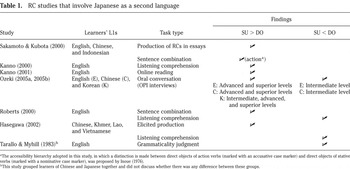
Table 1 presents a summary of the findings of previous studies on the acquisition of RCs in L2 Japanese.
RC studies that involve Japanese as a second language

Sakamoto and Kubota (2000) reported that their study of essays written by nonnative speakers (NNSs) of Japanese showed that subject-gap RCs were the most frequently used type of RC, followed by object-gap RCs.2
Shirai suggested that the difference in frequency between subject-gap and object-gap RCs found in Japanese NS discourse (reported in Ozeki, 2005a, 2005b; Ozeki & Shirai, this issue) can explain Sakamoto and Kubota's (2000) results. This might be correct for advanced learners of Japanese, but a preference for subject-gap RCs over object-gap RCs also showed up in at least one group of beginning learners in Sakamoto and Kubota's study.
Sakamoto and Kubota (2000) adopted Inoue's (1976) accessibility hierarchy, in which a distinction is made between direct objects of action verbs (marked with an accusative case marker) and direct objects of a stative verbs (marked with a nominative case marker). They reported that the learners in their study found the relativization of direct objects easier than the accessibility hierarchy predicts, but it is not precisely clear how much easier it was.
Ozeki (2005a, 2005b; see also Ozeki & Shirai, this issue) presented somewhat mixed results, in that subject-gap RCs were most frequently used in the Oral Proficiency Interview (OPI) data collected from Korean-, English-, and Chinese-speaking Japanese as a second language (JSL) learners at all of the nonnovice proficiency levels in her study—except for the English- and Chinese-speaking learners at the intermediate level, who produced more object-gap RCs. However, the importance of this exception might be tempered by the fact that the number of tokens was very small, as Ozeki noted. (The average frequency of RCs in the interview was 3.4 for the Chinese-speaking intermediate learners and 2.6 for the English-speaking intermediate learners.) Furthermore, the modifiers produced by these learners were short, and some consisted of just a verb. Additionally, it is possible that some of these modifiers were used as chunks rather than as RCs.
On the other hand, some of the studies summarized in Table 1 reported that the relative difficulty of the two types of RC varies depending on whether tasks involved production or comprehension. For instance, Roberts (2000) reported that learners did better on subject-gap RCs than on object-gap RCs on a sentence combination production task, but the accuracy order was reversed on a reading comprehension task. Hasegawa (2002) reported results parallel to those of Roberts: Of the children that she studied, those in grades 1–3 produced more subject-gap RCs than object-gap RCs on an elicited production task, but their accuracy rate was higher for object-gap RCs than for subject-gap RCs on a listening comprehension task.
Tarallo and Myhill (1983) reported an interesting result for a study that employed a grammaticality judgment task involving RCs with a resumptive pronoun in various syntactic positions. (A resumptive pronoun is a copy pronoun that appears in the position relativized on; it is coreferential with the head noun.4
An example of Hebrew object gap relative clause with a resumptive pronoun:
Shoshana hi ha-ishai [she-nili ohevet otai]
Shoshana is the-woman that-Nili loves her (resumptive pronoun)
“Shoshanna is the woman that Nili loves.” (Ariel, 1990, p. 149)
However, due to problems in both the task and the test sentences, I believe that Tarallo and Myhill's (1983) finding is inconclusive because it is difficult to know precisely why particular test sentences were rejected. Consider, in this regard, the sentence in (2), taken from their Appendix.

In the intended interpretation, the head noun gakusei “student” is coreferential with the NP in the subject position. This should give an unacceptable result for two reasons. First, a resumptive expression is not permitted in the subject position in Japanese. Second, the particular lexical item used in the test items (ano) cannot function as a resumptive expression in Japanese (J. Haig, personal communication, December 1, 2005).
Moreover, Tarallo and Myhill's (1983) test item might have a second interpretation because the head noun can be interpreted as a relativized comitative phrase, which gives the interpretation “The student with whom that person is studying English is pretty.” Although this interpretation is generally not acceptable to native speakers (NSs) of Japanese, as pointed out by a number of Japanese linguists (e.g., Kuno, 1973; Matsumoto, 1997), it can be made acceptable by simply adding an adverb such as isshoni “together,” as in (3).

The availability of this interpretation might have contributed to the higher acceptance of the RC with a resumptive expression in the subject position.5
The judgments for ungrammatical sentences with resumptive expressions in other positions were not consistent with the NPAH prediction, either. For instance, the postnominal RC group accepted resumptive expressions at a lower rate in the indirect object position than in the direct object position (34% vs. 21%).
If we set aside Tarallo and Myhill's (1983) results, a somewhat clearer picture emerges. In particular, the studies reviewed here uniformly indicate that subject-gap RCs are easier than object-gap RCs in production. On the other hand, results are split for comprehension. Where does this variation come from, and can it be attributed to processing factors that arise in the course of sentence comprehension? In the next section, I will discuss the possible role of two factors in the processing of RCs: the relative order of the filler and the gap, and the presence or absence of semantic clues (i.e., animacy, in this study) to the interpretation of the NPs in the RC.
STRUCTURAL PROPERTIES OF THE LANGUAGES INVOLVED IN THIS STUDY AND TWO FACTORS
Structural Properties of L1s Relevant to This Study
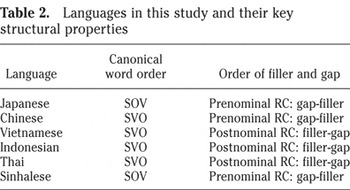
To isolate and assess the potential role of the two relevant factors of RC processing discussed in the next subsection, it is necessary to conduct a comparative study of the processing of Japanese RCs by adult L2 learners from different L1 backgrounds. Table 2 lists six relevant languages and their key structural properties.
Languages in this study and their key structural properties

Two Factors
Filler-Gap Order.
Whether a language has prenominal or postnominal RCs generally correlates with head directionality within VPs and prepositional phrases (PPs). Thus, head-initial languages with verb-object and preposition-NP order (e.g., English) typically have postnominal RCs. In contrast, head-final languages with object-verb and NP-postposition order (e.g., Japanese) typically have prenominal RCs.6
Although this generalization holds for the two languages involved in this study, it is too simplistic in the long run. Hawkins (1999), citing Dryer (1992), reported that there is a slight skewing in favor of postnominal RCs even in object-verb (OV) languages (59% vs. 41%). Hawkins further noted that postnominal RCs are predominantly found in nonrigid OV languages rather than in rigid OV languages such as Japanese.

As seen here, English has postnominal RCs, so the head noun (i.e., the filler) precedes the gap. In contrast, because Japanese has prenominal RCs, the gap precedes its filler. Thus, the gap in the direct object position in (4) and (5) occurs after the word that determines its reference (“book”) in English, but before it in Japanese. Hawkins (1999) made the interesting claim that the processor favors filler-gap order (vs. gap-filler), because this allows gaps to be immediately associated with a preceding filler, thereby lessening the burden on working memory.7
This has to do with the nature of gaps and fillers. A gap has no phonetic form and its existence has to be inferred, whereas a filler has both form and content that allows the parser to search for possible gap sites of the appropriate type. If the gap comes first, not only does the parser first have to recognize its existence but its interpretation also has to be delayed until the filler is encountered, which requires considerable backtracking.
Of the languages in this study, Vietnamese, Indonesian, and Thai are the least like Japanese with respect to word order and the position of RCs, because they are head-initial languages and have postnominal RCs. Sentences (6)–(8) are the equivalent of (4) in these languages.

On the other hand, Sinhalese is the most similar to Japanese because both are head-final languages with prenominal RCs. Sentence (9) is an example of a RC in Sinhalese.

Chinese presents an unusual intermediate case. Although it is a head-initial subject-verb-object (SVO) language like English, it has prenominal RCs; thus, the gap precedes its filler, as in Japanese.

Chinese is therefore like Japanese in having a prenominal RC but dissimilar in being a head-initial language.
If Hawkins' (1999) proposal that the parser favors the filler-gap order is correct, Vietnamese-speaking, Thai-speaking, and Indonesian-speaking JSL learners should have more difficulty processing Japanese RCs than Chinese-speaking and Sinhalese-speaking learners. This is because the former groups of learners have to switch from the parser-favored filler-gap order to the disfavored gap-filler order, whereas the latter can simply maintain the same disfavored gap-filler order.
Animacy.
Studies in the competition model (Bates & MacWhinney, 1981, 1989) investigated the strength of various cues (e.g., word order, animacy, and case markers) used in sentence processing in different languages. Previous L2 studies using this model suggested that a semantic-based strategy (i.e., the use of animacy cues) often takes precedence over a grammar-based one such as word order (Gass, 1987; Harrington, 1987; Sasaki, 1991, 1994). For instance, Sasaki (1991) found that English-speaking learners of Japanese (as well as Japanese-speaking learners of English) were more reliant on animacy cues than on word order cues in determining the grammatical function of NPs in processing target language sentences.
Additionally, studies on parsing of RCs have shown that animacy influences processing difficulty (Mak, Vonk, & Schriefers, 2002; Traxler et al., 2002; Weckerly & Kutas, 1999). For instance, Mak et al. reported that subject RCs had a shorter reading time than object RCs in online reading when the object was animate, but there was no difference in reading time when the object was inanimate. In other words, the additional semantic cue, namely the inanimacy of the direct object of a transitive verb, expedited RC processing.
EXPERIMENT
Participants
Five groups of JSL learners participated in this experiment: Group 1 was composed of 43 Chinese-speaking JSL learners, group 2 was made up of 10 Vietnamese-speaking JSL learners, group 3 was composed of 10 Indonesian-speaking JSL learners, group 4 had 7 Thai-speaking JSL learners, and group 5 was made up of 8 Sinhalese-speaking JSL learners. All participants were enrolled at the elementary level in an intensive Japanese language program at a university in Japan. All had received very little or no formal instruction prior to entering the program, and all can be assumed to be at a similar proficiency level. Data were collected during class time within a week after the RC construction was introduced, at which point the learners had had approximately 2 months of instruction in Japanese. Additionally, data were collected from 10 NSs of Japanese who were all students at the University of Hawai‘i at the time of the experiment.
Materials and Procedure
The picture selection comprehension task used in Kanno (2000) was employed in this study.8
The picture selection task was originally used by O'Grady, Lee, and Choo (2003), who found that subject-gap RCs were easier than object-gap RCs for English-speaking learners of Korean. This type of task was also adopted by Hasegawa (2002).

Participants were given a booklet that began with the following instructions in English:
Each page of this booklet contains a series of three pictures. As you go to each page, you will hear a tape-recorded voice describing a person or object in one of the three pictures. Your job is simply to put a small circle around the person or object described in the sentence. (Do NOT put the circle around the entire box.)
There were 20 test sentences arranged randomly. The instructions as well as the test sentences were prerecorded. The test sentences were read twice and played to the participants at the rate of about one every 8 s. The experiment took about 20 min to complete.
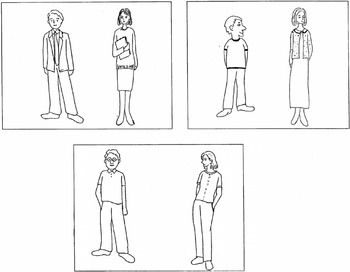
Figure 1 illustrates a sample picture from the booklet. If learners understand the subject RC in (11a), they will circle the right-hand figure in the third frame. If they comprehend the direct object RC in (11b), they will circle the right-hand figure in the second frame.

Sample page from the booklet.
As Figure 1 illustrates, the items (people or objects) in the three pictures are presented in pairs that are set up to contrast with each other in some respect. For instance, in the three pictures on the sample page, a woman watching a man contrasts with a woman being watched by a man, and a woman watching a man contrasts with a woman not watching a man. Similarly, in the three pictures for one of the [−R] RCs, a man eating a bowl of buckwheat noodles contrasts with a man eating ice cream, and a man eating a bowl of buckwheat noodles contrasts with a woman eating a bowl of buckwheat noodles.
RESULTS AND DISCUSSION
Accuracy
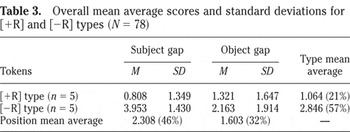
The 10 NSs of Japanese who participated in the task all scored 100% on all RC types, except for two individuals who missed one item each. Table 3 presents the overall comprehension scores of all JSL groups together.
Overall mean average scores and standard deviations for [+R] and [−R] types (N = 78)

The results permit two conclusions. First, nonreversible RCs ([−R] type) were much easier to comprehend than their reversible counterparts ([+R] type), as indicated by the mean average score for each type. Second, subject-gap RCs were easier overall than object-gap RCs, as indicated by the mean average score for each position type. A two-way repeated measures ANOVA showed significant effects for sentence type, F(1, 77) = 239.029, p < .01, gap position, F(1, 77) = 11.498, p < .01, and an interaction between type and gap position, F(1, 77) = 87.522, p < .01. Post hoc Scheffé tests (p < .01) revealed that the difference between subject-gap RCs and object-gap RCs was not significant for the [+R] type, but it was for the [−R] type.
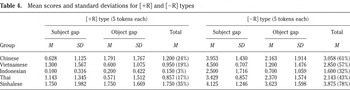
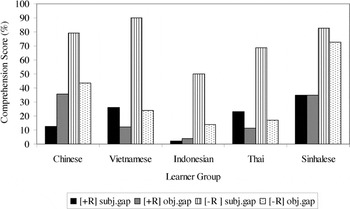
Let us now examine how each of the JSL groups performed. Table 4 and Figure 2 present the overall comprehension accuracy scores for each of the five groups of JSL learners on the [+R] type and [−R] type patterns.
Mean scores and standard deviations for [+R] and [−R] types


Comprehension scores in percentage for the five groups of JSL learners.
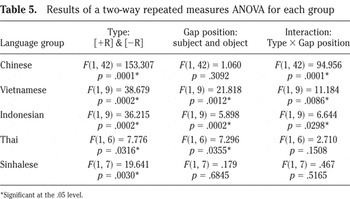
Table 5 presents the results of a two-way repeated measures ANOVA for each group. Because there is a huge difference in the number of subjects in the Chinese group versus the other four groups, no group comparison was done.
Results of a two-way repeated measures ANOVA for each group

All groups found nonreversible RCs much easier to comprehend than their reversible counterparts, as indicated by the mean average score for each type in Table 4. In fact, the difference between these two types of RCs was statistically significant for all groups. This is presumably because the learners have an additional animacy cue to assist in determining the grammatical relation of the overt NP and of the gap that occurred in each RC.
A more appropriate description might be that most of the learners could not even process the [+R] type RCs, as indicated by the very low accuracy rates for these patterns. This is particularly the case for NSs of head-initial languages with postnominal RCs: The Vietnamese, Indonesian, and Thai speakers performed around or below chance level (16.6%). This strongly suggests that in the period following initial exposure to Japanese RCs, learners cannot use case marker information to process these constructions and that they therefore must rely on nongrammatical information to determine the grammatical relation of the gap in RCs.
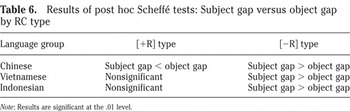
There was a significant effect for the position of the gap (i.e., subject gap vs. object gap) for the Vietnamese, Indonesian, and Thai groups, but no significant difference was found for the Chinese and Sinhalese groups. However, as Table 4 shows, a significant interaction effect for RC type and gap position was found for the Chinese, Vietnamese, and Indonesian groups but not for the Thai and Sinhalese groups. Table 6 presents the results of post hoc Scheffé tests.
Results of post hoc Scheffé tests: Subject gap versus object gap by RC type

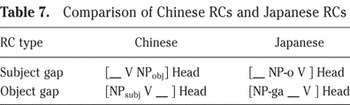
A key finding here is that the Chinese group found subject-gap RCs significantly easier than object-gap RCs for the [−R] type but that they exhibited the opposite performance for the [+R] type, for which they were much more accurate on the object-gap RCs. There appears to be an independent reason for this. As seen in the schema presented in Table 7, object-gap RC patterns in Japanese and Chinese are similar in an important respect, in that they both consist of the subject NP and the verb followed by the head noun, although the position of the gap is different. Hence, Chinese speakers might well be able to process object RCs in Japanese in a way very similar to how they process their counterparts in their native language. There is no comparable similarity between subject-gap relatives in the two languages. Matthews (personal communication, January 2006) pointed out that the Japanese object RC resembles not only an object-gap RC in Chinese but also the canonical order of a main clause in that language.9
In fact, this was also noted by Hsiao and Gibson (2003) as a possible factor for their observed result: that L1 Chinese speakers processed object-gap RCs faster.
Comparison of Chinese RCs and Japanese RCs

Nonetheless, neither of these types of strategies is used systematically, as indicated by the fact that the Chinese speakers attained an accuracy rate of just 35% (mean score of 1.79 out of 5) for [+R] type object-gap RCs. Moreover, it is important not to forget that the Chinese JSL learners found [−R] type subject-gap RCs easier than their object-gap counterparts.
In summary, we can draw three conclusions from these results. First, the JSL learners found subject-gap RCs easier than object-gap RCs, as indicated by the overall mean average scores in Table 3. However, this preference was suspended when the test sentences were too difficult for the learners to process (i.e., when there was no nongrammatical clue to their interpretation). Second, the usefulness of animacy in processing RCs is evident in the clear difference between the reversible and nonreversible test sentences ([+R] type vs. [−R] type), even though this clue is not reliable enough to overcome the difficulty of object-gap RCs (hence the lower scores on these patterns in the [−R] type test items). Third, the effect of the order of filler and gap was observed only when the L1 had the same head direction as the L2. This is the case for Sinhalese-speaking learners, who exhibited more or less the same degree of difficulty for subject-gap and object-gap RCs.
Error Patterns
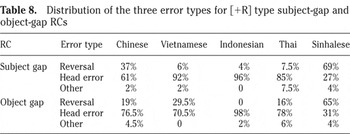
The errors made by the various groups of learners can be categorized into three types: reversals, head errors, and others. Reversals involve interpretation of the subject in the RC as if it were the direct object and vice versa, as illustrated in (13b).

Note that in order to make a reversal error, the learners must ignore information from case particles. Head errors involve a misidentification of the noun that serves as head of the RC. For instance, in a phrase like (14a), the first NP (otoko-no hito-ga “a man”) is interpreted as the head of the RC, resulting in the interpretation in (14b).

Head errors indicate that learners have not mastered the relative position of RCs and heads in the target language. Instead of having the RC precede the head, they incorrectly take the head to come first.10
Matthews suggested the canonical word-order strategy as another possible interpretation of head errors; that is, learners of head-initial languages process the relativized NP as a SVO main clause. However, the fact that these learners were quite accurate and made only few head errors in processing [−R] type subject-gap RCs indicates that they are indeed processing the stimulus as RCs but that they mistakenly take the head to be initial when encountering difficulty in processing RCs that contain nongrammatical cues.
Distribution of the three error types for [+R] type subject-gap and object-gap RCs

Once again, the pattern of error types exhibited by the Chinese JSL learners is very similar to that of the Vietnamese, Thai, and Indonesian JSL learners and is different from the Sinhalese speakers. The predominant mistake made by the Chinese and other head-initial language groups involved head errors both in subject-gap and object-gap RCs. This fact—along with the lower accuracy scores for [+R] type RCs—suggests that these groups have great difficulty with this type of RC. In contrast, the majority of errors made by the Sinhalese group are reversals. This suggests that they have no problem with the placement of Japanese RCs (they know that RCs are prenominal, just as they are in Sinhalese) but that they are not good at utilizing case marker information, which leads to a great many reversal errors.
The fact that Chinese has prenominal RCs, just like Japanese, did not help the Chinese speakers process [+R] type RCs in Japanese. This suggests that head direction is at least as important for predicting L2 learners' processing profiles as is the actual position of the RC in the L1. Chinese resembles Japanese in having prenominal RCs but differs from it in being head-initial with respect to other phenomena. Crucially, Chinese-speaking learners of Japanese make head errors just like those of NSs of Vietnamese and Indonesian—languages that have both head-initial word order and postnominal RCs. Another finding that is worth noting here is that the Chinese JSL learner group made more reversal errors for subject-gap RCs than for object-gap RCs. As noted previously, both subject-gap and object-gap RCs in Japanese are like object-gap RCs in Chinese with respect to word order ([NP V Head]). If the Chinese JSL learners were to ignore the accusative case marking information, they would end up with a reversed interpretation for subject-gap RCs—just as observed in this study.
EASE OF PROCESSING OBJECT-GAP VERSUS SUBJECT-GAP RCs
The results of this study are similar to those reported in Kanno (2000, 2001) but crucially different from those of Roberts (2000) and Hasegawa (2002), who both found Japanese object-gap RCs easier to process than subject-gap RCs. I will provide a possible account for Roberts' results and point out several confounding factors that might have contributed to Hasegawa's results.
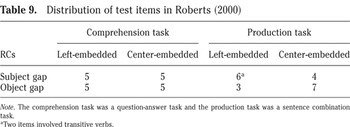
A possible explanation for Roberts' (2000) results lies in the type and distribution of his test items (see Table 9). Roberts' test items included left-embedded and center-embedded RCs, as illustrated in (15) and (16).

This is crucial because center-embedded subject-gap RCs create a garden-path effect that interferes with processing. As illustrated in (16a), the processor is misled into believing that the pattern being processed is a monoclausal sentence until the head noun is encountered. There is no such effect in the case of object-gap relatives. This could explain the unexpected preference for object-gap RCs in Roberts' data.11
I avoided this sort of problem in this study by using the formulaic matrix clause maru-o tsuketekudasai “please circle” for all test items, allowing subjects to focus on the interpretation of just the RC.
Distribution of test items in Roberts (2000)

Like Roberts (2000), Hasegawa (2002) reported that a group of nonnative participants found Japanese object-gap RCs easier than subject-gap RCs on the listening comprehension task that she employed. There were two groups of NNSs in Hasegawa's study: grade 1–3 children and grade 4–6 children, with four different L1 backgrounds represented in each group. A statistically significant difference between subject-gap and object-gap RCs was found for the younger age group. Hasegawa was cautious in interpreting her results because a ceiling effect was observed for the grade 4–6 children.
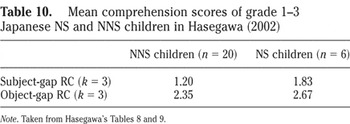
It appears that more than one factor might have contributed to Hasegawa's (2002) results. One such factor might involve the difficulty associated with particular test items. Hasegawa's results indicated that NS Japanese children as well as the NNS children found object-gap RCs easier than their subject-gap counterparts. In particular, the scores on subject-gap RCs were below 2.0 out of 3 for both groups: 1.20 for the NNS children and 1.83 for the NS Japanese children (see Table 10). The low score by the NS Japanese children suggests that they might have had some difficulty processing a particular test item used for the subject-gap RCs. Because there were only three tokens for each RC type, the effect of this difficulty would have been magnified.
Mean comprehension scores of grade 1–3 Japanese NS and NNS children in Hasegawa (2002)

Another possible factor is the difficulty of the task itself for this age group, as also suggested by Hasegawa (2002). The overall results showed that the grade 1–3 NS Japanese children scored as low as grade 1–3 NNS Japanese children. This suggests that some element of the task might have been problematic for this age group.
CONCLUSION
This study addressed the question of whether learners of Japanese who have just been exposed to RCs comprehend subject-gap RCs more easily than object-gap RCs regardless of their L1s, as predicted by a configurational account like the SDH. The results of a listening comprehension test involving two types of test sentence (reversible and nonreversible) were somewhat contradictory. On the one hand, JSL learners found subject-gap RCs easier to process than object-gap RCs when there were animacy clues (as in the [−R] type items). This suggests that when the interpretation of RCs is facilitated by animacy clues, they are processed in the manner assumed by the SDH, which results in lower scores for direct object relatives. On the other hand, matters are not so straightforward when learners have to rely on syntactic clues alone (the [+R] type items). Under these circumstances, performance is in general very low; in some cases, it is well below the level of chance. The Sinhalese, Vietnamese, Thai, and Indonesian groups in this study exhibited a slight or no clear preference for subject-gap RCs, whereas the Chinese group exhibited a preference for object-gap RCs, apparently because of a surface similarity with the word order in object-gap RCs in Chinese. This suggests that the learners have difficulty organizing elements into an appropriate structural representation and therefore have to resort to a L1 word-order strategy. This result is fully consistent with a configurational account like the SDH, because without the appropriate structural representation, the asymmetry between subject-gap and object-gap RCs cannot manifest itself.
Another intriguing finding of this study is that Chinese-speaking learners processed Japanese RCs in a way similar to NSs of other SVO languages, as evidenced by their high proportion of head errors, but different from speakers of subject-object-verb (SOV) languages such as Sinhalese. This suggests that the effect of Chinese having prenominal RCs like Japanese is relatively unimportant. This is consistent with the finding that in head-initial languages, information provided by the verb plays a major role in integrating and organizing the incoming elements (e.g., Boland & Tanenhaus, 1991). In contrast, recent studies (e.g., Miyamoto, 2002; Yamashita, 1997) have shown that in head-final languages like Japanese, the parser makes active use of other grammatical information (e.g., information from case markers or postpositions that are attached to arguments) in the course of sentence processing. It is possible that the Chinese speakers have difficulty adjusting to the sources of information required to process Japanese efficiently and therefore ignore the clues that signal the presence of a RC.
In assessing all of these findings, it is important to bear in mind that the participants in this study were deliberately tested within a short period of their first exposure to RC patterns. This has the advantage of allowing us to uncover their initial reaction to these sorts of construction, but it leaves open the question of how they adjust their L2 grammar and processor over time to accommodate these and other novel patterns. Unfortunately, investigation of this equally fascinating and important question must be left to future research.
APPENDIX
REVERSIBLE ([+R]) Type
Subject-Gap RCs
Otoko-no hito-o miteiru onna-no hito-ni maru-o tsuketekudasai.
“Please circle a woman that is watching a man.”
Onna-no hito-o matteiru otoko-no hito-ni maru-o tsuketekudasai.
“Please circle a man that is waiting for a woman.”
Onna-no hito-o yondeiru otoko-no hito-ni maru-o tsuketekudasai.
“Please circle a man that is calling a woman.”
Otoko-no hito-o miteiru robotto-ni maru-o tsuketekudasai.
“Please circle a robot that is watching a man.”
Onna-no hito-o shookaishiteiru otoko-no hito-ni maru-o tsuketekudasai.
“Please circle a man that is introducing a woman.”
Object-Gap RCs
Otoko-no hito-ga miteiru onna-no hito-ni maru-o tsuketekudasai.
“Please circle a woman that a man is watching.”
Onna-no hito-ga matteiru otoko-no hito-ni maru-o tsuketekudasai.
“Please circle a man that a woman is waiting.”
Onna-no hito-ga yondeiru otoko-no hito-ni maru-o tsuketekudasai.
“Please circle a man that a woman is calling.”
Robotto-ga miteiru onna-no hito-ni maru-o tsuketekudasai.
“Please circle a woman that a robot is watching.”
Onna-no hito-ga shookaishiteiru otoko-no hito-ni maru-o tsuketekudasai.
“Please circle a man that a woman is introducing.”
NONREVERSIBLE ([−R]) TYPE
Subject-Gap RCs
Denwa-o tsukatteiru otoko-no hito-ni maru-o tsuketekudasai.
“Please circle a man that is using a phone.”
Hana-o motteiru otoko-no hito-ni maru-o tsuketekudasai.
“Please circle a man that is holding flowers.”
Soba-o tabeteiru otoko-no hito-ni maru-o tsuketekudasai.
“Please circle a man that is eating a buckwheat noodle.”
Hon-o yondeiru onna-no hito-ni maru-o tsuketekudasai.
“Please circle a woman that is reading a book.”
Karee-o tsukutteiru otoko-no hito-ni maru-o tsuketekudasai.
“Please circle a man that is making curry.”
Object-Gap RCs
Onna-no hito-ga tsukatteiru denwa-ni maru-o tsuketekudasai.
“Please circle a phone that a woman is using.”
Otoko-no hito-ga motteiru hana-ni maru-o tsuketekudasai.
“Please circle flowers that a man is holding.”
Onna-no hito-ga tabeteiru soba-ni maru-o tsuketekudasai.
“Please circle a buckwheat noodle that a woman is eating.”
Otoko-no hito-ga yondeiru hon-ni maru-o tsuketekudasai.
“Please circle a book that a man is reading.”
Otoko-no hito-ga tsukutteiru karee-ni maru-o tsuketekudasai.
“Please circle a curry that a man is making.”