Introduction
Pests (especially weeds, pathogens and insects) are the greatest challenge to agricultural crops in the world, drastically reducing production, in the range of 25–50%Reference Pimentel, McLaughlin, Zepp, Lakitan, Kraus, Kleinman, Vancini, Roach, Graap, Keeton and Selig1, Reference Oerke2. Among the most important pests, weeds alone are responsible for a reduction in crop yields of almost 34%Reference Oerke2. With the objective of protecting the agricultural crops, high amounts of synthetic pesticides are used around the world. Nowadays, the maize weevil is the most relevant pest found during storage of maize grains.
Aromatic plants and their essential oils have been used since antiquity in flavor and fragrances, as condiment or spice, in medicines, as antimicrobial/insecticidal agents, and to repel insect or protect stored productsReference Dorman and Deans3, Reference Nerio, Olivero-Verbel and Stashenko4. These oils represent effective alternatives to synthetic pesticides without producing adverse effects on the environmentReference Isman5, Reference Kordali, Aslan, Çalmasur and Cakir6. The essential oils of plants have been broadly studied for pest-control, including toxic and repellent effectsReference Chu, Hu and Liu7, Reference Mossi, Astolfi, Kubiak, Lerin, Zanella, Toniazzo, Oliveira, Treichel, Devilla, Cansian and Restello8, anti-feedant, ovicidal and other propertiesReference Zapata, Lognay and Smagghe9, Reference Stefanazzi, Stadler and Ferrero10.
Many plant secondary metabolites such as monoterpenoids have insecticidal activity against stored product pestsReference Lee, Peterson and Coats11, Reference Regnault-Roger and Hamraoui12. Hideyuki and MitsuoReference Hideyuki and Mitsuo13 noted that the mixture of monoterpenoids could have a synergistic effect on the inhibition of acetylcholinesterase. These authors observed that a limonene, linalool and lynalyl acetate mixture showed a synergistic effect and was more inhibitory than bergamot oil or only the application of monoterpenoids.
The sassafras tree, a species of the Atlantic Forest ecosystem of South America, is of high commercial value, especially because of its wood quality. Leaves contain oils such as safrole, kaempferol, quercetin and other compounds that may have insecticidal activity, along with other uses. Moreover, sassafras is a phytochemical known by the presence of flavonoids such as kaempferol and quercetin, steroids, sesquiterpenes and essential oils, a component of which is safroleReference Lordello, Cavalheiro, Yoshida and Gottlieb14.
The leaf essential oils of ten species of Ocotea (Lauraceae) from Monteverde, Costa Rica (O. floribunda, O. holdridgeana, O. meziana, O. sinuata, O. tonduzii, O. valeriana, O. veraguensis, O. whitei and two undescribed species—Ocotea new species ‘los llanos’ and Ocotea new species ‘small leaf’) have been obtained by hydrodistillation and analyzed by gas chromatography coupled to a mass spectrophotometer (GC–MS), and the more common constituents were α-pinene, β-pinene, β-caryophyllene and germacrene-DReference Takaku, William, Haber and Setzer15.
Pinto Junior et al.Reference Pinto Junior, Carvalho, Pellico Netto, Weber, Souza and Furiatti16, evaluated the essential oils of sassafras and Eucalyptus viminalis (eucalyptus) on the control of larvae and adults of lesser mealworm (Alphitobius diaperinus), comparing their insecticide potential. They concluded that the essential oils of sassafras and eucalyptus can be used to control lesser mealworm as a new integrated strategy for the management of this pest.Reference Pinto Junior, Carvalho, Pellico Netto, Weber, Souza and Furiatti16 This study led us to consider and test these oils on the maize weevil.
Moreover, there are no reports in the current literature analyzing the effect of oil of sassafras against the maize weevil. In this context, the aim of this study was to evaluate the bioactivity and repellent effect of essential oil of sassafras against Sitophilus zeamais in maize grains.
Materials and Methods
Plant materials
Leaves of sassafras were collected in summer (March) in Marcelino Ramos (RS, south of Brazil). The identity of the plants was confirmed by the Balduino Rambo Herbarium of the Universidade Regional Integrada in Erechim, south of Brazil (BRH: 11.507).
Procedure for isolation and characterization of the essential oils
The plant material was dried naturally on laboratory benches at room temperature (30 °C) for 5 days until crisp. The dried material was stored at room temperature and then hydro distilled to extract the essential oil using a Clevenger-type apparatus for 4 h. The extraction conditions were established as 100 g of air-dried sample and 1:30 plant material/water volume ratio. Anhydrous sodium sulfate was used to remove the water after extraction. The extracted oil was stored in refrigerator at 4 °CReference Mossi, Astolfi, Kubiak, Lerin, Zanella, Toniazzo, Oliveira, Treichel, Devilla, Cansian and Restello8.
The chromatographic analyses of the essential oils were performed using a Shimadzu—QP 5050A series gas chromatograph (GC-MS), using a DB-5 fused silica capillary column (30 m×0.25 mm internal diameter×0.25 μm film thickness). The temperature program used for the analysis was: initial temperature at 60 °C, held for 3 min, and ramped at 3 °C min−1 to 180 °C, then 20 °C min−1 to 300 °C. Helium was used as a carrier gas at a flow rate of 1 ml min−1. The detector temperature was set to 300 °C, and the injector temperature 240 °C with injection port (split 1:20). The oil compounds were identified by comparison of mass spectra of each peak with those of authentic samples in a mass spectrum library (The Wiley Registry of Mass Spectral Data, 7th ed.).
Insects
S. zeamais was cultured in a controlled temperature (25±1 °C) and at 70–75% of relative air humidity (rh) in darkness. The food medium used was whole maize grainsReference Mossi, Astolfi, Kubiak, Lerin, Zanella, Toniazzo, Oliveira, Treichel, Devilla, Cansian and Restello8. The adults used in the experiment were 2–3 weeks post-emergence.
Contact toxicity on filter paper
The contact effect of essential sassafras oils against maize weevil was evaluated on filter paper discs (Whatman No. 1) (14 cm diameter, surface 153.9 cm2), treated with different dosages of oil. The filter papers were placed in glass Petri dishes (14 cm diameter, 1.5 cm height and volume 0.23 l). An aliquot of 0, 2.5, 5, 7.5, 10, 20, 50, 80, 100, 120, 150 and 200 μl of oil was applied to the filter paper discs, corresponding to dosages of 0, 0.016, 0.032, 0.048, 0.07, 0.14, 0.32, 0.52, 0.65, 0.78, 0.97 and 1.30 μl cm−2. Fifty unsexed maize weevil adults were used separately in each dish and these were kept in darkness in the laboratory at 25±1 °C and 70–75% rh. Each treatment was replicated at least three times. Insect mortalities were analyzed after 24 h. The percentage of insect mortality was calculated using the Abbott correction formula for natural mortality in untreated controlsReference Abbot17.
Assessment of lethal doses and repellency bioassay
The different 50% lethal doses (LD50) were calculated using linear regression analysis, at 24 h, based on the above-mentioned experimental data, i.e. contact toxicity on filter paperReference Finney18.
After that, the effect of on insect mortality against time (0, 4, 8, 12, 24, 48 and 72 h) at the lethal doses (LD50) was studied. The treatment was replicated five times in similar conditions to those used in the study of contact toxicity on filter paper.
The effects of essential sassafras oils against maize weevils were evaluated five times in the repellency bioassay. The repellent action of the essential oils was determined using a system comprising five Petri plates (diameter=14 cm, 153.9 cm2), codified as A, B, C, D and E. To plates A and B, 20 g maize with different aliquots (10, 20, 50, 80 and 100 μl) corresponding to dosages of 0.065, 0.130, 0.325, 0.520 and 0.659 μl cm−2 of the essential oils, were added. To plates C and D (blanks), only the substrate was added; and 50 adult maize weevils were added to the central plate (E). After 24 h the number of insects in each plate was counted. Each plate was kept in darkness at 25±1 °C and 70–75% rh. Aiming at comparing the different treatments, the preference index (PI) was established, as cited by Procópio et al.Reference Procópio, Vendramim, Ribeiro and Santos19, defined as:
 $${\tab{\rm PI} =\cr\tab\enspace \displaystyle{{\% \,{\rm of}\,{\rm insects}\,{\rm of}\,{\rm test}\,{\rm plants} - \% \;{\rm of}\,{\rm insects}\,{\rm of}\,{\rm blank}\,{\rm experiment}} \over {\% \,{\rm of}\,{\rm insects}\,{\rm of}\,{\rm test}\,{\rm plants} + \% \;{\rm of}\,{\rm insects}\,{\rm of}\,{\rm blank}\,{\rm experiment}}}$$
where a PI of −1.00 to −0.10, indicates test plant repellent; PI of −0.10 to +0.10, test plant neutral; and PI of +0.10 to +1.00, test plant attractant.
Repellency bioassay simulating small bins
The values of the effect of essential sassafras oils against maize weevil were evaluated five times in the repellency bioassay (similar to that previous described). However, in this case, the repellent action of the essential oils was determined using a system containing five small glass bins (diameter=4.5 cm, height=6 cm, and total area=95.4 cm3), codified as A, B, C, D and E. To bins A and B, 80 g maize with different aliquots (50, 100, 150, 250, 400 and 500 μl bins−1) corresponding to dosages of 0.52, 1.04, 1.57, 2.62, 4.19 and 5.24 μl cm−3 of the essential oils, were added. To bins C and D (blanks), only the substrate was added; and 50 adult maize weevils were delivered to the central bin (E). After 24 h the number of insects in each bin was counted. The treatment was replicated five times in similar conditions to those used in the contact toxicity on filter paper experiment. Each small glass bin was kept in darkness at 25±1 °C and 70–75% rh. Aiming at comparing the different treatments, the PI was established as cited by Procópio et alReference Procópio, Vendramim, Ribeiro and Santos19.
Statistical analysis
Data were analyzed by analysis of variance (ANOVA). Mean separation was determined by the Tukey's test at a confidence level of 95%.
Results and Discussion
Chemical constituents of the essential oils
In general, aromatic plants contain essential oils in concentrations of about 1–3 wt%Reference Rozmana, Kalinovica and Korunicb20. In this work, the yield of the essential oils obtained by hydro distillation was 2.6% (v/w) for sassafras. The essential oils, as already mentioned in the literature, can have different concentrations according to genetic, physiologic and climatic factors, the kind of soil and extraction techniqueReference Oltramari, Wood, Bonham, Verpoorte, Caro, Viana, Pedrotti, Maraschin and Maraschin21.
The results of the chemical analysis of each essential oil tested showed that the major constituents of the essential oils from leaves of sassafras were camphene (6%), mircene (1%), β-pinene (0.8%), limonene (3%), camphor (43%), safrole (42%), germacrene (1.2%) and spatulenole (2%).
The results obtained in this work are similar to those presented in the current literatureReference Oltramari, Wood, Bonham, Verpoorte, Caro, Viana, Pedrotti, Maraschin and Maraschin21; some differences could be attributed to the collection time, since medicinal species can present different concentrations of some compounds at different times of the year or development stagesReference Cansian, Mossi, Mazutti, Oliveira, Paroul, Dariva and Echeverrigaray22.
Filter paper contact toxicity
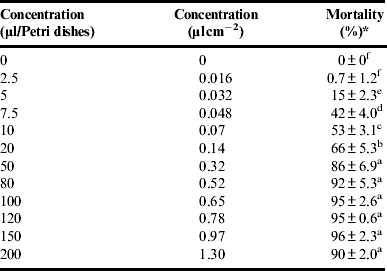
Table 1 shows the results in terms of the efficiency of insecticidal activity at different doses of essential oil of sassafras against maize weevil in stored maize grains. The essential oils of the sassafras caused about 86% mortality in concentrations of 0.32 μl cm−2, after 24 h of exposure.
Efficiency of insecticidal activity at different doses of essential oil of sassafras against maize weevil in stored maize grains in 24 h.
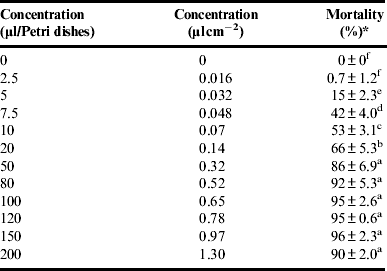
* Means (standard deviations) without a common letter are significantly different at 95% confidence level (Tukey's test).
The results obtained here can be considered interesting when compared with others presented in the literature. Tapondjou et al.Reference Tapondjou, Adler, Fontem, Bouda and Reichmuth23 showed that 1.56 μl cm−2 of essential oil of Eucalyptus saligna was necessary to obtain 100% mortality of S. zeamais on the fourth day of exposure, and 0.78 μl cm−2 of the essential oil of Cupressus sempervirens caused 100% mortality on the fifth day.
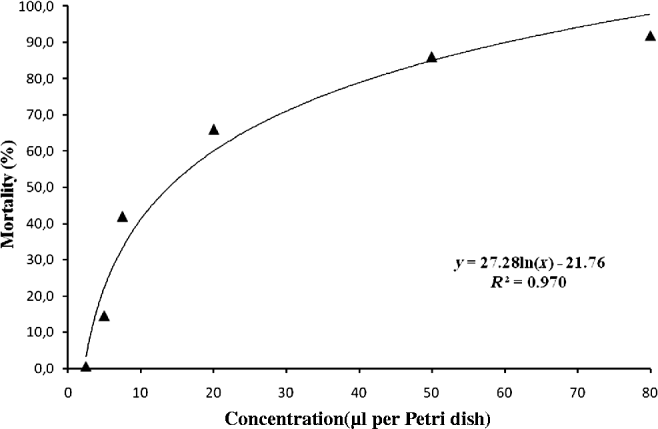
The LD50 value for sassafras essential oil against the maize weevil was 14.1μl or 0.09 μl cm−2. In the probit analyses, the calculated regression line equationReference Finney18 for maize weevil mortality was y=27.284ln(x)–21.764 (R 2=0.97), the results are shown in Fig. 1.
Mortality of maize weevil at different concentrations of sassafras oil at 24 h. The regression data were used to estimate the LD50 value.

The results obtained here are very promising when compared with those obtained by other authors. According to Tapondjou et al.Reference Tapondjou, Adler, Fontem, Bouda and Reichmuth23, the eucalyptus oil presented lower toxicity compared with cupressus oil to both insect species (LD50=0.36 μl cm−2 for maize weevil and 0.48 μl cm−2 for Tribolium confusum) on filter paper discs. These authors observed that the contact toxicity assayed by impregnation of these chemicals on filter paper discs, or coating onto maize grains, caused significant mortality of the evaluated insects.
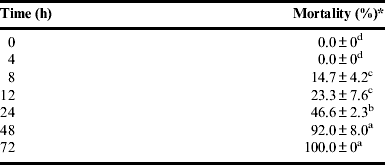
The study of the effect on insect mortality of lethal doses (LD50) showed that after 72 h a similar mortality of about 100% was observed. These results are presented in Table 2.
Effect of a lethal dose (LD50=0.14 μl cm−2) of sassafras essential oil against the maize weevil, for different times.
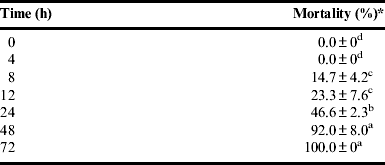
* Means (standard deviations) without a common letter are significantly different at 95% confidence level (Tukey's test).
Coitinho et al.Reference Coitinho, Oliveira and Godin Junior24, testing essential oils of different vegetable species, observed that the oil of Eucalyptus globulus, Lippia gracillis Schaer (Verbenaceae) and Azadirachta indica A. Juss. (Meliaceae) at a dosage of 50 μl/20 g presented higher toxicity, causing 100% mortality of adults of S. zeamais in maize grains. Mossi et al.Reference Mossi, Astolfi, Kubiak, Lerin, Zanella, Toniazzo, Oliveira, Treichel, Devilla, Cansian and Restello8 obtained for Eucalyptus dunni and E. saligna LD50 values of 0.16 and 0.25 μl cm−2, respectively, showing lower toxicity than sassafras essential oils (0.09 μl cm−2).
Dunkel and SearsReference Dunkel and Sears25 determined toxicity of essential oil vapors from Artemisia tridenata Nutt. ssp. vaseyana (Rydb.) against Rhyzopertha dominica and found that 1,8-cineole and camphor are the major agents of toxicity. Yan et al.Reference Yan, Shuit Hung and Manjunatha26, observed that S. zeamais Motschulsky and Tribolium castaneum (Herbst) adults were equally susceptible to contact toxicity of safrole or isosafrole. Safrole also possessed equal fumigant toxicity to adults of both species. However, isosafrole was generally more toxic than safrole to the insects tested. In flour disk bioassays, safrole showed very slight feeding deterrence against maize weevil adults.
The results obtained here are very interesting and the effect of the essential oil is probably because of the presence of camphor (43%) and safrole (42%), and the synergistic effect of both.
Repellency activity
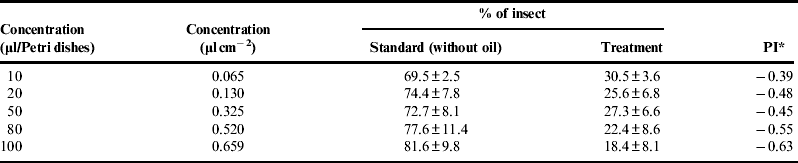
Based on the PI values (Table 3), the essential oil tested in this work showed efficiency against the adults of maize weevil and a trend of increasing activity with increasing dosage can be seen. The values of the PI varied from −0.39 (0.065 μl cm−2) to −0.63 (0.659 μl cm−2), being lower than −0.10, the minimum limit proposed by Procópio et al.Reference Procópio, Vendramim, Ribeiro and Santos19 to consider that a plant has repellent activity.
PI for the essential oil from sassafras, following the methodology proposed by Procópio et al.Reference Procópio, Vendramim, Ribeiro and Santos19.
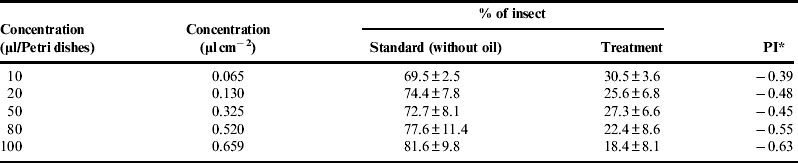
* PI of −1.00 to −0.10, test plant repellent; PI of −0.10 to +0.10, test plant neutral; PI of +0.10 to +1.00, test plant attractant.
Procópio et al.Reference Procópio, Vendramim, Ribeiro and Santos19 evaluated the repellent effect of fragments of leaves of six vegetable species against adults of maize weevil and verified, based on the PI, that two species were repellents, the leaves of Eucalyptus citriodora (PI=−0.81) and Capsicum frutescens (Meliaceae) (PI=−0.17)Reference Procópio, Vendramim, Ribeiro and Santos19. Tested eucalyptus oils were highly repellent to the two insect species, T. confusum and S. zeamais Reference Tapondjou, Adler, Fontem, Bouda and Reichmuth23.
The highly toxic and repellent effects of some of the other main constituents of these oils, such as camphor and safrole, terpineol and α-pinene, have been demonstrated by other researchersReference Prates, Leite, Craveiro and Oliveira27–Reference Papachristos and Stamopoulos29. The toxic effects of the essential oil extracts could also be attributed to an enhancement on the effect of some other minor constituents, such as limonene which was previously found to exhibit insecticidal activity against R. dominica (F.) and T. castaneum (Herbst)Reference Prates, Leite, Craveiro and Oliveira27. Concerning the mode of action of cymol and essential oil extracts mainly constituted of mono- and sesqui-terpenoids, Ryan and ByrneReference Ryan and Byrne30 suggested that the toxic effect may be attributed to reversible competitive inhibition of acetylcholinesterase by occupation of the hydrophobic site of the enzyme's active centre.
Repellency bioassay simulating small bins
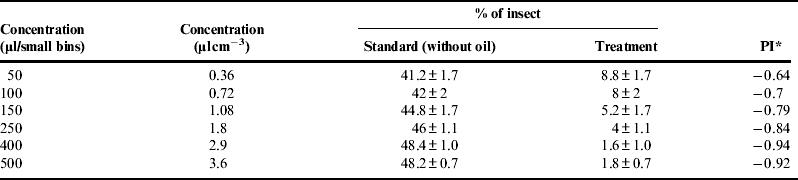
The repellency bioassay simulating small bins presented promising results at all aliquots of tested oils, showing repellent effects that ranged in preference level from −0.64 (0.36 μl cm−3) to −0.94 (2.9 μl cm−3) (Table 4). The results suggest that the essential oil of sassafras could be used against maize weevil on a large scale.
PI for the essential oil from sassafras in small bins, following the methodology proposed by Procópio et al.Reference Procópio, Vendramim, Ribeiro and Santos19.
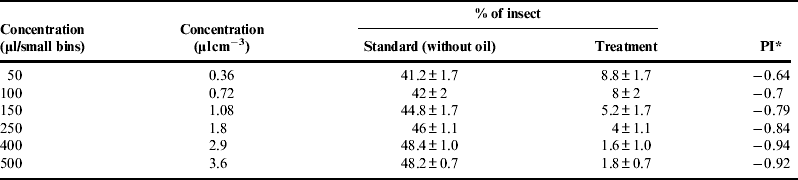
* PI of −1.00 to −0.10, test plant repellent; PI of −0.10 to +0.10, test plant neutral; PI of +0.10 to +1.00, test plant attractant.
Conclusion
Large quantities of plant material would have to be processed for use on a small scale. However, certain compounds in the oils exhibit stronger activity. In this case, the small farmer could cultivate their own biopesticides. In our study, the essential oil was extracted by hydrodistillation achieving an oil yield of 2.6% (v/w). The chemical composition of the essential oil showed that camphor (43%) and safrole (42%) are major compounds. The results showed that the essential oil caused about 86% mortality at a concentration of 0.32 μl cm−2, after 24 h of exposure. The LD50 was 14.1 μl or 0.09 μl cm−2. These results permitted us to conclude that the essential oil of sassafras presented insecticidal and repellent activity against maize weevil. Although from an economical point of view synthetic chemicals are still more frequently used as repellents, natural products (essential oils) have the potential to provide repellents that are efficient and safer for humans and the environment.
Acknowledgements
The authors thank Secretaria de Ciência e Tecnologia-RS, FAPERGS and CNPq for the financial support of this work and scholarships.