INTRODUCTION
Research has examined the relationship between a woman's body image and emotional distress over the lifespan. The results have found that: (1) body image remains relatively stable over the course of a lifetime (Tiggemann, Reference Tiggemann2004); and, (2) poor body image is associated with emotional distress (Cash et al., Reference Cash, Theriault and Annis2004; Paxton et al., Reference Paxton, Neumark-Sztainer and Hannan2006). In addition, initial evidence suggests an interaction between body image and age in predicting some aspects of emotional distress (i.e., self-esteem) (Webster & Tiggemann, Reference Webster and Tiggemann2003; Tiggemann, Reference Tiggemann2004).
This research has focused almost exclusively on expected body changes associated with aging. However, women of all ages can be faced with unexpected body changes. One of the most common, yet often unexpected threats to a woman's body is breast cancer. An estimated one in eight women will be diagnosed with breast cancer, and the vast majority of these women will undergo body altering surgical treatment (American Cancer Society, 2011). Not surprisingly, women often endure heightened emotional distress before breast cancer surgery (e.g., Schnur et al., Reference Schnur, Montgomery and Hallquist2008). It is unknown, however, how a woman's age and her body image jointly contribute to her experience of emotional distress prior to breast cancer surgery.
The current study conducted secondary data analyses to: (1) compare body image between older and younger women facing breast cancer surgery; (2) compare pre-surgical emotional distress between older and younger women; and, (3) examine whether age moderates the relationship between body image and pre-surgery emotional distress.
MATERIALS AND METHODS
Participants
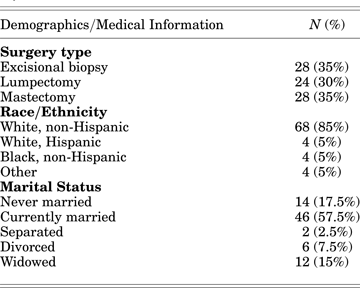
The data for this study was collected as part of a larger study investigating predictors of breast cancer surgery outcomes. Participants (n = 80) for this secondary data analysis were women scheduled for breast cancer surgery. Forty of the patients were aged 65 and over, and the other 40 were aged 64 and under. The decision to divide the groups at age 65 is consistent with the National Institute of Aging and US Census Bureau report 65+ in the United States (He et al., Reference He, Sengupta and Velkoff2005). The mean age was 47.8 (SD = 10.7) for the younger group and 71.9 (SD = 6.0) for the older group. These two groups were matched on marital status, race/ethnicity, and surgery type (mastectomy, lumpectomy, excisional breast biopsy). These matching factors were chosen because they have previously been found to be associated with body image [marital status (King et al., Reference King, Kenny and Shiell2000); race/ethnicity (Wildes et al., Reference Wildes, Emery and Simons2001); and surgery type (Collins et al., Reference Collins, Liu and Schootman2011)]. Eligibility criteria included: age 18 years or older, English speaking, and scheduled for breast cancer surgery. Exclusion criteria included: current uncontrolled mental illness. The two age groups did not differ significantly in terms of body mass index (p > 0.90). See Table 1 for demographic and medical information.
Participant demographics and medical information

Measures
Demographic/medical information was assessed via self-report questionnaire and medical chart review. Aspects of body image were assessed using items from the Additional Concerns section of the Functional Assessment of Cancer Therapy — Breast scale (FACT-B, version 4). Participants were asked to rate how true two statements had been for them since their surgery was scheduled. The items read: “I feel sexually attractive,” and “I am able to feel like a woman” (Brady et al., Reference Brady, Cella, Mo and Bonomi1997). These two items have been used in other body image and breast cancer research (Arora et al., Reference Arora, Gustafson and Hawkins2001). Items were rated on a five-point Likert scale (0 = Not at all; 4 = Very much). The correlation between the two items was 0.44 (p < 0.001).
Two measures of general emotional distress were used. The first was the Short Version — Profile of Mood States (SV-POMS). The SV-POMS is a 37-item self-report measure, which assessed level of mood disturbance over the past week (Shacham, Reference Shacham1983). Previous research has found the SV-POMS to have good internal consistency and validity with breast cancer patients (DiLorenzo et al., Reference DiLorenzo, Bovbjerg and Montgomery1999). In the current sample, Cronbach's alpha was 0.95. The second general emotional distress measure was a Visual Analog Scale (VAS) item (0–100 mm) that asked: “Right now, how emotionally upset do you feel?” The scale was anchored by “not at all upset” and “as upset as I could be.” Visual analog scales have previously been used with breast cancer surgery patients (e.g., Schnur et al., Reference Schnur, Montgomery and Hallquist2008).
Surgery-specific distress was measured using the Impact of Events Scale — Intrusion subscale (IES-Intrusion) (Horowitz et al., Reference Horowitz, Wilner and Alvarez1979). The seven-item subscale asked the frequency of surgery-specific intrusion symptoms over the last month. Items were rated on a four-point Likert scale, ranging from “not at all” to “often.” The IES has previously been used with breast cancer surgery patients (Tjemsland et al., Reference Tjemsland, Soreide and Matre1997; Schnur et al., Reference Schnur, Montgomery and Hallquist2008). In the current sample, Cronbach's alpha was 0.90.
Procedure
Patients scheduled for breast cancer surgery were referred to the study by their surgeon. Consenting participants completed the demographics questionnaire at home 5 days before surgery. On the day of surgery (prior to surgery) all participants completed the FACT-B body image items, the SV-POMS, the IES-Intrusion scale, and the VAS emotional upset item.
RESULTS
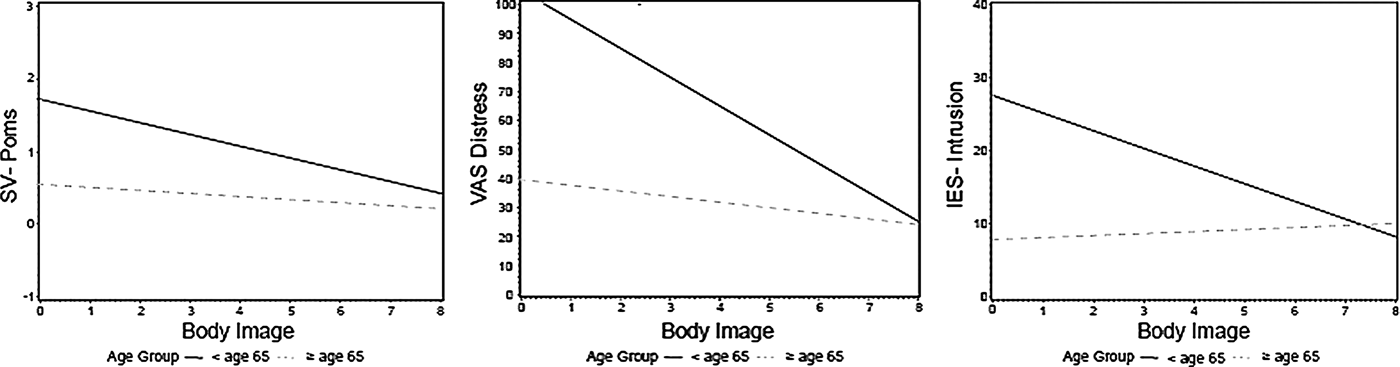
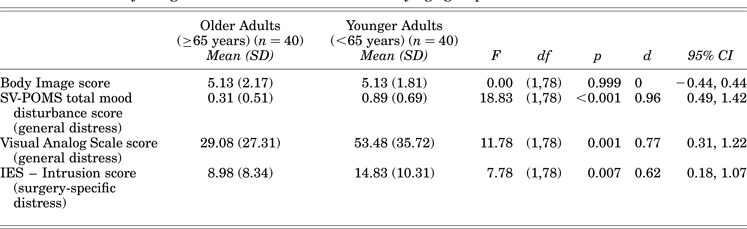
Aim 1 analyses (see Table 2) revealed that older adults did not differ significantly from younger adults in terms of body image (p > 0.999) prior to surgery. Aim 2 analyses revealed that older adults did however report significantly lower levels of both general distress (SV-POMS, p < 0.001; VAS, p < 0.001) and surgery-specific distress (IES-Intrusion, p < 0.01) than younger adults. Aim 3 results indicated that the relationship between body image and pre-surgery emotional distress differed by age group. Using a regression approach, body image, age (<65 or ≥65), and an interaction term (Body Image × Age) were entered as predictors of surgery-specific distress (IES-Intrusion) and of general distress (VAS, SV-POMS) separately. The regression to predict IES-Intrusion revealed that both body image (F (1, 76) = 4.67, p < 0.05) and age group (F (1, 76) = 12.72, p < 0.01) uniquely predicted surgery-specific distress, as did the interaction term (F (1, 76) = 7.30, p < 0.01) (Total model R2 = 0.20). The regression to predict VAS distress revealed that both body image (F (1, 76) = 13.40, p < 0.01) and age group (F (1, 76) = 13.22, p < 0.01) uniquely predicted general distress, as did the interaction term (F (1, 76) = 6.09, p < 0.05) (Total model R 2 = 0.29). The regression analysis to predict SV-POMS distress revealed that both body image (F (1, 76) = 10.33, p < 0.01) and age group (F (1, 76) = 11.62, p < 0.01) uniquely predicted general distress, and the interaction term approached significance (F (1, 76) = 3.59, p = 0.06) (Total model R2 = 0.31). To better understand the interactions, we plotted the effects for each of the dependent variables (see Fig. 1). For younger women, poor body image was related to increased general and surgery-specific pre-surgery distress. For older women, distress and body image were not significantly related.
Age by body image interactions in predicting general (SV-POMS and VAS Distress) and surgery-specific (IES-Intrusion) distress.
Mean body image and emotional distress scores by age group
Note: SV-POMS = Short Version - Profile of Mood States, IES = Impact of Events Scale. Higher body image scores indicate more positive body image.
DISCUSSION
This study yielded three primary findings. First, older and younger women had equivalent levels of body image prior to breast cancer surgery. This is consistent with the general body image literature, which has demonstrated that body image tends to remain stable throughout the lifespan (Tiggemann, Reference Tiggemann2004). Second, relative to older women, younger women had significantly greater levels of pre-surgical emotional distress. This is consistent with the larger breast cancer literature which has found that younger women with breast cancer experience greater levels of emotional distress, when compared to their older counterparts (Mosher & Danoff-Burg, Reference Mosher and Danoff-Burg2005). Third, younger women with poor body image experience heightened emotional distress in the face of breast cancer surgery, while older women, and younger women with better body image, seem to approach breast cancer surgery with less emotional distress. Although a similar interaction effect has been found in the general body image literature (Tiggemann, Reference Tiggemann2004), the present study is the first to examine this relationship in women facing immediate, potentially disfiguring changes to their bodies.
There are limitations to the present study that should be considered when interpreting the results. First, the body image measure that was used focused on two specific areas of body image (i.e., perceptions of sexual attractiveness and femininity) rather than measuring body image as a multi-dimensional construct. Future research should replicate this study with a more comprehensive body image measure. Second, the current study exclusively focused on women undergoing breast cancer surgery. Future research should examine the unique interactions between body image, age, and emotional distress with regard to other body-altering cancer treatments (e.g., chemotherapy).
CONCLUSIONS
Overall, this study can inform clinical care of women facing breast cancer surgery. The results of the present study suggest that younger women, particularly those with poor body image, are at an increased risk for pre-surgical emotional distress. These women may benefit from pre-surgical interventions designed to improve body image (e.g., cognitive behavioral therapy) (Rosen et al., Reference Rosen, Saltzberg and Srebnik1989) or to reduce pre-surgical emotional distress (Montgomery et al., Reference Montgomery, Bovbjerg and Schnur2007). Drawing from our assessment items, interventions that target perceptions of femininity and sexual attractiveness may be particularly therapeutic.
ACKNOWLEDGMENTS
Preparation of this manuscript was supported by the National Cancer Institute (K07CA131473; R25CA129094; R25CA081137; R03CA159530). The content is solely the responsibility of the authors and does not necessarily represent the official views of the National Cancer Institute or the National Institutes of Health.