Transcatheter closure of atrial septal defect has been established as an effective treatment.Reference Masura, Gavora and Podnar 1 Usually, transcatheter closure is designed to be via the femoral vein. Therefore, in some cases with an obstruction or interruption to the inferior caval vein, an alternative approach for transcatheter closure is necessary. We report a case of successful transcatheter atrial septal defect closure using an Agilis steerable guide catheter via transjugular approach.
Case report
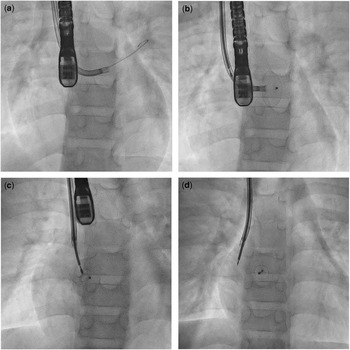
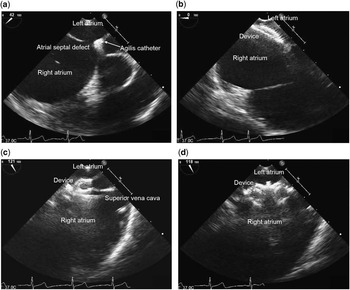
A 11-year-old boy was referred to our hospital for transcatheter closure of atrial septal defect. Transoesophageal echocardiography revealed a 11-mm secundum atrial septal defect with aortic rim deficiency. As his inferior caval vein was completely occluded because of an abdominal surgery during the newborn period, we planned transcatheter closure via the right jugular vein. The right internal jugular vein access was obtained. After the haemodynamic data were evaluated by cardiac catheterisation, transcatheter atrial septal defect closure was attempted under general anaesthesia. To deliver a device via transjugular approach, we selected an Agilis steerable guide catheter (St. Jude Medical, St. Paul, Minnesota, United States of America), which was able to create a steep curve by the handle and to insert another 8-Fr sheath to load the device. Under fluoroscopy and transoesophageal echocardiography guidance, the Agilis catheter was positioned across the defect into the left atrium, and then a 0.035-inch Amplatzer extrastiff guidewire (Cook, Indianapolis, Indiana, United States of America) was advanced into the upper left pulmonary vein. A 13-mm Amplatzer Septal Occluder (St. Jude Medical) was loaded into the sheath and advanced into the left atrium using the Agilis catheter. The left atrial side of the device was deployed, and the catheter was pulled back to the interatrial septum, after which the right atrial side was deployed (Fig 1). The delivery system of the Amplatzer Septal Occluder distorted the device position, which was being pulled superiorly before the release, but transoesophageal echocardiography confirmed that the device held the surrounding rims and was in a suitable position. Subsequently, the device was released (Fig 2).
The Agilis catheter was positioned across the defect, and the guidewire was advanced into the upper left pulmonary vein ( a ). The left atrial side of the Amplatzer Septal Occluder was deployed ( b ), the right atrial side was deployed ( c ), and the device was released ( d ).

The Agilis catheter was advanced across the defect ( a ). The Amplatzer Septal Occluder was deployed ( b and c ). Transoesophageal echocardiography confirmed that the device held the surrounding rims ( c ). The device was released ( d ).

Discussion
Transcatheter closure of atrial septal defect is less invasive and an effective treatment, and has become an alternative to surgical closure;Reference Masura, Gavora and Podnar 1 however, transcatheter closure is performed via the femoral vein. Therefore, when the inferior caval vein is obstructed or interrupted, transhepatic or transjugular approach is considered as an alternative approach.Reference Shim, Lloyd and Beekman 2 – Reference Hascoet, Fraisse and Elbaz 4 Transjugular approach is less invasive, but a few cases of success have been reported in adults.Reference Sullebarger, Sayad, Gerber, Ettedgui, Jimmo-Waumans and Alcebo 3 , Reference Hascoet, Fraisse and Elbaz 4 As the transjugular approach is difficult to maintain a pulmonary venous guidewire position and deploy the device stably, the procedure is very challenging.
The Agilis catheter is a steerable and adjustable curved guide catheter and has an insertion valve accommodating an 8.5- Fr catheter at the most proximal end to insert the device. In this case, the procedure using the Agilis catheter was successful at the initial attempt. This technique may become a valuable approach for patients with inferior caval vein occlusion.
In conclusion, this is the first report of transcatheter closure of atrial septal defect via transjugular approach using the Agilis steerable guide catheter. Further experiences are required to confirm the efficacy of this technique.
Acknowledgements
None.
Financial Support
This report received no specific grant from any funding agency, commercial or not-for-profit sectors.
Conflicts of Interest
Dr Teiji Akagi is a Consultant for St. Jude Medical, Inc. The other authors have no relationships relevant to the contents of this paper to disclose.
Ethical Standards
This work was performed according to the principles of the Helsinki Declaration, and was approved by our institutional ethics committee.