Introduction
Neurotransmitters are the endogenous substances released selectively from nerve terminals at synapses and neuromuscular junctions in mammals and helminth parasites. In helminth parasites, these neurotransmitters regulate muscle contraction and help in the attachment, feeding and reproduction of parasites (Prichard, Reference Prichard2005; Verma et al., Reference Verma, Katoch, Srivastava and Pankaj2007). Acetylcholine (ACh) is an endogenous classical neurotransmitter in the neuromuscular system of animals and has been demonstrated functionally and immunocytochemically in both the central and peripheral nervous systems of flatworm parasites (Maule et al., Reference Maule, Halton, Johnston, Show and Fairweather1990; Pax et al., Reference Pax, Day, Miller and Bennett1996). The activity of enzymes involved in the synthesis (choline acetyltransferase) and degradation (acetyl-cholinesterase) of ACh has also been detected in Fasciola hepatica (Probert & Durrani, Reference Probert and Durrani1977; Sukhdeo et al., Reference Sukhdeo, Sangster and Mettrick1986). The presence of cholinesterase activity has been reported in the nervous system of Echinococcus granulosus and interproglottid glands of Moniezia expansa (Kralj, Reference Kralj1967; Reznik & Tichrhenko, Reference Reznik and Tichrhenko1987). In mammals, ACh interacts with either muscarinic or nicotinic receptors or both (Dale, Reference Dale1914). Nicotinic receptors are ligand-gated ion channels and a musculo-nicotinic receptor (Nm) subtype predominates at neuromuscular junctions (Numa et al., Reference Numa, Noda, Takahashi, Tanabe, Toyosoto, Furutani and Kikyotani1983).
ACh has inhibitory effects on motility of flatworms and has also been reported to inhibit the larval stage of the cestode Grillotia erinaceus (Ward et al., Reference Ward, Allen and McKerr1986), whereas larval motility of Mesocestoides corti is increased significantly on application of ACh in vitro (Hrckova et al., Reference Hrckova, Velenbny, Halton and Maule2002). Important anthelmintics such as ivermectin (Cully et al., Reference Cully, Vassilitis, Liu, Raress, Vanderploeg and Schaeffer1994), levamisole (Harrow & Gration, Reference Harrow and Gration1985), piperazine (Martin, Reference Martin1985), pyrantel (Evans & Martin, Reference Evans and Martin1996), praziquantel (Mehlhorn et al., Reference Mehlhorn, Becher, Andrews, Thomas and Frenkel1981) and anthelmintic organophosphates (Courtney & Roberson, Reference Courtney, Roberson and Adam1995) cause paralysis resulting in disruption of the helminth neuromuscular system (Harrow & Gration, Reference Harrow and Gration1985; Geary et al., Reference Geary, Klein, Vanover, Bowman and Tompson1992). Modulation of neurotransmitter concentration adversely affects feeding, attachment and reproduction in trematodes (Martin, Reference Martin1997). Consequently, the neuromuscular system of helminth parasites has been considered an important area of research with a view to identifying some novel differences between the neuromuscular physiology of helminths and that of mammals (Pax et al., Reference Pax, Day, Miller and Bennett1996; Prichard, Reference Prichard2005; Von Samson-Himmelstjerna & Blackhall, Reference Von Samson-Himmelstjerna and Blackhall2005).
In vitro, ACh and cholinergic agonists (carbachol and nicotine) inhibited the frequency and amplitude of spontaneous muscular contractions in intact and longitudinal preparations of F. hepatica (Holmes & Fairweather, Reference Holmes and Fairweather1984), F. gigantica (Kumar & Tripathi, Reference Kumar and Tripathi1996; Tripathi et al., Reference Tripathi, Kumar, Chandra and Prasad2000), Schistosoma mansoni (Mellin et al., Reference Mellin, Busch, Wang and Kath1983; Day et al., Reference Day, Chen, Miller, Wing, Bennet and Pax1996) and dispersed muscle fibres of Bdelloura candida (Blair & Anderson, Reference Blair and Anderson1994), suggesting the presence of cholinergic receptor-like proteins in these parasites. Furthermore, cholinergic antagonists (atropine and mecamylamine) antagonized the paralytic effects of carbachol in a dose-dependent manner in S. mansoni (Mellin et al., Reference Mellin, Busch, Wang and Kath1983). Cholinesterase inhibitors (neostigmine and metrifonate), which increase ACh at the neuromuscular junction, cause a flaccid paralysis of S. mansoni (Mellin et al., Reference Mellin, Busch, Wang and Kath1983). Various cholinergic agonists have inhibitory effects, and antagonists have excitatory effects, on spontaneous muscular activity of different trematodes, such as S. mansoni (Mellin et al., Reference Mellin, Busch, Wang and Kath1983), F. hepatica (Maule et al., Reference Maule, Halton, Johnston, Fairweather and Shaw1989), F. gigantica (Kumar & Tripathi, Reference Kumar and Tripathi1996) and Clonorchis sinensis (Shyu et al., Reference Shyu, Jerada, Lee, Shyu and Lee1998). In view of the above, the present study was designed to provide evidence of cholinergic receptor-like proteins and investigate their role in an amphistome.
Materials and methods
Collection of rumen amphistomes
Apparently healthy and mature Gastrothylax crumenifer were collected from the rumen of freshly slaughtered goats at a local abattoir in warm (38 ± 1°C) Hank's balanced salt solution (HBSS) in an insulated container, and were brought to the laboratory. These amphistomes were kept in a biological oxygen demand (BOD) incubator at 38 ± 1°C, until further experimentation.
Tissue preparation and mechanical recording
The active, whole, mature amphistome was mounted isometrically in HBSS solution at 38 ± 1°C, as described for Gigantocotyle explanatum (Ahmad & Nizami, Reference Ahmad and Nizami1990). The spontaneous muscular activity of an isometrically mounted amphistome was recorded in Chart 4 Window Software programme using an isometric force transducer (Powerlab, AD Instruments, Sydney, Australia). Control recordings were made 15 min after application of tension for 15 min and before administration of a cholinergic agent. During the equilibration and control recording periods, the bath fluid was changed once every 10 min.
Experimental protocol
After equilibration, the cholinomimetic agents ACh (Sigma, St. Louis, Missouri, USA), carbachol (Sigma) and nicotine (Chemical de Universe Pvt. Ltd., Bombay, India) were applied in graded molar concentrations (10− 7–10− 3 m) to assess their effects on spontaneous muscular activity of the worm. Similarly, the cholinergic antagonist, atropine (Sigma) was also applied in graded molar concentrations (10− 7–10− 3 m) to determine its effect on spontaneous muscular activity, with a view to substantiating the observations made for ACh, carbachol and nicotine.
Data collection and statistical analysis
Parameters such as frequency and amplitude of rhythmic contractions and baseline tension of the isometrically mounted G. crumenifer were measured under different conditions and were compared with the controls to elucidate the effects of various cholinergic agents. The results are presented as mean ± standard error of mean. Paired t-tests were applied to measure the level of significance (Snedecor & Cochran, Reference Snedecor and Cochran1989).
Results
Rhythmic contractile muscular activity of G. crumenifer was recorded by isometrically mounting the amphistome in an isolated organ bath using an isometric force transducer connected to a data acquisition system (as described above). The isometrically mounted amphistomes exhibited an apparently uniform pattern of spontaneous muscular activity and non-significant changes in different parameters for a period of 2 h (amplitude, 0.39 ± 0.03 g; baseline tension, 0.11 ± 0.020 g; and frequency, 41.0 ± 3.44 per 5 min), as compared with those recorded 15 min after applying the tension to the amphistome (amplitude, 0.46 ± 0.03 g; baseline tension, 0.13 ± 0.01 g; and frequency, 45.0 ± 2.90 per 5 min).
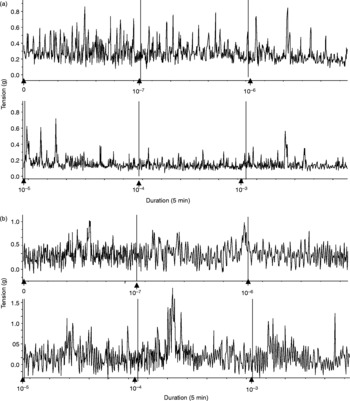
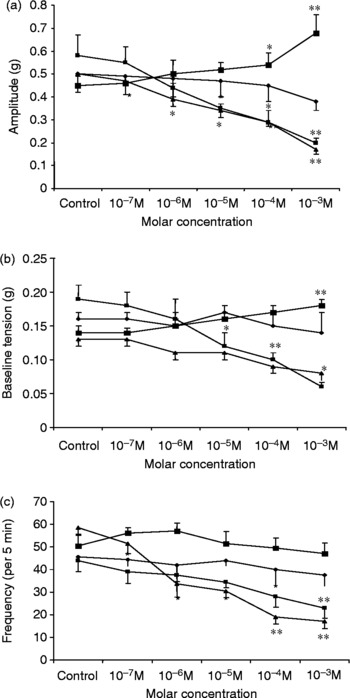
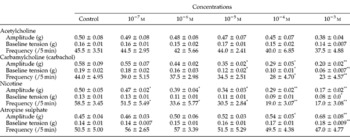
Cumulative administration of ACh at an increment of 1 log unit (10− 7–10− 3 m) did not induce any significant alteration in the amplitude (0.50 ± 0.08 g), baseline tension (0.16 ± 0.01 g) and frequency (45.5 ± 3.51 per 5 min) of muscular activity of amphistome as compared to the control. In contrast, cumulative addition of carbamylcholine (carbachol) (10− 7–10− 3 m), a nicotinic receptor agonist, caused a concentration-dependent reduction in the amplitude, baseline tension and frequency of spontaneous contractions of the fluke; representative recordings are presented in figs 1 and 2.
Effect of application of graded molar concentration (10− 7–10− 3 m) of (a) nicotine and (b) atropine sulphate on spontaneous muscular activity of Gastrothylax crumenifer.

Effect of acetylcholine (♦), carbachol ( ), nicotine (▲) and atropine () on (a) amplitude, (b) baseline tension and (c) frequency of spontaneous muscular activity of Gastrothylax crumenifer. * and ** represent levels of significance: P>0.05 and P>0.01, respectively.

Nicotine (10− 7–10− 3 m), a nicotinic receptor agonist, elicited a concentration-dependent reduction in amplitude and frequency as compared to control amplitude (0.50 ± 0.01 g) and frequency (58.5 ± 3.45 per 5 min) of isometrically mounted amphistomes. However, at 10− 3 m concentration nicotine also caused a significant (P < 0.05) reduction in the baseline tension as compared to control baseline tension (0.13 ± 0.01 g). The results are summarized in table 1 and representative recordings are given in figs 1 and 2.
The effect of acetylcholine, carbachol, nicotine and atropine on amplitude (g) baseline tension (g) and frequency (per 5 min) of spontaneous muscular activity of Gastrothylax crumenifer

Values represent mean ± standard error (n = 6); * and ** represents levels of significance, P>0.05 and P>0.01, respectively.
To substantiate further the cholinergic receptor activity, atropine sulphate, a non-specific cholinergic antagonist, produced significantly increased amplitude (at 10− 4 and 10− 3 m concentrations). Atropine produces a concentration-dependent increase in baseline tension (significant at 10− 3 m concentration), while there was no significant effect on the frequency of the contractile activity of the fluke; the representative recordings are presented in figs 1 and 2.
Discussion
The neuromuscular system of helminth parasites has been considered as an important area for identifying selective target sites for drug development (Pax et al., Reference Pax, Day, Miller and Bennett1996). The identification of physiological/structural differences would help in designing target-specific anthelmintic agents with low or no toxicity or residual side-effects in mammals. In the present study, ACh (10− 7–10− 3 m) did not significantly reduce the rhythmical muscle activity of rumen fluke. However, ACh has been reported previously to evoke inhibitory effects in the rhythmical activity of S. mansoni (Mellin et al., Reference Mellin, Busch, Wang and Kath1983), F. hepatica (Sukhdeo et al., Reference Sukhdeo, Sangster and Mettrick1986) and F. gigantica (Kumar & Tripathi, Reference Kumar and Tripathi1996) at 10− 4–10− 1 m concentrations in vitro. It also inhibited the contractility of isolated muscle fibres from S. mansoni (Day et al., Reference Day, Chen, Miller, Wing, Bennet and Pax1996) and the turbellarian flatworm, Bdelloura candida (Blair & Anderson, Reference Blair and Anderson1994). This may be due to the high turnover of acetyl-cholinesterase (AChE) causing rapid hydrolysis of ACh in rumen flukes (Sukhdeo et al., Reference Sukhdeo, Sangster and Mettrick1986). To eliminate this possibility, another cholinomimetic agent, carbachol, which is resistant to AChE, was employed. Carbachol induces a concentration-dependent reduction in the frequency, amplitude and baseline tension of the flukes. Similar effects with carbachol have been observed in S. mansoni (Mellin et al., Reference Mellin, Busch, Wang and Kath1983), F. hepatica (Holmes & Fairweather, Reference Holmes and Fairweather1984) and F. gigantica (Kumar & Tripathi, Reference Kumar and Tripathi1996).
The inhibitory effects on motility were more pronounced with nicotine compared to carbachol or ACh at similar concentrations. Nicotine caused a marked reduction in amplitude, frequency and baseline tension of the fluke, indicating involvement of at least two different classes of choline receptors in the regulation of spontaneous muscular activity of rumen fluke. Nicotine also exhibited similar effects in S. mansoni (Mellin et al., Reference Mellin, Busch, Wang and Kath1983), F. hepatica (Holmes & Fairweather, Reference Holmes and Fairweather1984) and F. gigantica (Kumar & Tripathi, Reference Kumar and Tripathi1996).
To further substantiate the involvement of a cholinergic system, a non-specific blocker of muscarinic receptors, atropine was applied. Atropine produced a concentration-dependent increase in baseline tension and amplitude without inducing any effect on the frequency of contractile activity of the fluke. Atropine has been shown to stimulate the rhythmic activity of S. mansoni (Mellin et al., Reference Mellin, Busch, Wang and Kath1983), F. hepatica (Holmes & Fairweather, Reference Holmes and Fairweather1984) and F. gigantica (Kumar & Tripathi, Reference Kumar and Tripathi1996). In the presence of atropine, probably the inhibitory effect of endogenous cholinergic neurotransmitters is blunted or atropine might be evoking a distinct effect on the parasites.
These observations suggest that the cholinergic system plays an inhibitory role in the regulation of spontaneous muscular activity and there are likely to be cholinergic receptors in G. crumenifer.
Acknowledgements
The authors thank the Director, IVRI, Izatnagar, Bareilly for providing necessary facilities to conduct the study. The authors are also grateful to Dr A. Prasad, Principal Scientist, Division of Parasitology, IVRI for helping in identification of rumen flukes.