Kawasaki disease is an acute febrile vasculitis associated with the development of arterial coronary aneurysms and myocardial infarction. Its aetiology remains unknown, although specific viral agents or virus-like cytoplasmic inclusion bodies in tissues of Kawasaki disease patients have been implicated.Reference Brogan, Bose and Burgner 1 – Reference Rowley and Shulman 3
Kawasaki disease is the main cause of childhood-acquired cardiac disease in developed countries, with an incidence of 174 in 100,000 per year in children less than 5 years of age, such as Japan. Children in the age group of 6 months to 5 years are most susceptible. The diagnosis of Kawasaki disease is based on clinical criteria established in 1993 by the American Heart Association, according to which the most important criterion was the presence of fever for more than 5 days, together with at least four of the five principal criteria: bilateral non-purulent conjunctivitis; erythematous oral cavity; red fissured lips and ‘strawberry’ tongue; polymorphous maculopapular skin rash; cervical lymphadenopathy, usually unilateral; and erythema and oedema of the hands and feet. Additional findings in children with Kawasaki disease include irritability, mood alterations, gastrointestinal discomfort, diarrhoea, arthralgia/arthritis affecting large joints (30%), hydrops of the gallbladder, and liver dysfunction.
Standard treatment with intravenous immunoglobulin and aspirin reduces the incidence of coronary artery lesions from 20 to less than 5%.Reference Wood and Tulloh 4
The term “refractory Kawasaki disease” refers to patients who failed to defervesce after repeated intravenous immunoglobulin doses. Persisting fever without treatment for more than 6 days leads to an increased risk for the development of cardiac complications.Reference Zhang, Yanagawa and Oki 5
Case presentation
We report the case of a 22-month-old girl who presented at a local hospital on the eighth day of fever along with bilateral non-purulent conjunctivitis, red cracked lips, erythematous rash over the trunk and the extremities, strawberry tongue, and unilateral lymphadenitis. She was the second child of non-consanguineous healthy parents, born at full term with an unremarkable past medical history. Initial laboratory work-up revealed leukocytosis, elevated C-reactive protein and erythrocyte sedimentation rate levels, and hypoglobulinaemia (Table 1). All blood cultures and serology for infections were negative.
Change of coronary artery diameter and laboratory findings.

A = aortic valve; CRP = C-reactive protein; ESR = erythrocyte sedimentation rate; I = insufficiency; LAD = left anterior descending branch of the left coronary artery; LCA = left coronary artery; M = mitral valve; N = normal; PLT = platelet; RCA = right coronary artery; SF = shortening fraction; WBC = white blood cells
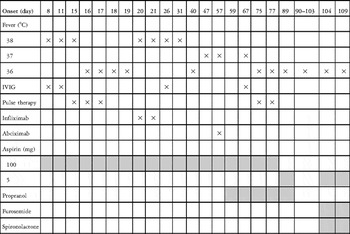
With the working diagnosis of Kawasaki disease, on day 8 she received one dose of intravenous immunoglobulin – 2 grams per kilogram – and was commenced on aspirin – 100 milligrams per kilogram per day. Owing to persistent fever, a second infusion of intravenous immunoglobulin was administered after 72 hours. Cardiac ultrasonography undertaken at that time revealed dilatation of the anterior descending branch of the left coronary artery, with a diameter of 2.5 millimetres and a z-score of 3.21. Coronary artery aneurysms in Kawasaki disease have been defined as small if the z-score is between 2.5 and 5.0, large if the z-score is between 5.0 and 10.0, and giant if the z-score is above 10.0.Reference Manhiot, Millar, Golding and McCrindle 6 The fever continued on day 15, and hence she was administered corticosteroid pulse therapy – methylprednisolone 30 milligrams per kilogram per 24 hours – for three consecutive days, with no response. In view of persisting systemic inflammation and increasing dilatation of the left coronary artery – with a diameter of 2.7 millimetres and a z-score of 4.03 – she received two doses of anti-tumour necrosis factor-alpha – Remicade, 5 milligrams per kilogram per dose. Desquamation of the palms and soles was noticed on day 23. Despite that, the fever continued through day 26 and the patient was administered a third dose of intravenous immunoglobulin. After 4 days, the fever subsided and the patient was discharged on aspirin in anti-inflammatory dose – 100 milligrams per kilogram per day.
A cardiac magnetic resonance imaging conducted at that time revealed a dilatation of the distal section of the stem of the left coronary artery, with a diameter of 5 millimetres and a z-score of 7.46; and a dilatation of the anterior descending branch and left circumflex artery, with a diameter of 2.7 millimetres and a z-score of 4.03. The right coronary artery was depicted without dilatation, that is, with a diameter of 1.8 millimetres and a z-score of 0.33. The size and function of the left ventricle, as well as the mitroid and aortic valves, were also normal.
On day 47, the fever relapsed along with increased inflammatory markers and the patient was admitted to the Department of Pediatric Cardiology. A cardiac ultrasonography revealed mild dilatation of the left ventricle with a normal ejection fraction of 67% and a large aneurysm of the left coronary artery – with a diameter of 4.5 millimetres and a z-score of 6.14; left anterior descending branch – with a diameter of 2.9 millimetres and a z-score of 4.84; and right coronary artery – with a diameter of 2.7 millimetres and a z-score of 3.15; (Table 1) and also mild insufficiency of both the mitral and aortic valves. On day 59, a further increase in the size of aneurysms was noticed – left coronary artery, with a diameter of 5 millimetres and a z-score of 7.46; left anterior descending branch, with a diameter of 3 millimetres and a z-score of 5.25; right coronary artery, with a diameter of 3 millimetres and a z-score of 4.09 – and the laboratory work-up revealed thrombocytosis – platelets: 1.187 × 10⁶ per litre – and elevated inflammatory markers. At that time, she received a single dose of abciximab and was commenced on propranolol. However, as the fever continued, she was administered a fourth dose of intravenous immunoglobulin on day 67 after which she remained afebrile.
A suggested coronary arteriography was not conducted. The child was discharged on an anti-inflammatory dose of aspirin, ranitidine, and propranolol.
On day 75, the patient presented with arthralgia of both knees and the joints of the left hand. A paediatric rheumatologist diagnosed juvenile idiopathic arthritis, and suggested a decrease in aspirin dose to anti-platelet levels – 5 milligrams per kilogram per day – along with ibuprofen. Autoimmunity screening was negative. Although the arthritic symptoms moderately resolved, the patient presented with abdominal pain. The administration of aspirin was discontinued, as it was deemed that it might have induced the pain, despite the administration of ranitidine. She also presented with constipation and further aggravation of the abdominal symptoms. Owing to abdominal pain, she was admitted again to a tertiary hospital for further investigation. At that time, she had increased inflammatory indices without fever. The spectrum of differential diagnosis of abdominal pain included constipation, intussusception, thrombosis of the mesenteric artery or myocardial ischaemia. The abdominal Doppler ultrasound was normal; however, cardiac ultrasound revealed dilatation of the stem of the left coronary artery – with a diameter of 3.7 millimetres and a z-score of 3.98 – insufficiency of both the aortic and mitral valves and decreased shortening fraction of the left ventricle (25%). The electrocardiogram showed abnormalities of the lower leads. She was placed on furosemide, spironolactone, and aspirin – dose 5 milligrams per kilogram per day – (Table 2). The cardiological evaluation necessitated the need for coronary angiography immediately; however, it was never conducted, as the same day the child suddenly deteriorated rapidly, became pulseless, and died despite intensive resuscitation efforts. Post-mortem examination revealed myocardial ischaemia with no evidence of inflammation in any other vessel.
Clinical course and treatment.

IVIG = intravenous immunoglobulin, Shaded area = duration of treatment.
Discussion
This report focuses on the treatment and course of a case of extremely refractory Kawasaki disease with a very prolonged acute phase and a fatal outcome. A review of the current published data revealed few cases of Kawasaki disease, mainly incomplete, that had a fatal outcome, but none of them had such a prolonged acute phase.
Among children with Kawasaki disease, 15% have persistent or recurrent fever despite intravenous immunoglobulin treatment and are characterised as having “refractory Kawasaki disease”. The aim of treatment in patients with Kawasaki disease is to reduce inflammation and prevent the development of cardiac lesions. The current practice for these patients is the repeat of intravenous immunoglobulin infusions two or more times. Our patient received the standard therapy on day 8 of illness, but failed to defervesce. Owing to persistent fever, even after the third dose of intravenous immunoglobulin, in combination with elevated inflammatory markers, she was considered a refractory case and second-line treatment was administered.
Additional therapies for such patients include high-dose pulse methylprednisolone, methotrexate, cyclophosphamide, cyclosporine A, and anti-tumour necrosis factor-alpha. Pulse methylprednisolone therapy should be used carefully, as it may cause thrombosis and exacerbation of coronary lesions. Anti-tumour necrosis factor-alpha was first used in 2004 by Burns et al,Reference Burns, Mason and Hauger 7 who reported that 17 patients with acute Kawasaki disease refractory to intravenous immunoglobulin and aspirin were successfully treated with a single dose of infliximab – 5 milligrams per kilogram. Those patients had failed to respond to two to three infusions of intravenous immunoglobulin and three of them remained febrile despite three to five courses of pulse methylprednisolone therapy. In our patient, methylprednisolone pulse therapy was followed by severe thrombocytosis. Infliximab succeeded in controlling inflammation but, in agreement with Hirono et al,Reference Hirono, Kemmotsu and Wittkowski 8 it did not completely control the local vasculitis, contributing to the unfavourable outcome in our case.
Abciximab is a monoclonal antibody that binds to the IIb/IIIa receptor of the platelet surface and prevents platelet aggregation. Its successful use in Kawasaki disease patients with thrombi has been recently reported. Preliminary data suggest that abciximab could aid in coronary artery remodelling.Reference McCandless, Minich, Tani and Williams 9 In our case, abciximab was used as an adjunctive anti-platelet treatment when the patient had active disease with deteriorating cardiac lesions and severe thrombocytosis.
Arthralgia/arthritis is usually presented during the acute phase of Kawasaki disease. According to bibliographic data, a few reports of systemic onset of juvenile idiopathic arthritis are primarily considered as Kawasaki disease, or alternatively Kawasaki disease could trigger the manifestation of juvenile idiopathic arthritis.Reference Rigante, Valentini and Onesimo 10 In our patient, we may hypothesise that activity of the disease was high even after 3 months from its onset and that we were dealing with an extended acute phase of Kawasaki disease, rather than a recurrence of the disease. In addition, the lack of response to steroids in combination with the overt cardiac lesions made the diagnosis of juvenile idiopathic arthritis extremely weak. According to published data, we may suggest that the discontinuation of aspirin played a crucial role in the development of the left coronary artery aneurysm and the subsequent myocardial ischaemia.
We present this case as an extremely refractory Kawasaki disease with prolonged acute phase, which was never put under control despite the administration of multiple therapeutic agents. Taking into account the lack of evidence-based approach in refractory cases, we might cautiously suggest considering the administration of anti-tumour necrosis factor-alpha as the next treatment after repeated intravenous immunoglobulin infusions, instead of corticosteroid pulse therapy; anti-tumour necrosis factor-alpha should also be combined with the administration of aspirin or warfarin and abciximab for the deterioration of cardiac lesions independently of their size. At present, warfarin is suggested in cases with giant aneurysms and not for multiple mild-to-medium-sized aneurysms, such as the ones in our patient. It is noteworthy that the use of anti-tumour necrosis factor-alpha for Kawasaki disease is not widely reported in Europe; however, further prospective studies are required.
Although the prognosis of our patient was uncertain, the discontinuation of aspirin and the lack of a constant referral medical centre could probably have played an important role in the dramatic outcome. The present case reports our experience on a refractory Kawasaki disease with unfavourable outcome; however, further studies are necessary in order to understand the aetiology and to standardise the optimal treatment.
Acknowledgements
We thank Drs Vassilopoulos Athanasios, Paediatric Intensive Care Unit, ‘P&A Kyriakou’ Children's Hospital, for providing valuable clinical information on the case and Karayianni Christina, Second Department of Pediatrics, ‘P&A Kyriakou’ Children's Hospital, Athens University, for critically reading the manuscript.