INTRODUCTION
Despite widespread expressions of support for diversity and inclusion by leading law firms and corporate law departments (Wilkins and Kim Reference Wilkins, Kim, Headworth, Nelson, Dinovitzer and Wilkins2016) and new rules of professional conduct defining sexual harassment and discrimination as ethical violations (Geraghty Reference Geraghty2016; American Bar Association 2018), we possess little systematic data on the prevalence and character of workplace discrimination in the U.S. legal profession (but see Collins et al. Reference Collins, Dumas and Moyer2017). While this is surprising given the considerable body of research on race and gender inequality among lawyers (Rhode and Ricca Reference Rhode2015), it reflects the general tendency in research on inequality to analyze unequal outcomes rather than the mechanisms that produce and maintain workplace hierarchies of race, gender, and sexual orientation (Roscigno Reference Roscigno2007).
In this Article we analyze self-reports of discrimination from a large national sample of lawyers and qualitative comments about the type and source of bias they have encountered. Using these data, we map the contours of perceived discrimination by race, gender, and sexual orientation in the contemporary legal profession and analyze the social correlates of these patterns. Our analysis draws from and advances theories of workplace discrimination. Quantitative results demonstrate the resilience of ascriptive hierarchies across practice contexts and career stages. The qualitative data complement and qualify the quantitative findings as they reveal that perceptions of discrimination are connected to the identities of disadvantaged groups and the particular types of bias they experience in the workplace and other professional contexts. Contrary to the common assertion that most discrimination today entails implicit bias and subtle forms of unequal treatment (Green Reference Green2007; Wax Reference Wax1999), respondents’ accounts show that workplace bias is often explicit. Both overt workplace interactions and implicit bias appear to reinforce the very hierarchies of race, gender, and sexual orientation decried by leaders of the legal profession. These findings extend our theoretical understanding of discrimination and have important implications for equal opportunity within the legal profession and the prospects for equal justice under the law.
THEORIZING SELF-REPORTS OF DISCRIMINATION
Hierarchies of Race, Gender, and Sexuality among U.S. Lawyers
In this Article we examine whether lawyers perceive that they have been the target of workplace discrimination. We consider self-reports of discrimination not as forming the basis for a formal legal claim, but as a measure of workplace inequality. As Hirsh and Lyons note, whether traditionally disadvantaged groups perceive that they are treated unfairly at work due to their ascriptive status comes prior to whether an individual or group files a legal claim (Reference Hirsh and Lyons2010). Perceptions of discrimination by marginalized groups are significant in their own right as a matter of workplace equality, but will also likely affect their health and well-being (Pavalko et al. Reference Pavalko, Mossakowski and Hamilton2003), their level of job satisfaction (Collins et al. Reference Collins, Dumas and Moyer2017), and their willingness to continue working for a given employer (Payne-Pikus et al. Reference Payne-Pikus, Hagan and Nelson2010).
Perceptions of discrimination in part reflect the amount and character of discrimination in society. A considerable body of social science research finds that women, persons of color, and LGBTQ persons continue to face discrimination in the labor market and employing organizations (see, e.g., Fryer et al. Reference Fryer, Pager and Spenkuch2013; Hull Reference Hull, Nielsen and Nelson2005; Quillian et al. Reference Quillian, Pager, Hexel and Midtbøen2017; Tilcsik Reference Tilcsik2011). Social psychological research suggests that these recurring processes are produced by status belief systems. When a certain group controls more resources in a given situation, people tend to equate greater power with greater competence (Ridgeway et al. Reference Ridgeway, Backor, Li, Tinkler and Erickson2009). In the contemporary United States, these status construction processes favor certain groups—whites, men, the middle or upper class (Cuddy et al. Reference Cuddy, Fiske and Glick2007; Fiske Reference Fiske2011). Once these status hierarchies are in place, they become the basis for continued competition as groups develop strategies to enhance their social position through the pursuit of elite credentials and other markers of social superiority (Bourdieu Reference Bourdieu1984; Lamont Reference Lamont2012).
Another mechanism that sustains workplace hierarchies is stereotyping based on ascriptive characteristics. Gender and racial stereotypes afford individual members of privileged gender or ethno-racial groups the presumption of competence while women and racial minorities are held to a higher standard than their white male counterparts (Rhode Reference Rhode2015; Ridgeway and England Reference Ridgeway, England, Crosby, Stockdale and Ropp2007; Cuddy et al. Reference Cuddy, Fiske and Glick2004). For example, African Americans and Latinos are assumed to be less capable and qualified, and women are assumed to be less committed. Moreover, men’s achievements are often attributed to their abilities while women’s achievements are attributed to external factors, and women are perceived as ineffective at self-promotion and cultivating clients (Rhode Reference Rhode2015; Cruz and Molina Reference Cruz and Molina2010; Thomas Reference Thomas2001; Swim and Sanna Reference Swim and Sanna1996).
Against the backdrop of social science research on discrimination in American society and the legacy of racism, sexism, and religious discrimination in the American legal profession (Ladinsky Reference Ladinsky1963; Smigel Reference Smigel1969; Auerbach Reference Auerbach1976; Epstein Reference Epstein1981; Heinz and Laumann Reference Heinz and Laumann1982; Abel Reference Abel1989), it would be surprising if we did not find evidence of ascriptive or status-based differences in contemporary legal workplaces. Yet there have been significant transformations in the demographic makeup of the profession. Women now make up more than 30 percent of all lawyers and almost half of lawyers under age forty (Carson and Park Reference Carson and Park2012; ABA 2017a). About one-quarter of law school graduates are persons of color, divided roughly equally between Asian Americans, African Americans, and Latinos (Snyder et al. Reference Snyder, de Brey and Dillow2016; Chung et al. Reference Chung, Dong, Hu, Kwon and Liu2017). These demographic shifts have been coupled with at least the symbolic embrace of equal opportunity by leaders of the organized bar, the judiciary, corporate law departments, and major law firms (Wilkins and Kim Reference Wilkins, Kim, Headworth, Nelson, Dinovitzer and Wilkins2016).
Despite these shifts, dramatic gender and racial inequalities persist in the legal profession. Women and persons of color have gained entry-level positions in corporate law firms at historically high levels but continue to be underrepresented among partnership positions (Noonan et al. Reference Noonan, Corcoran and Courant2008; Payne-Pikus et al. Reference Payne-Pikus, Hagan and Nelson2010; Kay and Gorman 2008, Reference Kay, Gorman, Headworth, Nelson, Dinovitzer and Wilkins2016; ABA 2017b; NALP 2017). Female attorneys on average earn 80 percent as much as their male counterparts, a disparity not explained by productivity-based performance differences (Dinovitzer et al. Reference Dinovitzer, Reichman and Sterling2009; Dinovitzer et al. Reference Dinovitzer, Garth, Nelson, Plickert, Sandefur, Sterling and Wilkins2014). And female lawyers must contend with a long-hours culture that rewards total commitment while balancing their greater share of familial responsibilities (Sommerlad Reference Sommerlad2016; Rhode and Ricca Reference Rhode2015; Epstein and Seron Reference Epstein, Seron and Van Hoy2001; Hagan and Kay Reference Hagan and Kay1995). In addition to being underrepresented among law firm partnerships, research indicates that women and racial and ethnic minorities are also underrepresented among tenured law professors, law school deans, and general counsel in Fortune 500 companies (Rhode Reference Rhode2017; Rhode and Ricca Reference Rhode2015; Neumann Reference Neumann2000), and are more likely than white men to begin their careers in the public sector (Dinovitzer et al. Reference Dinovitzer, Garth, Sander, Sterling and Wilder2004). The number of LGBTQ lawyers has risen since the National Association of Law Placement (NALP) began collecting data on this group in 2002, but they are concentrated primarily within associate positions (NALP 2017).
These inequalities appear rooted in stereotypes about gender, race, and lawyering. Pierce asserted that the dominant cultural script in many fields of law practice was that of a highly assertive male (Reference Pierce1995). Women were left to mimic that style or choose areas of practice where they could cultivate an alternative, “more caring” approach. Critical race scholars have illustrated the tensions that attorneys of color face as they make choices about whether and how to “act white” and thus meet expectations within predominantly white law firms and law schools (Carbado and Gulati Reference Carbado and Gulati2013; see Williams Reference Williams1991; Wilkins and Gulati Reference Wilkins and Gulati1996; Barnes and Mertz Reference Barnes and Mertz2012).
Women of color face particular challenges because they are outsiders on the boundaries of both race and gender from the dominant group in the legal workplace (Crenshaw Reference Crenshaw1989). Qualitative research suggests that African-American women (Reeves Reference Reeves2001), Asian-American women (Chung et al. Reference Chung, Dong, Hu, Kwon and Liu2017), and Latinas (García-López Reference García-López2008) experience discrimination in the workplace in different ways from men of the same race and ethnicity, and sometimes experience sexism from men of their own race. LGBTQ status also cuts across race and gender. While LGBTQ attorneys may “cover” their sexual orientation (Yoshino Reference Yoshino2006), they too may feel the sting of discrimination in the workplace.
Theories of Workplace Discrimination: Implications for Lawyers
In an important article, Hirsh and Lyons examined the relative influence of ascriptive status, personal characteristics, and workplace context in explaining whether a sample of workers “reported being discriminated against at work because of their race or ethnicity in the previous year…” (Reference Hirsh and Lyons2010, 280). They found that race and gender were associated with perceptions of discrimination, controlling for the characteristics of the job and the work organization. But workers who the authors characterized as more “entitled” because they were better educated, in a union, or held positions of authority were more likely to perceive discrimination, while workers employed at firms that signaled fair treatment through formalized personnel policies were less likely to perceive discrimination. Thus, it was a combination of ascriptive traits and workplace context that best explained perceptions of discrimination.
Drawing on Hirsh and Lyons and other research on workplace discrimination, we sought to examine the relative importance of ascriptive status versus other variables to perceptions of discrimination by lawyers. In addition to ascription, the literature points to the potential importance of career stage, marital and family status, social background, professional status, status in the work organization, and characteristics of the organization in which an attorney works. These other variables may explain away the effects of ascription or may interact with ascriptive status to increase or decrease perceptions of discrimination.
Ascription, Attribution, and Intersectionality
Members of traditionally marginalized groups are more likely to perceive discrimination in the workplace, both as a matter of objective experience (see Quillian et al. Reference Quillian, Pager, Hexel and Midtbøen2017 and other sources cited above) and the result of greater sensitivity or vigilance to discriminatory treatment, what is referred to as attribution (see Ruggiero and Major Reference Ruggiero and Major1998). Self-reports about personal experience with discrimination are subject to two kinds of errors: failing to see discrimination that objectively exists and seeing discrimination when it does not exist (Major and Kaiser Reference Major, Kaiser, Nielsen and Nelson2005). Personal and situational factors shape the accuracy of such judgments (Major and Sawyer Reference Major, Sawyer and Nelson2009). If members of disadvantaged groups have experienced discrimination in the past, they may be more sensitive to cues about unfair treatment and more likely to attribute a negative outcome to bias than members of traditionally advantaged groups (Feldman Barrett and Swim Reference Feldman Barrett, Swim, Swim and Stangor1998; Cohen et al. Reference Cohen, Steele and Ross1999; Steele et al. Reference Steele, Spencer and Aronson2002). High stigma consciousness makes African Americans, Asian Americans, Latinos, and women more likely to perceive personal and group discrimination (Major and Sawyer Reference Major, Sawyer and Nelson2009). The research suggests a gradient among racial and ethnic groups, with African Americans the most likely to report experiencing discrimination, whites the least likely, and Latinos and Asian Americans in between (Smith Reference Smith2002).
The scholarship on intersectionality suggests that women of color may be especially subject to discrimination and to reporting perceived discrimination (see Collins Reference Collins, Hill and Zambrana2009). The survey of North Carolina lawyers by Collins et al. (Reference Collins, Dumas and Moyer2017) found such an intersectional pattern, with African-American women reporting the highest levels of discrimination by race, sex, and age.
Career Stage
Studies that include longitudinal measures or a variable for age offer mixed results about whether workers will perceive more or less discrimination over the course of their careers (McLaughlin et al. Reference McLaughlin, Uggen and Blackstone2012, Hirsh and Lyons Reference Hirsh and Lyons2010, Collins et al. Reference Collins, Dumas and Moyer2017). Intuitively, we expect the rate of self-reports will decline over time as respondents who encountered perceived discrimination would likely leave discriminatory environments for less-biased environments over the course of their career. Yet, as we discuss below, women may experience more discrimination as their careers progress if they encounter penalties for having children or suffer a backlash as they assume more authority at work.
Marital and Family Status
Given the findings of discrimination based on parental status (Correll et al. Reference Correll, Benard and Paik2007; Cuddy et al. Reference Cuddy, Fiske and Glick2004), we expect that women with children will be more likely to perceive workplace discrimination than other women and men, including men who have children (Kay and Wallace Reference Kay and Wallace2009). Moreover, research suggests that single women may be more frequent targets of sexual harassment than married women because they are seen as being more sexually available and less protected, and as threatening traditional gender roles (De Coster et al. Reference De Coster, Estes and Mueller1999).
Social Background and Professional Status
Social background and its connection to elite educational credentials continues to play a role in shaping the career opportunities of lawyers in the Anglo-American legal professions (Rivera and Tilcsik Reference Rivera and Tilcsik2016; Rivera Reference Rivera2016; Ashley and Empson Reference Ashley, Empson, Headworth, Nelson, Dinovitzer and Wilkins2016; Webley et al. Reference Webley, Tomlinson, Muzio, Sommerlad, Duff, Headworth, Nelson, Dinovitzer and Wilkins2016). It may be that lawyers from less privileged backgrounds and from lower status law schools may be more likely to perceive they are discriminated against. However, following Hirsh and Lyons (Reference Hirsh and Lyons2010), it may be that lawyers from more privileged backgrounds or with law degrees from more selective institutions may feel more entitled and, therefore, more likely to perceive unfair treatment.
Status in the Work Organization
Both formal and informal status in the work organization may shape perceptions of discrimination. In their examination of sexual harassment in the workplace, McLaughlin et al. (Reference McLaughlin, Uggen and Blackstone2012) tested two competing conceptions of the role of power: a vulnerable-victim approach and a power-threat approach. The former conception argues that less powerful, more vulnerable people are more likely to report being sexually harassed at work; the latter suggests, paradoxically, that women with more power are more likely to be harassed because they threaten the male workplace hierarchy. The authors’ findings strongly support the power-threat approach and suggest it might have broader application beyond sex discrimination: members of traditionally marginalized racial groups might also report more discrimination as they rise in organizational authority. Other research suggests that if women and persons of color are not integrated into social networks in law firms, and thus are socially isolated, they will be less committed to staying at the firm and more likely to perceive discrimination (Payne-Pikus et al. Reference Payne-Pikus, Hagan and Nelson2010).
Characteristics of Work Organization
A considerable body of organizational research examines the relationship between organizational characteristics and levels of inequality and discrimination (see, e.g., Baron et al. Reference Baron, Mittman and Newman1991; Hirsh and Kornrich Reference Hirsh and Kornrich2008; Kalev et al. Reference Kalev, Dobbin and Kelly2006; Reskin and McBrier Reference Reskin and McBrier2000). More formalized personnel structures and policies, usually associated with organization size, are likely to reduce levels of perceived discrimination, either because such structures actually reduce discrimination or because they present a symbolic commitment to nondiscrimination that can shape workers’ perceptions (Hirsh and Lyons Reference Hirsh and Lyons2010; Edelman Reference Edelman2016; Bisom-Rapp Reference Bisom-Rapp1999). Yet in the legal profession, large law firms are up-or-out hierarchies in which women and persons of color have much higher rates of attrition than white men (Henderson and Galanter Reference Henderson and Galanter2008). We expect, therefore, that respondents will report higher levels of perceived discrimination in large firms.
Research suggests that public sector employers are friendlier to minorities and women than private sector firms (Roscigno Reference Roscigno2007, 12; Wilson and McBrier Reference Wilson and McBrier2005). In the legal profession, women and minorities have been overrepresented in public sector employment (Dixon and Seron Reference Dixon and Seron1995; Lempert et al. Reference Lempert, Chambers and Adams2001). Thus, we expect to see lower levels of perceived discrimination in public sector organizations. The racial and gender composition of the workplace also is likely to shape perceptions of discrimination by disadvantaged groups. In their study of Alberta lawyers, Kay and Wallace (Reference Kay and Wallace2009) find that in law firms with more than a token number of women lawyers, women receive higher levels of emotional and informational support. We may surmise that such a context would produce lower levels of perceived discrimination.
Explicit or Implicit Forms of Bias
A central issue in theoretical and policy debates about discrimination in the legal profession and more broadly, is whether most discrimination today arises from implicit or unconscious bias rather than more explicit biases against protected groups. A substantial body of research suggests that implicit bias in workplace decisions affects protected groups (Banaji and Greenwald Reference Banaji and Greenwald2013; Greenwald and Krieger Reference Greenwald and Krieger2006; Kang and Banaji Reference Kang and Banaji2006; Krieger and Fisk Reference Krieger and Fisk2006; but see Mitchell and Tetlock Reference Michelson2006). Decision-makers discriminate without conscious intent based on pervasive and uncontrollable biases against disadvantaged groups. Some scholars suggest that “unintentional or ‘unconscious’ discrimination has become the most pervasive and important form of bias operating in society” (Wax Reference Wax1999, 1130; see also Green Reference Green2007). Yet other scholars continue to show that a significant portion of discrimination claims involve overt acts (Sperino and Thomas Reference Sperino and Thomas2017; Berrey et al. Reference Berrey, Nelson and Nielsen2017; Selmi Reference Selmi2017). The survey data from After the JD (AJD) are not well-suited to addressing this debate, but the comments from respondents about the nature of the discrimination they experienced provide insights into the relative prevalence of overt and implicit forms of bias in legal workplaces.
MEASURING SELF-REPORTS OF DISCRIMINATION
Our empirical analysis focuses on respondents’ self-reports about being the target of discrimination in the workplace. While self-reports are subjective, lawyers’ perceptions of discrimination are significant in themselves. If we find that particular groups of lawyers are more likely to perceive being targets of discrimination, it would have important implications for equality and opportunity in the legal profession. We follow a tradition of other researchers who have used survey methods to collect self-reports of discrimination as measures of inequality (Bobo and Suh Reference Bobo, Suh, Bob, Oliver, Johnson and Valenzuela2000; Smith Reference Smith2002).
AJD is based on a nationally representative sample of lawyers who were admitted to the bar in 2000. The survey is composed of three waves, conducted in 2002–2003, 2007–2008, and 2012–2013. Across three waves of data collection, we received responses from 5,399 different attorneys, or 65.6 percent of the eligible sample group of 8,225. The numbers we report here are unweighted, without adjustment for whether a respondent was part of a minority oversample or according to patterns of nonresponse by sampling unit.Footnote 1
Self-Reports of Discrimination by Race/Ethnicity, Gender, and Sexual Orientation Across Three Waves of Surveys
The dependent variable for the analyses below is a composite measure of questions referring to specific types of discrimination experiences. Respondents were asked: “During the last two years,Footnote 2 has any of the following ever happened to you in your place of work by virtue of your race, religion, ethnicity, gender, disability, or sexual orientation?”Footnote 3 Their answer options in waves 2 and 3 were: “experienced demeaning comments or other types of harassment”; “missed out on a desirable assignment”; “had a client request someone other than you to handle a matter”; “had a colleague or supervisor request someone other than you to handle a matter”; or had “experienced one or more other forms of discrimination” with a “please specify” answer field. The wave 1 questionnaire did not include the item on supervisors or colleagues requesting someone else on a matter. The composite discrimination variable for each wave is binary and equals one if a respondent answered in the affirmative to any of the four or five answer options.
We rely on a composite measure of perceptions of discrimination to capture the full range of experiences in the legal workplace. To avoid the difficulty of subjective definitions of discrimination, we asked about specific negative experiences based on ascriptive characteristics.Footnote 4 This is a purposefully broad approach. As we discuss below, we also conducted analyses of individual items used in the composite measure. With the one exception of client requests, we found no differences in results between the composite measure and the individual items.
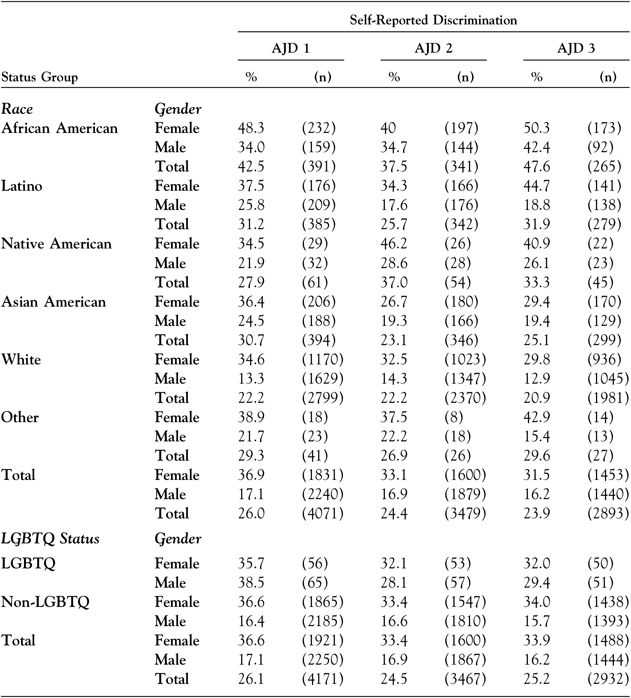
Table 1 presents the breakdown of self-reports of discrimination by detailed race and gender categories and LGBTQ status.Footnote 5 Contrary to our expectation that perceived discrimination would decline over career stage, we find remarkable continuity across waves, varying between 25 percent and 26 percent. But consistent with our expectations, we see striking differences across race, gender, and LGBTQ status, as well as at their intersection. In terms of race, African Americans report the most discrimination, followed by Latinos, Asian Americans, Native Americans, Other (mostly multiracial respondents), and whites. In every racial and ethnic group, women report higher levels of experiencing discrimination than their male counterparts. By far the highest level of reports come from African-American women. For LGBTQ respondents, men and women report similar levels of discrimination. LGBTQ women and non-LGBTQ women report similar levels of discrimination, suggesting that gender bias is equally pervasive as sexual orientation bias for women. However, LGBTQ men report almost twice as much discrimination as do non-LGBTQ men. Compared to other surveys of self-reported workplace discrimination, that vary between 18 percent and 33 percent for African Americans and Latinos (Berrey et al. Reference Berrey, Nelson and Nielsen2017, 46–47), the rates of self-reported discrimination by attorneys of color and white women are strikingly high.
Self-Reported Discrimination by Race, Gender, and Sexual Orientation across Waves

Multivariate Models
We now turn to logistic regression models predicting self-reported discrimination, both the composite measure we have previously discussed (see also Table 1), and a measure indicating whether a client had requested another lawyer to handle a matter. Presenting separate models for each wave of data allows us to consider the different patternings of results in each wave while taking full advantage of the number of responses at each wave. We used multiple imputation to account for missing data. Analyses were performed using the mi estimate: logit command in Stata, version fourteen.
Independent Variables
We detail below the range of measures that correspond to our theoretical expectations about the social correlates of perceived discrimination. In Appendix Table 1 we provide means and standard deviations for the variables we employ.
Ascriptive Status
We include the status-based variables of central interest in this analysis: race/ethnicityFootnote 6 and gender and LGBTQ status. Given relatively small numbers in some of the cells presented in Table 1, and our interest in analyzing the combined effects of race and gender, we created a four-category variable for race and gender: women of color, white women, men of color, and white men (with the latter as the reference category). We also included a variable for whether respondents identified as LGBTQ.
Marital and Family Status
We include variables for marital status and parental status at each wave.
Social Background
We measure the effect of social background by entering a binary variable for father’s education (with fathers with graduate or professional schooling compared to all others). An extensive body of research identifies father’s education as a measure of parental status (Dinovitzer Reference Dinovitzer2011; Hauser and Warren Reference Hauser and Warren1997; DiMaggio and Mohr Reference DiMaggio and Mohr1985). Father’s education has been found to be strongly correlated with mother’s education and to have fewer missing or difficult-to-interpret cases (Jæger and Holm Reference Jæger and Holm2003).
Professional Status
We include two measures of professional status: the selectivity of the law school respondent attended (with a binary variable representing respondents who attended the least selective tier three or four law schools compared to all others) and a measure for whether the respondent reported that they were practicing law at the time of their survey response. An exit from law practice does not necessarily entail a decline in occupational status, yet it is a common reference point for professional success (see, e.g., NALP 2016).
Status in Work Organization
We include several measures of status in the work organization: the interaction of being female with whether the respondent supervises other employees;Footnote 7 number of hours worked, which we employ as a measure of relative position in work production, but which can also be seen as a measure of the work intensity of the organization; number of years in organization; and whether the respondent spends recreational time with partners and managers, a variable that has proven useful in measuring social isolation in professional firms (Payne-Pikus et al. Reference Payne-Pikus, Hagan and Nelson2010).
Characteristics of Work Organization
We include measures for whether the employing organization is in the private sector or public sector, with the business sector as the reference category; organization size as measured by number of total employees; and gender and race composition of the employer as measured by whether the percentage of women or persons of color (as estimated by the respondent) exceeds the proportion for the entire sample.
Composite Measure of Self-Reported Discrimination
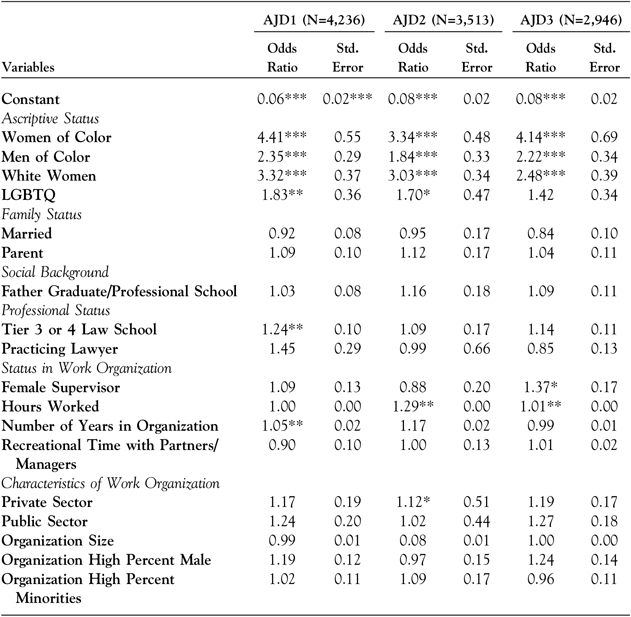
We began by investigating the main effects of the status-based variables of race, gender, and LGBTQ identity with no controls. In models not shown, we confirmed the pattern we saw in Table 1, finding statistically significant effects for race and gender in all three waves and LGBTQ status in waves 1 and 2. Table 2 shows the results for models that include the remainder of the independent variables. In all three waves, the race and gender variables remain statistically significant. Women of color have odds of perceiving discrimination that are between 3.3 and 4.4 times greater than those of white men, followed by white women whose odds of perceiving discrimination are between 2.5 and 3.3 times greater than white men, followed closely by men of color, whose odds are between 1.8 and 2.4 times greater than white men. We thus see very consistent results arrayed by race and gender even after controlling for several variables that might be plausibly linked to self-reports of discrimination.
Logistic Regressions Predicting Discrimination for Each AJD Wave

*p≤0.05, **p≤0.01, ***p≤0.001
Note: We tested interaction effects for female*parent and female*married, but neither was statistically significant at conventional significance levels.
The effect of LGBTQ status is also significant, yet the effect size is smaller. At wave 1, LGBTQ respondents have odds of perceiving discrimination that are 1.8 times higher compared to non-LBGTQ respondents, a 1.7 odds ratio in wave 2, and a 1.4 odds ratio in wave 3, which is non-significant. The lack of statistical significance at wave 3 may well reflect the somewhat smaller number of LGBTQ cases available at wave 3, but otherwise we could not develop a good explanation from either the survey or comments data. This is a topic that should be pursued in future research.
The effects of other independent variables, with a few exceptions, are not statistically significant and therefore tend to reject many of the expectations based on theories of workplace discrimination. These include null effects for marital or family status and having a highly educated father; attending a less selective law school increases the odds of perceiving discrimination but only in wave 1. The characteristics of the work organization also largely do not affect rates of perceiving discrimination. Surprisingly, private sector lawyers report higher discrimination only in wave 2. Status in the work organization does have significant effects, but some only emerge at wave 3. Our results support McLaughlin et al.’s (Reference McLaughlin, Uggen and Blackstone2012) suggestion that women supervisors are more likely to experience discrimination than other women. By wave 3, being a female supervisor becomes a significant predictor of discrimination, and this is in the context of wave 3 having the highest proportion of female supervisors, growing from approximately 8 percent of respondents in wave 1 to 21 percent in wave 2 and 22 percent in wave 3. Hours worked becomes statistically significant in waves 2 and 3, supporting the notion that attorneys who work in high demand positions are more likely to perceive discrimination. It may be that by wave 2, those working long hours are more keenly aware of the competition for senior positions and, therefore, are likely to perceive bias in how they are treated. Somewhat surprisingly, whether a respondent spends recreational time with partners and managers has no significant relationship to perceptions of discrimination.
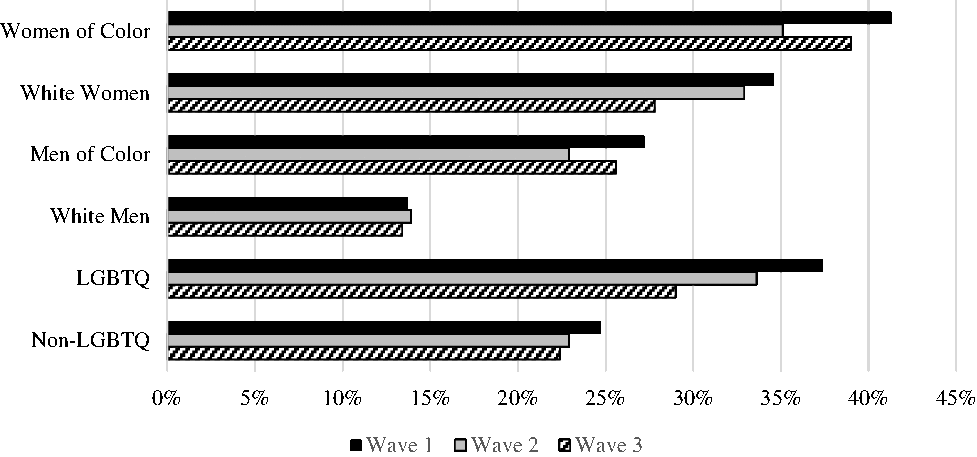
The multivariate results drive home the salience of ascriptive characteristics for explaining perceptions of discrimination. In Figure 1 we present the predicted probabilities of perceiving discrimination at each wave by race/gender and LGBTQ status based on the models in Table 2.Footnote 8 The probability of white men perceiving discrimination is between 13 percent and 14 percent across the three waves, which is substantially lower than for the other race/gender groups. Women of color have the highest probability of perceiving discrimination in all three waves, ranging from 35 percent to 41 percent, and have odds of perceiving discrimination that are about 3 to 4.5 times greater than white men. Although white women and LGBTQ respondents have consistently higher probabilities than white men and non-LGBTQ respondents, the probability of self-reporting discrimination decreases for both groups across waves, from 35 percent to 28 percent and from 37 percent to 29 percent, respectively. For non-LGBTQ respondents, the probability of perceiving discrimination remains remarkably stable across waves, varying only between 22 percent and 25 percent.Footnote 9
Predicted Probability of Self-Reporting Discrimination across Waves

Clients Requesting Another Attorney
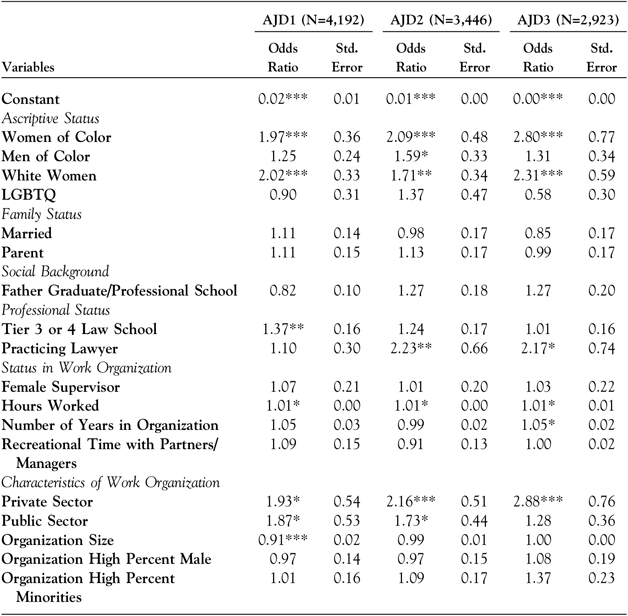
We tested the same multivariate models on the specific types of discrimination from which we constructed the composite measure. For all but one of the five specific measures we found virtually identical results as for the composite discrimination variable. The one exception was the question about whether a client had requested another attorney due to the respondent’s ascribed status. The models in Table 3 reveal interesting similarities and differences from the results for the composite measure of discrimination.
Logistic Regressions Predicting Clients Requesting New Attorney for Each AJD Wave

*p<0.05, **p<0.01, ***p<0.001
In all three waves, women of color and white women were significantly more likely than white men to report that a client had requested a different attorney. It is notable that in wave 3 women of color have odds of perceiving discrimination that are 2.8 times greater than are white men and white women’s odds are 2.3 times greater than white men. Men of color are only statistically significantly different from white men in wave 2, suggesting that gender may be more of an impediment to client representation than race.
Working in the private sector is a statistically significant predictor of this type of perceived discrimination across all waves, supporting our expectation about sectoral differences in perceived discrimination. Yet, somewhat contrary to that expectation, working in the public sector is a significant predictor in waves 1 and 2. We also find some support for our expectation that larger organizations would contain fewer self-reports of discrimination. In wave 1 only, we find that organization size has a statistically significant negative effect on having had a client request a different attorney. This may in part reflect the relative absence of client contact in large organizations at early career stages. Reports of client requests for other attorneys also are significantly associated with being a practicing lawyer in waves 2 and 3 and working longer hours (in all three waves). Attorneys who no longer practice may not have clients in a conventional sense, and so may be less exposed to this possibility. The effect of hours worked is more difficult to explain, but may reflect greater deference to clients’ preferences in more intense work environments as indicated by hours worked. In sum, the models for clients requesting other attorneys show the effects of race and gender, but also reflect more contextual effects than for the composite measure.
The quantitative data demonstrate striking differences in perceptions of discrimination across race, gender, and sexual orientation that are not explained away by other factors. But to understand the experiences that underlie these numbers, it is necessary to examine our qualitative data.
QUALITATIVE RESULTS: ACCOUNTS OF PERCEIVED DISCRIMINATION
While our survey data are powerful for systematically analyzing the prevalence and social correlates of self-reports of discrimination, qualitative data offer uniquely valuable information. It can reveal “how inequality is created and maintained, rather than merely its extent” (Roscigno Reference Roscigno2007, 8). Open-ended accounts state in the respondents’ own words how they see their position in the workplace, the kinds of interactions they perceive as enacting discrimination, whether the discriminatory conduct they observe is explicit or subtle, and who are the actors in the workplace or in professional contexts who engage in discriminatory conduct (e.g. Feagin Reference Feagin1991; Feagin and McKinney Reference Feagin and McKinney2003).
Our survey form provided respondents with the opportunity to provide comments about their experiences with discrimination. While this approach has the benefit of allowing broad coverage of the range of perceived discrimination, the accounts are necessarily short—limited to the space in a comments field in the survey instrument. Below we first present simple counts about the nature and source of perceived discrimination. We then analyze the content of the comments.
Positionality and Perceived Discrimination: Counts of the Nature and Source of Discrimination by Race, Gender, and Sexual Orientation
Across all waves, we received a total of 1,472 comments about perceived experiences of discrimination at work. Between 44 percent and 48 percent of respondents in each wave who reported that they experienced some kind of discrimination offered a written comment. Within the subsample of respondents who reported experiencing discrimination, chi-square tests indicate that there are no consistent differences between the ascriptive characteristics or practice settings of respondents who wrote a comment and those who did not. Thus, those providing comments appear to be representative of the larger group of respondents who reported an experience with discrimination.
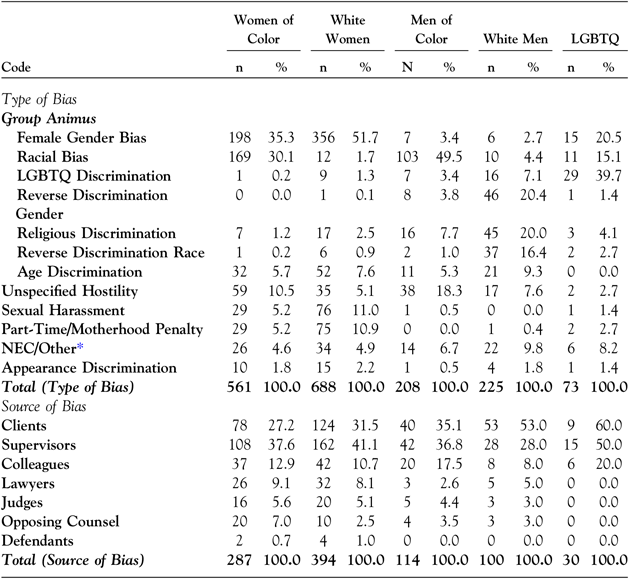
We coded the comments both according to the type of discrimination experienced and for the source of discrimination. A comment can indicate more than one type and source of discrimination; thus, the number of codes exceeds the number of comments. Table 4 classifies the codes by race and gender categories and LGBTQ status (note that LGBTQ respondents also appear in race and gender categories). The prevalence and distribution of comments referring to various types and sources of discrimination were relatively consistent across waves. Aside from a predictable drop-off in the proportion of comments referring to age discrimination and an increase in the number of comments citing a motherhood penalty—both reflecting life-course developments—there were no significant changes in the nature of the comments across the three waves.
Summary Table of Type and Source of Bias Reported in Comments by Status Group, All Three Waves
Note: The totals refer to the number of types or sources of discrimination mentioned in the comments, not the number of respondents or comments.
* “NEC/Other” includes comments that fall under categories that are not elsewhere classified, and comments referring to bias related to political affiliation and illness/disability as these were relatively small categories.
The patterns in Table 4 suggest the significance of positionality in these accounts, as different race-gender and sexuality groups report distinctive types of bias relating to their group membership. This reflects broader research on perceptions of discrimination, which finds that women are significantly more likely to perceive gender-based mistreatment than men, and that racial minorities are significantly more likely to perceive race-based mistreatment than whites (McCord et al. Reference McCord, Joseph, Dhanani and Beus2018). Perhaps somewhat surprisingly, women of color were most likely to describe experiences related to female gender bias, followed by racial bias, age discrimination, and sexual harassment. White women were most likely to report female gender bias, followed by sexual harassment, part-time/motherhood penalty, and age discrimination. It is striking that white women were far more likely than women of color to comment on sexual harassment and the motherhood penalty, possibly reflecting the complexities of how women of color experience sexual harassment as a combination of sexual and racial harassment (Welsh et al. Reference Welsh, Carr, MacQuarrie and Huntley2006).
Men of color were most likely to report racial bias, followed by unspecified hostility, and religious discrimination. White men were most likely to report reverse gender discrimination, followed by religious discrimination, reverse race discrimination, and age discrimination (most comments concerning age discrimination were, in contrast to the legal definition of protected age groups, about being treated as “too young”). LGBTQ respondents were most likely to report LGBTQ bias, followed by gender and racial bias.
The sources of discrimination are varied, from supervisors, to colleagues, judges, and clients. Across all minority groups except LGBTQ and in all three waves, supervisors are the most commonly cited source of discrimination (comprising about one-third of all reports), followed by clients and then colleagues. One exception to this pattern is white men, who are most likely to report clients as the source of reverse discrimination by gender or race.
Analyzing the Content of Comments
Based on our analysis of the full set of respondent comments, we identified a set of prominent themes and selected quotes to illustrate them. For each quote we indicate the race, gender, and practice setting of respondents, and the wave of the survey. In addition to the major themes, the quotes reveal three important dimensions of how respondents perceive discrimination that are of theoretical interest: (1) how frequently respondents report explicit, interactional types of discrimination or offer observations about the effects of implicit or unconscious bias; (2) who respondents see as the perpetrators of discrimination; and (3) the contexts in which respondents report discrimination.
Comments Reflecting Group Animus
Across all three waves, the most common type of discrimination mentioned in the comments section is discrimination based on one’s group membership. These experiences cover a broad range of interactions. For example, women are singled out in a negative way because of their gender. Some of the comments relate to judgements of women’s appearance, such as the following two experiences:
“Senior (male) HR person told me I needed to make my hair more attractive, wear more make-up and perfume. Seriously.” (White woman, business inside counsel, wave 3)
“I also regularly receive comments about my appearance. No one comments on the appearance of my male colleagues. Essentially, I am forever being assessed verbally with respect to things unrelated to my job and this does not happen to my male colleagues.” (White woman, business inside counsel, wave 3)
Women also express that their voices are not heard and they are not taken seriously by others, simply because of their gender:
“Women generally are not treated equally as their counterparts in the legal field—comments are ignored or put down. When a man in the room makes the same comment, it is brilliant.” (White woman, business inside counsel, wave 3)
“As a young female lawyer of color I am treated differently—sometimes by clients or by officers of court, lawyers, judges, etc., demeaning comments like, ‘girl,’ ‘hysterical,’ or ‘bitchy.’ (Asian-American woman, public interest organization, wave 1)
“Comments from a male partner about how I, as a blonde woman, would not be an appropriate choice to send to a board of directors’ conference, and not getting brought to client pitches or generally into networking circles.” (White woman, law firm of 251+, wave 3)
For members of minority groups, negative experiences are often racialized. Minority women report racial bias as the second most common form of discrimination, and minority men as the most common form of discrimination. These interactions signal to minority lawyers that they are considered outsiders, and lesser lawyers, because of their ethnic or racial status.
“I have had situations where attorneys assumed I didn’t know as much because I wasn’t white, spoke down to me as though I were a fool. If you’re in an environment where people are not sensitive, it’s demeaning. I complained about a manner and attitude that an attorney had and I was just told he didn’t have social skills. I experienced a lot of it and that’s why I started my own firm.” (African-American woman, solo practice, wave 2)
Many of these experiences are rooted in stereotypes that are based on the race, gender, or both of our respondents:
“Being mistaken for an interpreter or clerk at court because I’m Latina and look Latina.” (Latina woman, solo practice, wave 1)
“At my former job, I believe I was passed up for partnership. I was told I had more obstacles than another employee because I was female, Mexican, I was gentle natured. I was there the longest of any employee. Other comments were made, not about my ethnicity, but about minorities. My questions about partnership were ignored. I was told that I was not assertive enough, that I was too nice. Before I left, they promoted an associate who was a white male to partnership and he had been with the firm less time…. I thought I was more competent.” (Latina woman, law firm of 2–20, wave 2)
“Client made racist comments to me (without understanding my racial background) regarding intellectual inferiority of Blacks when I was defending him at a deposition.” (African-American man, law firm of 251+, wave 2)
For LGBTQ lawyers, the most common form of discriminatory experience is derogatory references to their sexual orientation:
“Heard the use of the word ‘faggy’ or ‘fags’ by colleagues before they knew I am gay.” (LGBTQ man, law firm of 251+, wave 3)
“Someone made a really derogatory comment about my sexual orientation while on assignment.” (LGBTQ woman, business nonlegal position, wave 3)
White men who were not LGBTQ report a different orientation to status-based discrimination. Their most common comment refers to reverse gender or race discrimination, sometimes by clients, sometimes by supervisors in their work organization.
“People sometimes perceive women as more desirable to handle divorce matters so I’ve actually been fired by a couple of clients who wanted a woman to handle their case in order to ‘soften’ their image.” (White man, law firm of 2–20, wave 3)
“Many minority in-house counsel are engaged in a form of reverse discrimination, requiring that only minority attorneys work on various projects. I have had many projects taken away from me as a white male.” (White man, law firm of 251+, wave 2)
Religious discrimination was the next most common type of discrimination white men reported.
“Boss expressed anger at request not to work on Saturday due to Sabbath. Said he thought request was bullshit. I’m the only Jew in the office and feel he is discriminating against me in terms of work and advancement.” (White man, law firm of 2–20, wave 1)
“I live in Utah. The legal community is mostly Mormon and I am not.” (White man, business inside counsel, wave 1)
One of the ways in which group animus manifests is through exclusion from social activities. Workplace interactions with both peers and superiors are key to the development of a lawyer’s career, and exclusion from these networks—which are both social and which might also lead to mentoring, training, and career advancement opportunities—contribute to the social isolation of women and minorities in the workplace (Payne-Pikus et al. Reference Payne-Pikus, Hagan and Nelson2010). A man of color described “not being invited or included in socializing opportunities with colleagues, race ethnicity related” (Asian-American male, law firm of 2–20, wave 1), while a woman noted: “Female attorneys are not included in social activities by male partners. Most partners are male and therefore women miss social interaction with superiors” (white woman, firm of 101–250, wave 1).
Another recurring theme relating to exclusion is that members of minority groups experience their place at work as one of an outsider, and as a token:
“No formal discrimination but there is definitely a boys club & the relationships the male bosses have with their white male subordinates is much different than the relationships they have with the female subordinates.” (Asian-American woman, nonprofit, wave 1)
“I believe the white male culture norm defines what is a good associate with regard to interpersonal skill. Others [from different backgrounds] are seen perhaps subconsciously as different or not as capable.” (Asian-American male, law firm of 251+, wave 1)
“I believe there is subconscious racial discrimination at my agency that impacts my overall ability to be considered for the most senior level positions in the agency. While I have advanced to what is considered a senior position, the most senior positions remain somewhat elusive. A combination of too few Black attorneys being hired and a lack of familiarity or comfort with such attorneys may contribute to the subconscious discrimination that results in the exclusion of candidates from the candidate pool considered for the most senior positions.” (African-American woman, federal government, wave 3)
These comments describe how social exclusion works along gender and racial lines without overt discrimination.
Sexual Harassment
Women attorneys provided accounts of the sexual harassment they faced at work. “As a female I experience sexual harassment on a weekly basis from judges, male attorneys, and clients” (white woman, solo practice, wave 3). Another recounts that:
“My male co-workers repeatedly referred to me as “honey,” “sugar,” and other inappropriate names, as well as rude inappropriate sexually charged comments in my presence. I am the only female attorney in my office. The male attorneys fraternize with each other and share the more interesting and important assignments with each other.” (White woman, state government, wave 2)
A number of women recount that sex is often used as a weapon or quid pro quo for assignments: “Supervisor withheld assignments based on refusal to provide sex favors” (white woman, education, wave 3); and “Boss made pass at me—I believe I missed desirable assignment because I turned him down” (white woman, business inside counsel, wave 2). Sex is used as a weapon in other dynamics as well, with one woman of color reporting that “when client was making sexual advancements, I rejected them and he reported to the bar association that I wasn’t doing my job” (African-American woman, solo practice, wave 2).
Motherhood/Part-Time Penalty
Although our quantitative results did not find a significant effect of being a parent or having children on the odds of reporting discrimination, the comments reveal that motherhood is a status that is used against some women. Mothers experience this form of discrimination when their familial obligations are assumed to interfere with their work role. Thus, while 5 percent of comments by women of color and 11 percent of comments by white women concerned bias against mothers, no men of color and only one white male comments on bias against being a parent.
The following comment demonstrates the ways in which motherhood acts as a status that is packaged with a set of assumptions about women’s commitment to their work:
“I was told that as a new mother I would not be considered for an assignment that was very prestigious due to travel requirements, although I was never asked if that would be an issue.” (White woman, federal government, wave 3)
Women also report negative work outcomes as a result of their transition to motherhood, with some noting penalties as a result of their maternity leave and others commenting that simply the status as parent is enough for them to lose significant professional authority and career advancement.
“Had twins and now demonstrable drop in trust and treated like a first-year associate. Managing Partner with whom I have worked for years now keeps me behind the scenes and won’t let me re-establish client relations I had before I left for maternity leave.” (White woman, law firm of 2–20, wave 2)
“When I learned I was pregnant and advised the managing partner, a woman, she told me that I had ensured that I was off of the partnership track for at least two years as a result of my choice to take maternity leave.” (White woman, law firm of 21–100, wave 2)
“I have been passed over for opportunities for certain work because I am a single mother, and the perception was that a man with a wife at home to attend to family obligations would be more available for the project(s).” (White woman, law firm of 21–100, wave 3)
Intersection of Gender and Supervisory Status: A Largely Unarticulated Form of Bias
While the quantitative and qualitative findings both point to the main effects of ascriptive status on perceptions of discrimination, the quantitative findings suggest that supervisory status is an additional mechanism that appears to exacerbate the negative experience of women at work. The quantitative data show that in wave 3, women in supervisory positions are significantly more likely to perceive discriminatory experiences. As noted above, the results are entirely consistent with power-threat theory as developed concerning sexual harassment by McLaughlin et al. (Reference McLaughlin, Uggen and Blackstone2012). That is, as women gain more power in the workplace—such as assuming supervisory roles—they provoke sexist reactions from male workers. But it could also be that having ascended to a supervisory position, these women are more aware of discrimination.
In the comments of women attorneys in supervisory positions we found an interesting disjuncture: it is rare to find an example of a woman who explicitly noted that her negative experiences stemmed from her supervisory status. The following comments, both made by African-American women, were unusual for their reference to their position: “I am a young, black attorney, so it’s not always easy to get support staff who I supervise to follow my direction” (State government, wave 2). And:
“Certain of my colleagues not affording me the same respect or treating me in the same way as other white males who have held my position or similar positions.” (African-American woman, education, wave 3)
Our interpretation is that women who are supervisors experience more discrimination than other women, but they do not articulate their experience as a product of being targeted because they are a woman in a position of authority. Typical of the quotes we see from women who were in supervisory positions at wave 3 are those which focus on gender. For example:
“Forceful opinions from a woman are not tolerated nor treated equally as they would be coming from a man. Lower pay offered than to a man in a similar or lesser position.” (Latino woman, state government, wave 3)
Uggen and Blackstone (Reference Uggen and Blackstone2004, 83), who also find that female supervisors experience more discrimination, comment that “a woman’s authority does not immunize her from sexual harassment, at least within a cultural context in which males hold greater power and authority.” Yet that women do not explicitly note that their position of authority exacerbates their workplace experiences points to the fact that while it is their gender that is targeted, additional mechanisms of workplace power are in play. The targets of workplace discrimination may not recognize the intersectional character of the discrimination they face. Just as women of color are somewhat more likely to report experiencing gender bias rather than racial bias, women in supervisory positions are more likely to interpret their experience in terms of gender. Thus, to gain better traction on our understanding of workplace discrimination, it is critical for researchers to pay attention to the intersectional experiences of individuals—such as race and gender, or gender and authority—and to investigate how (and whether) individuals perceive their intersectional status.
Clients Requesting Other Attorneys
The quantitative data suggested that for lawyers working in the private sector, having clients request another attorney on a discriminatory basis is a common experience. While the quantitative data emphasized the occurrence of this form of discrimination in the private sector, the comments highlighted that lawyers in the public sector had similar experiences, and we provide examples of both below.
“VP requested a male attorney handle matters in his area (whereas I had specific expertise in that area and male attorney did not).” (Asian-American woman, legal services, wave 3)
“Male clients often get angry and call me names or request a male attorney. Sometimes they do the opposite & try to flirt with me or ask me out.” (African-American woman, public defender, wave 3)
“Derogatory comment relating to race and request of no African-American counsel.” (African-American man, law firm of 2–20, wave 3)
“Clients prefer American (white) people as their lawyers and are willing to pay more for their services….” (Latina woman, solo practice, wave 3)
The comments of these respondents exemplify how men and women of color and white women perceive bias by clients. In some instances the bias is explicit, but perhaps more often respondents draw the inference of bias, as when respondents see clients ask for particular men to work on their matters even though they are not as expert as the respondent.
The comments demonstrate how respondents saw hierarchies of race, gender, and sexuality operate in the legal workplace. Together with our quantitative analyses of self-reports of discrimination, the comments indicate that women and persons of color often are the targets of what they perceive as discriminatory treatment. These groups experience anti-group animus, sexual harassment, penalties for motherhood and part-time status, sexist reactions to women achieving supervisory status, and discrimination by clients. The comments thus describe the various processes that enact discrimination for young attorneys, processes that are not otherwise captured in our survey results. Whereas prominent scholars of discrimination argue that overt acts of discrimination are now largely a thing of past, replaced by more subtle, implicit forms of bias, many of the comments of these early career attorneys describe very explicit forms of discriminatory behavior. Our results tend to confirm the arguments of Sperino and Thomas (Reference Sperino and Thomas2017) and Berrey et al. (Reference Berrey, Nelson and Nielsen2017) that overt forms of discriminatory behavior persist in American workplaces. Moreover, the comments illustrated why we did not see sectoral differences in the composite measure of reported levels of discrimination: discriminatory processes operate in private law firms, government employment, educational and nonprofit institutions, and in business.
What comes through in many of these comments by traditionally disadvantaged groups is the continuing dominance of the traditionally advantaged group in the legal profession, white (presumably heterosexual) men. In many of the quotes above, men are depicted as the perpetrators of discrimination as they comment on women’s appearance, fail to take women’s comments seriously, exclude women and minorities from important meetings and social events, and perpetuate a white male “boys club.” In other comments, the traditionally disadvantaged experience discrimination because the white heterosexual man is held out as the model of the superior lawyer, who has a wife at home to take care of family responsibilities; who is seen as a better courtroom performer in contrast to an Asian-American or Latino attorney, who are seen as too passive; who clients seek out as more presentable to a corporate board or able to stand up to aggressive opposing counsel; who commands respect as a supervisor when women and persons of color do not; and whose heterosexuality fits in perfectly with the aggression and dominance that LGBTQ men are assumed not to embody. Many of the quotes refer to a white male as a comparator, a person not in a protected group who receives unwarranted benefits in comparison to a person in a protected group. It is the white man who gets the promotion, gets the higher pay, and gets the client rather than the respondent, whose qualifications and seniority are overlooked.
DISCUSSION: THE PREVALENT, PERSISTENT, YET VARIABLE CHARACTER OF ASCRIPTIVE HIERARCHIES
The quantitative analysis of self-reports of discrimination demonstrates that perceived discrimination is prevalent and persistent. Women, and especially women of color, men of color, and LGBTQ attorneys are substantially more likely to perceive that they have been the target of biased treatment than their white male counterparts. This pattern holds through all three waves corresponding to different stages of the respondents’ careers. And it holds across employment contexts: in the public sector as well as in private practice; and in large organizations and small ones. And it holds despite controlling for a full range of other independent variables that might affect these perceptions.
When we turn to the qualitative comments of respondents about the nature of the negative experience they reported, we find that members of different ascriptive groups experience negative treatment that reflects how distinct hierarchies operate across various work settings. Women and persons of color describe the bias they experience from supervisors, clients, and other actors. These experiences are always described as a burden. Sometimes these experiences are described as limiting concrete career opportunities. For women, especially white women, the comments reveal gender bias, sexual harassment, or a motherhood penalty. For women of color and LGBTQ women, race or sexual orientation bias is often mixed with gender bias.
Interestingly, the qualitative comments sometimes are not consistent with the quantitative results. In our multivariate models we found no significant main effects for having children or interaction effects for women who have children reporting higher levels of perceived discrimination. Yet in the comments, several women spoke about the motherhood or part-time penalty. We found the opposite relationship between comments and numbers for female supervisors. While we found a significant effect for the interaction of supervisory status and female—a confirmation of power-threat theory—women, with a few exceptions, did not comment on the link between gender bias and supervisory status.
We do not view the differences between the quantitative and qualitative findings as problematic as these data are measuring distinct but related phenomena. Not enough women who are parents report they are a target of negative treatment to register in our statistical models, but some women do describe a motherhood penalty. And while female supervisors are significantly more likely to report negative treatment than other respondents, they very seldom report it as the combined effect of their status and their gender.
More broadly, the quantitative and qualitative results are complementary. The qualitative comments speak of relationships and of identity in context. They thus support a relational and contextual framework for understanding perceived workplace discrimination as suggested by Roscigno (Reference Roscigno2007) and Hirsh and coauthors (Hirsh and Lyons Reference Hirsh and Lyons2010; Hirsh and Kornrich Reference Hirsh and Kornrich2008). But they also support scholars who give priority to ascriptive hierarchies, such as Feagin (1991, Reference Feagin2000) and Bonilla-Silva (Reference Bonilla-Silva2012) who assert that racial hierarchies are reinforced through everyday interactions in multiple contexts. The qualitative comments reveal theoretically important variation in the nature of the bias respondents perceive. Many comments suggest discrimination that is overt, indicated by the words of managing partners and clients or a dramatic change in treatment after getting pregnant or having a child. In other comments respondents reflect on more subtle, systemic biases they see operating in their organization, which are more consistent with theories of structural or implicit bias in the workplace. Taken as a whole, these data provide a valuable corrective to scholarship that argues that implicit bias is now the dominant form that discrimination takes, but they also indicate there is substantial variation in the discriminatory treatment respondents observe and experience.
CONCLUSION
In this Article we have presented data from a national sample of lawyers about their perceptions of whether they have been the target of discrimination in the legal workplace. While these are self-reports and therefore subject to attribution error, we find striking differences in levels of perceived discrimination along the lines of race, gender, and sexual orientation. In the most recent wave of the survey (conducted in 2012–2013) over one-half of African-American women reported being the target of discrimination in their workplace in the last two years, as did 43 percent of African-American men, between 29 percent and 45 percent of women in other racial and ethnic groups, and 30 percent of LGBTQ attorneys. Multivariate analyses that controlled for several other variables did not explain away these ascriptive patterns. Qualitative comments describing these discriminatory experiences largely supported the quantitative results, gave content to the nature of bias that disadvantaged groups perceive, but also identified some disjunctures between quantitative results and individual perceptions. Interestingly, the comments also suggest that much of the bias in the workplace is overt in character, which contradicts a common narrative that most contemporary discrimination operates through unconscious or implicit bias.
It is important to recognize some of the limitations of this research. First, it is based on self-reports, which necessarily involve subjective judgments. The literature on attribution bias documents perceptual differences across race and gender groups, and these no doubt contribute to the patterns we observe. But research on employment discrimination claims suggests that there is often subjectivity in defining workplace events as discrimination. Even in instances where formal claims have been filed, there are conflicting, contested constructions of what is fair treatment in the workplace (Berrey et al. Reference Berrey, Nelson and Nielsen2017). To the extent we have captured perceptions of discrimination, the race, gender, and sexuality differences we report should be taken seriously. Second, one of the great strengths of our method is also a weakness: we posed standardized questions about negative treatment, which allowed us to estimate rates of perceiving discrimination, and we asked for short descriptions of those experiences, which allowed us to gather large numbers of accounts of these experiences. But we could only scratch the surface of respondents’ experiences. In-depth interviewing is necessary to examine their perceptions of workplace bias more fully. Third, while possessing data from three waves of surveys allows a unique perspective on when bias occurs in lawyers’ careers, we only have data on one cohort of lawyers, those passing the bar in 2000. Given dramatic changes in the market for legal services following the financial collapse of 2008 and its effects on the job prospects of more recent law graduates, it is fair to ask whether our results generalize to other cohorts. Yet nothing in our results suggests our findings are unique to one cohort.
With these limitations in mind, our results pose a serious challenge to the legal profession. In the perceptions of lawyers, we have found evidence of entrenched hierarchies of race, gender, and sexual orientation. Given the breadth of perceived discrimination, how do leaders of the organized bar, law firms, corporate law departments, and government agencies address this problem? Perhaps the first step is to recognize the scope and character of the problem. Rather than accept the narrative that all discrimination is subtle and unintended, it is important to see that there are identifiable actors engaging in identifiable misbehavior. It is necessary to design systems of accountability in the workplace to detect and correct this misbehavior.
Second, the #metoo movement suggests the importance of grassroots action in the workplace by targeted groups to raise awareness about and take action against discriminatory behavior. Other kinds of efforts to address these problems, while laudable and increasingly popular, have not been demonstrated to be effective. The most common response has been to mandate training about sexual harassment and workplace bias. Yet training programs appear not to have advanced diversity goals in organizations, and in fact may be counterproductive in some circumstances (Kalev et al. Reference Kalev, Dobbin and Kelly2006; Edelman Reference Edelman2016). Other efforts focus on moving women and minorities into positions of power in organizations (Dhir Reference Dhir2015). Experiments are currently underway to test the effects of requiring a minimum number of women on the compensation and promotion committees of law firms (Flores Reference Flores2017; Weiss Reference Weiss2017). While research suggests that greater representation of women on the corporate boards and in the corporate law departments of clients increases the chances for women to be promoted to partner (Phillips Reference Phillips2005), Wallace and Kay found that having women in positions of leadership in law firms did not enhance the informational and emotional support women received in those firms (Reference Wallace and Kay2012).
In this Article we have begun to develop a more comprehensive understanding of perceived discrimination by race, gender, and sexuality in the American legal profession. Further systematic work is needed to examine the effects of perceived discrimination on the career trajectories of lawyers. Do those lawyers who perceive that they are the targets of bias leave their employer or even leave the legal profession all together? Do they express lower levels of satisfaction with their decision to become a lawyer? Does the health and workplace performance of these lawyers suffer as a result of discrimination? These are questions best addressed with longitudinal data. The answers to these questions are of concern not just for the legal profession but for society more broadly. To the extent that lawyers of different races, genders, and sexual orientations are exposed to discrimination that limits their career development, it will erode the capacity of the legal profession to provide equal representation to all groups in society. Research suggests that communities served by a more racially and ethnically diverse legal profession experience smaller racial disparities in sentencing outcomes (King, Johnson, and McGeever Reference King, Johnson and McGeever2010). The fate of equal justice may be tied to the fate of equal opportunity in lawyer careers.