Introduction
The occurrence of an underdeveloped embryo in a seed means the embryo must grow inside the seed before the radicle emerges. If seeds with an underdeveloped embryo are incubated at a suitable temperature, light:dark and moisture conditions, and the delay in emergence of the radicle is only about 1 month or less, seeds have morphological dormancy (MD) (Nikolaeva, Reference Nikolaeva and Khan1977; Baskin and Baskin, Reference Baskin and Baskin1998). In contrast, if the delay in emergence of the radicle is longer than about 1 month and warm and/or cold moist treatments are required to promote germination, seeds have morphophysiological dormancy (MPD). Various levels of MPD have been identified, depending on requirements to break dormancy and promote germination, temperature requirements for embryo growth and response to gibberellins (GA3) (Nikolaeva, Reference Nikolaeva and Khan1977; Baskin and Baskin, Reference Baskin and Baskin1998, Reference Baskin and Baskin2004; Baskin et al., Reference Baskin, Chien, Chen and Baskin2008).
In one classical view of extant gymnosperms, there are three classes, Ginkgoopsida, Cycadopsida and Pinopsida (Meyen, Reference Meyen1984). Among the nine families in Pinopsida, only Podocarpaceae and Taxaceae are reported to have underdeveloped embryos. Detailed studies have shown that seeds of species in Taxaceae have an underdeveloped embryo, and deep simple MPD has been documented in seeds of Cephalotaxus wilsoniana (Yang et al., Reference Yang, Chien, Liao, Chen, Baskin, Baskin and Kuo-Huang2011), Taxus baccata (Devillez, Reference Devillez1978), T. brevifolia (Nikolaeva et al., Reference Nikolaeva, Rasumova, Gladkova and Danilova1985), T. cuspidata (Nikolaeva et al., Reference Nikolaeva, Rasumova, Gladkova and Danilova1985; Cheng et al., Reference Cheng, Tang, Gao and Shen2004) and T. mairei (Chien et al., Reference Chien, Kuo-Huang and Lin1998; Zhang et al., Reference Zhang, Liao, Zhong and Chen2000; Liu et al., Reference Liu, Yu and Guo2011). It also has been observed that embryos in seeds of Podocarpaceae are small in relation to the size of the female gametophyte (Ng, Reference Ng1992; Ferrandis et al., Reference Ferrandis, Bonilla and Osorio2011), and several studies on Podocarpaceae have revealed that varying periods of time are required for seeds to germinate. To reach 50% germination, seeds of Podocarpus angustifolius required 35 d if they first were soaked in water but otherwise >60 d (Ferrandis et al., Reference Ferrandis, Bonilla and Osorio2011), while seeds of P. falcatus required a 1-month period of moist storage and then an incubation period of 3 weeks (Negash, Reference Negash1992). Seeds of P. henkelii germinated to 68% after 160 d (Dodd and Van Staden, Reference Dodd and Van Staden1981). Further, seeds of Dacrydium comosum (Podocarpaceae) germinated over a period of 113–358 d, whereas those of Podocarpus imbricatus germinated over a period of 16–63 d and those of P. neriifolius over a period of 20–67 d (Ng, Reference Ng1992). In the temperate rain forest of southern Chile, seeds of P. nubigena planted on the soil surface in a canopy gap and in the understorey germinated to 0 and 22% in 2 years, respectively. There was a delay of more than 1 year in the germination of seeds planted in the understorey (Figueroa and Lusk, Reference Figueroa and Lusk2001). Further, cold stratification was ineffective in overcoming dormancy in seeds of this species (Figueroa, Reference Figueroa2003). Fresh seeds of Nageia nagi collected from southern Taiwan germinated to 95% after 10 weeks of incubation at 30/20°C and at 25°C with 12 h light, and cold stratification at 5°C shortened germination time (Hong et al., Reference Hong, Jhuang, Chien, Huang and Fan2009). However, none of these authors reported direct observations or measurements on the embryos to see if they grew prior to radicle emergence.
To our knowledge, no detailed studies have been conducted to determine if embryos of Podocarpaceae grow inside the seed prior to germination, i.e. radicle emergence. Unless embryos grow prior to germination, they are not underdeveloped and the seeds cannot have MD or MPD. Thus, our purpose was to address the following questions. Do embryos in Podocarpaceae seeds grow prior to germination? Do seeds have MD or MPD, and if MPD, which of the nine known levels of MPD do they have?
Materials and methods
Seed collecting and handling
The species selected for this study were Nageia nagi (Thunberg) Kuntze and Podocarpus costalis Presl. Both species are mainly distributed in tropical and subtropical areas, and both are native to Taiwan, where they are threatened by habitat loss and by overcollection for ornamental uses. In Taiwan, N. nagi grows at low elevations in broadleaved evergreen forests of the island, whereas P. costalis is found along the coasts among rocks on Lanyu Island (Orchid Island), south-east Taiwan (Li et al., Reference Li, Keng, Yang and Lu1994). P. costalis has been widely cultivated in Taiwan.
Mature seeds of P. costalis with a deep-blue fleshy sarcotesta and a red-purple fleshy receptacle were collected from Chashan (22°00′N, 120°50′E), Manjhou township, Pingtung County on the southern tip of Taiwan, in September 2010. Mature seeds with a green fleshy sarcotesta were collected from plants of N. nagi growing in Chiayi city (23°29′N, 120°28′E), in south-western Taiwan in August 2010. In seeds of both species, the embryo is surrounded by the megagametophyte, a stony sclerotesta and a fleshy sarcotesta (see Fig. 1). The sarcotesta was removed from seeds used to test for germination and embryo growth. All cleaned seeds were air-dried at room temperature overnight. There were 2310 seeds l− 1 and 3725 seeds kg− 1 in P. costalis and 500 seeds l− 1 and 900 seeds kg− 1 in N. nagi. The moisture content of fresh seeds without sarcotesta and with sclerotesta was 51 ± 3% in P. costalis and 56 ± 2% in N. nagi, as determined by oven drying for 17 h at 103°C (International Seed Testing Association, Reference Nijënstein, Nydam, Don and McGill2007). We cut more than ten freshly harvested seeds each of N. nagi and P. costalis and found that all of them had a healthy looking megagametophyte and embryo.
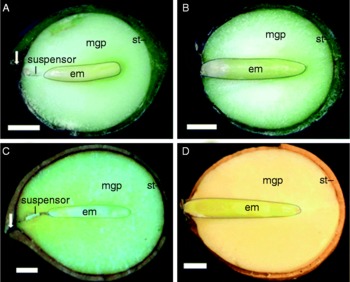
Embryo growth in seeds of Podocarpus costalis (A, B) and Nageia nagi (C, D). Longitudinal section of fresh seeds with a linear-shaped underdeveloped embryo (A, C) and of seeds with a fully grown embryo (B, D). Fleshy sarcotesta has been removed. The arrow in (A) and in (C) points to the micropyle; em, embryo; mgp, megagametophyte; st, sclerotesta. Scale bar = 2 mm.

Germination study
Seeds of P. costalis and N. nagi were mixed with moist sphagnum moss, placed inside polyethylene bags (0.04 mm in thickness) and incubated at 12 h/12 h alternating temperature regimes of 30/20, 25/15, 20/10 and 15/6°C and at a constant temperature of 25°C. The sphagnum moss was cut into small pieces, and then wetted to a water content of about 400% of its dry mass. The moist sphagnum provided a good germination medium and prevented the spread of mould because it contains the fungi Trichoderma and actinomycetes which are antagonistic to microorganisms (Wang et al., Reference Wang, Lin and Chang1998). The seeds were covered with 3 mm or less of sphagnum moss. The daily photoperiod of 12 h in the incubators (60–80 μmol m− 2s− 1, 400–700 nm) was at the high temperature. Due to the coarse nature of the sphagnum, most seeds received some light, but at any given point in time a few may have been in darkness. However, at weekly intervals the contents of each bag were poured out on a table to facilitate examination of seeds for germination. After germination was monitored, seeds and sphagnum were returned to the bag, resulting in a re-shuffling of seeds with regard to their position in the sphagnum and thus the amount of light they received. Consequently, all seeds were in light part (or all) of the time the lights were on in the incubators. Each treatment consisted of three replicates of 50 seeds. Radicle emergence (radicle ≥ 2 mm long) was recorded weekly for 8 weeks and shoot emergence was studied for an additional 6-week period with weekly recordings of seeds of P. costalis. Radicle emergence was recorded weekly for 20 weeks for seeds of N. nagi, but shoot emergence was not studied. Results are expressed as mean ( ± SE) germination percentage and as mean ( ± SE) germination time (MGT) in days. MGT = (Σn it i)/N, where n i is the number of seeds germinated in t i days from the beginning of the test, and N is the total number of germinated seeds at the end of the test (Naylor, Reference Naylor1981). MGT is a measure of the rate of germination and of the sharpness of the germination peak.
Embryo growth
Lengths of embryo and megagametophyte were measured in ten fresh seeds each of P. costalis and N. nagi and in ten seeds of each species in which the sclerotesta had split but none of the radicle had emerged ( = critical embryo length for germination) (Baskin and Baskin, Reference Baskin and Baskin2005). Seeds were dissected using a razor blade or scissors, and embryos were measured under a dissecting microscope equipped with a calibrated micrometer; representative sections were photographed.
Statistical analysis
Germination data based on number of seeds in a treatment were converted to percentages, and means (three replications) and standard errors were calculated. Statistical analysis of mean germination percentage and MGT was carried out using the GLM procedure of SAS, and means were compared by Least Significant Difference (LSD) (SAS Institute Inc., Cary, North Carolina, USA) and Microsoft Office Excel 2007. Percentage data were arcsine square-root transformed before analysis, but only non-transformed data are shown in Table 1 and Figs 2 and 3.
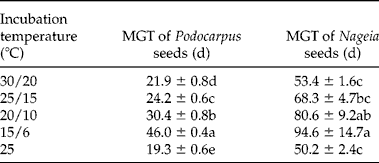
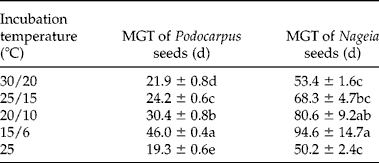
Mean germination time (MGT) of fresh seeds of Podocarpus costalis and Nageia nagi incubated at various temperatures. MGT was calculated after 8 weeks' incubation of P. costalis seeds and after 20 weeks' incubation of N. nagi seeds. Means (n=3)± SE within a column followed by different letters differ significantly (LSD, α=0.05)
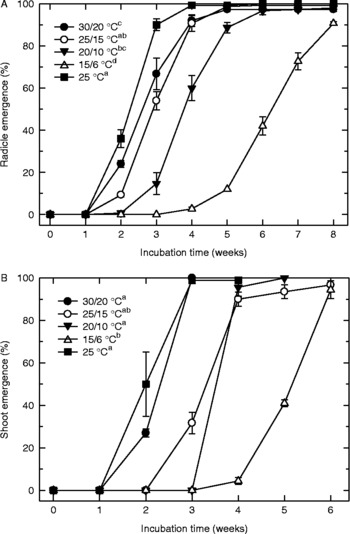
Percentage (means ± SE) radicle (A) and shoot (B) emergence of Podocarpus costalis seeds incubated at alternating temperatures of 30/20, 25/15, 20/10 and 15/6°C and at a constant temperature of 25°C. Incubation time 0 for shoot emergence starts after radicle emergence. Final percentages of radicle and shoot emergence among the incubation temperatures followed by different letters differ significantly (LSD, α = 0.05).

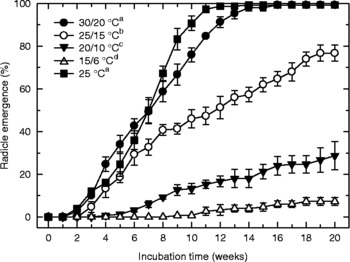
Percentage (means ± SE) radicle emergence of Nageia nagi seeds incubated at alternating temperatures of 30/20, 25/15, 20/10 and 15/6°C and at a constant temperature of 25°C. Final percentages of radicle emergence among the incubation temperatures followed by different letters differ significantly (LSD, α = 0.05).

Results
Embryo growth and germination
Embryos of fresh P. costalis seeds are linear-shaped and a suspensor links the embryo to the micropyle (Fig. 1A). Mean ( ± SE) lengths of embryos and megagametophytes in fresh seeds (n= 10) were 4.6 ± 0.5 mm and 10.6 ± 0.4 mm, respectively. Thus, the embryo length/megagametophyte length (E:M) ratio was 0.43. Embryo length just before radicle emergence was 7.1 ± 0.4 mm (Fig. 1B). Thus, both embryo length and E:M ratio increased to more than 1.5 times their values in fresh seeds.
Fresh seeds of P. costalis incubated at 30/20, 25/15, 20/10, 15/6 and 25°C germinated (radicle emergence) to 92, 90, 60, 3 and 99%, respectively, in 4 weeks. Extending the incubation time to 6 weeks increased seed germination to 96% at 20/10°C and to 42% at 15/6°C (Fig. 2A). Seeds incubated at 15/6°C required 8 weeks for 90% germination. In Podocarpus seeds incubated continuously at the above five temperatures, cotyledons had emerged from >90% of the seeds at 30/20 and 25°C by 3 weeks following radicle emergence (Fig. 2B). MGT of P. costalis seeds ranged from 19.3 ± 0.6 d at 25°C to 46 ± 0.4 d at 15/6°C (Table 1). The optimal temperatures for maximum germination percentage and rate were 30/20 and 25°C.
Embryos in fresh seeds of Nageia are linear-shaped and a suspensor links the embryo to the micropyle (Fig. 1C). Mean ( ± SE) lengths of embryos and megagametophytes in fresh seeds (n= 10) were 7.4 ± 0.8 and 15.4 ± 0.6 mm, respectively. Thus, embryo length/megagametophyte length (E:M) ratio was 0.48. Embryo length just before radicle emergence was 10.3 ± 0.6 mm (Fig. 1D). Thus, both embryo length and E:M ratio increased to 1.4 times their values in fresh seeds. It should be noted that N. nagi seeds consistently turned brown during incubation.
Fresh seeds of N. nagi incubated at 30/20, 25/15, 20/10, 15/6 and 25°C germinated (radicle emergence) to 24, 13, 0.7, 0 and 16%, respectively, after 4 weeks and to 91, 51, 17, 3 and 99%, respectively, after 12 weeks. Further, the N. nagi seeds incubated at 25/15, 20/10 and 15/6°C for 20 weeks germinated to 77, 29 and 7%, respectively (Fig. 3). MGT of Nageia seeds ranged from 50.2 ± 2.4 days at 25°C to 94.6 ± 14.7 days at 15/6°C (Table 1). The optimal temperatures for maximum germination percentage and rate were 30/20 and 25°C.
Discussion
An underdeveloped embryo is usually relatively small, and in many cases the seed has an embryo length/seed length (E:S) of < 0.5. Also, the small embryo must grow inside the seed before the radicle can emerge (Grushvitzky, Reference Grushvitzky and Borris1967; Baskin et al., Reference Baskin, Baskin, Chien and Chen2006a). The embryo in freshly harvested seeds of P. costalis is small (E:M = 0.43) and increased in length by about 54% inside seeds before the radicle emerged; thus, the embryo is underdeveloped. Fresh Podocarpus seeds germinated to 90–99% at 30/20, 25/15 and 25°C in 3–4 weeks (radicle emergence) and to 97% at 20/10°C after 6 weeks, without any pretreatment. Based on the short delay of 2–3 weeks at suitable temperatures of 30/20, 25/15 and 25°C between time of radicle and shoot emergence (Fig. 2B) and the fact that seeds germinated within 30 d, we conclude that seeds of P. costalis have morphological dormancy.
The embryo in fresh seeds of N. nagi is small (E:M = 0.48) and increased in length by about 39% inside the seeds before radicle emergence occurred; thus, the embryo is underdeveloped. The highest germination of N. nagi seeds at 4 weeks of incubation was < 25%, at 30/20°C, and it did not reach 50% (at 30/20 or 25°C) until week 7. Germination percentage at these two temperatures reached the maximum 99.3% after 14 (25°C) and 16 (30/20°C) weeks. Hong et al. (Reference Hong, Jhuang, Chien, Huang and Fan2009) also showed that seeds of this species germinated slowly at 25 and at 30/20°C. Thus, seeds of N. nagi required a much longer period of time than 1 month at optimal temperatures to germinate to high percentages, indicating that they have non-deep simple morphophysiological dormancy and need warm stratification to break it. The formula C1bB-C1b describes this level of MPD (Baskin and Baskin, Reference Baskin and Baskin2008), and it reads as follows. (1) Fresh seeds have an underdeveloped embryo (B) with non-deep physiological dormancy (C1) of the type requiring warm stratification (b of subscript 1b) for dormancy break. (2) Following (or occurring simultaneously with) breaking of non-deep physiological dormancy, the underdeveloped embryo grows to full size. (3) The seed, now with a fully developed embryo, germinates at warm temperatures ( − C1b).
At the Taiwan Forestry Research Institute, seeds of P. costalis and N. nagi are generally stored in a moist medium for a short period of time before use. The moisture content of fresh seeds with sclerotesta was 51% in P. costalis and 56% in N. nagi. Hong and Ellis (Reference Hong and Ellis1996) found that at maturity or at shedding the moisture content was between 36 and 90% for recalcitrant seeds and between < 20 and 50% for orthodox seeds. The Royal Botanic Gardens Kew Seed Information Database (Royal Botanic Gardens Kew, 2008) lists seeds of N. nagi (reported as Podocarpus nagi) and several other species of Podocarpus, but not P. costalis, as being recalcitrant. However, although no details on the storage behaviour of P. costalis seeds are available, the moisture content of fresh seeds of this species suggests that they may be recalcitrant. Recalcitrant seeds need a high moisture content to retain their viability, and they lose viability rapidly if dried to a moisture content of < 20–30% (Hong and Ellis, Reference Hong and Ellis1996). Therefore, on the basis of their seed moistures, both species studied may be expected to be recalcitrant, although this matter certainly requires further experimentation.
Underdeveloped embryos are considered to be primitive in seed plants (Martin, Reference Martin1946; Grushvitzky, Reference Grushvitzky and Borris1967; Baskin and Baskin, Reference Baskin and Baskin1998; Nikolaeva et al., Reference Nikolaeva, Lyanguzova and Pozdova1999; Forbis et al., Reference Forbis, Floyd and de Querioz2002; Finch-Savage and Leubner-Metzger, Reference Finch-Savage and Leubner-Metzger2006; Linkies et al., Reference Linkies, Graeber, Knight and Leubner-Metzger2010). However, this trait is not only present in extant primitive seed plants, but it can be found in advanced angiosperms. For example, an underdeveloped embryo is found in the most basal extant angiosperm Amborella (Baskin and Baskin, Reference Baskin and Baskin2007) as well as in some species of the advanced order Dipsacales (Baskin et al., Reference Baskin, Hidayati, Baskin, Walck, Huang and Chien2006b). The most primitive extant gymnosperms, i.e. Ginkgo biloba (West et al., Reference West, Frattarelli and Russin1970; Del Tredici, Reference Del Tredici2007; Shepperd, Reference Shepperd, Bonner and Karrfalt2008) and cycads (Martin, Reference Martin1946; Chien et al., Reference Chien, Chen, Chang and Chung2012) have underdeveloped embryos. Among the extant Pinopsida, underdeveloped embryos occur in some clades but not in others. Quinn et al. (Reference Quinn, Price and Gadek2002) investigated the phylogeny of conifers using the chloroplast genes rbcL and matK with Ginkgo as the outgroup. The first clade to diverge, the Pinaceae, has seeds with fully developed embryos. In addition to the Pinaceae, there are two other large clades in Pinopsida: (1) Araucariaceae and Podocarpaceae, and (2) Taxaceae and Cupressaceae. Now that underdeveloped embryos have been verified in seeds of Podocarpaceae, we can see that they occur in both of these clades, Podocarpaceae and Taxaceae. In their respective clades, both Podocarpaceae and Taxaceae are in advanced positions (Quinn et al., Reference Quinn, Price and Gadek2002). Thus, as in extant angiosperms, underdeveloped embryos are not restricted to the most basal groups. Unlike the advanced angiosperm clades, however, the Pinaceae do not have underdeveloped embryos.
Acknowledgements
The authors thank Yen-Wei Chang, Chang-Yen Chen and Chia-Yi Chen, Taiwan Forestry Research Institute, for technical assistance. This research was supported by a grant (99AS-8.1.2-F1-G1) from the Council of Agriculture, the Executive Yuan, Taiwan.