Introduction
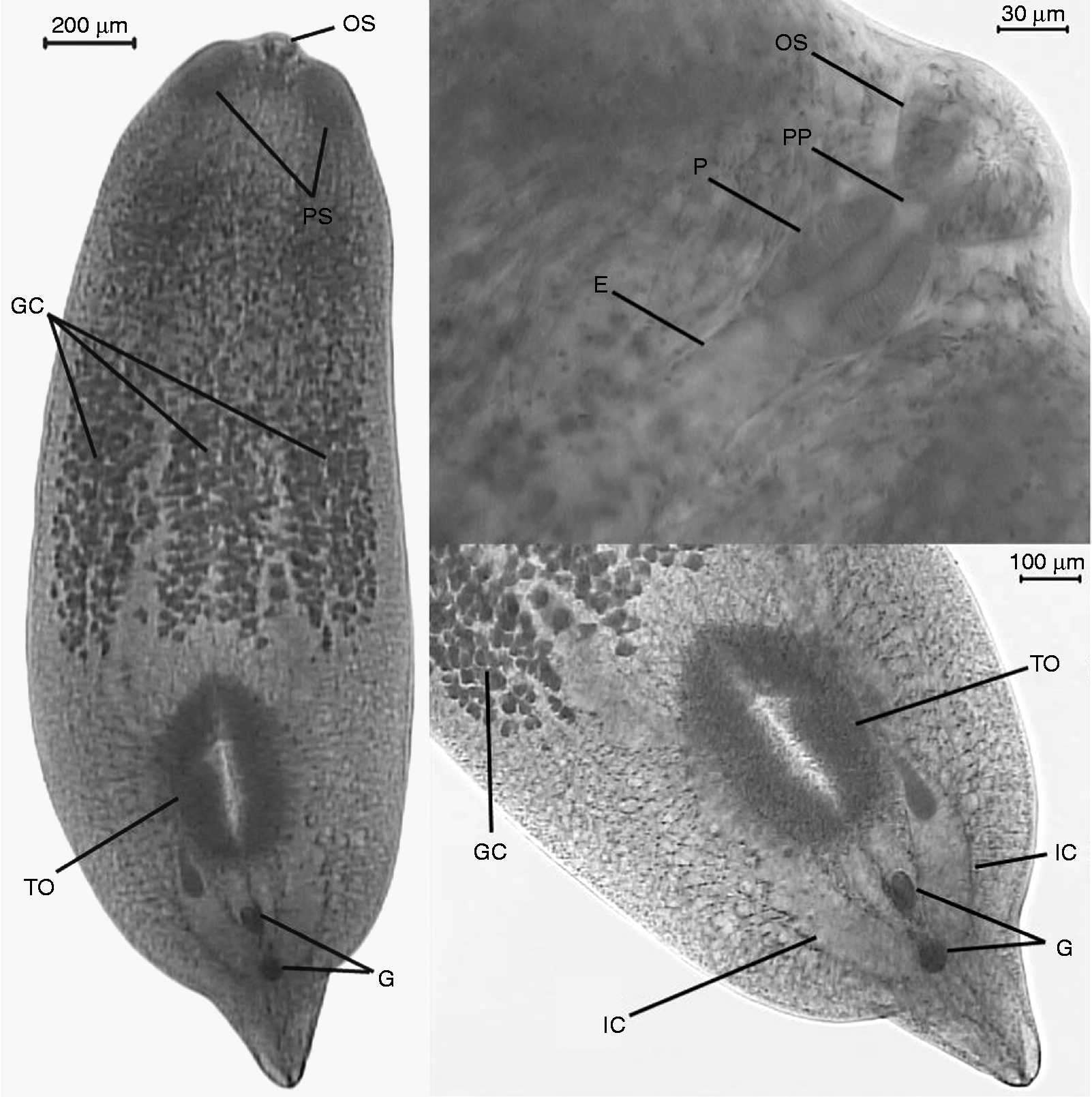
Austrodiplostomum compactum (Lutz, 1928) (Niewiadomska, Reference Niewiadomska, Gibson, Jones and Bray2002a, Reference Niewiadomska, Gibson, Jones and Brayb) is a digenetic trematode of the order Strigeoidea whose metacercariae (fig. 1) occur in the eyes of a wide variety of fish species (Ostrowski-Núñez, Reference Ostrowski-Núñez1982; Pineda-López, Reference Pineda-López1985; Osorio-Sarabia et al., Reference Osorio-Sarabia, Pineda-López and Salgado-Maldonado1987; Garcia et al., Reference Garcia, Osório-Sarabia and Constantino1993; Kohn et al., Reference Kohn, Fernandes and Baptista-Farias1995; Pavanelli et al., Reference Pavanelli, Eiras and Takemoto1997; Almeida, Reference Almeida1998; Silva-Souza, Reference Silva-Souza1998; Martins et al., Reference Martins, Fujimoto, Nascimento and Moraes1999, Reference Martins, Paiva, Fujimoto, Schalch and Colombano2002; Santos et al., Reference Santos, Pimenta, Martins, Takahashi and Marengoni2002; Paes et al., Reference Paes, Santos, Carvalho and Silva2003; Machado et al., Reference Machado, Takemoto and Pavanelli2005; Novaes et al., Reference Novaes, Ramos, Carvalho and Silva2006; Yamada et al., Reference Yamada, Moreira, Ceschini, Takemoto and Pavanelli2008; Zica et al., Reference Zica, Santos, Ramos, Zanatta, Carvalho and Silva2009). The metacercariae of these digeneans can infect the vitreous humour (Scholtz et al., Reference Scholtz, Vargas-Vazquez, Moravec, Vivas- Rodrıguez and Mendonza-Franco1995; Silva-Souza, Reference Silva-Souza1998; Amato et al., Reference Amato, Amato and Albrecht2001) and, more rarely, the brains of the intermediate fish hosts (Ostrowski-Núñez, Reference Ostrowski-Núñez1982; Silva-Souza, Reference Silva-Souza1998; Amato et al., Reference Amato, Amato and Albrecht2001).
Specimen of Austrodiplostomum compactum metacercaria (Digenea: Diplostomidae). E, oesophagus; G, gonads; GC, gland cells; IC, intestinal caeca; OS, oral sucker; P, pharynx; PP, prepharynx; PS, pseudo-suckers; TO, trybocitic organ.

In Brazil, A. compactum metacercariae have been reported previously in fishes of the orders Characiformes, Serrasalmus maculatus (Kner, 1858) (Characidae), Hoplias malabaricus (Bloch, 1794) (Erythrinidae) and Schizodon borellii (Boulenger, 1900) (Anostomidae); Siluriformes, Hypostomus regani (Ihering, 1905) (Loricariidae) and Auchenipterus osteomystax (Miranda-Ribeiro, 1918) (Auchenipteridae); and Perciformes, Cichla ocellaris (Block & Schneider, 1801), Cichla monoculus (Spix & Agassiz, 1831), Crenicichla britskii (Kullander, 1982), Cichlasoma paranaense (Kullander, 1983), Geophagus brasiliensis (Quoy & Gaimard, 1824), Satanoperca pappaterra (Heckel, 1840) (Cichlidae) and Plagioscion squamosissimus (Heckel, 1840) (Scianidae) (see Machado et al., Reference Machado, Takemoto and Pavanelli2005; Novaes et al., Reference Novaes, Ramos, Carvalho and Silva2006; Yamada et al., Reference Yamada, Moreira, Ceschini, Takemoto and Pavanelli2008; Zica et al., Reference Zica, Santos, Ramos, Zanatta, Carvalho and Silva2009).
Loricariid fish (family Loricariidae) have scarcely been examined for diplostomids. Amato et al. (Reference Amato, Amato and Albrecht2001) found diplostomid metacercariae of an undetermined species on the surface of, and within, the kidney ducts, on the surface of the liver and the peritoneum, and within the abdominal cavity and brain of Loricariichthys anus (Valenciennes, 1840) from Rio Grande do Sul State, Brazil. Hypostomus regani was recently recorded as a host for A. compactum metcercariae (Yamada et al., Reference Yamada, Moreira, Ceschini, Takemoto and Pavanelli2008; Zica et al., Reference Zica, Santos, Ramos, Zanatta, Carvalho and Silva2009). However, no other studies of infection by these metacercariae in loricariid fish have been conducted.
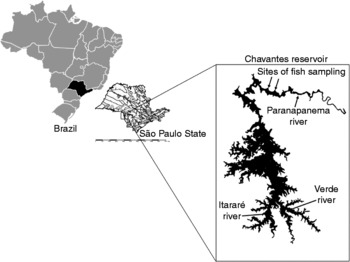
Based on the previous report on the occurrence of A. compactum metacercariae in fish of the genus Hypostomus (Yamada et al., Reference Yamada, Moreira, Ceschini, Takemoto and Pavanelli2008; Zica et al., Reference Zica, Santos, Ramos, Zanatta, Carvalho and Silva2009), the aim of the present study was to investigate the occurrence of infection by A. compactum metacercariae in the eyes of loricariid fish from Chavantes reservoir (see fig. 2), in the upper Paraná river basin, in the municipality of Ipaussu, São Paulo State, Brazil, in order to determine whether the reports of Yamada et al. (Reference Yamada, Moreira, Ceschini, Takemoto and Pavanelli2008) and Zica et al. (Reference Zica, Santos, Ramos, Zanatta, Carvalho and Silva2009) are incidental cases or whether these metacercariae are commonly distributed among loriicarid fish.
Sites of loricariid fish (Siluriformes: Osteichthyes: Loricariidae) sampling in the Chavantes reservoir, in the upper Paraná river basin, municipality of Ipaussu, São Paulo State, Brazil.

Materials and methods
The study was carried out from October 2007 to February 2009 in the Chavantes reservoir (fig. 2), in the upper Paraná basin, municipality of Ipaussu, São Paulo State, Brazil. The Chavantes reservoir is located in the middle of the Paranapanema River, between the states of São Paulo and Paraná (Sampaio, Reference Sampaio1944). The Chavantes hydroelectric power plant has an installed power capacity of approximately 414 MW. The dam is located at 480 m altitude, and its hydrographic basin includes large rivers such as the Paranapanema, Itararé and Verde. It is a reservoir of the accumulation basin type, with maximum depth of 70–90 m near the barrage, operational useful maximum quota of 474 m, total volume of 9.410 × 10⁶ m3, an area of 27,500 km2 and 400 km2 water mirror in its operational maximum quota (Duke Energy, 2010).
Fish were collected using a gillnet of nylon monofilament installed 2 days/month in two sites (Site 1: 23°07′30.71″S and 49°37′37.31″W; Site 2: 23°07′59.23″S and 49°36′10″W) of the reservoir (fig. 2), from 17.00 hours until 07.00 hours the following day, totalling 14 h of exposure. The collected loricariid fish specimens were transported to the field laboratory where they were measured (cm) and weighed (g). All data were presented as mean ± standard deviation (minimum – maximum) values. Then the fish were euthanized and the eyes were taken and examined under a stereomicroscope. Metacercariae found in the vitreous humour were fixed in AFA (alcohol–formaldehyde–acetic acid) solution under slight pressure of a coverslip for 10 min, and then transferred to 70% alcohol for further processing.
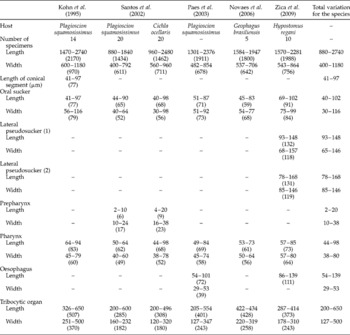
Identification of A. compactum metacercariae was based on the morphological studies of Kohn et al. (Reference Kohn, Fernandes and Baptista-Farias1995) and Zica et al. (Reference Zica, Santos, Ramos, Zanatta, Carvalho and Silva2009). The main characteristics of A. compactum metacercariae (fig. 1) were: foliaceous body, slightly concave in the ventral face; small conical segment in the posterior region; small subterminal oral sucker; two lateral pseudosuckers in the anterior region; oval pharynx; short oesophagus; intestinal caeca ending near the posterior region; oval tribocytic organ; gland cells occupying most of the anterior region, extending from the beginning of intestinal caeca in the anterior region to the tribocytic organ (Kohn et al., Reference Kohn, Fernandes and Baptista-Farias1995; Santos et al., Reference Santos, Pimenta, Martins, Takahashi and Marengoni2002; Paes et al., Reference Paes, Santos, Carvalho and Silva2003; Novaes et al., Reference Novaes, Ramos, Carvalho and Silva2006; Zica et al., Reference Zica, Santos, Ramos, Zanatta, Carvalho and Silva2009) (fig. 1). Morphometric data of A. compactum metacercariae are summarized in table 1.
Morphometric data of Austrodiplostomum compactum (Digenea: Diplostomidae) metacercariae. Measurements are in micrometres; ranges are followed by means in parentheses.

Fish voucher specimens were deposited at the Ichthyological Collection of Núcleo de Pesquisa em Limnologia, Ictiologia e Aquicultura (NUP) of the Universidade Estadual de Maringá, municipality of Maringá, Paraná State, Brazil and at the Laboratório de Biologia e Genética de Peixes, Instituto de Biociências (LBP) da Universidade Estadual Paulista, municipality of Botucatu, São Paulo State, Brazil. Metacercariae of A. compactum were deposited in the Coleção Helmintológica (CHIBB) of the Departamento de Parasitologia, Instituto de Biociências, Universidade Estadual Paulista, municipality of Botucatu, São Paulo State, Brazil.
Mean intensity of infection and mean abundance were calculated according to Bush et al. (Reference Bush, Lafferty, Lotz and Shostak1997). The Mann–Whitney test was used to examine whether there are effects of sample site on the parasitism. The effect of seasonalilty on the parasitism was examined using pooled data among all host species. Seasons were compared with the Kruskall–Wallis test. Spearmann's correlation test was used to evaluate the correlation between the intensity of infection and the fish standard length and weight using the software SigmaStat 3.0 (Jandel Corporation, San Rafael, California, USA).
Results
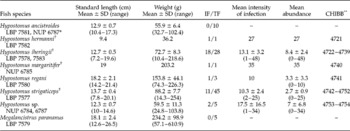
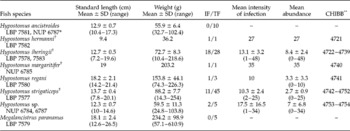
Ninety-eight specimens of loricariid fish were collected. These include Hypostomus ancistroides (Ihering, 1911), H. hermanni (Ihering, 1905), H. iheringii (Regan, 1908), H. margaritifer (Regan, 1908), H. regani, H. strigaticeps (Regan, 1908), Hypostomus sp. and Megalancistrus parananus (Peters, 1881) (table 2).
Data on infection by Austrodiplostomum compactum metacercariae in the eyes of loricariid fish sampled from the Chavantes reservoir, in the upper Paraná river basin, municipality of Ipaussu, São Paulo State, Brazil.
IF/TF, number of infected fish/total number of fish.
* Numbers in the first column are the accession numbers of voucher host species in the Ichthyological Collection of the Núcleo de Pesquisa em Limnologia, Ictiologia e Aquicultura (NUP) of the Universidade Estadual de Maringá, Municipality of Maringá, Paraná State, Brazil and at the Laboratório de Biologia e Genética de Peixes, Instituto de Biociências (LBP) da Universidade Estadual Paulista, Municipality of Botucatu, São Paulo State, Brazil.
** Numbers in the last column are the accession numbers of voucher helminth species in the CHIBB (Coleção Helmintológica of the Departamento de Parasitologia, Instituto de Biociências, Universidade Estadual Paulista, Municipality of Botucatu, São Paulo State, Brazil).
† New host record for Austrodiplostomum compactum metacercariae.
Metacercariae of A. compactum were found in the eyes of 34 specimens of the studied fish (overall prevalence = 34.7%). Only H. ancistroides and M. parananus were not infected by this diplostomid. Hypostomus hermanni and H. margaritifer were represented by only one specimen each but both had a high intensity of infection by A. compactum metacercariae (27 and 35 metacercariae, respectively). Infection was detected in H. regani and Hypostomus sp. The former had one specimen parasitized with 10 metacercariae in the eyes and the latter had two specimens parasitized with one and 34 diplostomids (table 2).
Hypostomus strigaticeps (n = 45) and H. iheringii (n = 28) were the species with the highest numbers of fish sampled in the study. For these species, the prevalence of infection was 24.4% and 64.2%, respectively. Hypostomus iheringii presented with a slightly larger number of parasites. However, abundance was higher in H. iheringii (13.1) than in H. strigaticeps (10.3) (table 2).
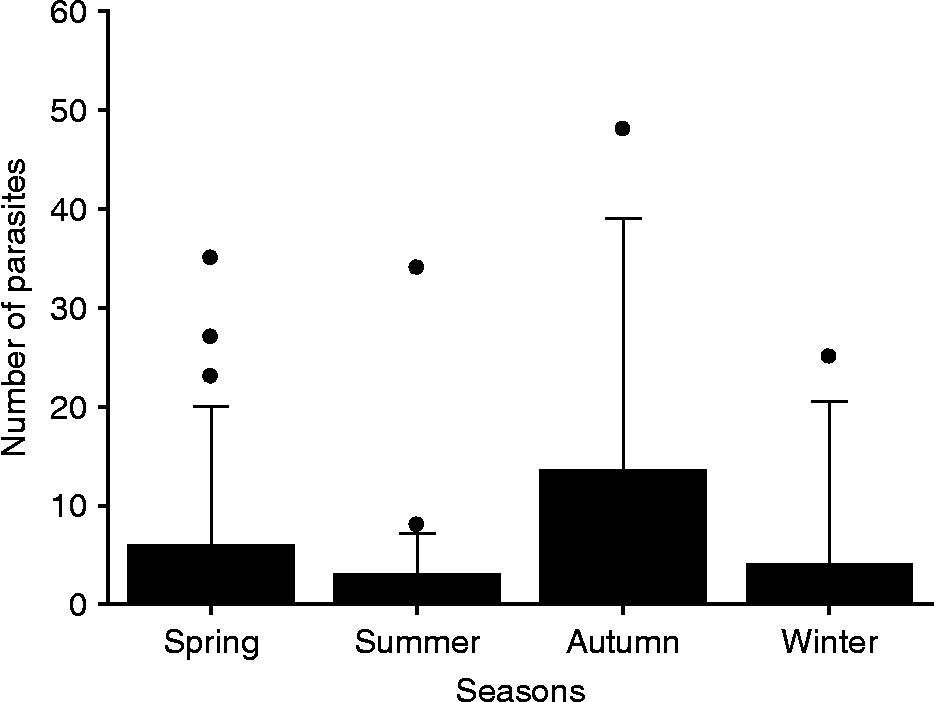
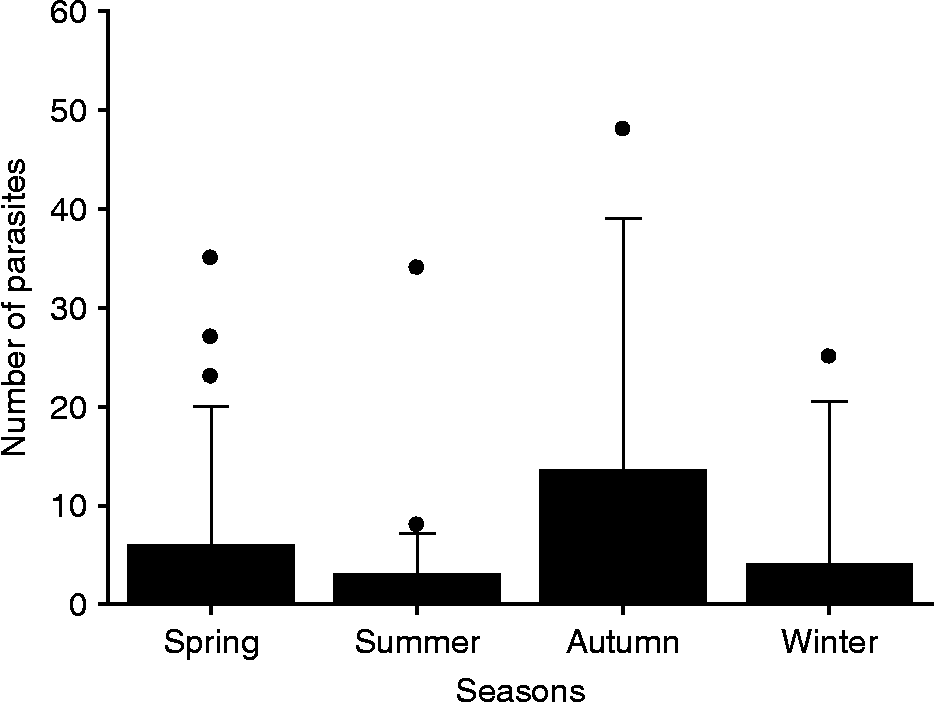
There was no correlation between the intensity of infection and the fish standard length (n = 98; r = − 0.0223; P = 0.827) or weight (n = 98; r = 0.0286; P = 0.779), and there was no effect of sample site on the parasitism (P = 0.766). Also, a seasonal pattern of infection was not observed (P = 0.815), although a slight tendency for an increase during autumn could be detected (fig. 3).
Box plot of the number of Austrodiplostomum compactum metacercariae in the loricariid fish (Siluriformes: Osteichthyes: Loricariidae) sampled in the Chavantes reservoir, in the upper Paraná river basin, municipality of Ipaussu, São Paulo State, Brazil in different seasons. All median values were zero. The superior limit of the boxes represents the 75th percentile, error bars are 90th percentile and circles are outliers. No statistical differences were observed between the seasons (P = 0.815).
Hypostomus hermanni, H. iheringii, H. margaritifer and H. strigaticeps were new hosts recorded for A. compactum metacercariae.
Discussion
The present study reports the occurrence of A. compactum metacercariae in six loricariid fish species from the Chavantes reservoir, in the upper Paraná river basin, municipality of Ipaussu, with a record of four new hosts. The metacercariae of this diplostomid have low specificity since many intermediate fish hosts have already been found to be infected with A. compactum metacercariae in the eyes or brain, mainly in Brazil (Machado et al., Reference Machado, Takemoto and Pavanelli2005; Novaes et al., Reference Novaes, Ramos, Carvalho and Silva2006; Yamada et al., Reference Yamada, Moreira, Ceschini, Takemoto and Pavanelli2008; Zica et al., Reference Zica, Santos, Ramos, Zanatta, Carvalho and Silva2009). However, the infection by A. compactum metacercariae is rarely observed in loricariid fish (Amato et al., Reference Amato, Amato and Albrecht2001; Yamada et al., Reference Yamada, Moreira, Ceschini, Takemoto and Pavanelli2008; Zica et al., Reference Zica, Santos, Ramos, Zanatta, Carvalho and Silva2009) and is restricted to Brazilian fishes.
Pojmanska & Chabros (Reference Pojmanska and Chabros1993) demonstrated that the prevalence of diplostomids was significantly lower in native fishes and higher for introduced species. In fact, it has been further demonstrated that the introduced species P. squamosissimus presents high infection levels by A. compactum metacercariae (Kohn et al., Reference Kohn, Fernandes and Baptista-Farias1995; Santos et al., Reference Santos, Pimenta, Martins, Takahashi and Marengoni2002; Paes et al., Reference Paes, Santos, Carvalho and Silva2003; Machado et al., Reference Machado, Takemoto and Pavanelli2005). Similar data were observed by Machado et al. (Reference Machado, Takemoto and Pavanelli2005) in several fishes from the floodplain of the upper Paraná river basin, Brazil. These authors hypothesized that this metacercaria species was introduced together with the hosts and is utilizing native fish from the region as alternative second intermediate hosts (Machado et al., Reference Machado, Takemoto and Pavanelli2005). As highlighted by several authors (see Zica et al., Reference Zica, Santos, Ramos, Zanatta, Carvalho and Silva2009 and references therein), progressively more native fishes have been reported as intermediate hosts for A. compactum, which appears to corroborate the hypothesis presented by Machado et al. (Reference Machado, Takemoto and Pavanelli2005).
Eight loricariid fish species collected from two sites of the Chavantes reservoir were sampled in this study. Only two species (H. ancistroides and M. parananus) were not infected with A. compactum metacercariae. Zica et al. (Reference Zica, Santos, Ramos, Zanatta, Carvalho and Silva2009) suggested that the infection by A. compactum metacercariae may be associated with environmental factors and biology of the hosts, as the first intermediate host is an aquatic snail and the loricariid specimens are usually bottom fish (Garavello & Garavello, Reference Garavello and Garavello2004). The infection can occur because both (first and second intermediate hosts) use the same habitats, which increases the possibility of the encounter between host and parasite. In this way, the absence of infection in H. ancistroides and M. parananus may be related to some unknown ecological aspects of these hosts. In the case of H. ancistroides, it is known that this species lives preferentially under the marginal vegetation in the river (C.H. Zawadzki, pers. obs.) or under wood debris (Casatti, Reference Casatti2005), which could explain the absence of parasites in this species. Future studies will be conducted to clarify this.
Acknowledgements
We thank to FAPESP (Fundação de Amparo à Pesquisa do Estado de São Paulo), for financial support (2007/58246-4). We are also grateful to Kristin Nicole Taylor, from Weill Cornell Medical College, New York, USA, for the English review of the manuscript.