Cultural historians of other world regions have devoted significant attention to advertisements, but their use as sources is much less common in African history. This partly reflects the relatively late development of advertising in Africa, and its limited reach in most African societies before the Second World War. For this period, historians of Africa have few advertising sources with which to work. Low literacy levels meant that newspaper readership was small and traditional newspaper advertisements would have been seen by only a limited section of the African population. Advertisements were mainly used to sell supplies to traders, as well as to market luxury goods to European residents and to the very small group of well-off Christian mission-educated Africans. Yet consumption, defined as the use of commodities produced by others, was widespread in West Africa, and much of this concerned imported goods that had been mass produced. Since the nineteenth century, traders and producers had been using trademarks – instead of newspaper advertisements – to influence consumers. They also used advertising posters and metal signs, which were stuck onto walls and nailed into trees. In the absence of market research organisations, they received feedback about consumer preferences through various channels, in particular through direct contact between African buyers and the storekeepers of the European trading companies who imported the bulk of mass produced consumer goods into West Africa. Although the first specialised marketing firms emerged in West Africa during the interwar years, advertising aimed at African consumers became widespread only after the Second World War.Footnote 1 ‘Scientific’ market research took hold even later, after 1960, more than forty years following its development in the United States and Britain.Footnote 2
Historians' limited interest in advertising in Africa has also reflected the research agenda of the field of African history during the 1970s through to the 1990s, which focused on the workings of colonial and postcolonial power; the history of missionary activity and the spread of Christianity; issues around migration, labor, gender, and neo-traditionalism – topics for which sources other than advertisements seemed more appropriate. The recent growth of interest in African modernities, the culture of decolonisation, and the history of consumption, means that advertising is set to become a more central interest for historians of Africa.
This article examines advertising for schnapps gin and beer in Ghana and Nigeria from the end of the Second World War until the mid-1970s. The divergence of gin and beer advertising will be explained as resulting from processes of negotiation about the local meanings of material goods. The different consumer responses to advertising for beer and gin – and the advertisers' reaction to these responses – derived from the differing ways in which African consumers attached meanings to specific commodities. This understanding of advertising as a process of negotiation has implications for the use of advertisements as sources for African history.
ADVERTISEMENTS AS SOURCES FOR AFRICAN HISTORY
How historians have read advertisements as sources has depended on their position in the debate about how advertising functions. This question was initially framed as being about whether advertising merely reflected consumer society at the time (in which case advertisements might be read as a way into understanding a specific social group and its needs, lifestyles, and consumption patterns), or whether advertising actively shaped and determined consumer behaviour by manipulating consumers and creating new and often ‘unnecessary’ wants (in which case advertisements might offer general insights in the functioning of capitalism and ideology).Footnote 3 This turned into a question about agency: who determines the cultural meaning of a commodity? Is it the consumers who decide to buy products and use them in certain ways? Or is it the producers and advertisers who tell the consumers what the commodity is about?
During the first half of the twentieth century those working in advertising generally subscribed to the latter viewpoint, assuming that a universal set of advertising principles could be employed anywhere.Footnote 4 However, when they set up offices abroad they found that they had to adapt their strategies to local cultural expectations and sensitivities.Footnote 5 On the basis of market research and consumer responses to advertisements, agencies developed advertising practices that were specific to local markets. When understood as constituting local genres, advertisements can thus be read as the outcomes of processes of negotiation between marketers and prospective consumers. To be effective, advertisements have to reflect, to some degree, the cultural expectations of the society in which they are used. They thus do not reflect society as such, but rather some of the dreams, ambitions, and cultural meanings ascribed to things.
Post-Second World War advertising in Ghana and Nigeria displays this tension between universal advertising principles and the specific circumstances of local markets. Advertisers understood African consumers to be ‘different’ from North American or European consumers. Some of their views about the specific circumstances of African markets contained stereotypes about African consumers that may have been drawn from imperialist ideology, although evidence for this is limited.Footnote 6 Marketing professionals certainly regarded the requirements of African consumers as unusual, and appear to have believed a number of stories about African consumptive habits that were almost certainly fictional.Footnote 7 Accepting the then-familiar modernisation myth, they considered African consumers to be ‘simpler’, especially in rural areas where Africans ‘emerged much more slowly into the modern world.’Footnote 8 In 1965, an article in the Journal of Marketing which gave advice to new entrants into the Nigerian market stressed that, for local marketing campaigns to be effective, they had to be different – less subtle – than advertising for the North American market. Advertising aimed at Africans had to be ‘direct, forceful, and continuous’. This advice was illustrated with an example of a successful campaign: ‘the ubiquitous slogan “Guinness gives you power”, next to the bulging biceps of an African arm has made Guinness stout the biggest seller in Nigeria.’Footnote 9
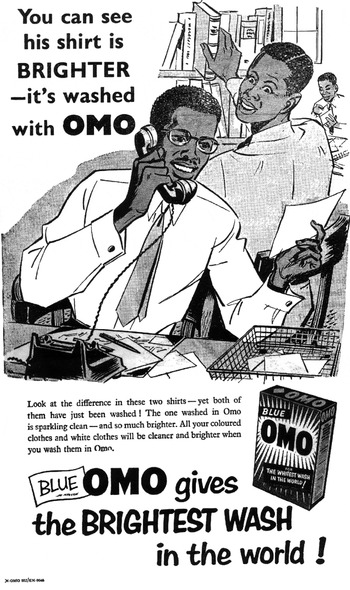
Yet, while offered as an example of advertising that understood African consumers as ‘different’ this was really very similar to earlier ‘Guinness for strength’ campaigns used in Ireland and the United Kingdom, only this time with images of Africans.Footnote 10 In spite of the marketing profession's discourse on African ‘difference’, there often appeared to be only a token response to local tastes and customs. A sampling of advertisements printed in popular West African newspapers during the 1950s brings up many campaigns that are similar to those in Europe and North America: African men ‘feel sure of success’ – and African women ‘look their best’ – after washing with ‘Palmolive’ soap; Nigerian mothers make sure that their children grow up strong and healthy by making them drink ‘Ovaltine’ and by feeding them bread with ‘Blue Band’ margarine; while Ghanaian shirts are whiter and brighter after having been washed in ‘Omo’.
Omo advertisement.

The individuals depicted in the advertisements were dressed according to European style, and they appeared to be office workers, managers, or business men, or to belong to the higher classes. Women were also shown in advertisements, and some of the products advertised were clearly intended for females. However, compared to advertising practices elsewhere, the gender balance was weighted more towards men.Footnote 11 Manual laborers, servants, and farmers were not often depicted. This was a reflection of the readership of the newspapers, and of those readers' aspirations. This may limit the use of newspaper advertisements as sources: other media, such as radio and cinema advertisements likely reached a broader section of the population. However, most advertising campaigns stretched across a range of media. For instance, an early 1950s ‘Star’ beer campaign combined publicity vans, billboards, sandwich-board men, and newspaper advertisements, while of the £79,500 that made up the 1964 advertising budget for ‘Guinness’ stout in Nigeria, 18 per cent was spent on newspaper and magazine advertisements, with another 18 per cent spent on billboards and other outdoor advertising, and 32 per cent spent on cinema and radio commercials.Footnote 12 In such cases, brand consistency required that the positioning of the product in the newspaper advertisements had to be similar to that elsewhere.
This examination of West African newspaper advertisements relies largely on company records in the United Africa Company (UAC) archive, while use has also been made of the company archive of Bols Distilleries and of local newspapers. UAC was one of the major trading companies operating in West Africa during the twentieth century and a major importer of gin and beer. From 1949 onwards, UAC, in joint ventures with others, was also a major local producer of beer.Footnote 13 The UAC archive contains internal correspondence, marketing plans, and correspondence with advertising agencies, which help to place the published advertisements within specific marketing strategies, and also within the broader context of market opportunities and challenges during the period of decolonisation and the first years of postcolonial rule.
THE GROWTH OF ADVERTISING AND MARKETING
In the decades following the Second World War, a number of related political, social, and economic developments provided the basis for rapid growth in the advertising business and the development of a marketing industry in West Africa. ‘Africanisation’ policies in government and business, instituted in preparation for decolonisation, meant speedy promotions, resulting in a rapid expansion of the African middle classes. Meanwhile, wages were rising across the board, as African workers for government or foreign enterprise received a succession of pay increases. This general rise in consumer purchasing power occurred alongside a rapid urbanisation that contributed to the gradual decline of colonial and kinship constraints on African consumption. Africans in cities fashioned new lifestyles for themselves, at least in part through the selection of certain (often foreign) goods, and the rejection of others.Footnote 14 All of these factors encouraged spending on consumer goods, and thus a growing market for mass-produced items. At the same time, the distribution channels were changing: large merchant firms withdrew from most retailing, and their place was taken by a much greater number of smaller African enterprises. As a result, distribution became more complex and less predictable.Footnote 15
These changes encouraged foreign traders and producers to consider two forms of advertising: first, advertisements that aimed to sell particular products to an expanding consumer market; and, second, ‘goodwill’ advertisements that aimed to defend the image of the company against accusations of being (neo-) colonial or exploitative.Footnote 16 These years also saw a rapid development of the media infrastructure on which advertising relied: billboards; newspapers and magazines; cinema screenings; and radio. While billboards continued to be the prime advertising medium, newspaper circulation increased 32-fold between 1937 and 1961.Footnote 17 Radio was first introduced in the late 1930s and spread rapidly. By the mid-1950s the size of the audience for radio broadcasts overtook that of newspaper readership.Footnote 18
The development of the advertising industry had started with the business of media buying when, in 1929, West African Publicity Ltd was founded. In the first decade of its existence, the company erected billboards across Nigeria and Ghana (then Gold Coast). It also owned large poster and printing businesses, handled all the advertising in the colonial administration's post offices, and placed advertisements on a commission basis in local West African newspapers.Footnote 19
European advertising agencies largely designed this material. Even when local branches of these agencies were engaged, much of the advertising continued to be developed in London. In 1968, although the bulk of Lintas's West African business had been transferred to Lintas Nigeria and Lintas Ghana, many of the skills remained in London, where most of the creative and production work was done. This reflected the predominantly foreign brands that were being advertised during the 1950s and 1960s. Towards the end of the 1960s, when more and more local brands were developed to be manufactured locally for local markets, West African advertising businesses began to build up their creative departments.Footnote 20
In the 1970s, following indigenisation decrees, branches of European agencies came under local ownership. Much of the production work nevertheless continued to be done in Europe, particularly for cinema and television commercials. Newspaper advertisements, billboards, and posters were more often produced in West Africa, using local photographers and writers. According to a former General Manager of Lintas Ghana, ‘our stuff was pedestrian’ but ‘adequate’: while the local photography was not up to international standards, Ghanaians could relate to the style of the advertisements, because the agency used the same photographers that took their portraits or that they hired to cover events in their own homes.Footnote 21
Dedicated market research organisations emerged in the 1960s, with Research Bureau Ltd Nigeria (RBL Nigeria) set up in 1964 as a Unilever subsidiary. RBL Nigeria offered socioeconomic surveys, brand evaluations, blind product tests, and test marketing services. The methodologies used were similar to those used in Europe and North America. Most of its business came from Lever Brothers (also Unilever) and from Nigerian Breweries Ltd (in which UAC held a stake), and to a lesser degree from companies such as Dunlop and Glaxo. From the very beginning, research was aimed at developing and evaluating brands, as well as at gathering information with which new products could be developed that met African consumers' needs and tastes.Footnote 22 RBL Ghana was launched in 1968, but did not have a good start: studies were done for the Ghana Broadcasting Corporation and for Lever Brothers, and there was some work from Kumasi Brewery Ltd. Overall, however, there was limited demand for market research at a time when most goods were in short supply.Footnote 23
The fate of RBL Ghana reminds us that the development of marketing and advertising in West Africa took place against a background of recurring periods of commodity scarcity. During such periods, some traders and producers could no longer afford the cost of advertising. Others considered that they could sell their wares without having to advertise them. However, even in times of scarcity there were reasons to advertise: to explain shortages; to announce the replacement of an imported product with a locally-manufactured one; or to explain changes in taste or appearance where ingredients had to be substituted due to the unavailability of raw materials. In this latter context, market research was sometimes commissioned to assess the acceptability of reformulated products. Ghanaian breweries faced shortages from the mid-1960s, as did Nigerian breweries throughout the 1970s and 1980s, resulting in supply difficulties and in constraints on advertising budgets.Footnote 24
THE MARKET FOR BEER AND GIN
Advertising for beer and gin aimed at African consumers started only after the Second World War, but alcoholic liquors had been imported into West Africa for hundreds of years. The importation of rum and, especially, schnapps gin increased after the ending of the transatlantic slave trade, as the changes in the economy of the second half of the nineteenth century brought imported goods within reach of a larger section of West Africa's population.Footnote 25 Around 1900, annual importation of gin into West Africa stood at around 85,000 hectolitres. The importation of beer at this time appears to have been insignificant in comparison. Gin acquired important functions for social drinking, as a currency, as an indication of the status of chiefs and elders, and as a ritual good used to pray to the gods and ancestors.Footnote 26
The large scale of liquor imports put colonial governments in a difficult position. They achieved a significant proportion of their revenue from import duties on distilled liquors: in some years up to between 30 and 40 per cent of total government income, but were under strong pressure from anti-liquor trade campaigners to prohibit its importation.Footnote 27 Between 1918 and 1940 various measures aimed to reduce the amount of liquor that was imported. In 1939 only 2,160 hectoliters of gin were imported into West Africa. This reduction was largely the consequence of the world economic crisis, which made imported liquor unaffordable to most Africans, and also encouraged what colonial governments classified as ‘illicit’ distillation.Footnote 28 However, even though less imported gin was consumed overall, its use remained essential for rituals, including the pouring of libation, funerals, and marriage proceedings, as well as visiting shrines and bringing matters to the elders for adjudication.
From 1919 onwards, the anti-liquor measures had included a ban on the sale of ‘trade spirits’, here defined as liquors produced specifically for consumption by Africans.Footnote 29 This particular measure complicated the marketing of all liquors, as an overly specific focus on African consumers risked the brand being classified as a ‘trade spirit’ and hence being prohibited. Meanwhile, bottled beer was slowly gaining in popularity, initially among the few Europeans employed in business and colonial service, and later also among those African urban dwellers who could afford it, appreciated the lighter taste, and were attracted to its image as a ‘modern’ drink and its association with European lifestyles and values. A bottle of beer was cheaper than a bottle of gin, particularly so because beer did not attract the same high customs duties as gin and other imported spirits. Beer was nevertheless more expensive than a single tot of imported gin served in a bar or shop, and it was particularly expensive compared to the locally distilled gin and palm wine consumed by the majority of the non-Muslim population. Following the overall pattern in the economy, beer consumption increased consistently during the 1920s, then – like gin – fell back after 1928 as a result of the world economic crisis. Beer consumption started to rise again during the late 1930s, but this recovery was interrupted by the onset of the Second World War.Footnote 30
The years following the war saw the lifting of interwar restrictions on alcohol, and the emergence of a postcolonial pattern of alcohol consumption. Restrictions on the importation of gin were lifted, but the amount imported remained low compared to the 1900s and the 1920s.Footnote 31 Gin producers and their importers – in particular UAC, which held the largest share of the market – now turned to advertising in an attempt to re-grow sales. This was possible because of the developing infrastructure for advertising and also because it was now possible to advertise gin directly to Africans without running the risk of being accused of peddling ‘trade-spirits’. Sales growth was expected to come not through gin purchases for traditional rituals, but from those who the marketers considered ‘modern’ urban dwellers who could afford to spend money on the regular purchase of liquor for leisure drinking in up-market bars, restaurants, and clubs.
The same market segment was being targeted by the local West African beer breweries that had been set up by foreign investors. As early as 1933, Overseas Brewery Ltd, a Swiss company, had opened a brewery in Ghana. Nigeria's first brewery was opened in Lagos in 1949 by Nigeria Brewery Ltd (NBL), a joint-venture between UAC and Heineken, with additional investment from other European trading companies.Footnote 32 Neither UAC nor Heineken appears to have conducted systematic market research before deciding to open the brewery. Historian Simon Heap has suggested that the establishment of NBL was in the first place a defensive move by the main importers of bottled beer into Nigeria to protect their market against expected local competition. Such competition was likely to emerge both because of the movement towards import-substitution industrialisation, and because of the cost advantages that a local brewery would have compared to a company bringing in beer from overseas.Footnote 33
Intended as an alternative to imported beers, locally produced beers needed to have the same quality, and similar labels and packaging. Consumers had to be convinced that the locally brewed beer was of the same quality as the imported kind, and that it carried the same associations of style and class. NBL, therefore, started advertising with the slogan ‘Star – beer at its best’.Footnote 34 Their early marketing strategy was to get ‘Star’ beer distributed in places that were frequented by expatriates and the wealthy Nigerian elite: fancy clubs, bars, and restaurants, and, of course, also the up-market Kingsway department stores, owned by UAC. Indeed, the earliest series of ‘Star’ beer advertisements focused on the availability and consumption of ‘Star’ beer in specific high-class bars and restaurants, with each advertisement including an illustration of a different venue with ‘men of distinction’ enjoying ‘Star’ beer.Footnote 35
By 1958 UAC and Heineken considered the Nigerian brewery business enough of a success to justify setting up Kumasi Brewery Ltd (KBL) in Ghana, to compete with Overseas Brewery Ltd's established ‘Club’ beer. In Nigeria – where for more than ten years NBL had been the only local brewery – competition began to emerge in the early 1960s, with the creation of two breweries to produce ‘Top’ beer and ‘Golden Guinea’ beer respectively, and the establishment of Guinness (Nigeria) Ltd. The latter was another joint-venture involving the UAC.Footnote 36
Meanwhile, local – illicit – distillation in improvised stills had emerged before the start of the brewery industry, and illegal gin had become the drink of choice for the poor in the 1930s. However, it would take decades before the industrial distillation of quality gins began.Footnote 37 In 1958 the first West African distillery was established by the Ghanaian government as part of its policy of import-substitution industrialisation.Footnote 38 Other distilleries in Ghana and Nigeria were set up as joint-ventures, with Dutch distilleries providing technology and technical management.Footnote 39 As with the locally brewed beer, the locally distilled gin needed to have the same quality, and similar labels and packaging to maintain its European feel, to be acceptable as an alternative to imported schnapps gin. By 1970, imported gins began to lose their share of the market of gin used for traditional rituals to locally distilled ‘foreign-style’ gins.
MODERNITY, GOOD LIVING, AND THE ‘STAR PEOPLE’
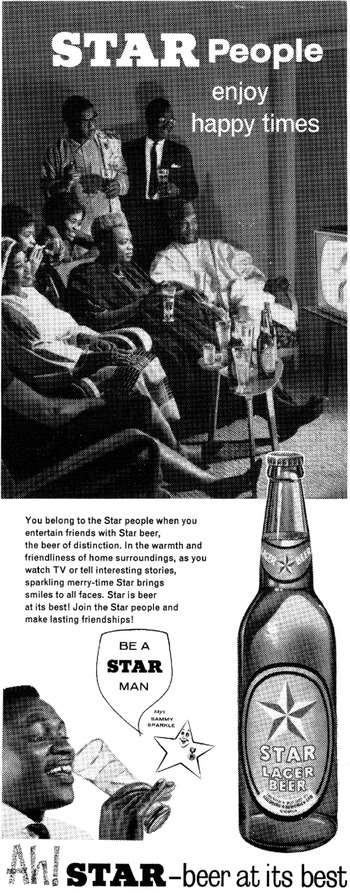
Producers and importers of beer and gin were among the first clients of the West African advertising industry. The industry's early efforts are illustrated by comparing an advertisement for ‘Henkes’ schnapps gin from around 1960, with a ‘Star’ beer advertisement from the same period. The ‘Star’ beer advertisement ‘Star people enjoy happy times’ (see Fig. 2) was part of a series encouraging consumers to picture themselves as (potential) ‘Star people’ who ‘enjoy good living’, ‘enjoy happy times’, and so on. The advertisement was composed around an illustration of people drinking ‘Star’ beer and watching television – then a new phenomenon introduced in Nigeria in 1959 (1965, in Ghana). The setting was domestic, the furniture modern. A mixed group of men and women between the ages of 20 and 45 – some of them wearing European suit and tie (male) or a dress (female), others sporting African outfits – gazed happily at a television screen. The copy read:
You belong to the Star people when you entertain friends with Star beer, the beer of distinction, in the warmth and friendliness of home surroundings, as you watch TV or tell interesting stories, sparkling merry-time Star brings smiles to all faces. Star is beer at its best! Join the Star people and make lasting friendships!
Arranged alongside the copy were a bottle of ‘Star’ beer, a picture of a satisfied and sophisticated-looking man in shirt and tie emptying a glass, and the cartoon character Sammy Sparkle saying ‘Be a Star man!’ Finally, the top header ‘Star people enjoy happy times’ was matched by the footer ‘Ah! Star – beer at its best’. The layout was quite busy, and needed space to work: perhaps a full page in a monthly magazine such as Drum or African Challenge. Indeed, elements of this advertisement – the man emptying his glass; the Sammy Sparkle character; and the slogan ‘Ah! Star – beer at its best’ – were also used on their own for smaller newspaper advertisements.
‘Star people enjoy happy times’ Star beer advertisement.

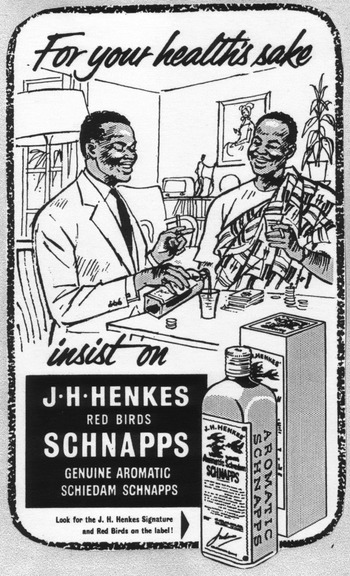
The layout of the ‘Henkes’ schnapps gin advertisement (see Fig. 3) was a lot simpler: one large drawing with in the foreground a large image of the product, along with a slogan and the product name. These advertisements were used at a small size: normally over one or two newspaper columns. The advertisement, nonetheless, had much in common with that for ‘Star’. The setting was domestic and modern: a living room with bookshelves, a modern arm chair, a photograph on the wall, a potted plant, a modern light, and a radio receiver. In the middle of the picture, two sophisticated men enjoyed their glasses of schnapps gin. The way they are dressed signalled ‘success’: one in suit and tie, wearing a shirt with cuff links, the other in a Ghanaian kente cloth (by definition expensive) and a watch. Each man was smoking a cigarette. The slogan ran: ‘For your health's sake insist on J. H. Henkes schnapps.’ This allusion to possible health benefits was not worked out in the ad, but was not uncommon in advertising alcoholic beverages. Meanwhile the message of the illustration was clear: successful, sophisticated, and up-to-date middle-class Africans knew to savour ‘Henkes’ gin. This advertisement was part of a series. In each episode the same two men, similarly dressed, were seen enjoying gin in a different context: at a cricket match; in a fancy modern bar (surrounded by Europeans); in an up-market restaurant (with a band playing); and sitting on the veranda (smoking cigars). This long-running series continued throughout the 1950s and 1960s with advertisements repeated weekly and, at times, daily in a range of West African newspapers.Footnote 40
‘For your health's sake’ Henkes schnapps advertisement.

During the 1950s and 1960s, both (‘Star’) beer advertising and (‘Henkes’) schnapps gin advertising referenced ‘the modern’, status, and success. Additionally, ‘Star’ beer advertisements worked up the theme of enjoyment (though this was also used in some schnapps gin campaigns, such as the ‘Happy Man’ series for ‘Capstan’), while the ‘Henkes’ schnapps advertisements developed a health theme (also used for certain beer brands, particularly ‘Guinness’).
The references to modernity, status, and success in the liquor ads captured the popular mood during the years of decolonisation and was also in line with trends in West African advertising, more generally. A sampling of advertisements from the 1950s and 1960s shows frequent references to ‘decolonisation’ and the ‘modern’ (often linked together). Both terms were also often used outside of advertising. In decolonising West Africa the idea of the ‘modern’ manifested itself in many places and on many levels, including: newspaper discussions; music and plays; architecture; political debates and election campaigns; and consumer choices for ‘modern’ products. Different users of the term, however, imbued it with quite different meanings. Most nationalist politicians and many newspaper contributors appear to have shared the assumptions of ‘modernisation theory’ that was popular at the time. For them, ‘modern’ evoked a specific economic, political, and technological trajectory along which their society would ‘develop’. Others used the term imprecisely as a synonym for ‘progress’. For many consumers, ‘modern’ rather referred to a style that could be adopted, with associations of urban life and links to the wider world beyond Africa. Yet all these different meanings of ‘modern’ shared the sense of something positive.Footnote 41
Use of the ‘modern’ in advertising seems to have fit well with these West African various evocations. Advertisements presented the ‘modern’ in generally positive terms but also imbued it with different meanings. Some advertisements contained illustrations of the modern factories in which the advertised goods were produced, or emphasised the modern science on which products were based. Other advertisements pointed towards the modern lifestyle that was associated with the featured product, and invited consumers to picture themselves as modern Africans who lived in bungalows, rode bicycles, consumed processed foods, and listened to recorded music. The shops where these goods could be acquired were also presented as modern.Footnote 42 These advertisements thus encouraged West African consumers to aspire to modernity. This marketing strategy was not unique to West Africa. Advertising in Europe and the Americas promoted many of the same attributes of modernity: science and technology, convenience, and sleek styling.Footnote 43 However, the modernity signalled in the advertisements, while cosmopolitan in outlook, was firmly located in Africa, as advertisements included references to Marina in Lagos and, in Accra, Achimota College, the Kingsway department stores, and the polo grounds.
Modernity was often linked to status. Advertisements implied that the consumption of the promoted goods provided a readily recognisable sign of status and success. As we have seen in the beer and gin advertisements, this claim was mainly communicated through the illustrations, which showed people dressed in expensive clothes, living in spacious houses, employed in prestigious jobs, or relaxing in classy venues. Sometimes the link with status was made more explicitly, as in the series of advertisements which emphasised that ‘Star’ beer was consumed by ‘men of distinction’.
These themes generally correspond with those that Frank Mort has identified as the common themes in advertising in Britain during the 1950s and 1960s: modernity, status, and sex.Footnote 44 However, it must be noted that allusions to sex in West African advertising were rather limited and quite modest. Of much greater visibility were the references to ‘health’. Not only were there many advertisements for ‘tonics’, creams, and health drinks, advertisements also often emphasised the health benefits of ‘ordinary’ products: ‘Blue Band’ margarine contained ‘Vitamins A and D – the vitamins essential to health’, ‘Horlicks’ provided ‘strength and energy’, and even gin was said to ‘keep you fit and healthy’.
The advertisements for ‘Star’ beer and ‘Henkes’ gin thus fit a general trend in West African advertising and appear to have been well suited for the intended market. However, their focus on status and success also reflected a global trend in the liquor industry to develop premium brands of liquor and position them as stylish and luxury products, appreciated by stylish and successful people. The strategy was generally successful in West Africa and elsewhere. To present the proper brand of liquor to your guests, to know your drinks, and to consume them in the appropriate fashion, was one of the means through which consumers, mainly men, expressed their identity, status, and aspirations.Footnote 45
The ads thus also reflected an assumption about who constituted the primary market for branded alcoholic drinks: male salary earners living in the principal urban areas. The vast majority of these were government officers, junior and senior managers, chief clerks, and businessmen.Footnote 46
The similarities between advertisements for gin and beer used in Ghana and Nigeria, raise questions as to how the market for alcoholic drinks was defined. UAC assumed that there was ‘probably a large overlap of beer and spirit drinkers’, and regarded gin, beer, whisky, and so on, as all belonging to the same market of ‘premium drinks’.Footnote 47 The difference between fermented alcoholic drinks (such as beer) and the much stronger distilled liquors (such as gin) was not regarded as relevant to marketing drinks in West Africa. Instead, the crucial difference was between the locally made unbranded drinks (fermented drinks such as palm wine, as well as illegally distilled liquors) consumed by the majority of the population, and the relatively expensive branded drinks that only a minority could afford on a regular basis. The marketing experts were sufficiently influenced by the myth of modernisation to assume that this latter group lived in the urban centres. They thus ignored consumers in rural areas where produce farming had resulted in significant purchasing power, and that had established traditions of consuming branded liquors. They also assumed that the consumption of beer and gin mainly took place in the new public spaces that bars, clubs, and restaurants provided.Footnote 48 One of the aims of advertising was to change this: by introducing branded drinks into the household, where they could be consumed more frequently, as the men could drink without being missed by their families, and where women could also partake in their consumption. While this particular perspective on the market saw ‘Africa’ as different, it also assumed that those Africans identified as the likely purchasers of branded drinks were very similar to urban middle-class consumers in Western Europe: male breadwinners, living with the nuclear family in self-contained homes, aspiring to a ‘modern’ lifestyle.Footnote 49
This approach was remarkably different from that used by South African Breweries (SAB) to reach African consumers in apartheid's townships: in the 1960s, SAB's marketing constructed the consumption of bottled beer as part of an African tradition of communal drinking, associated, not with an individualised, urban ‘modern’ style, but with ‘the gourd passed around in a rural homestead’.Footnote 50 These different visions of the African market for beer surely reflect different histories of local bottled beer brewing and consumption. Yet it also indicates the extent to which marketers in decolonising West Africa had moved away in practice from the colonial idea of African difference that was still underlying SAB's understanding of the market.
A further question about the definition of markets was whether each West African country constituted a different market with unique characteristics, or if the same marketing strategies and advertising could be used across the region? The importers and producers of beer and gin tended to use advertisements designed for one country more widely. For example, ‘Henkes’ gin used the same creative material throughout West Africa, not always with an eye for local cultural differences. This was particularly clear in the case of the ‘Prosperity to …’ series: advertisements celebrating the independence of various African states. As Ghana was the first West African country to gain its independence, the original advertisement was produced with Ghana in mind and shows two sophisticated Ghanaian gentlemen, one dressed in kente cloth, the other in a Western-style suit, toasting ‘Prosperity to Ghana!’ When the same advertisement was later re-used to tie in with the independence celebrations in Sierra Leone and Nigeria, it continued to show what were clearly two Ghanaians.Footnote 51 In the case of ‘Star’ beer, advertising strategies developed for use in Nigeria were considered acceptable for use elsewhere in West Africa. Such decisions were taken during ‘Breweries International Marketing Conferences’, where representatives of the UAC breweries in Ghana, Nigeria, and Sierra Leone agreed on advertising and marketing strategies.Footnote 52 Ghanaian managers remember these meetings as heavily dominated by the much wealthier Nigerian brewery. They were not always successful in their efforts to replace images of people who were recognisably ‘Nigerian’, with images of people that were dressed in a more generically ‘West African’ style.Footnote 53 It appears that financial constraints meant that an existing awareness of the differences between West African markets did not necessarily translate into different advertising images.
MARKET RESEARCH AND THE DISCOVERY OF ‘TRADITION’
The initial post-war advertising strategies for beer and gin in West Africa had been drawn up before the emergence of systematic market research in the region. We might expect, therefore, changes in advertising strategies from the mid-1960s, following the establishment of West Africa's first market research bureau. Among RBL Nigeria's first projects were indeed a handful of surveys for NBL, including ‘Beer drinking in Nigeria (men)’, ‘Star V. Top blind taste test’, and ‘Star attitude survey’. These surveys produced some unexpected results: NBL marketing people's assumed that the majority of ‘Star’ beer was consumed in bars. However, it turned out that most beer was drunk at home, a servant or junior relative having been sent to the shop to make the actual purchase. While the research had focused on men, the results made clear that there were many more women ‘Star’ drinkers than previously thought: although few women were seen drinking beer in bars, many drank it at home.Footnote 54 The ‘Star attitude survey’ also produced the worrying finding that consumers did not see anything particularly unique about ‘Star’ beer.Footnote 55 Clearly, from the company's viewpoint, advertising needed to create a more distinctive image for its brand.
Taking these results into account, NBL wrote a new advertising brief for their agency, specifying the need to build up a stronger brand image, and the aim of persuading ‘light’ drinkers (defined as one to three bottles per week) to drink more regularly.Footnote 56 The resulting advertising plan made only very minor changes to the existing strategy. The existing themes of ‘enjoyment’ and ‘brightness’ continued to be used, alongside the new slogan ‘You're brighter by far on a Star!’ ‘Star’ beer continued to be marketed as a ‘modern’ beer for urban consumers, but was positioned further away from being a beer that signalled status (the well known ‘men of distinction’ advertisements had been discontinued in 1960) to a beer that brought regular, day-to-day enjoyment. A proposal to use a redesigned label was rejected because test marketing showed that the majority of consumers did not accept the new design.Footnote 57
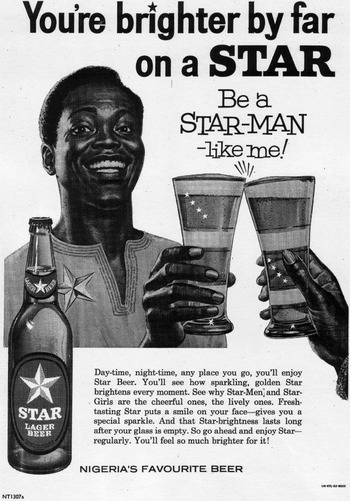
In subsequent years, an annual cycle of market research and revision of ‘Star’ beer marketing and advertising emerged. The advertising nevertheless remained remarkably consistent. Over the years, internal marketing documents described these campaigns using terms such as ‘caution’, ‘consolidation’, and ‘retaining Star identity’. Justifications for the lack of radical change included claims that ‘advertising messages filter slowly into the Nigerian consciousness’ and thus should not change too often,Footnote 58 and that West Africa was a conservative market ‘where unfamiliar images are viewed with suspicion’.Footnote 59 One change was the inclusion of women. An advertisement in the 1966/67 ‘You're brighter by far on a Star’ series (see Fig. 4) showed a smiling man with a glass of beer in his hand, clinking glasses with another person (who could be the viewer of the ad) of whom only a hand was visible, clutching a raised glass of beer. The copy associated women with ‘Star’ beer:
‘See why Star-Men and Star-Girls are the cheerful ones, the lively ones. Fresh-tasting Star puts a smile on your face – gives you a special sparkle. And that Star-brightness lasts long after your glass is empty. So go ahead and enjoy Star – regularly. You'll feel so much brighter for it!’Footnote 60
The aims of the advertising strategy were clearly visible: an emphasis on enjoyment and happiness (to strengthen the brand image), the inclusion of women as potential consumers of ‘Star’, and encouragement to get infrequent drinkers to drink more regularly. In addition to the advertisements, there were posters, radio spots, and a cartoon film.
‘You're brighter by far on a Star’ Star beer advertisement.

In 1973, the slogan was adapted to ‘Be Star-bright for life!’ That year's advertisements showed a group of three well-dressed men, happy and clearly enjoying the occasion, holding up glasses of ‘Star’ beer. According to the accompanying copy, when drinking ‘Star’ beer, ‘[t]roubles melt. People relax. Friendship grows. Brightness takes over your world. Life becomes a great big bubbling pleasure.’Footnote 61 Before the new advertisements were launched, RBL Nigeria's research had already confirmed that the new campaign would be ‘meaningful’ and ‘acceptable’ to consumers: 95 per cent of respondents ‘had fully accepted the new copy expression’; and 78 per cent had liked ‘the whole visual with pleasure/happiness and brightness which in essence is the perceived benefits they expect to get from drinking Star Beer.’Footnote 62 This consistency in advertising was successful. NBL achieved a market share of more than 50 per cent of the total Nigerian beer market for every year from 1960 to 1974.Footnote 63
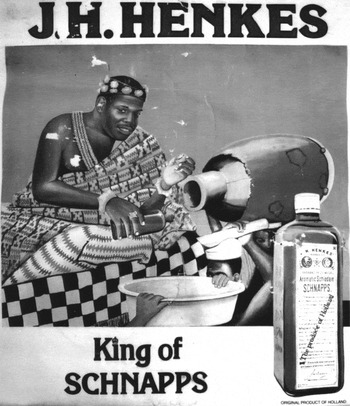
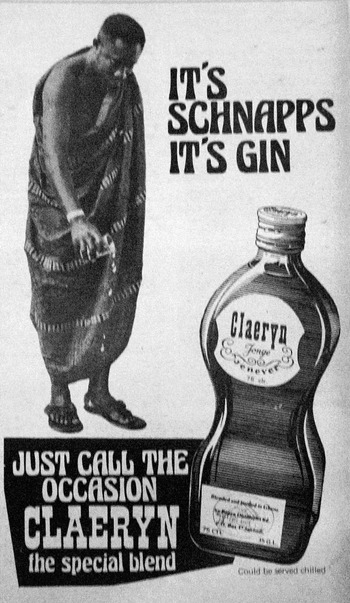
During the same period, advertising for ‘Henkes’ gin moved in a very different direction. While the breweries fine-tuned their advertising on the basis of market research, without departing from the established themes of ‘modernity’, success and happiness, schnapps gin advertisements radically changed their message towards the end of the 1960s: new advertisements for ‘Henkes’ – as well as for other brands of gin – now featured traditional chiefs and elders, and the copy emphasised the uses of gin as an essential ingredient for African traditions and as a way to show respect.
‘King of schnapps’ Henkes schnapps advertisement.

How to account for this divergence of strategies? Long-term trends in liquor sales and consumption in West Africa provide one explanation. Sales of beer showed an upward trend throughout the twentieth century, while schnapps gin sales declined. The advertising campaigns for gin did not succeed in reversing this trend. Furthermore, whereas beer remained firmly associated with the ‘modern’, ‘European’, and urban sections of colonial and postcolonial society, gin, by the mid-twentieth century, had become strongly associated with rituals, with funerals, and with the requirements of rural life. This association of schnapps gin with traditional rituals had been well known to UAC and other major gin sellers, as well as to the distilleries, since at least the 1920s, when they used it as an argument in discussions with the British Colonial Office.Footnote 64 The Henkes distillery had even developed a brand called ‘Paramount Chief Aromatic Schnapps’, the label of which showed an illustration of a chief, seated on a stool and dressed in traditional cloth, holding a glass of gin.Footnote 65 Gin advertising of the 1950s and 1960s nevertheless deliberately ignored this market segment, as the strategy was to broaden the appeal of schnapps gin and attract new consumers. Because of the high price of imported gin these new consumers had to have a middle-class income to be able to afford to drink regularly. As noted above, this strategy reflected a general trend in the global liquor industry. Henkes applied it in other markets, particularly in the Caribbean, while other Dutch distillers developed similar themes for their domestic market.Footnote 66 In West Africa, the marketing of imported whiskies and brandies followed a similar strategy.
Advertisers’ claim that schnapps gin signified modern lifestyles and European-style achievement did not accord with the experience of West African consumers. Thus the strategy of advertising with modernity failed to increase sales, because the advertisements’ intended public was a specific, urban, Western-style educated middle-class audience, that had already decided that schnapps gin was a drink associated with ‘old-fashioned’, traditional, rural Africa. Neither the UAC archive nor the Bols Distilleries archive contains any reference to scientific market research for schnapps gin in West Africa. It is possible that market research was commissioned and that the documentation has not survived. However, it is likely that no market research had been conducted: for UAC, the sales of schnapps gin had become relatively unimportant after the Second World War. Unlike the brewing industry, in which UAC had invested a good sum of money, the sales of gin took place in a part of the business – retail – from which it was withdrawing. Meanwhile, for Henkes, the 1950s and 1960s saw a declining relevance of the export business and an increasing focus on the domestic (Dutch) market.Footnote 67
Rather than the result of systematic market research, the shift in advertising focus from the modern to traditional was informed by the activities of Ghanaian and Nigerian competitors. When the first West African distillery opened in 1958, it packaged its ‘Kaiser Imperial Aromatic Schnapps’ to closely resemble that of ‘Henkes’ schnapps. Other local brands such as ‘J. H. Benson’ also looked a lot like the Dutch schnapps products, and even claimed to be ‘The produce of Holland’. The same strategy was followed by Nigeria's ‘Seaman's Aromatic Schiedam Schnapps’ and ‘Eagle’ schnapps; and the Ghanaian Paramount distillery. While West African gin producers copied the packaging for their locally produced gins from that of Dutch schnapps gins, in other ways their marketing strategy was very different. Rather than aiming at successful middle-class consumers with a modern, international outlook – and those aspiring to become like them – the local brands focused on the ritual market. In Nigeria, ‘Eagle’ schnapps advertised with the slogan ‘Respect tradition, enjoy tradition’, while Ghanaian ‘Kaiser’ schnapps was promoted as ‘Schnapps for Kings’ and as ‘the best choice on occasions such as traditional festivals, the performance of customary rites from birth, through marriage to death’. These local distilleries attempted to create an association with the imported schnapps in the minds of African consumers and thus locate their drinks in the same category of ritual drinks as the schnapps from Holland.Footnote 68 This strategy was successful, and the local branded schnapps gins became widely accepted for ritual purposes, further threatening the sales of imported gins. Henkes followed the lead of its West African competitors and, from the late 1960s onwards, used the slogan ‘When tradition calls it's Henkes’ schnapps!’ Thus the company no longer tried to increase total sales by increasing the range of occasions when schnapps gin was consumed. Henkes now merely attempted to emphasise the meanings that Africans had already given to the product, thereby protecting its existing market share that was being threatened by local products. Other imported brands of schnapps gin likewise retreated into tradition.
‘It's schnapps it's gin’ Henkes schnapps advertisement.

The very different advertising trajectories for ‘Star’ beer and ‘Henkes’ gin show how negotiations between marketing and advertising professionals, on the one hand, and prospective consumers and local competitors, on the other, influenced the use of notions of modern and traditional in advertisements, but are inconclusive about the impact of market research. The question about the effectiveness of market research was raised by the re-launch of ‘Gulder’ beer in Ghana and Nigeria in 1972. Even though the introduction of ‘Gulder’ the previous year had failed, the commercial managers in UAC's Breweries Division remained convinced that they needed another brand in West Africa alongside ‘Star’, which, according to market research, was perceived as a light beer that lacked character.Footnote 69 They decided that ‘Gulder’ would have a stronger flavour than ‘Star’ to appeal to more mature drinkers. The Nigerian brewery commissioned an advertising campaign, built around the character ‘Gulderman’: a cool, confident individualist who drank ‘Gulder’ beer for its flavour. It used the slogan ‘Proud to be different. Sure of his taste.’
When the marketing manager for the Ghanaian brewery was confronted with the campaign, he decided it could not be used in Ghana: ‘In Ghana, when you say someone is proud, it is not positive, it's negative.’Footnote 70 The Lintas Ghana manager for the GBL account agreed: ‘In Ghana, basically, people drink beer as a social activity. We drink when there are people around … and here you have this Gulderman campaign: always alone, no friends, sitting there just drinking by himself. This would kill the brand in Ghana.’Footnote 71 Even though GBL could have used the Nigerian campaign for free, it decided to trust the local market knowledge of their managers. This case thus provides an illustration of the importance of specific knowledge about local social and cultural circumstances. However, the ‘Gulderman’ campaign failed in Nigeria, the country for which it had been developed, and where the market research for the campaign had been conducted. Only after the focus of the advertising shifted from individual appreciation of the taste of the beer, towards ‘Gulderman’ as a leader (associating ‘Gulder’ drinking with leadership and status), did the ‘Gulder’ brand become a success in Nigeria.
CONCLUSION
The advertising industry that developed in West Africa in the decades following the Second World War relied for a long time on strategies, artwork, and copy developed by agencies in Europe, even when these agencies had established local branches in West Africa. This is not to say that these agencies simply placed international advertisements in Ghanaian and Nigerian newspapers. The campaigns were usually either specifically designed for use in West Africa, or adapted for that market, but local input was not always sought. Looking back, a former General Manager of Lintas Ghana observed: ‘All the theory said that you were [supposed to] listen … to the local company, but they reckoned that they had the expertise … They did it and then they sent it down to you.’Footnote 72
This comment neatly illustrates the continuing tension between universal principles and global trends in the advertising industry, on the one hand, and the awareness of specific local social, cultural, and business expectations, on the other. From the 1950s onwards, all advertisements used in West Africa were ‘localised’: they depicted Africans in the illustrations, and referenced specific locations and events. However, the social and cultural contexts were not always localised: the African mother serving her children bread with ‘Blueband’ margarine in the advertisements, lived as part of a nuclear family in a free-standing bungalow. In many other cases, the attempt to localise advertising went further, but resulted in stereotypical depictions of Africans, because the role of genuinely local knowledge in the design of advertising campaigns was often limited. This reflected in part the complacency of London-based professionals, in part the global ambitions of clients, and in part also the limited financial and human resources of West African advertising agencies. Such imbalances not only existed between ‘Europe’ and ‘Africa’, but also between West African countries. While it was clear that in terms of marketing and advertising, West Africa did not constitute one single market with shared social and cultural features, the desire to cut costs and increase efficiency often prompted advertisers to ignore such local differences.
‘Scientific’ market research was introduced relatively late, from the middle of the 1960s. Even then, most companies selling in West Africa did not make use of the services of market research bureaus. The evolution of the advertising for ‘Star’ beer shows how the introduction of market research helped the brewery to fine-tune its existing marketing strategy. However, market research did not identify the flaws in the campaign to introduce ‘Gulder’ beer. It was also not the only way in which advertisers gained feedback from the market: the U-turn in the advertising for schnapps gins came about without such market research. The differing development of the advertising for ‘Star’ beer and ‘Henkes’ gin shows how two campaigns, each of which seemed in tune with the prevailing mood in West Africa, met with very different levels of success. During the 1950s and 1960s, both beer and schnapps gin advertisements emphasised the ‘modern’ and associated it with success. However, while consumers accepted these claims as applicable to beer, they rejected them for schnapps gin. In this case, it was the agency of African consumers and local competitors, and not advertising messages, that determined the meanings of these products in West African societies. The case of schnapps gin is special, but elements of it can be found in other campaigns. For example, advertisements for the ‘Key’ soap brand emphasised ‘tradition’: a tradition that included both the African family, and the ‘Key’ brand bar soap. Other advertising claims were rejected by consumers, including the widely ridiculed ‘I believe I can fly’ campaign of now-defunct Ghana Airways.
This examination of beer and gin advertisements from the 1950s to the 1970s not only illustrates the development of marketing and advertising in West Africa, it also highlights the agency of West African consumers and businesses in deciding the meanings attached to products. Clearly, advertisements alone do not necessary reflect the society in which they were used, or transparently express the dreams, values, and ambitions found in that society. However, feedback from consumers encouraged advertisers to adjust their campaigns to try and better meet consumer expectations. When using advertisements as historical sources, we thus need to understand advertising as a negotiated process and consider how advertising for any particular product evolved over time.