Implications
Breed diversity has an important role in the sustainable development of the pig industry and loss of diversity negatively affects the ability of pigs to adapt to changes in production conditions. Knowledge of the genetic structure is the basis of research on genetic diversity, conservation, utilization and development of pig breeds. In this study, we applied various methods to assess the unique genetic structure of Pudong White (PW) pigs distributed in Shanghai, China, which are characterized by their wholly white coat colour, making them distinctive from traditional Chinese indigenous pig breeds.
Introduction
The basin of the giant lake, Taihu, includes parts of the Shanghai, Jiangsu and Zhejiang regions of China (Fan et al., Reference Fan, Wang, Li, Zhao, Liu, Zhao, Yu, Li, Chen and Xiong2002), and covers an area of 36 900 km2. The excellent geographical and social conditions in this region facilitated the farming of many valuable pig genetic resources over thousands of years, including breeds such as Meishan, Erhualian, Shawutou, Fengjing, Hengjing (extinct), Mi and Jiaxing black. These resources, generally referred to in China as Taihu pigs, are famous worldwide for their prolificacy, high meat quality and adaptability (Zhang, Reference Zhang1986). In this region, specifically the Pudong district of Shanghai, another pig population, the PW, was established in the 1980s, during the first national investigation of domestic animal genetic resources, and has very similar characteristics to other Taihu pig breeds, except that they are characterized by a wholly white coat colour (Supplementary Figure S1). This distinctive external characteristic has led to heated debates about the uniqueness of these animals and whether or not PW should be conserved as a separate breed. Recently, PW was classified as a Chinese indigenous pig breed after the national survey of domestic animal genetic resources (China National Commission of Animal Genetic Resources, 2011); however, there is currently insufficient evidence to prove that it is a unique breed. Moreover, due to the impact of the exotic commercial breeds with good performance in economic traits such as growth rate and lean meat percentage, the size of the PW population has declined steadily. Hence, it is significant to determine whether PW is a unique genetic resource, distinguished from Taihu and western pig breeds, to inform the conservation of genetic resources and biodiversity.
Our previous analysis of data from the complete mitochondrial DNA (mtDNA) D-loop suggested that PW was a Chinese indigenous breed (Wang et al., Reference Wang, Sheng, Wu, Wang and Pan2010). Nevertheless, the sequence data from the D-loop of mtDNA only provides maternally inherited evolutionary information. To confirm the uniqueness of PW, it is necessary to analyse the genetic relationships among PW, other Taihu and western pig breeds based on the genome-wide genetic markers.
Next-generation sequencing (NGS) technology has provided a great impulse to the genetic study of animals, for which genotyping by genome reducing and sequencing (GGRS) approach (Chen et al., Reference Chen, Ma, Yang, Chen, Liao, Xie, Wang, He, Tu and Zhang2013) was developed to enable discovery and genotyping of a great number of genetic markers across the genome at low cost. Therefore, the objective of this study was to use various strategies based on GGRS data to explore the uniqueness of the PW breed via exploration of the genetic relationships among PW, other Taihu and western pig breeds, in addition of determination of the genetic structure of PW, and to provide data to inform further research into the genetic origins, biodiversity and evolutionary history of this breed.
Material and methods
Animals and genotyping
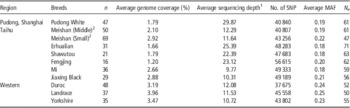
This study involved three pig populations: PW, a Taihu population (including six pig breeds: Meishan, Erhualian, Mi, Fengjing, Shawutou and Jiaxing Black) and a western population (including three pig breeds: Duroc, Landrace and Yorkshire). A total of 47 samples from PW animals were sequenced in the present study, and the sequenced individuals from Taihu (n=252) and western populations (n=120) were obtained from previous studies (Wang et al., Reference Wang, Chen, Yang, Liao, Zhao, Zhang, Chen, Zhang, Xue and Yang2015; Zhang et al., Reference Zhang, Wang, Yang, Zhao, Chen, Liao, Chen, Zhang, Xue and Yang2016). All individuals were genotyped using the GGRS protocol (http://klab.sjtu.edu.cn/GGRS/) (Chen et al., Reference Chen, Ma, Yang, Chen, Liao, Xie, Wang, He, Tu and Zhang2013). A summary of sequencing data, including sample sizes, are listed in Table 1.
Sample size, summary of the sequencing data and effective population sizes (N e ) of the tested populations

SNP, single nucleotide polymorphism; MAF, minor allele frequency.
1 Sequencing depth estimated based on the SNP identification.
2 The Meishan breed was further subdivided into Middle Meishan and Small Meishan (Zhang, Reference Zhang1991; Wang et al., Reference Wang, Chen, Yang, Liao, Zhao, Zhang, Chen, Zhang, Xue and Yang2015).
Pudong White individuals were sampled from the population at Shanghai Puhui Pudong White Pig Breeding Co., Ltd in China. Individuals were chosen to have as little relatedness as possible, based on pedigree information. Genomic DNA was extracted from ear tissues using a commercial kit (Lifefeng Biotech Co., Ltd, Shanghai, China). The quality and concentration of DNA was determined using a TGem Spectrophotometer (Tiangen Biotech, Beijing, China).
DNA libraries (fragment lengths ranging from 200 to 300 bp) were sequenced using the Illumina Hiseq2500 platform (Illumina, San Diego, CA, USA), according to the manufacturer’s protocol. Quality control (QC) of sequences was performed using NGS QC Toolkit v2.3 (Patel and Jain, Reference Patel and Jain2012) and the parameters settings referred to in Chen et al. (Reference Chen, Ma, Yang, Chen, Liao, Xie, Wang, He, Tu and Zhang2013). Clean sequencing reads were subsequently mapped to the pig reference genome (Sscrofa10.2, http://hgdownload.soe.ucsc.edu/goldenPath/susScr3/bigZips/) using BWA v0.7.5 with default settings for single-end mapping (Li and Durbin, Reference Li and Durbin2010). Single nucleotide polymorphism (SNP) calling was performed using SAMTOOLS v0.1.19 (Li et al., Reference Li, Handsaker, Wysoker, Fennell, Ruan, Homer, Marth, Abecasis and Durbin2009) and the missing genotypes were imputed using BEAGLE v4.1 (Howie et al., Reference Howie, Donnelly and Marchini2009). To ensure the precision of imputation and density of SNPs, only those genotyped in >30% of samples were retained (Wang et al., Reference Wang, Chen, Yang, Liao, Zhao, Zhang, Chen, Zhang, Xue and Yang2015). In addition, SNPs were retained for further analysis according to the following criteria: calling quality >20 (99% accuracy), average sequencing depth >5× and the minor allele frequency (MAF) >0.05.
Data analyses
Various methods were used to assess the uniqueness of the PW breed in this study. First, the genetic distance was calculated across the tested populations by using all informative SNPs to determine the genetic divergence between each pair of individuals. The average proportion of shared alleles (D st) was calculated using PLINK v1.07 (Purcell et al., Reference Purcell, Neale, Todd-Brown, Thomas, Ferreira, Bender, Maller, Sklar, De Bakker and Daly2007; Ai et al., Reference Ai, Huang and Ren2013). The pairwise genetic distances (D) between all individuals were calculated as follows: D=1−D st. A neighbour-joining tree was then constructed using MEGA v6.06 (Tamura et al., Reference Tamura, Stecher, Peterson, Filipski and Kumar2013) based on the resulting distance matrix to reflect the topological relationships among all individuals. Next, the pariwise genetic differentiation between breeds was measured using F-statistics (F ST) (Weir and Cockerham, Reference Weir and Cockerham1984; Akey et al., Reference Akey, Zhang, Zhang, Jin and Shriver2002; Ai et al., Reference Ai, Huang and Ren2013) based on the SNP data set. As F ST values were originally defined as ranging from 0 to 1 (Wright, Reference Wright1949), we set negative F ST values to 0, indicating no biological significance. The criteria for interpreting F ST were as follows: values of 0 to 0.05, 0.05 to 0.15, 0.15 to 0.25 and ⩾0.25 indicated low, moderate, high and very high genetic differentiation, respectively (Balloux and Lugon-Moulin, Reference Balloux and Lugon-Moulin2002). In addition, principal component analysis (PCA) was performed using GCTA software (version 1.24) (Yang et al., Reference Yang, Lee, Goddard and Visscher2011) to extract the dominant patterns based on the genomic relationship matrix between individuals. Finally, to further infer underlying ancestry proportions in individuals, fastSTRUCTURE (Raj et al., Reference Raj, Stephens and Pritchard2014) was used to investigate population structure. The algorithms of fastSTRUCTURE are nearly two orders of magnitude faster than those of STRUCTURE, while their accuracy is comparable to that of ADMIXTURE (Raj et al., Reference Raj, Stephens and Pritchard2014).
To further understanding the population viability of the tested populations, the effective population size (N e ) was estimated. The N e estimation procedure first emerged over 40 years ago (Sved et al., Reference Sved1971), and has now been improved to allow estimates based on high throughput SNP data from, for example, SNP chips or NGS technology, based on different algorithms (Waples and Do, Reference Waples and Do2008; Sved et al., Reference Sved, Cameron and Gilchrist2013). In this study, N e values were calculated using SNeP software (Barbato et al., Reference Barbato, Orozco-terWengel, Tapio and Bruford2015), which allows the analysis of large data sets.
Results
Single nucleotide polymorphisms discovery
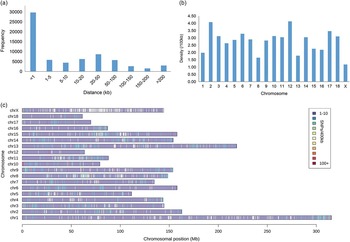
The average sequencing coverage was 2.5% and ranged from 1.20% for Fengjing to 3.96% for Landrace, while the average depth for SNP identification was 16.3× and ranged from 9.77× for Mi to 29.87× for PW (Table 1). After QC, the final working data set contained a total of 68 102 SNPs with MAFs⩾0.05. The largest number of SNPs were identified in the Fengjing breed (56 615), while the smallest number were identified in Duroc (37 675) (Table 1). The average of MAFs of SNPs in the tested pig breeds ranged from 0.18 (Erhualian) to 0.25 (Landrace). The distance between ~81% pairs of adjacent SNPs was ⩽50 kb. The percentage of SNPs separated by a distance of ⩾150 kb was ⩽7% (Figure 1a). Chromosomes 1 and 2 displayed the largest number of SNPs, with of 6261 and 6637, respectively. The results of density distribution analysis of SNPs on each chromosome indicated that chromosome 2 and 12 had the highest densities of SNPs (Figure 1b). In general, the SNPs appeared to be evenly distributed on each chromosome, other than at the telomeres of some chromosomes (Figure 1c). Putative population-specific SNPs were defined as those where one allele was present in only one population (Ramos et al., Reference Ramos, Megens, Crooijmans, Schook and Groenen2011). Considering only three populations (PW, Taihu and western), there were 647 258, and 1375 putative-specific SNPs for PW, Taihu and western pigs, respectively. When compared with the Taihu population, 770 putative PW-specific SNPs were identified, whereas PW had 8471 putative-specific SNPs when compared with the western population, indicating that PW pigs shared more similarities with the Taihu than the western population. The distributions of both of these two sets of PW-specific SNPs along chromosomes were non-uniform (Supplementary Figure S2). Pudong White is only a single breed, and the sample size was relatively small, which is likely to explain the fact that this population contained the fewest specific SNPs, relative to the Taihu and western populations, however, the existence of PW-specific SNPs indicates that differences do exist among these three populations.
The distribution of the single nucleotide polymorphisms (SNPs) across the chromosomes. (a) The distance distribution between pairs of adjacent SNPs in the genome. The x-axis represents the distance (kb), and the y-axis represents the frequency of the SNPs; (b) the density distribution of SNPs along chromosomes. The x-axis represents the different chromosomes, and the y-axis represents the density, calculated as the number of SNPs per 100 kb across the chromosome. (c) The location of SNPs along chromosomes. The x-axis represents the chromosome position (Mb), and the y-axis denotes the chromosomes. The number of the SNPs present in each 4000 kb genome block is expressed via colours as indicated in the key. No SNPs were discovered on chromosome Y.

Genetic distance within and between the tested populations
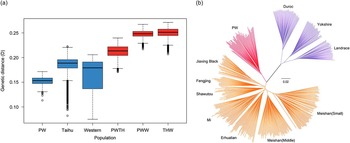
To confirm the distinctiveness of PW, we investigated the genetic distance between PW and (1) the Taihu population, and (2) the western population. The results demonstrated average genetic distances of 0.212±0.012 and 0.248±0.007 between the PW and Taihu population and the PW and western population, respectively (Figure 2a), indicating a shorter distance between the PW and Taihu than the PW and western populations. To further investigate the genetic diversity, we estimated the genetic distance between individual pigs within each population. The average genetic distances were 0.152±0.008, 0.185±0.017 and 0.168±0.028 within PW, Taihu and western populations, respectively (Figure 2a), suggesting lower genetic diversities of the PW and western populations compared with Taihu pigs.
Genetic distance (D) of individuals from Pudong White (PW), Taihu and western populations. (a) Box-plot of D within and between pairs of individuals. Blue boxes represent D within the tested populations; red boxes represent D between the tested populations: PWTH, D between PW and Taihu populations; PWW, D between PW and western populations; THW, D between Taihu and western populations. (b) Neighbour-joining tree of the individuals from tested populations based on the genome-wide allele sharing. Different colours represent clusters of individuals belonged to different populations. Red, purple and orange lines indicate individuals from the PW, the western and Taihu populations, respectively. The scale bar represents the identity-by-state score between individuals.

The results of neighbour-joining tree analysis reflected the topological relationships between all tested individuals, based on shared alleles. Populations sharing close genetic relationships are situated in different branches originating from the same basal node. In this study, all the individuals from the same populations were in the same clusters. The Taihu and western pig populations were clustered at the two ends of the tree. All PW individuals clustered into a clade distinct from the major Taihu clade; however, compared with the major western major clade, PW was closer to the Taihu population (Figure 2b).
Population differentiation between Pudong White Pigs and other breeds
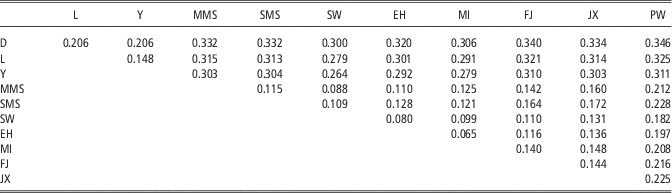
To provide more insight into the genetic relationship between PW and other breeds, we further investigated the relatedness by calculating pairwise F ST values. The results demonstrate the extent of the differentiation, indicating that F ST values between PW and Taihu pig breeds ranged from 0.182 (Shawutou) to 0.228 (Small Meishan) with high genetic differentiation, while those between PW and western pig breeds ranged from 0.311 (Yorkshire) to 0.346 (Duroc), indicating very high genetic differentiation (Table 2). These results demonstrate that the PW breed is more closely related to Taihu pigs than western breeds. Within the western population, the lowest F ST value was found between the Landrace and Yorkshire breeds (0.148), suggesting these pigs have an extensively shared genomic background.
Genetic differentiation measured using pairwise F-statistics (F ST) values for all breeds

L, Landrace; Y, Yorkshire; MMS, Middle Meishan; SMS, Small Meishan; SW, Shawutou; EH, Erhualian; MI, Mi; FJ, Fengjing; JX, Jiaxing Black; PW, Pudong White; D, Duroc.
Population structures of the tested populations
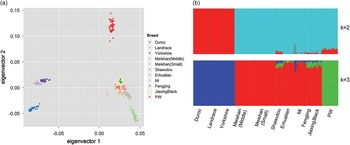
Principal component analysis and fastSTRUCTURE were used to investigate the population structure of PW, Taihu and western populations to further define the genetic relationships among them. By PCA, the first two eigenvectors separated all individuals from PW, Taihu and western pig breeds into their respective breed groups (Figure 3a). Pudong White formed a well-defined group, which was clearly discriminated, not only from western pig breeds, but also from Taihu breeds. Eigenvector 1 (47.42% of the total variance) clearly distinguished the PW and western pigs, whereas eigenvector 2 (7.97% of the total variance) mainly reflected the genetic difference between PW and Taihu pig breeds, consistent with the findings of genetic distance and neighbour-joining tree analyses. The results of fastSTRUCTURE analysis showed that, when the number of ancestral populations (K) was set to 2, the Taihu population was almost completely assigned to one of the two gene pools, with the western population assigned to the other. Pudong White was partially admixed between these two ancestries; however, the vast majority were assigned with the Taihu gene pool, indicating that PW shared more genomic background with the Taihu population. However, when we used K=3, PW was clearly assigned to a separate gene pool, whereas the Taihu and western populations remained assigned to two different gene pools (Figure 3b). Hence the results of PCA and fastSTRUCTURE analyses revealed the clustering tendencies of the tested populations and highlighted that PW was a unique population.
Population structures of Pudong White (PW), Taihu and western pigs. (a) Principal components analysis plot of the genetic relationship matrix for the tested pigs. PW, Taihu and western populations were clearly separated into three parts. (b) Population structure of the tested populations determined using fastSTRUCTURE software. Different colours represent different clusters.

Effective population size
Effective population size (N e ) is a crucial parameter influencing the population viability and conservation planning. The assessment of N e in this study was based on linkage disequilibrium. In general, the average N e of the tested pig breeds was ranged from 47 (Small Meishan) to 71 (Erhualian) (Table 1). The average N e of the PW breed was 61. Comparison of PW and Taihu pig breeds (except for Small Meishan) with western pig breeds generally indicated relatively small values of N e for the western breeds.
Discussion
Traditional Chinese indigenous pigs are covered with black or spotted hair, whereas PW and Rongchang pigs have wholly white coats. The white phenotype of the Rongchang pig is a recessive trait (Lai et al., Reference Lai, Ren, Ai, Ding, Ma, Zeng, Chen, Guo and Huang2007) and there is high conservation-related interest in investigating the origin of the PW breed. Knowledge of the genetic structure, based on genomic data, has been important in revealing the demographic and evolutionary history of pig breeds worldwide (Ai et al., Reference Ai, Huang and Ren2013; Herrero-Medrano et al., Reference Herrero-Medrano, Megens, Groenen, Ramis, Bosse, Pérez-Enciso and Crooijmans2013; Pham et al., Reference Pham, Do, Nam, Van Ba, Minh, Hoan, Cuong and Kadarmideen2014; Traspov et al., Reference Traspov, Deng, Kostyunina, Ji, Shatokhin, Lugovoy, Zinovieva, Yang and Huang2016). However, to date, the genetic structure of PW has scarcely been investigated, despite the specific, desirable qualities of this breed, including high prolificacy, high meat quality and good adaptability. This study represents the first attempt to describe the genetic structure of PW and provide evidence of the uniqueness of PW and its difference from other Taihu and western pig breeds, using genome-wide markers. Several methods to investigate the relationships between the PW and Taihu pig populations and the PW and western pig populations were employed in this study. These were genetic distance, population differentiation and population structure analysis. The results demonstrated that PW differed from both Taihu pig population and western pig populations, thus confirming that PW can be classified as a distinctive genetic resource.
Genetic markers, particularly SNPs, are widely used to explore important questions in population genetics and domestication. High-density SNP analysis plays an essential role in revealing the past and current population demographics (Herrero-Medrano et al., Reference Herrero-Medrano, Megens, Groenen, Ramis, Bosse, Pérez-Enciso and Crooijmans2013). In our study, high-quality reads (removing primer/adaptor contaminated reads) with average base quality scores ⩾20 (indicating an error rate of base calling of 1 in 100) were used to call SNPs, and the average sequencing depth for SNP calling was 16.3×, providing high confidence in the identified variants. In addition, SNPs were present on each chromosome, relatively uniform distributed, and <7% of pairs of adjacent SNPs were separated by distances of ⩾150 kb, indicating good genome coverage. Moreover, compared with the SNPs in pig single nucleotide polymorphism database (dbSNP) (download from http://hgdownload.cse.ucsc.edu/goldenPath/susScr3/database/, updated on 12 January 2016), we found that ~14% (9486) SNPs with MAF ⩾0.05 in our data were previously unreported, indicating the incompleteness of SNP identification in pigs.
Our results showed that the genetic distances within PW and western populations were shorter than those among individuals of the Taihu population. Except for the Small Meishan breed, the western pig breeds in our study displayed the smallest N e values. The western pig samples investigated in this study were obtained from Shanghai Xiangxin Pig Breeding Co., Ltd in China. Both the source of the western pig samples and the scale of the breeding farm were limited, potentially resulting in inbreeding and genetic drift. Moreover, historically, the western pigs have undergone intensive artificial selection for economically important traits (Ai et al., Reference Ai, Huang and Ren2013). Hence, the small N e values for western pig breeds in this study are not unexpected. The PW breed is suspected to have suffered due to consanguinity and conservation of the wholly white coat. In the past, this population almost became extinct because of lack of government protection and suffered as a result of the impingement of foreign commercial breeds. A study in 2010 reported that the size of the conservation population of this breed was only 116 (16 sires and 100 sows) (Wang et al., Reference Wang, Sheng, Wu, Wang and Pan2010). The limited numbers of PW are raised in state-owned conservation farms. This may have resulted in inbreeding and the observed small N e , which may explain the close genetic relationship among the PW individuals. In addition, the estimation of N e in our study was based on the samples collected, the method of sequencing and the software used for data analyses, which may have skewed the results of the estimation. To ensure veracity of the estimation of N e , more samples and assessment methods should be used in further research. Notably, the average MAF for PW and Taihu pig breeds were lower than those of the western pig breeds, indicating that the tested Chinese pig breeds are in urgent need of protection. Interestingly, Small Meishan pigs, which have previously been subject to an inbreeding (Fan et al., Reference Fan, Wang, Li, Zhao, Liu, Zhao, Yu, Li, Chen and Xiong2002), resulting in a small N e , displayed the highest average MAF among the tested Chinese pig breeds. This may be the reason for the high tolerance of Small Meishan pigs to inbreeding depression.
The results of analyses of breed-specific SNPs, genetic distance, neighbour-joining tree, genetic differentiation, PCA and fastSTRUCTURE all indicated that PW had a closer genetic relationship with Taihu than with western pig breeds, which may inform the investigation of the origin of the PW breed. Previous studies have implied that the genetic distance of pig breeds from China may be influenced by their geographical distribution (Megens et al., Reference Megens, Crooijmans, San Cristobal, Hui, Li and Groenen2008; Traspov et al., Reference Traspov, Deng, Kostyunina, Ji, Shatokhin, Lugovoy, Zinovieva, Yang and Huang2016). Thus, for further exploration of the relationship between PW and Taihu pig breeds may benefit from the inclusion of more breeds distributed in the area adjacent to Pudong. The results of genetic differentiation, analysis indicated that the highest F ST value within the Taihu population was lower than the lowest F ST value between PW and other pig breeds, demonstrating that PW exhibits greater divergence from Taihu pig breeds than the inter-breeds divergence within the Taihu population. In the past, the six pig breeds included in the Taihu population were regarded as one breed, named Taihu pigs (Zhang et al., Reference Zhang, Li and Chen1986). However, there are large genetic differences between these breeds; hence, they were divided into six according to the latest classification of Chinese indigenous pig breeds, and are reared in different state-run conservation farms (Wang et al., Reference Wang, Chen, Yang, Liao, Zhao, Zhang, Chen, Zhang, Xue and Yang2015). These findings imply that although the PW and Taihu populations may share a similar genomic background, as they were domesticated in the same area, the genetic structure of these two populations is quite different. Furthermore, the results of analysis using fastSTRUCTURE revealed that, at K=3, the Duroc, Landrace, Yorkshire and six Taihu pig breeds remained distinguished from one another, whereas PW was clearly assigned to a separate gene pool. These results indicate reliable classification of PW as a single breed. A few PW individuals exhibited slight genomic admixture with the Taihu and western gene pools using K=3. The possible reasons for this are as follows: (1) the results are based on limited SNP markers, or (2) PW might have a similar origin to the other breeds.
In conclusion, we report a comprehensive investigation of the genetic relationships among PW, Taihu and western pig populations based on genome-wide SNP markers, revealing the genetic uniqueness of PW. We demonstrated the distinct population relationships among PW, Taihu and western populations and offer evidence that PW is a unique population, different from the Taihu and western populations, confirming the rationality of the current breed classification of the PW breed among Chinese indigenous pigs. These results may improve our understanding of the current genetic structure of PW. Our results also provide information about the genomic biology of Chinese and western pigs, and will assist in the development of a national project for the conservation and utilization of these breeds.
Acknowledgements
This study was supported by the National Key Technology R&D Program (Grant No. 2015BAD03B01), the Agriculture Development Through Science and Technology Key Project of Shanghai (grant no. TuiZi (2016) 1-1-4 and ChanZi (2014-2016) 6) and the National Natural Science Foundation of China (Grant No. 31272414).
Supplementary material
To view supplementary material for this article, please visit https://doi.org/10.1017/S1751731116002494