Children with congenitally malformed hearts are at increased risk of neurodevelopmental deficits,Reference Hovels-Gurich, Seghaye and Schnitker1, Reference Griffin, Elkin and Smith2 although the potential aetiologic factors, which include genetic polymorphisms, perioperative state, and intraoperative methods, remain uncertain.Reference Wernovsky, Shillingford and Gaynor3 In most cases, the deficits investigated have pertained to intelligence and neuropsychological domains, such as motor skills, attention, visual-spatial skills, executive functions, attention, and academic achievement. It is increasingly apparent, however, that the psychosocial function of the children is also impaired, with the prevalence of deficits in this domain being described as “alarming”.Reference Williams, McCrindle, Ashburn, Jonas, Mavroudis and Blackstone4 Their nature and range of severity have yet to be adequately characterized. It is my belief that an important dimension of the neurodevelopmental morbidities of these children, and one that might contribute to psychosocial maladjustment, involves social cognition.
Social cognition refers to the ability to process social information, and to interpret accurately social situations and cues. A child with a deficit in social cognition will experience difficulty in “reading” other people, deducing their thoughts and emotions, and thus interpreting and responding appropriately to their actions. Such difficulties interfere with the judgments that are required in order to establish and maintain social relationships. In the psychiatric literature, these are referred to as “theory of mind” deficits.Reference Brune and Brune-Cohrs5 Another form of such deficits is difficulty reading one’s own internal states, that is identifying and communicating emotions. This is described as “alexithymia”. In this review, I describe the empirical bases of the hypothesis that children with congenitally malformed hearts have deficits in social cognition, including alexithymia. The hypothesis is based on observations made in the course of conducting a single-centre prospective study of children with concordant atrioventricular and discordant ventriculo-arterial connections, or transposition, who underwent the reparative arterial switch operation before 3 months of age. Children were randomly assigned to strategies supporting the vital organs involving deep hypothermia with either total circulatory arrest or low-flow continuous cardiopulmonary bypass.Reference Newburger, Jonas and Wernovsky6 Their neurodevelopment was evaluated post-operatively, and at ages 1, 4, and 8 years of age. Evaluations of the children at 16 years of age are ongoing. Informed consent was obtained from the parents on each occasion, and then from the children when they were aged 8 and 16 years. All protocols for the study have been approved by the committee at Children’s Hospital, Boston, overseeing human experimentation.
Early development of speech and language
At the 1-year evaluations, something was clearly amiss in the development of language, as the children were extremely quiet, rarely babbled, and almost never produced recognizable words.Reference Bellinger, Jonas and Rappaport7 At ½ years of age, compared to typically-developing children, their scores on the parent-reported MacArthur Communicative Development Inventory were delayed by 2 to 4 months in terms of production of vocabulary, use of words, word endings, irregular forms, over-regularizations, and complexity of sentences.Reference Bellinger, Rappaport, Wypij, Wernovsky and Newburger8 In addition, the proportion of children who were not yet combining words at this age was higher than expected. At 4 and 8 years of age, abnormal oral-motor planning and coordination, in many cases severe enough to warrant a diagnosis of apraxia of speech, resulted in reduced ability to imitate oral movements and speech sounds, such as “stick out your tongue”, “repeat ‘pa-ta-ka” ’, phonological deviations, cluster reductions and simplifications, omission of medial and final consonants, and sequencing difficulties, such as transposition of syllables.Reference Bellinger, Wypij and Kuban9, Reference Bellinger, Wypij and duPlessis10 The result was connected speech that was difficult to understand, particularly in the absence of contextual cues to aid the listener in identifying its referents. We confirmed that these difficulties were not due to reduced hearing, or to abnormalities in the structures required to produce speech.
Elicited personal narratives
As the children grew older, it became apparent that the atypicality of their speech and language was not limited to motor-speech programming, but also included pragmatic language skills. Such skills pertain to the ability to use language to accomplish communication goals within the context of a social interaction.Reference Adams11 Performance of the children on standardized assessments, which tend to focus on structural aspects of language, such as word knowledge, morphology, and syntax, generally will not reveal difficulties in the instrumental use of language. With the assistance of psycholinguists, therefore, we identified several conversation-eliciting tasks that have proven useful in characterizing pragmatic skills in typically-developing children. One task involved the elicitation of personal narratives. When the children were 4 and 8 years of age, the examiner used a script to model the production of short narratives relating to events experienced by most children.Reference Hemphill, Uccelli, Winner, Chang and Bellinger12 For instance, one narrative was elicited using the following prompt: “You know what I did last summer? I went on vacation, and I went up north. I went to a beach and went swimming. Did you ever go swimming at a beach?” Two additional prompts were used, one having to do with a bee sting, and the other with an accident involving spilling. A narrative was defined as a sequence of two or more topically related utterances that reported a specific past experience. We selected the most sophisticated narrative from each child for analysis. A variety of features were coded, such as the extent to which the narrative oriented the listener regarding who, what, where, when, and why? The organization of the narrative was also evaluated in terms of whether it had an opening and closing, included character speech, temporal markers to aid the listener, and a dramatic evaluative “high point”. Based on the composite score, a narrative was classified as below average, average, or above average depending on whether it was within plus or minus 1 standard deviation of the composite score for the narratives of children in the control group. The narratives were also rated on a 5-point scale in terms of informational adequacy and narrative coherence. The categories were:
• no narrative
• fragmentary accounts, story participants and key events not clearly specified, story incomprehensible
• clear but minimal descriptive accounts of a single happening
• clear information about central participants and key events, despite multiple instances of missing or contradictory information about the setting or consequences
• clearly specified sequence of key events, no contradictory information; missing information minor.
Children with transposition had substantial difficulty on this task. Whereas all control children produced a sequence of utterances that met our definition of a narrative in response to at least one of the prompts, one-sixth of children with transposition were unable to do so. Furthermore, the narratives that children with transposition did produce did not match those of control children in quality, as two-fifths of them were considered to be below average, versus one-eighth in the control group. With regard to information adequacy and coherence, the narratives of the children with transposition were more difficult to follow than were the narratives of the control children. On the 5-point scale, their mean score was significantly lower than the mean score of the control children, at 2.3, with standard deviation of 1.4, as opposed to 3.1, with standard deviation of 0.9, respectively. Overall, the narrative thread was sparser, often omitting critical events, placing greater demands on the listener to infer information about the identities and roles of the characters involved and the physical context of the event.
Analyses of content revealed that the children with transposition differed from controls in terms of the material they included in their narratives. For instance, they made less frequent reference to participants’ affective states, i.e., whether they were sad, happy, scared, or surprised about the event described, and made less frequent reference to participants’ plans and intentions. This is noteworthy because other research has shown that preschoolers’ reporting of internal states in narratives is related to their ability to understand complex emotions.Reference Hughes and Dunn13 Overall, the narratives produced at 4 years of age by the children with transposition more closely resembled the narratives of typically-developing 2–3 year olds than those of normally-developing 4-year olds. One hypothesis is that the children with transposition were not able to work out the information needs of the listener, that is to place themselves in the position of the listener and identify the information the listener needed to have in order to understand the narrative. Another hypothesis is that the children were able to identify the information needs of the listener but lacked the linguistic skills needed to respond to these needs. At 8 years of age, the narratives produced by the children with transposition were more sophisticated than they had been at 4 years of age, but they remained immature, resembling those produced by typically-developing 5 year olds (unpublished data).
Symbolic language: free play with a parent
At the 4-year assessment, each child also engaged in a 10-minute free play session with a parent.Reference Ovadia, Hemphill, Winner and Bellinger14 All pairs of parent and child were provided with a standard set of materials, which included a toy house, two adult figures, two child figures, a dog, furniture, and a car. Sessions were videotaped and transcribed, and a coding system used to characterize the language of the children, and the activities in which the pair engaged. Of particular interest was the extent to which a child’s language was “symbolic” or “non-symbolic”. Symbolic talk established the imagined story setting, such as “Let’s pretend that…”, and reported the actions of the play characters, their speech, and their internal states. In contrast, non-symbolic talk was more concrete, involving the labelling of play objects, such as “Here’s the dog”, and speech that related logistical information but did not involve any imagined event, such as “Let’s put this here”, “You can have this one”. In addition, the number of story episodes in which a pair engaged was counted. An episode was defined as a symbolic sequence of at least two actions that were logically linked. For example, some sequences involved enacting a routinized event, such as giving the baby a bath and putting her to bed, carrying out an intention, such as the dog chasing the car, or resolving a conflict between characters, such as the boy and girl fighting over a ball.
The control children, and the children with transposition, did not differ in terms of overall verbal production or the mean length of turn-taking, but the groups did differ significantly in the proportion of utterances that were symbolic or non-symbolic. Among control children, almost half of utterances were symbolic, and almost one-fifth non-symbolic. Among children with transposition, the proportions were more balanced, with non-symbolic utterances being somewhat more frequent than symbolic utterances, at 35% versus 28%, respectively. The group difference in the frequencies of story episodes was even more striking. Almost two-thirds of control pairs engaged in three or more episodes, compared to less than one-tenth of the pairs that included a child with transposition. The percentages of pairs who did not engage in any sequences that met the criteria were similarly discrepant, two-thirds of the transposition group, and 7% of the control group. Content analyses of the free play activities also revealed notable group differences. Control children took a major role in constructing and verbally elaborating the play episodes, as they role-played characters and narrated the action. In contrast, children with transposition frequently merely provided sound effects to accompany the actions. These children tended to combine isolated symbolic actions with repetition of actions, leaving parents to provide most of the verbal scaffolding that organized and integrated the activities.
Written narratives
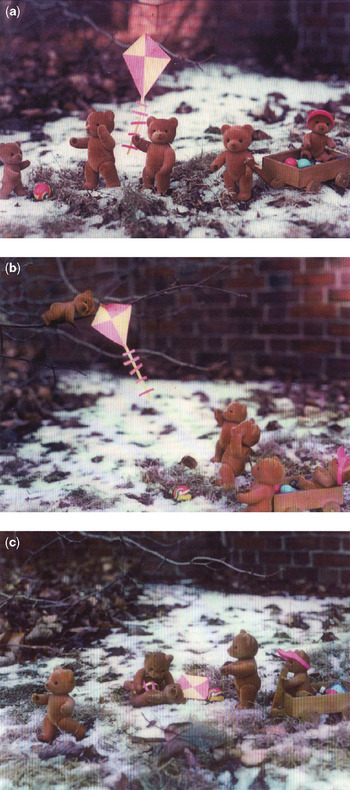
At the 8-year assessment, children were asked to write a brief story, called “The Bear Story,” based on a three-picture prompt showing a group of bears flying a kite that becomes stuck in a tree (see Fig. 1).15 The stories of children with transposition were more likely than the stories of controls to omit reference to key elements of the events, in particular those that were important in giving the overall narrative a temporal coherence. For instance, some children failed to relate the event that precipitated the fall of the bear from the tree, namely that the kite became stuck, or the dramatic consequence of the fall such that it resulted in injury. As with the elicited personal narratives, the stories of children with transposition resembled those of typically-developing children who were several years younger in chronological age. Like the elicited personal narratives, the written narratives did not adequately address the information needs of the target audience, although it is unclear here, as well, whether this reflects a social cognition deficit, a linguistic deficit, or both.
The three photographs that served as the basis for writing “The Bear Story.”

Ongoing assessments in adolescence
These are our observations of children with transposition suggesting that they have difficulty interpreting the emotional responses of others and, perhaps, their own emotional responses. Whether these observations are specific to children with transposition, or can be generalized to children with other forms of congenitally malformed hearts, is not known. Moreover, the deficits we have observed might be attributable, in part, to the methods used for surgical treatment and support during the period when these children underwent the arterial switch operation, namely from 1988 through 1992. Current methods might not place children at similarly increased risk.
We are currently re-evaluating the children in our trial cohort at 16 years of age. In order to clarify the nature and severity of their deficits in social cognition, we are administering several instruments developed to assess aspects of higher-order “theory of mind” skills in individuals with autism, or disorders in the spectrum of autism.
Of these instruments, 4 are questionnaires on which a child indicates, using a 4- or 5-point scale, the degree to which a statement is true for him or her, namely strongly agree, somewhat agree, neutral, somewhat disagree, strongly disagree. One is the Autism Spectrum Quotient.Reference Baron-Cohen, Wheelwright, Skinner, Martin and Clubley16 Sample items include: “I usually notice car licence plates or similar strings of information” and “I tend to have very strong interests, which I get upset if I can’t pursue.” In addition to identifying individuals at risk of disorders in the spectrum of autism, this questionnaire also appears to discriminate among subgroups of individuals in the general population. Scientists, especially mathematicians, tend to score higher, and hence perform worse, than individuals in the humanities. A second questionnaire is the Empathy Quotient.Reference Baron-Cohen and Wheelwright17 Sample items include: “I can easily tell if someone else wants to enter into a conversation” and “I find it difficult to explain to others things that I understand easily, when they don’t understand it the first time.” The third questionnaire is the Systematizing Quotient,Reference Baron-Cohen, Richler, Bisarya, Gurunathan and Wheelwright18 which includes items such as, “When travelling by train, I often wonder exactly how the rail networks are coordinated” and “In mathematics, I am intrigued by the rules and patterns governing numbers.” The fourth questionnaire is the Toronto Alexithymia Scale,Reference Bagby, Parker and Taylor19 which assesses the degree of difficulty a respondent experiences in identifying and describing his or her own internal states. Sample items include, “When I am upset, I don’t know if I am sad, frightened, or angry,” and “It is difficult for me to find the right words for my feelings.” The fifth instrument being administered is the “Reading the Mind in the Eyes” task,Reference Baron-Cohen, Wheelwright, Hill, Raste and Plumb20 which involves the presentation of 36 photographs of faces that show only the region around the eyes. Using a multiple choice format, the child must select which of four emotions best describes what the individual in the photograph is feeling or thinking. This test can be accessed at http://glennrowe.net/BaronCohen/Faces/EyesTest.aspx. The possible neural bases of “theory of mind” skills in these adolescents is being evaluated by means of volumetric magnetic resonance imaging and segmentation, diffusion tensor imaging, and functional imaging.
Co-morbidity of social cognition deficits and other neurocognitive deficits
The plausibility of the hypothesis that children with congenitally malformed hearts have deficits in social cognition is supported, indirectly, by studies that show co-morbidities of cognitive dysfunction, pragmatic language deficits, alexithymia, impaired face processing, and interpersonal problems in children and adults with other congenital or acquired neurodevelopmental disorders. For example, children with learning disabilities often present with deficits in social cognition and discourse skills.Reference Holder and Kirkpatrick21, Reference Bauminger, Edelsztein and Morash22 Emotional and interpersonal difficulties, as well as deficits in narrative discourse and story telling, are prominent features of children with a “nonverbal learning disability”.Reference Little23–Reference Humphries, Cardy, Worling and Peets25 Investigators have noted the similarities between the neuropsychological presentations of children with a nonverbal learning disability and children with certain forms of congenital cardiac disease, such as velocardiofacial syndrome.Reference Lajiness-O’Neill, Beaulieu and Asamoah26 An elevated prevalence of autism has also been reported in children with the 22q11 microdeletion.Reference Vorstman, Morcus and Duijff27 Deficits in narrative discourse are frequently observed in children who experience traumatic brain injuries.Reference Ewing-Cobbs, Brookshire, Scott and Fletcher28, Reference Chapman, McKinnon, Levin, Song, Meier and Chiu29 For example, compared to those of children with mild injuries, the stories produced by children with severe closed head injuries are impoverished in content, organization, and complexity.Reference Brookshire, Chapman, Sing and Levin30 Moreover, the quality of discourse was inversely related to the executive function skills of the children, a domain that is weak in those with transposition.Reference Bellinger, Wypij and duPlessis10 In adults with traumatic brain injuries, deficits in conversational discourse skills are associated with poorer social integration and lower quality of life.Reference Galski, Tompkins and Johnston31 The narratives of adults with high-functioning autism or Asperger syndrome tend to include fewer personal pronouns, temporal markers to aid the listener, and fewer referential expressions.32
Face processing is often noted to be deficient in children with neurodevelopmental disorders. For example, children with attention deficit hyperactivity disorder, another domain of particular concern in children with congenitally malformed hearts,Reference Mahle, Clancy, Moss, Gerdes, Jobes and Wenovsky33–Reference Hovels-Gurich, Konrad, Skorzenski, Herpetz-Dahlmann, Messmer and Seghaye35 are less accurate than controls in decoding facial expression, a deficit that puts a child at risk of interpersonal problems.Reference Corbett and Glidden36, Reference Pelc, Kornreich, Foisy and Dan37 Children with attention deficit hyperactivity disorder also lack self-awareness of the difficulty they have interpreting facial expressions accurately.Reference Pelc, Kornreich, Foisy and Dan37 Individuals with alexithymia tend to have poor interpersonal relationshipsReference Vanheules, Desmet, Meganck and Bogaerts38 and to be relatively inaccurate in recognizing facial expressions.Reference Parker, Taylor and Bagby39, Reference Jessimer and Markham40 Studies using magnetic resonance and positron emission show that individuals with alexithymia differ from controls in many respects in the way that they process facial expressions.Reference Berthoz, Artiges and Van De Moortele41, Reference Kano, Fukudo and Gyoba42 Among parents of children with autism, those who are less accurate on the Mind in the Eyes Test have poorer pragmatic language skills and more impaired interpersonal relations.Reference Losh and Piven43
The reason why children with congenitally malformed hearts might have deficits in social cognition is unclear. Several causal models can be postulated. First, the same developmental event that results in abnormal development of the heart could damage the area or areas of the brain involved in processing social and affective information. Second, the deficits might result from damage that occurs as a result of the interventions undertaken to correct a cardiac malformation. Third, the deficits might be secondary to the neuropsychological deficits associated with congenital cardiac disease or its repair. For example, the accurate processing of facial expressions depends, to some extent, on visual-spatial skills,Reference Durand, Gallay, Signeuric, Robichon and Boaudouin44 another domain in which children with congenitally malformed hearts are particularly weak.Reference Bellinger, Bernstein, Kirkwood, Rappaport and Newburger45 Fourth, because of the intensive, often repeated, medical interventions which many children with congenitally malformed hearts must undergo, their early interpersonal experiences might not permit the normal development of emotion regulation and inter-subjectivity that enables one to “read” other people or oneself.Reference Oppenheim, Nir, Warren and Emde46–Reference Minnis, Marwick, Arthur and McLaughlin48 Moreover, parents might chronically view such children as vulnerable and interact with them in ways that limit the development and expression of these skills. At present, data are insufficient to choose among these hypotheses, and they are not mutually-exclusive.
To provide children with congenitally malformed hearts with the assistance they require to achieve a satisfactory psychosocial adjustment, it is necessary to broaden our scope of inquiry regarding the neurodevelopmental domains for which they are at increased risk. Deficits in social cognition, which can seriously impair psychosocial functioning, warrant greater consideration.
Acknowledgements
Key members of the research team that carried out the studies of pragmatic language skills in children with transposition are Jane W. Newburger (Principal Investigator), David Wypij, and Leonard Rappaport of Children’s Hospital Boston, and Lowry Hemphill, Rebecca Ovadia, and Sarah Beck of the Harvard graduate School of Education.
Sources of Financial Support: Grants HL41786 and RR-02172 from the US National Institutes of Health.