Introduction
The income of older Swedes has increased continuously since 1960, as the universal earnings-related public pension scheme matured, as occupational supplementary pensions spread by the mid-1970s to around 90 per cent of employees, and with progressive increases in women's participation in the labour force. Women born during the 1940s and later have participated in paid work and earned pension rights to almost the same extent as men. By 1990, the point of departure for this study, the income standard of people aged 65–74 years was well over 90 per cent of that of persons aged less than 65 years (Gustafsson and Palmer Reference Gustafsson, Palmer, Gottschalk, Gustafsson and Palmer1997). The economic basis for this success story was hit hard at the beginning of the 1990s, however, when the slowdown in the world economy affected Sweden much more severely than most Organisation of Economic Co-operation and Development (OECD) countries. From 1990, both open-ended unemployment and benefit payments for unemployed people sky-rocketed. Open-ended unemployment was well under four per cent before the downturn began in 1990, but climbed to 14 per cent by 1993, with even more workers covered by labour-market measures such as subsidised training and education. Real gross domestic product (GDP) fell by five per cent from 1990 to 1994. Taxes were increased and public transfer payments and outlays for public services were trimmed to limit the mounting deficits. Among the transfers that were trimmed were benefit payments to pensioners. After almost five years of deep recession, the economy finally turned up in 1995. Since then Sweden has experienced substantial growth, albeit interrupted by a new recession that accompanied the dot.com crash in 2001–02.
In this paper we investigate how the economic wellbeing of people aged 65 years and older changed during both the recession of the first half of the 1990s and the following period of prosperity. This has been pursued by studying household disposable income using repeated cross-sectional data for 1991 to 2004, with historical reference points from 1975 and 1980. The data source is the Household Income Survey that has been conducted by Statistics Sweden since 1975. The study addresses the following questions. What has this turbulent period, of deep recession, strong expansion and then a stock-market crash, meant for the income standard of older people relative to the total population? How has income inequality among people aged 65 years and older changed, and what happened to poverty among this group? What roles did pensions, capital, other income and taxes play in this turbulent decade-and-a-half? Finally, we compare changes during this period with longer-term trends from 1975.
International comparative studies on income and income inequality typically find that Sweden has the lowest incidence of low-income older people. An early example was the Atkinson et al. (Reference Atkinson, Rainwater and Smeeding1995: 104) study using Luxembourg Income Study (LIS) data that examined the percentages of older people (60+ years) with low incomes in Sweden in 1981 and 1987 and in 13 other OECD countries. More recently, Förster and Pellizzari (Reference Förster and Pellizzari2000) reported that only three per cent of those aged 65 or more years in Sweden fell below the poverty line of 50 per cent of the median equivalent disposable income (calculated for the entire population) in 1995. These authors also reported that income inequality was very low among older people (65+ years) in Sweden; indeed, that the Gini coefficient of 19.6 per cent was the lowest among 19 countries.Footnote 1 Also, in a recent comparison of poverty rates in 2003 in the European Union (EU), Zaidi et al. (Reference Zaidi, Makovec, Fuchs, Lipszyc, Leikes, Rummel, Marin and de Vos2006) reported that only 14 per cent of Swedes aged 65 or more years had less than 60 per cent of the median income.Footnote 2 Recent LIS figures also indicate that relative poverty among older people in Sweden is lower than in most other countries.Footnote 3
In the Swedish literature, Ruist (Reference Ruist2002) examined the income of people born in 1920, and confirmed that the average income of the older population was affected less by fluctuations in the business cycle than by the average income of other groups.Footnote 4 Vogel (Reference Vogel2002, based on Vogel et al. Reference Vogel, Häll, Johansson and Skjöld2000), using a much broader definition of wellbeing than ours, investigated changes in living and health conditions among young, middle-aged and older people during 1980–98.Footnote 5 It was concluded that the living and health conditions of the older population had improved, whereas those for the young had worsened. Although Gustafsson and Palmer (Reference Gustafsson, Palmer, Gottschalk, Gustafsson and Palmer1997) examined in detail the income status of the older population during 1975–90, no more recent study has analysed changes in their income during the entire turbulent period from 1990 until the mid-2000s. This paper's contribution is to analyse in depth how one of the world's leading welfare states coped with a long period of economic crisis and managed the ensuing recovery with particular reference to older people's incomes. The study also provides interesting insights into the roles of various income components in determining the income status of old-age pensioners in a modern welfare state.
The remainder of this paper is organised as follows. The next section describes pertinent policy changes during the study period. The third section describes the data used in the study, and the fourth section examines the trend in the average income of older people. The fifth section takes a close look at the income distribution within the older population. Issues of poverty and low income are examined in the following section, while the seventh addresses the question of what is behind the development of income inequality among older people. We sum up the main conclusions in the final section.
Background and the changing scene
We begin by surveying the welfare of older Swedes. Most live either with a spouse or alone, and multi-generational households are rare. Until recently, following the introduction of the new pension reform and the legislation of the right-to-work until age 67 years, it was unusual for other than the self-employed and a handful of professionals to work beyond age 65 years because central labour-market agreements precluded this. For a long time, therefore, 65 years was regarded as the retirement age. Hence, in studying the development of income of those aged 65 or more years, we examine the income status of old-age pensioners.
Public, occupational and private pensions together account for about three-quarters of the total income of people aged 65 or more years (hereafter ‘older people’) (Statistics Sweden 2004). Around two-thirds of their aggregate income is from public pensions, which are therefore the main influence on older people's total income. The public sector also provides means-tested housing benefits, which constitute soft means-tested income support for older people with low income and account for around two per cent of older people's total income. The other main components of income for the age group are earnings, entrepreneurial income and income from capital. During the period under study, capital income became increasingly important as an income source for older people. This is important for the following analyses that examine the impact of separate components of income on the overall income of older people.
Until 2003, old-age pensions consisted of a flat-rate benefit, dependent only on years of residence, and an earnings-related pension, which for a person with a typical work history constituted the main benefit. People without an earnings-related pension received a supplement to the flat-rate benefit. The reform of the public pension system began with the creation of ‘non-financial defined contribution schemes’ (NDC) and financial personal accounts in 1999.Footnote 6 The most recent change, in 2003, has been the replacement of the flat-rate benefit and a special tax deduction for pensioners by a pension guarantee for low-income pensioners. At the same time, the level of the guarantee was set as neutral vis-à-vis the pre-reform tax deduction. Also, in the last stage of the reform, pension income was given the same tax status as earnings.
Public pension benefits and housing allowances are indexed for inflation using the consumer price index. In practice, benefit amounts are stated as multiples of a ‘base amount’, which is indexed with inflation. While originally straightforward, the relation between the development of the consumer price index and the base amount became increasingly blurred during the 1990s recession as policy makers attempted to cut expenditure.Footnote 7 In both 1991 and 1992, indexation was three per cent less per year than it would have been with straightforward price indexation (Swedish Social Insurance Agency 2007). During 1994–98, indexation was held back by another four per cent. Thus, a benefit granted in 1990 or earlier was 10 per cent lower in 1998 than it would have been in the absence of these interventions. In addition, in a separate intervention, the base amount was decreased by two per cent in 1993. This reduction remained in force until 1999, when the base amount was adjusted upward by the same percentage. Finally, since the second stage of the introduction of the new reform in 2001, benefits have been indexed upwards with the growth of real per capita covered earnings minus 1.6 per cent, in addition to a normal inflation adjustment. This indexation was positive during 2001–04, the post-reform years covered by this study.
Generally, the pensions of new pensioners are higher on average than those of previous pensioners, because pension rights grow continuously with the increase in workers' real earnings. Also, the proportion of old-age pensioners receiving only the basic (from 2003 guaranteed) pension, which historically have been mainly women, has fallen during the last 15 years or so as younger female pensioners with longer working careers have ‘replaced’ older female pensioners without or with incomplete working years. Moreover, policy focused on the poorest during the recession, as pension supplements to people with no earnings-related pension were higher in 1993 than in 1990. In addition, given the need to consolidate the public-sector budget, income taxes were increased at the highest end of the income distribution, which also affected the most well-off pensioners. Consolidating the financing of the public sector also meant fewer resources for public services to older persons. The consequences of these changes are not examined in our study, however, as the focus is on household disposable income.
It is important to note that the economic picture was not entirely bleak during the 1990s. High interest rates and a buoyant stock market benefited net savers, among them high-income pensioners. An increasing proportion of older people has substantial financial assets, in addition to the net worth of their owned homes. Generally speaking, participation in the stock market increased markedly from the 1980s; by the early 1990s, at least one-half of Swedes had some experience of the stock market. On the other hand, the first years of the present century saw a dramatic fall in stock prices with the dotcom market crash; recovery did not begin until 2004 and stock prices returned to the pre-crash level only in 2007. The volatile financial events of the decade-and-a-half from 1990 through 2004 were another influence on the development of the welfare of the older population.
Measuring the income of older people
The data for this study were drawn from the Swedish Household Income Survey (HINK/HEK) administered by Statistics Sweden. This annual inquiry has existed since the mid-1970s, and typically surveys between 10,000 and 19,000 households. This study focuses on the period 1991 to 2004, but we also use data from 1975 and 1980 to compare the 1990s with the preceding decade. Comparing the years before 1991 with those after raises a methodological problem, because the tax base was broadened in 1991. This definitional change led to an increase in household factor income of about five per cent and is the reason why we begin the analysis in 1991.Footnote 8 HINK surveys people in private households and not those living in institutions such as homes for frail older people. Prior to 1995, the HINK definition of the household encompassed up to two adults and all children aged up to 18 years. Although data using a more extensive definition are available from 1995, we used the older definition for consistency. This means that multi-generational households are treated as separate units in most of the presented analyses.Footnote 9 The HINK database is compiled from information on earnings, pensions, other transfers and income taxes obtained from public registers, supplemented with information collected through telephone interviews.
The main unit of measurement in this study is ‘equivalent disposable income’, which is estimated by dividing disposable income by an equivalence scale based on social assistance norms (as formulated during the 1980s) including housing costs (for details seeGustafsson Reference Gustafsson1987). ‘Normal’ housing costs are based on the size of the household and the region of residence. Individuals are the unit of analysis. We assume consumption opportunities are equally shared among all household members, which means that all share the household income. An equivalent income value of 1.0 means that the income of the household members, considered separately, is exactly equivalent to the social assistance norm for a single person living in the same region of the country. In this way, we estimated values for all older people, computed the average for various years, compared their average income with that of the entire population, and analysed income inequality among them. Our approach also makes it possible to study income poverty.
The development of average income among older people
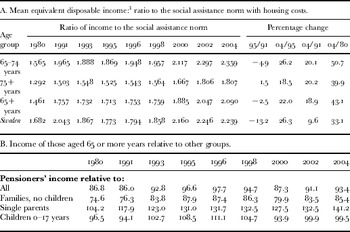
The real standard of living of older people in Sweden has increased steadily for several decades. In 1975, their average equivalent disposable income was only about 20 per cent above the social assistance norm (Gustafsson and Palmer Reference Gustafsson, Palmer, Gottschalk, Gustafsson and Palmer1997). Three decades later, in 2004, their average equivalent disposable income was a little over twice the social assistance norm. Panel A of Table 1 shows that, since the early 1990s, younger older people, aged 65–74 years, on average had about the same economic standard as the rest of the population, while the average equivalent income of those aged 75 or more years was lower.
The income of people aged 65 or more years in Sweden, 1980 and 1991–2004

Source: Swedish Household Income Survey, authors' calculations. As for all tables and figures. For details see text.
Note: 1. The tax-reform of 1990–91 broadened the income-tax base by on average about five per cent. The change affected mainly persons in the higher deciles. For this reason, measured income is not fully comparable before and after the reform.
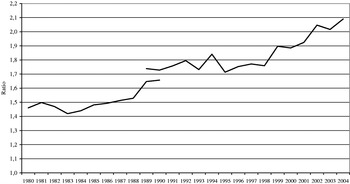
Sweden has experienced three recessions since the late 1970s. The first began in the late 1970s and continued into the early 1980s, the second began in 1990 and lasted until 1995, and the third began in 2002 and culminated around 2005. Figure 1 shows a clear tendency for stagnation in the growth of older people's material standard during these recessions. What are the reasons for this? The first two recessions were characterised by the development of substantial government budget and current account deficits, with ensuing pressure on the Swedish krona, on both occasions leading to substantial devaluations. Pensions, which in principle are price indexed, were not adequately indexed to compensate for the effect of the devaluations; that is, higher import prices. As discussed earlier, a succession of adjustments was also made during the recession of the 1990s and, as a result, the indexation of benefits was about 10 per cent less during 1991–98 than would have been required for a full price adjustment. Thereafter, the government claimed that pensioners were partially compensated through a higher housing allowance (Swedish Social Insurance Agency 2007). In addition, recall that the base used for calculating benefits was cut by two per cent and reinstated in 1999. No index adjustment accompanied the 2002 recession.
Development of equivalent disposable income among old-age pensioners in Sweden, 1980–2004.

As Panel A of Table 1 shows, the average income of older people decreased by 2.5 per cent from the beginning to the end of the recession (1990 to 1995). Their real average income would have decreased by more had it not been for the continuous inflow of new pensioners, with pensions based on higher earnings than their predecessors', and the continuous outflow of the oldest pensioners with the lowest pensions. The average income of the entire Swedish population fell much more dramatically, by 13 per cent. Although pensions were not fully indexed during the recession, older people nevertheless fared much better than the rest of the population. Surprisingly, those aged 75 or more years fared slightly better than those aged 65–74 years (Table 1, Panel A). Since all pensions had the same indexation, the relative advantage of the oldest age group attests to the importance of the ‘natural’ turnover of older pensioners, replacing the less well-off with the more well-off.
There were noticeable ‘spikes’ or rises from the previous year in 1994 and 1999 (Figure 1). In these two years, large holdings of equities were cashed in, leading to capital gains. This attests to the increasing importance of financial portfolios in the welfare of older households. The spike in 1999 also reflected an increase in old-age pension benefit levels to compensate for the absence of full indexation during the early 1990s recession. Panel B of Table 1 shows that while the average income of older people was 86 per cent of the average for the entire population near the beginning of the 1991 recession, by the turning point in 1996, it was as high as 98 per cent. This was more the result of a fall in the average income of wage earners than pensioners' income gains. This ratio remained around 90 per cent during the later years of study. On average, the income of pensioner households overtook that of households with children, the former being 94 per cent of the latter in 1991 and 111 per cent in 1996 (Table 1, Panel B). In 2004, the income per person of these two groups was essentially the same, signalling a clear gain for pensioners since 1990.Footnote 10 The fall in the relative position of pensioners from 1996 through 2001 reflects the general tendency during periods of economic prosperity for incomes dependent on price-adjusted fixed incomes to fall relative to those dependent on earnings. In sum, the 1990s was a decade in which pensioners gained materially relative to the rest of the population. The gain was strong during the recession of the first half of the decade, but during the ensuing expansion they lost ground. Nevertheless, in 2004 older people's standard of living relative to other groups was a little higher than during the early 1990s. In fact, it was on a par with Swedish society's other target group for social policy, households with children.
A close look at the distribution of income among older people
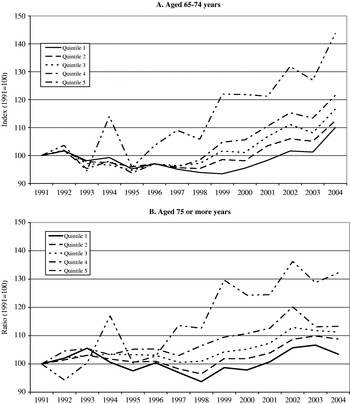
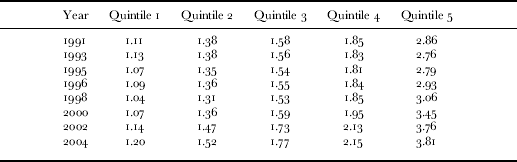
The previous section concluded that, as a group and during most (but not all) study years, older people fared better than the rest of the population. This is not the whole story, however, as shown by an examination of the within-group distribution of income. Table 2 reports the equivalent disposable income for older people by quintile since 1991, while the two panels of Figure 2 show the quintiles for those aged respectively 65–74 years and 75 or more years. Table 2 shows that the income of those in the first quintile has generally been close to the social assistance norm: their real income decreased during the recession and was only about four per cent over the norm at its lowest point in 1998. The average real income of persons in the second, third and fourth quintiles also fell and remained lower during and immediately after the recession. The two first quintiles did not reach their pre-recession levels until 2001, while for the third and fourth quintiles this took place two years earlier. Turning to the highest quintile, the change over time in average income was much more irregular, reflecting the importance of earnings and capital income for this group. What dominates the picture, however, is that the average income of the fifth quintile increased more or less continuously throughout the period.
Trends in ‘equivalent disposable income’ quintiles among pensioners in Sweden, 1991–2004.

Mean equivalent disposable income for persons aged 65 years and older: ratio to the social assistance norm with housing costs, 1991–2004
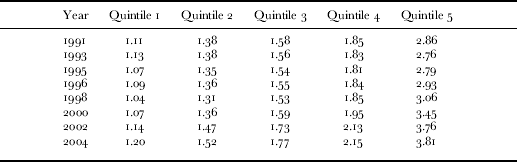
Note: The quintiles are of the income distribution of those aged 65 years or older.
Figure 2 reveals more clearly how the averages disguise a dramatic change in the distribution of real income since the end of the recession of the 1990s. The quintiles for those aged 65–74 years show that the distribution remained stable throughout the worst years of the recession but spread out immediately after its end, from 1996, with per capita real income increasing faster in the successively higher quintiles. The pattern was similar for those aged 75 or more years but with relatively smaller gains during the decade following the recession, especially for those in the lower income quintiles.
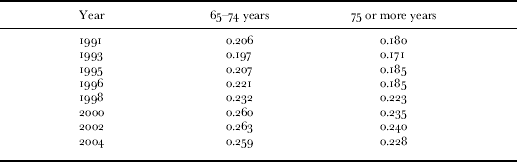
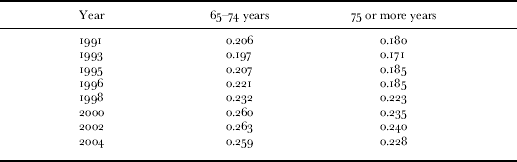
Table 3 reports the Gini coefficients of disposable equivalent income for people aged 65–74 years and 75 or more years. For the 65–74 age group, the Gini coefficient was on average 0.21 during 1991–93 and 0.26 during 2002–04. For the 75 plus age group, the (3-year average) Gini coefficient increased from 0.17 to 0.22 over the same period.Footnote 11 The changes in the Gini coefficients confirm the picture of increasing within-group inequality from the end of the recession in the mid-1990s. In other words, there was an underlying trend for increasing inequality among older people that had its roots in the pre-reform pension system.Footnote 12 Also, note that the change towards greater income inequality was not confined to this group but can be observed for the entire Swedish population and for many sub-groups (see Gustafsson and Palmer Reference Gustafsson and Palmer2002). In sum, for all but the fifth quintile, real per capita income fell at the outset of the recession and did not regain pre-recession levels until around a decade later, in 1999–2001. Generally, once economic growth returned, real per capita income improved progressively faster for the higher quintiles. The major conclusion of this section is that in the decade following the end of the recession in the mid-1990s, inequality among older Swedes increased profoundly.
Gini coefficients of equivalent disposable income: people aged 65–74 years and 75 or more years, Sweden 1991–2004
Poverty and low income among older people
We have seen that the per capita real income of older people in the first or lowest income quintile was only slightly above the social assistance norm as formulated in the 1980s. This is an average for the lowest fifth of the population, however, and to make clear statements about poverty it is important to study the income distribution within the group. There is no official poverty line in Sweden, but in its place two approaches are normally used to measure ‘poverty’. One is to follow EU practice and measure relative poverty (see Atkinson et al. Reference Atkinson, Cantilon, Marllier and Nolan2002); the other is to construct a measure of absolute poverty. Both kinds of measures are examined here, and indeed the considerable influence on the results of the choice of approach will be shown.
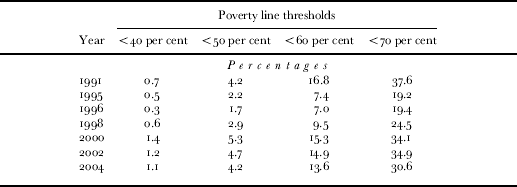
First, following the approach used in most comparative research, the poverty line can be defined as a fraction of median or mean income of the entire population. In much comparative research, the poverty line is set at 50 or 60 per cent of the median overall equivalent income. It is therefore a relative measure: the level of income in a country does not affect the poverty assessment, what matters is the shape of the distribution. If as the economy grows the shape of the distribution is more or less unchanged, then the share in poverty also remains largely unchanged. We have observed that although disposable income decreased for the first quintile of older people during the 1990s recession, so did the average for the entire population – and at a faster pace. Therefore, we do not expect a relative measure to show an increase in poverty; rather it should show a decrease. This is seen in Table 4, which shows a drop in the proportion of older people with incomes under 60 per cent of the median (computed for the entire population), from 17 per cent in 1991 to only seven per cent in 1996. Thereafter, increases prevail, and at the end of the study period, the percentage had returned to the 1991 level. The time trends for other poverty thresholds, such as having incomes less than 50 or 70 per cent of the median income, were similar, although predictably the poverty levels increased with higher thresholds (see Table 4).Footnote 13
Percentages of people aged 65 or more years in poverty under alternative poverty thresholds, Sweden, 1991 and 1995–2004
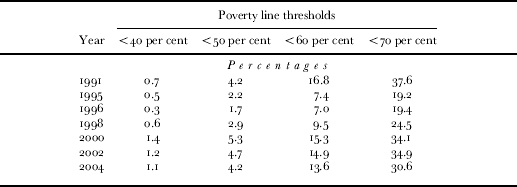
Note: The table shows the percentages of those aged 65 or more years having an equivalent income less than various percentages of the contemporary median income (computed for the entire population).
Source: Tabulations from Swedish Household Income Survey (HINK/HEK).
Since the relative measure of poverty follows the rate of growth both upwards and downwards, it is arguably more appropriate to apply a poverty line based on a given ‘consumption basket’ expressed in constant purchasing power. With this sort of measure, one sees that many people fall below the poverty line in a recession, and that many ‘escape’ poverty during economic growth. This is the approach taken by the official estimates of poverty in the United States. Using this approach, we imputed a poverty line from the recommendations issued by the Swedish Board of Health and Social Welfare for processing social assistance applications (for details seeGustafsson et al. Reference Gustafsson, Zaidi, Franzén and Biterman2007). This measure is based on a consumption basket, including regionally differentiated housing costs, and is indexed to the consumer price index to maintain a measure with constant purchasing power.Footnote 14
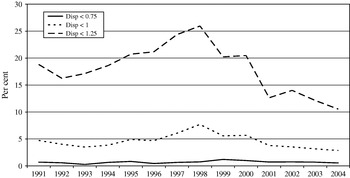
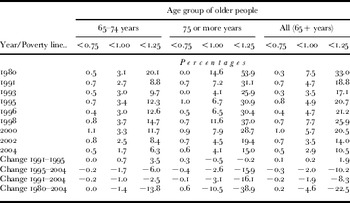
Table 5 and Figure 3 report the proportion of older people falling under the social assistance norm each year, as well as the proportion falling under 75 and 125 per cent of this level. Only about 0.5 to one per cent had incomes under 75 per cent of the norm during the entire study period, which indicates that poverty among older Swedes is shallow. Consistent with the findings reported in the previous section on falling equivalent disposable income in the lowest quintile of the distribution, there was an increase in the proportion of older people falling under the poverty line as the recession worsened towards 1993, with a rise from 3.5 per cent in 1993 to 7.7 per cent in 1998. In 1998 the proportion under the poverty line reached the 1980 level (in the middle of the preceding recession). After extra indexation of pension benefits in 1999 and after four years of continuous growth from 1995, however, only 2.9 per cent of older people were under the absolute poverty line in 2004, despite another albeit milder recession during the first years of the 2000s.
Proportion of pensioners under 75, 100 and 125 per cent of Swedish National Board of Health and Welfare's poverty line, 1991–2004.

Percentages of people aged 65 or more years with incomes less than 75, 100 and 125 percent of the National Board of Health and Welfare poverty line, Sweden, 1980 and 1991–2004

A slight increase in the poverty line to 125 per cent produced a poverty proportion close to 20 per cent in the early 1990s, with an increase to about 26 per cent in 1998 and then a fall to a little more than 10 per cent in 2004. This can be compared to a level of 33 per cent in 1980. This confirms that ‘absolute poverty’ among older Swedes has declined significantly during the last quarter-century. Looking at different age groups of older people, the highest poverty rates were among those aged 75 or more years. They were more likely than the younger age group to have incomes that put them just over the poverty line; that is, they were ‘almost poor’ (Table 5). The table also shows that for both age groups, the increase in the proportion at or below the poverty lines of 100 and 125 per cent increased through 1998, but from a much higher starting level for those aged 75 or more years. For those aged 65–74 years, only eight per cent had incomes less than 125 per cent of the norm in 1992; the proportion then rose to 15 per cent in 1998 and fell to about six per cent in 2004. Among those aged 75 or more years, the proportions changed from 26 per cent in 1993, through 37 per cent in 1998, to 15 per cent in 2004.
In sum, the data show that a relative measure of poverty indicates fewer older people in poverty during a recession. In addition, relative poverty among all older people was much the same in 2004 as in 1991, and the proportion in poverty was not very different from that for the entire population. Through the study period, relative poverty among older people decreased during the recession and then increased. This confirms that the income of older people has a much weaker link to the business cycle than the income of the economically-active. When we assess poverty in terms of a poverty line representing constant purchasing power, however, poverty among older people increased during the recession, reflecting benefit cuts and the cessation of full price indexation until 1999. As benefit levels returned to normal in 1999 and normal indexation was reinstated, poverty among older people decreased. In fact, in 2004 poverty was at its lowest level during the previous quarter-century, for both older people and younger adults.
What's behind the increase in inequality among older people?
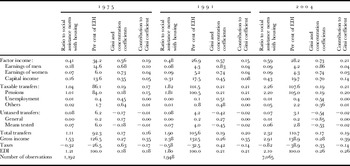
In this section we analyse the increase in income inequality from the mid-1990s by examining the various components of disposable income and their contributions to changes in the Gini coefficient. The framework for the analysis is slightly different from that of the previous sections, because it applies to people living in households with a household head aged 65 or more years. Table 6 displays the various sources of income for the years 1975, 1991 and 2004 – their levels, their relative shares of equivalent disposable income (EDI), and their concentration coefficients. The ‘concentration coefficient’ can range from ‘−1’, which indicates that this component of income goes entirely to those with the lowest EDI, to ‘+1’, which indicates that this income component goes entirely to those with the highest EDI.Footnote 15 The table also shows the contributions of each source of equivalent disposable income to total income inequality in a particular year (for details seeRao Reference Rao1969; Pyatt, Chen and Fei Reference Pyatt, Chan and Fei1980).
Decomposition of equivalent disposable income by source, families with a household head aged 65 or more years, 1975, 1991 and 2004

Note: EDI: equivalent disposable income. The total numbers of older people in Sweden were: 1,367,831 in 1975, 1,496,537 in 1991, and 1,517,719 in 2004.
The Gini coefficient for the older household population increased from 0.181 in 1975 to 0.214 in 1991 and to 0.259 in 2004 (Table 6). Starting with the earnings of men and women, we find that their shares of EDI decreased considerably between 1975 and 1991, partly as a result of the decrease in the general retirement age from 67 to 65 years in July 1976. In 2004, the earnings of both men and women accounted for only about four per cent of EDI. Earnings were strongly concentrated among those with high EDI, as indicated by the high concentration coefficient, which increased over time for men. While earnings are a small element of Swedish older people's total income, the opposite applies to income from capital (defined as interest, dividends, imputed rents of owner-occupied housing, and capital gains). This component constituted 14 per cent of EDI in 1975, 18 per cent in 1991, and 20 per cent in 2004. Not only has capital income's relative share increased, its concentration coefficient doubled, to 0.70 in 2004. As we will see below, this is driving the strong increase in income inequality.
Table 6 distinguishes taxable transfers (primarily pensions) and untaxed transfers (primarily means-tested housing benefits). Pensions have a positive concentration coefficient, which means that people at the top of the income distribution received larger pensions than those at the bottom. Not surprisingly the opposite is true for means-tested transfers: they were well targeted towards those at the bottom of the income distribution. Looking at changes over time, the concentration coefficient for pensions was about the same at the beginning and end of the study period, with a modest increase in 1991. On the other hand, the negative value for the concentration coefficient for means-tested transfers became larger through the period, signifying that they have been increasingly well targeted to those with the lowest incomes. Their relative shares in EDI moved in different directions. While pensions increased their share of EDI, means-tested transfers had a decreasing share. Finally, Table 6 shows that the relative share of taxes increased progressively from year to year. The tax rate (taxes in relation to gross income) increased from 21 per cent in 1975 to 25 per cent in 1991 and to 28 per cent in 2004. The concentration coefficient decreased considerably throughout the period, suggesting that taxes became less redistributive.
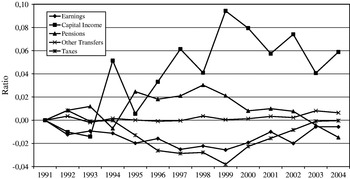
Based on this decomposition, we can now examine how the different income sources contributed to the increase in the Gini coefficient from 1991 to 2004. It is possible for each component to alter the coefficient through changes in both the relative share and the concentration coefficient. The decomposition presents the concentration coefficients and relative shares for each component for every study year compared to 1991. As Figure 4 indicates, the main cause of increased income inequality among older people was capital income. Its effect was strong throughout the period and, despite considerable variation, its effect was higher in 1999 than before. Capital income caused the ‘spikes’, or largest annual increments, throughout the period. Pension income also contributed to the increase in inequality between 1995 and 1999, but only slightly and in subsequent years not at all. In fact, during the final years examined, pension income contributed to a decrease in inequality compared to 1991. This could be a result of the ‘replacement’ of older female pensioners having low (survivor) pensions, by younger women with their own earnings-related pensions. It might also have been the effect of the introduction of the new pension system, for this converted the pre-reform ‘flat-rate benefit with a separate deduction’ to ‘a taxed guaranteed benefit without a separate deduction, but with a generous gross adjustment in the benefit to compensate for the excluded tax deduction’. This may also explain why taxes became less redistributive during the period. Two forces, earnings and income taxes, counteracted the increase in income inequality throughout the period, increasingly so until 1999, and less thereafter. In fact, from around 2001, capital was the single strong driver of inequality.
Contributions to changes in the gini-coefficient in families with household head aged 65 and older since 1991.

Conclusions
This paper has analysed the development of the income standard of older people in Sweden from 1990 until the mid-2000s. Developments through this period have been compared with 1975 and 1980, which enables us to draw conclusions about long-run trends. The analyses have shown that it is important to examine much more than the average income of older people in comparison with other age groups. First, there is a considerable difference between the younger and older age groups, and secondly, it is important to examine changes in income inequality. Even if pensions were the most important source of income, we have shown that other income components, namely capital returns and taxes, were important influences on income differences. In Sweden, both capital income and taxes turned out to be important.
This said, there is still more to do. For example, we have studied the younger and older age groups of the older population but have not had access to information about people living in institutions. We have worked with the consumer price index but for some groups of older people, especially the oldest, it may be more relevant to construct a special index based on an age-specific consumption basket. For example, those aged 80 or more years are the largest consumers of publicly-provided home help. Finally, our analysis has been cross-sectional. Much new knowledge on the income of older people in Sweden that will be relevant for policy makers can be obtained by conducting birth-cohort specific analyses. Many of the developments in the level and distribution of older people's income derived from the replacement over time of an older cohort possessed of low pension rights with a younger cohort that has higher pension rights. From a life-cycle perspective, income and pension rights are products of the economic times through which successive cohorts pass. What's more, it is important to examine how relative income is affected by ageing.Footnote 16 There is clearly a case for analysing panel data because it has the potential for revealing patterns of change and stability at the individual level as well showing how macro-events affect the development of income.Footnote 17
The principal findings
This study has generated several valuable findings. First, we have found that on average the income status of older people has continued to improve in absolute terms, but the transition has been far from smooth and it has not occurred at the same pace as changes in the income of the economically active. The average income of older people was relatively stable during the deep recession of the first half of the 1990s. Consequently, their relative income position improved, but older people were by no means isolated from the downturn, as pensions were cut, full indexation was abandoned and taxes increased. In contrast, during the ensuing years of rapid economic growth, the income of older people did not increase as fast as the earnings of the economically active, and their relative position deteriorated.
Secondly, the achievement of the Swedish welfare system in reducing old-age poverty during the 1970s and 1980s to a low level by international standards has been maintained into the mid-2000s. Nonetheless, as we have shown, many older people have very limited resources and are close to a poverty line. With the reduction in benefits during the first half of the 1990s, a rising proportion of older people slipped under a poverty line based on fixed purchasing power (although from 1998 the proportion has been decreasing). From 1998 until 2004, real income among the working-age population rose faster than the income of older people, leading to an increase in their relative poverty, i.e. defined as having an income less than 60 per cent of the median. It is concluded that relative poverty among older people in Sweden has not been entirely eliminated.
A third conclusion is that income inequality among older people in Sweden increased from the end of the recession in the 1990s. By 2004 the income of the fifth quintile had increased by 33 per cent since 1991, while that of the first quintile was only eight per cent higher. Just as has been the case for high income-decile labour-force ‘insiders’, i.e. those fortunate enough to have work throughout the 1990s (Gustafsson and Palmer Reference Gustafsson and Palmer2002), the wellbeing of well-off pensioners was not affected by the recession, whereas the average income of the worst-off declined and did not begin to increase again until the end of the decade. A fourth conclusion is that there have been changes in the influence of the various income sources on the economic situation of older people. Earnings have become insignificant as a source of income except among well-off males. In its place, the role of capital income has gradually increased. Capital income has become increasingly concentrated among older people with high incomes, and the development of capital income is the main reason why income inequality among older people increased from the mid-1990s. In addition, pension income has tended to become more unequally distributed, which can be associated with the younger replacement cohorts having higher earnings-related public and occupational pensions. Income taxes have counterbalanced the forces leading to greater income inequality among older people, but to a declining extent from the end of the 1990s.
Our findings have several policy implications. They illustrate that older people in Sweden are economically much less homogeneous than they used to be, which has several important implications, as for price tariffs for social services and for the mix between private and public provision and financing of services for older people. One part of the reality is that a substantial number of older people have difficulty making ends meet. They cannot afford to pay much – if anything – for services and cannot access privately-paid health-care and home or institutional-care services. The arguments for public provision and particularly for the public funding of services for these older people therefore remain strong. On the other hand, there are also older people who live in better economic conditions than most of the population, and where services are available they can afford and use private health-care services. To formulate policies that take the interests of both these groups of older people into account is a growing challenge for Swedish policy makers, not least because the population still values highly the principle of universality in the delivery of public services.