Introduction
Loss of smell in coronavirus disease 2019 (Covid-19) positive patients has been described in several reports since the beginning of the pandemic.Reference Lechien, Chiesa-Estomba, De Siati, Horoi, Le Bon and Rodriguez1–Reference Marchese-Ragona, Restivo, De Corso, Vianello, Nicolai and Ottaviano3 Olfactory and gustatory dysfunction is a clinical presentation of mild to moderate forms of Covid-19. The Centers for Disease Control and Prevention added ‘new loss of taste or smell’ to the list of symptoms that may appear 2–14 days after exposure to severe acute respiratory syndrome coronavirus-2 (SARS-CoV-2).Reference Yan, Faraji, Prajapati, Boone and DeConde4,Reference Moein, Hashemian, Mansourafshar, Khorram-Tousi, Tabarsi and Doty5 Coronavirus disease 2019 seems to have a particular tropism for the nervous structures of the olfactory bulb, similarly to other types of coronavirus such as severe acute respiratory syndrome.Reference Barthold, de Souza and Smith6 The potential public health implications of such evidence have been examined, and sudden anosmia or hyposmia nowadays constitutes a symptom that, even alone, can inform guidance for self-isolation and testing.Reference Moein, Hashemian, Mansourafshar, Khorram-Tousi, Tabarsi and Doty5
Anosmia presents as an early symptom in up to 85 per cent of Covid-19 positive patients, especially among the young and those with mild to moderate manifestations of the disease.Reference Lechien, Hopkins and Saussez7,Reference Chiesa-Estomba, Lechien, Radulesco, Michel, Sowerby and Hopkins8 When dealing with anosmic patients, the most relevant issues concern the symptom duration and the potential recovery of chemosensitive function. As months have passed since the start of the pandemic, numerous studies have investigated the olfactory sequelae in the mid-term.Reference Spinato, Fabbris, Polesel, Cazzador, Borsetto and Hopkins9–Reference Vaira, Hopkins, Petrocelli, Lechien, Chiesa-Estomba and Salzano11 Long-term results for smell recovery are missing, and this represents an emerging issue in terms of quality of life and healthcare burden.
According to the present authors’ previous research, after a mean follow up of six months, 63 per cent of patients with Covid-19 related anosmia or hyposmia had a complete recovery, whereas 37 per cent had persistent olfactory disorders. Whether any variables were associated with the olfactory recovery remained controversial.Reference Lucidi, Molinari, Silvestri, De Corso, Guaraldi and Mussini12
The main aims of the present study were to enlarge the previously analysed series of Covid-19 positive patients from the first wave of the pandemic, in order to confirm the preliminary results, and to clarify the patterns of olfactory recovery. We also investigated the clinical predictors of poor long-term olfactory function restoration.
Materials and methods
Study population and study design
An observational retrospective study was conducted on Covid-19 positive patients with olfactory dysfunction. Patients were selected from an electronic platform named ICWmix, created at the beginning of the pandemic (February 2020) by the Infectious Diseases Clinic of Modena Hospital. All data from patients diagnosed with Covid-19 infection at our institution by means of reverse transcription polymerase chain reaction testing on nasopharyngeal swab specimens were collected on the platform, which featured digital safeguards, built to ensure anonymity. In order to preserve the confidentiality of the report and the reporter, the computer's internet protocol address was not captured from the submitting provider. No identifiable data about the users were solicited.
The ICWmix platform included demographic, clinical, instrumental and laboratory information for each patient, as well as the onset time of olfactory dysfunction. The information was collected by means of a medical interview conducted at the time of the clinical onset of disease, in person or by telephone interviews. All these patients were either admitted to the hospital or followed remotely by an integrated home-care assistance service, according to the clinical conditions. Patients who were affected by olfactory dysfunction were asked for specific information (such as the time of onset or the association with other upper airways symptoms) and were invited to keep a diary recording the duration of the symptoms and other possible related clinical manifestations.
An Italian modified version of the COVID-19 Anosmia Reporting Tool for Clinicians from the American Academy of Otolaryngology – Head and Neck Surgery was created in September 2020.13 Between September 2020 and January 2021, it was sent by e-mail to Covid-19 positive patients with olfactory dysfunction identified from the ICWmix platform.
The original version of the questionnaire was supplemented with a question regarding the duration of anosmia or hyposmia. Responders could choose between the following answers: less than 7 days, 7–14 days, 15–30 days, 1–3 months and more than 3 months. The decision to provide these standardised answers was related both to the achievement of a more schematic interpretation of the results and to facilitate the answer, because the resolution of anosmia or hyposmia is a progressive phenomenon and it could have been difficult for the responder to define the exact day of the recovery. All the data from the questionnaire were archived on the ICWmix platform and analysed.
A total of 168 patients with olfactory dysfunction were identified from the platform and data were extrapolated. The exclusion criteria were: patients younger than 18 years, patients unable to complete the questionnaire (e.g. patients with dementia), patients who could not be reached by e-mail, non-native Italian speakers, patients with olfactory dysfunction known before the SARS-CoV-2 infection, patients whose clinical and/or demographic information was not complete, and patients with follow-up time of less than 3 months (considered as the time from SARS-CoV-2 infection diagnosis to the time of survey completion).
Ethical approval
This research was conducted in full accordance with the World Medical Association Declaration of Helsinki (2002). The institutional ethical committee approved the research protocol of this study (approval code: 576/2020/OSS/AOUMO SIRER ID 375 – ANOSMIA2020) and deemed written informed consent not to be required. Verbal informed consent was obtained from all cases.
Statistical analysis
Statistical analysis was performed using SSPS version 19.0 for Windows software (SPSS Statistics, IBM, Chicago, USA). Continuous variables were described using means, standard deviations (SD) and ranges when their distribution was found to be normal; medians and ranges were used for non-normally distributed variables. Categorical variables were described using frequency counts and percentages. The association between recovery from anosmia or hyposmia and other variables was explored using the student's t-test for continuous variables with normal distribution, whereas the Mann–Whitney U test was used for non-normally distributed continuous variables. The association between discrete variables was assessed using the chi-square test or Fisher's exact test, as appropriate.
Finally, a multivariate analysis using a binary logistic regression model was performed, including all variables found to be statistically significant on univariate analysis, to evaluate the role of the different factors associated with recovery from anosmia or hyposmia. The dependent variable used in the model was recovery from hyposmia or anosmia (complete recovery vs incomplete or no recovery). Statistical significance was set at p < 0.05. Confidence intervals were set at 95 per cent.
Results
Based on the inclusion criteria, 146 patients were finally included in the study. The male-to-female ratio among the participants was 0.54 (51:95). The mean (± SD) follow-up time, considered as the time from SARS-CoV-2 infection diagnosis to the administration of the questionnaire, was 5.6 ± 2 months.
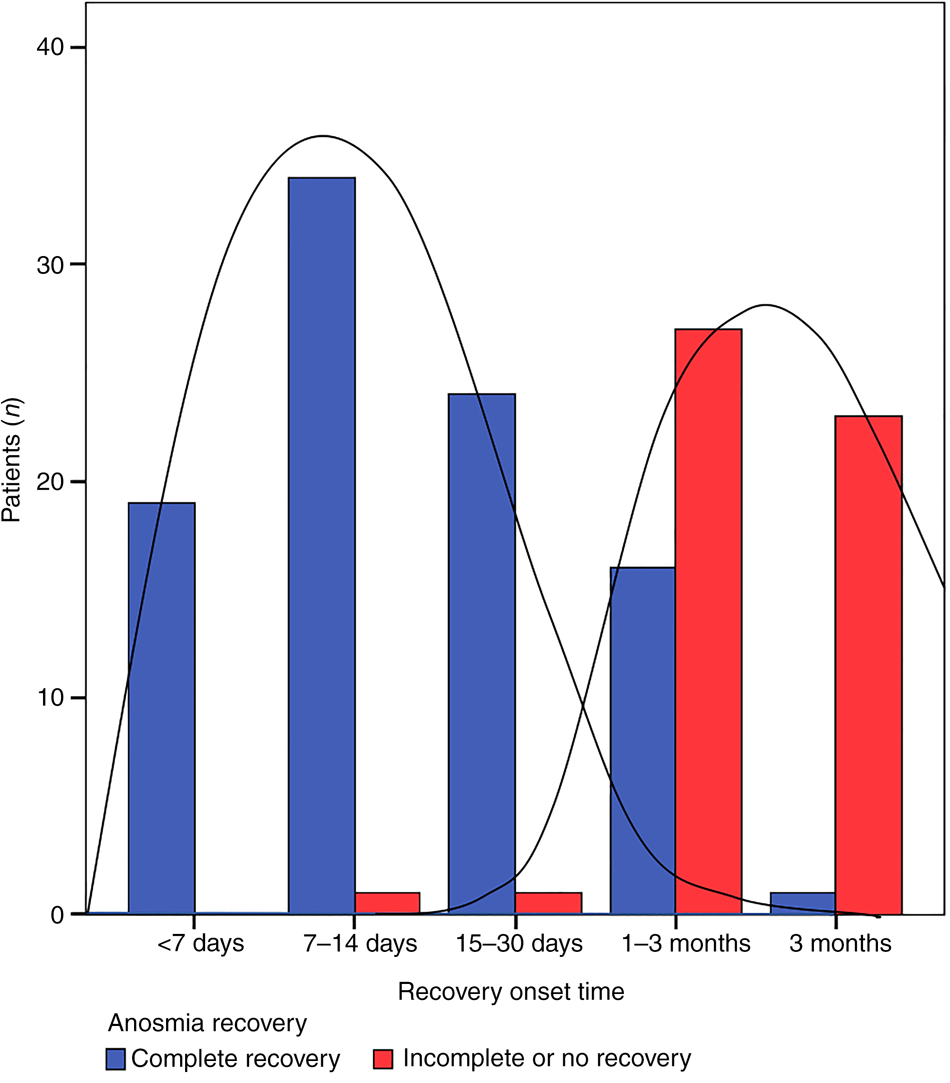
In 94 out of 146 patients (64.4 per cent), complete recovery of anosmia or hyposmia was registered, with a median time for recovery of 7–14 days (range, 4–90 days). In 29 out of 146 patients (19.9 per cent), a partial recovery was registered after a median time of 1–3 months (range, 15–180 months). In 23 out of 146 patients (15.8 per cent), the taste impairment remained unchanged as compared with that at the outset, as reported in Table 1. The difference in median recovery time between the complete recovery group and the incomplete or no recovery group was statistically significant (p < 0.0001). Overall, persistent olfactory disorders were self-reported in 35.7 per cent of the patients. Figure 1 shows the temporal trend of recovery in the two considered groups.
Temporal trend of coronavirus disease 2019 related anosmia and hyposmia recovery in the complete and incomplete recovery groups.

Recovery pattern distribution

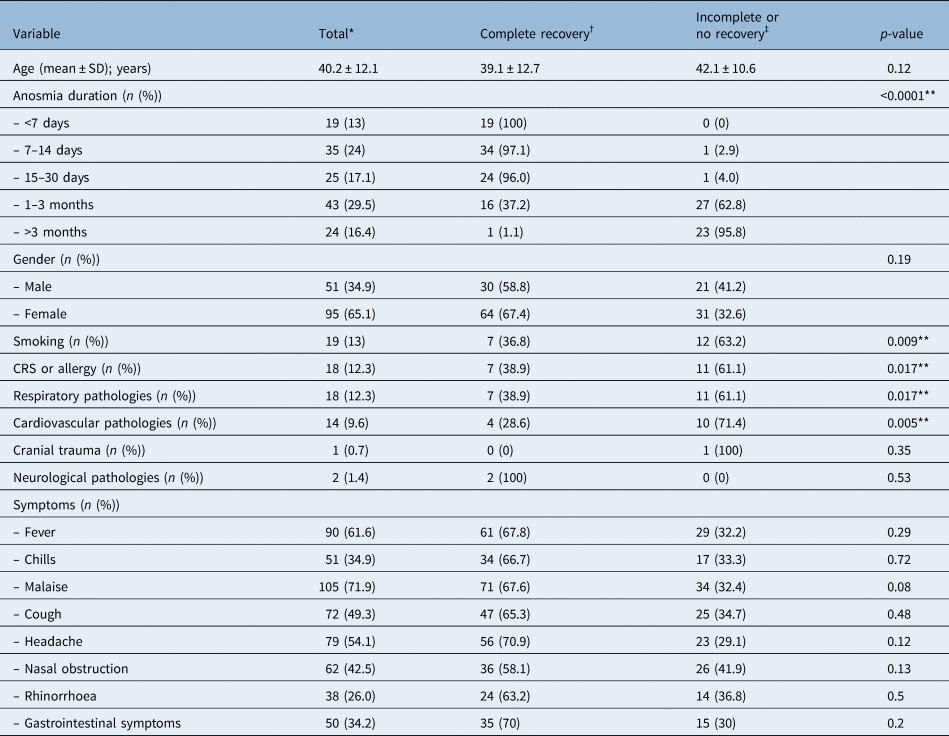
The most frequently reported co-morbidities and associated factors were smoking (13 per cent), chronic rhinosinusitis or allergy, and respiratory pathologies (both 12.3 per cent). In the univariate analysis, the variables significantly associated with incomplete or no recovery from anosmia or hyposmia were: anosmia duration (p < 0.0001), cigarette smoking (p = 0.009), chronic rhinosinusitis or allergy (p = 0.017), respiratory pathologies (p = 0.017), and cardiovascular pathologies (p = 0.005). No statistically significant association was detected between complete recovery from anosmia or hyposmia and age or sex (p = 0.12 and 0.19, respectively) or any associated symptoms (p > 0.05 for all analyses). Results from the univariate analysis are displayed in Table 2.
Role of different variables associated with anosmia and hyposmia recovery on univariate analysis

*n = 146; †n = 94; ‡n = 52. **Indicates statistically significant p-value. SD = standard deviation; CRS = chronic rhinosinusitis
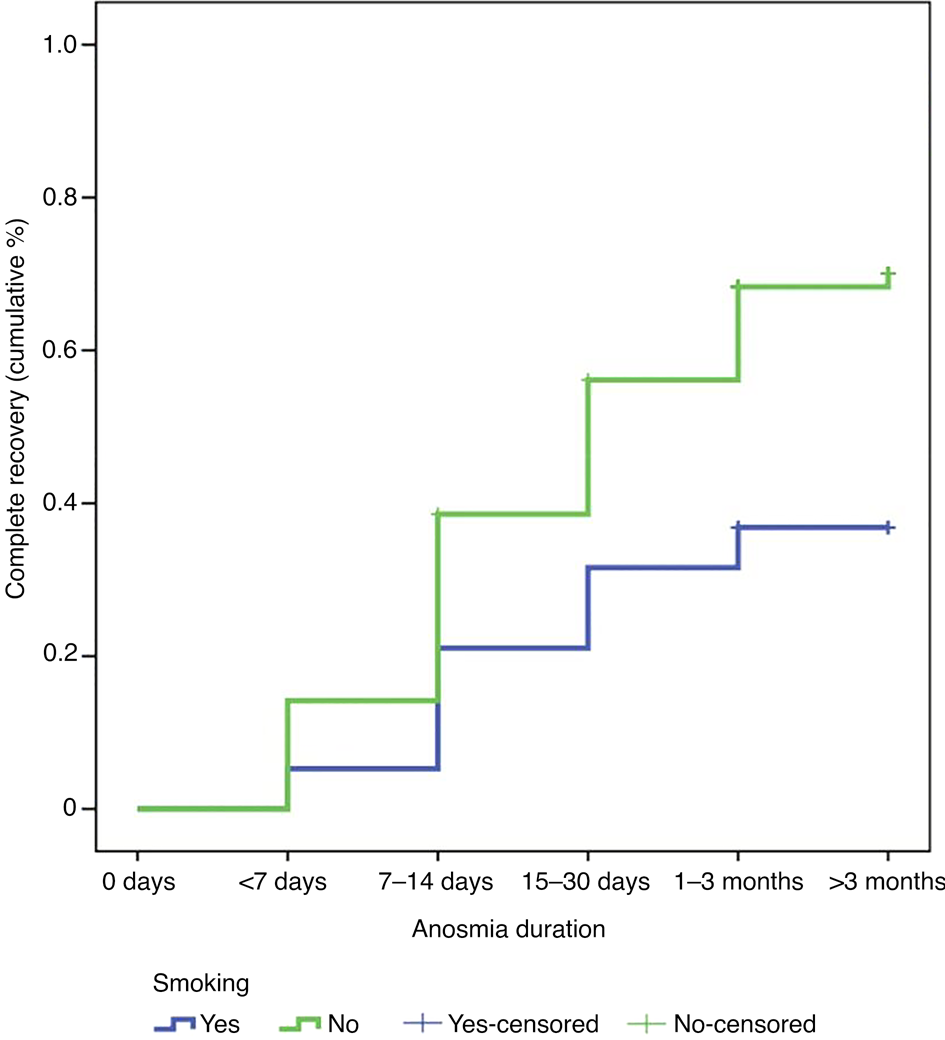
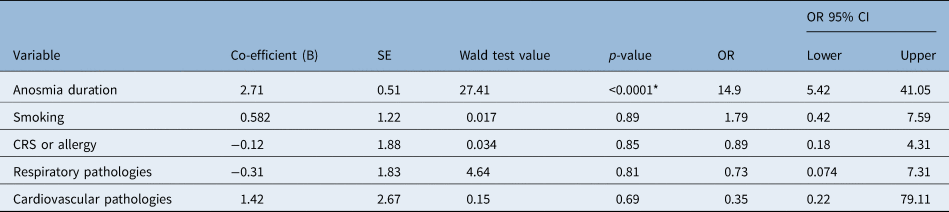
On the contrary, in the multivariate analysis (Table 3), only anosmia duration was significantly associated with incomplete or no recovery (p < 0.0001), which increased the odds ratio of incomplete or no recovery by 14.9 (confidence interval = 5.42–41.05). Table 4 describes the associations between anosmia duration and significant variables from the univariate analysis. A significant association was demonstrated only between cigarette smoking and increasing anosmia duration (p = 0.026), as displayed in Figure 2.
Association between cigarette smoking and complete recovery from anosmia over time.

Role of different variables associated with incomplete or no anosmia or hyposmia recovery on multivariate analysis

*Indicates statistically significant p-value. SE = standard error; OR = odds ratio; CI = confidence interval; CRS = chronic rhinosinusitis
Association between anosmia duration and significant variables on univariate analysis

*Indicates significant association (p < 0.05) on Mann–Whitney analysis. CRS = chronic rhinosinusitis
Only 13 patients (9 per cent) were treated for SARS-CoV-2 infection; among them, the most frequently used medication was hydroxychloroquine.
Discussion
The recovery of olfactory function after SARS-CoV-2 infection is an important factor, as smell impairment can severely impact quality of life.Reference Chung, Lee, Kang, Kim, Jang and Kim14 Being able to predict the possible evolution of this symptom is crucial, especially because the affected population is mostly represented by young and healthy people with a long life and social functioning expectancy. In our study, in 15.8 per cent of patients the virus-related anosmia or hyposmia was unchanged after nearly six months of follow up.
Previous studies, mostly characterised by short follow-up periods and variable percentages of recovery, have probably captured the first and fastest resolution pattern; longer observational periods are needed to attain evidence-based results.Reference Chiesa-Estomba, Lechien, Radulesco, Michel, Sowerby and Hopkins8,Reference Vaira, Hopkins, Petrocelli, Lechien, Chiesa-Estomba and Salzano11,Reference Chary, Carsuzaa, Trijolet, Capitaine, Roncato-Saberan and Fouet15–Reference Gorzkowski, Bevilacqua, Charmillon, Jankowski, Gallet and Rumeau20
In our study, 64.4 per cent of the patients had complete recovery, attained after a median time of 7–14 days, and 19.9 per cent of the patients had a partial recovery, occurring after a median time of 1–3 months. This could suggest that two possible recovery patterns exist: when complete recovery occurs, it happens within the first two weeks, whereas a slow improvement occurs after one to three months in those patients who do not reach complete recovery in the long term. The low chances of recovery over time are confirmed by the significant association between anosmia duration and incomplete or no recovery, as demonstrated in the multivariate model. Konstantinidis et al. had previously demonstrated a similar resolution pattern.Reference Konstantinidis, Delides, Tsakiropoulou, Maragoudakis, Sapounas and Tsiodras21
Chiesa-Estomba and colleagues studied a large multicentric cohort of 751 patients, and similarly reported a mean olfactory dysfunction duration of 10 days in those who completely recovered (49 per cent).Reference Chiesa-Estomba, Lechien, Radulesco, Michel, Sowerby and Hopkins8 In contrast to our study, the mean time to improvement in the partial recovery group (37 per cent) was shorter, at 12 days. The variation in findings may be explained by the shorter follow-up time in that study (47 days), as some patients can obtain a complete recovery even after that period.
It is possible that the two recovery patterns may be related to different pathophysiological mechanisms or to different extents of olfactory epithelium damage.Reference Saussez, Lechien and Hopkins22 Currently, some authors suggest that the Covid-19 virus can enter the olfactory neuroepithelium via the angiotensin-converting enzyme 2 (ACE-2) and neuropilin-1 receptors,Reference Hoffmann, Kleine-Weber, Schroeder, Krüger, Herrler and Erichsen23 while others suggest that the Covid-19 virus mainly affects non-neural cells of the olfactory epithelium, such as sustentacular cells and horizontal basal cells.Reference Brann, Tsukahara, Weinreb, Lipovsek, Van Den Berge and Gong24 Other authors argue that the short-term anosmia recovery could be due to a dramatic effect of SARS-CoV-2 on olfactory epithelium, which can quickly renew and recover following the period of viral clearance.Reference Yan, Faraji, Prajapati, Boone and DeConde4 Disruption of this ongoing neurogenesis may result in more severe olfactory dysfunction compared with that caused by sustentacular cell damage. It could be assumed that the different proportions and types of cells damaged in the olfactory neural pathway might result in different recovery patterns.
In our study, patterns of smell recovery were not related to patients’ ages. The preferential involvement of olfactory functions in young populations, which are conversely less likely to have severe Covid-19 symptoms requiring intensive care unit hospitalisation, has been confirmed by the majority of studies.Reference Lechien, Chiesa-Estomba, De Siati, Horoi, Le Bon and Rodriguez1,Reference Chary, Carsuzaa, Trijolet, Capitaine, Roncato-Saberan and Fouet15,Reference Amer, Elsherif, Abdel-Hamid and Elzayat19,Reference Kosugi, Lavinsky, Ricci Romano, Fornazieri, Lessa and Piltcher25 A cross-sectional study by Nouchi et al. on 390 patients also confirmed that hyposmia was more frequent in younger patients, in the absence of chronic co-morbidities and severe respiratory illness.Reference Nouchi, Chastang, Miyara, Lejeune, Soares and Ibanez26
On the contrary, Amer et al.Reference Amer, Elsherif, Abdel-Hamid and Elzayat19 and Guan et al.Reference Guan, Liang, Zhao, Liang, Chen and Li27 stated that co-morbidities were associated with a more delayed recovery from anosmia. They attributed their findings to the assumption that patients with co-morbidities were more likely to have a poorer baseline wellbeing, with a reduced recovery potential. In our study, neither cardiac nor respiratory co-morbidities were identified as independent prognostic predictors on multivariate analysis. This may be related to the relatively young age of our study population, with no severe systemic involvement or need for hospitalisation and intensive care.
Regarding sex differences, some studies have demonstrated a higher prevalence of olfactory dysfunction in females.Reference Lechien, Chiesa-Estomba, De Siati, Horoi, Le Bon and Rodriguez1,Reference Chary, Carsuzaa, Trijolet, Capitaine, Roncato-Saberan and Fouet15,Reference Amer, Elsherif, Abdel-Hamid and Elzayat19,Reference Kosugi, Lavinsky, Ricci Romano, Fornazieri, Lessa and Piltcher25,Reference Paderno, Schreiber, Grammatica, Raffetti, Tomasoni and Gualtieri28,Reference Meini, Suardi, Busoni, Roberts and Fortini29 The authors have suggested that the gender-related difference might be linked to: the possible decreased capacity of males to perceive olfactory disorders, divergences in the inflammatory reaction process, or the influence of hormonal factors. In our study, however, no statistically significant differences were detected between males and females.
Our results did not allow us to confirm a clear relationship between smoking and recovery from anosmia. However, a significant association with an increasing pattern of anosmia duration was determined (Figure 2 and Table 4). The role of smoking as a risk factor in SARS-CoV-2 remains controversial.Reference Engin, Engin and Engin30 A significant relationship has been found between smoking and SARS-CoV-2 infection: tobacco smokers have a greater predisposition (1.4-fold) to develop severe Covid-19 symptoms, and their death rate is approximately 2.4 times that of non-smokers.Reference Guan, Liang, Zhao, Liang, Chen and Li27,Reference Vardavas and Nikitara31
• Long-term results of coronavirus disease 2019 (Covid-19) related smell impairment are lacking and prognostic factors for recovery remain unclear
• An observational retrospective study was conducted on 146 Covid-19 positive patients with olfactory dysfunction
• Of the patients, 35.7 per cent reported anosmia or hyposmia six months after severe acute respiratory syndrome coronavirus-2 infection
• Complete recovery seems more likely within 15 days; later recovery is associated with incomplete restoration
• The affected population are mostly young and healthy, with a long life and social functioning expectancy
This study has some strengths and limitations. Among its strengths is the length of follow-up time. Moreover, a uniform and accessible self-reporting scale was used, allowing comparison with other ongoing and future studies. The main limitation is the absence of an objective olfactory assessment because of difficulties in performing the olfactory assessment at the baseline, when the infection was still active.
Conclusion
After a mean time of nearly six months from infection, persistent olfactory disorders were self-reported in 36.7 per cent of a sample of Covid-19 positive patients. Chemosensory recovery was not associated with the patients’ demographic or clinical characteristics, except for anosmia duration. Complete recovery is more likely to occur within 15 days, while those patients experiencing a later recovery (after at least 1 month) could expect an incomplete recovery.
Competing interests
None declared