INTRODUCTION
Pediatric brain tumors (gliomas, medulloblastomas, and ependymomas) are most frequently located within the posterior fossa (PF) (Habrand & De Crevoisier, 2001; Smith & Gloeckler Reis, 2002). Advances in medical therapies, including improved surgical approaches and the use of cranial radiation, have dramatically increased survival rates for these children. For average risk medulloblastoma survival rates range from 70% to 80% (Packer et al., Reference Packer, Goldwein, Nicholson, Vezina, Allen, Ris, Muraszko, Rorke, Wara, Cohen and Boyett1999; Strother et al., Reference Strother, Pollack, Fisher, Hunter, Woo, Pomeroy, Rorke, Pizzo and Poplack2002). Unfortunately, white matter damage and related intellectual problems is associated with cranial radiation (Mabbott et al., Reference Mabbott, Noseworthy, Bouffet, Rockel and Laughlin2006; Palmer et al., Reference Palmer, Gajjar, Reddick, Glass, Kun, Wu, Xiong and Mulhern2003; Ris et al., Reference Ris, Packer, Goldwein, Jones-Wallace and Boyett2001; Spiegler et al., Reference Spiegler, Bouffet, Greenberg, Rutka and Mabbott2004).
Persistent problems in sustained attention are also evident in pediatric brain tumor patients (Butler & Mulhern, Reference Smith and Gloeckler Reis2005; Mulhern et al., Reference Mulhern, Palmer, Merchant, Wallace, Kocak, Brouwers, Krull, Chintagumpala, Stargatt, Ashley, Tyc, Kun, Boyett and Gajjar2005). Because these difficulties are consistently identified, attentional problems have been characterized as a core deficit in pediatric cancer (Butler & Mulhern, Reference Smith and Gloeckler Reis2005). A core deficit is an impairment in an underlying cognitive process that is robust across various levels of disorder severity and mental ability (Dennis et al., Reference Dennis, Landry, Barnes and Fletcher2006). Prior to characterizing attention as a core deficit for pediatric brain tumor patients, it is necessary to comprehensively examine a variety of attentional processes. Given the role of attention in the production of goal-directed behavior it is critical to understand the impact of brain tumors on the multiple cognitive processes that comprise attention functioning.
Prior research has focused almost exclusively on evaluating deficits in sustained attention in childhood cancer. Sustained attention allows one to remain focused and is measured using tasks that require monitoring and detecting rare and unpredictable signals over time (Davies & Parasuraman, 1982; Sarter et al., Reference Plude, Enns and Brodeur2001; Warm, Reference Warm and Warm1984). Deficits in sustained attention do not appear during cranial radiation for brain tumors (Merchant et al., Reference Merchant, Kiehna, Miles, Zhu, Xiong and Mulhern2002), but are evident 4–5 years post-treatment (Dennis et al., Reference Dennis, Hetherington and Spiegler1998; Mulhern et al., Reference Mulhern, White, Glass, Kun, Leigh, Thompson and Reddick2004b; Reddick et al., Reference Reddick, White, Glass, Wheeler, Thompson, Gajjar, Leigh and Mulhern2003) and are associated with decreased white matter volume in frontal regions (Mulhern et al., Reference Mulhern, White, Glass, Kun, Leigh, Thompson and Reddick2004b). Once deficits in sustained attention have been identified, cognitive rehabilitation and/or medication is effective in ameliorating difficulties (Butler & Copeland, Reference Butler and Copeland2002; Butler & Mulhern, Reference Smith and Gloeckler Reis2005; Mulhern et al., Reference Mulhern, Khan, Kaplan, Helton, Christensen, Bonner, Brown, Xiong, Wu, Gururangan and Reddick2004a; Reference Mulhern, White, Glass, Kun, Leigh, Thompson and Reddick2004b; Penkman, Reference Penkman2004; Thompson et al., Reference Thompson, Leigh, Christensen, Xiong, Kun, Heideman, Reddick, Gajjar, Merchant, Pui, Hudson and Mulhern2001). Although sustained attention is critical for normal functioning, it reflects only one facet of attention. A complete understanding of the impact of treatment for pediatric brain tumors on attention requires a broader evaluation of other relevant processes. To address this gap in the literature, the present study examined the impact of PF tumor treatment on selective attention.
Selective Attention
Selective attention is an important process that has received little consideration in the literature regarding late effects of childhood cancer. It enables the selection of goal-relevant information (e.g., objects, thoughts) by enhancing the processing of relevant information and filtering out irrelevant information (Pashler, Reference Pashler1988). Selective attention is typically assessed by success in orienting to information (i.e., covert-orienting tasks), disregarding irrelevant information (i.e., filtering tasks), and locating important information (i.e., visual-search tasks). Control over selective attention can be exerted by automatic (i.e., exogenous) and/or voluntary (i.e., endogenous) processes (Jonides, Reference Jonides, Long and Baddley1981; Müller & Rabbitt, Reference Müller and Rabbitt1989; Yantis & Jonides, Reference Yantis and Jonides1990) with efficient behaviour predicated on an interaction between the two. In addition, both exogenous and endogenous attention may be deployed either overtly (i.e., accompanied by eye, head, and/or body movements) or covertly (i.e., with the eyes aimed straight ahead, effectively “looking out of the corner” of one’s eye).
To our knowledge, only a single study (Dennis et al., Reference Dennis, Hetherington and Spiegler1998) has examined selective attention in patients with brain tumors. Patients treated with cranial radiation performed more poorly than those treated with surgery alone, regardless of tumor location, in their ability to ignore distracting information presented during a vigilance task. However, performance was not evaluated relative to a medical comparison group or healthy age-matched controls.
The Present Study
The use of heterogeneous samples of cancer patients has made it difficult to understand the impact of different disease and treatment characteristics on attention. For example, in many studies, patients with different locations of brain tumors, who have undergone different treatment modalities and intensities, were examined as a single group. In some studies, patients with acute lymphoblastic leukemia and brain tumors have been considered as a single group. In the present study, the performance of patient with PF tumors on measures of selective attention was examined. We focused on two PF tumor patient groups who were treated with either: (1) cranial radiation and surgery, or (2) surgery alone. A critical feature of this study was the comparison of the PF tumor patients with a medical control group of non-CNS malignancy (non-CNS solid tumors) patients to account for the impact of frequent hospitalizations and absences from school, fatigue, and the psychological impact of having a chronic health condition on selective attention. We also included a healthy age-matched control group to account for typical developmental processes related to selective attention.
Although the literature examining selective attention in pediatric cancer is limited, a number of studies have examined these processes in normal child development (Akhtar & Enns, Reference Akhtar and Enns1989; Enns & Akhtar, Reference Enns and Akhtar1989; Enns & Brodeur, Reference Enns and Brodeur1989; Rueda et al., Reference Rueda, Fan, McCandliss, Halparin, Gruber, Lercari and Posner2004). Thus, our comprehensive evaluation of selective attention in pediatric patients with PF tumors was conducted using these same well-validated, multiple experimental tasks that included covert-orienting, filtering, and searching. Because selective attention processes have been associated primarily with posterior located neural networks (Fan et al., 2005), we hypothesized that patients treated for tumors located in the posterior brain regions (i.e., with cranial radiation with a boost to the PF; or focal PF radiation) would demonstrate slower response time (RT), and decreased accuracy for selective attention tasks relative to the non-CNS malignancy patients and healthy controls. Furthermore, given the important role that the cerebellum plays in the timing and modulation of cognitive functions (Dennis et al., Reference Dennis, Edelstein, Hetherington, Copeland, Frederick, Blaser, Kramer, Drake, Brandt and Fletcher2004; Dum & Strick, Reference Dum and Strick2003; Schmahmann & Pandya, Reference Schmahmann and Pandya1997), we hypothesized that patients with PF tumors treated with surgery only would also demonstrate impaired selective attention relative to the non-CNS malignancy and healthy control groups—albeit to a lesser degree than patients treated with cranial radiation.
For the covert-orienting, filtering, and search tasks, the effects of specific task conditions on RT are also used to evaluate selective attention processes. Hence, specific hypotheses regarding the impact of these task conditions on RT are also relevant in considering the performance of PF tumor patients. First, covert-orienting tasks can assess both exogenous and endogenous components of attention using a variation of the Posner cueing task (Posner, Reference Posner1980). The exogenous component can be measured by orienting attention to a location in the visual field via a luminance increment that is not predictive of target location. Exogenous and endogenous components can be measured together by having the luminance increment highly predictive of target location. RT to detect or identify a target is facilitated in the predictive condition as is evidenced by faster RT at a validly cued than at an invalidly cued location (Posner, Reference Posner1980). Even young children demonstrate covert-orienting ability with performance remaining relatively stable across development except for changes in efficiency of performance (Enns & Brodeur, Reference Enns and Brodeur1989; Rueda et al., Reference Rueda, Fan, McCandliss, Halparin, Gruber, Lercari and Posner2004). We hypothesized that patients treated for PF tumors would not demonstrate the expected facilitation effects for RT on predictive (exogenous-endogenous) versus nonpredictive (exogenous only) trials.
Second, filtering tasks assess the ability to inhibit irrelevant information (e.g., Ericksen & Ericksen, Reference Eriksen and Eriksen1974). In such tasks, a target requiring identification is presented alone, or flanked by identical (i.e., compatible) or different (i.e., incompatible) distracters. RT to identify a target is fastest for targets presented alone, slower for a target that is flanked by compatible distracters and slowest for a target flanked by incompatible distracters. Young children filter as effectively as adults when their attention is oriented to the location of the upcoming stimuli (Akhtar & Enns, Reference Akhtar and Enns1989; Enns & Akhtar, Reference Enns and Akhtar1989). We anticipated that relative to the control group, the PF tumor patients would demonstrate smaller RT differences between targets appearing with versus those without distracters.
Finally, visual-search tasks assess the efficiency of detecting important information when attention is required, as well as when it is not required. These tasks involve determining whether a prespecified item (i.e., the target) is present or absent among task-irrelevant (distracter) items (Plude, et al., 1994). Two patterns of search performance occur. If the target is dissimilar to the distracters and the distracters are similar to each other, a fast and accurate feature search, that does not require attention, occurs with RT independent of the number of distracters. If the target shares two or more features (e.g., size and color) with the distracters, a slower, less accurate conjunction search, that requires attention to conjoin features, occurs with RT increasing as the number of distractors increases (Treisman & Gelade, Reference Treisman and Gelade1980). In children, the same differences in search are seen, and in addition, a decrease in overall RT is evident with age, particularity for conjunction search (Trick & Enns, Reference Trick and Enns1998). We expected that patients treated for PF tumors would demonstrate inefficient search rates.
METHOD
Participants
Eligible patients were identified through database review at each site and an information sheet was mailed to their parents asking them to indicate their interest in participating in the study. A research assistant telephoned interested families and scheduled an assessment appointment. Patients were not recruited if they were treated for recurrent disease, had a diffuse brainstem glioma, were receiving palliative care, or had a premorbid history of neurological, learning disability, or attention problems. The study was approved by the Research Ethics Boards of the participating hospitals.
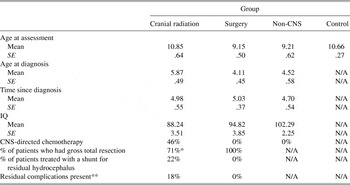
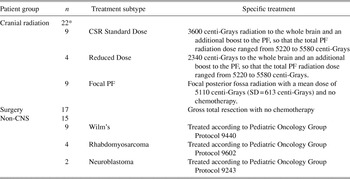
Fifty-four patients (age range 5–17 years) treateda for pediatric cancer were recruited into the study between 1998 and 2005. Medical information and demographic characteristics are presented in Tables 1 and 2.
Demographic and medical variables for patients and healthy age-matched controls

Note.
* Information was unavailable regarding extent of resection for 1 patient.
** Residual complications included motor deficits (for cranial-spinal radiation (CSR) and FOCAL groups only: ataxia, dysmetria, hemiparesis; to ensure a homogeneous comparison sample, patients with surgery only with motor deficits were excluded), cranial nerve deficits, transient mutism, and meningitis.
Treatment protocols for the patient groups

Note.
* Ten patients received adjuvant chemotherapy with different combinations of lomustine, cisplatin, vincristine, etoposide, ifosfamide, carboplatin, and cyclophosphamide depending on the protocol.
Twenty-two patients were treated for PF tumors with cranial radiation and surgery (Cranial Radiation group)b with 13 receiving cranial-spinal radiation and a boost to the PF and 9 receiving focal radiation to the PF. Eleven of the 22 patients were diagnosed with medulloblastoma, 7 with ependymoma, and 4 with astrocytoma. Seventeen patients were treated for low-grade PF gliomas with gross total resection (Surgery group). Patients with low-grade glioma and with residual motor deficits were excluded from the study in order to provide a relatively uncomplicated and homogenous comparison sample. Fifteen patients were treated for non-CNS solid tumors without CNS-directed therapy (Non-CNS group). Finally, 10 nonpatients participated as age-matched controls (Control group). The groups did not differ in age at assessment, F(3, 60) = 2.42, p > .05 nor did the patients groups differ in time from diagnosis to assessment, F(2, 51) = .11, p > .10 (see Table 1). Group differences were evident for age at diagnosis, F(2, 51) = 3.53, p < .05, with post-hoc tests (Games-Howell) revealing that patients treated with cranial radiation were older than those treated with surgery alone, p < .05.
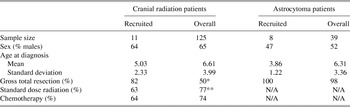
To examine the representativeness of our sample we compared patients recruited into the study to the remaining PF tumor patients diagnosed in the same time period at the Hospital for Sick Childrenc (Table 3) using analysis of variance (ANOVA) for continuous variables and chi square for dichotomous variables.
Comparison of demographic and medical variables of PF tumor patients recruited into the study and the remaining population of PF tumor patients at the Hospital for Sick Children (1998–2005)

Note.
* Based on the 114 patients for whom this data was available.
** Based on the 74 patients for whom this data was available.
Patients treated with cranial radiation did not differ (p < .05) from the reference sample in age at diagnosis, treatment with chemotherapy, or treatment with standard dose radiation. However, the recruited patients had a greater frequency of gross total resections, χ2 = 4.08, p < .05. Generally, gross total resections are associated with more favorable outcomes, as tumors that are amendable to such resection tend to have clearer margins and are less intrinsic with normal brain tissue. Patients treated with surgery only were younger at diagnosis than their reference sample, p < .05. Considering their low-grade pathology, as expected, virtually all astrocytoma patients had gross total resections and were not treated with chemotherapy.
Materials and Procedures
A short form estimate of intelligence (short form IQ) was calculated based on the Vocabulary, Similarities, Coding, and Block Design subtests of the Wechsler Intelligence Scale for Children – Third Edition for the patient groups only. This short form has excellent test-retest reliability, r = .93, and is correlated with full-scale intelligence based on all WISC-III subtests, r = .89 (Sattler, Reference Sattler2001).
Selective attention tasks
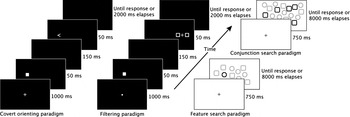
For all attention tasks, a computer controlled the stimulus presentation and feedback for incorrect responses, and collected data that included RT and accuracy. Participants were seated 30 cm from the monitor.Before each experimental attention task, verbal instructions, which were accompanied by visual illustrations were given regarding stimulus presentation, task requirements, and feedback for incorrect responses, and were followed by practice trials on the computer. The stimulus display and timings for each of the three tasks are presented in Figure 1.
At the far left is an example of a covert-orienting trial where the cue appears left of fixation and the target, the leftward-pointing arrow, appears left of fixation (i.e., at the cued location). In the middle is an example of a filtering trial where the cue appears left of fixation and the target, the cross, flanked by square incompatible distracters appears right of fixation (i.e., at the uncued location). At the lower far right is an example of a target-present feature search trial with 9 distracters consisting of gray circles and gray squares, and the target, a black “O”. Below the feature search example is an example of a target-absent conjunction search trial with 18 distracters consisting of gray circles, gray squares, and black squares, but no target.

The following events were common across all tasks. At the start of each trial, a fixation stimulus appeared in the center of the monitor. The duration of the fixation stimulus was 1000 ms for the covert-orienting and filtering tasks and 750 ms for the visual-search tasks. Participants were requested to keep their eyes focused on the fixation stimulus. Feedback following incorrect responses was given with a 220-Hz tone presented for 200 ms.. Incorrect responses included misses (i.e., not responding within 2 seconds after the target onset in the covert-orienting and filtering tasks or 8 seconds after the search array onset in the visual-search task), false alarms (i.e., responding before target onset or before the appearance of the search array), and wrong key presses. The inter-trial interval was 1000 ms. Practice trials preceded experimental trials as follows: 48 nonpredictive and 48 predictive trials in the covert-orienting task; 32 trials in the filtering task; 30 feature and 30 conjunction search trials in the visual-search tasks.
Covert-orienting task. Following the offset of the fixation cross measuring .95˚ x .95˚ visual angle, a square measuring 3.4˚ x 3.4˚ (i.e., the cue) appeared with equal probability to the right or the left of center for 50 ms. At 200 ms cue-target onset asynchrony (CTOA), an arrow measuring 1.1˚ x 1.1˚ that pointed left- or rightward with equal probability (i.e., the target) appeared to the right or left side of center for 50 ms. The task was to press the ‘z’ key if the arrow pointed left and the ‘/’ key if the arrow pointed right. Participants received 2 blocks of 48 nonpredictive (i.e., 50% validly cued and 50% invalidly cued) trials and 2 blocks of predictive (i.e., 80% validly cued and 20% invalidly cued) trials. On a validly cued trial, the target appeared at the cued location (i.e., in the location where the square had appeared) and on an invalidly cued trial, the target appeared at the noncued location (i.e., in the location opposite to where the square had appeared).
Filtering task. This task was identical to the covert-orienting task with the following exceptions. First, the fixation stimulus was a solid square measuring .4˚ x .4˚, the target was either a cross or an outline square with each measuring .95˚ x .95˚ presented with equal probability alone or flanked by distracters. Second, the cue was always nonpredictive of target location (i.e., 50% validly cued and 50% invalidly cued). Third, there was an equal probability that distracters were compatible (e.g., ‘+++’) or incompatible (e.g., +□+) with the target. Fourth, the task was to press the ‘z’ key if the target was a cross and the ‘/’ key if it was a square. And finally, participants received 4 blocks of 32 (i.e., 16 target without distracters and 16 target flanked by distracters) trials.
Visual-search task. Following the offset of the fixation cross measuring .95˚ x .95˚, a search array containing 2, 10, or 18 items appeared. The target, a black circle measuring 1.9˚ in diameter was present on half of the trials. In the feature search the distracters were gray circles measuring 1.9˚ in diameter and gray squares measuring 1.9˚ x 1.9˚. In the conjunction search, the distracters were grey circles, grey squares, and black squares. The task was to indicate with a key press whether the target was present or absent. Half of the participants pressed the ‘z’ key when a target was present and the ‘/’ key when it was absent and the other participants used the opposite mapping. Search task order was counterbalanced across participants. Participants received 3 blocks of 30 feature and 30 conjunction search trials presented separately and with equal numbers of trials with 2, 10, or 18 items across the 90 trials.
Statistical Analyses
First, group differences in short form IQ were examined using a mixed ANOVA including post-hoc analyses (Tukey’s). Second, for each selective attention task, a mixed ANOVA was conducted on mean correct RT with group (Cranial Radiation, Surgery, Non-CNS, Control) as a between-subjects factor, and the relevant repeated measures factors for each task, including post-hoc analyses to account for potential heterogeneity of variance (Games-Howell). As part of these omnibus analyses, planned tests of simple effects were used to examine the a priori hypotheses regarding task-specific effects on RT for the covert-orienting and filtering tasks, including (a) whether patients treated for PF tumors did not demonstrate the expected facilitation effects for RT on predictive (exogenous-endogenous) versus nonpredictive (exogenous only) trials, and (b) whether PF tumor patients demonstrated smaller RT differences for targets appearing with versus without distracters. For the search tasks, search rates for feature and conjunction search task were obtained using regression analyses of mean correct RT for target present trials as a function of display size. We did not control for age in our analyses because the groups did not differ on this variable and showed similar variability in age ranges (Table 1).
RESULTS
Differences in short-form IQ, were present among the patient groups, F(2, 51) = 4.04, p = .02. Based on post-hoc (Games-Howell) comparisons, IQ for the Cranial Radiation group was lower than for those in the Non-CNS group, p < .01 (see Table 1).
Selective attention tasks
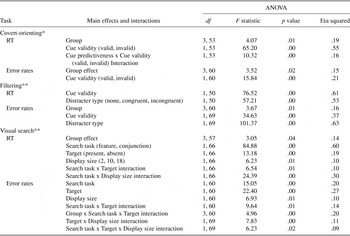
Significant main effects and interactions for each of the selective attention task are presented in Table 4.
Significant main effects and interactions for all selective attention tasks

Note.
* Findings are from analyses with group as a between-subjects factor and cue validity (valid, invalid) and predictiveness (predictive, unpredictive) as within-subjects factors.
** Findings are from analyses with group as a between-subjects factor and cue validity (valid, invalid) and distracter type (none, congruent, incongruent) as within-subjects factors.
*** Findings are from analyses with group as a between-subjects factor and search task (feature, conjunction), target (present, absent), and display size (2, 10, 18) as within-subjects factors.
Covert-orienting
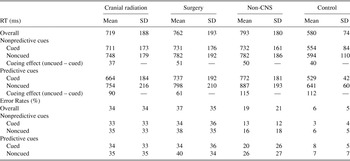
Mean correct RT and error rates for the repeated measures factors of cue predictiveness and validity are presented in Table 5. A statistically significant main effect of group was observed. Based on post-hoc comparisons (Games-Howell), the Cranial Radiation, Surgery, and Non-CNS patient groups were slower in responding relative to the Control group, p < .01.
Mean correct response time and cueing effects (ms) and error rates (%) as a function of group for the covert-orienting task

A statistically significant main effect was also observed for cue validity and its interaction with cue predictiveness across all groups. Overall, participants showed facilitation, responding faster on validly than invalidly cued trials, as well as demonstrated appropriate endogenous-exogenous orienting with faster responses on validly cued predictive than validly cued non-predictive trials. Based on tests of simple effects, the Control and Non-CNS groups demonstrated the expected finding of greater cueing effects for endogenous-exogenous versus exogenous orienting, as did the Cranial Radiation group (p’s < .05), though the mean difference between conditions was smallest for this PF tumor group (see Table 5). Patients in the Surgery group did not show greater cueing effects for the endogenous-exogenous versus exogenous conditions (p > .05).
Overall error rates also differed as a function of group (see Table 4). Mean error rates were higher for the Cranial Radiation and Surgery groups than for the Control group (Games-Howell), p < .01. Error rates for the Non-CNS group fell between these ranges (see Table 5).
Filtering
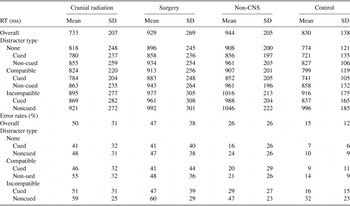
Cue validity (valid, invalid) and Distracter type (none, compatible, incompatible) were the repeated-measures factors for the filtering task. Mean correct RT and error rates are presented in Table 6. Differences in RT were not observed across groups. A cueing effect was observed in the filtering task with faster RT on validly than on invalidly cued trials, which is consistent with the effects observed on the covert-orienting task. Tests of simple effects revealed that groups responded most quickly on trials with no distracter, slower on trials with a compatible distracter, and slowest on trials with an incompatible distracter (see Table 6), p < .01. Of note, the mean difference between the no distracter and incompatible distracter was greatest for the Control group.
Mean correct response time (ms) and error rates (%) as a function of group for the filtering task

Accuracy varied as a function of group (see Table 4) with post-hoc comparisons (Games-Howell) revealing mean error rates for filtering were significantly higher for the both PF groups relative to the Control group, p < .01 (see Table 6). Overall error rates for the Non-CNS patients fell between these ranges.
Visual search
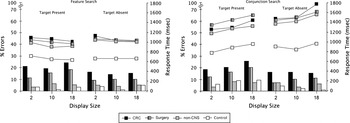
Search task (feature, conjunction), target (present, absent), and display size (2, 10, 18) were the repeated-measures factors. Mean correct RT and error rates are presented in Figure 2. A statistically significant main effect was observed for group (see Table 4). Based on post-hoc comparisons (Games-Howell), the Cranial Radiation, Surgery, and Non-CNS patient groups were slower in responding relative to the Control group. All main effects for the repeated-measures factors were statistically significant as were the following interactions: search task x display size and search task x target (see Table 4). Across all groups, RT was longer for the conjunction search task with increasing display size and on target-absent trials. Regression analyses were performed for each group to obtain a measure of the search rate. For typically developing 10-year-old children, feature (i.e., easy, efficient) search has a search rate of 1 ms/item or less whereas conjunction (i.e., difficult, inefficient) search has a search rate of 13 ms/item (Trick & Enns, Reference Trick and Enns1998). The data for each group is consistent with this finding (see Figure 2).
On the left are mean correct response time (ms) and error rate (%) as a function of group for the feature search task. Search rate (items/s) for the target present condition were, –3.39, –5.28, –2.07, and .59 for the Cranial Radiation, Surgery, Non-CNS, and Control groups, respectively. On the right is mean correct response time (ms) and error rate (%) as a function of group for the conjunction search task. Search rate (items/s) for the target present condition were 12.02, 12.88, 12.22, and 10.98 for the Cranial Radiation, Surgery only, Non-CNS, and Control groups, respectively.

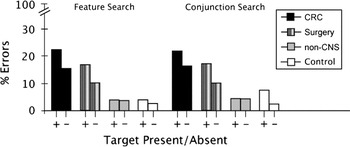
For accuracy rates, all main effects for the repeated measures factors were statistically significant, as were the following interactions: search task x target, target x display, and search task x target x display (see Table 4). Across all groups, error rates were higher for the conjunction search task with increasing display size and on target-absent trials. Furthermore, a group x search task x target interaction was evident: based on tests of simple effects this interaction was due to the fact that the Control group showed the expecting finding of a higher error rate when targets were present on the conjunction task only, but the Cranial Radiation and Surgery groups had higher error rates when the target was present on both search tasks, p’s < .01 (Figure 3). Error rates for the Non-CNS group did not vary as a function of target presence or search task. Furthermore, the Cranial Radiation group had higher error rates than Control and Non-CNS groups when targets were present on the feature search, and higher error rates than the Non-CNS group when targets were present on the conjunction search, p < .01.
Error rate (%) as a function of search task (feature, conjunction) group (Cranial Radiation, Surgery, Non-CNS, Control) and target (present, absent).

DISCUSSION
We found that selective attention is inefficient in PF brain tumor patients. This novel finding, taken together with the existing literature showing sustained attention is impaired in PF tumor patients (Dennis et al., Reference Dennis, Hetherington and Spiegler1998; Mulhern et al., Reference Mulhern, White, Glass, Kun, Leigh, Thompson and Reddick2004b; Reddick et al., Reference Reddick, White, Glass, Wheeler, Thompson, Gajjar, Leigh and Mulhern2003), is further evidence that attention functioning should be considered a core deficit in pediatric cancer.
Consistent with our main hypotheses, both PF patient groups displayed greater error rates for the covert-orienting and filtering tasks relative to the Control group. Error rates for the PF groups on the filtering task were particularly high, with performance at the level of chance. On the search tasks, the Cranial Radiation group showed increased errors when the target was present relative to the Control and Non-CNS groups. Both PF tumor patient groups also had slower RT than the Control group on the covert-orienting and search tasks.
Our findings regarding the effects of specific tasks on RT were more equivocal. First, findings for the Surgery group were consistent with our hypothesis that PF tumor patients would demonstrate smaller effects for RT than Controls on predictive (i.e., exogenous-endogenous) versus nonpredictive (i.e., exogenous only) trials. Specifically, the Surgery group was the only one for which this effect was not significant. The Cranial Radiation group showed facilitation effects for both exogenous-endogenous and exogenous covert-orienting, but the effect for predictive trials was smaller for this group than for the Non-CNS and Control groups. Our findings suggest that for patients treated for PF tumors, the effects of predictiveness and cueing on RT in covert-orienting may have been less robust than for Controls, suggesting that these patients may have experienced some difficulty in moving their attention voluntarily. Second, the presence of distracter effects in the filtering task was documented for all groups. Consequently, our hypothesis that PF patients would demonstrate smaller RT differences between targets appearing with versus without distracters was not supported. However, we note that the error rates for the PF tumor patients were particularly high on the filtering task, which would have restricted the number of data points used in these analyses. Finally, the search task regression analyses revealed that the search rates for both patient groups were well within the expected range. These analyses demonstrate that when patients do engage selective attention processes, at least for filtering and searching, they do demonstrate the expected task effects—albeit with slower RT and more errors than age-matched controls. Overall, the slower RT and increased error rates for patients with PF tumors provides compelling evidence of less efficient, but not completely impaired, processing in covert-orienting, filtering, and visual-search tasks.
A number of factors, including those specifically related to the impact of PF tumors and their treatment and those more generally related to the impact of a chronic medical condition, are important in considering our findings. Because all patients treated for PF tumors experienced difficulties—irrespective of whether they were treated with surgery alone or received further adjunctive radiotherapy—the effects of tumor location and resection (i.e., near the cerebellum) must be considered in understanding our outcomes. The cerebellum is important in the timing and modulation of cognitive functions (Dennis et al., Reference Dennis, Edelstein, Hetherington, Copeland, Frederick, Blaser, Kramer, Drake, Brandt and Fletcher2004; Dum & Strick, Reference Dum and Strick2003; Schmahmann & Pandya, Reference Schmahmann and Pandya1997). Hence, disruption of cerebellar function due to the direct effects of the tumor and surgery may interfere with the efficient execution of selective-attention tasks. In addition to these tumor/location specific effects, cranial radiation may damage the known attentional networks in patients treated with this modality. In patients treated with cranial-spinal radiation and those treated with focal radiation, posterior cerebral regions typically receive higher doses of radiation because of their proximity to the PF—where the highest doses are targeted (Nagel et al., Reference Nagel, Palmer, Reddick, Glass, Helton, Wu, Xiong, Kun, Gajjar and Mulhern2004). Posterior cerebral regions, including the parietal cortex, are activated during covert-orienting tasks in adults (Corbetta et al., Reference Corbetta, Miezin, Shulman and Petersen1993) and during conjunction search tasks in adults and typically developing children (Booth et al., Reference Booth, Burman, Meyer, Lei, Trommer, Davenport, Li, Parrish, Gitelman and Mesulam2003; Reference Booth, Burman, Meyer, Trommer, Davenport, Parrish, Gitelman and Mesulam2004). The increased radiation dose to these regions may selectively disrupt this posterior network. Furthermore, in patients treated with cranial-spinal radiation, broader areas of the brain are also affected. It is possible other cognitive processes that are important for attention are disrupted by these larger fields of radiation—further contributing to their deficits in selective attention. For example, slow processing speed is documented following cranial radiation (Mabbott et al., Reference Mabbott, Penkman, Witol, Strother and Bouffet2008; Schatz et al., Reference Schatz, Kramer, Ablin and Matthay2000) and may have contributed to patients missing stimuli and hence increased error rates on these tasks. Finally, the Non-CNS patients were also slower than the age-matched controls on the covert-orienting and searching tasks, suggesting that general factors related to cancer treatment (i.e., frequent hospitalizations, absences from school, fatigue, and the psychological impact of a chronic health condition) also have a subtle impact on selective attention.
Although our study had a large sample of patients, our results must be interpreted with caution. First, the impact of tumor location on selective attention was not tested, because patients with supra-tentorial tumors were excluded. Second, the patients treated with cranial radiation had the oldest age at diagnosis, and it is possible that if this variable was comparable to the other patient groups, it may have resulted in greater differences in cognitive outcome. Third, although our overall sample size was large (64 patients and controls), the relatively smaller samples within each group may have limited the power to detect some effects. Furthermore, patients treated with focal and cranial-spinal radiation were combined into a single group. In the future it will be important to examine the effects of dose and location of radiation treatment, but the current study did not have sufficient sample size to conduct these specific subgroup analyses. Fourth, data regarding IQ is not available for the age-matched control children. Fifth, the generalizabilty of our findings might be the limited. Although the representativeness of our samples was examined relative to reference sample of brain tumor patients for a number of medical variables, information regarding potential demographic differences was not collected. Potential differences in such information may have influenced to our results. Furthermore, our sample of patients treated with cranial radiation had a greater frequency of gross total resection than the comparison sample. This difference may be responsible for yielding better than expected outcomes in this study sample. In addition, patients with motor impairments were not included in the Surgery group. Because of this exclusion, the findings from the Surgery group may underestimate this group’s deficits relative to the broader population of children undergoing surgery. If a more representative sample of these children had been included, the Surgery group may have performed less well relative to Cranial Radiation groups than was observed in this study.
SUMMARY
We present novel findings regarding the impact of PF tumors on selective attention. Our findings are clinically relevant in indicating that selective attention should be monitored in pediatric brain tumor patients. Such efforts are important considering the poor academic and school outcomes of childhood brain tumor survivors. Children treated for brain tumors show poor school function based on standardized achievement tests, parent report, and utilization of special education services (Carlson-Green et al., Reference Carlson-Green, Morris and Krawiecki1995; Johnson et al., Reference Johnson, McCabe, Nicholson, Joseph, Getson, Byrne, Brasseux, Packer and Reaman1994; Mabbott et al., Reference Mabbott, Spiegler, Greenberg, Rutka, Hyder and Bouffet2005; Radcliffe et al., Reference Radcliffe, Bennett, Kazak, Foley and Phillips1996; Seaver et al., Reference Seaver, Geyer, Sulzbacher, Warner, Batzel, Milstein and Berger1994; Zucchinelli & Bouffet, Reference Zucchinelli and Bouffet2000). It is possible that difficulties in selective attention contribute to these poor academic outcomes. Our findings regarding overall error rates and RT indicate PF tumor patients have difficulties orienting to novel stimuli, inhibiting distracting material, and searching for relevant material, but that they can still engage these processes—although less efficiently than their age-matched peers. This finding is relevant, as it suggests that rehabilitation and school efforts focused on modifying the environment to decrease task demands, increase the salience of relevant stimuli, and decrease distracting material may be effective in allowing patients with PF tumors to engage selective attention processes more effectively.
ACKNOWLEDGMENTS
This research was supported by grants to DJM from the Hospital for Sick Children and b.r.a.i.n.child, to LP and DJM from the Alberta Children’s Hospital Foundation, to AW and DJM from the Northern Alberta Children’s Health Foundation, and to JJS from the Natural Sciences and Engineering Research Council of Canada and the Alberta Heritage Foundation for Medical Research. Portions of this data were presented at the Meeting of the International Neuropsychological Society, 2001.