




Lower-Class Reading and Writing
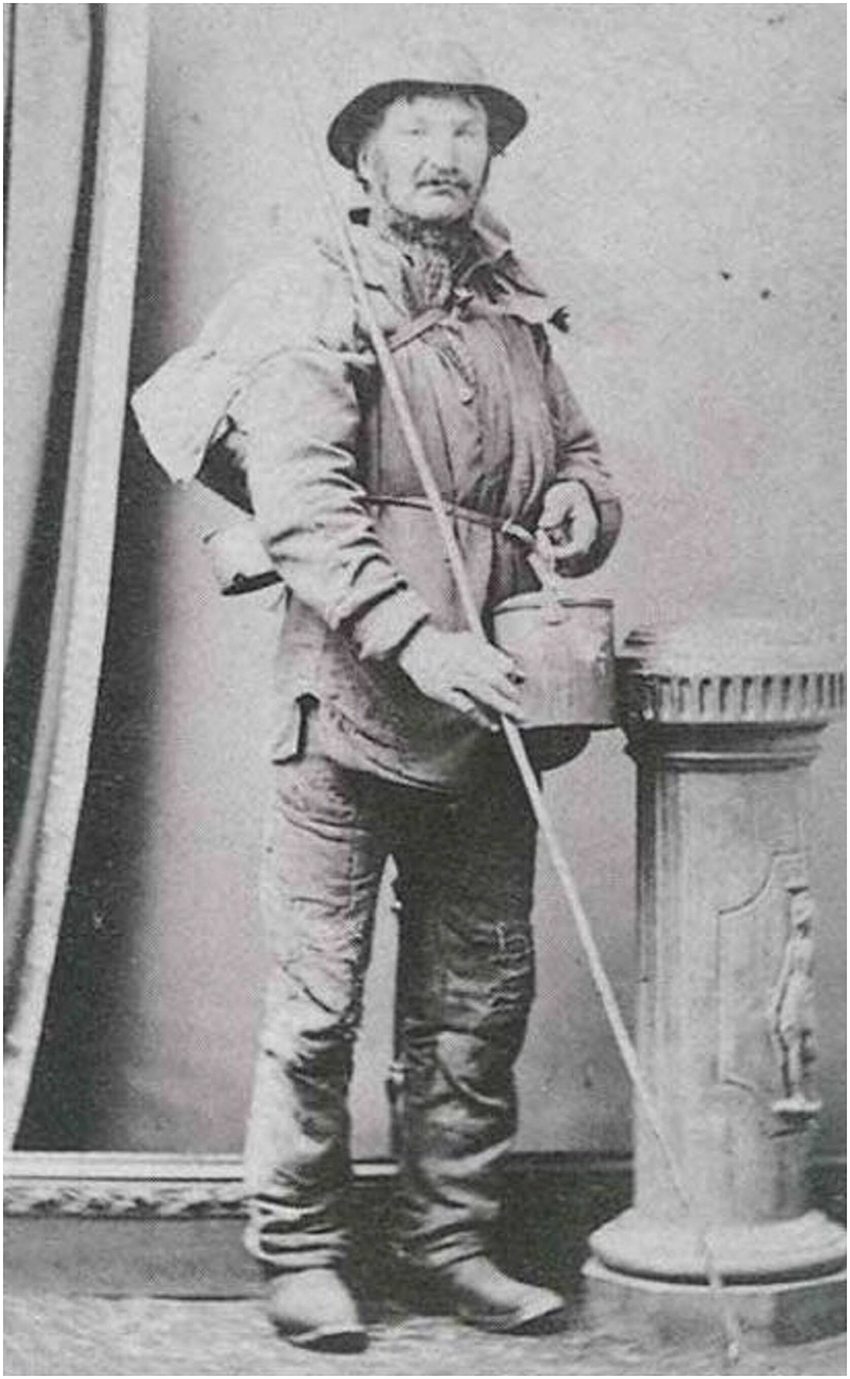
Joseph Jenkins was born at Llanfihangel Ystrad in Cardiganshire in 1818. He arrived in Australia in March 1869, at the age of fifty-one, and worked in the Ballarat and Castlemaine region of Victoria as an itinerant labourer, before securing a steady job in 1885, cleaning drains for Maldon Shire Council (Figure 1). He began his diary in Wales in 1839, continued it in Australia, and carried it on after his return home in 1894 until shortly before his death in 1898 – probably making fifty-eight volumes in all. The Australian section, with which this article is concerned, comprises twenty-five annual volumes, maintained regularly and almost without interruption for a quarter of a century, regardless of long working hours, fatigue, ill health, and hospitalization.Footnote 1
Joseph Jenkins in 1871. A posed photograph to send home to Wales from Ballarat.

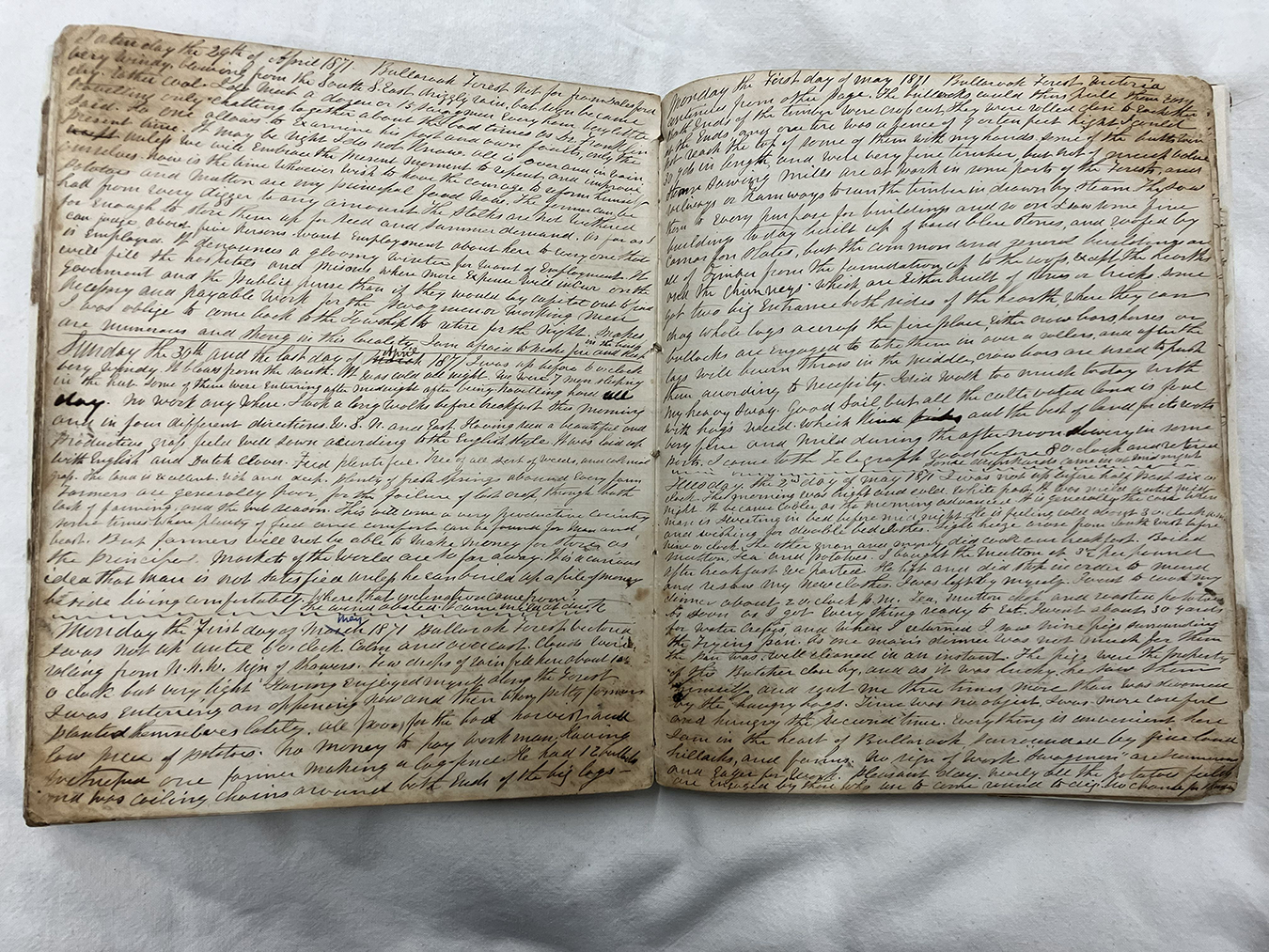
A page from Jenkins’s diary.

Figure 2 Long description
Scanned open diary spread showing two facing pages filled with dense handwritten cursive text in dark ink. The writing covers nearly the entire surface of both pages with no visible headings comma section breaks comma or dates. Text runs in continuous paragraphs from top to bottom on each page. The handwriting is small and closely spaced. The paper shows visible staining comma discoloration comma and worn edges consistent with age. Due to the resolution and density of the script comma individual words are not fully legible for exact transcription. No printed text comma illustrations comma or ruled lines are visible on either page.
Jenkins worked between twelve and fourteen hours a day, six days a week, year after year, and not even Sundays and holidays were entirely his own when stables had to be cleaned and horses prepared for his master’s use. Nevertheless, the diary imposed a relentless discipline and survived all Jenkins’s vicissitudes. “Not a blank day can be found”, he boasted and, remarkably, it is almost true.Footnote 2 There is a three-month lacuna in 1886, when intruders destroyed some of his possessions,Footnote 3 and occasional short gaps (in April 1871, November 1886, October 1889, and April 1890) but these never lasted more than a few days.Footnote 4 The longevity of the diary, and the assiduity with which he completed it every day, make Jenkins an exceptional Australian writer (Figure 2).
The life-writings of (mainly British) workers in the nineteenth century have been mined for data on their reading by David Vincent, Jonathan Rose and others, including myself.Footnote 5 These studies have demonstrated the long and unique tradition of spiritual autobiography in Britain, and the respect in which working-class readers held the classical works of the English literary canon. Rose’s effervescent and prolific study explored the improvised literary culture of the workers’ intelligentsia, composed of skilled artisans whose reading, limited by long working hours, was usually confined to Sundays. Joseph Jenkins’s Sunday reading and writing similarly reflected some characteristics of the worker-autodidact, although he was a diarist not an autobiographer, and an agricultural labourer not a craftsman. He was acquainted with the traditional proletarian canon, focusing primarily on Milton, Shakespeare, and Dickens. Most of his reading, however, was Bible-focussed; his engagement with secular literature was sporadic and his responses to it laconic. He followed European political events closely and occasionally expressed sympathy for workers’ causes, but took no interest in unionism. He spent little time examining his soul, but he certainly strove to live a useful life. As he wrote in one poem in 1871:
Our duty is to do our best
Before the time we’ll have to rest
And make this world as we go round
In better form than it was found.Footnote 6
In a vague sense he aimed at self-improvement, but he also wrote simply for pleasure, like many of the journal-writers examined by Philippe Lejeune, who has contributed more than anyone to the revaluation of personal writing by obscure authors.Footnote 7 In these ways, Jenkins fits into the pattern of the self-improving autodidact outlined by many previous analyses; but he followed an individual path, and his Australian environment sets him apart.
The inspiration for Jenkins’s reading and writing was drawn, as it was for many others, from a non-conformist, Bible-based Protestantism. He was a Unitarian but worshipped in the churches and chapels of several different denominations. New Testament Christianity formed his sense of morality and his work ethic. Furthermore, he was self-taught and, like many of the autodidacts presented by Vincent and Rose, his serious purpose and dedication to writing set him apart from his fellow-workers and made him a lonely and no doubt rather misanthropic diarist.
This special dossier focuses on workers’ reading, but their literary culture demands a broader examination. The study of reading has unfortunately eclipsed the rich and varied history of manuscript culture. As Roger Chartier argued, there are “two literacies” – reading and writing – but this was no reason to treat them in isolation from each other.Footnote 8 Reading has until now been considered the dominant literary skill, essential to the workings of a liberal, democratic society. Consequently, according to sociologist Deborah Brandt, “assumptions about reading as dominant and writing as recessive conditioned the ways that mass literacy was supported, experienced, regulated, and valued”.Footnote 9 As she justifiably complained, “this lop-sided attention to reading over writing is a condition endemic to historical studies”.Footnote 10
There are, however, signs that the history of writing is increasingly coming into scholarly focus, at least in continental Europe. A special issue of the Revista de historiografía and a thematic issue on popular writing in the Revue historique du XIXe siècle illustrate a growing awareness of the importance and ubiquity of lower-class writings in nineteenth-century Europe.Footnote 11 A recent anthology demonstrates the variety of genres adopted by lower-class writers, from graffiti to hand-written newspapers, and analyses the characteristics of their limited writing competence. This collection took as its title “The Common Writer”, deliberately echoing Richard Altick’s pioneering study of the British “common reader” while carrying the analysis forward into new territory.Footnote 12 In the last third of the nineteenth century, as I have argued elsewhere, an enormous expansion of ordinary writing occurred in Europe, mainly in the form of correspondence, which for the first time involved the lower classes, not just artisans and craftsmen and their wives but also workers and peasants.Footnote 13 The democratization of writing practices took a quantum leap forward between approximately 1880 and 1920, though this time-frame applies best to western Europe. Steven King’s study of pauper letters suggests an earlier date for Britain.Footnote 14 Much of this expansion was fuelled by emigrants like Joseph Jenkins, which makes his diary a small piece of evidence of the “writing revolution”.
The Discipline of the Diary
As detailed studies like Jennifer Sinor’s analysis of Annie Ray’s diary show, diaries impress by their banality. They record the petty routines of everyday life: the weather, the writer’s health problems, his or her work and travel habits, diet and regular human contacts. They outline the day-to-day impressions that form the pattern of a daily existence, endlessly repeated with few variations. Proletarian diaries are particularly down-to-earth and, like Jenkins’s, they may record the price and availability of essential food items, the prospect of finding work, and prevailing wage rates, all matters of high importance to workers and agricultural labourers. Diaries also have their silences and inconsistencies, as Susan Martin discovered when she underlined the “patchiness” and “randomness” of what was recorded by middle-class women in nineteenth-century Melbourne.Footnote 15 Diary-writing often exhibits parataxis: disparate items are juxtaposed without any attempt to distinguish what is most important. Hence, Jenkins’s diary may speak of the direction of the wind, his brother’s marriage, Queen Victoria’s illness, and washing his underwear almost in the same breath. Diaries, furthermore, are always open-ended. They cannot tell what will happen next. The diarist has no pre-conceived structure, no vision of closure, he or she simply faces a continuous flow of days without end. By the same token, diaries rarely reflect on the past. They are embedded in the details of the here and now – what Jennifer Sinor calls “the relentless concentration on the minimal”.Footnote 16 Joseph Jenkins’s diary shared many of these features. On the positive side, diaries carry within themselves a valuable meta-discourse, in which the diary comments on itself. This often happens after the diarist has been failing to maintain his or her regular rhythm and now returns to the daily task with new resolve and a comment on the purpose, as well as the difficulty, of continuing to write.
Jenkins wrote extensively about his work through the various stages of the agricultural year – ploughing, harrowing, harvesting, threshing, mowing, sheaving, weeding, building stone walls, thatching roofs, grooming horses – some of what he called the 150 different skills that the agricultural worker had to learn on the job, contradicting all those who classified him as an unskilled labourer.Footnote 17 I am not searching, however, for evidence of his agricultural life, but rather of his cultural life more generally and, in particular, for evidence of Jenkins’s reading and writing practices, of his engagement with the printed word and his appropriation of the power of writing for his own purposes. I take the diaries firstly as a guide to what Jenkins read and what was distinctive about his style of reading. At the same time, they record his epistolary practices. Jenkins was also a poet and many examples of his work, in both and English and Welsh, are scattered throughout the diaries. Furthermore, and most obviously, the diary itself raises its own questions about Jenkins as a writer: where and when did he write it? For whom was it intended? What role did writing play in Jenkins’s life and why did he devote so much effort to sustaining and prolonging the diary?
Jenkins’s diary is an example of “ordinary writings”Footnote 18 – the raw materials of a new history from below, which recognizes the importance of individual experience, and attempts to give voice and agency to members of the lower classes.Footnote 19 The term “ordinary writings” is useful, but as historians dig deeper into the textual practices of the subordinate classes, they inevitably encounter individual lower-class writers who are far from “ordinary”. So it proved with Joseph Jenkins.
The starting point for this inquiry must be the physical documents themselves. The twenty-five volumes of Australian diaries were composed in notebooks with board covers of various formats, containing blank or lined pages, except for the volume for 1874, when Jenkins experimented with a commercially printed Letts diary and almanac. The spaces allocated for daily entries were too small for him and he clearly found this constraining. Normally he wrote two or three days’ entries on each page and, if he ran out of pages, he inserted loose sheets. He wrote most frequently in black ink, sometimes resorting to pencil or blue ink, which he was forced to do when admitted to Maldon hospital with the Russian influenza in 1890. His handwriting was densely packed, his grammar mostly accurate, and his spelling good, except for writing “salms” for psalms and the occasional double consonants, as in “stabbles” for stables, “coppies”, “plannet” and the “Bibble”, etc. His punctuation, as with many ordinary writers, was sketchy. There are few deletions and some ink stains. The English text is interspersed with poems in English and Welsh, a little Welsh prose, and one or two newspaper cuttings. He used the endpages to write an introduction or a conclusion to the year, or to calculate the wages due to him, or to record some useful information – for example, instructions on how to treat snake bites are found in the endpages to volume six in 1876.
The diaries are fragile and were already falling apart in Jenkins’s own lifetime. The binding of some volumes has been re-sewn with twine and brown paper. At least one volume looks like a home-made book, made by folding writing paper in four, cutting it, and sewing it to plain cardboard to form a codex. The diaries have suffered water damage so serious that would-be readers in the State Library of Victoria are not permitted to turn the pages. I rely on the online version.
His daily entries followed a formula. He recorded the time he rose and often the time he retired. He always described the weather, temperature, and wind direction, all of which affected his working day. The wind was “boisterous”, the sky was “gloomy”, or there was “genial rain”; this was his favourite vocabulary for describing the day’s weather. The state of his health was another regular concern, and he sometimes recorded a dream. Mail and newspapers received and sent were diligently noted. The rest of the entry followed no precise formula but might include political news, thoughts of home, and comments on his reading, although these were generally confined to Sunday entries. He wrote a short review of every year at the end of the volume. The year 1871, for example, concluded with a sigh of “Adieu 1871”, and a sense of resignation; all we can do in life, thought Jenkins, was to keep paddling our coracle (a Welsh image) through whatever circumstances lie ahead.Footnote 20
The Biographical Context
Before analysing the diary further, it is useful to establish some biographical context. I draw on four main sources to sketch the background of Jenkins’s life: his grandson William Evans’s introduction to the edited diary extracts he published in 1975;Footnote 21 Bill Jones’s contribution on Jenkins to the Australian Dictionary of Biography;Footnote 22 Bethan Phillips’s biography of Jenkins, first published in Welsh but subsequently translated into English;Footnote 23 and, above all, the diaries themselves.
Little information is available in any of these sources on Jenkins’s education. The fact that he rarely mentioned school in his diaries suggests that he never spent much time in one. He refers to his “two quarters of English schooling”, and he briefly attended a Unitarian church school.Footnote 24 We do not know any more than this of his apprenticeship in reading and writing, and it seems likely that he was largely self-taught.
He left behind a large family in Wales. He was one of twelve siblings, but he seems closest to his four brothers Ben, John, David, and Jenkin. He was the father of nine children, and he corresponded most frequently with his daughters Mary, Ann, Nel (Elinor), and his favourite, Margaret. Through their letters he learned of births, marriages, and deaths in his extended family in Wales. Together with a handful of friends, including David Evans and his widow Margaret at Rheola (near Maldon), they made up his epistolary network. To his daughter Margaret he would write long letters (seventeen pages on New Year’s Day 1871, twelve pages in May 1877), and he would send his family copies of The Leader, the weekly companion paper to the Melbourne Age. In turn, they would regularly send him The Welshman, the Aberystwyth Observer, the Cambrian News, or the Cardiff Mail, and sometimes also London papers such as the Weekly Dispatch and Reynolds’s News.
Jenkins ran a successful farm at Trecefel. It consisted of 183 acres and the household was wealthy enough to employ six servants.Footnote 25 All of which makes his sudden emigration to Australia difficult to fathom. Two of his brothers had already emigrated to Wisconsin, so the idea was always present. His diaries made dark allusions to family quarrels that may have sparked his decision to leave. There were unsubstantiated rumours that his wife was unfaithful and had physically attacked him.Footnote 26 He wrote of his “aledged [sic] wife” and “the tretorious [sic] behaviour of my family towards me in Wales”, and the fact that he felt so strongly about perceived wrongs more than twenty years after leaving Wales suggests that he harboured a lasting grudge against his wife Elizabeth and his family.Footnote 27 According to Jenkins, unnamed persons had robbed him of his comfort and his property, but exactly what form their “treachery” had taken was never clarified.Footnote 28 Jenkins may also have been fleeing the consequences of some rash political decisions. He had unwisely lent his support to the unsuccessful local Tory candidate at the 1868 General Election, which would have made him deeply unpopular with local tenant farmers who saw him as a traitor to the radical cause.
Bethan Phillips considered that Jenkins’s alcoholism may have played a role in the marital break-up.Footnote 29 If this was the case, by the time he reached Melbourne Jenkins was a reformed character. According to his diary, he took a very occasional shot of brandy to boost his energy when ill, and as a young man he sometimes had a pint of beer on Sundays. This would have angered the Sabbatarians but it hardly constituted excessive consumption of alcohol. Either the diaries are disguising more dark secrets or drink was no longer Jenkins’s problem.
Jenkins was a Unitarian, a member of a Christocentric, Non-conformist Protestant faith which denied the doctrine of the Holy Trinity. In the absence of Unitarian ministers nearby, Jenkins sometimes worshipped in the churches and chapels of other denominations, usually Presbyterian or Methodist, and he distanced himself from petty sectarian quarrels. There were many churches in Maldon, he wrote – Anglican, Catholic, Wesleyan, Baptist, and Presbyterian – but he belonged to the “stay at Homeans”, who were in the overwhelming majority.Footnote 30 He frequently initiated theological discussions with other workers and employers who did not share his denial of the Holy Trinity or his rejection of infant baptism. In September 1877, he tells us that he was in dispute over these questions with a Swiss gardener, Johannes.Footnote 31 He had a particular animus towards Wesleyan employers who expected their workers to attend Sunday evening service. “They consider Unitarianism worse than infidelity”, wrote Jenkins, “Why because they never read the scripture and took the trouble to judge for themselves. Their creed is pinned to that of J. Wesley’s.”Footnote 32
The call for Sabbath observance caused friction of its own. Jenkins defied Sabbatarianism by using Sunday, his only rest day, to wash and mend his clothes, to write and to read sacred and profane works. Sometimes he did his washing secretly to avoid discovery and censure, and in summer he took his newspaper out into the bush to read for the same reason.Footnote 33 Jenkins viewed employers’ Sunday observance as hypocritical. He objected to preaching at the Sunday evening service on the grounds that Jesus never preached after sundown. At Lal Lal farm near Bungaree, there was clear tension between Jenkins and his employer Westcott, who was apparently a Calvinistic Methodist. Westcott insisted on a service and a sermon on his property every Sunday evening. Jenkins resented singing hymns from a Wesleyan hymnbook, was critical of the sermons he heard, and felt a pronounced distaste for the revivalist style of preaching.
In spite of these sectarian conflicts, Jenkins’s Christianity was an inclusive religion. After supper at Lal Lal farm, Jenkins, Dent the gardener, and Westcott the proprietor fell into discussion about Voltaire. According to Jenkins, Voltaire “was denounced as the Chief of Hell […]”, and he went on
but I am of a different oppinion [sic]. He was a true disciple of Jesus of Nazareth at least Humanity was his whole career on earth and he was a man that durst to publish the truth against the world.Footnote 34
The Bible remained Jenkins’s ultimate guide: “The Rights of Man were not far from reach, being the Old and New Testaments.”Footnote 35
Jenkins followed events in Europe in his newspapers. In 1871, he recorded the fall of Paris: “the proud city was starved out”.Footnote 36 He had no sympathy, however, for the Paris Commune, or the “communants”, as he called them. “It’s a dreadful revolution there”, he wrote.Footnote 37 His support for the oppressed was far from consistent. He saw the Australian maritime strike of 1890, supported by miners and shearers, as the struggle of labour against the capitalists, and he sympathized with the strikers even though their action pushed the price of foodstuffs higher.Footnote 38 His main concerns, however, were humanitarian: “I am afraid”, he wrote,
that it will bring a bloody riot before long. The capitalists hold out from any settlement. It is a pity to starve the thousands of children for stupidness on both sides.Footnote 39
In a similar vein, he regarded the South Wales miners’ strike of 1870 as “the colliers’ foolishness”.Footnote 40 In one aspect only, his political views never wavered: he was consistently against the Irish, who were guilty of “disloyalty and fenianism”.Footnote 41
Jenkins loved Australia for its climate, which made outdoor work much more pleasant than elsewhere. When the weather was fine and not too hot, he took great pleasure in working in the fields. Australia was a land of plenty: there was meat with every meal and he always had enough to eat – mutton and potatoes for dinner, and for supper “bara a llaeth”, bread and milk. But he deplored Australian greed and materialism, which he associated with the gold rush. He regularly condemned the drunkenness and fighting he witnessed, and widespread gambling on cards, horses, and cricket.Footnote 42 He remained a loyal subject of Queen Victoria. She was the “queen of the Saxons” but, nevertheless, the mother of the Prince of Wales.Footnote 43 Except for Victoria, whom he revered, and his daughter Margaret, whom he loved, and his allegedly treacherous wife, few women made an appearance in Jenkins’s diary. His world was overwhelmingly masculine.
The Welsh Connection
One of the main functions of both his correspondence and his diaries was to maintain his Welsh connections and sustain the religious and literary culture of his homeland. As with the Scottish emigrants studied by Bill Bell, print and scribal culture preserved the values of home and reinforced a sense of national identity overseas.Footnote 44 Bethan Phillips entitled her biography of Jenkins Rhwyng Dau Fyd, “Between Two Worlds”, conjuring up a classic case of the emigrant’s double identity.Footnote 45 But in his letters, his newspaper exchanges, and his diary, Jenkins never truly left his native Cardiganshire behind. His Australian network was almost exclusively Welsh from the moment he set foot in Melbourne and found lodging at the Carnarvonshire Boarding House. When later searching for work near Moorookyle, he targeted Welsh farms as most likely to offer him a job, but found there only north Welsh farmers who offered him nothing.Footnote 46 He preferred to keep company with Welsh workers and felt a special bond with those from Cardiganshire.Footnote 47 We can assume the existence of a strong informal network that kept Jenkins in contact with fellow-Welshmen in Victoria.
He often compared the climate and the customs of Australia to those of Wales, and he seemed to be writing his diary with a Welsh reader in mind, translating terms such as chickweed (purslane) into Welsh (gwlydd).Footnote 48 He self-consciously introduced his putative reader to strange new expressions like “swagging”, “earning my tucker”, and “on the wallaby track”.Footnote 49 Keeping up his native language was important to Jenkins; he reverted to Welsh frequently in his diary and whenever possible in conversations with friends. When a special event moved him, he composed a poem in Welsh, as he did on the death of his mother in 1871.Footnote 50 He criticized fellow-Welshmen who were too eager to assimilate and learn English, thereby losing their Welsh fluency.Footnote 51 His diary noted St David’s day (the patron saint of Wales) on 1 March, “the Welshman’s holiday”, even if he did little to celebrate it; and on 16 March he always remembered “Ffair garon”, Tregaron fair, his hometown’s annual show.
Jenkins was an Eisteddfod bard, well versed in bardic traditions, who submitted work to local Eisteddfodau in Victoria. He criticized the Ballarat Eisteddfod in 1877 for concentrating too much on musical performances, reducing it to little more than a concert.Footnote 52 Old traditions were being lost, he implied; poetry and the crowning of the best bard ought to be at the heart of the festival. He composed many englynion, a short form of Welsh poem, four lines long, with strict rules governing the rhyming pattern and number of syllables in each line. Bardism was a demanding discipline but Jenkins was a master of it. He won first prize for an englyn for thirteen consecutive years (1870–1882) at Ballarat Eisteddfod.Footnote 53 He kept a separate book of his own poetry alongside his current diary, and later in life referred to his “manuscripts”, which probably contained more of his verse.Footnote 54
In these ways, Jenkins’s various writings celebrated Welsh culture and sustained his sense of identity. The Welsh, he insisted, were the “true Britons”. Did Jenkins ever develop sense of Australian identity? Not if we believe his periodical complaints that he was permanently homeless. “O What a homeless country for the working chap”, he exclaimed in 1871,Footnote 55 and later he asked: “Who would emigrate to this colony for four months to be bounced about and suffer a gipsy life without any thing like home.”Footnote 56 But he also maintained that he had never had a permanent home in Wales either.Footnote 57 Rootless or not, his sense of ethnic identity was a continual source of pride in his Australian diaries.
Epistolary Practices
Jenkins’s experiences of corresponding with his family provide good examples of “mail anxiety”, brought on by the uncertainty and delays of the international postal system, and they illuminate the conditions under which correspondents operated. Jenkins systematically recorded all his ingoing and outgoing mail. Like Australian post offices, he divided his personal mail into two distinct categories: “home mail” and “colonial mail”. “Home mail” denoted his regular communications with several brothers and his surviving children in Cardiganshire, who exchanged letters and many local newspapers with Jenkins over a quarter of a century. “Colonial mail” described his letters to and from a handful of friends in Victoria; he never received a letter from, nor sent one to, any correspondent in another Australian colony – a reminder that the various Australian colonies were largely self-sufficient in postal terms. As well as newspapers and letters overseas, he also sent postcards, recording his first use of this medium in 1876.Footnote 58
Jenkins did not merely record the mail he sent or received from Wales; he also noted the dates when letters sent to him were posted and calculated when his own letters would arrive.Footnote 59 In June 1871, at Smeaton post office, he received a letter from his brother Ben announcing their mother’s death, posted on 7 April, which had taken nine weeks to arrive.Footnote 60 A letter from his daughter Mary in December 1876 had also taken, as he recorded, exactly nine weeks.Footnote 61
The arrival of the English mail was a major event and delays could cause serious worry. In June 1879, during just such a delay, Jenkins lamented “I am in the backside of creation now”.Footnote 62 Actually he was at Ravenswood, near Bendigo. Sometimes the local post office gave him news that the mail steamer had been sighted approaching Sydney, which no doubt heightened his sense of anticipation.Footnote 63 Occasionally, mail was lost at sea, causing serious frustration. In November 1871, the mail steamer from England did indeed sink, and all the mails were lost. Jenkins recorded, as an important afterthought, that thankfully all the passengers had been saved.Footnote 64
Writers like Jenkins had to know exactly when the steamer was due to sail from Melbourne and, when he lived at Maldon, he had to know exactly when the mail train from Bendigo would leave Maldon station for Melbourne. The timing and the frequency of collections dictated what and how much he sent. Missing the train meant waiting at least a week for another chance to send international mail – long enough for some of his text to become obsolete and need rewriting. He relied on messengers to carry his mail, a bullock-driver on one occasion, his employer’s son on another, a shepherd on another;Footnote 65 but he could never be sure of meeting the deadline when depending on a third party to carry mail from his place of work to the post office. These risks were real: a messenger entrusted with money to buy stamps might pocket some or all of the cash, leaving the writer unaware that his or her letters carried insufficient postage, if indeed they had been posted at all.Footnote 66 If Jenkins literally missed the boat, as he sometimes did in old age, letters to Wales would simply have to wait.
Jenkins registered the periodical despair he experienced when the expected mail failed to arrive. In March 1876, he bemoaned the fact that “I had no home letters since the last six months or more”.Footnote 67 He was worried that his family had forgotten him. The following month he walked five miles to Walmer post office to investigate “but there was no letters for me from any quarter of the world”.Footnote 68 He blamed the local postmaster, who was, Jenkins concluded, an ass and all you could expect from a donkey was a kick.Footnote 69 When the mail eventually did arrive after a long delay, there was likely to be a substantial backlog: like proverbial London buses, nothing for weeks, then everything at once – times of feast alternating with times of postal famine. When Jenkins collected his mail at Walmer post office in 1883 after a long absence, there were thirty-seven newspapers waiting for him.Footnote 70 In the mid-nineteenth century, therefore, international correspondents were likely both to receive and to send outdated news; if an important family event occurred, they would most likely be the last to know. When they wrote letters, they wrote to a strict deadline. When mail they expected to receive failed to arrive or was delayed, their sense of isolation was magnified and they experienced intense “mail anxiety”.
Jenkins as an Intensive Reader
Jenkins’s reading practices qualify him as an “intensive reader”, as defined by Rolf Engelsing in his study of the Bremen middle classes at the end of the eighteenth century.Footnote 71 The intensive reader read chiefly within a religious framework (Bremen was in a Protestant area of Germany). He or she had a traditional style of reading: books were not plentiful and readers relied on a small number of select texts, to which they repeatedly turned. They had a close relationship with their chosen texts, unlike “extensive readers”, for whom reading matter was easy to come by and soon discarded after use, before they moved on to something new, such as the latest popular novel.
Not all of Jenkins’s reading was religious, but he relied heavily on regular readings of the Bible and various psalms. His secular reading consisted almost entirely of newspapers. There were a few notable exceptions. He first encountered Shakespeare in December 1870, when he read two unspecified plays.Footnote 72 In January 1871, he dipped further into both the plays and poetry, arriving at a very conventional judgement:
I read few chapters in Shakspeare writings [sic]. He was a clever and witty poet. I am sorry I did not catch his works sooner as he describes the movement of the world, even at the present time, though he flourished about 270 years ago. He must have been a classical scholar of the time. His plays are worth reading over and over and treble meanings are numerous and witty writen [sic] in short and good English.Footnote 73
When he returned to Shakespeare fifteen years later, in 1886, borrowing a volume of his complete works from a friend, he changed his mind. This time, the poetry attracted him rather than the plays, whose high reputation he could no longer understand. He disliked the histories in particular, because they were full of “murders, traitorships, executions with all description of iniquities and disappointments beside unfair abdications and martyrdoms”.Footnote 74
He read David Copperfield in 1886, the only novel he ever mentioned in his Australian diary, and returned it to the library with his personal review of the book inserted between its pages. He had enjoyed the novel but felt the death of the fisherman Ham was too disturbing, and found it inconceivable that David could love Emily, Dora, and Agnes all at once.Footnote 75 He admired Pope’s translation of the Iliad, he mentioned Byron and Burns, and read some poetry of Milton, Butler, and Dryden, especially enjoying the latter.Footnote 76 He discussed Milton with a prospector in 1874, and unusually expressed a preference for Paradise Regained over Paradise Lost.Footnote 77 These, however, were rare excursions into secular books.
His chosen texts were firstly the Bible, and secondly the psalms of the Welsh poet Iolo Morganwg (1747–1826), who Jenkins dreamed about and knew affectionately as “Iolo”, although they had never met.Footnote 78 Jenkins had an intimate and traditional relationship with the Bible, typical of the intensive reader: he would “read it through” from start to finish, from Genesis to Revelation. One Sunday in 1875 he wrote: “Having finished to peruse the Old Testament for the fourth time since I left home. And I cannot see much consistency in it with that which was taught by our Saviour Jesus Christ respecting God and so on.”Footnote 79 The Bible, he wrote in 1876, “is the only printed book I possess here, which is enough for me to comprehend”.Footnote 80 In April 1877, he was again content with the Leader, Morganwg’s psalms, and the Bible, and had no wish for any other books.Footnote 81 Iolo’s psalms, he wrote,
are a great comfort to me here and I am glad that I brought the book with me. I can say that I never valued them at home nor even understood their meanings and so it is in respect of the Old and New Testaments. More I read of them better I understand and appreciate their contents.Footnote 82
Specific parts of Scripture greatly appealed to him and he read them repeatedly. One was Solomon’s advice to his son, and another was Christ’s Sermon on the Mount, which Jenkins re-read on most Sundays.Footnote 83 It inspired one of his poems on “Blessed are the meek.”
Although Jenkins’s repetitive reading of a small number of religious texts fits the pattern of the intensive reader, his hours of newspaper reading, at first sight, depart from this norm. He was an avid newspaper reader and his letters to their editors on agricultural matters, such as the use of manure, were published in local papers like the Leader, to which Jenkins subscribed. The Leader, he wrote, “give [sic] me both pleasure and information among strangers”.Footnote 84 Whenever in a town of any size, such as Ballarat, he gravitated towards the nearest public reading room, and it is likely he did so to consult newspapers.Footnote 85 A newspaper is designed to be read piecemeal, by readers who pick and choose the articles that interest them, roaming across and through the pages before deciding where to settle. This represents a casual, extensive reading style. Jenkins read many newspapers, but he did not follow this reading model. Instead, he would read them just as he read the Bible, from beginning to end. Upon receiving one paper he explained: “When I got the that [sic] paper I through [i.e. threw] other readings aside until I digest it all.”Footnote 86 In uncertain English, he revealed his aim was total absorption, not superficial browsing. Again, in July 1889, he received two issues of the Cambrian News and “I read them nearly all through”.Footnote 87 This reading tactic was perfectly consistent with the traditional reading mode that Jenkins employed with his religious texts.
Jenkins’s critical gaze was primarily directed at sermons. He appreciated the sermons regularly reproduced in the Leader, just as he commented on the sermons he listened to. Whether he was reacting to a printed text or a sermon delivered verbally, he often found fault with preachers.Footnote 88 When young preachers told their congregation that God’s grace rather than good works would ensure salvation, Jenkins cynically thought they were wasting their breath, since nobody in the neighbourhood was generous enough to ever donate anything to charity. In any case, this devaluation of charitable works was doctrinally suspect as far as he was concerned; he wanted everyone to live a Christian life. Such sermons fell short of his expectations; he preferred the impeccable model of Christ’s Sermon on the Mount.Footnote 89
Joseph Jenkins the Marathon Diarist
We have some insight into Jenkins’s writing habits and the documents he routinely carried around with him because, in December 1870, he lost what he called his “wallet”, and he listed its missing contents. It contained his “diaries, my dictionary, my book of poetry, my private accounts, six shillings and three pence of stamps, my right of voting, my recommendation paper, with other valuables”.Footnote 90 Within a fortnight he had recovered these treasured items, but meanwhile he had revealed something of his intense personal documentary culture, in which the diary held pride of place. A marathon diary, a book of poems, letters to newspaper editors, and long letters to his children: did Jenkins suffer from “graphorrhoea”, an uncontrollable urge to write? The diary had an important meaning and purpose for Jenkins, which I will briefly explore in this final section.
The act of writing was not always easy for Jenkins. Jenkins was born into the age of steel pens, but rather perversely preferred to use a quill. According to Bethan Phillips, he would cut his own quills, and make homemade ink from berries and spring water.Footnote 91 “I bought a box full of steel pens”, he wrote in March 1884, “but not equal to the quill pens for me.”Footnote 92 Whichever instrument he used, some physical effort was required. In his old age, he suffered from fatigue and stiffening fingers, which made his self-appointed task more difficult. Yet, even when he felt too tired or sick to go on writing, he would nevertheless write that he could no longer write.
The preservation of the diaries was precarious. Mice started eating the pages.Footnote 93 In 1886, children broke into his home and destroyed some books and papers. Twice his cottage was burgled and the second time intruders set it alight. Jenkins returned home to find his diaries scattered over the ground outside.Footnote 94 Fortunately, it seems they all survived. In wet weather there was a risk of mould. Jenkins accordingly spent time airing the volumes when the sun came out.Footnote 95 Ink spills were another hazard.Footnote 96 As for the water damage that currently makes consulting the diaries difficult, there is no telling when exactly it occurred.
He wrote either early in the morning or, more usually, before he went to bed at night, recalling and summarizing the day that had passed. He much preferred writing on Sunday when, as he put it, “I do enjoy myself always when I can use the present tense in my diary that is to say when writing of things as I pass the time.”Footnote 97 When he wrote in the evening, adequate lighting was a problem. Candles were expensive and writing for long periods by candlelight strained his eyes. In later years, he acquired spectacles and a kerosene lamp. He wrote in his hut or cottage and sometimes al fresco, on a log or a natural table, as he did at Mount Cameron in 1876:
I am in a delightful place this moment under a rock of big boulders sheltering the light southerly breeze. The sun shines his warm rays upon me. One big stone serves me as a chair and the other as a writing desk.Footnote 98
The pleasure of completing his daily duty in a bucolic setting compensated for other difficulties. These included the occasional ridicule of his working companions, which he had to endure in 1877 at Lal Lal farm, as he related:
Young and would be wise colonial was laughing at me last night for taking so much bother as to write some sort of manuscripts about my movement in the world. My answer was that I by doing so was building and carving my own monument, let the same be bad or good.Footnote 99
This revealing statement encapsulated Jenkins’s distaste for “colonials” in general and for the younger generation in particular, as well as illustrating his purpose as a diarist, his foresight and his confidence in achieving it.
The underlying purpose of the diaries changed over time. At the beginning, his stated aim was to write in order to practise and improve his command of his second language, English. He gave this retrospective explanation in the preface to his diary for 1876:
My first idea in writing a journal was in order to learn to write and to correspond in the English language. As I had only two quarters of English schooling, and that when very young and very indifferent about learning anything but working on the farm. My first diaries are a sufficient proof that I could not even attempt to write a single line in a legible form but through my exertions as well as the cheap newspapers, letter postage and so on I became able to correspond with my distant friends and relatives in two languages, the Welsh and the English language. As the contents of my diary are composed principally to my own daily history as every man’s diary ought to be. When few remarks about others are inserted very likely that my idea at the time was to prove where I was and to remind others of my whereabouts. Should any dispute happen to arise The chief excuse from all [illegible word] for not writing a history of themselves is that the bother and labour would be vanity. But very few neglect the pleasant and the useful task for that, but, because that they are ashamed of reporting many of their transactions before the public.Footnote 100
Several ideas are expressed here. Firstly, Jenkins wanted to improve his English, and he presented himself as a self-taught writer with self-improvement on his mind. At the same time, he wanted to remind others of his whereabouts and thus of his existence. Lastly, he seems to be referring to the need for any diarist to be frank and open.
In 1839, at the age of twenty-one, Jenkins started his marathon, but by the time he composed his Australian diaries decades later, his English, although imperfect, was no longer the issue. He still had a vague idea about the diary as a means to self-improvement, as shown by this passage written on Christmas Day 1877, framed as advice to the young:
I sincerely advise every young person to do the same [i.e. keep a diary] and to try to possess more knowledge and wisdom when going to bed every night than he or she had when getting up in the morning.Footnote 101
For Jenkins, the diary demanded a daily reflection on what had happened, and this was a way to learn from experience and become wiser as a result. In a later entry, he recommended that all schoolchildren should be made to keep a diary. This, he wrote, would reduce crime and “writing a regular diary would nurse their learning through life”.Footnote 102
Writing, of course, was a pleasure to Jenkins, and one motive that should not be overlooked is the sheer enjoyment he derived from writing. If he could find a solitary moment to read or write, with a view of the countryside, he was content. “Reading writing and resting are my favourite companions”, he wrote.Footnote 103 In old age, however, his writing pleasure was limited by stiff fingers and fatigue, and he began to record more often that he had “lost the taste” for writing in the way that he had done in the past.Footnote 104 He took longer to complete his letters home and risked missing the mail boat.Footnote 105 Old age was wearing him out.
The diaries were heavy. As they accumulated, they increasingly weighed Jenkins down. When he left one employer in 1871, he estimated that his swag, with all his clothes, blankets, and books, weighed seventy-five pounds (thirty-four kilograms).Footnote 106 He may have been exaggerating, but the transport and preservation of his diaries certainly caused a problem. He partially solved it by leaving some of them with his friend and fellow Welshman David Evans at his farm at Rheola.Footnote 107 When he later wanted to assemble all his belongings, he travelled there to examine his box of possessions.
As the years advanced, Jenkins faced the prospect of being no longer physically capable of earning his living. He had always been prone to exaggerated mood swings and, in a poem of 1871, he already bemoaned his fate, writing “I am like a roving thrush/ Perambulating through the bush”.Footnote 108 Now, in later life, he cast himself as a martyr and increasingly lamented his fate in the diary. Whenever he slipped into a bout of self-pity, he switched to a third person narrative. He created a character who was his alter ego – “poor old Jo”, a figure beset with difficulties, mistreated by miserly employers, betrayed by his family, facing a lonely and miserable end. This was a displacement technique, in which the author positioned himself as one of his own readers and as the spectator of his own misfortune. In so doing, Jenkins was trying to elicit the reader’s sympathy with his hardships and disappointments.
His thoughts turned to his own death, or his “dissolution” as he called it. “Poor old Jo” was suffering and felt “the fatal blow” was not far off. He spent several hours in Maldon cemetery copying In Memoriams into a notebook, with a view to composing his own epitaph.Footnote 109 In his diary, he contemplated wandering out into the bush and letting himself starve to death.Footnote 110 He was afraid of dying on the journey home to Wales (in fact, if anything the voyage invigorated him). “Poor Jo start for Wales as soon as you can or to somewhere else”, he advised himself, “The grave would be safe from burglars and swindlers.”Footnote 111 In these moments, he thought of returning to Wales to be buried in Welsh soil, and the question inevitably arose: what would happen to his diaries?
In spite of Jenkins’s pessimism, he wanted to live to see his grandchildren, and he certainly wanted his diaries to survive him. He did not trust most of his relatives to take good care of them. “Very likely”, he mused, “that some of them are devoured and burnt by my traitors in Cardiganshire but I can’t help that revengeful crime”.Footnote 112 He was not far off the mark: the family did eventually destroy the last four volumes, presumably because of Jenkins’s hostility and portrayal of his relatives in a negative light. He decided to send the diaries to his daughter Nel, whom he trusted: “I hope that my diaries and my manuscripts will reach their destination at Llanio railway station in the care of my children Ebenezer and Elinor Evans.”Footnote 113
Although Bethan Phillips claims that Jenkins used his diaries to “exorcise his demons”,Footnote 114 he continued throughout to refer to past family disputes only in innuendoes, and the conflicts were never directly confronted or resolved. He remained “a prisoner of his own past”.Footnote 115 Jenkins’s motivations must be sought elsewhere, in his self-improving ambitions, in the sheer pleasure of writing, and in the desire to make a personal mark. Just as he sent newspapers home to show that he was still alive,Footnote 116 he wanted to leave some trace of his life in the form of his diaries, and to let those who knew him know what his life had been in Australia.Footnote 117 He was indeed “carving his own monument”, to ensure that he would not be forgotten, and to guarantee that “Poor old Jo” would enjoy an afterlife beyond his physical death. The diaries had to wait until 1968 to be rediscovered in Nel’s attic, but in his aim to overcome oblivion Jenkins was spectacularly successful.
The study of ordinary writings regularly reveals some extraordinary proletarian writers. Joseph Jenkins was one of these exceptional individuals, an assiduous and compulsive diarist all his life. At the same time, he was a part of broad cultural changes, contributing to the writing revolution of the late nineteenth century, when writing became a daily necessity for millions of lower-class, often unschooled writers all over western Europe. In this sense, we might call him a “normal exception”, as Carlo Ginzburg enigmatically labelled his celebrated miller of Friuli in a much earlier period.Footnote 118 Jenkins’s reading choices reflected the literary culture of other self-taught workers in the nineteenth century. He respected the English literary canon, even if his responses to it were not always predictable, but, for the majority of his reading, he turned to non-fiction, especially the newspapers and religious literature that constantly sustained him. His story illuminates the epistolary practices of his place and time, when exchanges between Britain and Australia were difficult, drawn-out, and sometimes precarious. This was the period in which the eastern colonies of New South Wales and Victoria were becoming two of the most prolific letter-exchanging societies in the world, global leaders in epistolary traffic, and Jenkins was a part of this development.Footnote 119 Jenkins’s diary allows us to embed his reading and writing within the texture of his daily life, and it shows us the value of ego-documents in helping us to see readers and writers as flesh-and-blood individuals, making literary choices that were often banal but sometimes surprising.
Above all, Jenkins’s significance lies in his role as a diarist and a writer. He shows us the primordial importance of writing at all social levels by the late nineteenth century. He always wrote for pleasure and sometimes for self-improvement. Writing sustained his life and his sense of identity, as an agricultural labourer, an émigré, and a bilingual Welsh poet. Writing helped him to find meaning in his life, and to create something that would transcend his own “dissolution”.

 Open access

