There is a substantial body of research suggesting that exposure to community violence, defined as witnessing someone experiencing serious harm in their neighborhood or directly experiencing threats of serious physical harm in their neighborhood, can lead to a host of mental health problems in children and adolescents (Cooley-Quille, Boyd, Frantz, & Walsh, Reference Cooley-Quille, Boyd, Frantz and Walsh2001; Fitzpatrick, Piko, Wright, & LaGory, Reference Fitzpatrick, Piko, Wright and LaGory2005; Rosario, Salzinger, Feldman, & Ng-Mak, Reference Rosario, Salzinger, Feldman and Ng-Mak2008). The effects of this exposure is at least partially independent of other stressors that children living in high-risk neighborhoods might experience (e.g., neighborhood disorganization; Cooley-Quille et al., Reference Cooley-Quille, Boyd, Frantz and Walsh2001). Of particular concern is the well-established link between children who are exposed to community violence and their risk for aggression and violence later in development (Guerra, Huesmann, & Spindler, Reference Guerra, Huesmann and Spindler2003; Kimonis, Ray, Branch, & Cauffman, Reference Kimonis, Ray, Branch and Cauffman2011; Maschi & Bradley, Reference Maschi and Bradley2008). Both witnessing and being a victim of violence have similar associations with aggression and violence perpetration. For example, Guerra et al. (Reference Guerra, Huesmann and Spindler2003) examined only witnessed violence and found that it predicted later aggressive behaviors. Kimonis et al. (Reference Kimonis, Ray, Branch and Cauffman2011) examined both witnessing and being a victim of violence as separate components and found that they both were significantly associated with lifetime violent offending; however, only victimization was associated with aggression perpetration at the p < .01 level.
There have been a number of theories developed to explain this cycle of violence (Cicchetti & Lynch, Reference Cicchetti, Lynch, Cicchetti and Cohen1995; De Bellis, Reference De Bellis2005; Ford, Chapman, Connor, & Cruise, Reference Ford, Chapman, Connor and Cruise2012). Many of these theories have focused on the various emotional changes in children that can result from being exposed to violence (Del Giudice, Ellis, & Shirtcliff, Reference Del Giudice, Ellis and Shirtcliff2011). For example, children exposed to community violence may become hypervigilant toward threatening stimuli, which can lead to heightened arousal in emotionally charged situations, resulting in high rates of negative emotions (e.g., anger and anxiety) and difficulty regulating their behavior as a result of this intense level of emotional arousal (Kimonis et al., Reference Kimonis, Ray, Branch and Cauffman2011). Similarly, accumulating evidence suggests that exposure to violence compromises self-regulatory capacities, such as impulse control (Attar, Guerra, & Tolan, Reference Attar, Guerra and Tolan1994; Overstreet, Reference Overstreet2000; Schwartz & Proctor, Reference Schwartz and Proctor2000). However, chronic exposure to community violence also can desensitize a child to the harm that violent acts inflict on others, leading the child to show deficient emotional arousal to the distress of others (Miller, Chen, & Zhou, Reference Miller, Chen and Zhou2007) and an interpersonal style characterized by a lack of empathy and a callous disregard for others’ feelings (Dembo et al., Reference Dembo, Jainchill, Turner, Fong, Farkas and Childs2007; Kimonis, Frick, Munoz, & Aucoin, Reference Kimonis, Frick, Munoz and Aucoin2008). Specifically, youth with elevated callous–unemotional (CU) traits, relative to other children and adolescents with conduct problems, show reduced responses to cues of distress in others across several methods such as attentional orienting (Kimonis, Frick, Fazekas, & Loney, Reference Kimonis, Frick, Fazekas and Loney2006; Kimonis, Frick, Munoz, et al., Reference Kimonis, Frick, Munoz and Aucoin2008), neuroimaging (Marsh et al., Reference Marsh, Finger, Mitchell, Reid, Sims, Kosson and Blair2008; Viding et al., Reference Viding, Sebastian, Dadds, Lockwood, Cecil and DeBrito2012; White et al., Reference White, Marsh, Fowler, Schechter, Adalio, Pope and Blair2012), skin conductance (Kimonis, Frick, Skeem, et al., Reference Kimonis, Frick, Skeem, Marsee, Cruise, Munoz and Morris2008), heart rate change (Anastassiou-Hadjicharalambous & Warren, Reference Anastassiou-Hadjicharalambous and Warden2008; de Wied, van Boxtel, Matthys, & Meeus, Reference de Wied, van Boxtel, Matthys and Meeus2012), and blunted cortisol reactivity (Stadler et al., Reference Stadler, Kroeger, Weyers, Grasmann, Horschinek, Freitag and Clement2011). These divergent effects on a child's emotional responsivity are related not only to community violence but also to other forms of maltreatment (e.g., abuse and neglect; Pollak, Reference Pollak2008; Shields & Cicchetti, Reference Shields and Cicchetti1998).
These changes in how a child responds in emotional situations as a consequence of exposure to community violence could be important for explaining its association with aggression. That is, an extensive body of research has suggested that there are different functional forms of aggression. Specifically, aggressive acts can be divided into (a) behaviors that are more reactive in nature in which the aggressor directs harm to a victim in response to perceived provocation from others and (b) behaviors that are more proactive in nature in which the aggressor harms the victim because of the desire to achieve an instrumental goal (Little, Jones, Henrich, & Hawley, Reference Little, Jones, Henrich and Hawley2003; Marsee et al., Reference Marsee, Frick, Barry, Kimonis, Centifanti and Aucoin2014).Footnote 1 Although these two forms of aggression are the result of both genetic predispositions and environmental stressors (Baker, Raine, Liu, & Jacobson, Reference Baker, Raine, Liu and Jacobson2008), the most salient differences are in their associated patterns of emotional responding. These patterns of emotional responding mirror the various emotional sequelae of violence exposure. Specifically, reactive aggression has been linked to low frustration tolerance, poor impulse control, and poorly regulated responses to provocation (Marsee & Frick, Reference Marsee and Frick2007; Munoz, Frick, Kimonis, & Aucoin, Reference Munoz, Frick, Kimonis and Aucoin2008; Phillips & Lochman, Reference Phillips and Lochman2003), whereas proactive aggression is associated with reduced responsiveness to negative emotional stimuli and a CU interpersonal style (Crapanzano, Frick, & Terranova, Reference Crapanzano, Frick and Terranova2010; Frick, Cornell, Barry, Bodin, & Dane, Reference Frick, Cornell, Barry, Bodin and Dane2003; Hubbard et al., Reference Hubbard, Smithmyer, Ramsden, Park, Flanagan, Dearing and Simons2002; Kruh, Frick, & Clements, Reference Kruh, Frick and Clements2005; Lozier, Cardinale, VanMeter, & Marsh, Reference Lozier, Cardinale, VanMeter and Marsh2014; Marsee et al., Reference Marsee, Barry, Childs, Frick, Kimonis, Muñoz and Lau2011; Thornton, Frick, Crapanzano, & Terranova, Reference Thornton, Frick, Crapanzano and Terranova2013).
In sum, research on the different emotional sequelae to exposure to community violence and the different emotional correlates to aggression could be integrated to make the novel prediction that the risk for aggression related to exposure to community violence is through different pathways, characterized by distinct patterns of emotional responding and distinct types of aggressive outcomes. To date, this theoretical model has not been tested explicitly, although two studies have provided data that would be consistent with its predictions. First, in a sample of 81 American immigrant adolescents (age 12 to 20 years), witnessing community violence was associated with both reactive and proactive functions of aggression (Hamner, Latzman, & Chan, Reference Hamner, Latzman and Chan2015). However, this study did not control for the correlation between these two functions of aggression, nor did it test potential emotional mediators that may account for the association between exposure to violence and either type of aggression. Second, in a small sample (n = 40) of community children (age 7–12 years), being a victim of violence was associated with proactive aggression, after controlling for reactive aggression, but only for children who exhibited low resting heart rate (Scarpa, Tanaka, & Haden, Reference Scarpa, Tanaka and Haden2008). In contrast, violent victimization was associated with reactive aggression when controlling for proactive aggression but only for children who showed high heart rate variability. Although this study reported results consistent with the theoretical model proposed above, the relatively small community sample with a low base rate of violent victimization and cross-sectional design make it important to replicate the results with a high-risk sample of youth who are more likely to have been exposed to violence and utilizing a longitudinal design that can test the temporal ordering of effects.
In the current study, we provide a stronger test of the proposed model linking exposure to violence to different types of aggression via different psychological pathways using an 18-month longitudinal design. Specifically, we hypothesized that exposure to community violence would predict later reactive and proactive aggression. We also tested whether different factors might mediate the association with exposure to violence for the two functions of aggression, taking into account correlates of the two functions of aggression. First, we hypothesized that the exposure to violence link with proactive aggression would be partially mediated by diminished empathy and CU traits, a constellation that includes deficiencies in empathic concern for others as well as other indicators of a lack of emotional responsiveness in social situations (Frick, Ray, Thornton, & Kahn, Reference Frick, Ray, Thornton and Kahn2014). Second, we hypothesized that the link between exposure to violence and reactive aggression would be mediated by an indicator of emotional dysregulation (i.e., anxiety) and poor impulse control. We conducted these tests using a longitudinal design in which the predictor was measured prior to the proposed mediators, which were also measured prior to the outcomes of interest. Such methodology provides the strongest tests of mediation (Preacher & Kelley, Reference Preacher and Kelley2011).
Finally, we conducted our tests in a large and ethnically/racially diverse sample of adolescent males who were arrested at least once for criminal behavior. It is important to note that understanding community violence exposure among males is important because previous research has found that boys are exposed to violence as both victims and witnesses more frequently than are girls (Begle et al., Reference Begle, Hanson, Danielson, McCart, Ruggiero, Amstadter and Kilpatrick2011; Buka, Stichick, Birdthistle, & Earls, Reference Buka, Stichick, Birdthistle and Earls2001; Stein, Jaycox, Kataoka, Rhodes, & Vestal, Reference Stein, Jaycox, Kataoka, Rhodes and Vestal2003) and they engage in higher rates of physical aggression and violence than girls (Archer & Coyne, Reference Archer and Coyne2005; Moffitt, Caspi, Rutter, & Silva, Reference Moffitt, Caspi, Rutter and Silva2001). Thus, understanding the link between violence exposure and aggression is particularly important for boys. Further, girls may be more likely to express aggression in less direct ways than boys (Marsee et al., Reference Marsee, Frick, Barry, Kimonis, Centifanti and Aucoin2014), and they may be more likely to report internalizing problems as a results of exposure to community violence when compared to boys (Fowler, Tompsett, Braciszewski, Jacques-Tiura, & Baltes, Reference Fowler, Tompsett, Braciszewski, Jacques-Tiura and Baltes2009). Given these gender differences, it is important to study the effects of violence exposure on aggression separately for boys and girls.
In addition, adolescence is an important time to study these potential mechanisms related to physical aggression because it is the developmental period when a child's emotional responsivity consolidates into stable patterns of relating to others that can have long-term effects on his or her psychological and social adjustment (Roberts & DelVecchio, Reference Roberts and DelVecchio2000). Further, given that adolescents in the juvenile justice system typically have high rates of exposure to traumatic events, utilizing a justice-involved sample is particularly useful for examining the association between exposure to violence and aggression. For example, in a nationwide sample of 9,611 justice-involved adolescents, 80% of youth reported some type of exposure to a traumatic event in their neighborhood, with an average of 2.6 traumatic events in their lifetime, such as witnessing someone hurt badly or dying as a result of violence (51.6%) or being badly beaten (29.9%; Wasserman & McReynolds, Reference Wasserman and McReynolds2011). Thus, a justice-involved sample has the potential to provide greater variation in the degree of community violence exposure across participants, which enhances our power to test the mediational hypotheses. Finally, justice-involved adolescents represent an important population in which to better understand the effects of community violence exposure, so that appropriate interventions to reduce the effects of trauma can be designed and implemented (Ford et al., Reference Ford, Chapman, Connor and Cruise2012).
Method
Participants
The sample consisted of adolescent male first-time offenders from the Crossroads Study, which draws from the juvenile justice systems of Jefferson Parish, Louisiana; Orange County, California; and Philadelphia, Pennsylvania. To be eligible for the Crossroads Study, juveniles had to be first-time male offenders, English speakers between the ages of 13 to 17 years at the time of arrest, and have an eligible offense. It is important to note that although participants were required to have their first official charge in the three sites’ court systems, they may have had offenses in other jurisdictions or have committed prior offenses for which they were not charged. Eligible charges were midrange offenses, such as theft, burglary, and robbery (27%); marijuana offenses (22%); simple battery and assault (18%); vandalism (18%); and minor weapon offenses and resisting arrest (15%). Across all sites, 72.32% of individuals eligible to participate enrolled in the study, resulting in a sample of 1,216 adolescents interviewed at the first assessment. The participants were first assessed within 6 weeks of their processing decision (baseline) and then reassessed at 6 month (n = 1,161; 95% retention), 12 month (n = 1,141; 94% retention), and 18 month (n = 1,141; 93% retention) follow-ups.
The current study utilized participants who had valid information on all study variables at each time point (n = 1,134; California = 513; Pennsylvania = 480; Louisiana = 141). Comparisons were made between individuals included in the analyses and those who were excluded from analyses due to missing data on key demographic and study variables. The two groups did not differ with respect to race, age, IQ, exposure to violence, proactive and reactive aggression, empathy, impulse control, and anxiety. However, participants who were excluded from analyses had higher levels of CU traits, F (1, 1186) = 9.55, p = .002, η2 = 0.01. The age of participants included in the analyses ranged from 13 to 18 years (M = 15.30 years, SD = 1.29) at baseline and was representative of youth in the justice system with 47% Latino, 37% Black, and 16% White. Participants’ average intelligence was lower than that of the general population (full-scale IQ = 88.54, SD = 11.65) as assessed by the Wechsler Abbreviated Scale of Intelligence (Wechsler, Reference Wechsler1999) using the vocabulary and matrix reasoning subtests.
Procedure
Institutional review board approval was obtained at each site before data collection began. Informed consent was obtained from the parent/guardian of all eligible youth, and assent was obtained from all eligible youth. Both the youth and the parent were informed that participation in the study was entirely voluntary and that participation in the study would in no way influence the youth's treatment by the juvenile court system. Youth and parent were also informed that the research project had obtained a Certificate of Confidentiality from the Department of Justice, which prevents the research information from being subpoenaed for use in legal proceedings.
Participants were first interviewed within 6 weeks of initiating contact with the juvenile justice system (baseline) and then at 6-month intervals (6-month, 12-month, and 18-month time points). Interviews were conducted using laptop computers to assist with administration as well as ease of data entry. The laptops were equipped with an interviewing program that included all of the items and measures for standardized administration. The interviews took place at a location convenient to the youth, such as their home or a local place in the community (e.g., library or coffee shop) or in a facility if the youth had been incarcerated. The percentages of participants who were interviewed while incarcerated are 1% at baseline, 3% at the 6-month assessment, 6% at the 12-month assessment, and 5% at the 18-month assessment. For those who were incarcerated, average length of incarceration was about 3 months for the 6-month assessment, 4 months for the 12-month assessment, and 4.5 months for the 18-month assessment.
Participants received $50 for the baseline interview. For each successive interview, participants received $15 more than the previous interview (i.e., $65 for the 6-month interview, $80 for the 12-month interview, and $95 for the 18-month interview). This schedule of compensation encouraged participation but was not so high as to coerce the participants into being in a study against their self-interest.
Measures: Key predictor (baseline)
Exposure to violence (ETV)
My ETV (Selner-O'Hagan, Kindlon, Buka, Raudenbush, & Earls, Reference Selner-O'Hagan, Kindlon, Buka, Raudenbush and Earls1998) is a self-report inventory with 18 items that assesses the frequency of being a witness or victim to different violent acts, such as sexual attacks, attacks with weapons, shootings, and suicides. Scores on this scale have been associated with living in high-crime neighborhoods, as well as higher levels of self-reported violent acts (Selner-O'Hagan et al., Reference Selner-O'Hagan, Kindlon, Buka, Raudenbush and Earls1998). The scores from the baseline assessment were used in analyses and demonstrated adequate internal consistency (Cronbach α = 0.78). In this sample, adolescents reported experiencing an average of 2.81 violent events, either as a witness or as a victim, which is consistent with the rate reported in other samples of justice-involved adolescents (Wasserman & McReynolds, Reference Wasserman and McReynolds2011). The most common types of events reported were witnessing someone be seriously threatened (56%), witnessing someone chased by another person (51%), and witnessing someone attacked with a weapon (27%). The most common types of victimization reported were being seriously threatened (25%), being chased by another person (22%), and being attacked with a weapon (21%).
Measures: Mediators (6 month and 12 month)
CU traits
CU traits were assessed using the Inventory of Callous-Unemotional Traits (ICU; Kimonis, Frick, Skeem, et al., Reference Kimonis, Frick, Munoz and Aucoin2008), a 24-item instrument that utilizes a 4-point Likert scale from 0 (not at all true) to 3 (definitely true) to indicate how accurately each statement describes them. The total ICU score has been consistently associated with antisocial behavior (Essau, Sasagawa, & Frick, Reference Essau, Sasagawa and Frick2006; Fanti, Frick, & Georgiou, Reference Fanti, Frick and Georgiou2009; Kimonis, Frick, Skeem, et al., Reference Kimonis, Frick, Munoz and Aucoin2008; Roose, Bijttebier, Decoene, Claes, & Frick, Reference Roose, Bijttebier, Decoene, Claes and Frick2010) and negatively associated with prosocial behavior (Eremsoy, Karanci, & Berument, Reference Eremsoy, Karanci and Berument2011) in adolescent samples. Within the current sample, the internal consistency for the ICU was adequate at both the 6-month and 12-month time points (Cronbach α = 0.78 and 0.79, respectively) and significantly correlated across time (r = .66, p < .001). Mean scores across the two time points were used in all analyses.
Consideration of others
Consideration of others was measured with the consideration of others subscale of the Weinberger Adjustment Inventory (Weinberger & Schwartz, Reference Weinberger and Schwartz1990). The consideration of others subscale contains seven items that assess empathy toward others. This scale has been negatively correlated with both delinquency and aggression in youth (Farrell & Sullivan, Reference Farrell and Sullivan2000). Within the current sample, the internal consistency for this subscale was adequate at both time points (Cronbach α = 0.69 and 0.72) and stable across time points (r = .54, p < .001). The mean scores of consideration of others across the two time points were used in all analyses.
Impulse control
Impulse control was measured with the impulse control subscale of the Weinberger Adjustment Inventory (Weinberger & Schwartz, Reference Weinberger and Schwartz1990). Higher scores on impulse control indicate less impulsivity. The impulse control subscale contains eight items, and scores on this subscale have been negatively correlated with drug use, delinquency, and aggression in youth (Farrell & Sullivan, Reference Farrell and Sullivan2000). The items were internally consistent in the current sample at both time points (Cronbach α = 0.76 and 0.79) and stable across time points (r = .64, p < .001), supporting the use of the mean scores across time in all analyses.
Anxiety
Anxiety was measured using the generalized anxiety disorder subscale of the Revised Children Anxiety and Depression Scale (Chorpita, Yim, Moffitt, Umemoto, & Francis, Reference Chorpita, Yim, Moffitt, Umemoto and Francis2000). The generalize anxiety disorder subscale contains six items rated on a 4-point Likert scale from 0 (never) to 3 (always). Scores on this subscale have been associated with other measures of anxiety in children and adolescents (Chorpita et al., Reference Chorpita, Yim, Moffitt, Umemoto and Francis2000; Esbjorn, Somhovd, Turnstedt, & Reinholdt-Dunne, Reference Esbjorn, Somhovd, Turnstedt and Reinholdt-Dunne2012). The scale was internally consistent in the current sample (Cronbach α = 0.82 and 0.81) and stable across time points (r = .53, p < .001), which supports the use of mean scores across the two time points.
Measures: Aggression outcomes (18 month)
Proactive and reactive overt aggression
Proactive aggression and reactive aggression perpetration outcomes were measured at 18 months using the Peer Conflict Scale (PCS; Marsee, et al., Reference Marsee, Barry, Childs, Frick, Kimonis, Muñoz and Lau2011). The PCS was also measured at baseline to serve as a control for earlier aggression perpetration. The PCS is a 40-item scale designed to provide extensive coverage of both functions of aggression expressed both physically (i.e., intentional physical harm to others) and relationally (i.e., intentional harm to others social relationships). Only the physical aggression items were used in the current study, with 10 items assessing reactive aggression and 10 items assessing proactive aggression. Items are rated on a 4-point Likert scale from 0 (not at all true) to 3 (definitely true). Scores on the PCS have been associated with a laboratory measure of aggressive behavior (Muñoz et al., Reference Munoz, Frick, Kimonis and Aucoin2008). Factor analytic support for separating reactive and proactive aggression was reported in a large sample of older children and adolescents (N = 855; age range = 12–18 years; Marsee et al., Reference Marsee, Barry, Childs, Frick, Kimonis, Muñoz and Lau2011). In addition, reactive and proactive aggression were associated with different responses to provocation (e.g., reactive aggression was associated with aggressive responses to low provocation) in a detained sample of adolescent boys (Muñoz et al., Reference Munoz, Frick, Kimonis and Aucoin2008). The proactive (Cronbach α = 0.82) and reactive (Cronbach α = 0.86) subscales were internally consistent in the current sample. The reactive and proactive subscales were also significantly correlated with each other (r = .65, p < .001), which is consistent with past research (Marsee et al., Reference Marsee, Frick, Barry, Kimonis, Centifanti and Aucoin2014; Mathieson & Crick, Reference Matheison and Crick2010).
Data analyses
Preliminary analyses tested zero-order correlations between the main study variables and key demographic variables. Next, we tested the zero-order correlations between the key independent variable (violence exposure), potential mediators (CU traits, consideration of others, impulse control, and anxiety), and outcomes (reactive and proactive aggression). To test the mediational hypotheses, the Process procedure (Field, Reference Field2013) was utilized in IBM SPSS Statistics 23.0 (IBM, 2015). Specifically, age, IQ, and dummy-coded race variables (Latino as the comparison group) were entered as controls in all models. Exposure to violence at baseline was entered as the independent variable, and proactive aggression and reactive aggression at 18 months were entered as the outcome variables. CU traits, consideration of others, impulse control, and anxiety at 6 and 12 months (averaged) were entered simultaneously as potential mediators for all models. The process procedure produces estimates of the total, direct, and indirect effects of an independent variable (i.e., exposure to violence) on an outcome (e.g., proactive aggression). Indirect effects test the amount of the direct effects accounted for by the mediators. Indirect effects are not tested with p values but with bias corrected bootstrapped 95% confidence intervals. Further, total indirect effects were broken down by each mediator, and contrast effects were conducted to test differences in the size of the indirect effects associated with each of the mediating variables. These contrast effects were used to test the hypothesis that different mediators would account for the different associations between exposure to violence and the two functions of aggression. Finally, these mediational analyses were repeated, first controlling for baseline level of the same type of aggression (e.g., predicting proactive or controlling for baseline proactive aggression) and then controlling for the other form of aggression (e.g., predicting proactive or controlling for reactive aggression). These analyses tested whether the total and indirect effects of exposure to violence on later aggression were better accounted for by earlier aggressive behavior and to test these effects on each type of aggression while controlling for the other form.
Results
Preliminary analyses
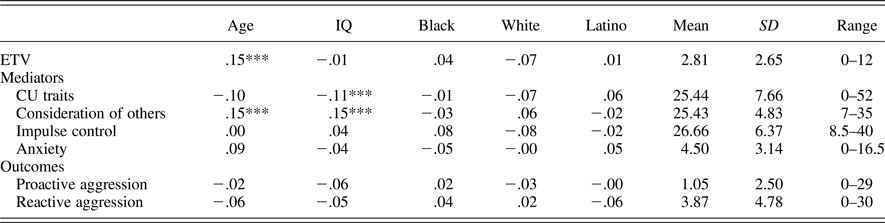
The correlations between key demographic variables (e.g., age, IQ, and ethnicity/race) and main study variables are provided in Table 1. Age was positively associated with exposure to violence, consideration of others, and anxiety, but negatively associated with CU traits. IQ was positively associated with consideration of others and negatively associated with CU traits and proactive aggression. Finally, Black participants reported higher levels of impulse control, whereas Latino participants reported lower levels of reactive aggression. White participants reported lower levels of exposure to violence, CU traits, and impulse control, but higher levels of consideration of others. Based on these correlations, age, IQ, and ethnicity/race were entered as covariates in the tests of mediation.
Correlations between demographic and main study variables

Note: ETV, exposure to violence assessed at baseline; CU, callous–unemotional. Consideration of others, impulse control, and anxiety were assessed as the average of 6 and 12 months; and proactive and reactive aggression were assessed at 18 months. Race/ethnicity variables were dummy coded as 1 for endorsing the race/ethnicity and 0 for all other individuals.
***p < .001.
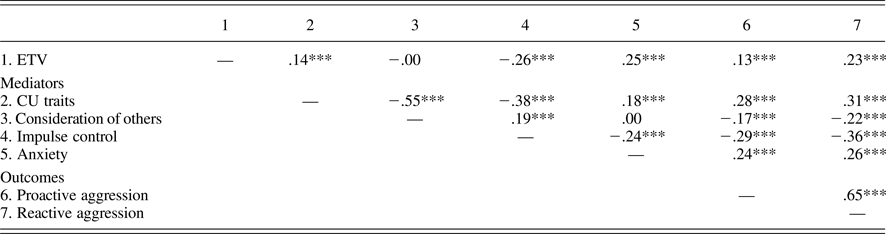
In Table 2, the zero-order correlations between study variables are provided. Consistent with predictions, exposure to violence at baseline was positively associated with both reactive and proactive aggression assessed at 18-month follow-up. Further, exposure to violence was correlated with three of the four proposed mediators, with the exception being a nonsignificant correlation with the consideration of others measure. Finally, all four potential mediators (assessed at 6 and 12 months) were associated with both aggression outcomes (assessed at 18 months) in expected directions.
Zero-order correlations among main study variables

Note: ETV, exposure to violence assessed at baseline; CU, callous–unemotional. Consideration of others, impulse control, and anxiety were assessed as the average of 6 and 12 months; and proactive and reactive aggression were assessed at 18 months. Race/ethnicity variables were dummy coded as 1 for endorsing the race/ethnicity and 0 for all other individuals.
***p < .001.
Mediation analyses
Proactive aggression
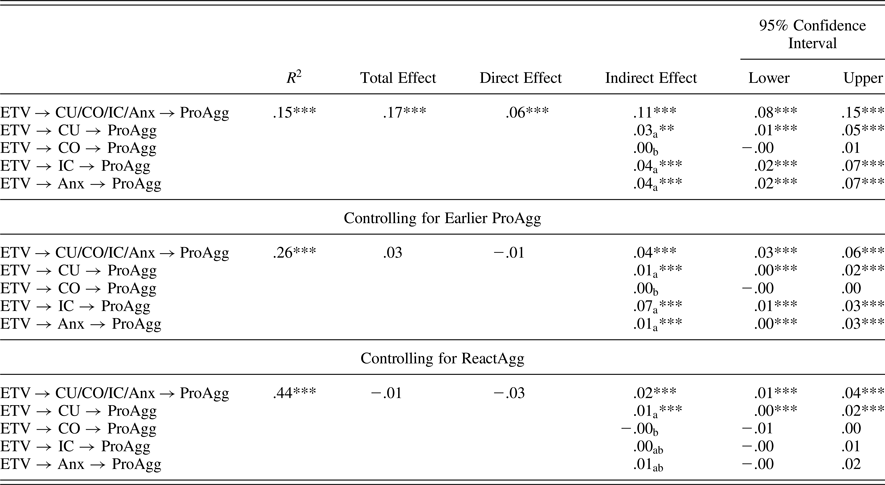
Table 3 presents the total, direct, and indirect effects, with their corresponding bootstrapped confidence intervals in the prediction of proactive aggression. As hypothesized, there was a positive total effect from exposure to violence to proactive aggression, R 2 = .15, F (8, 1125) = 23.93, p < .001. Further, there was evidence for indirect effects through the mediators, indirect effect = 0.11, bootstrapped 95% confidence interval = [0.08, 0.15]. Consistent with predictions, there was an indirect effect associated with CU traits but, contrary to predictions, there were also indirect effects associated with impulse control and anxiety. Further, the indirect contrast effects showed no significant differences in the size of the indirect effects across these variables. In addition, the analyses provide support for only partial mediation, given that the direct effect between exposure to violence and proactive aggression remained significant after accounting for the indirect effects through the mediators.Footnote 2
Bootstrapped regression analyses for mediation with proactive aggression as the outcome

Note: ETV, exposure to violence assessed at baseline; CU, callous–unemotional; CO, consideration of others; IC, impulse control; Anx, anxiety; ProAgg, proactive aggression; ReactAgg, reactive aggression. CO, IC, and Anx were assessed as the average of 6 and 12 months; ProAgg and ReactAgg were assessed at 18 months. Age, IQ, and dummy coded race variables (Latino comparison group) were entered as covariates. Indirect effects with different subscripts differed significantly at p < .05.
***p < .001.
The bootstrapped regression analyses were repeated, first controlling for baseline levels of proactive aggression and then controlling for concurrent levels of reactive regression (see Table 3). In both cases, the total effects between exposure to violence and proactive aggression were no longer significant. Thus, the association between exposure to violence and proactive aggression appears to be due to earlier proactive aggression and its overlap with reactive aggression.
Reactive aggression
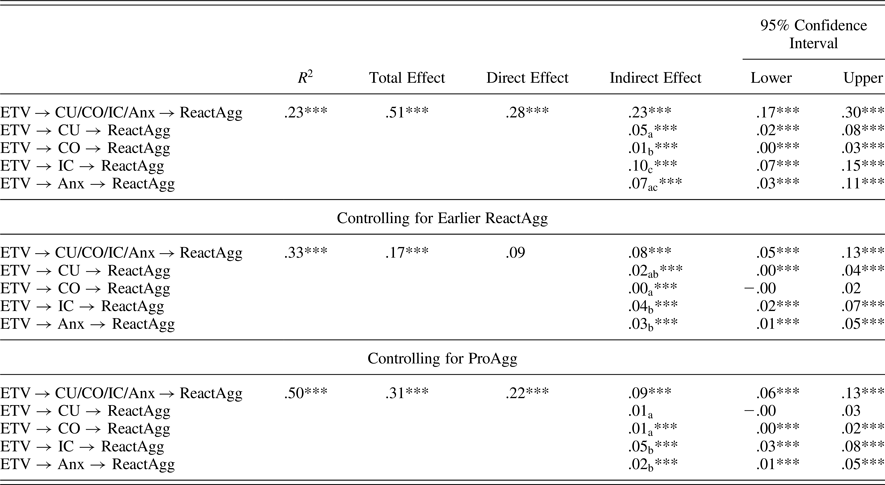
Similar analyses were conducted using reactive aggression as the outcome measure, and the results are provided in Table 4. There was a positive total effect from exposure to violence to reactive aggression, R 2 = .23, F (8, 1125) = 41.36, p < .001. Further, there was evidence for indirect effects through the mediators, effect = 0.23, bootstrapped 95% confidence interval = [0.17, 0.30]. Contrast effects suggested that all four mediators significantly contributed to this indirect effect, although the indirect effect through impulse control was significantly stronger than the indirect effects through CU traits and consideration of others. The indirect effect through anxiety was significantly greater than the effects through consideration of others, but they did not differ from the other two mediators. Finally, after accounting for the indirect effects of the mediators, the direct effect of exposure to violence on reactive aggression remained significant, indicating partial mediation.
Bootstrapped regression analyses for mediation with reactive aggression as the outcome

Note: ETV, exposure to violence assessed at baseline; CU, callous–unemotional; CO, consideration of others; IC, impulse control; Anx, anxiety; ProAgg, proactive aggression; ReactAgg, reactive aggression. CO, IC, and Anx were assessed as the average of 6 and 12 months; ProAgg and ReactAgg were assessed at 18 months. Age, IQ, and dummy coded race variables (Latino comparison group) were entered as covariates. Indirect effects with different subscripts differed significantly at p < .05.
***p < .001.
These analyses were repeated controlling for baseline reactive aggression and concurrent proactive aggression, and the total effects remained significant. Thus, the predictive association between exposure to violence and reactive aggression was not completely explained by earlier aggression or by the overlap with proactive functions of aggression. Further, when controlling for proactive aggression, the indirect effects through impulsive control were significantly stronger than the effects through CU traits and consideration of others (see Table 4).Footnote 3
Ancillary analyses of types of violence exposure
Based on past work, we did not have an a priori theoretical rationale for predicting differences in findings for being a victim of violence and witnessing violence in others. In addition, these two types of community violence exposure were highly correlated in this sample (r = .59, p < .001). However, to ensure that our use of a composite measure of violence exposure did not significantly influence our findings, analyses were conducted separately for the two types of violence exposure. These analyses resulted in the same pattern of significant findings, although the strength of the effects was somewhat stronger in analyses evaluating the direct experience of violence. Specifically, the total effects of direct violence exposure on proactive (0.31) and reactive (1.03) aggression were stronger than the total effects of witnessed violence on proactive (0.23) and reactive (0.68) aggression (all p < .05).
Discussion
Overall, our results support past research showing a link between exposure to violence and later aggressive behavior (Guerra et al., Reference Guerra, Huesmann and Spindler2003; Kimonis et al., Reference Kimonis, Ray, Branch and Cauffman2011; O'Donnell et al., Reference O'Donnell, Stueve, Myint-U, Duran, Argonick and Wilson-Simmons2006). Our results also suggest that this association may be more important for explaining subsequent reactive aggression than proactive aggression. Past research examining the relation between exposure to violence and aggression generally has not distinguished between the different functions of aggression nor has it controlled for the correlation between the two types of aggression (Hamner et al., Reference Hamner, Latzman and Chan2015). In the current sample, exposure to violence was associated with both later proactive and reactive aggression. However, the predictive association between violence exposure and proactive aggression was no longer significant when accounting for baseline aggression or controlling for the overlap with reactive aggression. In contrast, the predictive association between exposure to violence and reactive aggression remained significant after accounting for level of baseline aggression and controlling for the overlap with proactive aggression.
In our analyses, all four of the proposed mediators accounted for indirect effects between exposure to violence and reactive aggression. However, the indirect effects of impulse control were significantly stronger than indirect effects of CU traits and consideration of others, and this was particularly evident when controlling for the overlap with proactive aggression (see Table 4). This finding is consistent with past research documenting a relationship between impulsive behavior and reactive aggression (Marsee & Frick, Reference Marsee and Frick2007; Muñoz et al., Reference Munoz, Frick, Kimonis and Aucoin2008; Phillips & Lochman, Reference Phillips and Lochman2003). This type of aggression is sometimes called “impulsive aggression” because of its link to various aspects of poor impulse control (Gauthier, Furr, Mathias, Marsh-Richard, & Dougherty, Reference Gauthier, Furr, Mathias, Marsh-Richard and Dougherty2009). Further, research on youth exposed to violence has provided a number of explanations for how traumatic events can make it difficult for youth to learn to regulate their behavior, leading to frequent impulsive acts. For example, youth who experience dangerous environments can become chronically overaroused and hypervigilant to threats, which interferes with their ability to pay attention to other important aspects of the environment and to adequately consider the consequences of their behavior (Del Giudice et al., Reference Del Giudice, Ellis and Shirtcliff2011; Hastings, Zahn-Waxler, & McShane, Reference Hastings, Zahn-Waxler, McShane, Killen and Smetana2006; Pollak, Reference Pollak2008). This explanation would also support our findings that exposure to violence was related to reactive aggression through the indirect effects on anxiety as well.
Future research needs to explore the various mechanisms through which exposure to violence can negatively influence youths’ ability to regulate their emotions and behaviors. Such research could have important implications for interventions with populations who experience a significant level of exposure to violence, such as youth in the juvenile justice system (Wasserman & McReynolds, Reference Wasserman and McReynolds2011). Specifically, interventions to directly reduce youths’ exposure to violence while in the juvenile justice system (Levitt, Reference Levitt2010) or that directly target the effects of traumatic experiences (Ford et al., Reference Ford, Chapman, Connor and Cruise2012) could help to reduce risk for later aggression. Further, interventions that target the consequences of these traumatic experiences, such as teaching skills needed to regulate emotions and control impulses, could be critical for reducing the risk for aggression (Larson & Lochman, Reference Larson and Lochman2003).
The current study has a number of strengths that help to increase the confidence in the results, such as its use of a longitudinal design with very low attrition to test mediation and its use of a large and ethnically/racially diverse sample of individuals with varying degrees of exposure to violence. However, there are also several limitations to the study that need to be considered when interpreting the results. First, although the sample was large as well as ethnically/racially diverse, the sample only included justice-involved boys, which may not generalize to community samples and samples of girls. Considering that exposure to violence may have differential effects for boys and girls (Foster, Kuperminc, & Price, Reference Foster, Kuperminc and Price2004), it is important for research to examine these processes in girls. Further, the current sample only included first-time offenders who had committed offenses of moderate severity. As a result, the findings may not generalize to youth who show more severe and chronic offending patterns. Second, all measures were based solely on the adolescent's self-report, which could have inflated the correlations among measures because of shared method variance. Thus, the confidence in results would be increased by having the constructs, especially some of the mediators, assessed using different methods. For example, using laboratory measures of impulsivity and emotional responsivity, as well as other informant report of measures, would have enhanced the confidence that could be placed in the results. Further, the current study focused on only a few potential mediating mechanisms that could help to explain the link between exposure to community violence and aggression. There have been other possible mediators that have been proposed in past research, such as hostile attributional biases (Kimonis et al., Reference Kimonis, Ray, Branch and Cauffman2011) and greater acceptance of aggression and violence as being normative (Guerra et al., Reference Guerra, Huesmann and Spindler2003). Thus, future studies should test other potential mediators, especially given that our findings indicated that the mediators included in the current study did not fully account for the association between exposure to violence and either type of aggression. Third, as noted previously, childhood maltreatment can lead to similar changes in a child's pattern of emotional responses, and child maltreatment is associated with exposure to community violence (Margolin & Gordis, Reference Margolin and Gordis2004). Thus, future studies should attempt to disentangle whether the effects of community violence may have been better accounted for by other types of trauma, like child maltreatment.
Within the context of these limitations, the results of this study help to advance knowledge on the consequences of being exposed to community violence among youth. Specifically, the current study helps to clarify how such exposure can place an adolescent at risk for acting aggressively. Our findings suggest that exposure to violence can disrupt a youth's ability to regulate emotions and behavior, leading to reactive aggression in response to real or perceived provocation. Beyond advancing causal theories, the results could lead to improved treatments for children and adolescents who are exposed to high levels of community violence, such as youth in the juvenile justice system. These interventions could directly address the trauma related to exposure to violence, or target the problems in impulsivity and emotional regulation that result from such exposure, and thereby reduce the adolescent's risk for future aggression and violence. Further, given that impulsivity and emotional regulation can lead to a host of other problems in adjustment (e.g., anxiety, depression, suicidality, and substance use; Cicchetti & Lynch, Reference Cicchetti, Lynch, Cicchetti and Cohen1995), such interventions could potentially help to reduce a number of other mental health consequences of exposure to violence.