Introduction
It is well documented that laryngomalacia is the most common cause of stridor in newborns.Reference Thompson 1 , Reference Holinger 2 The majority of cases are mild and resolve spontaneously as the child gets older, with only community-based monitoring required. Moderate-to-severe cases are commonly managed initially by paediatric respiratory specialists and are referred for surgical intervention after maximal medical therapy. The conversion rate to surgery has been reported as 15–20 per cent for severe laryngomalacia patients.Reference Olney, Greinwald, Smith and Bauman 3 Patients who exhibit signs and symptoms of severe laryngomalacia, in particular respiratory distress, cyanosis, recurrent oxygen desaturations, failure to thrive and concurrent difficulty feeding, have been successfully managed surgically with supraglottoplasty (first proposed by Variot in 1898).Reference Ayari, Aubertin, Girschig, Van Den Abbeele, Denoyelle and Couloignier 4 , Reference Martin, Howarth, Khodaei, Karkanevatos and Clarke 5
There is national and international variation in post-operative practice. Some surgeons opt to routinely observe their patients in paediatric intensive care units (PICUs) in the immediate post-operative period, whilst others prefer to keep their patients intubated for a period of time.Reference Richter, Wooten, Rutter and Thompson 6 , Reference Richter and Thompson 7 In our clinical practice, patients have been admitted to PICU by default in the post-operative period, with a bed secured pre-operatively. Clinical observation has suggested that the majority of cases remain in PICU less than 24 hours after admission and some are even well enough to be discharged from hospital the day after the operation. This warrants investigation into the practice of routine PICU bed booking and admission after supraglottoplasty for laryngomalacia. In some cases, routine supraglottoplasty operations have been delayed because of the lack of an available PICU bed.
It would be useful to ascertain predictive factors that may highlight those patients more likely to require PICU level of care post-operatively. We have found limited evidence on predictive factors for PICU admission, and none of the studies have been based in the UK. This study aimed to answer three main questions: (1) what proportion of patients required PICU level of care?; (2) Were there identifiable pre-operative predictive factors common to these cases?; and (3) What were the patient outcomes at six weeks’ follow up?
Materials and methods
Departmental approval was granted and details of the study were submitted to the Trust. The case record search criteria isolated all patients diagnosed with laryngomalacia who underwent supraglottoplasty over a 10-year period (13 June 2005 to 23 September 2015), and who were assessed and treated by the ENT Department based at our regional tertiary referral centre for Newcastle upon Tyne Hospitals NHS Foundation Trust. Case identification was conducted through local coding practices, with broad term requests being manually cross-checked via individual electronic notes interrogation in order to avoid missing cases associated with minor coding differences.
Supraglottoplasty was performed by a number of consultant surgeons using either cold steel or laser techniques. We included all methods of supraglottoplasty and post-operative management in this analysis.
Exclusion criteria were as follows: pre-operative admission to the paediatric intensive care unit (PICU), a history of pre-existing or major airway reconstruction, and insufficient data recorded either pre-operatively or in the follow-up period.
Medical records were manually reviewed for demographic characteristics, birth centile, presenting signs and symptoms, medical history, medications, physical findings at endoscopic examination, intra-operative factors, and post-operative hospital course including any complications. Patients were followed up six weeks after the procedure, and data pertaining to weight gain and status of feeding and breathing were recorded.
Retrospective analysis of the total dataset was achieved by pre-defining the need for PICU level of care according to whether one or more of the following criteria were met: intubation, positive pressure ventilation or multiple doses of nebulised adrenaline required, and oxygen dependency over 12 hours post-operatively. Oxygen dependency was defined as the need for oxygen therapy in order to maintain oxygen saturation levels at or above 95 per cent.
We were able to hypothetically and retrospectively divide the total dataset into a PICU care criteria fulfilled group and non-PICU care criteria fulfilled group. Statistical analysis was conducted with the Fisher's exact two-tailed test to determine significant differences in the two groups based on recorded pre-operative characteristics.
Results
A total of 56 patients were initially identified who were coded as diagnosed with laryngomalacia and who underwent supraglottoplasty during the study period. Fourteen patients were excluded: five had incomplete records, five did not undergo supraglottoplasty and four had incorrect diagnoses. After exclusions, 42 patients were included in the final dataset.
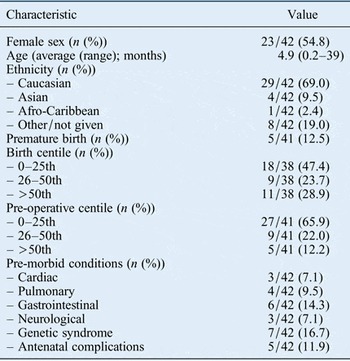
Patient demographics are displayed in Table I. The majority of patients were low weight centile children of white race, with an almost equal spread of male to females, and an average age of 4.9 months at the time of the operation.
Clinical characteristics of included patients

Pre-morbid conditions were fairly evenly spread with the most common conditions of genetic and gastrointestinal origin Figure 1 shows the spread of presenting symptoms from least to most frequent. The triad of stridor, failure to thrive and difficulty feeding were predictably the most common presenting symptoms.
Bar graph summarising presenting symptoms of included patients. O2 = oxygen; pre-op = pre-operative; NG = nasogastric

Regarding operative technique, laser was favoured over cold steel supraglottoplasty (79 per cent of all cases). Post-operative antibiotics were not routinely given (26 per cent of all patients received a short course of prophylactic antibiotics). Intra-operative and post-operative steroids were favoured (81 per cent of all patients received at least one dose of intravenous dexamethasone). The average length of stay on the paediatric intensive care unit (PICU) was 1.45 days, with an average ward stay of 2.8 days.
Whilst all patients went to PICU following supraglottoplasty, retrospective analysis showed that only 12 of the 42 patients (28.5 per cent) met our criteria for PICU level of care. Half of the patients had just one criterion, whilst the other half met two or more criteria. The majority of patients (9 out of 12) were oxygen dependent after 12 hours; only 5 patients were still intubated when transferred from the operating theatre. All intubated patients were cases of failed extubation attempted immediately after the operation or in the recovery area. None of the patients were intubated after subsequent admission to PICU. Seven out of 12 patients required nebulised adrenaline.
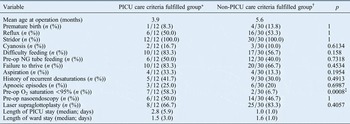
We subdivided the total dataset into two groups based on criteria for PICU level of care requirement: a PICU care criteria fulfilled group (n = 12) and a non-PICU care criteria fulfilled group (n = 30). The results are summarised in Table II. The PICU care criteria fulfilled group were on average younger at the time of the operation (3.9 vs 5.6 months). Two-tailed p values were calculated using the Fisher's exact statistical test to determine the probability of observed variance between the two groups. Laser supraglottoplasty was used in 66.7 per cent of PICU care criteria fulfilled cases compared to 83.3 per cent in the non-PICU care criteria fulfilled cases, but this difference was not significant. There was a highly significant pre-operative difference between the two groups in terms of the need for pre-operative oxygen therapy to maintain oxygen saturation levels (p = 0.0008), which was the only significant finding.
Comparison of pre-operative variables between PICU and non-PICU care criteria fulfilled cases

*n = 12; † n = 30. ‡Statistically significant finding. PICU = paediatric intensive care unit; pre-op = pre-operative; NG = nasogastric; O2 = oxygen
At six weeks’ follow up, 82.5 per cent of all cases had an increase in weight and 75.0 per cent were feeding better than before the procedure. Only a third of patients (13 out of 42) had any residual airway noise on breathing at 6 weeks; this was mild in 11 patients and moderate to noisy in 2 patients. There were no significant differences in the outcomes of the two groups at six weeks’ follow up, as measured by weight centile change and improvement in airway characteristics.
Discussion
Supraglottoplasty is the most common surgical intervention for patients with severe laryngomalacia. It is generally associated with a low rate of complications and good outcomes.Reference Ayari, Auberyin, Girschig, Van Den Abbeele and Mondain 8 A consensus review published in 2016, by Carter et al., provided comprehensive care pathway algorithms for patients diagnosed with laryngomalacia.Reference Carter, Rahbar, Brigger, Chan, Cheng and Daniel 9 However, there are still few recommendations regarding the immediate post-operative care, and whether these patients should have a bed pre-booked and be admitted to the paediatric intensive care unit (PICU) as routine. This is reflected in the variability in practice in different centres, both within and between countries.
Our data suggest that the duration of stay in PICU is generally very short and that the vast majority of cases do not need routine PICU level of care. We acknowledge that our case numbers are smaller than other studies published outside the UK (a reflection of the low incidence of severe laryngomalacia), but we believe there is a clear case for centres who routinely admit their post-supraglottoplasty patients to PICU to revisit and optimise the selection of patients. Having measurable pre-operative variables that reliably predict future care needs will ultimately help with appropriate patient selection.
Our study suggests that the need for pre-operative oxygen therapy in order to maintain saturation levels above 94 per cent is a good negative predicting discriminator of the requirement for PICU level of care, as defined by our PICU care criteria mentioned above. This factor is useful in identifying children that, on the balance of probabilities, will not need PICU level of care and therefore should not have a PICU bed pre-booked prior to surgery. Conversely, it can be used as a red flag marker: of those children with low pre-operative oxygen saturation levels, seven out of nine will require PICU level of care.
Whilst we have been actively conservative with our pre-defined PICU care criteria, they are comparable with a previous study by Albergotti et al.Reference Albergotti, Sturm, Stapleton, Simons, Mehta and Chi 10 It could be argued that oxygen dependency for greater than 12 hours and the use of adrenaline nebulisers post-operatively does not necessitate delivery in a PICU setting, and that these children could be nursed on a paediatric ward with appropriately trained staff. Re-analysis of the data with only the need for intubation and positive pressure ventilation as criteria warranting PICU level of care made no percentage difference compared to our original findings.
One of the key considerations of stepping down care from the PICU level would be the provision of paediatric wards with staff trained to care for these particular patients in the acute phase. The ability to detect respiratory deterioration and escalate care appropriately would be a key factor.
Our results showed that, regarding operative technique, laser was favoured over cold steel supraglottoplasty (79 per cent of all cases). It became apparent from the operating surgeons that surgeon preference played a role in this observation. Analysis of the operating technique and its effect on outcome is outside the scope of this study; however, there was a trend for the increased use of cold steel by some surgeons, thought to be associated with concerns over laser-induced post-operative oedema.
Whilst the natural history of laryngomalacia remains to be further studied and characterised, it is thought that spontaneous resolution can take as long as 42 months in some cases.Reference Mancuso, Choi, Zalzal and Grundfast 11 It is unknown how the long-term developmental and growth outcomes are affected by non-surgical or delayed laryngomalacia treatment. Our data, particularly at six weeks’ follow up, support previous studies that have described the overall benefit and faster health improvements of those patients who have undergone supraglottoplasty.Reference Isaac, Zhang, Soon, Campbell and El-Hakim 12 Post-operative routine admission to PICU, whilst standard practice in some institutions, may not be necessary, and could postpone an operation that significantly benefits the quality of life of affected children and their families.
Using low pre-operative oxygen saturation levels as the single isolated discriminating variable in the non-PICU care criteria fulfilled group would have freed up 28 of 30 PICU beds (2 patients had pre-operative oxygen saturation levels of less than 95 per cent). Hypothetically, this would save 27 days in PICU. Full cost–benefit analysis was not an aim of this study; however, it is estimated that the standard daily charge for PICU admission is approximately £1401 per day, in contrast to the charge of a paediatric surgical ward bed of £336 per day. There are clearly cost benefits to be had, as well as the benefit associated with freeing up a bed for acute emergency admissions.
This single-centre, retrospective, observational study, whilst producing useful informative data, would benefit from multi-centre and regional data input to allow for more comprehensive statistical analysis. The binary nature of both the independent and dependent variables restricted the use of multiple regression analysis. Nevertheless, logistical regression was attempted, and this confirmed pre-operative oxygen saturation levels as a significant predictive pre-operative variable.
Surgical technique-related factors, such as surgical duration, arterial oxygen desaturation levels during the procedure and use of an operating microscope, were not recorded in this study as much of this information was not routinely recorded, which is in keeping with restrictions relating to retrospective case analysis.
-
• Surgical treatment of laryngomalacia through supraglottoplasty is reserved for severe cases
-
• Current literature on post-operative care of these patients is limited, and practice between departments is variable
-
• This study retrospectively analysed laryngomalacia patients treated with supraglottoplasty over 10 years
-
• It aimed to identify pre-operative variables predictive of the need for post-operative paediatric intensive care unit (PICU) level of care
-
• Pre-operative oxygen saturation below 95 per cent was a significant predictor of PICU level of care requirement
-
• This study can help optimise patient selection for planned routine PICU admission
This study adds to the limited body of evidence surrounding post-operative care pathways for laryngomalacia patients treated with supraglottoplasty. Whilst our case numbers are small, ours is the first study published in the UK that suggests the importance of pre-operative oxygen saturation levels as a predictor for the requirement of PICU level of care. It provides a good framework for further dialogue with intensive care and respiratory paediatricians in units that routinely admit their post-supraglottoplasty patients to PICU, in an effort to optimise PICU bed allocation. Prospective multi-centre studies would be helpful to confirm these findings.
Acknowledgements
The study authors would like to thank Professor Janet Wilson and Dr Michael Drinnan for their valued input in data analysis, and Jayne Richards for her invaluable help with notes acquisition.