In 1950, C. H. Roberts published the original edition of one of our earliest fragments of 2 John, P. Antinoopolis 12 (Gregory-Aland 0232)—henceforth P.Ant. 12.Footnote 1 This parchment leaf, discovered at Antinoopolis by J. de M. Johnson in the winter of 1913–14, measures just 8.8 × 7.3 cm and contains 30 well-preserved lines covering 2 John 1–9 (see Figures 1 and 2 below).Footnote 2 Not only did Roberts offer quite an early date for P.Ant. 12—‘not much later than the middle of the [third] century’Footnote 3 —but he also suggested that the portion of the codex prior to 2 John originally contained a number of other Johannine writings, namely the Gospel of John, Revelation, and 1 John.Footnote 4 This latter suggestion is (largely) based upon the fact that P.Ant. 12 contains page numbers 164 and 165 in the top margin of the recto and verso. If Roberts's analysis is correct, then P.Ant. 12 is not only our earliest copy of 2 John,Footnote 5 but also constitutes our earliest known corpus of Johannine writings.Footnote 6
P.Ant. 12 Recto. Figure reproduced (in print only) courtesy of Imaging Papyri Project, Oxford and Egypt Exploration Society. All rights reserved
P.Ant. 12 Verso. Figure reproduced (in print only) courtesy of Imaging Papyri Project, Oxford and Egypt Exploration Society. All rights reserved
The problem, however, is that both of Roberts's claims—regarding both the date and content of P.Ant. 12—run into serious obstacles upon closer examination. While a third-century date has been affirmed by J. van Haelst,Footnote 7 it has been challenged by K. Aland as well as G. Cavallo and H. Maehler who seem to go in the opposite direction to Roberts, placing the manuscript in the fifth or sixth century.Footnote 8 Obviously, such a disparity in dates (nearly three centuries!) warrants a closer examination of this manuscript. As for the suggestion that P.Ant. 12 formed an early Johannine corpus, it will be argued below that such an idea runs into insurmountable spacing problems. Remarkably, these problems have gone largely unnoticed until recent times. All of these issues, combined with the general neglect of P.Ant. 12 over the last half-century, suggest that a reassessment of the date and content of this manuscript is long overdue. The purpose of this article is to offer some preliminary steps in that direction.
1. The Date of P.Ant. 12
In order to establish a more definitive date for P.Ant. 12, we shall consider three factors: (1) size; (2) scribal hand; and (3) other scribal features (nomina sacra, punctuation, etc.).
1.1. The Size of the Codex
In most discussion of P.Ant. 12, the small size of the codex (8.8 × 9.9 cmFootnote 9) has played too little a role in establishing its probable date.Footnote 10 Although the average height of early Christian codices often exceeded 20 cmFootnote 11 —as can be seen in some of our most significant NT manuscripts, P45Footnote 12 (20.4 × 25.4 cmFootnote 13), P52Footnote 14 (18 × 21.3 cm), and P75 (13 × 26 cm)—small codices were not rare in early Christian communities.Footnote 15 Such ‘miniature’ codices (defined by Turner as less than 10 cm wide) were most likely designed for private use and could contain a surprising number of pages.Footnote 16 They were often quite elegant and provided convenient and portable access to various forms of Christian literature.Footnote 17 Biblical books were not uncommon in this tiny format; e.g. Pap. G. 39212Footnote 18 (0217) John; Pap. G. 3072Footnote 19 (0223) 2 Corinthians; PSI 251Footnote 20 (0176) Galatians; P.Oxy. 1080Footnote 21 (0169) Revelation; PSI 5Footnote 22 (0173) James. But, extra-biblical literature was also common; e.g. the Shepherd of Hermas,Footnote 23Acts of Peter,Footnote 24Acts of Paul and Thecla,Footnote 25 an apocryphal gospel,Footnote 26Protevangelium of James,Footnote 27Didache,Footnote 28 the Apocalypse of Peter,Footnote 29 the Life of Mani,Footnote 30Bel and the Dragon,Footnote 31 the Gospel of Mary,Footnote 32 VI Ezra,Footnote 33 and Tobit.Footnote 34
Most noteworthy for our purposes here is that the miniature codex did not become a regular part of Christian literary culture until the fourth century or later. Although the advent of miniature parchment codices in secular literature can be traced back to the time of Martial where classical authors (e.g. Homer, Virgil, Cicero) were available in pugillaribus membranis for the private use of the literate upper class,Footnote 35 this innovation did not appear to meet with much success and in the later years of Martial's publishing there are no more references to it. However, in the fourth century and later the Christian use of the miniature codex became quite widespread—so much so that Roberts originally hypothesized that ‘the miniature codex would seem to be a Christian invention’.Footnote 36 When we look at miniature codices of only NT texts and other Christian literature provided by the recent catalog of Thomas Kraus, the statistics are quite compelling.Footnote 37 Of 29 such codices, only two are dated to the third century, P.Ryl. 463 and P.Ant. 54, but the latter is not really a codex at all, but an amulet.Footnote 38 There are two other codices that date to the third/fourth century, but one of these is also an amulet (P.Oxy. 2684).Footnote 39 All the rest of these codices, 25 of 29, are definitively fourth century or later (with many in the fifth and sixth century).Footnote 40 It is also interesting to note that 23 of these 29 codices are on parchmentFootnote 41 —a material that did not become common in Christian manuscripts until the fourth century and later.Footnote 42 Perhaps it is not surprising, then, that the other miniature parchment codex discovered at Antinoopolis, the Acts of Paul and Thecla (P.Ant. 13), was dated to the fourth century.Footnote 43
Given that P.Ant. 12 is a miniature codex (8.8 × 9.9 cm) constructed from parchment, Roberts's mid-third-century date would be decidedly out of sync with the trends observed here. While such an early date is surely not impossible, it appears to be quite unlikely—unless there are other factors that compel us to accept it. We now consider what some of those factors might be.
1.2. Scribal Hand
The script of P.Ant. 12 is rounded and upright, with a smooth and flowing style that Roberts describes as a hand of ‘elegance’.Footnote 44 The ϵ, ο, σ, and ω are quite large and circular, creating a broad similarity to the classical ‘biblical majuscule’ of Sinaiticus and Vaticanus that is difficult to miss.Footnote 45 However, unlike the biblical majuscule, the hand of P.Ant. 12 has a more curved execution, often creating loops in the α, υ, μ, and even the ι. Not only are the ρ and the ι often extended well below the line (esp. verso ll. 5 and 8), but left-to-right oblique strokes are often prolonged and end in a flourish (esp. end of ll. 1, 3, 4, 7, 9, 10 of the recto). This flowing nature of the script is most aptly seen in the curved horizontal stroke over the nomina sacra that often ends in a ‘roundel’ or ink blob (ll. 9, 10, and 15 of the recto). Cavallo observes that this mix of large, rounded letters, along with a curved, flowing execution, are the classic marks of ‘Alexandrian majuscule’Footnote 46 which was rare prior to the fourth century and at its peak in the fifth.Footnote 47
The large, rounded ο and ω of P.Ant. 12 stand in contrast to the much smaller ο and ω (often raised above the line) that were typical in the third and early fourth centuries.Footnote 48 The small ο is evident in a number of third-century texts (e.g. P.Oxy. 847, P45, P75, P.Oxy. 1016, P.Oxy. 223, P.Oxy. 2341, and P.Oxy. 1015), and the small ω is evident in a number of third- and early fourth-century texts (e.g. P.Oxy. 1016, P.Oxy. 840, P.Oxy 847, P.Oxy. 856, P.Herm.Rees. 5, P.Oxy. 1015, P.Oxy. 2656, P.Oxy. 2458, B.M. Pap. 126, P.Herm. Rees. 5, P.Lond. inv. 2852, P. Chester Beatty XI, P.Oxy. 1352).Footnote 49 In addition, the large, rounded nature of the ϵ, θ, and σ in P.Ant. 12 stands in contrast to the later versions of Alexandrian majuscule, typically sixth century and beyond,Footnote 50 which are marked by a very clear narrowing of these same letters.Footnote 51 Note particularly P.Grenf. II.112, P.Oxy. 1820, and P.Oxy 2258 (all sixth-century versions of Alexandrian majuscule) which have quite narrow versions of ϵ, θ, and σ (and even ο).Footnote 52 This combination of factors suggests that the extreme ends of the dating range for P.Ant.12 (third century and sixth century) are the less likely options, making a fifth-century date, or perhaps late fourth century, the strongest possibility.
In Roberts's original dating of P.Ant. 12, he leaned on comparisons with the Chester Beatty Daniel and Esther which are dated to the third century.Footnote 53 However, while there are certainly similarities between these scribal hands, there are also notable differences. Take, for instance, folio 80 (recto) of the Chester Beatty Daniel. What immediately stands out is the much smaller ο and σ (e.g. ll. 2, 3, and 6), and the smaller ω often raised above the line (e.g. ll. 7, 9, and 11)—both features that are common in the third century but lacking in P.Ant. 12.Footnote 54 Moreover, it lacks the flowing style of P.Ant. 12, including the loops in the υ and the long extension of ι and ρ below the line.Footnote 55 In terms of comparisons, the Chester Beatty Daniel fits better with P.Bodmer II (P66), the Gospel of John dated c. 200Footnote 56—a text which Cavallo, not surprisingly, considers an early precursor to Alexandrian majuscule.Footnote 57
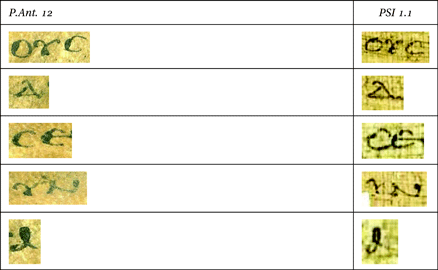
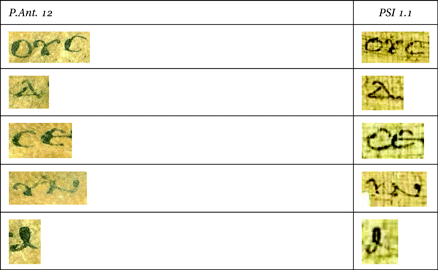
A likely fifth-century date for P.Ant. 12 is confirmed when it is compared to PSI 1.1 (P35), a fifth/sixth-century fragment of Matthew which Cavallo and Maehler consider to be an even more ‘fully-fledged “Alexandrian Majuscule”’.Footnote 58 There we see again the flowing script, often with loops and extensions, combined with the full-size, rounded ο, σ, ω, and ϵ. The ϵ frequently has the upper curve almost touching the oft-extended middle horizontal stroke. The formation of the ν in both manuscripts is also strikingly similar; the letter is quite broad and the oblique stroke is not only extended, but nearly horizontal. In addition, the υ is almost identical with its looped stem and curved arms, and both begin the left-to-right diagonal stroke of the δ with a slight hook or downward curve. The α in both documents is formed in a single motion, resulting in an upper loop and a lower loop—the latter often left incomplete or half-closed.Footnote 59 See Table 1 for examples of the similarities.
Images of P.Ant. 12 courtesy of Imaging Papyri Project, Oxford and Egypt Exploration Society. All rights reserved. Images of PSI 1.1 used by permission of Biblioteca Medicea Laurenziana, Florence
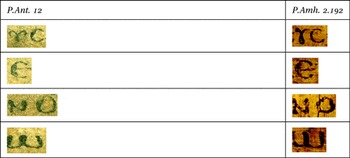
In addition to P35, there are other comparanda that provide support for a fifth-century date for P.Ant. 12. For instance, P.Heid.inv. G 5148, a fifth-century papyrus codex of Genesis, is described by Rodney Ast as having a script that bears ‘some resemblance to the developed stage of the “Alexandrian majuscule”’.Footnote 60 In this manuscript we see (again) the fully rounded versions of ο, σ, and ϵ, as well as broad versions of μ and ν. Moreover, the δ exhibits the same ‘hook’ at the start of the left-to-right diagonal stroke. PSI 2.138, a fourth/fifth-century papyrus codex of Homer, shares many of these same characteristics and also forms the α in a similar fashion as the hand of P.Ant. 12, creating an upper loop but often leaving the lower loop incomplete.Footnote 61 P.Amh. 2.192, a sixth-century papyrus codex of Deuteronomy, also bears a great deal of similarity to P.Ant. 12 but is likely a later, more developed version of Alexandrian Majuscule.Footnote 62 It, too, has the looped υ, and rounded ο, ω, ϵ, and σ. However, it lacks the flourishes and extensions so common in P.Ant. 12, such as the roundels at the end of the υ, the lengthened horizontal line of the ϵ, and letters that extend below the line. Its more squared, formal style suggests a time period slightly later than P.Ant. 12.Footnote 63 See Table 2 for comparisons.
Images of P.Amh. 2.192 used by permission of The Pierpont Morgan Library, New York

1.3. Other Scribal Features
In addition to size and scribal hand, there are other inscriptional features that can help date P.Ant. 12. Particularly noteworthy is the enlarged ϵ, preceded by a small space, which marks the beginning of a new section in line 11 (recto). The κ at the very beginning of line 1 is also enlarged despite the fact that it is the middle of the sentence. Such enlarged letters were relatively infrequent in Roman or Ptolemaic literary papyri,Footnote 64 but were not unusual in documentary papyri.Footnote 65 Although enlarged initial letters are found in some of our earliest Christian texts—P. Egerton 2 (II century), Chester Beatty Numbers/Deuteronomy (III century), Chester Beatty Ezekiel (III century)—the practice did not become abundant or pronounced until the fourth century or later.Footnote 66 More vivid examples of this practice include: Chester Beatty Melito (IV century), P.Berlin inv. 6747 (IV century), P.Oxy. 840 (IV century), P.Oxy 1351 (IV century), P.Oxy 2068 (IV century), Codex Alexandrinus (V century), Codex Bezae (V century), and P.Oxy. 1169 (VI century). Of course, this factor does not rule out a third century date for P.Ant. 12, but it does, once again, make that date much less likely.
Another consideration that led Roberts to an early date was the use of the nomina sacra in P.Ant. 12.Footnote 67 In particular, he appealed to the ‘unorthodox’Footnote 68 form of παρς for the genitive πατρος. However, is an odd form of the nomina sacra able to provide a reliable guide to dating? Although πατηρ is contracted as early as the second century (Chester Beatty Genesis), it was not consistently contracted throughout the first five centuries of early Christian manuscripts. Indeed, of the 133 manuscripts in which the word occurs during this time frame, 80 of them have it only written out in full.Footnote 69 Moreover, there are other odd contractions of πατηρ in later manuscripts; e.g. the fifth-century Freer codex (W) uses the unusual προς for the genitive and the fifth-century PSI 7.759 uses the very rare πρα followed by an apostrophe. In the end, it seems this particular instance of the nomina sacra is too idiosyncratic to provide much assistance to our quest for a solid date.Footnote 70
In sum, all of these considerations—size, material, scribal hand, enlarged letter—suggest that the most probably date for P.Ant. 12 is not third century, as Roberts suggested, but the late fourth or early fifth century.
2. The Content of P.Ant. 12
One of the most intriguing features of P.Ant. 12 is the page numbers in the top margins of the recto and verso, 164 and 165. These page numbers not only demonstrate that this small codex must have originally held a number of other writings, but they also allow us to make an educated guess about what other writings might have fitted within this space. As is now well known, Roberts originally suggested that ‘the codex held a corpus of Johannine writings, with the Gospel, Revelation, and 1 John all preceding II John’.Footnote 71 Since Roberts's original pronouncement, a number of scholars have (understandably) appealed to P.Ant. 12 as one of our earliest pieces of evidence for a Johannine corpus.Footnote 72 The problem, however, is that this hypothesis was built upon Roberts's own mistaken observation that P.Ant. 12 contained ‘400 words to the page’Footnote 73 when in fact it only contains around 400 letters to the page.Footnote 74 The latter would not even provide enough space for the Gospel of John, not to mention Revelation and 1 John.Footnote 75 In light of this reality, it is appropriate that we now consider alternative possibilities about what might have been originally included in P.Ant. 12.
To begin, we must first provide some fresh calculations about the amount of space available prior to our leaf of 2 John. Even though the bottom of the folio is missing, we can calculate the number of letters on the recto with a fair degree of accuracy because we know which words are at the beginning of the following page. The total comes to 405. Unfortunately, we cannot be as certain about the number of letters on the verso because we do not have the page that follows it. Even though the amount of letters per page can change throughout a codex due to a variety of factors,Footnote 76 we have little choice but to use 405 as our working ‘average’. Using this amount, we can calculate that the number of letters preceding 2 John is approximately 66,000 (405 × 163). This space would definitively rule out larger books like Acts (98,075) and the Gospel of John (73,932).
In terms of what might have filled this space, we can only offer conjectures. After all, it is always possible that P.Ant. 12 was part of a ‘composite’Footnote 77 codex like P72 with a combination of (seemingly) unrelated works—Nativity of Mary, 3 Corinthians, Jude, Melito's Homily on the Passover, 1 and 2 Peter, etc.—which were drawn from a variety of different codices and patched together, even retaining the old page numbers in the top margin.Footnote 78 However, while such possibilities always exist, it is reasonable for any hypothesis about P.Ant. 12 to be based on what Christians in the fourth/fifth century might have normally or regularly placed alongside 2 John. Even a quick look at the development of canonical collection units during this time period shows that 2 John found a secure home not only with the other Johannine letters but also with the broader corpus of the ‘Catholic Epistles’.Footnote 79 While David Trobish would argue that the Catholic Epistles were a unit by the middle of the second century,Footnote 80 David Nienhuis has argued that Origen and Eusebius show that this was not a stable unit until the late third and early fourth century.Footnote 81 Regardless of whether one sides with Trobisch or Nienhuis, by the time P.Ant. 12 was produced, it is reasonable to think that 2 John would have been regularly circulating within this relatively well-established corpus.Footnote 82
If so, then there is the question of which of the Catholic Epistles came before 2 John and which came after. A number of the Eastern church fathers (Eusebius, Cyril of Jerusalem, Athanasius, Epiphanius), as well as the major fourth/fifth-century uncials (א, A, B), placed the epistles in the order of James–Peter–John–Jude.Footnote 83 Other canonical lists (particularly from the West) reveal that the order of the Catholic Epistles was not so uniform; e.g. Augustine (Peter–John–Jude–James), Rufinus (Peter–James–Jude–John), Council of Carthage (Peter–John–James–Jude), Codex Claromontanus (Peter–James–John–Jude), and Innocent I (John–Peter–Jude–James). Depending on which option one takes, there are a number of different possibilities for how much space the Catholic Epistles might occupy prior to 2 John. But, even if we followed Rufinus's order and assumed that all the Catholic Epistles preceded 2 John (except, of course, 3 John), this would still not fill up the available space. The letter amounts are as follows:Footnote 84 1 Peter (9,321), 2 Peter (6,222), James (9,102), Jude (2,641), and 1 John (9,793), for a total of 37,079 letters.Footnote 85 This would still leave room for 28,917 letters.Footnote 86 What could possibly fit into that remaining space?
One could certainly hypothesize about various Pauline epistles that would make up this difference (the whole corpus could not fit), or perhaps even the Gospel of Mark (if the order of the Catholic Epistles were rearranged). While such possibilities surely could not be ruled out definitively, there is little reason to think a codex like this would include such a random sampling of NT books. A stronger possibility is the book of Revelation. Given that it typically stands next to the Catholic Epistles in most canonical lists (as well as extant codices), it seems more likely that we might find all these books together in the same manuscript. While Revelation normally is found at the end of a codex, perhaps we could hypothesize that it was moved earlier in the codex to stand alongside the Johannine letters—as was possibly done in Codex Bezae.Footnote 87 The problem with this scenario, however, is that Revelation and 1 John would only fill up about 57,000 of the 66,000 letters preceding 2 John, still leaving a gap of about 9,000 letters. In order to fill that gap, we would have to imagine that another one of the Catholic Epistles (maybe James?) came first in this codex, followed by Revelation, the Johannine letters, and then the remainder of the Catholic Epistles. Such a bizarre arrangement—with Revelation in the middle of the Catholic corpus—seems difficult to imagine.Footnote 88
Thus, as far as canonical books are concerned, we turn to the final option for filling this extra space: the book of Hebrews. Although some of our earliest codices place Hebrews within the corpus of Paul's letters (P46, א, A, B), other patristic testimony from this time period indicates that its location within the NT canon was not so stable.Footnote 89 In the Western church, where Pauline authorship was doubted most often, the ‘traditional sequence’Footnote 90 of Hebrews was after Philemon at the end of the Pauline corpus (and often immediately prior to the Catholic Epistles). This was the position for Hebrews offered by Augustine,Footnote 91 the synods of Hippo and Carthage, Amphilochius of Iconium, Jerome's Latin Vulgate, as well as the fifth-century uncial 048Footnote 92 and the sixth-century codex Claromontanus (D).Footnote 93 Given this historical context, it is not difficult to imagine that doubts about the Pauline authorship of Hebrews might have led some to place the book within a codex of the Catholic Epistles. If that were done, it would be natural to put Hebrews in the first position in the codex. What is particularly attractive about this suggestion is that it solves the complex spacing problems. The book of Hebrews contains 27,134 letters, making it a remarkably good fit into the remaining space of 28,917 letters (again, assuming all the Catholic Epistles preceded 2 John). On this hypothesis, the space preceding 2 John would have begun with the book of Hebrews and ended with 1 John. The space between Hebrews and 1 John would have been filled with 1–2 Peter, James, and Jude, though their exact order is unclear. And, of course, 3 John would naturally come after 2 John. While this solution nicely solves the spacing problems, its weakness is that it assumes the Catholic Epistles end with the Johannine letters—a relatively uncommon order (although, as noted above, Rufinus testifies to this orderFootnote 94).
In the end, it appears that none of the various combinations we have examined here is entirely satisfying. There does not seem to be a book (or set of books) that is a ‘natural’ fit into this space. Such challenges remind us that hypothetical reconstructions of codices are always an uncertain affair. Moreover, the fact that no combination of canonical books provides a neat solution raises the possibility (again) that P.Ant. 12 may very well have been a ‘composite’ codex filled with a mix of apocryphal and canonical materials. Nevertheless, when one takes all the issues into consideration, including the broader historical context of what books might naturally have circulated together, the suggestion that P.Ant. 12 was originally a codex of Hebrews and the Catholic Epistles still seems to be the most plausible option available to us.
As for what books might have come after the Johannine letters, that is even more difficult to determine than what might have come before. If P.Ant. 12 was a single-quire codex then it would be nearly 170 pages—approaching the upper limit of what it could comfortably hold (especially given its small size).Footnote 95 However, as Turner notes, ‘No example of a single-quire codex of parchment has yet been identified’.Footnote 96 Thus, it is reasonable to assume that P.Ant. 12 was likely a multi-quire codex, particularly given its fourth/fifth-century date. We have other examples of miniature parchment codices that are multi-quire, such as the fifth-century Mani Codex that had a total of 192 pages.Footnote 97 Even so, it seems unlikely that P.Ant. 12 could have reasonably held much more than Hebrews and the Catholic Epistles. The most natural candidate to end a codex like this would be the book of Revelation, but this would add approximately 116 pages, for a total of about 286 pages. That would create a codex around 5–6 cm thick—an unlikely scenario for a codex that is only 8.8 cm wide.Footnote 98
3. Conclusion
The purpose of this article has been to offer a reappraisal of both the date and content of P.Ant. 12. While Roberts originally suggested a date in the middle of the third century, and Aland a date as late as the sixth century, we have seen that a number of factors indicate that a fifth-century (or perhaps late fourth-century) date is more appropriate. Given that P.Ant. 12 is a miniature parchment codex, a date in the middle of the third century would be surprisingly early. Moreover, we have argued that the scribal hand—with its fluid style and large, rounded ο and ϵ—best fits with the ‘Alexandrian majuscule’ that reached its peak in the fifth century. The sixth century is unlikely because by that time Alexandrian majuscule often had versions of ο, ϵ, and θ that were decidedly more narrow. Such a conclusion finds further confirmation in the substantially enlarged letters at the beginning of new sections and new lines.
In regard to the content of P.Ant. 12, we can only be certain of what did not precede 2 John. Despite the oft-repeated claims that this codex was our earliest Johannine corpus, there is inadequate space to include the Gospel of John, Revelation, and 1 John. While hypothetical reconstructions are always limited by the available data, we have argued that the most reasonable combination of books (though not without its weaknesses) is Hebrews followed by the Catholic Epistles. If so, then P.Ant. 12 might be evidence that, in some circles, the book of Hebrews was more closely associated with the Catholic letter collection than the Pauline one. As such, this codex might be an additional data point in the already complex discussions about the place of the book of Hebrews in the canon of the NT.