




No CrossRef data available.
Article contents
The expression and understanding of jealousy in children with autism
Published online by Cambridge University Press: 13 April 2004
Abstract
We investigated the expression and understanding of jealousy in 16 high-functioning children with autism and 17 typically developing children matched for IQ, chronological age, gender, and maternal education. We examined the expression of jealousy via children's behaviors, verbalizations, and affects demonstrated during two jealousy-provoking triadic scenarios (drawing and playing) enacted among the child in the experimental group (autism or typical), that child's main caregiver (mostly mothers), and a familiar peer or sibling. The two scenarios corresponded with the two types of jealousy described in past studies: social-comparison jealousy (drawing scenario) and social-relational jealousy (playing scenario). To tap children's understanding, we asked them to identify jealousy from a picture, to provide examples of times they felt jealous, and to offer suggestions for coping with jealousy. The main results revealed that children with autism expressed jealousy in situations similar to their typical age mates but manifested it in different behaviors. Moreover, children with autism revealed a less coherent understanding of the feeling. We discuss the meaning of the gap between demonstrating and understanding jealousy in light of the two central theoretical views conceptualizing the core emotional deficit in children with autism.The Internal Grants Program of Bar-Ilan University supported this research. The author extends special thanks to the children and families who were willing to take part in this study and expresses her appreciation to Dee B. Ankonina for her editorial contribution and to Dov Har-Even for his statistical assistance. The author would also like to thank Galit Halevy–Tendler for her inspiring remarks, Cory Shulman for her help in data collection, and the four anonymous reviewers for their thought-provoking comments.
Information
- Type
- Research Article
- Information
- Copyright
- © 2004 Cambridge University Press
Jealousy is a complex, unpleasant feeling that is highly dependent on social context and the ability to make spontaneous comparisons (Izard, 1991; Miller, Volling, & McElwain, 2000). By definition, an individual experiences jealousy when a potential threat exists that a valued relationship will be lost to a rival (Izard, 1991; Parrott, 1991; Salovey & Rothman, 1991). Thus, jealousy primarily appears in triadic contexts involving the jealous individual, the rival, and the valued relationship with a significant other (Hansen, 1991; Parrott, 1991).
Although researchers have often examined jealousy (mainly romantic jealousy) in adults, much less work has focused on childhood jealousy. One issue that complicates the study of jealousy (like other complex emotions such as embarrassment or pride) concerns the vagueness of the facial indices related to jealousy, which precludes identification of jealousy based solely on facial expression. Researchers tend to agree that the affective expression of jealousy comprises a composite of several emotions (e.g., fear, frustration, sadness, anger); however, agreement is lacking about the specific emotional components that constitute jealousy (Arnold, 1960; Hupka, 1984; Izard, 1991; Parrott, 1991). Because of this unreliability of facial indices associated with jealousy, researchers believe its manifestation is organized in a script-based pattern rather than as a simple blend of basic level emotions. Therefore, studies have focused on the identification of situations that provoke jealousy in children and on the detection of behaviors and action components that indicate jealousy in these situations (Masciuch & Kienapple, 1993).
When considering situations that provoke jealousy, another issue to be taken into account constitutes the obscurity of the distinction between jealousy and envy (Parrott, 1991). Jealousy always involves a triadic situation in which the child's own loss equals the rival's gain, and it involves complex projections about the self in regard to others. In contrast, envy may involve only two-person situations, and this feeling comprises the wish to have another person's possession or success and/or the wish that the other person did not possess this desired characteristic or object (Parrott, 1991). According to these definitions, the major differentiation between the two feelings consists of jealousy's necessary loss of a relationship within a triadic situation, whereas envy does not require this loss. Furthermore, Parrott and Smith (1993) have suggested that in envy one's own appraisal leads to dissatisfaction with oneself whereas in jealousy the reflected appraisal or attention of another leads to a lack of security and confidence. However, complicating the differentiation is that in jealousy the perceived threat may not necessarily involve the loss of love, and the child may experience jealousy related to the significant other's appreciation of the rival's higher success (Parrott, 1991). Moreover, both jealousy and envy are concerned with losses of self-esteem stemming from social comparison, demonstrate similar behavioral manifestations, and may co-occur in the same situations (Bers & Rodin, 1984; Parrott, 1991; Salovey & Rodin, 1984; Silver & Sabini, 1978).
In an attempt to better differentiate jealousy from envy in children, investigators devised two different situations within a social triad to distinctly elicit jealousy. One focuses on the child's loss of love and/or attention, which is social-relations jealousy. The other focuses on the child's loss of admiration because of another child's higher success, which is social-comparison jealousy. Situations of social-relations jealousy challenge one's exclusivity in a relationship, whereas situations of social-comparison jealousy challenge the child's superiority or equality (Bers & Rodin, 1984; Masciuch & Kienapple, 1993; Miller et al., 2000).
Distinct behaviors and actions have been identified as indices of jealousy among children of different ages. In infancy through preschool, children in both types of jealousy-provoking situations (social comparison and social relations) evidence behaviors such as gazing directly at their main caregiver (mothers and/or fathers) and/or the other child, discontinuing work and focusing attention on the triad, frowning, making attempts to interfere with or enter into the rival interaction using attention-provoking behaviors, taking the other child's objects, hugging or climbing on the main caregiver, answering questions that were addressed to the other child, attempting to correct the other child, or trying to change the situation by complaining (Masciuch & Kienapple, 1993; Miller et al., 2000). As children reach school age, other behaviors also emerge, such as comparing oneself to the other child, expressing a desire for the object or relations, attempting to protect oneself from being demeaned, behaving negatively or making negative comments toward another person or about oneself, and attempting to do at least as well as (equalization) or better than (competition) the rival (Bers & Rodin, 1984). It should be noted that preadolescents and adolescents, in particular, are socialized to show their anger, distress, fear, or anxiety more indirectly through more subtle behaviors rather than direct actions or explicit facial expressions (Blumberg & Izard, 1991; Harris, 1989). Thus, children's capacity for spontaneous comparisons (which allows for jealousy) increases with age, whereas their overall explicit negative affect associated with jealousy diminishes with age (Bers & Rodin, 1984).
Wide consensus exists that emotional difficulties comprise one of the chief characteristics of the autism syndrome, manifesting themselves in both the expression and understanding of emotion. However, the affective versus cognitive nature of these difficulties remains ambiguous (Happé, 1994; Hobson, 1993a; Travis & Sigman, 1998). Although an extensive body of research has investigated simple emotions such as happiness, sadness, fear, and anger (see review in Dissanayake & Sigman, 2001), few studies have focused on the understanding of complex, self-conscious emotions such as pride, embarrassment, and guilt (e.g., Capps, Yirmiya, & Sigman, 1992; Kasari, Chamberlain, & Bauminger, 2001; Yirmiya, Sigman, Kasari, & Mundy, 1992) or on the behavioral manifestations and expressions of such emotions (e.g., Dawson & McKissick, 1984; Kasari, Sigman, Baumgartner, & Stipek, 1993; Spiker & Ricks, 1984). In self-conscious emotions, the child expresses awareness or concern for others' evaluations. These emotions hold particular importance for studying the nature of the emotional deficit in autism, in that they touch upon one of these children's major difficulties: the metarepresentation of one's own and others' mental states (Baron–Cohen & Swettenham, 1997; Hobson, 1993a). Complex emotions involve projection of one's own mental state vis-à-vis others. For example, a child may be hurt, sad, or even angry after slipping and falling but will feel embarrassed if an audience observed the situation. In Kasari, Sigman, Baumgartner, and Stipek's (1993) study on pride, young children with autism could express pleasure from their success in completing a puzzle as often as typically developing children, but they failed to share their success or to look for praise from another and even looked away when they were given praise (which is different than typical controls). Thus, Kasari and colleagues concluded that autism may involve a specific affective deficit that is related to emotions and situations that contain some social interactive component.
Like pride, jealousy comprises a self-reflective, socially mediated, complex emotion that is highly dependent on the individual interpretation of social reactions. Jealousy occurs when one believes that a significant other prefers a rival; thus, like in pride, one's own mental state is reflected vis-à-vis the reflection of another person's mental state. However, jealousy seems to require multiple inferences on the part of the child. It appears that the child needs to infer someone else's mental perspective (significant other) toward two individuals (rival and oneself). Furthermore, conceptualization of a rival relationship seems to call for an understanding or beliefs regarding the quality of the interpersonal relations between the jealous individual and a significant other (i.e., mother), as well as the understanding of the interpersonal relationship between the significant other and a rival (i.e., peer or sibling). Thus, jealousy appears to require inferences regarding a network of interpersonal relationships involving the self and others (Volling, McElwain, & Miller, 2002). Moreover, the experience of jealousy involves the loss of “formative attention,” which influences the particular aspects of the self that are intrinsically interpersonal (Neu, 1980; Tov–Ruach, 1980). Thus, one may consider the child's “interpersonal self” to be important for jealousy to occur (i.e., the particular aspect of the self that concerns the self as distinct from others, as socially effective, and as an object of others' regard; Neisser, 1988). Hobson (1990) and Lee and Hobson (1998) suggested that the development of the self in relation to the physical world (i.e., the “ecological self” according to Neisser, 1988) is intact in children with autism, whereas their interpersonal self fails to develop normally, resulting in difficulties in self-conscious emotions such as jealousy.
The Present Study
The social complexity and cognitive and affective prerequisites of jealousy enable its use as a means to shed light upon several debated issues in the affective deficit of children with autism. In order to attain a thorough understanding of both the expressions and understanding of jealousy, the present study combined observations of children's behavioral reactions to two in vivo triadic situations with an actual rival, which were known to engender jealousy in typically developing children, with the examination of children's social cognitive processing of jealousy such as its recognition and the experience of and coping with jealousy.
The first issue of debate relates to the nature of the affective deficit in autism. Inasmuch as jealousy involves both social–affective capabilities (e.g., the ability to form an interpersonal relationship with a significant other, the ability to perceive the evolving rival relationship as interpersonal) and social–cognitive capabilities (e.g., self-evaluation vis-à-vis others, sense of competition, possessiveness), it is very likely that both theories concerning the understanding of autism (affective and cognitive) would predict difficulties in the expression and understanding of jealousy. The affective view (Hobson, 1993a, 1993b; Rogers & Pennington, 1991) highlights the child's disturbance in intersubjective personal engagement with others, which is the lack of intersubjective sharing in autism, which seriously disrupts the child's ability to experience or understand interpersonal relationships as such. Thus, this approach would emphasize the child's inability to grasp the relations between the mother and a rival as interpersonal and as relations that could potentially jeopardize the child's interpersonal relations with the mother. The cognitive view, that is, the theory of mind explanation to the affective deficit in autism, would emphasize the child's inability to take another person's views into account, leading to difficulties in attributing mental states to others and to oneself in regard to others (e.g., Tager–Flusberg, 2001). Thus, such difficulties would necessarily impede the manifestation or understanding of self-reflective emotions such as jealousy.
In line with research in typical development, the present study implemented two different jealousy-provoking social situations to test these two theories in children with autism. The social-relations scenario comprised an affectively laden situation designed to evoke jealousy as the child's reaction toward an interpersonal interaction (shared play) between another child (a rival) and the mother, who ignored her own child. If the affective approach best characterizes the affective deficit in autism, then the child would be expected to act as a “behaviorist” (standing outside relationships and only watching behaviors; Hobson, 1993b); therefore, jealousy would be experienced less in this situation. In the “social-comparison scenario,” the mother praised another child's drawing (but did not actually socially interact with that rival) while ignoring her own child's drawing. This scenario aimed to challenge the child's sense of self-evaluation vis-à-vis the reflection of another person's mental state (e.g., “I believe she thinks/feels my drawing is not as good.”). Thus, if theory of mind best characterizes the nature of the affective deficit, children would be less likely to experience jealousy in this situation. The different foci of the two situations (interpersonal vs. cognitive processes) aimed to help elucidate the nature of the emotional deficit in autism.
We also posed the second question of deviant versus delayed expression and understanding of jealousy. It is already well documented that high-functioning children with autism possess higher social–emotional capabilities compared with their low-functioning peers (e.g., higher prosocial abilities and emotional responsiveness; Bacon, Fein, Morris, Waterhouse, & Allen, 1998). Furthermore, in the understanding of social emotions such as empathy and embarrassment, children with autism compensate for their emotional deficit by utilizing their higher cognitive capabilities, which is the cognitive compensation hypothesis (Capps et al., 1992; Kasari et al., 2001; Yirmiya et al., 1992). Finally, certain capabilities develop later in these children, for example, theory of mind capabilities (Happé, 1995). Considering all these previous studies together, we hypothesized that the ability to express a self-reflective emotion such as jealousy may already be present among older (preadolescent and adolescent) high-functioning children with autism, even if a similar self-reflective emotion such as pride was not shown to exist yet in younger, low-functioning children with autism.
A third issue of particular interest was the examination of differences between children with autism and children with typical development in regard to their expressions and/or understanding of jealousy. According to Lewis (1993), children may sustain an emotional state but not necessarily experience conscious awareness of that state. For example, children as young as 2–3 years can express pride in the presence of others, but it is not until 7 or 8 years that they recognize the role that others play in the evaluation of their own accomplishments. In addition, the majority of school-aged children's descriptions of pride-evoking events do refer to an audience (Kasari, Sigman, Yirmiya, & Mundy, 1993; Seidner, Stipek, & Fesbach, 1988). Thus, the investigation of children's expressions and understanding of jealousy can help clarify whether a gap exists between a more automatic behavioral process of affective expression and a higher level, conscious-awareness process that encompasses children's ability to understand the factors eliciting this emotion, including the role of others.
The present study sought to examine the expression and understanding of jealousy in high-functioning children with autism. More specifically, the study posed three objectives: to describe the manifestations of jealousy in children with autism compared with typically developing age-matched children, to explore the differences in understanding jealousy between the two samples, and to examine how understanding and exhibiting jealousy is related to children's mental age.
Method
Participants
A sample of 33 preadolescents and adolescents participated in the study, including 16 (2 female) high-functioning individuals with autism and 17 (2 female) typically developing individuals. All participants in the autism sample met the criteria for autism on the Autism Diagnostic Interview—Revised (ADI-R; Lord, Rutter, & LeCouteur, 1994). In addition, all children but one had the diagnosis of autism based on the Diagnostic and Statistical Manual of Mental Disorders (DSM-IV; American Psychiatric Association, 1994) prior to their participation in the study as determined by licensed psychologists unassociated with the current study. One child was diagnosed with Asperger syndrome prior to his participation in the study, but he met the ADI-R criteria for autism. The DSM-IV criteria included (a) onset prior to 36 months of age; (b) qualitative impairment in social interaction; (c) qualitative impairment in communication (e.g., deficits or abnormalities in language development or deficit in play, particularly symbolic play); and (d) restricted and repetitive stereotyped behaviors, which may include bizarre responses to various aspects of the environment, such as resistance to change. The author administered the ADI-R to the parents of the children to verify diagnosis and to provide additional information about the children's developmental histories. The ADI-R focuses on meeting criteria for autism in three main areas: reciprocal social interaction; communication and language; and repetitive, restrictive, and stereotyped behaviors. The child also needs to show evidence of developmental delay or deviance prior to the age of 36 months. All 16 children met the criteria for autism on all four ADI-R criteria.
The mean age was 11.14 years (SD = 3.01) for the children with autism and 11.51 years (SD = 2.62) for the typically developing children. Mean full-scale IQ scores, as measured on the Wechsler Intelligence Scale for Children—Revised (Wechsler, 1974), were 92.81 (SD = 14.15) for the children with autism and 98.35 (SD = 7.19) for the typically developing children. We matched the group of typically developing children to the children with autism on chronological age, mental age, all IQ scales (full, verbal, and performance), gender, and maternal education. As can be seen in Table 1, student t tests revealed no significant differences between groups regarding any demographic variables. We recruited the children with autism through the Special Education Department in the Israeli Ministry of Education. We recruited typical children from local public schools.
Sample characteristics

Measures
To examine children's expressions of jealousy in the two different jealousy-provoking situations, we manipulated and videorecorded two experimental triadic scenarios. Assessment of children's jealousy-provoked behaviors, verbalizations, and affects utilized three coding scales: explicitness of jealousy manifestations, quantity of different jealousy behaviors, and response time. To investigate the understanding of jealousy, we asked children to recognize jealousy from a picture, to generate examples of times they experienced jealous feelings, and to suggest ways for coping with such feelings.
Jealousy-provoking experimental scenarios
Based on Masciuch and Kienapple (1993), we manipulated two experimental scenarios in the current study to provoke jealousy in the children. The drawing scenario corresponded with social-comparison jealousy, and the playing scenario corresponded with social-relations jealousy. Each scenario included a triad consisting of the child in the experimental group (autism or typical), his or her main caregiver (all mothers except for two families having a child with autism, where the father, who was the main caregiver, participated), and another familiar child (the rival child) who was either the child's friend or sibling. The interchangeable participation of siblings and peers in the scenarios, in accordance with parents' preferences and accessibility considerations, was justifiable because of the procedure's similar ability to provoke jealousy in children with both a sibling and a peer (Masciuch & Kienapple, 1993; Miller et al., 2000). Ten parents in each sample preferred to implement the scenarios with a sibling.
In the drawing scenario (i.e., social-comparison jealousy), based on Masciuch and Kienapple (1993), we gave each child a box with colored markers and a blank sheet of paper and instructed the child to complete a drawing of his or her choice. Parents received prior written instructions (a) to sit in close proximity to the two children, (b) to complete a demographic questionnaire while ignoring the two children, and (c) to praise the rival child's picture while ignoring his or her own child upon the children's completion of their drawings. Videotaping began when the parent started to praise the rival child and lasted 5 min.
In the playing scenario (i.e., social-relations jealousy), adapted from Masciuch and Kienapple's (1993) reading scenario, we told children that they were going to play separately with some games. We instructed children to choose a game from a box that included seven games: a falling tower construction game, an optical viewing device with a choice of different 3-dimensional slides of animated movie scenes, two different assembly toys, dominoes, one magnetic construction game, and one magnetic mosaic game where the child needed to copy a shape from a picture. Prior to the beginning of the scenario, parents received written instructions (a) to sit in close proximity to the children, (b) to ignore both children while completing a questionnaire for 2 min, and (c) after 2 min to join the rival child in lively affectionate play for 5 min while ignoring his or her own child. Videotaping began when the parent joined the rival child and lasted 5 min.
We adapted the playing scenario from Masciuch and Kienapple's (1993) reading scenario in order to suit the ages of the children in the current sample. The original study on preschoolers instructed the mother to place the rival child on her lap while reading him or her a story, which would have been inappropriate for preadolescents and adolescents. Prior to the beginning of the present study, we implemented a pilot study of the current playing scenario with children unrelated to the present sample (three typically developing children and three high-functioning children with autism). The pilot study confirmed that the playing scenario provoked behaviors and verbalizations similar to the ones reported in the reading scenario by Masciuch and Kienapple.
Coding of videotaped jealousy expressions
As mentioned above, we assessed children's jealousy-provoked behaviors, verbalizations, and affects using three coding scales: explicitness, quantity of different jealousy behaviors, and response time.
Explicitness: Hierarchical jealousy scale
We developed a hierarchical jealousy scale for the purpose of this study to measure the explicitness of the jealousy manifestations evidenced by the child during each of the two scenarios. The scale derived from the behaviors, verbalizations, and affects identified as jealousy indices by previous research (e.g., Bers & Rodin, 1984; Hupka, 1984; Masciuch & Kienapple, 1993; Miller et al., 2000). This scale included six scores describing the behaviors, verbalizations, and affective expressions of jealousy in hierarchical order from an absence of explicit jealousy indices to the most explicit indices of jealousy. Scoring was as follows: a score of 1 indicated that the child did not seem to pay attention to any of the ongoing scenario; a score of 2 indicated one brief eye gaze at the parent, rival child, or dyadic interaction; a score of 3 indicated one long gaze or a number of several short eye gazes directed at the parent, rival child, or dyadic interaction, with or without stopping his/her own activity; a score of 4 indicated behaviors or verbal comments that indirectly intervened into the interaction between the parent and the rival child, such as asking the parent different questions or grabbing objects from the other child's hand; a score of 5 indicated direct behaviors or verbalizations that focused parent's attention on the drawing or playing of the child in the experimental group, such as putting one's picture in front of the parent's eyes after the parent finished praising the other child's picture, with or without asking the parent to look at the picture or game; and a score of 6 indicated a direct declaration of comparison and lack of equality, with or without frustration, such as “Mom, why don't you also play with me?” and/or when a child expressed negative affects such as frustration, anger, crying, sadness, or a depressed facial expression as a reaction to the mother's behavior. It should be noted that behaviors and verbalizations were rated as 5 for only one child, but both coders gave him a final score of 6 based on his negative affective reaction (intensely frustrated tone of voice and facial expression). In all other cases, children's negative affective reactions to the mother coincided with a full, explicit behavioral and/or verbal expression of jealousy.
On this scale, separately for each of the two scenarios (drawing and playing), the child was assigned the highest score evidenced over the 5-min scenario. A score of 4 and above indicated explicit behaviors, verbalizations, and affects that reflected jealousy whereas a score below 4 indicated only eye gaze in different degrees. Appendix A presents a more systematic description of children's jealousy responses on the hierarchical scale.
Two different trained coders rated all of the children's responses separately for the drawing and the playing scenarios. Pearson correlations between the two coders were .82 for the drawing scenario and .81 for the playing scenario.
Quantity of different jealousy manifestations: Behavioral coding category scale
We utilized the behavioral coding category scale (Masciuch & Kienapple, 1993) to assess the quantity of jealousy behaviors and vocalizations of different categories that we observed in each of the two 5-min jealousy scenarios (drawing and playing). The scale included 10 indices of jealousy comprising three main categories: the child's gaze direction, verbalizations, and actions. We separately counted and summed up the total number of jealousy indices observed for each of the three categories during the 5 min of observation for the drawing and playing scenarios; thus, a higher score in a particular category indicated a higher quantity of that category of jealousy manifestations. The child's gaze direction category included two main gaze behaviors: the eyes of the child in the experimental group directed at parent and/or directed at the peer/sibling. The child's verbalizations category included five components: (a) attention seeking: the child makes verbal attempts to draw the parent's attention to self or to the child's own drawing/playing, such as “My drawing is prettier,” “Mom, we used to play this together”; (b) self-deprecatory: the child makes comments that refer negatively to self or the child's own drawing/playing, such as “My picture is ugly”; (c) prosocial comments: the child makes positive comments about the rival child's drawing/playing, such as “That's such a nice game”; (d) interactive comments: the child makes comments that enter into the ongoing actions and conversations between the parent and the rival child, such as “Yes, I remember that family trip to Eilat, do you remember diving with the dolphins?”; and (e) negative comments: the child makes comments that signal contempt or personal disregard for the rival child or the parent, such as “Your assembly game is very easy compared to mine.” The category for child's actions included three components: (a) desisting/modifying activity: the child stops playing when the parent joins the interaction with the rival child, or the child tries to improve his/her own drawing after the parent praises the other child's (i.e., resumes drawing after having stopped earlier); (b) attention seeking: the child takes actions to draw the parent's attention to self or to his/her own drawing/playing, such as placing his/her picture in front of the parent's eyes or caressing the parent's hair; and (c) involvement behaviors: the child attempts to physically intervene in the interaction between the parent and the rival child, such as initiating play with that dyad.
Two observers underwent training in coding the three categories (children's eye gaze behaviors, verbalizations, and actions) using the six pilot study videotapes (three autism and three typical development), until an interobserver agreement level of 85% or higher was obtained on each of the scale's three categories for both of the scenarios (drawing and playing). Then, these two observers independently rated a randomly selected 50% of children's responses across participants and scenarios. The intraclass correlation coefficients for the drawing scenario were .99 for eye gaze and .98 for verbalizations and for actions. The intraclass correlation coefficients for the playing scenario were 1.00 for eye gaze, .98 for verbalizations, and .90 for actions.
Response time
We measured the response time to examine whether children with autism, because of their well-documented emotional difficulties in linking emotions with social situations (Dennis, Lockyer, & Lazenby, 2000), would need a longer duration to respond in both scenarios compared to their typical age mates. We coded children's initial jealousy response on the jealousy behavioral coding scale in seconds and separately for each of the two scenarios (drawing and playing).
Assessing the understanding of jealousy
We assessed the understanding of jealousy through three tasks measuring the child's ability to recognize jealousy in a picture, elicit examples of different situations that provoke jealousy, and provide strategies for coping with jealousy. In the first task, in order to assess the recognition of jealousy, we showed children a color drawing depicting a typical social-relations triadic scenario (similar to Miller et al., 2000), in which a mother is hugging her new baby while an older sibling is watching. Fifteen typically developing preadolescents and adolescents (unrelated to the present study) who viewed the picture in a prior pilot study could easily recognize that the older sibling was jealous and wanted to obtain the mother's attention as well. After looking at the picture, we asked the children to identify the child's (older sibling's) feelings in the picture. A score of 0 indicated erroneous identification of the child's feeling (e.g., very happy, joyful), a score of 1 indicated a basic feeling sharing the same hedonic tone (e.g., sad, angry), a score of 2 indicated a complex feeling from the same hedonic tone (e.g., lonely, neglected), and a score of 3 indicated the recognition of jealousy in the picture.
In the second task, the understanding of the different situations that elicit jealousy, we asked children to provide examples of situations in which they or other people would feel jealous. We coded children's generated examples of jealousy first in line with the two theorized types of jealousy (social relations and social cognitive) and second in line with the personal immediacy of the example given (a personal example vs. an example about other persons). For the first analysis, we coded affective jealousy (corresponding to social-relations jealousy) when participants' examples indicated that jealousy involved negative feelings associated with a child's responses to a social triangle in which the parent, another familiar adult (e.g., teacher, grandmother, or grandfather), or a peer paid exclusive attention to another peer or a sibling (Masciuch & Kienapple, 1993). Affective jealousy reflects situations in which the child's exclusivity in a relationship is threatened.
We coded social–cognitive jealousy (corresponding with social-comparison jealousy) when participants' examples indicated that jealousy arose when one child enjoyed more success or possessions compared with another child, challenging the first child's superiority or equality (Bers & Rodin, 1984). Children obtained a score of 2 if they provided both types of examples (affective and social–cognitive jealousy), a score of 1 if only one type was specified, and a score of 0 if neither type was specified. Appendix B presents examples of children's suggestions for their experiences of jealousy according to the jealousy type.
In addition, to determine whether the participants who included both types of jealousy in their examples did so because they were more verbally productive, we computed a productivity score for each participant to measure verbal output regarding their descriptions of jealousy experiences. Similar productivity rates in the two groups would eliminate the possibility that verbal output rendered confounding effects on the dependent variable of types of jealousy. To obtain this score, we calculated the total number of words stated by the child in the description of the experience of jealousy. The t-test analysis revealed that no significant differences emerged between the autism group (sum = 470, range = 3–85, M = 29.37, SD = 25.04) and the typical group (sum = 508, range = 6–70, M = 29.88, SD = 17.73) with regard to productivity, t (31) = .07, p > .05.
The intraclass correlation coefficients calculated between two raters who independently coded all of the children's responses were 1.00 for social–cognitive jealousy and .96 for affective jealousy. Raters discussed all disagreements on the affective scale until they attained agreement.
We conducted another analysis for the second task with regard to the personal immediacy level demonstrated in children's examples of the experience of jealousy. This examination compared children's generation of personal examples of jealousy, which was scored 1 (e.g., “I'm jealous of my friend because she's prettier than me.”) versus children's generation of examples regarding other persons, which was scored 0 (e.g., “When everyone gets the credit, but he does not”).
To further the assessment of jealousy understanding, the third task sought to assess the quality and quantity of children's repertoire of strategies for coping with jealousy. We coded coping strategies to deal with jealousy along two dimensions: the number of suggestions offered by the child and the various content areas suggested by the child. Because of the paucity of research specifically investigating children's coping strategies for jealousy, the present content analysis utilized Harris' (1989) reported coping strategies implemented by children when dealing with similar unpleasant, painful feelings (e.g., sadness, disappointment, distress). Harris identified two main strategies for coping with an unpleasant feeling. First, children attempt to change a situation by moving to or creating a situation or activity that is more enjoyable. Usually this will involve partial or total restoration of the loss. “When confronting sad feelings, children may try to modify this feeling by deliberately engaging in an activity that is normally associated with feeling happy” (Harris, 1989, p. 156). Second, children may attempt to reduce an unpleasant feeling by implementing cognitive–mentalistic techniques such as trying not to think about the unpleasant event, forgetting it, or occupying the mind with other things. By offering the first solution, children acknowledge that a later positive event can mitigate an earlier negative emotion; by suggesting the second solution, children demonstrate awareness of the connection between cognition and emotion. According to Harris, the types of solutions offered by children change over development: younger children (at around age 6 years) are more likely to offer the first solution whereby unpleasant feelings are modified by carrying out some activity; and by the age of 10 years or over, children are more likely to suggest cognitive solutions as well.
Two coders examined the adaptability of Harris' (1989) categories to the present sample's solutions for coping with jealousy. All of the children's suggestions but four could be coded in line with one of the two criteria, and there was 92% agreement between coders. The four exceptions all comprised aggressive solutions such as hitting the other child (suggested by a child with autism) or destroying the other child's beautiful car (suggested by a typically developing child). Thus, we considered aggressive solutions as a separate content category; however, because of their low frequency, they were not included in the analysis. Appendix C presents examples of children's suggestions for each of the two categories.
Procedure
We contacted the parents of the children in both the special and regular education settings through their school principal and/or through the child's teacher. After obtaining written parental consent for participation, we arranged home visits by telephone with parents. We advised parents in advance about the nature of the research and the need to arrange for another child to be present in the home during the experimenter's visit. We conducted the research at the home of the child in the experimental group in a quiet room during one home visit. In half of the cases the children completed the three-part jealousy understanding task prior to enactment of the two experimental jealousy scenarios, and the sequence was reversed for the other half. No significant order effect or interaction of Group × Order emerged for any of the expression or understanding variables. To counteract possible negative effects of the jealousy-provoking situations, we instructed parents to compliment the drawing produced by the child with autism or to join in the child's play immediately after we turned off the videocamera.
Results
Expressions of jealousy
The first set of analyses examined the differences in the explicitness, quantity, and response time of jealousy expressions (using the hierarchical scale, behavioral coding scale, and response time measure, respectively) between children with autism and typically developing children in the drawing and playing scenarios.
As can be seen in Table 2, which describes the distribution of the two groups on the jealousy hierarchical scale, the majority of children in both groups expressed explicit behaviors, verbalizations, and affects that indicated jealousy (i.e., a score of 4–6). On this scale, a score of 4 and above indicated explicit behaviors, verbalizations, and affects that reflected jealousy whereas a score below 4 indicated only eye gaze in different degrees. A jealousy index of 4 or above for the drawing and the playing scenarios emerged for 88 and 75% of the children with autism and 67 and 73% of the typically developing children, respectively. Indeed, a 2 × 2 Grouping (autism/typical) × Scenario (drawing/playing) analysis of variance (ANOVA) with repeated measures on scenario, which we executed to examine group differences for the explicit expression of jealousy on the hierarchical scale, was not significant for group effect, scenario effect, or the interaction of group and scenario. Children in both groups (autism and typical) displayed jealousy at a similar level of explicitness on the two scenarios (M = 4.46, SD = 1.34 for drawing and M = 4.31, SD = 1.36 for playing in the autism sample, and M = 3.80, SD = 1.37 for drawing and M = 4.16, SD = 1.33 for playing in the control group).
Distribution of the two groups according to explicitness of jealousy scores on the hierarchical jealousy scale for the drawing and playing scenarios

Next, we conducted a 2 × 2 (Group × Scenario) multivariate ANOVA (MANOVA) with repeated measures on scenario to investigate group differences on the quantity of the jealousy behaviors observed for each of the three category types (gaze, verbalization, and action). The results of the MANOVA revealed a significant main effect of group, F (Wilk's criterion) (3, 27) = 7.20, p < .001. Neither the main effect of the scenario nor the interaction effect of Group × Scenario was significant. Table 3 presents the means and standard deviations for the three jealousy categories' scores on the behavioral coding category scale evidenced by the children with autism and children with typical development. As can be seen in the table, univariate ANOVAs revealed significant group differences on gaze and action. Compared to typically developing children, children with autism were significantly less likely to look at the parent and/or the rival child but were significantly more likely to act toward them, regardless of the scenario (drawing or playing).
Means (M), standard deviations (SD), and F values for differences between children with autism and children with typical development on the behavioral coding category scale

Further, to examine the differences among the three behaviors of the jealousy coding scale (eye gaze, verbalizations, and actions), we performed a 2 × 2 × 3 ANOVA (Group × Scenario × Type of Jealousy Behaviors) with repeated measures on the type of scenarios and behaviors. The results of the ANOVA yielded a significant behavior effect, F (2, 58) = 32.08, p < .001, and interaction effect (Group × Behavior), F (2, 58) = 5.87, p < .01. The interactions for Type × Scenario and for Group × Type × Scenario were not significant. To determine the source of the significant interaction, simple effect tests examined the differences between the three jealousy behaviors (eye gaze, verbalizations, and actions) within each group. A significant F value emerged for each group, but the difference between the behaviors in the typically developing group, F (2, 28) = 22.18, p > .001, was higher compared with the difference within the group of children with autism, F (2, 30) = 9.11, p < .001. Indeed, a further set of paired comparison tests according to Newman–Keuls (p < .05) within each group revealed significant differences between all three jealousy behaviors for the typical control group and only between eye gaze and the other two jealousy behaviors (e.g., verbalizations and actions) for the autism group.
To examine the group differences on response time, we conducted a 2 × 2 (Group × Scenario) ANOVA with repeated measures. We calculated the response time using logarithm values in order to decrease the large standard deviations. The results of the ANOVA yielded a significant main scenario type effect, F (1, 29) = 10.84, p < .01, and nonsignificant effects for group and for the interaction of scenario and group. Children in both groups (autism and typical) responded faster in the drawing scenario compared with the playing scenario.
Last, nonparametric Mann–Whitney tests examined within-group differences between those scenarios implemented with siblings (n = 10 in each group) and those implemented with peers regarding all three scales for the expression of jealousy (hierarchical scale, behavioral coding scale, and response time). No significant differences emerged on any of the scales for either the drawing or the playing scenarios.
Correlations between mental age and expressions of jealousy: Within-group examination
We computed the correlations between the children's mental age and the three measures of jealousy manifestation (hierarchical scale, jealousy behavioral coding scale, and response time) in each group (autism and typical) for the drawing and the playing scenarios. Few significant correlations emerged for either group. For children with autism, the child's mental age correlated negatively with the action scale for the playing situation (r = −.56, p < .05). In the autism group, children with a higher mental age were less likely to display actions that expressed jealousy during the play scenario. In the typically developing group, during the play scenario, children with a higher mental age were less likely to display jealousy explicitly (r = −.46, p < .05). A Fisher Z analysis revealed significant group differences only in regard to the correlation between the child's mental age and action on the play scenario (Fisher Z = 2.00, p < .05; autism, r = −.56; typical, r = .06).
Understanding jealousy
The next set of analyses focused on children's understanding of jealousy along the three main dimensions tapped by the tasks: recognition of jealousy in a picture, providing examples of the experience of jealousy, and describing ways to cope with jealousy. Regarding the first task, which assessed children's ability to recognize jealousy, the majority of children with typical development (n = 13; 76.5%) accurately recognized jealousy in the picture versus only 4 children (25.0%) in the autism group. However, among the remaining 12 children with autism who could not recognize jealousy in the picture, 7 children (comprising 43.8% of the autism sample) were nevertheless able to identify basic and complex emotions with an accurate hedonic tone (e.g., sad), as were 3 out of the 4 remaining typically developing children who had failed in the recognition scale (17.6% of the typical sample). An ANOVA with group as the independent variable and the child's score on the recognition of jealousy as the dependent variable yielded a significant group difference. Children with autism were less likely to recognize jealousy in the picture compared with typically developing children, F (1, 31) = 12.39, p < .001 (M = 1.31, SD = 1.19, for autism, and M = 2.59, SD = 0.87, for the typical group).
Regarding children's ability to provide examples of the experience of jealousy, a chi-square analysis revealed that the two groups differed in the proportion of children who included both the affective and the social–cognitive jealousy types in the examples of jealousy experiences that they provided, χ2 (2, 33) = 8.11, p < .05. Only 2 children with autism (12.5%) provided both types, versus 10 typically developing children (58.8%). An ANOVA with group as the independent variable and the total jealousy example score as the dependent variable revealed that, compared to typical children, children with autism were significantly less likely to offer both types of examples (affective and social–cognitive jealousy), F (1, 31) = 10.10, p < .01 (M = 1.06, SD = 0.44, for autism, and M = 1.58, SD = 0.50, for the typical group). The next analyses separately examined the proportions of each group that provided examples of each type of jealousy. The percentage of affective jealousy examples differed between the two groups, provided by only 31.2% of the children with autism compared to 70.5% in the control group, χ2 (1, 33) = 5.10, p < .05. In contrast, no significant differences emerged in the percentages of children who provided examples related to social–cognitive jealousy (75.0% in autism vs. 88.2% in the typical group, Fisher exact test, ns).
A significant difference appeared in the percentages of children who provided personal examples of jealousy versus children who provided examples of jealousy relating to other people. Only 56% percent of the children with autism (n = 9) described personal examples versus 100% of the children with typical development (Fisher exact test, p < .006).
Regarding the third task, children's strategies for coping with jealousy, we conducted analyses to examine the number of solutions suggested by the child and the type of content areas suggested. Children with autism suggested a lower number of solutions for coping with jealousy compared to their typical age mates, F (1, 31) = 11.51, p < .01 (M = 1.06, SD = 0.57; M = 2.11, SD = 1.11, respectively). We computed an ANOVA to test for group differences regarding the number of solutions suggested by the children in each of the two main coping categories (situation activity and cognitive–mentalistic). Children with autism suggested fewer situation-activity solutions compared with typically developing children, F (1, 31) = 4.47, p < .05 (M = 0.68, SD = 0.47; M = 1.35, SD = 1.69, respectively), and a similar number of cognitive–mentalistic solutions (M = 0.31, SD = 0.47; M = 0.59, SD = 0.87, respectively). Because of the large standard deviations found in comparison to the means for the cognitive–mentalistic domain, we also performed a nonparametric Mann–Whitney test for two independent samples, which mirrored the ANOVA results.
Correlations between mental age and understanding jealousy: Within-group examination
We computed the correlations in each group (autism and typical) between the children's mental age and the three tasks measuring the understanding of jealousy: picture recognition, the child's examples of jealousy, and the child's suggestions for coping with jealousy. Few significant correlations emerged for either group. For children with autism, the ability to provide examples of social–cognitive jealousy and the ability to provide both types of jealousy examples (both affective and social–cognitive) each correlated positively with the children's mental age (r = .52, p < .05; r = .60, p < .01, respectively). Similarly, the ability for children with autism to suggest cognitive–mentalistic solutions for coping with jealousy correlated positively with children's mental age (r = .56, p < .05). For typically developing children, child's mental age correlated negatively with providing a situation-activity solution to cope with jealousy and correlated positively with the ability to provide cognitive–mentalistic solutions (r = −.42, p < .05; r = .45, p < .05, respectively). The Fisher Z test revealed significant group differences for the following correlations: mental age and children's ability to provide both types of examples of jealousy (Z = 1.87, p < .05; r = .60 for autism; r = −.03, for typical) and mental age and the ability to provide only the social-comparison examples of jealousy (Z = 1.69, p < .05; r = .52 for autism; r = −.07 for typical).
Discussion
The present study explored the expression and understanding of jealousy among high-functioning children with autism. The main findings revealed that children with autism expressed jealousy in situations similar to those that provoked jealousy in their typically developing age mates (the experimental drawing and playing scenarios), yet, the manifestations of jealousy differed in autism versus typical development. Typically developing children demonstrated more eye gaze behaviors toward the parent and/or toward the rival child in each of the jealousy-provoking situations (drawing and playing), whereas children with autism displayed more actions to express their jealous feelings. Furthermore, children with autism exhibited a less coherent understanding of the feeling and of situations that provoke jealousy, compared to the typical control group. This discussion considers the meaning of these differences between autism and typical development and discusses the implications of these gaps for understanding the emotional deficit in autism.
The finding that children with autism expressed jealousy in both situations, which involved the risk of losing formative attention (play) and evaluation (draw), may suggest that these older, high-functioning children's awareness of themselves as objects for others' evaluations and/or concerns (“interpersonal self”) is developed, even if expressed differently than among typical controls. What was absent from the capacity of 2-year-old children with autism and mental retardation, namely indications of pride, embarrassment, possessiveness, or competition (Hobson, 1990; Kasari et al., 1993), may already have evolved within older high-functioning children with autism. Furthermore, the current sample's showing behaviors (e.g., “Mom, look!”) and direct and indirect spontaneous attempts to share attention with the caregiver regarding a third object (e.g., the child's painting) call for further examination of the possibility of later development of secondary intersubjectivity and, by extrapolation, joint attention (the shared attention of two persons regarding a third event or object) in these children. Indeed, the DSM-IV-TR (American Psychiatric Association, 2000) considers the lack of a spontaneous search for shared experience to be a cardinal symptom of autism, but less is known about this behavior in older high-functioning children with autism (Rogers & Bennetto, 2001).
The different expressions of jealousy demonstrated by the children with autism in the present study as compared to their typical age mates may stem from a deficit in understanding socially accepted rules for emotional display, which children gain through the socialization process during typical development. The considerably more explicit, active expressions of jealousy demonstrated by children with autism compared to their typical age mates in our study resembled the less mature, more explicit jealousy-provoked behaviors reported as characterizing younger, typically developing children (e.g., Bers & Rodin, 1984; Masciuch & Kienapple, 1993). For example, one child with autism took his drawing and pushed it in front of his mother's face after she had praised the rival child. He repeated this behavior seven times, including one instance when he jumped over the other child's head in an attempt to reach his mother's face and show her his picture. The extent of active behaviors exhibited by the children with autism was unparalleled in the typical sample, whose more implicit expressions of jealousy were generally limited to gazing at the parent or rival child. In addition, only the mental age of children with autism negatively correlated with the action jealousy scale during the play situations, indicating that children with a higher mental age exhibited fewer actions during this scenario. Although the current outcome regarding manifestations of jealousy in autism are possibly linked to deficits in emotional understanding rather than to a qualitative deviance explanation, this study calls for future research that directly compares children with autism to young typical children. Further studies would also do well to investigate the expression of other self-reflective emotions (pride, embarrassment) in older high-functioning children with autism.
What implications arise from such findings in terms of the affective versus cognitive interpretations of the emotional deficit in autism? In contrast with expectations, each of the two scenarios (drawing and playing) rendered the same jealousy-provoking effect on children with autism. Albeit there were different roots for the two jealousy experiences manipulated in the present study (playing: affective and interpersonal; drawing: social–cognitive and comparison processes), both comprised classic jealousy situations in which the child lost something (either attention or evaluation) from a valued person (caregiver) to a rival; hence, the loss experienced by the child in the experimental group equaled the rival's gain. Thus, the children with autism in the present study did seem to experience a self-reflective, socially mediated emotion such as jealousy. Although not enough is known about the demands of the current jealousy tasks to draw clear-cut conclusions, expressing jealousy in the play scenario could possibly imply children's sense of the intersubjectivity of the network of relations within the triadic scenario (caregiver–rival–child in the experimental group). Expressing jealousy in the drawing scenario may possibly imply children's capabilities to attribute their caregiver's implicit mental states toward their own picture. However, the lack of superiority for one theoretical explanation (affective vs. cognitive) over the other calls for an integrative developmental theoretical model that allows for the evolvement of higher social–emotional capabilities in high-functioning children with autism and also accepts the existence of the expression of self-reflective emotions and sharing capabilities. In addition, this model needs to take into account the gap between these children's ability to experience an emotion that is socially mediated and rooted in social interaction in comparison to their seriously lagging ability to understand this emotion.
Indeed, the present study demonstrated a more severe deficit in the ability to consciously describe the experience and to understand jealousy than in the expression of the emotion. According to Saarni (1999), the ability to describe emotional experience requires the development of a network of concepts, which are scripts for representing children's own emotional responses within a multidimensional matrix of causes, goals, values, social relations, and beliefs about emotion management. Typically developing children of about age 6–8 have well-defined scripts that reveal such a multidimensional matrix. In the case of autism, these scripts seem to fail to develop in the normative way. Not all types of experiences are difficult for these children to reflect upon. It appears that when the emotional experience requires a projection about the self vis-à-vis the representation of social relations, like in social-relations jealousy, the child with autism is less likely to succeed. The children with autism in the present study were less accurate in identifying jealousy from a social-relations picture compared with typically developing children, and they provided examples of social-relations jealousy less often (fewer than one-third of the autism group succeeded vs. more than two-thirds in the typical group). Such intergroup differences did not emerge for social-comparison jealousy. Thus, although children with autism expressed affective jealousy (in the playing scenario) as often as typical controls, they were less capable of recognizing the emotion in such a situation and less competent at identifying the conditions that reflect this type of jealousy.
Similarly to these findings, the children with autism in Bauminger and Kasari's (2000) study reported greater loneliness compared with typical controls, but they failed to include the more affective dimension of loneliness (being left out of intimate close relationships) in their definitions of the emotion. Is it possible that when dealing with the more affective root of an emotion that is linked to social relatedness (e.g., emotional loneliness, affective-relational jealousy), high-functioning children with autism are able to experience the emotion but cannot describe this experience because of their affective deficit? Interestingly, Lee and Hobson (1998) reported that high-functioning individuals with autism were deficient in their ability to describe issues related to their interpersonal self; none of the participants in their study provided social self-statements that referred to friends or to being a member of a social group. However, that study did not examine children's actual social-interpersonal relations, and it is possible that these children were involved in interpersonal relationships without the ability to reflect on them. Other recent studies have reported friendships in these high-functioning older children with autism (Bauminger & Kasari, 2000; Bauminger & Shulman, 2003).
The social-comparison examples were relatively intact in children with autism. These examples are based on the child's sense of competition and/or feeling of lack of equality, and they are rooted in a social–cognitive rather than affective process of comparison—the child is projecting about the self through the accomplishments or possessions of others. Furthermore, in contrast with the experimental scenario that elicited jealousy, in the examples of social-comparison jealousy it is hard to discount the possibility that children provided examples of envy (“I want for myself what the other child has.”). Inasmuch as jealousy involves complex projections about the self vis-à-vis others whereas envy does not necessarily, the children with autism in the present study could more easily provide less mature examples of jealousy (or envy), because of their difficulties in performing the more complex projections about the self required for the reflection of jealousy. They could more easily furnish examples stemming from their own self-needs or their own appraisal that led to dissatisfaction, rather than examples rooted in interpersonal relationships and dealing with the fear of losing these relationships.
Overall, what seems to remain distorted even at older ages is the ability to reflect about emotional experience with others, a reflection that requires the consideration of interpersonal relationships. One common explanation for the superior social–emotional functioning of high versus low-functioning children with autism comprises the cognitive compensation or logicoaffective hypothesis (Capps et al., 1992; Hermelin & O'Connor, 1985; Kasari et al., 2001; Yirmiya et al., 1992). This hypothesis suggests that children with autism learn strategies to recognize emotions that “come naturally” to individuals with typical development. The major dilemma of this hypothesis concerns the boundaries of this strategy in fully compensating for the affective deficit in autism (Kasari et al., 2001). In the present study, only for the autism sample, children's mental ages correlated positively with the ability to provide social-comparison examples of jealousy but not with the ability to provide social-relations examples of jealousy. Thus, cognitive capabilities seemed less helpful in producing examples that are rooted in interpersonal relationships (e.g., social-relations jealousy). Moreover, future studies utilizing social–cognitive analogue tasks such as recognition of affective jealousy in a picture should take into account the possibility that such tasks contain affective elements that may be difficult for children with autism to reflect upon.
In terms of coping with jealousy, the children's ability to provide cognitive–mentalistic suggestions was positively linked with mental age for both samples; however, overall, children with autism provided a lower number of solutions for coping with jealousy in comparison to their typical age mates. This finding emphasizes the difficulties in emotional understanding in the autism sample; they have less knowledge of how to deal with an unpleasant feeling such as jealousy.
The following study limitations should be noted. First, because of the fact that only high-functioning older children participated in the study, questions still remain regarding the chronology of the development of jealousy in autism and its universality to the disorder. Future studies may examine whether low-functioning children with autism experience and understand jealousy in a similar manner and may attempt to identify the onset of jealousy among low- and high-functioning children with autism. Along these lines, future research may do well to include participants with a narrower IQ range and to utilize a one on one matching procedure. Second, the peer/sibling participation factor should be mentioned. Because of the fact that the manipulation of jealousy scenarios largely depended on the parent's ability to perform the scenarios accurately, it was especially important that parents felt comfortable. Therefore, parents were given the option of performing the scenario with a peer or with a sibling, in light of past studies' reports that both siblings and peers provoke jealousy in similar situations (Masciuch & Kienapple, 1993; Miller et al., 2000). Indeed, a similar percentage of peers and siblings was selected by parents in the two groups (autism and typical), and nonsignificant differences emerged between scenarios that were implemented with siblings versus those with peers. However, a possibility remains that because the study was not limited to only siblings or to only familiar peers for all of the scenarios, the results may have been influenced in some way.
Third, another limitation regards the experimental manipulation of jealousy. The present study followed the same paradigm that successfully provoked jealousy in typically developing children, altering none of its components. However, in order to claim unequivocally that the presence of the other peer or the mother was necessary to provoke jealousy, future research should compare these results with nontriadic scenarios comprising only the mother and child while the mother solely praises her own drawing and/or with two triadic scenarios (one including the mother and the other including an unfamiliar adult). Previous research on prosocial behaviors revealed that children with autism were relatively indifferent to mothers' behaviors (e.g., pretending to be sick; Sigman, Kasari, Kwon, & Yirmiya, 1990), but researchers have not tested this issue for jealousy. In addition, to better tease out the differentiation of jealousy from envy, another experimental condition could include only two peers, for example, with one receiving what the other one desires. Fourth, because the present study employed only a single picture to tap affective jealousy, future studies would do well to include control pictures (e.g., including other emotions) in order to claim specificity for the difficulties these children exhibit in understanding affective jealousy.
In conclusion, high-functioning children with autism manifested jealousy in similar situations as did their typically developing counterparts; yet, their understanding of the feeling was less coherent compared with their typical age mates. These outcomes call for a developmental–integral model to explicate the affective deficit of these children and take into consideration the better social–emotional performance of individuals with autism who have higher cognitive capabilities. In particular, the major contribution of the present study revealed a gap between a more intact capability to experience jealousy (a self-reflective, socially mediated emotion) and a deficit in the capacity to fully reflect on the experience of such an emotion. This gap between expression and understanding of the more affective–interpersonal roots of emotions should be studied further. Along these lines, the current study's outcomes emphasize the need to promote emotional understanding capabilities in high-functioning children with autism.
Appendix A
Appendix A: Examples of children's manifestations of jealousy on the explicitness scale for the drawing and playing scenarios

Appendix B
Appendix B: Children's examples for the experience of jealousy

Appendix C
Appendix C: Examples of children's suggested solutions for coping with jealousy

References
REFERENCES
American Psychiatric Association.
(1994).
Diagnostic and statistical manual of mental disorders
(4th ed., Revised).
Washington, DC:
Author.
American Psychiatric Association.
(2000).
Diagnostic and statistical manual of mental disorders: Text
revision
(4th ed., Revised).
Washington, DC:
Author.
Arnold, M. B.
(1960).
Emotion and personality.
New York:
Columbia University Press.
Bacon, A. L.,
Fein, D.,
Morris, R.,
Waterhouse, L., &
Allen, D.
(1998).
The responses of autistic children to the distress of others.
Journal of Autism and Developmental Disorders
28,
129–142.Google Scholar
Baron–Cohen, S., &
Swettenham, J.
(1997).
Theory of mind in autism: Its relations to executive function and
central coherence. In
D. J. Cohen &
F. R. Volkmar (Eds.),
Handbook of autism and developmental disorders (pp.
880–893).
New York:
Wiley.
Bauminger, N., &
Kasari, C.
(2000).
Loneliness and friendship in high-functioning children with autism.
Child Development
71,
447–456.Google Scholar
Bauminger, N., &
Shulman, C.
(2003).
The development and maintenance of friendship in high-functioning
children with autism: Maternal perceptions.
Autism
7,
81–97.Google Scholar
Bers, S. A., &
Rodin, J.
(1984).
Social comparison jealousy: A developmental and motivational study.
Journal of Personality and Social Psychology
47,
766–779.Google Scholar
Blumberg, S., &
Izard, C.
(1991).
Patterns of emotion experiences as predictors of facial expressions
of emotion.
Merrill–Palmer Quarterly
37,
97–183.Google Scholar
Capps, L.,
Yirmiya, N., &
Sigman, M.
(1992).
Understanding of simple and complex emotions in non-retarded
children with autism.
Journal of Child Psychology and Psychiatry and Allied Disciplines
33,
1169–1182.Google Scholar
Dawson, G., &
McKissick, F. C.
(1984).
Self-recognition in autistic children.
Journal of Autism and Developmental Disorders
14,
383–394.Google Scholar
Dennis, M.,
Lockyer, L., &
Lazenby, A. L.
(2000).
How high-functioning children with autism understand real and
deceptive emotion.
Autism
4,
370–381.Google Scholar
Dissanayake, C., &
Sigman, M.
(2001).
Attachment and emotional responsiveness in children with autism.
International Review of Research in Mental Retardation
23,
239–266.Google Scholar
Hansen, G. L.
(1991).
Jealousy: Its conceptualization, measurement, and integration with
family stress theory. In
P. Salovey (Ed.),
The psychology of jealousy and envy (pp.
211–230).
New York:
Guilford Press.
Happé, F. G. E.
(1994).
Annotation: Current psychological theories of autism: The
“theory of mind” account and rival theories.
Journal of Child Psychology and Psychiatry
35,
215–229.Google Scholar
Happé, F. G. E.
(1995).
The role of age and verbal ability in the theory of mind task
performance of subjects with autism.
Child Development
66,
843–855.Google Scholar
Harris, P. L.
(1989).
Children and emotion: The development of psychological
understanding.
Oxford:
Basil Blackwell.
Hermelin, B., &
O'Connor, N.
(1985).
The logico-affective disorder in autism. In
E. Schopler &
G. B. Mesibov (Eds.),
Communication problems in autism (pp.
283–310).
New York:
Plenum Press.
Hobson, R. P.
(1990).
On the origins of self and the case of autism.
Development and Psychopathology
2,
163–181.Google Scholar
Hobson, R. P.
(1993a).
Autism and the development of mind.
Hove, UK:
Erlbaum.
Hobson, R. P.
(1993b).
The emotional origins of interpersonal understanding.
Philosophical Psychology
6,
227–249.Google Scholar
Hupka, R. B.
(1984).
Jealousy: Compound emotion or label for a particular situation.
Motivation and Emotion
8,
141–155.Google Scholar
Izard, C. E.
(1991).
The psychology of emotions.
New York:
Plenum Press.
Kasari, C.,
Chamberlain, B., &
Bauminger, N.
(2001).
Social emotions and social relationships in autism: Can children
with autism compensate? In
J. Burack,
T. Charman,
N. Yirmiya, &
P. Zelazo (Eds.),
Development and autism: Perspectives from theory and research (pp.
309–323)
Hillsdale, NJ:
Erlbaum.
Kasari, C.,
Sigman, M.,
Baumgartner, P., &
Stipek, D.
(1993).
Pride and mastery in children with autism.
Journal of Child Psychology and Psychiatry
34,
353–362.Google Scholar
Kasari, C.,
Sigman, M.,
Yirmiya, N., &
Mundy, P.
(1993).
Affective development and communication in children with autism.
In
A. P. Kaiser &
D. B. Gray (Eds.),
Enhancing children's communication: Research foundations for
intervention (pp.
201–222).
New York:
Brookes.
Lee, A., &
Hobson, R. P.
(1998).
On developing self-concepts: A controlled study of children and
adolescents with autism.
Journal of Child Psychology and Psychiatry
39,
1131–1144.Google Scholar
Lewis, M.
(1993).
The emergence of human emotions. In
M. Lewis &
J. M. Haviland (Eds.),
Handbook of emotions (pp.
223–235).
New York:
Guilford Press.
Lord, C.,
Rutter, M., &
LeCouteur, A.
(1994).
Autism Diagnostic Interview—Revised: A revised version of a
diagnostic interview for caregivers of individuals with possible
pervasive developmental disorders.
Journal of Autism and Developmental Disorders
19,
185–212.Google Scholar
Masciuch, S., &
Kienapple, K.
(1993).
The emergence of jealousy in children 4 months to 7 years of age.
Journal of Social and Personal Relationships
10,
421–435.Google Scholar
Miller, A. L.,
Volling, B. L., &
McElwain, N. L.
(2000).
Sibling jealousy in a triadic context with mothers and fathers.
Social Development
9,
433–457.Google Scholar
Neu, J.
(1980).
Jealous thoughts. In
A. O. Rorty (Ed.),
Explaining emotions (pp.
425–463).
Berkeley, CA:
University of California Press.
Parrott, W. G.
(1991).
The emotional experience of envy and jealousy. In
P. Salovey (Ed.),
The psychology of jealousy and envy (pp.
3–31).
New York:
Guilford Press.
Parrott, W. G., &
Smith, R. H.
(1993).
Distinguishing the experiences of envy and jealousy.
Journal of Personality and Social Psychology
64,
906–920.Google Scholar
Rogers, S. R., &
Bennetto, L.
(2001).
Intersubjectivity in autism: The role of imitation and executive
function. In
A. M. Wetherby &
B. M. Prizant (Eds.),
Autism spectrum disorders: A transactional developmental
perspective
(Vol. 9, pp.
79–107). Baltimore, MD: Paul H. Brooks.
Rogers, S. R., &
Pennington, B. F.
(1991).
A theoretical approach to the deficits in infantile autism.
Development and Psychopathology
3,
137–162.Google Scholar
Saarni, C.
(1999).
The development of emotional competence.
New York:
Guilford Press.
Salovey, P., &
Rodin, J.
(1984).
Some antecedents and consequences of social-comparison jealousy.
Journal of Personality and Social Psychology
4,
780–792.Google Scholar
Salovey, P., &
Rothman, A.
(1991).
Envy and jealousy: Self and society. In
P. Salovey (Ed.),
The psychology of jealousy and envy (pp.
271–286).
New York:
Guilford Press.
Seidner, L. B.,
Stipek, D. J., &
Fesbach, N. D.
(1988).
A developmental analysis of elementary school-aged children's
concept of pride and embarrassment.
Child Development
59,
367–377.Google Scholar
Silver, M., &
Sabini, J.
(1978).
The perception of envy.
Social Psychology
41,
105–117.Google Scholar
Sigman, M.,
Kasari, C.,
Kwon, J., &
Yirmiya, N.
(1990).
Responses to negative emotion of others by autistic, mentally
retarded, and normal children.
Child Development
63,
796–807.Google Scholar
Spiker, D., &
Ricks, M.
(1984).
Visual self-recognition in autistic children: Developmental
relationships.
Child Development
55,
214–225.Google Scholar
Tager–Flusberg, H.
(2001).
A reexamination of the theory of mind hypothsis of autism. In
J. Burack,
T. Charman,
N. Yirmiya, &
P. Zelazo (Eds.),
Development and autism: Perspectives from theory and research (pp.
173–193).
Hillsdale, NJ:
Erlbaum.
Tov–Ruach, L.
(1980).
Jealousy, attention, and loss. In
A. O. Rorty (Ed.),
Explaining emotions (pp.
465–488).
Berkeley, CA:
University of California Press.
Travis, L. L., &
Sigman, M.
(1998).
Social deficit and interpersonal relationship in autism.
Mental Retardation and Developmental Disabilities
4,
65–72.Google Scholar
Volling, B. L.,
McElwain, N. L., &
Miller, A.
(2002).
Emotion regulation in context: The jealousy complex between young
siblings and its relations with child and family characteristics.
Child Development
73,
581–600.Google Scholar
Wechsler, D.
(1974).
WISC-R manual: Wechsler Intelligence Scale for
Children—Revised.
San Antonio, TX:
Psychological Corporation.
Yirmiya, N.,
Sigman, M.,
Kasari, C., &
Mundy, P.
(1992).
Empathy and cognition in high-functioning children with autism.
Child Development
63,
150–165.Google Scholar
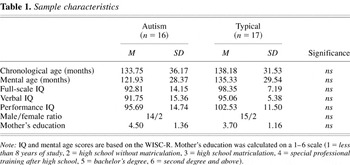
Sample characteristics
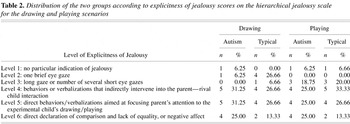
Distribution of the two groups according to explicitness of jealousy scores on the hierarchical jealousy scale for the drawing and playing scenarios
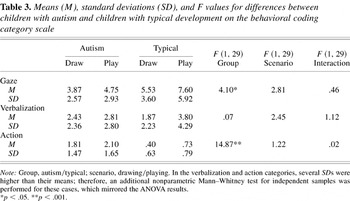
Means (M), standard deviations (SD), and F values for differences between children with autism and children with typical development on the behavioral coding category scale
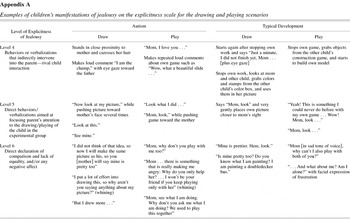
Appendix A: Examples of children's manifestations of jealousy on the explicitness scale for the drawing and playing scenarios
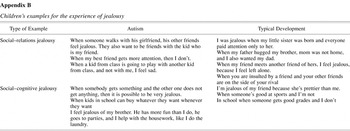
Appendix B: Children's examples for the experience of jealousy
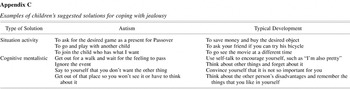
Appendix C: Examples of children's suggested solutions for coping with jealousy
 You have
Access
- 61
- Cited by