Patients with hematologic malignancies are prone to colonization and infection by vancomycin-resistant Enterococcus (VRE),Reference Matar, Tarrand and Raad 1 and these infections are associated with significant morbidity and mortality.Reference DiazGranados and Jernigan 2 , Reference Vydra, Shanley and George 3 At Roswell Park Cancer Institute (RPCI), VRE was a frequent pathogen among patients with hematologic malignancies and recipients of hematopoietic stem cell transplantation (HSCT). In the past, infection prevention policies included weekly fecal surveillance of all patients with hematologic malignancies and recipients of HSCT admitted to the hospital, and lifelong contact isolation if colonized. However, we found that strict implementation of these measures failed to reduce the incidence of either colonization or bacteremia. Therefore, we studied fecal and blood isolates for genetic similarity in an attempt to define clonality and to identify common sources of infection or modes of transmission. The molecular epidemiology analysis revealed a primarily sporadic pattern of VRE acquisition in which the majority of the patients harbored unique VRE strains.Reference Almyroudis, Lesse and Hahn 4
Based on the inefficiency of the contact isolation and the molecular epidemiology data, a decision was made to discontinue the systematic surveillance for VRE and contact isolation of colonized patients. As a component of routine infection control surveillance, we continued to follow the incidence rate of VRE bacteremia. In this study, we present the impact of the intervention on the incidence rates of VRE bacteremia among patients with hematologic malignancies and recipients of HSCT.
METHODS
Patients
We prospectively recorded the episodes of VRE bacteremia that occurred in all patients with hematologic malignancies admitted at Roswell Park Cancer Institute (RPCI). RPCI is a 125-bed National Cancer Institute–designated Comprehensive Cancer Center in Buffalo, New York. The patients were admitted under Leukemia, Bone Marrow Transplant and Lymphoma services into 3 protected-environment inpatient hematology wards and the intensive care unit. All patients were admitted to single-bed rooms with private bathrooms. The study was approved by the RPCI Institutional Review Board.
Definitions
Colonization was defined as isolation of VRE on culture of perianal swab, stool or any other non-sterile body site. Bacteremia was defined as the isolation of VRE in ≥1 blood culture either as a single isolate or as part of polymicrobial infection. Recurrent bacteremia was defined as a subsequent episode of bacteremia due to VRE in the same patient that occurred after completion of an adequate course of appropriate antibiotics and after sterilization of the bloodstream was documented. The identification at the species level and the susceptibilities of the isolates were performed according to standard methods by our clinical microbiology laboratory.Reference Facklam and Collins 5 , 6 The study included episodes of bacteremia due only to vancomycin-resistant E. faecium species; bacteremias due to vancomycin-resistant E. faecalis were excluded because they were infrequent.
Infection Prevention Policies and Environmental Cleaning Practices
During the first period of the study, all patients with hematological malignancies and HSCT recipients admitted at RPCI underwent weekly VRE surveillance with perianal swabs. Active surveillance was conducted every Monday regardless of the day of admission. Colonized patients were placed in contact isolation for the current and subsequent admissions in accordance with the guidelines of the Society of Healthcare Epidemiology of America.Reference Muto, Jernigan and Ostrowsky 7 In addition, in August 2010, we adopted a policy of administering levofloxacin as routine antibacterial prophylaxis for adults with acute leukemia or HSCT recipients throughout the duration of neutropenia or until fever or infection developed, leading to a modification in antibiotic treatment.Reference Bucaneve, Micozzi and Menichetti 8 Finally, beginning in August 2013, we implemented daily bathing with chlorhexidine-impregnated washcloths for all patients admitted to the hematology floors, the intensive care unit, and the intermediate care unit to decrease acquisition and bacteremia rates due to various multidrug-resistant organisms.Reference Climo, Yokoe and Warren 9
Cleaning and disinfection of patient rooms after discharge was performed with an ammonium chloride–based solution (A-456 II disinfectant, Ecolab, St. Paul, MN). It included scrubbing frequently touched surfaces such as bed rails and door handles. Bleach wipes were used only in the rooms of patients with Clostridium difficile infection. Environmental cleaning practices were not altered during the study.
Intervention and Study Periods
Based on the available molecular data generated for the same population that demonstrated the predominantly sporadic nature of VRE acquisitionReference Almyroudis, Lesse and Hahn 4 and the failure of contact precautions to contain the endemic, we abandoned the policy of active weekly surveillance for VRE and contact isolation of colonized and infected patients on March 1, 2011. Because this change in institutional policy regarding VRE surveillance and precautions was based on our judgment of best clinical care rather than on conducting research, informed consent was not required. We continued contact precautions and mandatory hand hygiene for patients colonized by methicillin-resistant Staphylococcus aureus (MRSA) and multidrug-resistant Gram-negative bacteria; we also continued contact precautions along with mandatory hand washing with soap and water for patients with Clostridium difficile infection.
Bacteremia is the single most common manifestation of invasive infection by VRE in patients with hematologic malignancies, and we continued to prospectively monitor the incidence of VRE bacteremia to detect any potential surge of invasive infection. We compared the incidence rates of VRE bacteremia in 2 distinct 3-year time periods. The first period extended from March 2008 to February 2011 and the second from March 2011 to February 2014; these periods occurred before and after discontinuation of contact precautions for patients colonized by VRE.
Incidence of VRE Bacteremia and Other Infectious Events
The incidence of VRE bacteremia was the primary endpoint and was calculated as the number of events per 1,000 patient days of care per month after determining the number of patient days. Because contact precautions targeting VRE may serve as a barrier against transmission of other hospital-acquired infections, we studied the collateral impact of the intervention on the incidence of bacteremia due to MRSA and Clostridium difficile infection. The incidence of various infectious events was considered as the number of events per 1,000 patient days of care per month.
Because the incidence of VRE bacteremia correlates with previous antibiotic use,Reference Almyroudis, Lesse and Hahn 4 we compared the aggregated antibiotic exposure during the 2 time periods. We studied antibiotic exposure for bacteremic patients within 1 month before the development of bacteremia and for the total cohort. We assessed the aggregate use of commonly administered antibiotics: ceftazidime, cefepime, piperacillin/tazobactam, imipenem, meropenem, levofloxacin, metronidazole, and intravenous vancomycin. We measured antibiotic utilization as days of antibiotic therapy per 1,000 patient days of care per year. Finally, because the patient-to-nurse ratio has been shown to influence transmission of resistant bacteria among hospitalized patients,Reference Raboud, Saskin and Simor 10 we obtained pertinent data on nursing hours per patient day.
Statistical Analysis
The statistical analysis was performed using SPSS version 22.0 (IBM, Armonk, NY). Continuous variables were compared using Student’s t test, and categorical variables were compared using the χ2 test. We assessed periodicity using autocorrelation. To evaluate time trends, we used interrupted time series analysis with monthly rates (total of 72 data points) using the autoregressive integrated moving average (ARIMA) model. We investigated the effect of cessation of contact precautions at the time of the policy change and every 6 months thereafter. We also examined the effect of levofloxacin prophylaxis during neutropenia and that of daily chlorhexidine bathing on the incidence of VRE bacteremia. P<.05 was considered statistically significant.
RESULTS
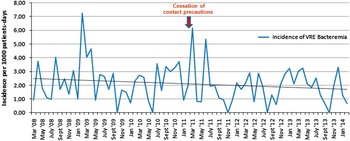
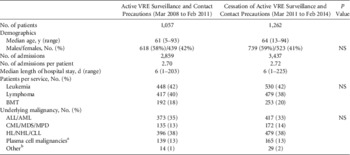
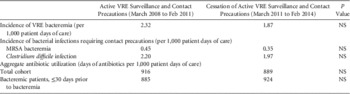
The patient populations were similar for the 2 study periods, based on median age, gender, underlying malignancy, and median duration of hospitalization (Table 1). Although the number of patients increased during the second time period, the ratio of admissions per patient remained stable. The incidence of VRE bacteremia remained stable after the discontinuation of contact precautions (Figure 1, Table 2). Autocorrelation analysis showed no periodicity. The ARIMA model showed that cessation of contact precaution had no impact on the incidence of VRE bacteremia (P>.05, not significant). The use of levofloxacin prophylaxis during neutropenia and daily chlorhexidine bathing had no effect on the incidence of VRE bacteremia (P>.05, not significant). The incidence of MRSA bacteremia and Clostridium difficile infection remained stable during the 2 time periods (Table 2).
Rates of vancomycin-resistant Enterococcus faecium (VRE) bacteremia.

Demographic Data

NOTE. ALL, acute lymphocytic leukemia; AML, acute myelocytic leukemia; CLL, chronic lymphocytic leukemia; CML, chronic myelogenous leukemia; BMT, Bone marrow transplantation; HL, Hodgkin lymphoma; MDS, myelodysplastic syndrome; MM, multiple myeloma; MPD, myeloproliferative disease; NHL, non-Hodgkin lymphoma; NS, not significant (P>.05).
a Plasma cell malignancies include multiple myeloma, Waldenstrom’s macroglobulinemia, amyloidosis.
b Other includes aplastic anemia, Diamond-Blackfan anemia, hemophagocytic lymphohistiocytosis, meduloblastoma, testicular carcinoma, paroxysmal nocturnal hemoglobinuria, unspecified conditions.
Incidence Rates of Bacteremia Due to Vancomycin-Resistant Enterococcus faecium, Methicillin-Resistant Staphylococcus aureus, and Clostridium difficile InfectionFootnote a

NOTE. VRE, vancomycin-resistant Enterococcus faecium; NS, not significant (P>.05).
a Including all-cause mortality and aggregated antibiotic utilization.
Antibiotic utilization also remained stable during the 2 time periods (P>.05, not significant) (Table 2). Finally, nursing hours per patient per day decreased from 13.99 during the control period to 12.86 during the second period (P>.05, not significant).
DISCUSSION
Contact precautions have been the mainstay of prevention and control of VRE colonization and invasive infection for several decades. Contact precautions against VRE include the assignment of single-patient rooms and the use of gowns and gloves during patient contact.Reference Muto, Jernigan and Ostrowsky 7 When invasive infections due to VRE were originally described in 1988,Reference Leclercq, Derlot and Duval 11 , Reference Uttley, Collins and Naidoo 12 contact isolation was already standard practice for containment of resistant bacteria. 13 They were introduced as the standard of prevention of VRE infections based on rationale rather than evidence. Evidence of the efficacy of these measures was limited, even for methicillin-resistant Staphylococcus aureus. Subsequent literature provided evidence supporting the use of contact precautions for resistant bacteriaReference Byers, Anglim and Anneski 14 , Reference Jain, Kralovic and Evans 15 and VRE specifically.Reference Puzniak, Leet and Mayfield 16 Similar data exist for patients with hematologic malignancies.Reference Hachem, Graviss and Hanna 17 However, many of these studies tested more than one concurrent intervention (eg, improvement in hand hygiene, etc).Reference Jain, Kralovic and Evans 15 It is also likely that literature is biased toward studies with successful outcomes.
The efficacy of contact precautions has been questioned as well.Reference Gurieva, Bootsma and Bonten 18 – Reference Harris, Pineles and Belton 23 In particular, in a cluster-randomized trial, active surveillance for MRSA and VRE colonization resulted in a 2-fold increase in the number of patients requiring isolation and had no benefit on rates of transmission of either MRSA or VRE.Reference Huskins, Huckabee and O’Grady 22 In another cluster-randomized trial in 20 intensive care units, the universal use of gowns and gloves did not result in a difference in MRSA and VRE acquisition when compared with the targeted use on known colonized patients.Reference Harris, Pineles and Belton 23
In addition to its unproven efficacy, contact precautions are linked to increased risk for injuries and adverse outcomes. Contact isolation can be associated with medication errors,Reference Karki, Leder and Cheng 24 reduced visits of physicians and nurses,Reference Morgan, Pineles and Shardell 25 , Reference Masse, Valiquette and Boukhoudmi 26 safety concerns such as increased falls and bedsores,Reference Karki, Leder and Cheng 24 , Reference Gandra, Barysauskas and Mack 27 anxiety and depression among patients,Reference Day, Morgan and Himelhoch 28 , Reference Day, Perencevich and Harris 29 and a significant increase in the cost of care.Reference Lai, Kelley and Melvin 30 , Reference Armstrong-Evans, Litt and McArthur 31
Based on a molecular analysis showing that VRE acquisition among patients with hematological malignancies at our center was principally sporadic rather than clonalReference Almyroudis, Lesse and Hahn 4 and the failure of contact precautions to limit VRE acquisition, we discontinued active weekly surveillance for VRE and contact isolation of colonized patients. The primary aim of the current analysis was to compare VRE bacteremia rates between these 2 periods. We found that VRE bacteremia incidence was similar between the 2 periods. Thus, the policy of VRE surveillance and contact precautions did not appear to prevent VRE bacteremia. We also studied the collateral impact that the intervention might have on the rates of MRSA bacteremia and Clostridium difficile infection even though we maintained contact precautions for these organisms. Similar to VRE bacteremia, there was no increase in the rates of MRSA bacteremia and Clostridium difficile infection.
We examined the use of levofloxacin prophylaxis for neutropenia and daily bathing with chlorhexidine-impregnated washcloths as potential confounding variables. The use of levofloxacin prophylaxis during neutropenia preceded the discontinuation of contact precautions by 6 months. However, fluoroquinolones have weak activity against Enterococcus species,Reference Donskey, Helfand and Pultz 32 and at our center the VRE isolates are uniformly resistant to fluoroquinolones. Time series analysis showed no impact on the incidence of VRE bacteremias. Daily chlorhexidine bathing for all patients in the hematology floors was implemented the last 6 months of the intervention period. The effect of this intervention on VRE acquisition and bacteremia is unclear; however, our time series analysis demonstrated no effect. Finally, antibiotic utilization remained stable between the 2 study periods, and no changes in the nursing hours per patient days or in environmental cleaning practices were observed.
We are aware of several limitations to this study. This study involved only a single center and a sequential rather than contemporaneous cohort. Another limitation relates to lack of data on compliance with hand hygiene and lack of molecular epidemiologic data on VRE isolates from the second study period. Our study population included only patients with hematologic malignancies and recipients of HSCT, and molecular epidemiology previously demonstrated the predominantly sporadic nature of the outbreak although that study preceded the discontinuation of contact precautions by 6 years. The role of active surveillance and contact precautions was not examined in clonal outbreaks; therefore, our results may not be applicable in other patients’ populations or in outbreaks characterized by different molecular data.
In conclusion, contact precautions for VRE characterized by predominantly sporadic molecular epidemiology did not appear to protect against VRE bacteremia in high-risk patients with hematologic malignancies and recipients of HSCT in our institution. The results of this study should be interpreted within the limitations of the study design. Our results support the need for larger trials that include molecular analysis of isolates to evaluate the benefit of specific strategies to limit VRE acquisition among patients at high risk for VRE bacteremia.
ACKNOWLEDGMENTS
Financial support: No financial support was provided relevant to this article.
Potential conflicts of interest: NGA, RO, and ESW report no conflicts of interest relevant to this article. GS reports that he has been a consultant to Gilead, Pfizer, MSD, Astellas, and Novartis, and that he has received research funding from Gilead, Pfizer, MSD, Astellas, and Novartis. PLM reports that he has been a consultant to Celgene, Takeda Millennium, Sanofi, Bristol Myers Squibb, Karyopharm, and The Binding Site. BHS reports that he has received research funding from Assembly Bioscience.