INTRODUCTION
Morphological variations in bivalve shells are increasingly the focus of diverse studies that bridge palaeontology and ecology. Shape in bivalves is a key morphological characteristic that reflects both phylogenetic history and life habits (Stanley, Reference Stanley1970; Crampton & Maxwell, Reference Crampton, Maxwell, Harper, Taylor and Crame2000). Different studies (Ferson et al., Reference Ferson, Rohlf and Koehn1985; Innes & Bates, Reference Innes and Bates1999; Palmer et al., Reference Palmer, Pons and Linde2004; Rufino et al., Reference Rufino, Gaspar, Pereira and Vasconcelos2006; Krapivka et al., Reference Krapivka, Toro, Alcapán, Astorga, Presa, Pérez and Guiñez2007; Costa et al., Reference Costa, Aguzzi, Menesatti, Antonucci, Rimatori and Mattoccia2008a, Reference Costa, Menesatti, Aguzzi, D'andrea, Antonucci, Rimatori, Pallottino and Mattocciab; Márquez et al., Reference Márquez, Robledo, Escati Peñaloza and van der Molan2009, among others) have proved that Elliptic Fourier Analysis (EFA) on outline bivalve shells is very useful for defining specific shape features that might distinguish species or intraspecific variations among different populations along a wide geographical range.
This study therefore uses a morphometric approach to document patterns of phenotypic change through space and time in Tawera gayi (Hupé in Gay, 1854) shells, and interprets these patterns in light of the concepts expressed below.
Tawera gayi is a shallow burrowing, siphonate, infaunal suspension feeder. This taxon was selected for study for different reasons, including its widespread distribution in southern South America, its abundance and its good preservation in the fossil record.
The genus Tawera is a small member of the family Veneridae and it is apparently confined to the southern hemisphere. Tawera displays a disjointed biogeographical distribution, with occurrences in Australasia, South America, Mid-Atlantic islands and South Africa (Dell, Reference Dell1964; Pether, Reference Pether1993). One single species, T. gayi, is a typical element of shallow marine waters in southern South America, extending its range of distribution along both sides of America from 56° to about 42°–40°S. As fossils, this species was also recovered from Quaternary sediments in Argentinean Patagonia and Tierra del Fuego (Feruglio, Reference Feruglio1950; Gordillo, Reference Gordillo1998), and in northern Chile (Herm, Reference Herm1969; Guzmán et al., Reference Guzmán, Marquardt, Ortlieb and Frassinetti2000). Along the Beagle Channel, in southern Tierra del Fuego, T. gayi is typically very abundant and this species completely dominates the soft benthic fossil palaeocommunities of the Holocene age.
Shell morphology and overall appearance of T. gayi is very similar to T. philomela (Smith) from South Africa, suggesting a close relationship in the recent past. A third species T. spissa (Deshayes) is part of a group of ten Tawera species living within the Australia–New Zealand region. Based on the fossil record and available information on extant species of Tawera, Gordillo (Reference Gordillo2006) postulated that Cenozoic Tawera might first have arisen in Australia during the Early Miocene, and then expanded and radiated to New Zealand. Later, perhaps during the Early Pleistocene, Tawera first crossed from Australasia to South America by means of the Antarctic Circumpolar Current, with subsequent migration to the southern African Region, and then probably coming back again to Australasia during the most extreme Pleistocene glaciations.
In this paper we attempt to answer the following questions: (1) is outline analysis (EFA) useful for discriminating between the Tawera species and T. gayi populations? (2) are morphological variations of the shell outline within populations related to a latitudinal gradient? This approach can be useful for evaluating whether Tawera spans the southern oceans in a series of stepwise shifts in morphology; (3) when comparing fossil and modern Tawera shell shapes from a single region, is it possible to recognize morphometric changes through time (temporal variations)?; and (4) is the morphometry of Tawera specimens collected at selected locations along the Magellan Region a potential tool for evaluating environmental changes (spatial variations)?
This preliminary approach will attempt to evaluate the potential implications of morphological variations of Tawera associated with different environmental conditions during the Quaternary in southern South America.
The Magellan Region
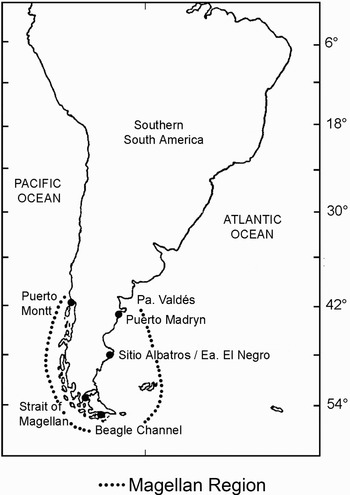
The Magellan Region is a U-shaped area starting at the southern tip of South America (55°S) and stretching northwards up to about 42°S, i.e. Península Valdés on the Atlantic seaboard and Puerto Montt on the Pacific seaboard. In the Atlantic, this region is dominated by the cool Malvinas (Falkland) Current, with mean temperatures ranging from 4° to 11°C and salinity varying from 33.8 to 34.4 psu. A second current, the Patagonian Current, affects the coastal zone northwards to 38°S, with mean temperatures between 5° and 16°C and salinity between 33 and 33.5 psu (Boltovskoy, Reference Boltovskoy1979). On the Pacific seaboard, this region is dominated by sub-Antarctic water and the melting of local glaciers (Escribano et al., Reference Escribano, Fernández and Aranís2003). At these latitudes, sub-Antarctic water reaches the coast and initiates the poleward Cape Horn Current, which passes around the continent through the Drake Passage, influencing both the east and west coasts of South America (Pickard, Reference Pickard and Fraser1973). In the southernmost part of the Magellan Region, Tierra del Fuego connects the Pacific and Atlantic oceans. This area is characterized by an irregular system of islands interconnected by channels and internal seas shaped by glacial and postglacial processes during the last 800,000 years (McCulloch et al., Reference McCulloch, Clapperton, Rabassa, Currant, McEwan, Borrero and Prieto1997). The whole area is affected by heavy continental run-off due to extreme rainfall throughout the year, making the water column strongly stratified, with salinities between 14 and 33 psu and temperatures between 4° and 11°C, from the surface to a depth of 50 m (Pinochet & Salinas, Reference Pinochet and Salinas1996). It is suggested that biotic recolonization of the Beagle Channel and the Strait of Magellan occurred quite recently, as the areas became gradually ice-free during glacial retreat after the Last Glacial Maximum (Gordillo, Reference Gordillo1999; Gordillo et al., Reference Gordillo, Coronato and Rabassa2005; Kilian et al., Reference Kilian, Baeza, Steinke, Arevalo, Ríos and Schneider2007), i.e. the benthic communities of the southernmost tip of South America have to be considered as relatively young.
The Beagle Channel, in southern Tierra del Fuego, develops in a mainly east to west direction for about 300 km. The sea bottom is characterized by the alternation of rocky coasts and sandy littorals (Colizza, Reference Colizza1991). This channel is a tectonic valley that was completely filled by ice during the last glaciation. Later, it was occupied by a glacial lake from 12,000 to 8000 years BP and then flooded by the sea, reaching a maximum sea level between 6000 and 4500 years BP.
MATERIALS AND METHODS
Tawera shells and localities
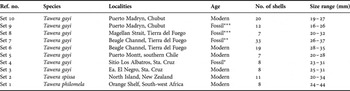
Fossil and modern specimens of Tawera gayi were collected at localities in Tierra del Fuego, Argentinean Patagonia and southern Chile, in order to cover a broad geographical area (Figure 1). Isolated collections from other localities in South Africa and New Zealand were also studied. Shells of T. philomela and T. spissa were provided by the South African Museum in Cape Town and the New Zealand GNS Science, respectively. In total, 133 individuals were included in the morphometric analysis. Only left valves were analysed. Details of the material studied are summarized in Table 1.
Map of southern South America showing sampling sites of Tawera gayi shells.

List of localities and material studied in this work.

Radiocarbon age (not corrected): ***, not dated but recent; **, 4400 years BP; *, 1400 years BP.
Outline analysis
The shell shape variation was studied by Elliptic Fourier Analysis (EFA), which consists of decomposing a curve into a sum of harmonically related ellipses (Lestrel, Reference Lestrel1997). For each valve, images with the inner region upward were photographed using a digital camera. The closed contours of each shell outline were obtained as chain-coded data from the digital images (Freeman, Reference Freeman1974). The number of harmonics (n) was calculated following Crampton (Reference Crampton1995). The Fourier series was truncated at n = 10 with an average cumulative power of 99.98% of the total average power. The orientation, size and starting point of the different outlines were standardized (Kuhl & Giardina, Reference Kuhl and Giardina1982) so that three of the four elliptic Fourier coefficients describing the first harmonic ellipse were constant for all outlines. The Fourier normalized space was therefore composed of 37 morphometric variables. The software Shape v.1.3 (Iwata & Ukai, Reference Iwata and Ukai2002) was used for all the analyses. Principal component analysis (PCA) of the variance–covariance matrix (Rohlf & Archie, Reference Rohlf and Archie1984; Crampton, Reference Crampton1995) was applied to summarize shape variation based on harmonic coefficients for each shell. Differences in the coefficients between localities were tested using multivariate analysis of variance (MANOVA). The average ±2 standard deviation (SD) shape for each group was reconstructed from the mean values of Fourier coefficients using the inverse Fourier transformations (provided by SHAPE-PrinPrint). A cluster analysis generated using an unweighted pair group method with arithmetic mean (UPMGA) was also used to show the distances (Mahalanobis) among species and localities.
RESULTS
The among-group pattern of shape similarities was displayed by means of the position of the ‘average’ shape of each group in the principal component space. Principal component axes are interpreted as shape gradients between two extreme configurations, which are visualized using the inverse elliptic Fourier transformation.
Outline analysis: interspecific variation
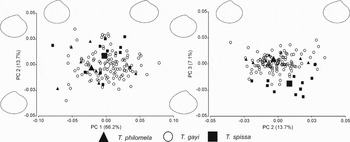
When Tawera gayi (fossil and modern) was compared with modern T. spissa and T. philomela, the MANOVA revealed significant differences in the Fourier coefficient between species (Wilks' λ74,188 = 0.17, P < 0.0001). The first three PCs (Figure 2) explicated around 87% of all the variations.
Plot of principal components (PC) for Tawera philomela (modern), T. gayi (fossil and modern) and T. spissa (modern) based on 37 Fourier coefficients from shell outlines and the diagrams of the reconstructed extreme configurations. The largest symbols indicate the averages for each species. Left: PC 1 and PC 2; right: PC 2 and PC 3.

Using the extreme shapes of these figures it is possible to assign morphological meaning to the three significant PC axes. The first PC (66.2%) can be explained by the degree of roundness. Although it represents the highest variation, it does not follow any pattern which allows for the differentiation between species. However, the average shape of T. spissa and T. gayi are more closely related than T. philomela, which is more rounded than the other two species. The second PC (13.7%) is related to the inflation of the umbo and the lunule area. Tawera spissa is differentiated from T. gayi and T. philomela by having lower inflation and a more prosogyrous umbo. The third PC (7.1%) represents the degree of antero-posterior elongation.
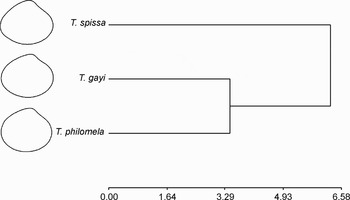
A UPGMA tree based on the Fourier coefficient showed T. philomela and T. gayi more closely related than T. spissa, which is more elongated in an antero-posterior axis, on average (Figure 3).
UPGMA tree, obtained from the Mahalanobis distance between the averages of 37 Fourier coefficients and showing shell shape relationships among three Tawera species. The diagrams before the species designation refer to the mean configurations of the reconstructed shell shape.

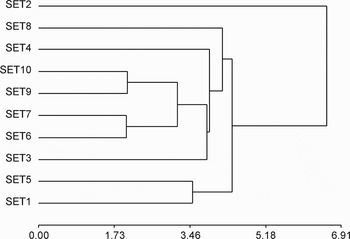
When considering different localities, three major groups are formed. Argentinean localities appeared grouped into a UPGMA tree. In a second group Chile appears together with South Africa. The third one is represented only by New Zealand (Figure 4).
UPGMA tree showing shell shape relationships among the different localities studied. See Table 1 for locality reference numbers.

When modern specimens of T. gayi were compared with modern T. spissa and T. philomela, the same pattern was maintained. However, a lower dispersion in T. gayi resulted in greater differences when compared to results which included fossil specimens. The first three PCs explained around 89% of the variance. Cluster analyses show that the localities in South America, which represent T. gayi, define a single cluster in the tree. This group is closer to African T. philomela than to New Zealand T. spissa.
Outline analysis: intraspecific variation
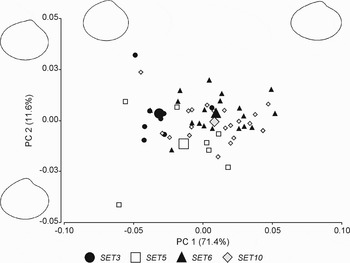
Shell shape differences accounted for the first two PCs (explaining 83% of the variance) and are shown in Figure 5. Some overlap in shape morphospace between all four Tawera gayi groups (Set 3, Set 5, Set 6 and Set 10) is observed. However, PC 1 shows T. gayi shells from Puerto Madryn and the Beagle Channel very close to each other, since they have a similar rounded shape. The PC 2 shows that Tawera shells from Puerto Montt, on the Pacific, are more dorsally peaked than the other sets.
Plot of principal components (PC) for modern Tawera gayi localities showing shell shape variation and diagrams of the reconstructed extreme configurations. The largest symbols indicate the averages for each species. Right: PC 1 and PC 2; left: PC 2 and PC 3. See Table 1 for locality reference numbers.

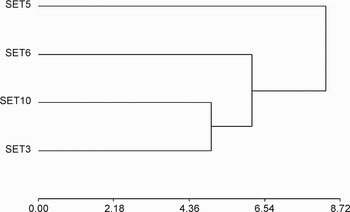
Cluster analysis (which includes all variability of the shell shape) showed T. gayi from Puerto Montt, on the Pacific, clearly apart from the remaining sites located on the Atlantic (Figure 6). These differences may indicate that these populations belong to different stocks.
UPGMA tree showing shell shape relationships between different modern Tawera gayi localities. See Table 1 for locality reference numbers.

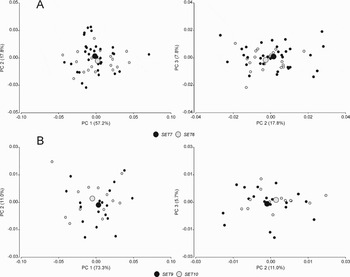
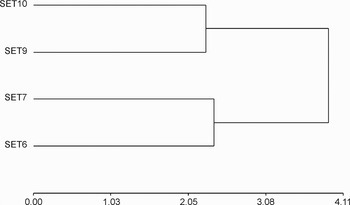
Finally, relationships at specific times (i.e. modern shells versus fossil shells) and between particular groups (i.e. Puerto Madryn and Tierra del Fuego) were explored in more detail. When fossil and modern Tawera specimens from the Beagle Channel (Set 6 and Set 7) were compared, no differences were observed (Figure 7A).
Plot of principal components (PC) for Tawera gayi (fossil and modern) from (A) Puerto Madryn and (B) Beagle Channel localities showing shell shape variation. The largest symbols indicate the average for each species. See Table 1 for locality reference numbers.

Similarly, Tawera specimens from Puerto Madryn (Set 9 and Set 10) display no differences between modern and fossil shells (Figure 7B).
Cluster analysis showed two major groups separating Chubut from Tierra del Fuego, with fossil and modern Tawera from each region more closely related (Figure 8).
UPGMA tree showing shell shape relationships among Tawera gayi (fossil and modern) from Puerto Madryn and Beagle Channel localities. See Table 1 for locality reference numbers.

DISCUSSION
In this study we considered both modern and fossil Tawera gayi shells in order to improve the use of this species in palaeo-environmental reconstructions. Morphological changes through space and time were analysed.
Changes through space
Detection of morphometric differences between Tawera sets indicates that different environments are reflected in the shell morphology. Thus T. gayi is able to live in different shallow environments, from intertidal to depths of more than 100 m, and within different kinds of substrates. Each set must represent a distinct subgroup belonging to a different local community. For example, for the Atlantic, at Golfo Nuevo, Chubut (42°47′S 64°53′W), T. gayi is the third member in order of abundance of a shallow soft infaunal community dominated by venerids (Venus antiqua, Retrotapes exalbidus and T. gayi) and mainly preyed upon by volutids (Odontocymbiola) (Schuldt, Reference Schuldt1975; Verdinelli & Schuldt, Reference Verdinelli and Schuldt1976). In Tierra del Fuego, T. gayi was sampled at Laredo Bay, Strait of Magellan (5–10 m depth; 52°58′S 70°47′W) (Urban & Tesch, Reference Urban and Tesch1996). In contrast, in the same region, T. gayi appears as a secondary member in a typically hard-bottom community of boulder–cobble intertidal fields resting on a sandy-sediment matrix, dominated by mytilids (Mytilus chilensis and Perumytilus purpuratus) (Ríos & Mutschke, Reference Ríos and Mutschke1999). From a structural point of view this type of physical habitat can be considered as an intermediate situation between soft substrate (e.g. sandy beaches) and typical hard-bottom substrate (i.e. rocky shores). In Tierra del Fuego, T. gayi also inhabits shallow coarse sandy substrates along the Beagle Channel (Gordillo, Reference Gordillo1994; Lomovasky et al., Reference Lomovasky, Brey and Morriconi2003), and was also collected at Isla Navarino from grey mud (6–10 m depth; 54°55′S 67°37′W), together with other shelled molluscs such as Xymenopsis, Yoldia and Plaxiphora (Dell, Reference Dell1971). This species was also found in this channel within holdfasts of Macrocystis pyrifera (Adami & Gordillo, Reference Adami and Gordillo1999). As fossils, in the same region, T. gayi was recovered from Holocene mollusc assemblages along the Beagle Channel, as the dominant species, and together with other bivalves (e.g. Retrotapes exalbidus, Venus antiqua and Hiatella solida) and predator gastropods such as muricids (Trophon geversianus). On the Pacific, in Chile (43°28′S–45°55′S), T. gayi was found at different depths (i.e. 10–15, 70, 130 and 160 m), at the bottom of cobbles, gravel and coarse sands, sometimes with Venus antiqua (Reid & Osorio, Reference Reid and Osorio2000; Osorio et al., Reference Osorio, Peña, Ramajo and Garcelon2006; Cárdenas et al., Reference Cárdenas, Aldea and Valdovinos2008), and as dominant taxa at 16–20 m, within medium to coarse sands together with echinoids (Loxechinus albus), asteroids (Stichaster striatus), nematodes, amphipods and other molluscs (i.e. Mulinia edulis, Tindaria striata, Tagelus dombeii and Nassarius species).
This ability to adapt to different environments, including varied substrate and predators, is probably the main reason for morphological variability between Tawera populations.
Our preliminary analysis of Tawera suggested that several factors must be considered in order to decipher the ecological significance of its morphological variations.
Changes through time
In this study, we compared Tawera shells from different regions within a short scale of hundreds to thousands of years. Tawera specimens from the Beagle Channel displayed little morphological variability during the last 4500 years, indicating environmental stability in this region. Similarly, fossil and modern Tawera specimens from Puerto Madryn display no significant difference between the recent past and the present.
Fossil and modern Tawera specimens from each region are more similar than modern specimens from different regions. It must be thought of as temporal stability and spatial variability of the Tawera shell shape.
As Tawera was apparently able to achieve a circumpolar distribution during the Cenozoic, this dispersal ability via planktonic larvae can be correlated with phenotypic and physiological plasticity of this group. Crampton & Gale (Reference Crampton and Gale2005) pointed out that the presence of planktonic larval development in a marine mollusc may favour the evolution of phenotypic plasticity as a way of maximizing phenotypic adaptability while minimizing physiological costs to the individual. In other words, this relationship may result because high levels of gene flow in readily dispersed species will promote genetic homogenization, but, at the same time, wide dispersal exposes the organism to a broad spectrum of environmental stresses.
There was no evidence of a latitudinal trend or a gradient of shape change from north to south in either ocean, although the observed difference between the Pacific and Atlantic sites turned out to be significant in relation to the arrival of Tawera in South America, probably first into the Pacific, and then expanding along both oceans. Differences between Tawera subgroups would therefore be the result of both the dispersal route in South America and local environmental conditions. However, data on fossil Tawera from the Pacific as well as from the Atlantic oceans would be required to reinforce this interpretation.
Thus it could be argued that the broad distribution of T. gayi in the Magellan Region with spatial phenotypic variations between Tawera subgroups is an evolutionary morphological change that was not associated with speciation.
CONCLUSION
Shell shape variations of Tawera species can be quantified by the Fourier coefficient obtained from 2-D digital images. Elliptic Fourier Analysis thus seems to be a powerful method for detecting intra- and interspecific differences between Tawera populations (or subgroups). Furthermore, another important advantage of EFA is that one can visualize the results of different statistical multivariate analyses reconstructed graphically from the series with high precision.
Looking back at the questions presented in the Introduction we conclude that outline analysis is useful for differentiating the three Tawera species and for separating intraspecific groupings, indicating that considerable phenotypic plasticity exists among the populations of T. gayi. The morphological variations of T. gayi appear to be related to ecophenotypic plasticity as a response to different environmental conditions.
Over the short geological period that represents the interval of the last 4500 years, the shell shape of T. gayi from the Beagle Channel exhibits stasis, suggesting stable environmental conditions at the southern tip of South America.
As morphological variation of Tawera shells is the product of both heredity and environment, morphological change need not be interpreted solely as a species-level phenomenon, but can and should be considered in a community or palaeocommunity context, in which phenotypic variation between localities may represent a source of ecological information suitable for the evaluation of environmental changes.
Future research
In the future, stronger methodology for this investigation could be obtained by incorporating information from different disciplines, including ecology, genetics and geochemistry.
Some basic documentation is also still needed in several areas. For example, a genetic analysis of Tawera would help to determine if there is an association between genetic and morphological variations of shells, possibly linked to environmental parameters.
Another gap is the poor knowledge of shallow soft benthic communities, including community structure, diversity, density and biotic relationships. The lack of this kind of basic information makes it difficult to compare Tawera communities, to identify the different factors associated with morphological variations of Tawera and to discover which of them are more sensitive to ecological changes over short time intervals.
There is great potential in the application of morphometry to palaeo-environmental studies. Future studies should also include stable oxygen and carbon isotopic composition of Tawera shells, in order to evaluate morphological changes associated with environmental conditions such as temperature and hydrologic changes.
Finally, more work on the Tawera group is needed to evaluate morphological changes associated with environmental conditions and those which represent evolutionary innovations.
ACKNOWLEDGEMENTS
We sincerely thank James S. Crampton (GNS Science, New Zealand) who helped us with criticism during the writing of a previous version. We also thank two anonymous referees for their valuable comments. This work was supported by the National Research Council, CONICET (S.G., grant no. PIP 05-6323); and the National Agency for the Promotion of Science and Technology (grant no. PICT 06-00468).