Introduction
The investigation of the degree to which the words of one language are functionally connected to those of the other is a central topic in bilingual reading research. A rich source of data for this endeavor comes from priming procedures in which words from one of the participant's languages (primes) are presented prior to words in the other (targets) that require a response. The relevant data from such studies is the pattern of across-language priming that occurs for primes and targets that are translation equivalents.
The current study investigated the factors that give rise to two patterns of translation priming that have influenced models of bilingual lexical representation: asymmetries in the size of priming produced when the prime is in the participant's dominant language (L1) or the non-dominant language (L2), and differences in the amount of priming depending on whether cognate or non-cognate translations are used. We will consider each of these in turn.
When the response measure is the lexical decision task (LDT), it has been found that larger priming effects are found when the prime is in L1 and targets in L2 compared to when L2 primes precede L1 targets (e.g., Keatley, Spinks and de Gelder, Reference Keatley, Spinks and Gelder1994). More recent studies of bilingual lexical processing have used a masked priming procedure whereby the presentation of prime stimuli is masked so that participants are aware only of the language of the target items. In this procedure, the directional priming asymmetry in the LDT is also evident with negligible or no priming being found for the L2–L1 prime–target direction (e.g., Gollan, Forster and Frost, Reference Gollan, Forster and Frost1997; Jiang and Forster, Reference Jiang and Forster2001; Finkbeiner, Forster, Nicol and Nalamura, Reference Finkbeiner, Forster, Nicol and Nakamura2004). It should be noted, however, that L2–L1 priming has been found for different response measures (e.g., semantic categorization; see Grainger and Frenck-Mestre, Reference Grainger and Frenck-Mestre1998). This finding that the pattern of cross-language masked priming is not fixed raises broader issues concerned with how mechanisms of word identification interface with those concerned with task management (see General discussion).
There are two types of explanation of priming asymmetry. One is based on the idea that priming in the L2–L1 direction is controlled by the processing limitations of the L2 lexicon. For example, Kroll and Tokowicz (Reference Kroll, Tokowicz and Nicol2001) have suggested that asymmetrical L1 and L2 processing arises because initially L1 is required to mediate access to meaning for L2. This differential reliance of L2 on L1 semantic processing is captured by the revised hierarchical model (Kroll and Stewart, Reference Kroll and Stewart1994), where the various linkages between languages have different strengths of connectivity. At the level of lexical form, the connections between L2 and L1 are stronger than those connecting L1 to L2 (due to the inconsistent lexical mappings from L1 to L2), whereas at the conceptual level, the connection between L1 representations is stronger than those of L2 and their concepts. To explain the priming asymmetry, it is assumed that priming occurs due to semantic activation. The L1 prime activates a conceptual node shared with L2, which then preactivates the L2 translation-equivalent and facilitates recognition. Priming is not effective in the L2–L1 direction because L2 primes do not sufficiently activate conceptual representations, resulting in no preactivation of the L1 translation-equivalent and thus no priming. This model also allows for different patterns of priming as a function of different levels of L2 proficiency. That is, the directional asymmetry in priming would be largest for beginning bilinguals, since for these language users the semantic links between L2 and L1 would be at their most rudimentary.
Finkbeiner et al. (Reference Finkbeiner, Forster, Nicol and Nakamura2004) have proposed a second type of account. Rather than resorting to differences in the strengths of semantic links between L2 and L1, the asymmetry in priming is assumed to arise because of a representational asymmetry between L1 and L2 semantic representations. In this account, the priming asymmetry occurs because of differences in the relative number of L1 and L2 semantic representations (L1 representations are richly populated whereas L2 representations are not). Priming in the L2–L1 direction is unreliable because an L2 prime does not always activate sufficient L1 lexical semantic representations (this assumes that the amount of priming in the LDT increases as the proportion of primed to unprimed senses in the lexical–semantic representation of the target word increases). The plausibility of this account was demonstrated using an analogous priming situation in which within-language semantic priming for many-to-few sense prime and targets (e.g., head-SKULL) was contrasted with priming from few-to-many sense pairs (skull-HEAD). Consistent with the representational asymmetry account, priming was found from many-to-few sense primes and targets but not vice versa. Given that, under the sense model, the priming asymmetry is a consequence of any representational asymmetry that exists in cross-language translation equivalents, it is not entirely clear whether this model would predict different degrees of priming asymmetry as a function of L2 proficiency.
As mentioned above, another factor that has a strong influence on the pattern of priming is whether primes and targets are cognate or non-cognate translations. It is this finding that highlights limitations in the above proposals. For as it turns out, a clear asymmetry in masked translation priming has only been demonstrated in the LDT with languages that do not share an orthography, e.g., Chinese and English, Hebrew and English (e.g., Gollan et al., Reference Gollan, Forster and Frost1997; Jiang and Forster, Reference Jiang and Forster2001; Finkbeiner et al., Reference Finkbeiner, Forster, Nicol and Nakamura2004). In the case of languages that do, the pattern of priming appears to be quite different. For instance, priming for cognate translations (that share orthographic and phonological form) is symmetrical. On the other hand, priming for non-cognate translations is tenuous at best (e.g., García-Albea, Sánchez-Casas, Bradley and Forster, Reference García-Albea, Sánchez-Casas, Bradley and Forster1985; García-Albea, Sánchez-Casas and Igoa, Reference García-Albea, Sánchez-Casas, Igoa and Hillert1998; Grainger and Frenck-Mestre, Reference Grainger and Frenck-Mestre1998).
However, before concluding that the pattern of same- and different-script masked priming is different, it should be noted that only a few studies have examined the symmetry of cognate priming using the LDT (e.g., Grainger and Frenck-Mestre, Reference Grainger and Frenck-Mestre1998, only examined L2–L1 priming and Sánchez-Casas, Davis and García-Albea, Reference Sánchez-Casas, Davis and García-Albea1992, used a semantic classification task). Likewise, although the majority of studies have found a null priming effect for same-script non-cognates, two studies have reported priming (Williams, Reference Williams1994; De Groot and Nas, Reference De Groot and Nas1991). However, it should be noted that both of these studies employed masking procedures that might have allowed participants transient awareness of the primes. For example, Williams (Reference Williams1994) used an unusual masked priming procedure in which a series of blanks, masks and primes were shown over a period of 712 ms before the target. Recently, Vanderelst, Speybroeck, Brysbaert and Forster (submitted) have shown that such sequences of masks lead to less secure masking than the standard “sandwich” method used by Forster, Davis, Schoknecht and Carter (Reference Forster, Davis, Schoknecht and Carter1987). In addition, the primes and targets in the Williams (Reference Williams1994) study were not always length matched such that primes were longer than targets (e.g., wahnsinnig priming mad; prossimo priming next, etc.); this mismatch in length might also lead to awareness of the presence of the primes. In the other study that found non-cognate priming in the LDT (De Groot and Nas, Reference De Groot and Nas1991), not only were the primes physically larger than their targets (uppercase primes, lowercase targets), but these were also sometimes longer than targets. Importantly, when De Groot and Nas (Reference De Groot and Nas1991) used lowercase primes and uppercase targets, the non-cognate priming effect was not significant.
Since it is the variation in the patterns of priming that forms the basis of inferences about the structure of bilingual lexical representation and process, it is important that the pattern of same-script masked translation priming effects is well established. The purpose of the current study was to determine the size of cognate and non-cognate translation priming effects and investigate how each is affected by the degree of bilingual experience and the order of prime/target language.
In regards to this latter variable, it is of interest to note that on the basis of the results of an event related potential study of German–English bilinguals, Kotz and Elston-Guettler (Reference Kotz and Elston-Güettler2004) have suggested that age of acquisition is the key determinant of the strength of links between L2 words and concepts and not the degree of L2 proficiency. What they found was that both high and low L2 proficiency groups failed to show a categorical N400 priming effect (i.e., an attenuation of the N400 ERP component for categorical related word pairs), whereas in a previous study, early L2 learners did. On this basis, they proposed that both high and low proficient late learners of an L2 have weaker links from L2 words to concepts, whereas early learners of an L2 have stronger word–concept connections. If this were the case, it might be that the pattern of asymmetry in masked priming will differ according to whether L2 was learned early or late (and not by proficiency). In order to examine whether the pattern of masked cross-language priming is affected by age of acquisition and/or L2 proficiency, the current study will examine three groups of L2 participants: those who had exposure to L2 pre-puberty, low proficient beginning bilinguals and proficient later L2 learners.
EXPERIMENT 1
Method
Participants
From an initial pool of 140 participants who reported that they had experience speaking Spanish and English, 84 were selected to form four equal-sized groups. Membership in these groups was determined on the basis of responses to a language history (see Materials section below). The first three groups will be called the bilingual groups, the last group, the beginning bilingual (Spanish) group.Footnote 1 The bilingual groups consisted of people who rated their current competence in both English and Spanish as “good”, and who rated their current usage (reading, writing and speaking) of both languages as either “often” or “always”. The beginning bilinguals were native speakers of Spanish and had only an intermediate level of English (rating their current competence in English as “poor”). However, it should be noted that these participants would have certainly known the translations used in the experiment (this was confirmed after the experiment).
The bilingual groups primarily differed on when they had begun learning their second language, on the relative amount of each language use and on their selection of which language they felt more “comfortable” with. The first group, the balanced bilinguals, consisted of bilingual speakers of Spanish and English (generally American English) who had learned their second language, either Spanish or English, before puberty. Their current and past pattern of language use was similar for both languages, and they rated feeling equally comfortable using both. The vast majority of the participants in this group live (and grew up in) countries where English is the official language but had early contact with Spanish (typically in the home). The second group of participants, the spanish dominant bilinguals, consisted of people who had learned English as their second language after puberty. Participants from this group had used more Spanish than English in the past (and also in current use). They rated themselves as more competent in Spanish than in English, and chose Spanish as their preferred language for speaking, listening, reading and writing. The third group, the english dominant bilinguals, consisted of people who had learned Spanish as their second language after puberty. In contrast to the Spanish dominant group, participants from this group had used more English than Spanish in the past as well as currently, and they also rated themselves as being more competent in English; indeed they chose English as their preferred language for speaking, listening, writing and reading. The beginning bilingual (Spanish) group consisted of a selection of second year undergraduate students from the University of St. Louis (Madrid campus). These students had at least one lesson in English per day and were preparing to spend some of their final year in the United States.
Materials
Questionnaire: In order to establish the bilingual history of each participant, questions concerning four periods of time were asked: childhood, adolescence, adulthood and current experience. Within each of the age divisions, the participant was asked to estimate the amount of their language use (speaking, writing and reading) for each of their languages. In order to assist in making this judgment, a nominal scale was used (“never”, “sometimes”, “often”, “always”). A further question asked them to rate their perceived language competence (speaking, understanding, reading and writing) for their languages. Once again, participants selected the appropriate label (“poor”, “fair”, “competent”, “good”). A final question asked them to decide in which language they felt “more comfortable” (Spanish, English or “equally comfortable”). Participants were assigned to a language group based upon which language they had learned first, on their ratings of current language use and competency, and according to which language they felt more comfortable with.
Lexical decision: One hundred and forty-four target words, 72 in Spanish and 72 in English, were selected for the Spanish and the English parts respectively (see Appendix online for a listing of the items used in all experimentsFootnote 2). These targets were chosen in order to form two sets (one set based on cognate translations, the other on non-cognate translations), with three different priming conditions within each set. The Spanish cognate targets had an average word frequency of 60 words per million (B-Pal corpus; Davis and Perea, Reference Davis and Perea2005) and an average orthographic neighborhood size (N) of 7 (a neighbor was defined as any word that can be produced by changing one letter, preserving letter position; see Coltheart, Davelaar, Jonasson and Besner, Reference Coltheart, Davelaar, Jonasson, Besner and Dornic1977). The Spanish non-cognate targets average word frequency was 81 words per million with an average N of 6.6. The differences between the frequencies for the Spanish cognates and non-cognate targets was not significant, F < 1. There was no difference in the number of neighbors, F < 1. The English cognate targets average log word frequency was 9.63 (HAL; Balota et al., Reference Balota, Yap, Cortese, Hutchison, Kessler, Loftis, Neely, Nelson, Simpson and Treiman2007), with an average N of 5.6. The average number of senses of the cognate words (determined using WordNet 2.1, excluding proper nouns, archaic usage, etc.) was 8.0. The English non-cognate targets average log word frequency was 10.38 (HAL; Balota et al., Reference Balota, Yap, Cortese, Hutchison, Kessler, Loftis, Neely, Nelson, Simpson and Treiman2007), with an average N of 6.4. The differences between the frequencies for the English cognates and non-cognate targets was significant, t(70) = 2.16, p < .05. There was no difference in the number of orthographic neighbors, F < 1. The average number of senses of the non-cognate words was 4.9. The cognate words had more senses than the non-cognate words [t(114) = 2.41, p < .05].
The priming conditions for the cognate set consisted of the following conditions: a repetition condition, where the Spanish or the English target word was preceded by a lowercase version of itself (e.g., rico/RICO, clear/CLEAR); and a cognate translation condition, in which the prime for the respective language target words was similar in form (e.g., rich/RICO; claro/CLEAR). For the Spanish targets, the average letter overlap, based on serial position (absolute overlap), between prime and target was 3.0 letters, the average word length was 4.5 letters. For the English targets, the average overlap was 2.9 letters and average word length 4.6 letters. Finally, there was a form control condition, in which both the Spanish and the English target words were preceded by a nonword that exhibited the same form overlap as the cognate pairs (e.g., rict/RICO, clarn/CLEAR. Note, as these nonword primes were controls for the translation primes, they were constructed with respect to that language and not the target one). This baseline was selected so that any facilitation observed for Cognate primes and targets could not be attributed simply to form overlap.
The priming conditions for the non-cognate set mirrored the above: a repetition condition (e.g., pato/PATO; tail/TAIL); and a non-cognate translation condition, where the prime for the respective language target was not form similar (e.g., duck/PATO; cola/TAIL). For the Spanish targets, the average letter overlap between prime and target was 1.5 letters; the average word length was 4.5 letters. For the English targets, the average overlap was 1.7 letters and average word length 4.4 letters. There was also a control condition, where both the Spanish and the English target words were preceded by a nonword which had the same form overlap as the cognate pairs (e.g., pano/PATO; tair/TAIL). This baseline was selected so that the Cognate and Non-cognate sets had equivalent form overlap.
One hundred and forty-four nonwords were used as foils in the experiment. These nonword targets were length matched with the word targets. Further, the nonword targets were constructed in accordance with the orthographic constraints of their respective languages, i.e., the nonwords in the English version respected English orthographic constraints. In order to mimic the prime–target relationships of the word set, the nonword targets were arbitrarily divided into two sets (corresponding to the cognate and non-cognate sets for the word targets). Within each set, three types of primes were prepared for use with each target: a Repeated prime (e.g., runo/RUNO, amal/AMAL), a pseudo-cognate or Non-cognate prime (e.g., rupa/RUNO, ojer/AMAL) and a Form-control (e.g., ruen/RUNO, amin/AMAL).
Three versions of the experiment were constructed for the targets of each language (six versions in total), so that each target would appear in each of the priming conditions, without being repeated within a version. A set of 14 practice items was constructed for the English targets (half word targets, half nonwords), and another set of 14 for the Spanish targets, and each set preceded the appropriate version.
Procedure and data treatment
Participants were tested singly, in one or other of the versions of the experiment. They were asked to make a lexical decision about the item presented in uppercase letters. Participants indicated their decisions by pressing one of two response buttons; “word” responses being made with the preferred hand. No mention was made of the number of stimuli that would be presented on each trial. Each version of the experiment was blocked according to target language, and the order of these blocks was randomized for each participant, i.e., one participant might receive the Spanish targets first, then the English ones, whereas another might receive the English targets first. For each participant, the computer provided a different pseudo-random order of item presentation. The experiment was run using the DM display software (see Forster and Forster, Reference Forster and Forster1990).
Items were presented in a computer-controlled video display in which the timing of the display was synchronized with the video raster. Each stimulus was centered in the viewing screen, superimposed on the one proceeding. Each item consisted of a sequence of three stimuli. The first stimulus acted as a forward mask and consisted of a row of hash marks that were length matched to the prime and target; this forward mask was displayed for 500 ms. Immediately following this a lowercase prime was displayed for 57 ms, and was in turn followed by an uppercase target displayed for 500 ms. Primes and targets were always matched on letter length and targets were physically bigger than primes (primes in lowercase, targets in uppercase). Primes and targets were displayed using a 10 point Courier font; targets were on average 1.5 cm in length and 0.6 cm high. Feedback about speed and accuracy was provided to each participant, after each response, in the appropriate test language.
Data corresponding to incorrect responses were discarded from the analysis and reaction times more than two standard deviation units above or below the mean for that participant in all conditions were trimmed to the appropriate cut−off value to moderate the influence of outliers (this affected 3.9% of the English targets and 3.8% of the Spanish targets). Any participant who made more than 19% errors was replaced (this resulted in the replacement of 6 participants). For the beginning bilingual (Spanish) participants, when the target language was English, an error rate of more than 20% was accepted (the average error rate was 22.4%).
Results
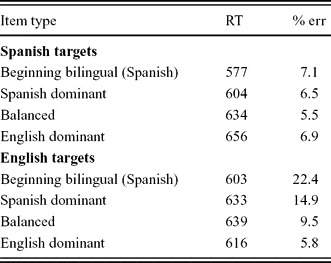
Before examining the pattern of priming across the different bilingual groups, we first consider the pattern of LDT response times to the Spanish and English targets with respect to the classification of participants made on the basis of their questionnaire responses. Participants’ overall response latencies and percentage error rates as a function of the target language and their assigned bilingual group are shown in Table 1. It can be seen that for Spanish targets, the pattern of response latencies was consistent with the categorization of participants based on the questionnaire data. That is, the beginning bilingual (Spanish) group responded the fastest; next fastest was the Spanish dominant group, then the balanced group, with the English dominant group the slowest.Footnote 3 The analyses of the data took the form of two analyses of variance, one for the participant means (collapsing over items) and one for the items (collapsing over participants). The difference in response latencies across all of the different language experience groups was significant, F 1(3,72) = 3.24, p < .05; F 2(3,396) = 66.73, p < .05. There was, however, no difference in mean number of errors made by the groups, both Fs < 1.
Mean lexical decision times (ms) and percentage error rates for Spanish and English targets as a function of language group.

The pattern of response latencies to the English targets was not consistent with what might be expected from the questionnaire data. Indeed, the beginning bilingual (Spanish) group actually had the fastest mean response latencies. There was no overall difference in response latencies across the different language groups in the participant data, F 1(3,72) = 1.44 p > .05, but there was an effect in the item analysis, F 2(3,396) = 12.79, p < .05. A straightforward reason for why response latencies did not correspond to the classifications based on language experience is that there was a speed–accuracy trade-off. It can be seen in Table 1 that, although the beginning bilingual (Spanish) group was the fastest, they also had the largest error rate. Unlike with the Spanish targets, the analysis of errors made on the English targets as a function of language experience was significant, F 1(3,72) = 28.45, p < .05; F 2(3,396) = 37.22, p < 0.05. It seems that for the English targets, it is the pattern of error rates that corresponds well with the questionnaire data.
The analysis of the bilingual and beginning bilingual data took the following form. The first contrast was made to determine if there were different priming patterns for the two language dominant bilingual groups. Specifically, this analysis examined cognate and non-cognate priming for the Spanish and English dominant bilinguals as a function of whether the target was in L1 (hence the translation prime in L2) or the target was in L2 (hence the translation prime in L1).
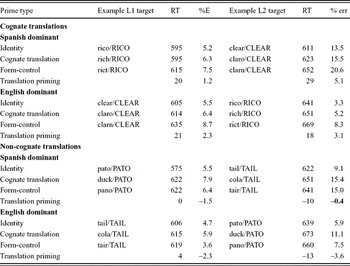
Average response times and error rates for the language dominant bilingual groups (i.e., English dominant and Spanish dominant) are shown in Table 2. As can be seen, the pattern of translation priming (translation versus control) was very similar across the two groups. The cognate priming effect for each condition (the two language dominant groups for L1 and L2 targets) was about 20 ms, whereas the priming effect for the non-cognate translations was either a very small (L1) or even a negative effect (L2).
Mean lexical decision times (ms) and percentage error rates for the Spanish and English dominant bilingual groups as a function of translation and prime type.

The analysis of the response data indicated that there was a main effect of whether the target was in L1 or L2, with L1 targets being responded to faster than L2 targets, F 1(1,72) = 18.74, p < .05; F 2(1,264) = 114.66, p < .05. There was also an effect of prime type, F 1(2,72) = 18.42, p < .05; F 2(2,264) = 26.49, p < .05. There was no main effect of translation type (cognate versus non-cognate), both Fs < 1. However, there was an interaction effect between translation type and prime type, F 1(2,72) = 5.23, p < .05; F 2(2,264) = 7.49, p < .05 (with there being a larger priming effect for cognate translations). There was no interaction between language dominance and prime type, both Fs < 1. For the error data, there was an effect of the target being in L1 or L2, with L1 targets attracting fewer errors than L2 targets, F 1(1,72) = 28.34, p < .05; F 2(1,264) = 29.89, p < .05. There was an effect of prime type, F 1(2,72) = 8.68, p < .05; F 2(2,264) = 8.26, p < .05. There was no main effect of translation type, F(1,72) = 1.18, p > .05; F 2 < 1, but once again there was an interaction between translation type and prime type, F 1(2,72) = 4.55, p < .05; F 2(2,264) = 4.52, p < .05. There was no interaction between language dominance and prime type, both Fs < 1.
In terms of translation priming (translation versus Form-control) per se, in the response data there was an effect of whether the target was in L1 or L2, with L1 targets being responded to faster than L2 targets, F 1(1,32) = 15.91, p < .05; F 2(1,132) = 83.04, p < .05. There was no effect of prime type in the participant analysis, F 1(1,32) = 2.48, p > .05. However, the item analysis was significant, F 2(1,132) = 5.52, p < .05. There was no effect of translation type, F 1(1,32) = 2.48, p > .05; F 2 < 1. There was an interaction effect between translation type and prime type, F 1(1,32) = 7.12, p < .05; F 2(1,132) = 11.85, p < .05. Priming was tested for each translation type. There was a significant effect of cognate priming, F 1(1,32) = 20.50, p < .05; F 2(1,66) = 15.07, p < .05, but no priming effect for the non-cognate translations, both Fs < 1. There was no interaction between language dominance and prime type, both Fs < 1. For the error data, there was an effect of the target being in L1 or L2; L1 targets were responded to with fewer errors than L2 targets, F 1(1,32) = 34.57, p < .05; F 2(1,132) = 31.96, p < .05. There was no effect of prime type, both Fs < 1. There was no effect of translation type, both Fs < 1. There was an interaction effect between translation type and prime type, F 1(1,32) = 15.25, p < .05; F 2(1,132) = 8.75, p < 0.05. Once again, priming was tested for each translation type. There was a significant effect of cognate priming, F 1(1,32) = 9.72, p < .05; F 2(1,66) = 9.14, p < .05, and no priming effect for the non-cognate translations, F 1(1,32) = 3.00, p > .05; F 2(1,66) = 2.13, p > .05. There was no interaction between language dominance and prime type, both Fs < 1.
In summary, there was no difference in the pattern of priming for the English and Spanish dominant bilingual groups. Both showed larger cognate than non-cognate priming, with the effect of cognate priming significant and the effect of non-cognate priming not significant. The size of priming did not differ as a function of the target being presented in L1 or L2 (i.e., L2 primes produced the same amount of priming for L1 targets as L1 primes did for L2 targets).
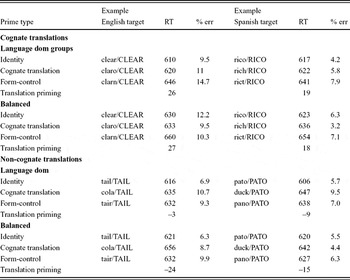
Given that the pattern of priming did not differ for the two language dominant groups, the data of these groups were combined and contrasted with the balanced bilingual group to determine whether there was a difference in the pattern of priming as a function of age of onset of bilingual experience (participants from the balanced group were exposed to Spanish and English pre-puberty). It should be noted that collapsing these bilingual groups this way means that the target language variable becomes meaningless, since the L1 of the groups was different; as such this variable has not been reported in the following analyses. Mean response times and mean percent error rates for these groups are presented in Table 3. Note that the target language is now coded as English and Spanish (rather than L1 and L2, as in Table 2) since it is not clear what the L1 or L2 would be for the balanced bilingual group.
Mean lexical decision times and percentage error rates for the combined language dominant groups and balanced bilingual group as a function of translation and prime type.

In the response times, there was no main effect of language group (combined language dominant groups versus balanced bilinguals). In the participant data, F 1 < 1. However, there was a significant (6 ms, 632 vs. 638 ms) difference in the item data, F 2(1,264) = 5.721, p < .05. The overall priming effect was significant, F 1(2,72) = 29.5, p < .05; F 2(2,264) = 27.51, p < .05. There was no difference in the response times to the cognate and non-cognate targets, both Fs < 1. The interaction between translation type and prime type was significant, F 1(2,72) = 16.30, p < .05; F 2(2,264) = 13.19, p < .05. However, there was no three-way interaction between translation type, prime type and language group, F 1(2,72) = 1.02, p > .05; F 2 < 1.
The pattern of the error data was broadly consistent with that of the response data. The difference in the number of errors made to the Spanish and English targets was not robust; that is, although the participant F-ratio was significant, the item one was not, F 1(1,72) = 31.31, p < .05; F 2 < 1. Also, there was no main effect of the language group, F 1 < 1; F 2(1,132) = 3.0, p > .05. There was an effect of prime type, F 1(2,72) = 3.91, p < .05; F 2(2,264) = 3.94, p < .05. There was no difference between the error rates for the cognate and non-cognate targets, F 1(1,72) = 1.88, p > .05; F 2 < 1. Likewise, the translation type by prime type interaction was not significant by items, F 1(2,72) = 3.49, p < .05; F 2(2,264) = 2.86, p > .05. Nor was the three-way interaction between translation type, prime type and language group, F 1(2,72) = 2.53, p > .05; F 2 < 1.
In summary, there was no difference in the pattern of priming between the dominant and the balanced bilingual groups. Both showed larger cognate than non-cognate priming, with the effect of cognate priming significant and the effect of non-cognate priming not significant. The size of priming did not differ as a function of prime–target language (i.e., L2 primes produced the same amount of priming for L1 targets as L1 primes did for L2 targets).
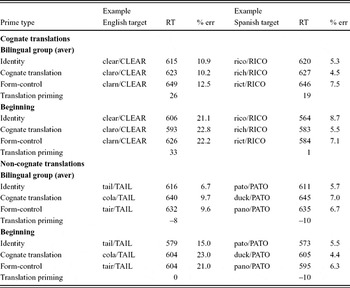
Given that there was no difference in the pattern of priming for early versus later bilinguals, we now examine whether the degree of proficiency with L2 makes a difference. The influence of this factor can be determined by comparing the priming pattern of the bilingual participants to that of the beginning bilingual group (see Table 4 for the summary data for this comparison).
Mean lexical decision times (ms) and percentage error rates for the combined language dominant groups and beginning bilingual group as a function of translation and prime type.

As shown in Table 4, targets preceded by cognate translation primes were responded to faster than those preceded by control primes. This was not the case for the non-cognate primes, where there was a tendency for slower target classification compared to the control primes. The omnibus ANOVA contrasted Language Group (combined bilingual groups versus beginning), translation type (cognate versus non-cognate) and Prime Type (Identity, Translation, Form-control). An effect of language group was found, F 1(1,36) = 4.32, p < .05; F 2(1,264) = 83.89, p < .05, such that the beginning bilingual group was significantly faster than were the combined bilingual groups (this effect seems due to a speed–accuracy trade-off, with the beginning group making considerably more errors, see below). There was no effect of translation type (i.e., no difference in the response times to cognate and non-cognate targets), both Fs < 1. There was a difference between the prime types, F 1(2,72) = 43.74, p < .05; F 2 (2,264) = 17.20, p < .05, and the interaction between translation type and prime type was significant in the participant data, F 1(2,72) = 10.90, p < .05, but failed to reach significance in the item data, F 2(2,264) = 1.79, p > .05. The three-way interaction between translation type, prime type and language group was not significant in the participant analysis, F 1(2,72) = 2.20, p > .05, but was significant in the item analysis, F 2(2,264) = 5.32, p < .05.
The analysis of the error data indicated that there was a significant effect of language group, F 1(1,36) = 28.39, p < .05; F 2(1,132) = 72.49, p < .05, such that the beginning bilingual group made more errors. The effect of translation type was not secure in the item analysis, F 1(1,72) = 4.96, p < .05; F 2 < 1. The effect of prime type was significant, F 1(2,72) = 8.53, p < .05; F 2 (2,264) = 3.28, p < .05. The interaction of translation type and prime type was not significant, F 1(2,72) = 2.60, p > .05; F 2(2,264) = 2.68, p > .05, and nor was the three-way interaction between translation type, prime type and language group in the participant analysis, F 1 < 1; F 2(2,264) = 3.96, p < .05.
As indicated in the Introduction, one prediction from the revised hierarchical model proposal is that translation priming for the beginning group should be less from L2 primes to L1 targets compared to the other prime–target direction. This was investigated by two planned contrasts. The first contrast was to determine whether there was an interaction for the beginning bilinguals between the size of cognate priming and the direction of prime–target translation (i.e., cognate priming should be significantly larger for the L1–L2 prime target direction than for the L2–L1 direction). The second planned contrast was to determine if, for cognate primes, there was an interaction between prime type and language group for L1 targets (i.e., to test whether L2–L1 cognate priming for the bilingual groups was larger than for the beginning group).
The analysis showed that for the beginning bilinguals (with only cognate translation primes), there was an interaction between target language and prime type, F 1(1,18) = 6.39, p < .05; F 2(1,66) = 5.08, p < .05, such that there was larger cognate priming in the L1 prime–L2 target direction than vice versa. The test of whether there was larger cognate priming for the bilingual groups compared to the beginning bilingual group was also significant, F 1(1,36) = 4.57, p < .05; F 2 (1,33) = 3.8, p = .06.
The analysis of the response times for nonword targets revealed that there was no effect of prime type, both Fs < 1. The analysis of the error data revealed a slightly different pattern. The effect of prime type was significant in the participant data (note that this is in the negative priming direction), F 1(1,72) = 4.63, p < .05. However, it was not significant in the item data, F 2(2,268) = 2.72, p > .05.
Discussion
The aim of the experiment was to determine whether the size of cross-language masked priming produced from cognate and non-cognate translation equivalents varied as a function of prime–target direction and language dominance. For the cognate items, a robust cross-language priming effect was found for all of the three bilingual groups. The size of this cognate priming effect did not differ as a function of the direction of prime–target language. This cognate effect was also found for the beginning bilingual (Spanish) group, but only from L1 Spanish primes to L2 English targets. The finding of reliable cognate priming confirms previous findings that have used slightly different methods or tasks (e.g., De Groot and Nas, Reference De Groot and Nas1991; Sánchez-Casas et al., Reference Sánchez-Casas, Davis and García-Albea1992). What is new in the current results is the demonstration that the size of this cognate effect was not modulated by the direction of the prime and target language except for the beginning bilingual group, in which case, priming only occurred in the L1 to L2 prime–target direction. This latter finding is consistent with a developmental version of the revised hierarchical model (Kroll and Stewart, Reference Kroll and Stewart1994), in which beginning bilinguals have the most prominent directional asymmetry in priming because for this group the semantic links between L2 and L1 have not been developed.
The current null non-cognate priming result is consistent with the result of a number of other studies in which the tested languages shared a script (e.g., De Groot and Nas, Reference De Groot and Nas1991; Grainger and Frenck-Mestre, Reference Grainger and Frenck-Mestre1998; García-Albea, Sánchez-Casas and Valero, Reference García-Albea, Sánchez-Casas and Valero1996). This null effect stands in marked contrast to the finding of robust cross-language translation priming when primes and targets do not have the same script (e.g., Gollan et al., Reference Gollan, Forster and Frost1997; Jiang and Forster, Reference Jiang and Forster2001; Finkbeiner et al., Reference Finkbeiner, Forster, Nicol and Nakamura2004). Before we consider how the finding of robust cognate priming and no non-cognate priming might square with the different models of cross-language priming outlined above, an important issue concerning how priming is measured needs to be addressed.
A masked priming effect is estimated against a control condition that is used as a baseline from which to measure priming. De Groot and Nas (Reference De Groot and Nas1991) used a form-unrelated control in both their cognate and non-cognate sets, whereas in the current study a form-related control was used for both. Form-related controls were used for the cognate set in order to try to rule out any direct influence of form. This control type was carried over to the non-cognate set in order to maintain consistency. It was presumed that since all of the targets had relatively large numbers of orthographic neighbors, then form-priming effects would be negligible (see Forster et al., Reference Forster, Davis, Schoknecht and Carter1987). However, ideally, the control prime should be as similar as possible to the experimental prime condition except for the variable of interest (in this case a translation equivalent).
Grainger and Frenck-Mestre (Reference Grainger and Frenck-Mestre1998) have raised another potential problem with the type of baseline used in the current study. These authors suggest that using a nonword prime as the baseline is not the optimal comparison, as the lexical status of the prime may influence target processing irrespective of the relationship between the prime and target (although see Davis, Kim and Forster, Reference Forster and Forster2008, who found that the lexical status of the control prime did not influence responses to targets). Grainger and Frenck-Mestre (Reference Grainger and Frenck-Mestre1998) argue that the appropriate control for a word prime is another word prime. They also point out that it has been shown that primes with language-specific spellings (possibly more likely for the non-cognate primes) can interfere with target processing (e.g., Grainger and O'Regan, Reference Grainger and O'Regan1992; but see Sánchez-Casas and García-Albea, Reference Sánchez-Casas, García-Albea, Kroll and De Groot2005). Given this, it could have been that the non-cognate translation primes produced cross-language interference not present in the form-related control condition. This would have canceled any translation priming facilitation effect measured relative to the control condition.
A related issue concerning baselines has been recently raised by Voga and Grainger (Reference Voga and Grainger2007). They pointed out that in selecting control prime baselines, Sánchez-Casas et al. (Reference Sánchez-Casas, Davis and García-Albea1992) only controlled for orthographic overlap, and that variation in phonological overlap may have affected the results. This view that phonological overlap is important was based on Voga and Grainger's (Reference Voga and Grainger2007) masked translation priming experiments with Greek–French bilinguals tested with Greek primes and French targets. Since Greek and French have different orthographies, cognates were defined in terms of sharing a meaning and having extensive phonological overlap. Due to this, the baselines primes were also selected to control phonological prime/target overlap. Thus it is hardly surprising that the phonological relationship between primes and targets was important in these experiments. The extent to which phonological overlap has a role to play in priming when languages have the same orthography is unclear. However, in the experiments to follow we will report both orthographic and phonological prime and target overlap.
Experiment 2 addressed the non-cognate baseline issue in a partial replication of the first experiment (the variable of L2 experience was not tested) that employed two cross-language word prime baselines; one that was form-related and one was form-unrelated. It should be pointed out, however, that having word form controls (as against nonwords) necessarily restricts the extent to which precise form matching can be achieved.
EXPERIMENT 2
Method
Participants
Twenty-one Spanish/Catalan–English speakers participated in the experiment. All were students or teachers from the Department of English Philology at the Universitat Rovira i Virgili (Tarragona, Spain). Spanish and Catalan were the native languages of all participants. English was learned as a third language after puberty. Participants from this group rated their use of Spanish as greater than Catalan, which was rated as greater than English in the past, and the same was the case for current use. They rated themselves as more competent in Spanish and Catalan than in English, but all of them reported themselves to be competent in English in the linguistic abilities that were asked about (speaking, understanding, reading and writing).Footnote 4
Materials
The Spanish word targets consisted of 64 cognates and 64 non-cognates (defined by the prime translation type). The cognate targets had an average word frequency of 61 words per million and average N of 6.8 (B-Pal corpus; Davis and Perea, Reference Davis and Perea2005). The average word frequency of the Spanish non-cognate targets was 105 words per million, and these targets had an average N of 7.2. The differences between the frequencies for the Spanish cognate and non-cognate targets was not significant, F(1,63) = 2.94, p > .05. Importantly, there was no difference in the number of N of the cognate and non-cognate targets, F < 1. For the cognate and non-cognate sets, four different types of word primes were used: repetition, translation, form-relatedFootnote 5 and form-unrelated controls (apart from the repetition prime, all the other word primes were English words). The cognate primes had an average log word frequency of 9.5 (HAL; Balota et al., Reference Balota, Yap, Cortese, Hutchison, Kessler, Loftis, Neely, Nelson, Simpson and Treiman2007) and average orthographic neighborhood size of 6.6. Cognate primes and targets had an average absolute orthographic overlap of 65% and an absolute phonological overlap of 45%. The form-related word primes had an average frequency of 9.2 (HAL; Balota et al., Reference Balota, Yap, Cortese, Hutchison, Kessler, Loftis, Neely, Nelson, Simpson and Treiman2007) and average orthographic neighborhood size of 6.9. The form-related primes and targets had average absolute orthographic overlap of 48% and an absolute phonological overlap of 27%. The form-unrelated prime words had no absolute (letter-specific) orthographic or phonological overlap with their targets. The non-cognate primes had an average log word frequency of 10.2 (HAL; Balota et al., Reference Balota, Yap, Cortese, Hutchison, Kessler, Loftis, Neely, Nelson, Simpson and Treiman2007) and average orthographic neighborhood size of 6.6. The non-cognate form-related word primes had an average frequency of 9.6 (HAL; Balota et al., Reference Balota, Yap, Cortese, Hutchison, Kessler, Loftis, Neely, Nelson, Simpson and Treiman2007) and average orthographic neighborhood size of 8.2.
The English targets consisted of 64 cognate and 64 non-cognate targets. The cognate targets had an average log word frequency of 9.5 (HAL; Balota et al., Reference Balota, Yap, Cortese, Hutchison, Kessler, Loftis, Neely, Nelson, Simpson and Treiman2007) and an average N of 6.4. The non-cognate targets had an average log word frequency of 10 (HAL; Balota et al., Reference Balota, Yap, Cortese, Hutchison, Kessler, Loftis, Neely, Nelson, Simpson and Treiman2007) and average N of 6.7. The differences between the frequencies for the English cognates and non-cognate targets was not significant, t(126) = 1.89, p = .06. Once again, there was no difference in the average number of N of the cognate and non-cognate targets, t(126) = 0.38, p > .5. For the cognate and non-cognate sets, four different types of word primes were used: repetition, translation, form-related and form-unrelated controls (apart from the repetition prime, all the other word primes were Spanish words). The cognate primes had an average word frequency of 61 per million (Davis and Perea, Reference Davis and Perea2005). Cognate primes and targets had an average absolute orthographic overlap of 65% and an absolute phonological overlap of 45%. The form-related word primes had an average frequency of 42 per million (Davis and Perea, Reference Davis and Perea2005). The form-related primes and targets had average absolute orthographic overlap of 56% and an absolute phonological overlap of 37%. The form-unrelated prime words had no absolute orthographic or phonological overlap with their targets.
One hundred and twenty-eight Spanish and 128 English legal nonwords targets were also created (these were length matched with the word targets). As with Experiment 1, the Spanish and English nonword targets were arbitrarily divided into two sets to mimic cognate and non-cognate sets. Each of these was preceded by primes in a repetition condition, a cognate or non-cognate condition (defined only by form overlap) and the form-related and form-unrelated baselines. Four versions of the experiment were constructed for the targets of each language (so that each target could appear in each of the priming conditions, without being repeated within a version). A set of practice items was constructed for the English targets (half word targets, half nonwords), and another set for the Spanish targets, and each set preceded the appropriate version.
Procedure and data treatment
The same procedure as used in Experiment 1 was used, with participants completing both the Spanish and the English versions of the current experiment. Since the target words in the Spanish and English versions were translation equivalents, participants were tested on each on different days. Half of the participants were tested on the Spanish version first and the other half on the English version first. The assignment of the participants to each order (Spanish–English vs. English–Spanish) was randomized. As in Experiment 1, data corresponding to incorrect responses were discarded from the analysis and reaction times more than two standard deviation units above or below the mean for that participant in all conditions were trimmed to the appropriate cut−off value to moderate the influence of outliers. Any participant who made more than 15% errors was replaced.
Results and discussion
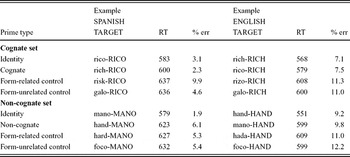
The results of the second experiment for the cognate and non-cognate sets for the word targets are shown in Table 5. As can be seen from Table 5, the results are very similar to those of the first experiment. Taking the Spanish and English data together, it was found that there was a significant difference in the speed for which correct word decisions were made to the Spanish (615 ms) and English targets (589 ms), F 1(1,51) = 5.47, p < .05; F 2(1,232) = 39.92, p < .05. There was also a difference in the number of errors for the different language targets, F 1(1,34) = 13.74, p < .05; F 2(1,240) = 26.35, p < .05, such that the Spanish targets attracted fewer errors (4.8% vs. 9.9%). The pattern of response times and errors suggest that a speed–accuracy trade-off occurred, with the faster response to the English targets accruing more errors. There was a significant cognate priming effect, F 1(1,17) = 37.82, p < .05; F 2(1,120) = 28.8, p < .05, that did not interact with the variable of target language, both Fs < 1. There was no non-cognate priming, F 1(1,17) = 2.87, p > .05; F 2(1,120) = 1.14, p > .05.
Mean lexical decision times (ms) and percentage error rates for cognate and non-cognate translation equivalents as a function of target language and prime type.

Considering the priming results for each language separately shows that there was robust cognate priming, for both the Spanish targets as measured against the form-related baseline, F 1(1,17) = 21.15, p = .05; F 2(1,60) = 12.70, p < .05 and the English targets, F 1(1,17) = 19.99, p < .05; F 2(1,60) = 16.24, p < .05. For the Spanish targets there was no non-cognate priming as measured against the form-unrelated baseline, F 1(1,17) = 1.47, p > .05; F 2(1,60) = 1.53, p > .05. The same null non-cognate priming effect was found for the English targets, F 1(1,17) = 2.50, p < .05; F 2 < 1. There was no difference between the form-related and form-unrelated baselines, either for the Spanish targets (both Fs < 1) or the English targets (both Fs < 1). This result indicates that the type of form-control used for the non-cognate targets in Experiment 1 was unlikely to have produced any spurious effect. Finding no difference between the form-related and form-unrelated baseline conditions is consistent with the result that high N targets do not produce form priming (e.g., Forster et al., Reference Forster, Davis, Schoknecht and Carter1987). The final result to mention concerns whether targets that were repetition primed were responded to faster than those that were cognate primed. For the Spanish targets, repetition primed targets were faster than the cognate primed ones. However, this difference was only significant for the participant-based analysis, F 1(1,17) = 6.0, p < .05; F 2(1,60) = 1.86, p > .05. The same pattern was found for the English targets, F 1(17) = 6.2, p < .05; F 2(1,60) = 1.71, p > .05.
The results of Experiment 2 have confirmed the pattern of cognate and non-cognate priming observed in Experiment 1. The finding that in the LDT, cross-language masked translation priming occurs for cognate but not non-cognate translations for languages that share orthography obviously requires an explanation that takes orthographic form into account. The simplest model is an interference account, in which a potential priming effect generated at the semantic level is abolished by interference generated by mismatching inputs at the orthographic level. To explain the difference between the robust priming for cognate translation versus the null effect for non-cognates, it could be assumed there is very little interference when the primes were related in form (i.e., cognate primes and targets). This account also provides a straightforward explanation for why there is priming for translation equivalents that do not have the same orthography (since with different scripts no interference is generated). A problem with this account is that there was no difference between the two types of control prime (form-related and unrelated) that differed in the extent to which the primes were form-related to the targets. That is, if orthographic mismatches between the primes and targets caused interference, then this should have resulted in a difference between the two baselines. To address this difficulty, it could be suggested that priming occurs at the semantic level and that form-based (orthographic) interference acts to reduce this; since the form controls do not share semantics with their targets there is no priming and hence nothing to reduce.
An alternative account can be constructed that does not require form-based orthographic inhibition to explain the difference between cognate and non-cognate priming. In this account, masked cognate priming occurs because cognate translations have a special connection with their cross-language translation equivalents; a connection that transcends each language-specific lexicon. This idea of supralexical connections between cognate translations has similarities to that proposed by Giraudo and Grainger (Reference Giraudo, Grainger, Baayen and Schreuder2003) in regard to morphological representation. In this proposal, root morphemes are represented amodally, so that they are activated by all words that have that root. In a similar fashion, the representation of cognate words is independent of language, such that they could be activated by any word in either language that shared a common etymology (how exactly this is defined in practice would need to be determined).
The idea that cognate translations have a supralexical connection explains the pattern of masked cognate and non-cognate translation priming in the following way. In a masked priming experiment, participants are only aware of the language of the targets, that is, from the participant's perspective, the experiment tests only one of their languages (the target words in a test session belong to a single language). Gollan et al. (Reference Gollan, Forster and Frost1997) have suggested that this creates a bias towards accessing words from the target language, which prevents the rapid and sustained processing of the other language translation primes. This bias toward the language of the target will slow the bottom-up activation of non-cognate prime information but because cognates are represented supralexically they will not be as affected. To explain non-cognate priming when primes and targets are in different orthographies, it would need to be assumed that the different script of the prime provides a strong language-specific cue that permits unrestricted access to this lexicon (see Gollan et al., Reference Gollan, Forster and Frost1997).Footnote 6
It should be clear that this explanation applies to conditions specific to masked priming, where, for priming to occur, prime information must be activated quickly and strongly enough to assist target processing (see Kim and Davis, Reference Kim and Davis2003). Indeed, if primes where presented for a longer period of time then same-script non-cognate priming might be expected (e.g., De Groot and Nas, Reference De Groot and Nas1991; Williams, Reference Williams1994).
The following experiment examined the above accounts of cross-language priming by examining whether the size of any cognate priming effect is modulated by the orthographic overlap of the prime and target (a key feature of the interference account). That is, if the priming due to semantic overlap is reduced when prime and target letters mismatch, then the size of any cognate priming should be reduced if only a few prime and target letters match.
EXPERIMENT 3
Experiment 2 showed that targets preceded by cognate primes were responded to faster than form-related controls. However, due to the restriction that only word primes were selected as controls, it was not possible to completely match the degree of both orthographic and phonological overlap for the cognate and control conditions. It is possible that form priming is not linear and that large increases in priming might occur with small increments in form relatedness once a certain limit in relatedness has been exceeded.
The current experiment was designed to circumvent problems associated with a form-matched control condition by comparing cognate priming with repetition priming, for in this way the specific effects of a mismatch between the prime and target forms can be determined. In this regard, the results of Experiments 1 and 2 are interesting as it was found that in Experiment 1 the size of cognate priming was not significantly different from the repetition priming effect (there was a reduction for cognate priming in Experiment 2, but this was not significant in the item analysis). In this experiment, to really push the repetition versus cognate contrast, we selected cognate translation primes and targets for which there was considerably less position-specific orthographic and phonological overlap than in Experiments 1 and 2.
This experiment once again also examined whether priming from non-cognate primes differed from a form-unrelated baseline. Once again the control primes were words (e.g., the non-cognate prime vida preceded the English target LIFE and was compared with the form-matched Spanish word cita preceding that same target). In order that responses to the non-cognate targets were comparable to the cognate ones, non-cognate targets were selected that have a higher word frequency than the cognates, as Lemhöfer, Dijkstra and Michel (Reference Lemhöfer, Dijkstra and Michel2004) have suggested that the language-specific word frequency of cognates is underestimated.
In summary, then, to examine whether cognate primes produce a similar response time advantage as do repetition primes, response times for targets preceded by cross-language cognate primes will be compared with those preceded by within-language repetition primes. To determine whether any response facilitation accrues to targets preceded by non-cognate primes, response times for targets preceded by cross-language non-cognate primes were compared to those preceded by semantically unrelated form-control primes.
Method
Participants
Fourteen Spanish–English bilingual participants were chosen on the basis of information about their language history obtained using the same questionnaire as Experiment 1. Unlike in Experiment 1, they were not selected with respect to their language dominance, but all rated their current competency in both English and Spanish as “good”. Although the profile of these bilinguals was similar to the Spanish dominant group in Experiment 1 (this prime–target direction should not be a factor in priming), it was decided that presenting targets in L2 would maximize any potential priming effects.
Materials
Sixty English words were selected as word targets in order to form two sets of translation equivalents, i.e., a cognate and a non-cognate set. The cognate targets had an average log word frequency of 9.5 (HAL; Balota et al., Reference Balota, Yap, Cortese, Hutchison, Kessler, Loftis, Neely, Nelson, Simpson and Treiman2007), an average length of 4.6 letters, an average orthographic N of 6.2 and an average phonological N of 17.2. The non-cognate targets had an average log word frequency of 10.3 (HAL; Balota et al., Reference Balota, Yap, Cortese, Hutchison, Kessler, Loftis, Neely, Nelson, Simpson and Treiman2007), an average length of 4.5 letters, an average orthographic N of 7.0 and an average phonological N of 16.4. The frequencies of the non-cognate targets were significantly higher than those of the cognates, t(58) = 2.233, p < .05. There was no difference in the number of orthographic or phonological neighbors of the cognate and non-cognate targets, t(58) = 0.54, p > 0.05; t(58) = 0.32, p > .05, respectively. The conditions were, for the cognate set: (a) a repetition condition, in which the English target word was preceded by itself (e.g., tower/TOWER); and (b) a cognate translation condition, where the target was preceded by its translation (e.g., torre/TOWER). The average orthographic overlap was 49% and the average phonological overlap 44%. For the non-cognate set, the conditions were: (a) a non-cognate translation condition, where the target was preceded by its translation (e.g., vida/LIFE), with an average number of absolute overlapping letters between prime and target of 0.4 letters; and (b) a control condition, where the targets were preceded by a word which had the same form overlap as the non-cognate translation pairs (e.g., cita/LIFE).
Sixty nonwords were used as foils in the experiment. These nonwords were constructed in accordance with the orthographic constraints of English and were length matched with the words. Two versions of the experiment were constructed, so that each target would appear in each of the priming conditions without being repeated within a version. In order that the nonword conditions mirror the word target conditions, it was decided that the form relationships between prime and target would be kept the same for the nonword set, i.e., a repetition condition (e.g., tiden/TIDEN), a pseudo-cognate condition (e.g., tipan/TIDEN), a pseudo-non-cognate condition (e.g., bito/TASH) and a control condition (e.g., deno/TASH). A set of 10 practice items was constructed to precede the experiment proper.
Procedure
The procedure was identical to that used in the preceding experiments, except that in this experiment only English words were used as targets, since the results from the first experiment showed that there were no significant effects of the language of test for bilinguals with this level of language experience. Similarly, no separation was made between types of bilingual participants (i.e., English dominant, Spanish dominant and balanced bilinguals), since in Experiment 1 the pattern of priming effects was the same across all these bilingual groups.
Results and discussion
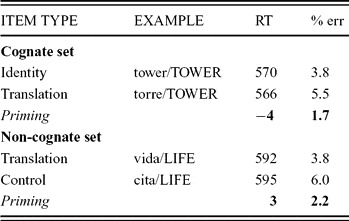
The mean participant latencies and percentage error rates for the repetition and cognate translation conditions are presented in Table 6. It can be seen that there was little difference between the cognate condition and the repetition priming condition (4 ms). This difference was not significant, both the participant and item F-ratios < 1. This seems a noteworthy result given that the primes and targets in the cognate condition shared less than half of their letters, and it certainly does not fit with the notion that priming is simply the sum of all the activated lexical codes shared by the prime and target. Furthermore, this result undermines the idea that the null non-cognate priming effect was due to mismatching letters from the prime and target reducing the size of any semantic priming. It is also worth noting that Sánchez-Casas, García-Albea and Igoa (Reference Sánchez-Casas, García-Albea and Igoa2003) have shown that robust within-language masked morphological priming shows a similar lack of sensitivity to the degree of form overlap between prime and target (see also Domínguez, Segui and Cuetos, Reference Domínguez, Segui and Cuetos2002, for similar results).
Mean lexical decision times (ms) and percentage error for the cognate and non-cognate translations as a function of prime type.

Also depicted in Table 6 are the mean participant latencies and percentage error rates for the non-cognate condition and its respective control. Targets preceded by their non-cognate translation were responded to on average 3 ms faster than when they were preceded by a control prime. This difference was not significant for latencies, F 1(1,12) = 2.11, p > .05; F 2 < 1, or for errors, both Fs < 1. Given that the non-cognate targets had a higher word frequency than the cognates, it might have been expected that they would have elicited faster responses. This was not the case, and indeed the cognate targets were responded to more quickly. This pattern supports the interpretation that the cognate targets were in fact primed by their respective repetition and translation primes, whereas the non-cognate targets were not (see Sánchez-Casas, Guasch, Ferré and Esteban, Reference Sánchez-Casas, Guasch, Ferré and Esteban2007, for a similar pattern of results with Spanish–Catalan cognate and non-cognate words).
The current results concur with those of Experiments 1 and 2, in that they also failed to find a non-cognate priming effect. It is of interest to note that data from the parafoveal-viewing paradigm, which uses rapidly presented displays to keep attentional processing to a minimum, also has suggested that the activation of semantic codes alone is not sufficient to benefit lexical processing. For example, Altarriba, Pollatsek and Rayner (Reference Altarriba, Pollatsek and Rayner1992) have found that the naming of target words by bilingual participants was speeded up only by cognate translation previews.
As in the previous experiments, no significant priming effects were found for the nonword targets. In this regard, the comparison of most interest is between the repetition condition and the pseudo-non-cognate baseline (where the prime and the target have different letters). There was no priming F 1(1,12) = 3.82, p > .05; F 2(1,28) = 2.84, p > .05 for the latency data, and F 1(1,12) = 1.48, p > .05; F 2(1,28) = 1.66, p > .05 for the error data.
General discussion
Masked priming provides a window into the very earlier stages of word processing (it is presumed to tap pre-existing memory representation (see Davis, Kim and Forster, Reference Davis, Kim and Forster2008), which would explain why there were no priming effects for nonword targets in the current experiment). Priming occurs if the processes set off by the prime can rapidly influence those used in processing and generating a task-relevant decision to the target (see Kim and Davis, Reference Kim and Davis2003). It is in this regard that we have used masked translation priming to examine the initial stages of cross-language bilingual lexical processing when using the LDT as the response measure.
The results showed that the masked priming effects for cognate and non-cognate translations differed. For cognate translations, it was found that there was robust translation priming that did not differ in size from the within-language repetition priming. Moreover, it was not diminished by limited prime–target letter position-specific form overlap. This cognate priming effect was symmetrical as a function of the direction of prime–target language except for beginning bilinguals, where robust cognate priming occurred only when the prime was in L1 and the target in L2. There was no priming for non-cognate translations. These results require an explanation in terms of processing mechanisms (or the manner in which lexical items are represented) that can distinguish cognate and non-cognate translation types. In what follows we consider different ways that this might be accomplished so that cognate but not non-cognate priming is produced.
As outlined earlier, the senses model of Finkbeiner et al. (Reference Finkbeiner, Forster, Nicol and Nakamura2004) accounts for different magnitude priming effects in terms of the relative number of L1 and L2 semantic representations. Priming will be unreliable if an L1 target has many senses not picked out by an L2 prime (since the prime may fail to activate the appropriate L1 lexical semantic representation). For this mechanism to explain the finding of robust cognate but no non-cognate priming, it would need to be the case that these translation types that differ in terms of form overlap also systematically differ in the distribution of cross-language sense overlap. The determination of sense overlap for the current materials is beyond the scope of the present study. However, in a large-scale rating study of the properties of 562 Dutch–English translation pairs, Tokowicz, Kroll, De Groot and Van Hell (Reference Tokowicz, Kroll, Groot and Van Hell2002) found that ratings of semantic similarity (a measure correlated with the number of translations a word had) were not correlated with ratings of form similarity. This suggests that cognate and non-cognate translation types do not necessarily differ in their pattern of cross-language sense overlap.
The other model that was brought up in the Introduction proposed that target priming occurs due to the semantic activation provided by the L2 prime. Under this model, differences in the strength of priming occur due to differences in the degree to which primes can activate conceptual representations. Following the framework of the revised hierarchical model (Kroll and Stewart, Reference Kroll and Stewart1994), this model has the capacity to explain why there was only L1 to L2 cognate priming for the beginning bilinguals, since it proposes that connections between L1 representations and their concepts is stronger than those of L2. The finding that, for the bilingual groups, the size of cognate priming for both prime target language directions was symmetrical, could be explained in terms of these readers having obtained equal strength L1 and L2 semantic connections.
A problem with this model is that because priming is determined by the strength of semantic connections, it is not clear how the difference in the effectiveness of cognate and non-cognate primes might be explained. It could simply be stipulated that the connection between non-cognate translations are weak or non-existent (therefore producing no priming). However, it would be more satisfactory if there were some reason for why this should be the case. One possibility is that in the case of cognate primes and targets, semantic priming is supplemented by additional form priming. That is, unlike non-cognate translation equivalents, cognate translations share both form and meaning, so it is possible that the cognate priming effect simply consists of combined form and semantic priming effects.
This proposal seems unlikely on several grounds. First, there was no evidence of any form priming in the above experiments, so it is unclear how form overlap per se would make any contribution in the cognate case (especially since masked semantic priming effects are also weak; see Perea and Gotor, Reference Perea and Gotor1997). Additionally, the cognate priming effect did not vary in size as a function of the amount of form overlap (Experiment 3). This seems an unexpected finding if form priming was involved in the cognate priming effect. Furthermore, García-Albea, Sánchez-Casas and Valero (Reference García-Albea, Sánchez-Casas and Valero1996) have directly investigated the extent to which form and meaning overlap contribute to cross-language priming effects. They examined masked priming with high proficiency Catalan–Spanish bilinguals and tested three types of prime–target relations: cognate pairs (e.g., cotxe–coche), non-cognate pairs (e.g., gàbia–jaula) and so-called “false friends” that were similar in form but had totally different meanings (e.g., curta–curva). Repetition, translation and orthographical and phonological controls were tested and only significant cognate priming was found (see also Sánchez-Casas and García-Albea, Reference Sánchez-Casas, García-Albea, Kroll and De Groot2005).
Although the idea that cognate priming is simply the sum of form and semantic priming effects has problems, it is evident that any difference between cognate and non-cognate primes must involve the additional form relationship that cognate translations share. Rather than the cognate primes simply generating form priming, it could be that the additional priming for cognate translations is due to the way that these are represented. The idea that the association between different elements of form and meaning plays a role in the way the lexicon is structured has a long history and still informs recent investigations. Indeed, in a series of recent articles, Marslen-Wilson and colleagues (e.g., Marslen-Wilson, Bozic and Randall, in press; Marslen-Wilson and Tyler, Reference Marslen-Wilson and Tyler2007; Bozic, Marslen-Wilson, Stamatakis, Davis and Tyler, Reference Bozic, Marslen-Wilson, Stamatakis, Davis and Tyler2007) have produced evidence that morphological properties provide an independent principle for lexical organization that cannot simply be reduced to the joint contribution of form and meaning.
Sánchez-Casas and García-Albea (Reference Sánchez-Casas, García-Albea, Kroll and De Groot2005) have taken the proposal that morphological relations play a role in the structuring of the lexicon and applied it to the bilingual case by arguing that the representation and processing of cognate translations can be characterized in morphological terms. More specifically, they suggested that cognate translations are jointly represented in the bilingual lexicon. The following will outline how aspects of the current results can be accounted for by such a proposal, and also describe other evidence for the view that cognate priming is more than simply the sum of form and semantic priming.
The joint listing proposal is consistent with the current finding that cognate priming is of the same magnitude as repetition priming (this is because either cognate translation can open the joint entry). It also explains why there is no priming effect between non-cognate translations; as these are listed separately, the prime and target open separate entries and so no priming will eventuate. Moreover, since either cognate term can open the joint entry, the direction of prime–target translation would not have a differential effect, as was the case. Indeed, joint listing also explains why the order of language acquisition made no difference to the production of a priming effect; once a joint entry has been formed either cognate term can access it.
The idea of cognate joint listing is also consistent with other results. For example, if cognate translations are more closely connected than non-cognate ones, it would be expected that cognate word translation would be faster. This was the pattern that Sánchez-Casas et al. (Reference Sánchez-Casas, Davis and García-Albea1992) found for the speeded single word translation task. Further, the cognate cases were not affected by the direction of the translation (e.g., from Spanish to English or vice versa), whereas this had an effect for the non-cognate cases. Further evidence for a shared representation for cognates comes from the finding that lexical decision times for the non-dominant language of a bilingual are faster for cognates than for non-cognate frequency-matched control words (Caramazza and Brones, Reference Caramazza and Brones1979; Lalor, Reference Lalor1996; Dijkstra, Van Jaarsveld and Ten Brinke, Reference Dijkstra, Van Jaarsveld and Ten Brinke1998; Van Hell and De Groot, Reference Van Hell and De Groot1998). This result would be expected if cognate frequency was the summed frequencies of use in the separate languages.
How might the greater similarity or connection between cognate translations be modeled? At a general level it could simply be proposed that form and meaning relationships are taken into account in language learning. One example of this is the model of word recognition proposed by Kirsner, Lalor and Hird (1993). This model is based upon the idea that words that share both form and meaning will undergo conjoint learning, so that when practice makes the processing of one word more fluent, other related words will also benefit. This notion of related words forming a type of group or morphological “paradigm” has recently been extended to the case when a person learns another language, that is, cognate translations are viewed as a morphological relation of a special kind (see Lalor, Reference Lalor1996; García-Albea et al., Reference García-Albea, Sánchez-Casas, Igoa and Hillert1998; Sánchez-Casas and García-Albea, Reference Sánchez-Casas, García-Albea, Kroll and De Groot2005).
A more direct way of capturing cognate relations can be achieved by proposing changes to existing models of bilingual lexical processing. For example, Kroll and De Groot (Reference Kroll, De Groot, Groot and Kroll1997) have proposed a model that incorporates a language-independent (shared) lexical-feature level of representation that contains information specifying the form of words, and a conceptual-feature level that represents aspects of meaning. The connection between cognate translations could be captured by shared features at both the lexical and conceptual levels of representation. This suggestion, however, suffers from the problem that cognate priming would simply be the sum of form and meaning priming (and as described above, both of these effects are very weak). To generate robust cognate priming it would be necessary for there to be feedback and reinforcement between the form and semantic representations so that super-additive effects can be produced (see Kim and Davis, Reference Kim and Davis2001, for a similar suggestion).
Another possibility as to how robust and specific cognate priming could be produced is via a morphological level of representation in which cognate translations would be jointly represented. For example, in the Kroll and De Groot (Reference Kroll, De Groot, Groot and Kroll1997) model, this additional lexical level could be located between the form level, representing orthographic and phonological features, and the lemma level. This proposed morphological level would supplement the functioning of the existing model because it would enable information about morphological structure to be provided to the lemma level.
Cognate priming effects could also be modeled in the BIA model of bilingual lexical processing (Dijkstra and van Heuven, Reference Dijkstra, van Heuven, Grainger and Jacobs1998). This model is based upon the Interactive Activation framework introduced by McClelland and Rumelhart (Reference McClelland and Rumelhart1981). Once again, what is needed is a level of representation that captures the quasi-regular properties of word form that consistently map to meaning (i.e. a “morphemic” level). Cognate priming in this model could result in the following way. When a prime is presented, activated letter nodes in turn activate the words in the two languages that share these letters (other words will be inhibited). The activated word nodes will activate nodes at the morphemic level. Activated morphemic nodes will then send activation back to the nodes representing the cognate words of both languages. Thus a target word that has a link to the common morphological node will have been pre-activated by the prime and so cognate priming will be produced.Footnote 7
It should be noted that because the above two models do not literally joint-list the representation of cognates they are in a better position to explain the asymmetric pattern of cognate priming shown by the beginning bilinguals in Experiment 1 compared to an account where cognates have a single common representation. This is because the listing of cognate terms in a common entry would seem to predict symmetrical priming, whereas having morphological representations linked to the different language word forms allows for the development of different strength connections (e.g., Kroll and Stewart, Reference Kroll and Stewart1994).
In conclusion, the results reported in the present paper indicate that, in languages that have the same script, the type of cross-language translation (cognate versus non-cognate) plays a major role in the pattern of cross-language masked priming. This finding is consistent with the view that lexical processing and representation are shaped by the occurrence of consistent patterns that occur between form and meaning that capture in some way both the morphological and cognate relationships that occur within and across languages.