Introduction
Children of parents with unipolar disorder (UD) and bipolar disorder (BD) are at increased risk of developing mental illnesses (Beardslee, Gladstone, & O'Connor, Reference Beardslee, Gladstone and O'Connor2011; Rasic, Hajek, Alda, & Uher, Reference Rasic, Hajek, Alda and Uher2014). Genetic vulnerability and early traumatic life events are well-known risk factors associated with the onset and severity of UD (Hovens, Giltay, Spinhoven, van Hemert, & Penninx, Reference Hovens, Giltay, Spinhoven, van Hemert and Penninx2015) and BD (de Codt, Monhonval, Bongaerts, Belkacemi, & Tecco, Reference de Codt, Monhonval, Bongaerts, Belkacemi and Tecco2016). Emerging evidence suggests that subtle adversity in mother–infant interactions could also play a role in the intergenerational transmission of risk. Acute postpartum depression may be an example of such adversity, since the mother's emotional expressions are blunted and her behavior toward the infant can be withdrawn or intrusive (Aktar, Colonnesi, de Vente, Majdandzic, & Bogels, Reference Aktar, Colonnesi, de Vente, Majdandzic and Bogels2017; Field, Hernandez-Reif, & Diego, Reference Field, Hernandez-Reif and Diego2006). But no study has investigated whether symptomatically stable mothers with UD or BD display deficits in interactions with their infants.
Infant stimuli receive prioritized processing in the maternal brain (Parsons, Young, Stein, & Kringelbach, Reference Parsons, Young, Stein and Kringelbach2017b). Moreover, duration of motherhood has been associated with enhanced neural processing of infant sounds, which could indicate neurocognitive adaptation to motherhood (Parsons et al., Reference Parsons, Young, Petersen, Jegindoe Elmholdt, Vuust, Stein and Kringelbach2017a, Reference Parsons, Young, Stein and Kringelbach2017b). These adaptations could underlie mothers' sensitive behavior toward their infants and thus be fundamental for infant emotion regulation (Fonagy, Reference Fonagy2018). These abilities may be compromised in mothers with UD and BD because of illness-related neurocognitive emotion processing abnormalities in these mood disorders (Miskowiak & Carvalho, Reference Miskowiak and Carvalho2014; Redhead, Jordan, Ferrier, & Meyer, Reference Redhead, Jordan, Ferrier and Meyer2016). Specifically, negative cognitive bias – including enhanced attentional processing and recognition of negative emotional expressions, and negative interpretation of emotional expressions – has been observed in symptomatic and remitted patients with UD (Miskowiak & Carvalho, Reference Miskowiak and Carvalho2014). Accordingly, emerging research on mothers with postpartum depression indicates a negative bias in the cognitive processing of infant emotional stimuli (Webb & Ayers, Reference Webb and Ayers2015),and one study reported avoidance of negative infant faces (Webb & Ayers, Reference Webb and Ayers2019). No study has investigated whether this negative bias is present in mothers with UD in remission. BD is accompanied by impaired facial expression recognition and emotion regulation across symptomatic and remitted states (Miskowiak et al., Reference Miskowiak, Seeberg, Kjaerstad, Burdick, Martinez-Aran, del Mar Bonnin and Vieta2019). Additionally, emerging evidence indicates positively biased emotion processing in BD, including enhanced attention toward positive words following positive mood induction (Roiser et al., Reference Roiser, Farmer, Lam, Burke, O'Neill, Keating and McGuffin2009) and lower ability to down-regulate positive emotional states (Gruber, Reference Gruber2011). No study has investigated whether symptomatic or remitted mothers with BD show atypical cognitive responses to infant signals.
The present study aimed to investigate whether mothers with UD and BD in full or partial remission exhibit atypical cognitive and psychophysiological responses to emotional infant signals compared with healthy mothers. We also investigated the association between maternal responses to infant signals and deficits in mother–infant interactions and infant development. Although this research field is still in its infancy, we defined four hypotheses based on the existing result presented above. We hypothesized that in comparison with healthy mothers: (I) mothers with mood disorders in full or partial remission would show blunted cognitive and psychophysiological responses to emotional infant stimuli, as reflected by less time spent gazing and fixating and decreased galvanic skin responses (GSR); (II) mothers with BD would in addition display a positive cognitive bias, as reflected by more positive facial expressions to and ratings of infant stimuli; (III) mothers with UD would show a negative cognitive bias, as reflected by more negative facial expressions to and ratings of infant stimuli. Finally, we hypothesized that (IV) atypical psychophysiological and cognitive responses to infant stimuli would be associated with more deficits in mother–infant interactions and delayed infant development. The study explores whether non-conscious behavioral and psychophysiological measures (i.e. eye-tracking, GSR, and facial expression analyses) can help elucidate important features of maternal cognitive processing of emotional infant stimuli. This research will increase the scientific understanding of psychological factors involved in intergenerational transmission of risk.
Methods
Participants
Participants were recruited during pregnancy or shortly after birth. Most mothers with BD were recruited by their consultant at psychiatric centers in the Capital and Northern Regions of Denmark. Mothers with UD and healthy control (HC) mothers were recruited by obstetricians or nurses at the Department of Obstetrics and Gynecology, Hvidovre Hospital. UD and bipolar diagnoses were made according to ICD-10 criteria for recurrent major depression or dysthymia, and for BD with subdivision into BD type I, II, or BD unspecified (see Table 1). For mothers with BD and UD, this diagnosis was made initially by a clinician and subsequently verified with the Mini International Neuropsychiatric Interview (MINI) (Sheehan et al., Reference Sheehan, Lecrubier, Sheehan, Amorim, Janavs, Weiller and Dunbar1998). At the time of testing, mothers had to be in full or partial remission defined by scores of ⩽14 on the Hamilton Depression Rating Scale 17 items (HDRS-17) (Hamilton, Reference Hamilton1967) and the Young Mania Rating Scale (YMRS) (Young, Biggs, Ziegler, & Meyer, Reference Young, Biggs, Ziegler and Meyer1978). Exclusion criteria for HC mothers were personal history of mental illness (confirmed with MINI), current alcohol or substance abuse (defined by ICD-10 F1X.1 or F1X.2 criteria), and first-degree relative history of psychiatric disorder. Mother–infant pairs were excluded in case of infants born with Downs syndrome, cerebral palsy, or other neurological illnesses expected to impact mother–infant interaction and early development. The project was approved by the local ethics committee in the Capital Region of Denmark (ID: H-17009045) and by the Danish Data Protection Agency Capital Region of Denmark (ID: RHP-2017-024; I-Suite: 05603). Written informed consent was obtained from all mothers and co-parents (as available), and the study was conducted in accordance with the Declaration of Helsinki.
Demographics, mood symptoms, medication, and infant characteristics in mothers with BD and UD compared with HC mothers

BD, bipolar disorder; UD, unipolar disorder; HC, healthy control; MD, mood disorder; HDRS, Hamilton Depression Rating Scale; YMRS, Young Mania Rating Scale; GA, gestational age; CS: Cesarean section; NA: not applicable.
Group differences were investigated with χ2 tests for categorical data and one-way ANOVA for numerical data with score as within-subject factors and group comparison as between-subjects factor, *p values for main effect of group. Values display means and standard deviations (s.d.) for normally distributed data and medians and full range (R) or number and percent for non-normally distributed data.
Power calculation
One of the primary outcomes is maternal sensitivity assessed with the Coding Interactive Behavior Manual (Feldman, Reference Feldman1998). In a previous study of mothers with depression (Feldman et al., Reference Feldman, Granat, Pariente, Kanety, Kuint and Gilboa-Schechtman2009), there was a difference between depressed and control mothers (mean ± s.d.): depressed: 3.2 ± 0.8, healthy 4.1 ± 1.0. Based on this, we aimed to detect a minimal difference of 1.0 between groups. We estimated the s.d. to be 1.0. Using a two-sided α = 0.05 we had to include N = 22 per group to obtain 90% power (http://www.stat.ubc.ca/~rollin/stats/ssize/n2.html). Expecting a drop-out rate of 25%, we had to include N = 30 per group. This sample size also provides sufficient statistical power for the detection of between-group differences in cognitive response to emotional stimuli (Miskowiak et al., Reference Miskowiak, Glerup, Vestbo, Harmer, Reinecke, Macoveanu and Vinberg2015).
Procedure
Mothers and their infants were assessed on one occasion approximately 4 months after birth (mean infant age at home-visit: 4.13 months, S.D.: 0.62) during a 4 h home-visit. Mothers were interviewed with the MINI, HDRS-17, and YMRS by a trained MSc in psychology (AJB) and completed computerized emotional cognitive tasks during which their facial expressions, GSR, gazes, and fixations were recorded. Infant developmental assessment and mother–infant interaction video-recording were conducted when the infant was fed and well-rested.
Emotional infant stimuli
Two infant video clips, a ‘distress’ and a ‘laughter’ video, of each 28 s were shown once to the mothers in a randomized counterbalanced order. The ‘distress video’ displays a 4-month-old infant crying heavily, unattended by a caregiver. The ‘laughter video’ displays a mother and her quadruplets all laughing continuously. Mothers were instructed to watch the videos passively.
Mothers were then asked to rate 50 color infant face-images [same stimuli as in Parsons et al. (Reference Parsons, Nummenmaa, Sinerva, Korja, Kajanoja, Young and Karlsson2019)] and 50 infant vocalizations obtained from the OxVoc database, a validated set of infant emotional stimuli that contains recordings from real-life parent–infant interactions (Parsons, Young, Craske, Stein, & Kringelbach, Reference Parsons, Young, Craske, Stein and Kringelbach2014; Young et al., Reference Young, Parsons, LeBeau, Tabak, Sewart, Stein and Craske2017). Each of the 50 infant faces and 50 vocalizations was presented once in random order for 2 s and in five intensities: most happy, moderately happy, neutral, moderately distressed, and most distressed. Responses to neutral faces and vocalizations were excluded from the analyses since we were particularly interested in responses to emotional infant stimuli. Images were displayed on the screen and vocalizations were played via computer speakers or headphones while the screen turned black. A horizontal rating bar appeared between each stimulus presentation and mothers rated how happy or distressed they thought the infant was by moving the bar right or left using the computer mouse. Mothers had a maximum of 5 s to rate the infant emotion on a continuous numerical Likert scale ranging from −4 (most distressed) to +4 (most happy) with two decimal places. The total time of the task was 15 min.
All stimuli were presented on a Lenovo T430 14” laptop with a 1920 × 1080 resolution monitor using iMotions Software version 6.4 (iMotions A/S, Copenhagen, Denmark).
Psychophysiological measures
Mothers' emotional facial expressions
Facial expressions were recorded using the laptop's camera and post-processed in iMotions software with the Affectiva Affdex algorithm. This algorithm uses the Facial Action Coding System (FACS) to identify facial ‘action units’ specific to different facial expressions and determine whether the facial expression is positive or negative (Affectiva, 2017; Ekman & Friesen, Reference Ekman and Friesen1978; iMotions, 2017b). Results were accepted if the iMotions software estimated that the probability of a human evaluation equal to the algorithm's decision was at least 10%. For data surviving this threshold, results were reported as percent of time a positive or negative facial expression were displayed. Thus, data that did not survive the threshold have a result of ‘0% of time’. This does, however, not necessarily specify the absence of valanced facial expression but rather indicate high uncertainty as to whether the expression was positive or negative (Affectiva, 2017; iMotions, 2017b).
Eye-tracking
Time spent gazing and fixating at pre-defined areas of interest (AOI) for infant stimuli was recorded using a Tobii Pro 60 Hz eye-tracker (Tobii Pro, Danderyd, Sweden) monitored on the test computer. For both infant videos and images, AOIs were infant faces. For the laughter video, a combined AOI was created by adding AOIs for each of the four infant faces and integrating these as one large AOI. By directing near-infrared light toward the pupils, a camera in the eye-tracker recorded reflections from the cornea of the eye and thereby tracked gaze and fixation patterns (Gonzalez-Sanchez, Baydogan, Chavez-Echeagaray, Atkinson, & Burleson, Reference Gonzalez-Sanchez, Baydogan, Chavez-Echeagaray, Atkinson, Burleson and Jeon2017; iMotions, 2017a). In the iMotions software, a Velocity-Threshold Identification (I-VT) fixation algorithm classified eye movements with velocity below 30 degrees per second as a fixation (iMotions, 2018). Short fixations (<60 ms) were discarded. Gaze time was defined as total time spent looking at the AOI including fixations. To enhance measurement accuracy, mothers went through a calibration procedure before each task, where they visually followed a dot moving around on the screen (Tobii Pro, Reference Tronick2020).
Galvanic skin response
The number of GSR peaks per minute in response to infant stimuli was collected with a Shimmer sensor3 with 128 Hz sampling rate through two electrodes attached to fingers. The Shimmer sensor was connected with the iMotions software via Bluetooth. GSR are changes in sweat gland activity measured as the skin conductance response (Boucsein, Reference Boucsein2012). Peaks were calculated by a ‘peak detection algorithm’ in iMotions and detected when the signal received from sensors crossed a threshold of 0.01 μS and the amplitude at least 0.005 μS. Since the event-related GSR signal is delayed by 1–5 s (Benedek & Kaernbach, Reference Benedek and Kaernbach2010) and infant images and vocalizations had a maximum duration of 2 s, only GSR responses to infant videos occurring later than 1000 ms were included in analyses.
Mother–infant interaction
Mothers were instructed ‘to be with’ their infants as they normally would, while the experimenter filmed the interaction for 5 min, in order to facilitate the most naturalistic interaction. They were not given any instructions on the use of toys or where to play with their infant but if they asked, they were told that all activities – except feeding and nursing – were allowed and anyplace they wanted. Mother–infant interactions were coded on the Coding Interactive Behavior (CIB), which is a global rating system sensitive to variations in parental and dyadic behavior related to parental psychopathology, such as maternal depression (Feldman, Reference Feldman, Mayes and Lewis2012). The CIB consists of 18 parent scales, eight child scales, five dyadic scales, and two scales representing the extent to which the interaction is child-led and parent-led (Feldman, Reference Feldman1998). Each scale is rated from 1 (low) to 5 (high) and they form six theoretically based composites (Feldman, Reference Feldman, Mayes and Lewis2012). For this study, composite scores for maternal sensitivity and maternal intrusiveness, and the single item dyadic reciprocity were analyzed. Maternal sensitivity comprises the scales: acknowledging, imitating, elaborating, parent gaze, positive affect, vocal appropriateness, appropriate range of affect, resourcefulness, and parent supportive presence and maternal intrusiveness comprises the scales: forcing (physical manipulation of the child), overriding, and parent-led. To investigate the internal consistency of the composite scores, we calculated Cronbach's α values in SPSS. Maternal sensitivity had good internal consistency: α = 0.85, while maternal intrusiveness had acceptable internal consistency: α = 0.75. Dyadic reciprocity is a measure of mutual synchrony, and therefore, group differences in this item were controlled for infant fatigue post hoc. In order to investigate inter-rater reliability, two independent coders (IE and TWH), who were blind to group status, coded 22% (n = 16) of the mother–infant interactions. Inter-rater reliability was calculated at the scale level using Intra-Class Correlations (ICC) and their 95% confidence intervals (CI) based on a single measure, absolute agreement, two-way random-effects model (Koo & Li, Reference Koo and Li2016). The scales showed excellent reliability; ICC (2,1) = 0.92, 95% CI 0.91–0.94.
Infant development
Three domains of infant development: cognition, communication (receptive and expressive), and motor skills (fine and gross motor) were assessed with The Bayley Scales of Infant and Toddler Development Third Edition (Bayley-III) (Bayley, Reference Bayley2006). Performance on each domain was assessed on individual test items with an increasing level of difficulty. Assessment of a domain ended when the infant scored ‘0’ on five consecutive items (Bayley, Reference Bayley2006). Total raw scores from each domain were calculated, converted to age-based scale scores, and then converted to index scores of cognition, communication, and motor skills. The assessment had a total duration of 40–50 min and was administered by a trained Bayley-III administrator (AJB).
Statistical analyses
Group differences in psychophysiological responses and infant emotion ratings were investigated with repeated-measures analysis-of-variance (ANOVA) with infant emotion as the within-subject factor and group comparison (mood disorder v. HC, BD v. HC, or UD v. HC) as the between-subject factor. Significant interaction effects on the overall repeated-measures ANOVA were followed-up by pairwise group comparisons using t tests for normally distributed data and Mann–Whitney U tests for non-normally distributed data. Group effects on CIB and Bayley-III scores were investigated by one-way ANOVA with score as within-subject factors and group comparison as between-subjects factor. For significant group differences, post hoc analyses with subsyndromal mood symptoms as covariates were performed. For psychophysiological measures and ratings with significant group differences, correlations between these variables and mother–infant interaction and infant development were explored. All tests were two-tailed with a significance level of 0.05. For significant results, effect sizes are reported as partial η 2 for ANOVA (η 2 = 0.01 small, η 2 = 0.06 medium, η 2 = 0.14 large), Cohen's d for t tests (d = 0.2 small, d = 0.5 medium, d = 0.8 large) (Watson, Reference Watson2020), and Pearson r for Mann–Whitney U tests (r = 0.1 small, r = 0.3 medium, r = 0.5 large) (StatisticsSolutions, 2021). Due to the exploratory nature of the different measures used to investigate the hypotheses, the primary analyses were not corrected for the number of comparisons. However, to assess the robustness of any significant group differences, we conducted post hoc analyses with Benjamini–Hochberg (B-H) adjustment with a false discovery rate of 0.05 (Benjamini & Hochberg, Reference Benjamini and Hochberg1995). Outliers within each group of mothers were removed at individual item level if they were ⩾2.5 s.d. below/over mean for normally distributed data or ⩾1.5×interquartile range below/over first/third quartile for non-normally distributed data (Widmann, Heine, & Silipo, Reference Widmann, Heine and Silipo2018). For the infant emotion rating task, individual ratings were only removed if they, in addition to the criterion above, were opposite to the stimuli valence, i.e. negative stimuli rated as positive and vice versa, since this would represent an error. For psychophysiological measures, low-quality data were identified by iMotions software and removed from the analyses (iMotions, 2017a, 2018). Data were analyzed using the Statistical Package for the Social Sciences (SPSS) version 25.
Results
Clinical characteristics
Recruitment was conducted from September 2017–2019. Of the 58 mothers with BD, 32 mothers with UD and 91 HC mothers were asked or applied to take part in the study, 31 mothers with BD, 19 mothers with UD, and 55 HC mothers met the exclusion criteria or declined participation. The final sample consisted of 27 mothers with BD and 13 mothers with UD in full or partial remission and 36 HC mothers and their infants (see online Supplementary material for a flow chart of the recruitment process). On average, mothers with BD and UD had been in remission for 34 and 29 months, respectively. Four mothers with BD and two mothers with UD experienced depression in the time after birth but were in full or partial remission at the time of assessment. Groups were comparable on age, years of education, parity, infant gender, infant age, birth weight, gestational age (p values ⩾ 0.06) and all mothers were on maternity leave at the time of assessment. Two mothers with BD and three HC mothers were sole caregivers whereas all mothers with UD were living with a partner. Mothers with BD or UD breastfeed less frequently, were more often medicated, unemployed, and experienced more subsyndromal mood symptoms than HC mothers (p values < 0.03) (for full details, see Table 1).
Assessment of hypothesis (I): blunted reactivity to infant emotions in mothers with mood disorders
Mothers with mood disorders (BD and UD combined) in full or partial remission spent less time gazing and fixating at infants in the ‘distress’ and ‘laughter’ videos [gaze: F (1,58) = 20.44, p ⩽ 0.001, B-H adjusted p = 0.005, η 2 = 0.26; fixation: F (1,58) = 4.53, p = 0.04, B-H adjusted p = 0.05, η 2 = 0.07], displayed fewer GSR peaks to infant videos [F (1,70) = 4.86, p = 0.03, B-H adjusted p = 0.050; η 2 = 0.07], and spent less time gazing and fixating at infant faces [gaze: F (1,72) = 17.73, p ⩽ 0.001, B-H adjusted p = 0.003, η 2 = 0.20; fixation: F (1,72) = 4.05, p = 0.048, B-H adjusted p = 0.048, η 2 = 0.05] than HC mothers (Fig. 1). After controlling for subsyndromal mood symptoms, the main effect of group on gaze time and GSR remained significant (videos, gaze: p = 0.01, GSR: p = 0.01, face images, gaze: p = 0.001), whereas fixation rendered non-significant (videos: p = 0.35; face images: p = 0.25).
Comparisons between mothers with mood disorders and HC mothers. (a) Percent of time spent gazing and fixating at a video of (i) a distressed infant lying on his back and crying without being picked up and (ii) quadruplets laughing together with their mother. Mothers with mood disorders spent less time gazing and fixating at both the (i) infant distress and (ii) infant laughter videos. (b) Galvanic skin response (GSR) peaks per second to the infant distress and infant laughter videos. Mothers with mood disorders had fewer GSR peaks to both infant distress and infant laughter videos than HC mothers. Bars show mean scores; error bars show the standard error (s.e.m.).

Assessment of hypothesis (II): positive bias in mothers with bipolar disorder
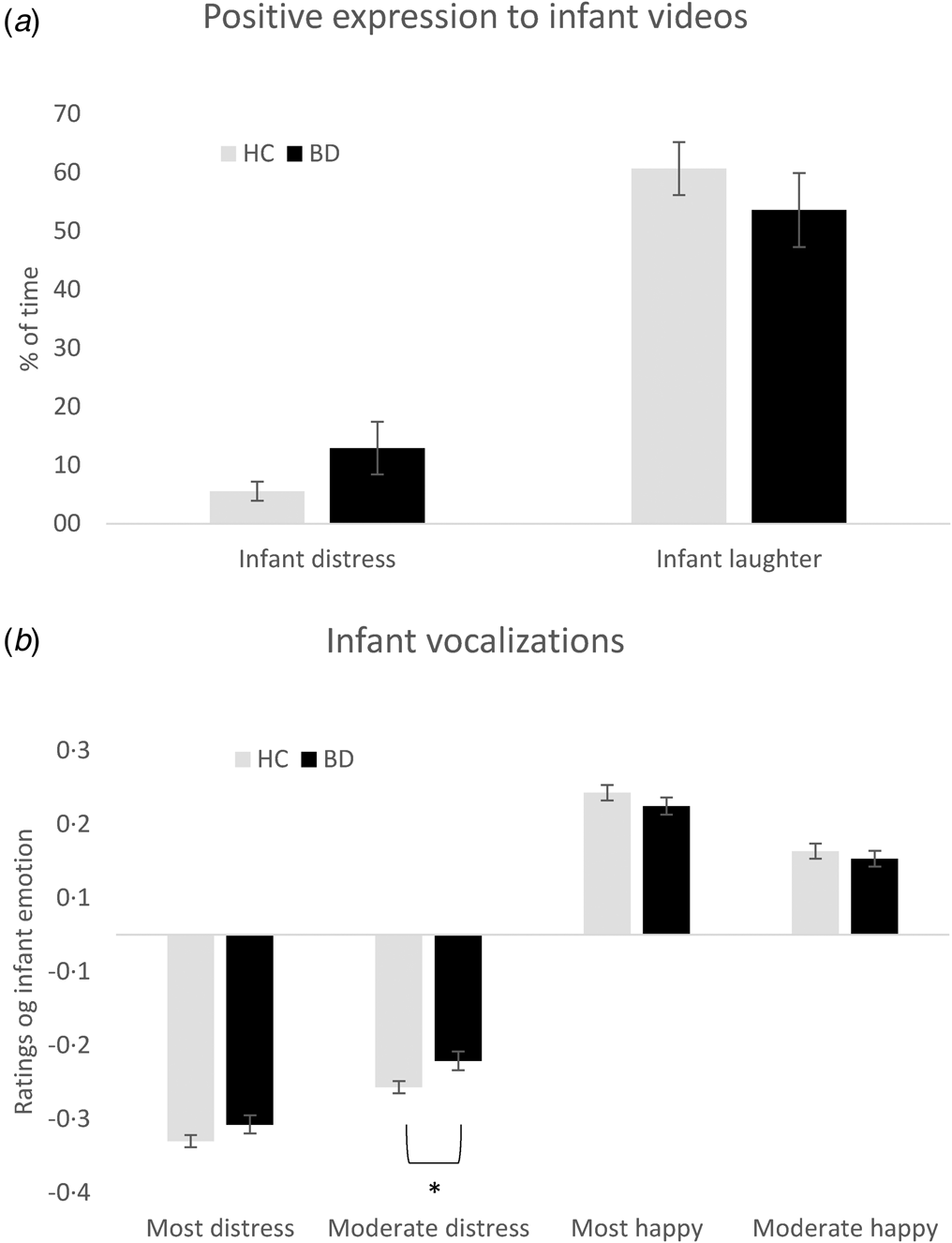
Mothers with BD in full or partial remission displayed positive facial expressions more of the time while watching the infant distress v. laughter video [interaction effect: F (1,58) = 4.47, p = 0.04, B-H adjusted p = 0.06, η 2 = 0.07; post hoc Mann–Whitney U tests non-significant p values ⩾ 0.49] and spent less time gazing and fixating at the infant videos compared with HC mothers [gaze: F (1,47) = 27.27, p ⩽ 0.001, η 2 = 0.37, B-H adjusted p = 0.0009; fixation: F (1,47) = 6.05, p = 0.02, η 2 = 0.11, B-H adjusted p = 0.04] (Fig. 2a). Compared with HC mothers, mothers with BD spent less time gazing and fixating at infant faces [gazing: F (1,61) = 24.77, p ⩽ 0.001, η 2 = 0.23, B-H adjusted p = 0.0005; fixating: F (1,61) = 10.92, p = 0.002, η 2 = 0.15, B-H adjusted p = 0.006) and rated moderately distressed infant vocalizations less negatively [interaction effect: F (2.0,120.5) = 3.37, p = 0.04, η 2 = 0.05, B-H adjusted p = 0.07; post hoc t test: moderately distressed: t = 2.37, df = 60, p = 0.02, d = 0.62; for other infant vocalizations p values⩾0.12] (Fig. 2b). The significant effects prevailed after controlling for subsyndromal mood symptoms for gazes at videos (p = 0.003) (but not fixations, p = 0.29), for gazes and fixations at face images (gaze: p ⩽ 0.001; fixation: p = 0.047), for the interaction effects on positive expressions to infant distress v. laugher videos (p = 0.04), and for ratings of infant vocalizations (p = 0.01). Controlling for subsyndromal mood symptoms also revealed a main effect of group, indicating that BD mothers generally rated all vocalizations less negatively than HC mothers (p = 0.02). In contrast, there were no group differences in negative facial expressions to infant videos (p values ⩾ 0.59), facial expressions to infant face images or vocalizations (p values ⩾ 0.18), or ratings of infant faces (p values ⩾ 0.16).
Comparisons between BD and HC mothers (a) Percent of time displaying positive facial expressions in response to (i) a distressed infant lying and crying without being picked up and (ii) quadruplets lying and laughing together with their mother. Mothers with BD spent more time displaying a positive facial expression in response to the infant distress videos than HC mothers. (b) Ratings of infant emotional vocalizations. Mothers with BD rated the moderately distressed infant vocalizations as less negative than HC mothers. Bars show mean scores; error bars show the standard error (s.e.m.); *indicates significant group difference on specific emotion-level for tests with overall significant interaction effects.

Assessment of hypothesis (III): negative bias in mothers with unipolar disorder
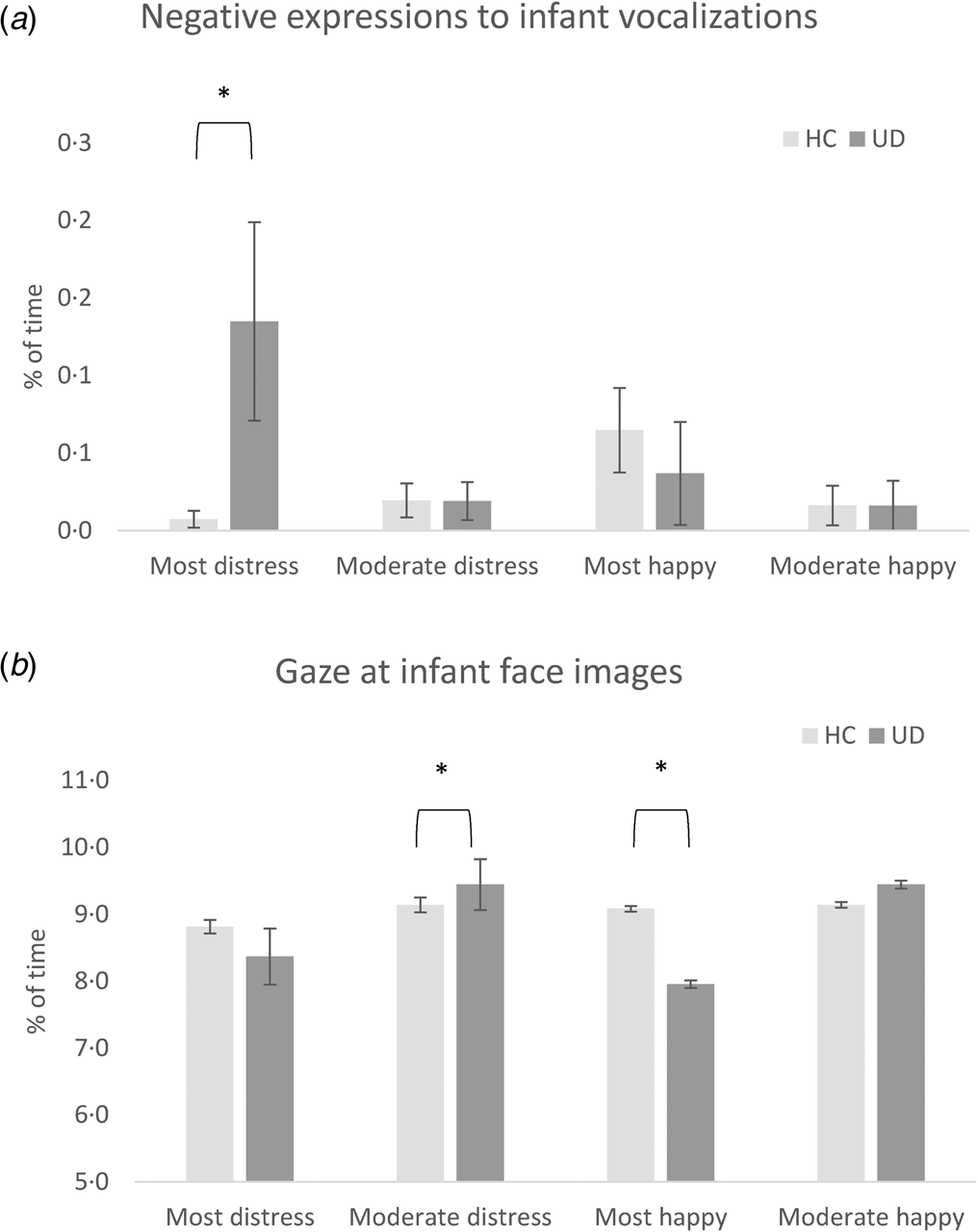
Mothers with UD in full or partial remission spent less time gazing at infant videos [F (1,40) = 5.04, p = 0.03, η 2 = 0.11, B-H adjusted p = 0.09], and displayed more negative facial expression in response to the most distressed infant vocalizations compared with HC mothers [interaction effect: F (2.10,96.68) = 4.14, p = 0.02, η 2 = 0.08, B-H adjusted p = 0.09; post hoc Mann–Whitney U: most distressed: U = 188.00, p = 0.003, r = 0.42] (Fig. 3a). Further, mothers with UD spent more time gazing at moderately distressed and less time gazing at the most happy infant faces [interaction effect: F (2.04, 91.96) = 9.84, p ⩽ 0.001, η 2 = 0.18, B-H adjusted p = 0.0009; moderately distressed: t = 3.89, df = 47, p ⩽ 0.001, d = 1.32; most happy: t = 2.61, df = 12.35, p = 0.02, d = 1.09] (Fig. 3b). After adjustment for subsyndromal depression symptoms, the interaction effects for gaze and fixations at infant faces remained significant (p = 0.01 and p = 0.046, respectively), whereas the group differences in gaze time to videos and negative expressions to vocalizations rendered non-significant (p = 0.25 and p = 0.44, respectively). There were no differences between mothers with UD and HC mothers in time spent fixating at videos or images (p values ⩾ 0.06), display of facial expressions in response to videos (p values ⩾ 0.17) or infant faces (p values ⩾ 0.12), or in ratings of infant vocalizations or infant faces (p values ⩾ 0.12).
Comparisons between UD and HC mothers (a) Percent of time displaying negative facial expressions in response to infant vocalizations. Mothers with UD spent more time displaying negative facial expressions in response to moderately distressed infant cries compared with HC mothers. (b) Percent of time spent gazing at infant faces. Mothers with UD spent more time gazing at the moderately distressed infant faces and less time gazing at the most happy infant faces compared with HC mothers. Bars show mean scores; error bars show the standard error (s.e.m.); *indicates significant group difference on specific emotion-levels for tests with overall significant interaction effects.

Assessment of hypothesis (IV): associations with mother–infant interaction and infant development
Mother–infant interaction and infant development
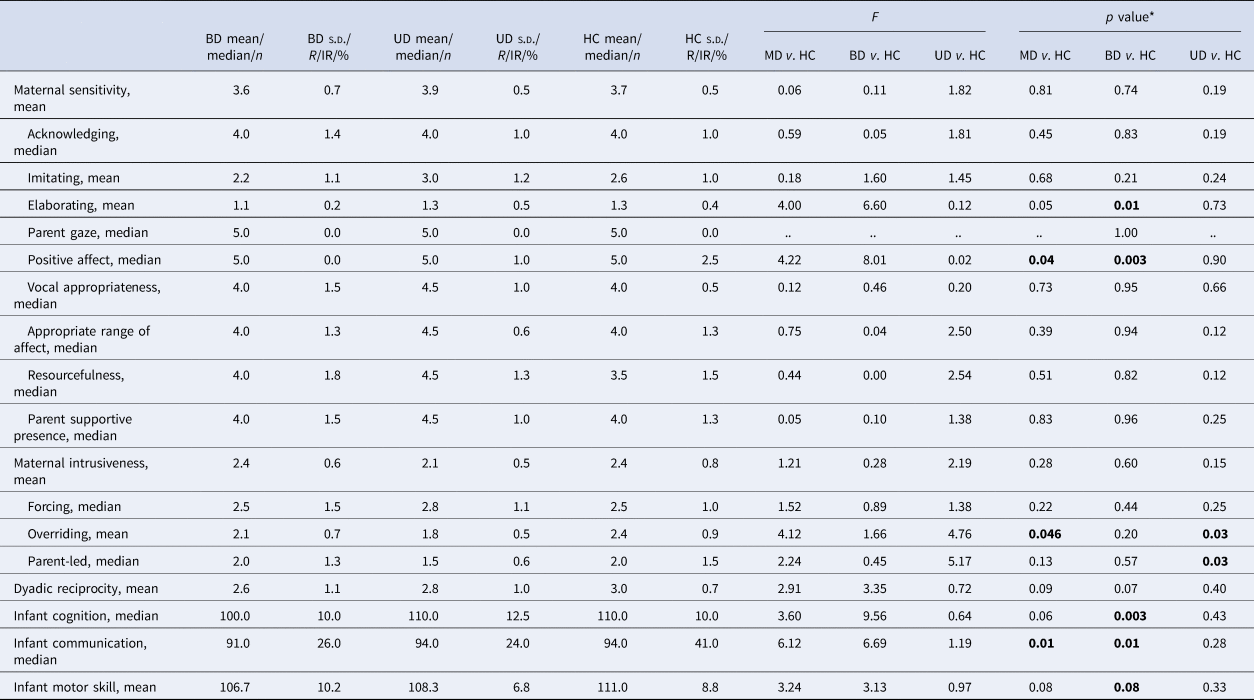
As seen from Table 2, mothers with BD or UD showed no differences from HC mothers in their interaction sensitivity, intrusiveness, or dyadic reciprocity. For BD mothers, there was a trend toward less dyadic reciprocity in the interactions with their infants compared with HC mothers [F (1,59) = 3.35, p = 0.07, η 2 = 0.05], also in analyses controlled for infant fatigue (p = 0.08).
Mother–infant interaction measured by CIB composite scores and individual scales and infant development measured as Bayley-III index scores for infants of mothers with BD and UD compared with infants of HC mothers

BD, bipolar disorder; UD, unipolar disorder; HC, healthy control; MD, mood disorder, NA: not applicable.
Group differences were investigated with one-way ANOVA for numerical data with score as within-subject factors and group comparison as between-subjects factor, *p values for main effect of group; mother–infant interaction data are missing for one HC due to inability to code the video and for one UD mother, since she did not wish to be video-filmed; infant development assessment data are missing for one HC infant due to experimental error. Values display means and standard deviations (s.d.) for normally distributed data and medians and interquartile range (IR) or full range (R) or number and percent for non-normally distributed data.
Infants of mothers with BD scored lower than infants of HC mothers on the Bayley-III scores of cognition [F (1,60) = 9.56, p = 0.003, η 2 = 0.14, B-H adjusted p = 0.01] and communication [F (1,60) = 6.69, p = 0.01, η 2 = 0.10, B-H adjusted p = 0.02] but not motor skills (p = 0.08). There were no differences between infants of mothers with UD and infants of HC mothers (p values ⩾ 0.28).
Associating infant emotion processing with mother–infant interaction and infant development
Across all mothers, less time spent gazing at infant videos (as seen in BD and UD mothers) correlated with delayed infant cognition (r = 0.33, p = 0.01, B-H adjusted p = 0.19). Less time spent fixating at infant videos (as seen in BD mothers) correlated with delayed infant cognition (r = 0.30, p = 0.02, B-H adjusted p = 0.07) and communication (r = 0.26, p = 0.047, B-H adjusted p = 0.07). Less time spent gazing at infant faces (as seen in BD and UD mothers) correlated with less dyadic reciprocity (r = 0.31, p = 0.01, B-H adjusted p = 0.04), delayed infant communication (r = 0.24, p = 0.04, B-H adjusted p = 0.07), and delayed infant motor skills (r = 0.26, p = 0.03, B-H adjusted p = 0.06). More positive facial expressions while viewing the infant distress video (as seen in BD mothers) correlated with less sensitivity in mother–infant interactions (r = −0.24, p = 0.04, B-H adjusted p = 0.08). More time spent gazing at moderately distressed infant faces (as seen in UD mothers) correlated with more dyadic reciprocity (r = 0.35, p = 0.002, B-H adjusted p = 0.02), maternal sensitivity (r = 0.27, p = 0.02, B-H adjusted p = 0.07), better infant cognition (r = 0.35, p = 0.002, B-H adjusted p = 0.02), and motor skills (r = 0.25, p = 0.03, B-H adjusted p = 0.07). Less time spent gazing at the most happy infant faces (as seen in UD mothers) correlated with less dyadic reciprocity (r = 0.27, p = 0.02, B-H adjusted p = 0.06). There were no other correlations between time spent gazing, fixating, GSR, or ratings and mother–infant interaction or infant development (p values ⩾ 0.10).
Discussion
This study combined in-depth assessments of mothers' cognitive and psychophysiological responses to emotional infant signals with at-home observations of mother–infant interaction and infant development. Mothers with mood disorders in full or partial remission showed blunted psychophysiological responses to emotional infant videos and gazed less at emotional infant videos and images than HC mothers with medium to large effect sizes. Mothers with BD displayed a positive bias, reflected by more (incongruent) positive facial expressions to infant distress v. laughter videos and less negative ratings of infant cries with medium effect sizes. Mothers with UD exhibited a negative bias, evidenced by more gazes at distressed and less gazes at happy infant faces and more negative facial expressions while listening to infant cries with medium effect sizes. Across all mothers, less gazes at emotional infant videos correlated with small disruptions in infants' cognitive and communication performance, while less gazes at infant faces correlated mildly with less dyadic reciprocity and delayed infant communication and motor skills. Finally, more positive facial expression to infant distress videos correlated mildly with lower maternal sensitivity.
The most remarkable finding was that mothers with mood disorders had less gaze and fixation time and blunted psychophysiological responses to emotional infant stimuli, in accordance with our first hypothesis. This points to less of the adaptive ‘maternal attunement’ to emotional infant signals, occurring in healthy mothers. Motherhood is associated with increased attentional processing of infant stimuli, as evidenced by behavioral cognitive tasks (Gollan, Rosebrock, Hoxha, & Wisner, Reference Gollan, Rosebrock, Hoxha and Wisner2014) and neuroimaging studies (Parsons et al., Reference Parsons, Young, Petersen, Jegindoe Elmholdt, Vuust, Stein and Kringelbach2017a, Reference Parsons, Young, Stein and Kringelbach2017b). This could reflect an evolutionary adaptive neurocognitive change with motherhood, since heightened attention toward the infant would support caregiving response and thus aid chances of infant survival. Greater physiological reactivity in mothers to their infants' distress has been associated with more maternal sensitivity (Augustine & Leerkes, Reference Augustine and Leerkes2019). Mothers who gaze away from their infants' faces and are less physiologically activated by their infants' emotions may respond less sensitively and contingently to their infants' signals and, consequently, the infants may become less conscious of and able to regulate their own emotions (Beebe & Steele, Reference Beebe and Steele2013). In keeping with this, we found that the less time mothers spent gazing and fixating on emotional infant stimuli, the lower their dyadic reciprocity and the greater the delay in their infants' development. Nevertheless, we observed no abnormalities in the interaction between mothers with mood disorders and their infants. Hence, cognitive and psychophysiological responses during computer tasks may not map directly onto real-life mother–infant interactions. Further, while more than half the correlations were not statistically significant, only few of the significant correlations survived B-H adjustment for multiple comparisons. The interpretation that mothers’ affective cognitive biases are associated with negative infant outcomes is therefore tentative.
Infants' development of emotional expression and regulation abilities hinges on mothers' contingent emotional expressions attuned to infants' signals (Fonagy, Gergely, & Target, Reference Fonagy, Gergely and Target2007; Tronick, 1989). It is therefore noteworthy that mothers with BD showed less attuned positive facial expressions in response to infant distress and rated infant cries less negatively, and that this correlated with less maternal sensitivity in real-life mother–infant interactions. In line with this, a recent study reported more positive facial expression among depressed mothers with BD that was non-contingent on their infants' emotions (Anke et al., Reference Anke, Slinning, Moe, Brunborg, Siqveland and Skjelstad2019). Another study associated mothers' positive facial expressions to their infants' distress at 4 months with increased risk of disorganized mother–child attachment one year after birth (Groh et al., Reference Groh, Roisman, Haydon, Bost, McElwain, Garcia and Hester2015), suggesting that unattuned positive facial expressions in response to infant emotions constitute a risk factor for the child.
Our finding that mothers with UD gazed more at distressed and less at happy infant faces and displayed more negative facial expressions to infant cries supports the hypothesized negative cognitive bias. This could indicate that mothers with UD are more ‘tuned in’ to and mirror signals of sadness more than infants' positive signals. Infants between 2 and 5 months typically only display positive emotions during social interaction, when their caregiver expresses positive emotions (Messinger & Fogel, Reference Messinger and Fogel2007). Hence, early experiences with positive emotions are dependent on the mother's ability to ‘tune in to’ and elicit positive emotions in her infant. In this sense, negatively biased mirroring and excessive exposure to the mother's negative emotional expressions may reinforce the infant's awareness, experiences, and expressions of negative in contrast to positive emotional states. This may constitute the basis for a negative cognitive bias and increase vulnerability for mental illness in the child (Beck, Reference Beck2008).
Maternal sensitivity and attuned mirroring of infants' facial expressions influence the infants' developing socio-emotional brain systems (Leppänen, Reference Leppänen2011) and predict infants' neural motor system activity when observing the facial expressions of others (Rayson, Bonaiuto, Ferrari, & Murray, Reference Rayson, Bonaiuto, Ferrari and Murray2017). Thus, maternal behavior may directly impact infant development through biological mechanisms. Given the existing evidence, we argue that mothers' biased processing of infant emotion in the current study could disrupt mother–infant interaction and infant development, although infant development was not investigated at a neural level. Shared genetic vulnerability could also account for large variability in negative child outcomes but the relative effect of genetic confounds on the results in the current study is unknown. More research is needed, which separates genetic and environmental factors and analyzes causal mechanisms in the intergenerational transmission of risk of mental illness.
A strength of the study is the inclusion of mothers with mood disorders in full or partial remission, which enabled insight into trait-related mechanisms by which the risk of mental illness can be transferred intergenerationally. The small sample size, the low number of UD mothers, is a limitation that reduces statistical power. Another limitation is multiple comparisons, which could increase the risk of type 1 errors. Still, half of the significant results survived post hoc B-H adjustment. Specifically, significant group differences in time spent gazing at infant stimuli and the poorer cognitive and communicative scores in infants of mothers with BD survived B-H adjustment, indicating that these findings are relatively robust. In contrast, the analyses of differences in mothers' facial expression, GSR, and subjective ratings did not survive B-H adjustment or were non-significant and must be considered more tentative. Measures of facial expression, GSR, and ratings could be less sensitive to detect differences in the processing of emotional infant stimuli. Consistent with this, group differences in time spent gazing had large effect sizes, while the effect sizes of group differences on all other measures were medium. Further, limitations include group difference in medication status and assessments of infant development by an assessor, who was not blind to group status. Nevertheless, the Bayley Scales Assessment of child development is a highly reliable, structured, and manual-based tool with very specific guidelines for scoring on the individual test-items (Bayley, Reference Bayley2006). This minimizes the risk of biased scoring of infant development within the study. Additionally, our cohort may not be representative of all mothers with mood disorders, since they had been symptomatically stable for a mean duration of 33 months, were well-educated, and had supportive partners. This may explain the lack of statistically significant group differences in mother–infant interaction. Nevertheless, these mothers still displayed atypical psychophysiological and cognitive responses, which is likely to be a real trait-related phenomenon worthy of attention in the clinical management of mood disorders postpartum.
In conclusion, symptomatically stable mothers with mood disorders exhibit atypical psychophysiological responses to and processing of emotional infant stimuli, which is associated with poorer mother–infant interaction and delayed infant development. This identification of early subtle environmental risk for the infant warrants further study including follow-up assessments. If our findings are replicated and predict longer-term child development, they have important clinical implications for future prophylactic intervention strategies targeting subtle psychological risk factors. This, in turn, could contribute to the prevention of risk transmission and adverse child development.
Supplementary material
The supplementary material for this article can be found at https://doi.org/10.1017/S0033291721000891.
Acknowledgments
The study was funded by a grant from the Research Fund of the Mental Health Services in the Capital Region of Denmark, the Augustinus Foundation, Hartmann Foundation, L'Oréal for Women in Science, Ivan Nielsen Foundation, and A.P. Møller Foundation. We are grateful to Ph.D. Tue Hvass Petersen, Sr. Customer Success Manager at iMotions A/S for his valuable technical assistance in setting-up computer tasks and processing psychophysiological data. We thank Tina Wahl Haase, M.Sc. in psychology at The Department of Psychology, University of Copenhagen, for coding CIB reliability. We thank M.D. Rie Lambæk Mikkelsen, psychiatrist at Psychiatric Centre Copenhagen, for her help with mediated contact to participants with mood disorder.
Author contributions
AJB contributed to study design, development of experimental methods, coordinated participant recruitment and assessments, undertook the literature searches, statistical analyses and interpretation of results, and wrote the first draft of the manuscript under supervision on KWM. KWM in addition contributed to drafting of the original proposal, conception and design of the study, and development of study methods. IE contributed to data analyses and interpretation, and critical revision of the manuscript. MM, AK-T, and REN contributed to participant recruitment and critical revision of the manuscript. CEP contributed to the development of experimental methods and critical revision of the manuscript. LVK and AKP contributed to drafting of the original proposal, conception and design of the study, and critical revision of the manuscript. MSV contributed to drafting of the original proposal, conception, and design of the study, co-supervised AJB on participant assessments and critically revised the manuscript. All authors have approved the final version of the manuscript to be published.
Conflict of interest
KWM has received consultancy fees from Lundbeck and Janssen-Cilag in the past 3 years. REN has received research grants from H. Lundbeck and Otsuka Pharmaceuticals for clinical trials, received speaking fees from Bristol-Myers Squibb, Astra Zeneca, Janssen & Cilag, Lundbeck, Servier, Otsuka Pharmaceuticals, Eli Lilly, and Teva Pharmaceuticals and has acted as a advisor to Astra Zeneca, Eli Lilly, Lundbeck, Otsuka Pharmaceuticals, Takeda, and Medivir. LVK has received consultancy fees from Lundbeck in the past 3 years. AJB, IE, MM, AK-T, CEP, AKP, and MSV have no disclosures.