How does one come to terms with the “already said” or the “already danced”? I ask this in light of the many instances where contemporary dance has insistently undertaken—as a condition of its own renewal—a critique of past works that have been transmitted through the oral tradition. This undoing of the oral tradition's dominance has instantiated a new relation to the past in contemporary dance. Hannah Arendt throws some light on this process when she quotes Walter Benjamin, for whom modernity required that we find a different way of connecting with the past—one that would replace transmission with citationality. To cite, in speech act theory, as in dance, presupposes that the authority of the past be replaced with that disquieting ability of the past to infiltrate the present in a disembodied way (Arendt Reference Arendt1974, 291). The challenge of citation to the prestige of oral person-to-person transmission of a dance has introduced a new way for contemporary artists to relate to and re-embody past works.
The return to an earlier choreographic work in the French dance world of the early 1990s inevitably meant a head-on confrontation with modernist dogma: citation was formally forbidden. In the German Ausdruckstanz tradition, which has been highly influential on the contemporary field in France, dance was experienced and composed based on the idea of possession, so that revivals were impossible if the work was not an outright incarnation of a quasimagical nature. Mary Wigman, for instance, refused to teach others her solos. She lived and conceived her dancing as part of her vision of possession, according to which a movement could only be performed once (Launay Reference Launay and Bloess2009). Alive and active, a danced movement could not survive its original execution, and could only be “incarnated” by a single dancer. “Did the reason for this fear [stage fright each time she danced Dreh-Monotonie] lie in the realization that I would again surrender to dying one of those peculiarly unreal deaths which a work of art created by the dancing body demands of its performer?” (Wigman Reference Wigman and Sorell1966, 38). Imaginary forces set in motion by dance possessed the expressionist dancer, whether those forces originated in the power of the genius-as-creator or in ancestral, archaic sphere. At the beginning of the twentieth century, modern dance in Europe and the United States alike aligned itself with the modern regime of artistic and intellectual property, which played out on two levels: asserting (not without some difficulty) the same recognition and rights as other artists, while at the same time affirming the quasisacred dimension of their practices. In the mode of secular possession, the “presence” of the dancer was essentially a godless possession.
The identity of the work itself was hence ambivalent for modern dancers: if the danced experience was inseparable from, indeed, exiled in the body that had produced it through its own firsthand experience, the work could nevertheless never be entirely possessed by subjective consciousness. Had this been the case, it would not have been able to circulate, to be danced on different stages, to be transmitted to others, thus acquiring an exchange value. We remember how the American modern dancers were trailblazers—teaching, initiating, and recruiting dancers able to interpret their work. But outside of those closely guarded circuits, it was almost impossible for dancers to work with other companies. Isadora Duncan, Martha Graham, Doris Humphrey, José Limón, and even Merce Cunningham all created institutions that allowed them to ensure the production and distribution of their works. There were strict limitations on how their works could be shared.
We Are Dancing One AnotherFootnote 1
The possibility of citing or quoting a dance did not first come about with the emergence of modern or postmodern dance; it was actually a vital aspect of nineteenth and twentieth century ballet. Ballet is doubtless the quintessential “intertextual” danced genre, to borrow a concept from literary studies. Interchoreographic games (using known compositional models, variations, outright plagiarism, and pastiche, but also a montage of citations) assured the continued practice of citation in the ballet tradition. This work relied on a repertoire of steps and figures that could be recycled, conceived of as a storehouse of examples and models not subject to authorial control, and whose status is still today, in many respects, compromising to the integrity of individual works. It was based on a fairly unstable yet active hierarchy, with the multitude of versions and variations severely challenging the idea of the integrity of the original work. The ballet master, before becoming “choreo-author” (a word invented by Serge Lifar), was the person who copied and assembled steps, augmenting or enriching them in accordance with the “rules” of his or her art, backed up again by the authority of tradition. It is in this sense that he or she enters into the sphere of influence or tendency of the work's vocabulary.Footnote 2 Classical citation was practiced as part of a framework that asserted tradition; invention presupposed canonical models upon which the aesthetic of the variation was based. Citation, in this framework, in no way challenged the aesthetic of the ballet; on the contrary, it reinforced and ensured the memory of each piece, with its physical techniques and interpretive traditions. But, it was a memory in constant transformation, whose movements nevertheless guaranteed, for better or for worse, the presence of ballet and repertory in ballet companies as current choreographic institutions (Paré Reference Paré2010).
The new way of relating to the past that Benjamin proposed is not based on the classical form of citation, but instead on a memory liberated from tradition, which thus compromised the conventional notion of transmission itself. Citation without a heritage, if I may put it that way, is paradoxical: it is both the site at which a transmission takes place and the site of transmission's impossibility. The value of examining what we shall call intercorporeality is crucial for the kind of choreographic memory we have in mind. If dance, like the other performing arts, invents itself in relation to the world, it also invents itself in relation to itself. The presence of previously used steps in a dance, whether they be cited, plagiarized, or merely alluded toFootnote 3—be they parody, pastiche, or burlesque travesty—impels one to reflect upon the memory that dance has of itself, its own history, its works, and its distinctive performances.
The issue for us is not one of a history of sources in any one piece, nor of a historical breakdown of the influences from one choreographer to another, or from one dancer to another (although this could, of course, be interesting in itself, historically speaking). Our motive is rather to reveal or to discover how a modern work lays out its own origins and/or its originality by inscribing itself within a history to which it is then free to refer.Footnote 4 It is a question of revealing for dance as for the other arts—literature and the plastic arts in particular have already done it—its process of incessant interior monologue with itself. This interior monologue is fundamental to, if still obscured by, the reductionist tendencies of modernity (une modernité liquidatrice) as well as by the prevailing market logic, which ensures the continuing prestige of new “merchandise.” How earlier work is taken up in this context, and the sort of work derivative bodies (corps seconds) perform to resuscitate that work, remains remarkably undertheorized in both dance history and dance criticism.
But one would be correct to object that everything in dance derives from either intertextuality or intercorporeality. Did not Montaigne first bring up the idea, which he then played with in every imaginable manner, that all we do is interpret one another?
It is more of a job to interpret the interpretations than the things, and there are more books about books than about any other subject. We do nothing but write about each other. [“Il y a plus affaire à interpréter les interprétations qu’à interpréter les choses, et plus de livres sur les livres que sur autre sujet: nous ne faisons que nous entregloser.”] (Montaigne Reference Montaigne and Frame1957, 818; 1962, 520)Footnote 5
This idea is too general to be of any use. But, Julia Kristeva introduced a dynamic theory of textual production as a system of citation and, through citation, transformation: “Every text is constructed as a mosaic of citations, every text is the absorption and transformation of another text,” she wrote in 1969, in Séméiotiké.Footnote 6 So, if all we are doing is dancing one another, one subject is compromising the identity of another. Michel Schneider reminds us from a psychoanalytic perspective that the subject of him or herself is actually only made up of “snippets of identity incorporated images, assimilated character traits, all of it combined (if I may put it this way) to form a fiction that we call the ego” (Reference Schneider1985, 12). That is, psychological identity itself comes about through citation. The phenomenon of citation casts a psychological light on intertextuality and its choreographic analogues. Let us try to illuminate this through the analysis of a choreographic work, in this case The Afternoon of a Faun, by asking how transformative operations related to the identity of the subject are integral to changes in choreographic, gestural, and sociocultural context over time.
How does the memory of choreographic works, once disengaged from its relationship to tradition, operate not so much by transmission as by the uncanny power of citation? Random or intentional vague memories or a proclaimed homage, subversion, or faithful copy, literal quote or disintegrated reference merged into a new work—revivals, reconstructions, adaptations, and reenactments in contemporary dance occur in such myriad shapes that it is impossible to catalogue an exhaustive list of their techniques. Some dance works have been able to convey, with a fairly convincing visibility, traces of earlier movements or dances, revealing in the process the heterogeneity of the materials by integrating them or dissociating them, revealing more or less the history of the work, its interpretations, its dancers, or, less commonly, the history of various perceptions of the work. It would be best to try to describe some of the movements as they progress from one interpretation to another, from one performer to another, and the inventive transfers that take place between them at the core of a piece that itself has already displayed multiple modalities of citation: in short, an established art of citing in every sense. The piece … d'un faune (éclats), the Albrecht Knust Quartet's 2000 interpretation of Vaslav Nijinsky's l'Après-midi d'un faune,Footnote 7 is exemplary in this regard.Footnote 8
The idea that dancers who are not trained by the masters would revive modern pieces by those very masters was received with mixed reviews in the 1990s: it was considered either without interest, highly suspicious (“Who do they think they are?”), sacrilegious (“How dare they touch it?”), or received with enthusiasm, but not without misunderstandings. The possibility of citing a modern movement and placing the power of citation on stage, is for our purposes here, the creative space developed by the Knust Quartet. They managed to remove a form of censorship that weighed on contemporary dance in France. Work that was learned “second hand,” to borrow a phrase from Antoine Compagnon (Reference Compagnon1979), or from an “nth” person—the analytic dissection of a movement sequence, its interpretation by a “foreign body,” then finally its implantation in a new work—this was an entirely new way of thinking about the creative process. The Quartet's approach fell in with a process of citation proclaimed for some time as a workable creative practice in literature and in the plastic arts. And the diversity of the Quartet's enterprises shows the fields and the possibilities for which this work paved the way.Footnote 9
Beginning with a documentary project, in this case a choreographic score transcribed in the Labanotation system (also known as kinetography), the Quartet undertook a commemorative creation that would eventually go well beyond the basics of citation. This practice of reading and interpreting is still relatively obscure in the French dance worldFootnote 10 for many reasons that we will not go into here. But it does allow for all kinds of readings, re-readings, selections, collages, combinations, underscorings, and inspirations.
The Theaters of Dance History: Organizing the Anachronism from Yvonne Rainer to Vaslav Nijinsky
Dominique Brun, Anne Collod, Simon Hecquet, and Christophe Wavelet formed the Knust Quartet in 1993 while they were students of Labanotation under Jacqueline Challet-Haas at the Conservatoire National Supérieur de Musique et de Danse de Paris.Footnote 11 The Quartet took its name from the German dancer and “notator” Albrecht Knust (1896–1978),Footnote 12 nearly unknown to French audiences, who developed a system for transcribing movement originally presented by Rudolf Laban at the Second Dancers’ Congress in Essen in 1928. Their first projects reflected on the idea of a dance piece as it is conveyed in a system of notation, and explored how notation should be used. Each project represented one way of coming to terms with the already danced by situating themselves within practices of revival/reconstruction, both from the oral and written traditions; they concerned themselves with how could one reactivate works, “re-experience” them (to use the vocabulary of the 1990s) with “the lines of intensity of the choreographers of an unfinished modernity.” This is how the group presented itself in a 1996 program note at the Cartier Foundation: “Working from the Labanotation system, this Quartet was constructed around the desire to re-activate many exemplary moments that were part of the charter trajectories of modernity in dance.”
Let us briefly summarize their first three projects. The first, entitled Paper Dances (Les Danses de papier), was conceived in 1994 as a reconstruction of two solos choreographed in 1931 by Doris Humphrey. They were presented at the Conversatoire National Supérieur de Musique et de Danse in Paris, and then at the Théâtre de la cité internationale, also in Paris. Two Ecstatic Themes, was a solo in two parts—Circular Descent Footnote 13 and Pointed Ascent—to which the Quartet added a solo by Dominique Brun, Du ravissement (Rapture), which was a variation based on Circular Descent. Paper Dances also included a study by Kurt Jooss from 1953: a duet, Märtzlied, which was created for the students of the Essen School and notated by Knust himself the same year. This modest program, which was a product of the Quartet's study with Challet-Haas, allowed for a direct confrontation with the work of deciphering and reading. Even though at this time the work was more a “reconstruction” with variations, it did establish a double necessity: that of “reinventing a dance of the historical past in another time, another space, in other bodies, knowing that none of them had studied at the School in Essen” (Hecquet, in Collod et al., Reference Collod, Hecquet and Wavelet2002, 16). This work required a critical approach to the transcriptions themselves, which, like translations, could have been written differently. In fact, Simon Hecquet wrote a new score in Labanotation for the central figure of Circular Descent in that he emphasized the spatial logic of the choreography over its anatomical and motivational logic.Footnote 14Paper Dances displayed a defiance of the choreographic milieu of the time.
Emboldened by this experience, the Quartet hazarded a second program in 1996 that was well received by artists, which contributed to a wider collective discussion of the memory of dance works. This program included work on Steve Paxton's Satisfyin’ Lover (1967),Footnote 15 which was based on the verbal script of actions for forty-two walkers (Banes Reference Banes1987, 71–74), and Yvonne Rainer's project Continuous Project/Altered Daily (1970)—also called C.P/A.D.—based on Barbara Katz's 1970 transcription, which combined kinetography and verbal description. These two works had never before been seen in FranceFootnote 16: the French audience and art world were certainly aware of the concept of postmodern dance through Steve Paxton's performances in Sainte-Baume in 1978, as well as through works by Trisha Brown, and most notably Lucinda Childs, or they had at least become familiar with the postmodern dance aesthetic by reading important critical texts by Laurence Louppe, but they had not yet seen the important works dating from the late 1960s. The specific return to these two works added to the favorable reviews they received in the press and in the art world, and inaugurated the rediscovery of American postmodern avant-garde work in France of the mid-1990s.
If, for its first program, the Knust Quartet felt the need to present a historical “restitution” of works that it had “inherited, been entrusted with” (Brun Reference Brun2006, 34), its next two pieces were oriented rather differently. As soon as this initial dynamic had been introduced, it was no longer so much the “return” that was important as much as addressing what would happen to a work that had already been transcribed into a score.Footnote 17 In other words, they began working with deconstruction and reactivation, more specifically with the examination of differences in interpretation allowed in the reading of a score, which is itself driven by a different logic: that of recollection or involuntary memory.
The Quartet's third program was its breakthrough work on L'Après midi d'un faune (The Afternoon of a Faun) (1912) by Nijinsky, Debussy, and Mallarmé: …d'un faune (éclats) [… of a faune (fragments)] in 2000. Here the Quartet utilized the rigor of reading protocols acquired in their first project, Paper Dances, as well as the deconstructive approach of the imagined choreographic work Continuous Project/Altered Daily. It was now possible for them to problematize and put onstage the real question of a “return,” since this return to Nijinsky would also draw upon knowledge gained from their previous returns to Humphrey, Jooss, Paxton, and Rainer. This return to Nijinsky's Faune, far from using the idea of accurate reconstruction as replication, implemented anachronism as a principle. In fact, the methodology the Quartet devised with Faune is the object of our analysis.
It seems that in 2000, Nijinsky inherited something from Yvonne Rainer. More precisely, the re-enactment of Nijinsky's original 1912 version of l'Après-midi d'un faune is thoroughly permeated by a critical rapport to what went into the Quartet's remaking of Yvonne Rainer's 1970 Continuous Project/Altered Daily. The revival of C.P./A.D. benefited in turn from the experience of a group of dancers who were aware of the problems that may develop in systems of notation and/or transcription, and who had also worked on many choreographic projects between 1980 and 1990. Their critical detachment impelled them to work differently—finding in the Laban score of the 1930s, as well as in the return to the avant-garde work of the 1960s, a new working approach to this return to the 1912 work, and to Nijinsky. One might even call these two projects “constructive,”Footnote 18 with their interweaving of different periods. …d'un faune (éclats) thus highlighted the realization of an important aspect of choreography: the possibility of citing a dance, of autociting, as if relating one's own experience of a dance through the performance of that very dance.
These two last two projects made quite a splash in the contemporary dance field in France: dancers who until then had neither institutional recognition nor any particular attention in the media were now not only authorizing themselves to interpret iconic works from twentieth-century dance history through the use of scores, but were also subjecting the works themselves to critical analysis. Such was indeed the intention of the Knust Quartet, in the words of Christophe Wavelet:
We felt like a generation of amnesiac dancers whose relationship to history (practices or artistic projects) as well as to memory and transmission had been bungled. On one hand, there were the heavens above where some of the famous, nearly fetishized, names were ensconced (Graham, Wigman, Humphrey, Limon, Nikolais, Cunningham, Bausch). And on the other, there was a refusal to acknowledge our questions about the activities and projects associated with these luminaries. History is not supposed to be dead, static. We needed to confront history, without really knowing what that meant, but we realized this had to be done in a concrete fashion…. We weren't born yesterday; we know that like everyone else we have been indoctrinated by family, school and arts education. We needed to begin examining these influences critically. (Collod, Hecquet, and Wavelet Reference Collod, Hecquet and Wavelet2002, 19)
The Quartet's members decided to examine a history of their art form and to re-elaborate their own vision of dance history. Faced with the dominant modernist point of view, they wished to propose a different narrative: a narrative that on the one hand would be found within the works themselves, and that, on the other hand, would also be interpreted by themselves as the contemporary subjects of that narrative. The Quartet wanted to show that its dancers, while being conscious of history as a whole, were also fully aware that they themselves were subjects of the process of placing the choreographic work into history.Footnote 19 The objective was to annotate a history of dance that was freed from questions of affiliation. For Anne Collod, dance should be interpreted “from the perspective of the dancer,” and “based on the experience of movement felt by the dancer” (Collod et al., Reference Collod, Hecquet and Wavelet2002, 22). This perspective gave body and a voice to dancers who did not have a (H)istory; that is, it gave them the possibility of citing, borrowing, appropriating, and of covering their tracks in the process.
This historical concern, which was a constant in rehearsals and in the general preparation of the piece, appears through a process of citation that reveals its genealogy. What scenes of oral tradition will be revisited in this piece, and how? What masks will it remove?
Three kinds of material and modes of citation come together in a series of sequences that the montage contrasts and examines:
1. What we will call the “murmur of the legend” and the oral tradition (quotes involving the oral tradition by those who perform it)
2. The choreographic material as it has been notated in the score for L'Après-midi d'un faune and interpreted by six different dancers
3. The material consisting of extensive improvisations based both on the dancers’ memory and lack thereof (citations and autocitations by the dancers)
The Murmur of the Legend
Let us first examine several moments in the oral tradition of L'Après-midi d'un faune. Nijinsky probably began work in collaboration with his sister Bronislava and without a pianist, but with precise knowledge of the musical score, in 1910. He experimented with the iconic postures that were to define Faune and provide the basis for its choreographic design. Bronislava Nijinska quoted her brother:
I want to move away from the classical Greece that Fokine likes to use. Instead, I want to use the archaic Greece that is less known and, so far, little used in the theatre. However, this is only to be the source of my inspiration. I want to render it in my own way. Any sweetly sentimental line in the form or in the movement will be excluded. More may even be borrowed from Assyria than Greece. (Nijinsky cited in Nijinska Reference Nijinska, Nijinska and Rawlinson1992, 315)
Two years later, after numerous rehearsalsFootnote 20 culminating in an eight- to ten-minute piece, L'Après-midi d'un faune premiered at the Théâtre du Châtelet on May 29, 1912, conducted by Pierre Monteux and signed by Nijinsky and Debussy equally.Footnote 21 Nijinsky danced the piece 59 times between May 1912 and September 1917, when he gave his last performance in Buenos Aires. He would never again appear onstage except for his tragic and final appearance in 1919, at the Suvretta Hotel. Over those five years the piece fluctuated, sometimes quite a lot: the ending, known even today for its evocation of a masturbatory gesture, was subsequently notably modified by Nijinsky, just after its premiere in Paris. In the second incarnation of the piece, the Faun no longer slid his hand under his pelvis, but instead laid down with his arm extending down along his chest. Some time later in London, however, Nijinsky returned to the movement that had caused such a scandal at the Théâtre du Châtelet.Footnote 22
When he arrived in New York in 1916 to take over the American tour of the Ballets Russes, Nijinsky, despite his own propensity for changing choreography, was very clearly disturbed by the massive changes Massine had wrought: he claimed no longer to recognize his own ballet (Järvinen Reference Järvinen2010). Nijinsky used the press to inform audiences of the situation in a New York Times article of April 1916 entitled “Nijinsky's objections to Diaghilev's way of presenting his ballet Le Faune”:
… [T]he ballet, “The Afternoon of a Faun”, should not be given as the organization (the Ballets Russe) is now presenting it. That ballet is entirely my own creation, and it is not being done as I arranged it. I have nothing to say against the work of Mr. Massine, but the choreographic details of the various rôles are not being performed as I devised them. I therefore insisted strongly to the organization that it was not fair to me to use my name as its author and continue to perform the work in a way that did not meet my ideas. (Nijinsky quoted in Guest Reference Guest1991, 18)
It was only after holding several rehearsals with the corps de ballet that he allowed the performances to continue. In October 1916, The New York Times noticed the difference between the two series of performances—the “restraint and smoothness” of the version directed by Nijinsky versus Massine's more “strange and chaotic … movements” (Avant Scène, Ballet Danse October/January, 1982). For Nijinsky, these changes strained the limits of a faithful interpretation. One gesture (the final movement) could be altered, and L'Après-midi d'un faune would still be L'Après-midi d'un faune, but it was no longer the same work if the “dynamic” of that very movement was altered. Nijinska and Sokolova insisted on this, underlining the risk that an interpretation could easily become a mechanized caricature sapping the life of the original if they were not dedicated to working on the faithful transmission of the mobility of the positions themselves (Hodson Reference Hodson1982, 52). These comments show just how much Nijinsky wanted to retain control of his piece as well as of its interpretation.
L'Après-midi d'un faune remained in the repertory of the Ballets Russes until the company's dissolution in 1929, and the role of the Faun was performed, without ever referring to the score, by several dancers who then taught it personally to many other companies throughout the world. In this way, the oral tradition of the ballet was disseminated everywhere outside Russia, through the dancers of the Ballets Russes, thus creating diverse versions and interpretations of the piece. Léon Woizikowski—to whom Nijinsky relayed the piece directlyFootnote 23—danced it in 1926 with the Ballets Russes, taught it to Serge Lifar in 1927, and then in 1931 to the Ballet Rambert in London,Footnote 24 notably to William Chappell and Elizabeth Schooling. They taught it, in turn (based on their recollections), to Rudolf Nureyev in 1977 for the Joffrey Ballet and then, in 1982, to the American Ballet Theatre (ABT). In response to the ABT dancers expressing concern at Schooling's modification of some movements that she viewed as wrong, she said, “In the absence of precise notation, the reconstitution of a ballet is an affair of pragmatic trial and error” (Schooling quoted in Vaughan Reference Vaughan1982, 65). Marie Rambert collaborated with Lydia Sokolova (the Nymph in the Ballets Russes version) to re-arrange it for Milorad Miskovitch at Ballet Rambert (who would later perform it in recitals with Alicia Markova, notably in Paris in 1954, and outdoors at the Parc de Bagatelle), and for Jean Babilée in 1949. Léonide Massine, who performed it in 1916 during the Ballets Russes tour in New YorkFootnote 25 (with Tchernicheva as the Nymph), taught it in turn to the Ballets du Colonel de Basil in 1936 at Covent Garden (Hodson Reference Hodson1982, 51) in Massine's version “according to Nijinsky,” and to the Ballets Russes de Monte Carlo.
Nijinska, as choreographer of the Ballets Russes, danced the ballet (and even took on the role of the Faun herself in a 1922 tour, based on an idea by DiaghilevFootnote 26) and later transmitted it to George Zoritch of the Ballets du Marquis de Cuevas, where the ballet was danced with a single nymph. Serge Lifar, who, after having danced it in 1927, created his own version for the Ballets Russes in 1928, and then in 1935 made a new version for the Opéra de Paris—a solo version. He danced that version until 1959, teaching it to Attilio Labis in 1962 (who then transmitted it to Cyril Atanassoff around 1967, who then taught it to Jean Guizérix in 1969). Lifar's version stayed in the repertory of the Paris Opéra until 1976, when the Opéra purported to present Nijinsky's original choreography with Charles Jude, alternating with Patrick Félix as the Faun. Nureyev, who had also learned the role with Jude, said that none of the celebrities who showed up for the premiere of the revival at the Théâtre Musical de Paris in 1982—neither Nijinska, Romola Nijinsky (Nijinsky's wife), Massine, nor Lifar—were in agreement, and neither were William Chappell and Elizabeth Schooling (with whom Nureyev had already worked in 1977). Nureyev said: “I suppose they came to a compromise… . I had to work out my personal version using the arrangement that was the most logical and the closest to the music.” “But choreography,” he went on, “is like clothing, you have to try it on, move inside it and make it fit your body. Nijinsky's body was thicker than mine, and he had a different style.”Footnote 27 Jean Guizérix also said of this version: “Romola did not remember much. It was more Massine's version, assisted by Romola.”Footnote 28 However, according to Romola Nijinsky, “Massine had it all wrong” (Guest and Jeschke Reference Guest and Jeschke1991, 8). In spite of these fluctuations and massive amounts of contradictory information, this authorized Opéra version, itself later revived, was presented in a 1978 program as a “scrupulously faithful revival, recognized by Romola Nijinsky, widow of the famous dancer.”Footnote 29 When the Opéra remounted it in 1982 with a reconstruction of Bakst's set, Jean Guizérix remarked that this version was “somewhat similar to the one Nureyev danced.”Footnote 30
Finally, there is the version by Nicolas Zvereff, dancer in the Ballets Russes and later a teacher, who had alternated in the role of the Faun with Nijinsky. He taught it, based on his personal notes, to Jean-Jacques Béchade, then to Dominique Dupuy, both of whom wore plain unitards instead of the original costumes. The performance by the Ballets Modernes de Paris at the Festival des Baux in 1963 marked the first time l'Après midi d'un faune had been interpreted by a contemporary dance company (Dupuy and Dupuy Reference Dupuy and Dupuy2002, 231).
Staging the Murmur of Legend
Of a faun (fragments)… opens with the murmur of the legend—the cacophony of all these past performances suggested by many voices from off-stage. A series of interview sound bites welcomes the audience members as they settle into their seats, and is followed by an audio montage of the voices of various dancers who either saw or danced in L’Après-midi d'un faune: one of them (Jean Guizérix), speaking of his admiration for the interpretation he saw from the wings by Cyril Atanassoff, who later taught it to himFootnote 31 (a repeat of the tradition of Lifar via Labis). The voice of Dominique Dupuy relates his fear when taking on the role of the Faun as Zverev had taught it to him; the voice of Jacqueline Challet-Haas speaks of her experience as a spectator. We also hear the voices of Russian dancers of the time (Romola Nijinsky speaking English with a heavy Russian accent, and Bronislava Nijinska, speaking Russian). All this murmuring—the pre-recorded crowd noise of a performance—is complemented by the sound of a text being read offstage, evoking, with grace and a refined tone, “La Vie Moderne” of Parisian theate + rs, whose long list of names takes one back to the fin de siècle Paris of Mallarmé.Footnote 32
The murmur of all these rising and falling voices blends into a sort of background noise during the entire first danced sequence in semidarkness. This sequence, dubbed the garland of ghosts, has ten dancers wearing gaudy ballet costumes, all lined up downstage, holding hands with their arms raised, walking backward very slowly while lowering their arms and disappearing gradually into the darkness, in the form of an adieu—a figurative retreat into the ballet world. The line, both visual and auditory, marks the gradual disappearance of a world, namely that of the sustained legend of the oral tradition in the same auratic mode as its own life, as well as that of the legend of the economy and aesthetic of the Opéra Ballet.Footnote 33 Behind this scene, archival images flicker in the background: Auguste Rodin, admirer of the Ballets Russes, and of Nijinsky whom he sketched and sculpted, is seen descending a staircase in Sacha Guitry's film Ceux de chez nous; a ghostly Tamara Karsavina from a deteriorated black and white film leaves the stage and disappears with a slight smile into the wings;Footnote 34 and finally, an excerpt from Jean Renoir's silent film, Boudu Saved from Drowning, a derisive image of an old faun and a nymph in a pseudo-antique setting. These flickering images in black and white, shown on a giant screen where the figures are hardly distinguishable, increase the sensation of distance and legend, and emphasize the fictitious nature of the work, revealing how much our representations of Nijinsky's world have also been filtered through the cinema.
Poetics of the Cliché
In addition to this mélange of soundtrack, film projection, and performance, other elements of the legend became material for a poetics of memory: in particular, the sequences in which the performers take individual responsibility for the collective imagination of Faune. From the evocation of memories of L'Après-midi d'un faune and works linked to Nijinsky to the powerful imagery of the Ballets Russes itself, these motifs were extrapolated as starting points for improvisation. First of all, the parodic sequence entitled “The Greek Vases” in which a couple of high society types (Emmanuelle Huynh or Cécile Proust and Loïc Touzé) in evening clothes speaking and miming to a progressively more erotico-burlesque degree the postures on Greek vases evoke Nijinsky's inspirational visit to the Louvre. Then, the sequence based on the children's game “red light, green light, 1-2-3” (“Un! Deux! Trois! Soleil!”) in which the performers, facing upstage, spin around to suddenly stop in postures that evoke motifs from Nijinsky's choreography. Each dancer chooses his or her version of the essential shape remembered (or not) from Petrouchka, Rite of Spring, Le Spectre de la Rose, Giselle, the Pavillon of Armide, Schéhérazade, Till Eulenspiegel, Narcisse, The Firebird, Games, Prince Igor's Dances, etc.Footnote 35 Works by Fokine or Nijinsky are brought back to life in the era of technical reproduction through mimed photographs from a common memorial legacy. This seems to be one of the particularities of this project: the piece does not try to take apart the oral tradition, but rather acknowledges it as proposing a non-nostalgic poetics of memory of L'Après-midi d'un faune in our collective unconscious. This imagery, if it does revitalize a choreographic strength through its critical weight, also produces new imaginary investments.
Let us call this a process of citation that establishes a relationship between two works, in this case between L'Après-midi d'un faune and …d'un faune (éclats): the title, in English, …of a faune (fragments) indicates both the refusal of totality in favor of the fragment, and begins a series (this being one Faun among many potential others). This interpretation unmoors L'Après-midi d'un faune from its many original contexts, frameworks, and referents but does not forget them at all. … d'un faune (éclats) maintains a link with scenes from the oral tradition, which it evokes in the citational mode promoted by this very tradition: the return to personal memory, documentation, the legend, the common ground. By its power of suggestion, citation has here a memorial function; it recalls and extends an intellectual and artistic horizon. If it is slightly distanced, it creates a relay—a form of discontinuous continuity through the repetition of its motifs.
Second Return: The Work of The Notation Score
The power that this gestural murmur has held throughout several generations has made it possible to leave behind the traditional mode of reconstruction established with Nijinsky's own notational system; he, of course, was so worried that his work might fall under the classical regime of ballet variations. We have seen above how the composition of a ballet was structurally marked by the logic of the variation, as it was by that of the montage allowing a circulation of both steps and variations, subject to a more or less regimented regulation. When audiences come not to see a particular principal dancer, but rather to see an interpretation of Nijinsky, the entire economy of ballet is modified. So the legend finds itself in … d'un faune (éclats) up against a second register of presence of L'Après midi d'un faune—that of the interpretation of its notation, which is itself in a critical dialogue with other uses of that same notation. Let us look briefly at the importance Nijinsky placed on the ability to transcribe the movements of his ballet.
The concept of a choreographic work here necessitates a logical system of writing. In this respect, Nijinsky shared a concern with Stravinsky, who dreamed—not without irony—that his music might be played on a mechanical piano, in order to avoid all egotistical excess by the performer. Nijinsky's concurrence with this point of view is documented in a letter, in which he wrote,
I believe that one must compose a ballet as one writes a score. Such that each note, each rhythm, each intonation, each ensemble is established definitively by the musician. I wish to determine the smallest gesture, step and attitude of my characters. My dancers would naturally add the precious element of their personality, but they will conform strictly to my instruction. Such a process would obviously require many hours of work; sixty rehearsals were necessary to mount L'Après-midi d'un faune, which lasts eight minutes. (Nijinsky quoted in Hecquet and Prokhoris Reference Hecquet and Prokhoris2007, 104)
Along these lines it was logical that Nijinsky, interested for several years by the idea of a score, would want to transcribe his new work, as he began obsessively to do in 1913. Of the four works by Nijinsky (the other three being The Rite of Spring, Games, and Till Eulenspiegel), L'Après-midi d'un faune is, again not without irony, the only work that has survived through the oral tradition, while also being the only piece (still in performance today) for which Nijinsky wrote a score that was nearly complete. In fact, contrary to the choreographic practices of the time that used the Saint Léon notation system, Nijinsky wanted to write the score using a system inspired by the Stepanov system, which he had learned at the Imperial Ballet School between 1902 and 1907, and which was used for repertory ballets at the Maryinsky Theatre (Guest and Jeschke Reference Guest and Jeschke1991, 144–5). He finished his first manuscript in September 1915 (Guest and Jeschke Reference Guest and Jeschke1991, 5–7). In Saint Moritz in 1917–1918, he took up the manuscript again and perfected his system, as evidenced in this often-cited letter to Reynaldo Hahn in 1918:
I am working, I am composing new dances and perfecting the dance notation system I have invented over these last years. I am very happy to have found this notation, which we have been looking for for centuries, because I believe, I am certain, my dear friend, that you will agree, that this notation is indispensable to the development of the art of dance. It is a simple, logical way of writing down movements. In a word, this system renders the same services to the artists of dance as musical notes do for musicians. (Guest Reference Guest1991, 6)
Nijinsky's wife Romola gave this manuscript to the British Library, but Nijinsky's modifications of the Stepanov system rendered it indecipherable. Let us remember that Stepanov's manual, Alphabet of the Movements of the Human Body, was first published in Paris in 1892 in French, and a Russian manual was edited by Alexandre Gorsky in 1899. Nijinsky made his changes using Gorsky's modified system, so that the changes became illegible for European or English-speaking scholars who did not speak Russian, until Gorsky's manual was translated into English as Table of Signs for Writing Movements of the Human Body According to the System of the Artist of the Imperial Theatre of St Petersburg, V.I. Stepanov. So it was not until 1987 that Claudia Jeschke and Ann Hutchinson Guest, using the translation of Gorsky's translation, examined Nijinsky's manuscript, hoping to elucidate it. Their deciphering of Nijinsky's system was followed by a translation of his score into Labanotation in 1988. By cross-checking three sources attached to the dossier (a notation of Cecchetti exercises well-known to classical ballet dancers, one of characters’ postures sculpted in a bas-relief of Luca della Robbia with its photographic reproduction, and one of the beginning of a saraband), they were able to elucidate Nijinsky's system based on its distinctions from the Stepanov system (Guest Reference Guest1991; Guest and Jeschke Reference Guest and Jeschke1991).
Grow and Multiply: Combining Citations and Multiplying Interpretations
The first citational mode is that of an excerpt from the notation score. It allowed for the generation of multiple formal combinations: one to five dancers dancing different fragments of the score in different configurations. In the piece as it was shown in December 2000, diverse configurations played out in the following order:
First we see a succession of very short fragments—postures from the duet between the Faun and the Main Nymph, which is performed in relay by all the dancers in street clothes (jeans and t-shirts or sweaters). They do this one after the other downstage, silently, without respect to the gender traditionally attributed to the roles. This is a series of small, successive sketches, like accelerated pauses in a choreographic flipbook, that establishes the tone of the work—the affirmation of their freedom to cite in whatever way they chose.
Next, the Nymph role, devalued in the oral tradition since Lifar, is extracted and performed in silence by three men (Jean-Christophe Paré, Loïc Touzé, and Boris Charmatz) who are placed in a staggered formation in the space. Compellingly, this section dislodged the traditional principle of attaching a role to a specific gender—evoking Nijinska's gesture when she also took the role of the Faun in 1922—as well as the principle of assigning a role to a single dancer, amplifying through these three nymph-men the effect of this inversion. It showed, moreover, that choreographic language does not use two separate vocabularies to distinguish between masculine and feminine. If Bakst was careful to distinguish the Nymph and the Faun by their costumes, Nijinsky had initially undermined the gendered elements of the story in using quite similar movements for both characters. The Quartet's choice echoes that of Nijinsky, giving an enigmatic intensity to the similarity of, and the possible confusion between, the Faun and the Nymph. Moreover, the figures of these three contemporary dancers—tall, handsome, and in the prime of life, facing in the same direction, on relevé, arms straight, dancing the part of the Nymph in unison and in silence—gives the sequence an almost militant tone against the dominance of academic versions of dance works, whether from the oral tradition or as reconstructions from the written tradition.
The score of Faune was further cited and mobilized in other ways, notably in the study of postures when Jean-Christophe Paré did a solo in total silence running through the twenty-one positions of the Faun. Through the ellipse of his movements and relationship to the other figures, the narrative of the Faun, in the postural framework alone, creates an extremely condensed and accelerated effect. This isolation followed by the succession of postures created another form of choreography out of the fluid, uninterrupted delivery of postural citations. In another sequence (later cut because of its powerful emotional content), Paré performs in semidarkness wearing a white straitjacket, explaining out loud his passage from one position to another. He comments on what he is doing—breaking down directions, changes in orientation, inclination, level, plane, starting points, and difficulties in the movement. In this self-referential commentary, Paré reveals a new choreography underlining the stiffness of the dancer grappling with the jacket as well as with the movement. These were fascinating sequences, exposing everything (savoir-faire, speech, feeling, the experience of performing) in real time. Working with great clarity and essential visual and spatial data, the abstraction of a Faun-Paré, consisting of movements of planes, lines, and points, materializes before our eyes as we take the dancer's point of view.
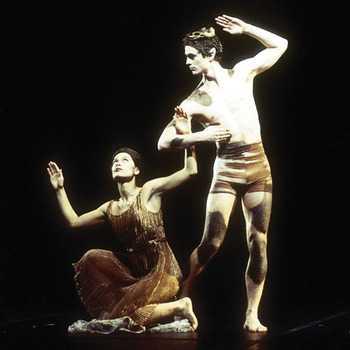
Emmanuelle Huyhn and Boris Charmatz in …d'un faune … (éclats) by the Quartet Albrecht Knust. Photo Boris Conte.

Following this series of citational segments comes the dance associated with the original version, complete with new interpretations of the music (a score for flute and piano), costumes based on Bakst's designs by Sylvie Skinazi, and with traditional casting: the Faun danced by a man, the Nymph by a woman, plus the chorus of six female nymphs, and a platform in the middle of the stage as an abstract representation of the Faun's rock. This was probably the most anticipated version, performed each evening by different couples. It introduces the serial aspect of the performances (three men playing the role of the Faun, two or three women playing the Nymph, Emmanuelle Huynh alternating with Cécile Proust). Here the notation score came into its own as a source of creative energy for the dancers, each of whom was called upon to develop a specific interpretation not dictated by tradition. Cast differently each evening, these interpretations co-existed in the series of performances in 2000. The attention given to each new citation of the original score showcased as much the individual citing and performing it, as it did the less personal revival of the choreography.
Transfers of Spaces: From Upstage to the Figures
The Quartet deliberately chose not to reconstitute the painted backdrop by Léon Bakst with its Fauvist allusions. The absence of the set where the Faun camouflaged himself in his mottled costume, created in the original a tension between the figure in a frieze-like profile and the background that absorbed it, or between Bakst's color wash (bain de couleurs) and the choreographed line of figures. By removing this figure/background tension, the Quartet focused attention on the relationships between the figures themselves. Without the distraction of a backdrop, the main focus was now on the duet between the Nymph and the Faun, more than on the spatial relationship between the Faun and the chorus of nymphs, or on all the nymphs, thus creating a specific hierarchy of figures that was not featured in the score.Footnote 36
There is yet another version, this one in everyday garb, with only two dancers: the Faun (danced at times by a man) and the Nymph (danced at times by a woman), with live music for solo piano or for piano and flute, and with a white scrim downstage. This gives significantly more visibility to the duet and removes the mythological context of the costumes, establishing in a way different from that of Nijinsky the tension between the narration and the score. On the one hand, costume, the conventional sign of gendered roles, and the closeness of the dancers to one another and to the audience accentuate the narration; on the other hand, the figures are flattened out and subjected to overexposure by the lighting, more radical than Nijinsky's treatment of frieze perspective. The figures in this version are thus transformed into silhouettes moving against a white background.
The next version, performed center stage, cites again the complete scores for the roles of the Faun and the Nymph, but this time in silence, and reverses the genders (the role of the Nymph was performed by Jean-Christophe Paré). By decontextualizing the duet from its sound setting, the Quartet undid another tension essential to L'Après-midi d'un faune—that of its relationship to Debussy's music, by creating resistance to the legato and setting aside any lyrical outpouring. This version of the silent duet, staged very close to the audience, presents a new temporality inflecting the narrative differently. The drama of the dancers’ breathing contrasted with the slowness of the movement tending toward immobility lends intensity to this moment. It also reveals their intimacy and the way they organize their touching; in Nijinsky's Mallarméan version, the protagonists never touch. The Nymph exits the stage, leaving the Faun alone, still in silence, giving an extremely suspended temporality to the end of the piece.
It is clear that the choice of citations and their mode of execution is not innocent, and neither is their order: before the presentation of the much anticipated uncut version, the audience was invited to discover some unexpected elements, contextualized differently, notably those moments less validated by tradition, and particularly the part of the Main Nymph. The most literal version with costumes and music was not placed on a pedestal as if it were the “star” of the evening. It was part of the series, of the fragmentation. As each interpretation was fitting in its own way, showing a singular vision of the score, none could be seen as an “authorized” version, as each was followed by another that was equally appropriate and coherent in its own way. This performance was thus a step in a new direction for citation: rather than showing variations of one “authorized” version, the Quartet presented a clear series of citations, each of which had been transformed because of its new context. In contrast to the classic method of transmission, choreographic variations were not made to adapt to the personal strengths of the dancers (which would validate them via the established codes), but rather to modes of interpretation and citational rewriting whose only meaning was to unsettle the dancer caught up with a citation—and the citation caught up in a new context.
These two modalities—the coexistence of different interpretations and the combination of sequences—gave way to a combinatory poetics capable of dealing with the plurality of modes of interpretation as much as the multiplicity of a stock of motifs, figures, and choreographed sequences. This use of the score lifted the ban on reconstruction of a sacred original and the necessity for reincarnation. Emphasis was placed not on the past meaning the score was supposed to contain, but on its future—its citational potential. The question was not so much knowing where L'Après-midi d'un faune came from, but instead where it might take us. The relationship to historical time was accented differently: returning to the original is here actually returning to a forward movement, it is to inscribe into the return a projection, a new project of interpretation. The use of the score-citation does not yield to any imperative, whether it be cognitive (the imperative of truth), ethical (the imperative of loyalty), political (the imperative of copyright), or finally theological (the imperative of incarnation), to underwrite the interpretive exercise. To work from the score in this way unmasks the appropriative power of the oral tradition that had limited L'Après-midi d'un faune to being a ballet like any other inscribed in the repertory of a patrimonial institution, dependent on the whims of dancers and on institutional politics, all of which had established a monopoly on the work. Working in this way also unmasks the scientific pretentions of the scriptural tradition of notators: the score document here has neither the value of command nor of beginning, and it is not founded on a transparent relation between words or signs and things. Nothing in the work or the discourse of the Knust Quartet calls upon a hierarchy of sources, rendering sacred the score as arkhé—the beginning and the command—or the reader/transcriber as the archon—the one who gives the command (Derrida Reference Derrida and Prenowitz1998, 1–2). To the contrary, it reveals a machine able even to expose the shifting genealogies of performances from evening to evening, in the sequences of improvisation based on the dancers’ stories. Let us now turn to this aspect.
Third Return: The Dancers’ Memory, Autocitation, and Anamnesis
The sequences devoted to L'Après-midi d'un faune alternated with two other kinds of sequences generated through improvisation calling for imaginative work around the figure of the Faun, and recollections of the dancers’ own work. Boris Charmatz, Jennifer Lacey, and Emmanuelle Huynh took on an improvisation whose aim was to evoke the Faun in individual and collective memory. Charmatz's improvisation brought into play the animal and virile aura of the Faun, using a children's story in which a little girl meets the child of a faun and asks him “What is virility?” to which the child-faun-Charmatz answers, “Virility is to strangle a bear with my bare hands, to knock a tree down with a flick of my finger, to run very fast without losing my breath; it is jumping, having hair on your chest …,” while dancing with a masculinity that begins tense and knotted, and is piteously undone at the end by the falling apart of his athletic prowess. The second sequence, by Jennifer Lacey (entitled “the little faun” or “fauna”), blended the figure of the Faun with that of the Nymph, inventing a creature evocative of a bathing faun, enshrouded by a soft strange halo. Finally, the third sequence featured Emmanuelle Huynh, wearing heels and tight pants and a rhinestone top, dancing in the style of Prince while humming the song Kiss, evoking this iconic pop figure who in certain ways reminded her of the Faun-Nijinsky: small, stocky, yet feminine at the same time, radiating eroticism while always remaining at a dandy's distance.
Gestural Autobiographies: Collective History and Individual Memory
Three other improvisational sequences, called “pleasurable memories,” and taken on each evening by different dancers, staged various moments from their own dance histories. The instructions for these particular sequences were the following: in about five minutes, recollect past moments of work, or old excerpts of choreography that had given them pleasure, thus allowing them to transition from one memory to another, verbalizing as much as possible what they were doing or dancing. In these improvisations, the dancers spoke more about sensations than the emotions their recollections elicited, keeping in mind a line from Samuel Beckett: “This sentence has gone on long enough” (Reference Beckett and Gontarski1946/1955, 37).
The self-citing dancer engages in a process of self-discovery: the choice of citation opens onto the history of his or her gesture, onto a biography through a gestural “bibliography.” By citing the name of a choreographer or the name of a piece associated with the gesture that s/he was redancing, s/he reminded us of one of the essential aspects of all training—imitation and copying—as much as the absorption of the movement of the other. By multiplying these memories, s/he also underlined the overflowing profusion of works between themselves and their “intercorporeality.” The movement of an individual, as choreographic language, happened inside/within an artistic and cultural movement at the center of which the individual appeared. “There is no individual work,” wrote Michel Butor. “… [T]he individual is from the beginning a moment in this cultural fabric. A piece is always a collective work,” and he added, “it is for this reason I am interested in the problem of citation” (Reference Butor1969, 2). The dancer appears all the more singular for evoking his or her relationship to what has been internalized through study, which he or she unveils by recomposing in the present the material of a past training. The dancer is the matter of his or her dance, just as Montaigne was the matter of his bookFootnote 37 : a matter consisting of countless borrowings, citations, allegations, references, parodies, pastiches, even various training systems. Every citation is, in this case, autocitation, where relationships are built as much between the danced works as among the dancers themselves.
The selection of dancers willing to call upon their memories was obviously essential. By choosing to work with Boris Charmatz, Emmanuelle Huynh, Jennifer Lacey, Jean-Christophe Paré, Cécile Proust, and Loïc Touzé, the Quartet chose, not only internationally known dancer-choreographers from the contemporary dance scene, but also six dancers with the experience of having danced with the leading choreographers of the day—among others, Odile Duboc, Régine Chopinot, Hervé Robbe, Mathilde Monnier, Claude Brumachon, François Verret, Carolyn Carlson, Merce Cunningham, Robert Dunn, and Randy Warshaw. Added to this wealth of relationships with well-known dancers were a number of connections with various dance forms, including Jean-Christophe Paré's “baroque” dances (staged by Francine Lancelot at the Paris Opéra), nineteenth-century classical ballets, most of which were danced by Paré and by Loïc Touzé (both of whom were ballet dancers at the Opéra), flamenco, Middle Eastern dance, and Cécile Proust's experiences of Japanese jiuta-mai.
This diversity of influences is for us one of the richest, most adventurous dimensions of this project: it creates a model of time in which the work's time (aesthetic), the subject's time (psychic), and gestural time (somatic) are subject to an array of free associations mixing everything together—fragments of stories, traces of learned movement, precise citations, blocks of sensations, or elements of past contexts. The execution of a recent movement unexpectedly calls up another from the past, bouncing us to a different fragment of a story, summoning up a sensation, another body—so many signs of an entire memory of live performance. Each one conjures up moments from a history that is at once personal and collective.Footnote 38
Each dancer improvised based on a narrative and kinesthetic pattern. There were as many dancers as there were ways of approaching a collective history focused on a singular memory. These moments were particularly moving, as they exposed the link between the desire to dance and the memory of danced works. But these staged scenes of the self brought with them the risk of autosatisfaction or autolegitimization in the guise of citation (narcissistic high camp), or the exhibitionism of revealing a secret (the intimate “scoop”). In fact, letting a seemingly random citation from a dancer's story emerge while keeping it under control entails risk. There is also a considerable risk in giving dancers poetic license in their citation, as it allows them the possibility to be unfaithful to their gestural statements—caricaturing them sometimes, stepping away from them, or refusing to get too close to a confessional/justificatory logic (“cite your sources!”), thus causing the dancers to become masked in this process of autocitation that they are intentionally scrambling. By not clarifying the citation, asserting that they speak in their own names or on behalf of someone else, they leave the citation unfinished and the subject/dancer is freed from assuring unity with himself or with his story. To resist clarifying what is cited, to resist revealing in the name of whom they are moving, has the effect of leaving the citation incomplete. To interrupt, contradict, or contra-“dance” oneself, or to take pleasure in one citation at the cost of others instead of many is, in short, to authorize oneself to dance in no one's name. They had opened a “fiction faucet,” even if the references were autobiographical, and they gave themselves the liberty of playing with it. Beyond this, we should add that psychoanalysis has never been absent from the dialogues and practices of the Quartet.Footnote 39
Dancing in Your Own Name or for No One?
For all the dancers, these public movements of anamnesis created a tension, if not a contradiction, with the staged memorial theater work. Over a number of performances, these improvised sequences gradually became set and subject to repetition. But in the effective dynamic of memory, such returns can be neither decreed nor summoned—they just happen. The need for an efficient and organized mode of remembering for the sake of the piece risked substituting itself for the randomness of the actual process of remembering—its emptiness, silences, confusions, latencies, and hesitations. The work of spontaneous citation ran the risk of shutting down once the dancers relied on memories that “worked.” While these spontaneous moments were the most adventurous of the piece, they naturally happened and worked best in the studio setting (Boulanger Reference Boulanger2004; Rivière Reference Rivière2003). Despite this impediment, however, it had proved important to explore the possibility of spontaneous citation so that the experience of the process could be woven into the piece to be shared and understood by others.
The power of these sequences is compelling in several ways. First, the public staging of the process and of the dancer's personal history as part of the setting of chosen and composed memories has been largely absent from the French stage. In this sense, the profusion of these elements reveals forgotten things: the names of artists, choreographers, performers, relatively recent works—what should have been unforgettable moments, but have still somehow been omitted or have slipped from the memory of the work itself. This is a scene as physical as it is cerebral, in which the imaginations as well as the movements of the performers are staged in the dance. Through their various and individual approaches, they tell the story of their dance, their desire to dance, and the contexts that have made it possible.
These moments threw a different light on the interpretations of L'Après-midi d'un faune: the game of metamorphoses of the dancers into the Faun or the Nymph also became part of these unique histories, and the reactivation of Nijinsky's piece was woven into this associative gestural genealogy. The evocation of each dancer's memory gave a kaleidoscopic perspective to the interpretations of L'Après-midi d'un faune, and the piece thus avoided being catalogued with other dry interpretations and biographical memories. On the one hand, a consistent general trend toward the blueprint helped steer the piece over the period of performances back towards the original motifs of Nijinsky's choreography, especially concerning the role of the Faun. On the other hand, by correlating this piece more and more tightly with the individual histories of the dancers, it ramified into multiple facets in which individual memories shimmered, intertwining with dance history itself.
Does not the Knust Quartet's genealogical work, through its altercation with the oral tradition and its difference with the scriptural tradition of Afternoon-of-a-Faun-of-Nijinsky, unmask the theater of historical forces, powers, and knowledge that had commandeered Nijinsky's L'Après-midi d'un faune, creating its reputation and its mythology? In fact, there were in Nijinsky's work numerous disappearances, reappearances, disguises, embellishments, accidents, and reversals—successive “masks” behind which it made its returns. Exposing or evoking borrowed and cited items and certain scenes and locations is to detail how the desires, ideas, and movements of L'Après-midi d'un faune took another direction—a different logic—and found new meaning. In other words,
… genealogy must record the singularity of events…. It must seek them in the most uncompromising places, in what we tend to feel is without history—in sentiments, love, conscience, instincts; it must be sensitive to their recurrence, not in order to trace the gradual curve of their evolution, but to isolate the different scenes where they engaged in different roles. Finally, genealogy must define even those instances where they are absent, the moment when they remain unrealized. (Foucault Reference Foucault and Faubion1998, 369)
What appears onstage is as much the history and the memory of the work, with its many masks, as it is the history of the dancers dancing. The performers are staging, as much as dancing, the difficulties of grappling with movement that predates their own: the places and moments of confrontation, revelation and pleasure, impossibilities and resistances, even dissociations from the self. The Knust Quartet brings us a fictional, choreographic, and kinesthetic space with a poetics of collective traces. By the dehierarchized multiplication of forms of citations, allusions, references, and burlesque drag in L'Après midi d'un faune, the central figure of the Faun-Nijinsky, as well as its language, deploys as much as it manifests itself through different types of bodies and representations. Far from melancholy, the Quartet speaks through the traces left by live performance—traces still to come, mnemonic traces we cannot yet name or localize—which float from body to body through both audiences and dancers because they are not attached to a specific memory or a single individual. Perhaps these traces are the memory of live performance working toward active oblivion so that it can be in an eternal state of transformation. Perhaps it is a quest for traces, for their collective invention and transformation, sending the spectator back to his own desire for memory—his way of singularly and collectively inscribing the event he experiences in time. This memorial activity is for us not passive as indicated by this question: What traces (to which we could later return) does such an event “leave” behind? This memorial activity is, in fact, active, engendering the question: What re-memorizations shall we invent in order to bring about new work?