Introduction: the problem with borders
Borders, as delineated physical frontiers both dividing and constituting states, represent a particular European understanding of space and separation, which displaced indigenous conceptions, including Islamic ones, through the spread of formal and informal colonialism. Where European powers could not assert their authority directly, ‘native’ polities were pressured to adopt Westphalian state forms, through the construction of borders. These borders were central to the construction of states by indigenous political communities, helping define ‘them’ as well as the ‘other’ that they confronted. The images and conceptions of space communicated by these practices colonized the local political imagination. Thus when indigenous agents shaped their political space, physically and politically, they did so with these European-inspired images firmly fixed in their imagination. Afghanistan was one of the first political entities defined by this process of frontier-making beyond direct colonial control. Although bordered by two European empires, its first modern frontier was its western border facing Persia.Footnote 1 It was thus against Persia, another polity of the Dar al-Islam, that Afghanistan was first topographically delineated and physically defined.
As the Afghan and Persian political communities coalesced into modern states in the course of the nineteenth century, they attempted to strengthen their institutions through the demarcation of frontiers and the assertion of territorial sovereignty. Yet our understanding of this process is heavily coloured by the story of Anglo-Russian rivalry, known as the ‘Great Game’.Footnote 2 The Perso–Afghan frontier represented the only one defined largely by indigenous actors themselves, rather than by the Russians or British.Footnote 3 It therefore became the centre of a definitional rivalry between the emerging Persian and Afghan states. In this arena of contestation, these powers faced an opponent of roughly equal strength, rather than the imperial juggernauts pressuring them from other directions. The contest over the Perso-Afghan frontier reveals a story fundamental to state construction for both protagonists, one which was repeated elsewhere in the world as European norms of political intercourse came to monopolize the expectations of the international community, as well as indigenous communities.
Central to the process of border creation on Afghanistan’s western frontier in the late nineteenth century was the first delineation of the Sistani frontier by the Goldsmid mission of 1870–72. This mission embodied a profound conceptual shift, redefining the Islamic and ‘tribal’ political world, from which the Afghan and Persian states were emerging. It marked the point at which these political communities assumed, to differing degrees, the characteristics of modern Westphalian states in their rhetoric and aspirations. Rather than simply emphasizing the role of local interests in affecting the outcome of Anglo-Russian imperial rivalry, this article recasts the Perso–Afghan frontier dispute as a vehicle for the transformation of the region’s political landscape into one contoured by ‘native’ states of recognizably European form. This transformation was not simply imposed by the region’s colonial hegemon, British India, whose power was too ephemeral to warrant such an assertion. While the British may have originally framed the conceptual landscape of statehood, it was ultimately subverted by indigenous actors who populated it with local notions, creating a hybrid political order.
The Goldsmid mission occurred at a time when the influence of centralizing Islamic states was at low ebb. Both the Qajar and Durrani dynasties were relatively weak. Likewise, neither the British, still embracing their policy of ‘masterly inactivity’, nor the Russians, who had yet to secure their control of Central Asia, were particularly interested in asserting their limited power in the region at this time. Consequently, the mission that the British dispatched was charged with arbitrating between local states, rather than delineating the frontier on behalf of the Empire, as would later be the case. The mission took place before our vision becomes blurred by the all-encompassing legend of the Great Game.Footnote 4 It thus offers a window onto a vanishing world of indigenous polities adapting, and simultaneously succumbing, to the pressures of imperial conformity. Finally, the mission’s introduction of Westphalian norms of statehood was expressed through the cartographic depiction of both political identity and control. Mapping the delineation of political authority in the area embodied a fundamentally different understanding of politics within it.
The experience of the Goldsmid mission encapsulates the contradictory pressures of modernization and traditionalization affecting the British colonial project in South Asia, and Western imperialism more generally. Yet, as neither Persians nor Afghans were directly ruled by colonial powers, their assumption of European ideas of statehood stands apart, even if it was driven by power disparities with neighbouring empires. As in Siam (Thailand), Persians and Afghans defined their own ‘geo-bodies’ in the absence of direct colonial control.Footnote 5 The demarcation of their common border thus gives rise not so much to a study of imperial domination as to an examination of the ‘indigenization’ of European norms and forms of political intercourse.
The Perso–Afghan contest was an expression of the hegemony of the European paradigm of political community, which colonized spaces beyond direct imperial control. It redefined the nature of the emerging Qajar and Durrani states by making them essentially territorial entities. While both Persian and Afghan polities adopted the norms and forms of European political intercourse through the demarcation of boundaries separating discrete physical and political spaces, their assumption of these remained distinct. Neither the Afghan nor the Persian experiences followed the same course. The process of state formation in Afghanistan was largely driven and defined exogenously.Footnote 6 Further, the image of geo-bodies was initially central to the mapping and creation of a state rather than a nation. In contrast, the Persians, though prompted by Anglo-Russian pressures, had an indigenously authored cultural memory of statehood and political authority on which they could draw, even if it differed markedly from the new political project they were in the midst of constructing.Footnote 7
This article aspires to investigate larger claims regarding imperialism’s transformation of this region’s political landscape, employing the Goldsmid mission as the main case study under consideration, with the earlier Perso–Afghan dispute over Herat treated in less detail. Consequently, my sources are largely drawn from Sir Frederic Goldsmid’s public and private papers in the India Office Records, as well as the Persian files at the National Archives in Kew. Although these are extremely rich and under-utilized sources, I am conscious of the limitations that reliance on these sources places on research. Our understanding of this region will be furthered by greater access to Russian sources, and more importantly Persian ones. This article is therefore offered as a beginning, both conceptually and historically, to the study of an area too long ignored by contemporary scholarship.
Territoriality and the meaning of sovereignty
The issue of territoriality has elicited a sophisticated body of scholarship, examining the implications of the pre-eminence of European understandings of territory in the creation of the nation.Footnote 8 According to these authors, the creation of state boundaries through technological innovation, including mapping and surveying, gave birth to geopolitical shapes, or ‘geo-bodies’, which ‘created nationhood spatially’.Footnote 9 As Thongchai Winichakul has argued, ‘The geo-body, the territoriality of a nation as well as its attributes such as sovereignty and boundary, are not only political but also cultural constructs.’Footnote 10 The main thrust of this scholarship has focused on the role of territoriality in the construction of the nation, rather than that of the state. Yet the modern delineation of territory through boundaries is first and foremost an exercise of state power, and a prescriptive practice of state competence. While important in the definition and construction of the ‘nation’, territoriality must be understood as constitutive of the state itself. This is particularly true in the Afghan case where the territorial genesis of the state preceded the tentative emergence of an Afghan nation.
The dominance and entrenchment of European ideas of territoriality can be traced through the sharpening of frontiers during the nineteenth century. Originally conceived of as spaces of transition, regions of overlapping claims of suzerainty and control, it was only with advancing survey technologies that conceptions of boundaries began to sharpen in the European imagination.Footnote 11 This sharpening filtered into colonial spaces first, and then affected interstitial spaces by drawing the limits of the colonial state. Thus, boundaries moved from a zone of control to a line of control. In South Asia, what once had been a frontier zone separating East India Company (EIC) influence from that of Ranjit Singh became a textual line with the 1809 treaty of Amritsar, and practical reality with Ranjit’s establishment of a line of forts along the Sutlej.Footnote 12 Likewise, Franco-Thai competition for influence in Vietnam collapsed what had been a space of transition, where tributaries navigated the demands of multiple suzerains, into a discrete line, cartographically depicted and separating sovereign states.Footnote 13 As colonial regimes became more firmly established, and more convincingly monopolized political space, the political concepts that they represented gained traction in indigenous imaginations.Footnote 14 Territory thus became a central element of political identity, and its delineation a constituent element of statehood. The representation of this understanding of political order took cartographic form, with an emphasis on mapping, particularly by the colonial authorities.Footnote 15
Pre-European states throughout the region conceptualized political space and territoriality quite differently, stressing a relational rather than territorial focus which existed in Islamic legal principles, as well as in tribal concepts of use rather than land value.Footnote 16 The lands constituting the emerging Durrani and Qajar states had previously been subject to different administrative divisions. ‘Feudal’ estates, known as tiyūls, in many cases served as units of administration, emphasizing the power of local lords in a political universe defined largely by suzerain relations.Footnote 17 Political authority, in the main, rested on tributary, segmentary relationships better mapped through genealogical tables than cartographic depictions.Footnote 18 Tributary polities often formed relationships with multiple overlords, creating overlapping layers of authority, and allowing them to play suzerains off against one another. Accepting multiple tributary relationships as a fundamental part of the political order, suzerains claimed paramountcy rather than exclusive allegiance.Footnote 19 The overlords’ concern focused on the obligations that tributary relationships entailed, rather than on land and its control. These relationships had their symbolic, and submissive, expression in the confined physical space of the court. Direct control could therefore be circumscribed, but nonetheless effective. In this space, the visible bestowal of honour, visitation and expressions of mutual, albeit hierarchical obligation filled the substance of these pre-modern political orders.Footnote 20
In contrast, modern European concepts were emphatically territorial, with space judged not by relational proximity to centres of authority, but by physical distance. European political ideas elevated the exclusive control of territory as a constituent element of sovereignty, wherein the sovereign maintained a permanent and uncontested claim over territory alienable only by its consent. During the nineteenth century, indigenous polities’ sophisticated understandings of territory and its relation to political authority were eclipsed and replaced by universalizing European norms, shaping legitimately recognizable expressions of political community.Footnote 21
While the territorialization of state boundaries and political authority ultimately represented the pre-eminence of European ideas of sovereignty, it was nonetheless the outcome of a lengthy and hotly disputed process. Nowhere was this contestation, and the hybridity it produced, more visible than in South Asia, and especially in the domains of the East India Company. The establishment of Company power radically altered the political landscape, by challenging indigenous concepts of political order. Yet, while Company governance was in the main a modernizing phenomenon, it was also a uniquely ‘Asian’ polity. Although the Crown asserted sovereignty over Company lands as early as 1813, Company servants nevertheless recognized the suzerainty of the Mughal emperor in Delhi, presenting nazr (presents) to him until 1843.Footnote 22 The Company thus understood, and to a limited extent maintained, indigenous concepts of suzerainty and tributary relations, as well as European precepts of sovereignty and territoriality. After the imposition of Crown rule in 1858, however, the Government of India allowed such understandings to lapse, in favour of European norms of territoriality.
Much the same was true of the Russian Empire, as it expanded into Central Asia from mid-century onwards, with its identity as a European or Asian power constantly contested. Imperial power was exercised not simply by local collaborators, but also through local channels, often predating the Russian conquest.Footnote 23 The Russians, as well as the British, were conservative imperial powers who sought to utilize pre-existent social structures rather than create new ones. Thus while colonialism ultimately displaced indigenous concepts and practices of power, it often did so by initially usurping them.
The ascendance of the Westphalian political paradigm, and its indigenization, therefore took time. The emergent states of the nineteenth century were initially able to navigate a hybrid political universe with considerable success, due to their ability to speak both the old indigenous languages of political authority and the new European one. The Punjab of Ranjit Singh, the Gorkha kingdom, Awadh under Ghazi al-Din Haydar’s rule, and the Thai kingdom all continued effectively to employ the languages of suzerainty and territorial sovereignty.Footnote 24 Yet the success these states enjoyed previously waned as European ideas of statehood became the only acceptable language of politics after mid-century. It remained, nonetheless, at least rhetorically important for indigenous polities to employ earlier idioms of authority, which resonated with ideas of political order that still shaped the communal imagination. This was particularly true in instances where indigenous Islamic polities faced off against one another, rather than against neighbouring imperial powers.
Herat and the Great Game
Herat, on the margins of both the Persian and Afghan political projects for much of the first half of the nineteenth century, became a focus of dispute for these emerging states. Although the city entered the Afghan political orbit in the late eighteenth century, the disintegration of the Durrani Empire, and the concurrent rise of the Qajar state, led to renewed contestation of control.Footnote 25 As the Afghan kingdom spiralled into a prolonged period of civil strife, attention wandered from its western reaches. The Qajars recognized this as an opportunity to replace Herat’s de facto independence with de jure recognition of Persian paramountcy. Their demands were commensurate with contemporary conceptions of suzerainty, notably the reading of the khu⃛ba (Friday sermon) in the jame masjid (main mosque) in the name of the shah, the minting of coins with the shah’s inscription, and annual tribute dispatched to Tehran.Footnote 26
Russian encouragement turned Persian ambitions decisively eastwards, as the Qajars sought to compensate for lands lost in the northwest through conquests in Afghan Khorasan.Footnote 27 Such irredentist ambitions aimed to bolster flagging Qajar prestige, as well as secure Persian frontiers against the constant plundering of Afghans and Turkmen. The British, in turn, sought to counter Russian pressure with a combination of incentives and threats, designed to dissuade Qajar attempts on Herat. When these failed and Persian forces besieged the city in 1837, the British responded by invading Afghanistan, but arrived only after the Persians had retreated in defeat.Footnote 28
Chastened by their own incompetence, Afghan resistance and the force of British reaction, the Qajars did not mount another attempt against Herat until the mid-1850s. By 1856, Afghan instability, combined with the British attitude of ‘masterly inactivity’, created what the Qajars thought to be a receptive environment for their territorial claims. The expedition they dispatched, however, elicited a sharp and violent British response, leading to Persian withdrawal. For a third time in little more than twenty years, the Persians retreated from what was to be their last organized military attempt to annex Herat.
The struggle for Herat has long been viewed primarily as part of the Great Game. According to this dominant narrative, indigenous actors had little say in the evolution of a complex political situation, shaped almost exclusively by the strategic calculations of London, Calcutta, and St. Petersburg.Footnote 29 Some have challenged this account, arguing that considerations of indigenous powers affected regional events as much as colonial policies.Footnote 30 Yet both interpretations view this competition rather narrowly, as driven by state strategic imperatives, be they Russian, British or Persian. Such analysis overlooks the construction of European-like states as the expression of political order by indigenous communities. The contestation of Herat and its environs was not simply driven by calculations of state advantage, but by the very nature of the emerging states themselves.
Alternatively, Perso–Afghan competition for Herat has been understood under the rubric of a familiar and ‘traditional’ contest for suzerain allegiance to a monarch, whose authority remained distant and whose power rested on personal ties to his vassals. Both the Persians and the Afghans relied on the dynastic and tribal loyalties of local sardārs (lords) to assert their suzerain claims to the area. The demands of the Persian shah, for example, focused on the submission of the Herati ruler to Persian overlordship. To the Afghans, with a long collective memory of Persian political paramountcy, this possibility was not completely alien. Tehran repeatedly attempted to pull Herat into its orbit by exploiting the tribal rivalry between the Saddozai and Barakzai Durrani, promising aid against Kabul. The Persians buttressed their dynastic claims with cultural assertions, especially stressing the linguistic patrimony of Herat. The limited linguistic differentiation between Afghans and Persians, however, made such assertions fall rather flat.
Persian shahs also looked for religious sanction for their territorial expansion, persuading the ulama to declare a jihād against the Sunni Afghans.Footnote 31 Yet the invocation of religious sanction by the Qajar state was ambivalent at best. Shi‘i doctrine arguably did not allow for jihād in the absence of the Imam.Footnote 32 Further, the Qajars attempted to demarcate a fairly restricted political community, based on a combination of linguistic (Persian) and confessional (Shi‘i) commonality.Footnote 33 Such efforts were complicated by both the prevalence of Persian-speaking Sunnis and Shi‘i who did not speak Persian, both within and without the empire’s territorial borders.
Likewise, the language of defiance chosen by Herat’s sardārs remained the language of ‘pre-modern’ Islamic political communities, resting on religious as well as tribal bases, with declarations of jihād against the apostate Persians.Footnote 34 Such calls resonated with the ‘ecumenical character of Islamic sovereignty’, as opposed to rallying Heratis to defend the polity’s territorial integrity.Footnote 35 Yet resistance in the name of Sunni Islam was complicated by the area’s large Shi‘i population, to whom the Persians presented themselves as protectors against the incessant slave raiding practised by Sunni tribesmen.
Embedded in such religious discourses were ideals of community based on Islamic precepts, such as the umma (community of faith) and watan (homeland), as well as their limits marked by the hodūd (limit, or boundary) and sarhadd (frontier). The majority of Afghans were Sunni adherents of the Hanafi school, and thus theoretically embraced a larger confessional community than the Shi‘i.Footnote 36 But Afghan tribal society greatly coloured understandings of Islam, making it difficult for many to transcend lineage-based social identities in the name of religion, and thus circumscribing the community of faith. Sectarian differences therefore meshed with a divergence between the textually Islamic religious-politico universe of the Qajars, and the largely non-textual, lived Muslim one of the Afghans. The religious space separating the Persians from the Afghans was as much a divide between ‘Islamic’ and ‘Muslim’ societies as between Shi‘i and Sunni ones.
Yet this was a period of dramatic religious change for both Persians and Afghans, as movements of Islamic revival in Persia and South Asia transformed public debates about the meaning and content of religious community. Modernists tended to accept novel ideas about nation states, while at the same time advocating a textually based Islam of universal applicability.Footnote 37 As part of their adoption of European norms of statehood, the Qajar and Durrani monarchies aspired to an increasing secularization of political space, in which religious leadership was to be subservient to the state. Such aspirations were clearly discernable in their efforts to subjugate offices of religious authority to state control.Footnote 38 Offices of Islamic authority, as well as ideas of Islamic community, were eventually subsumed within the political discourse and institutions of emerging states, at least until the late twentieth century.
Older political languages of Islamic suzerainty disguised the emergence of a new sovereign political order. European empires demanded the trappings of European political form from the polities that they dealt with, imposing these forms on those that they conquered or indirectly controlled. The direct involvement of British and Russian troops in the Herat dispute personified the reality of a European political universe stealthily inhabiting the space claimed by the old order. This was a process, as new norms first integrated with, and then replaced, those more familiar. Thus, while reading the khu⃛ba in the name of the Persian shah may have been an acceptable sign of submission in the early 1820s, it no longer was by the 1870s. While earlier Persian expeditions against Herat sought to extract the rituals of allegiance common to the Islamic political universe, the British boundary arbitration of 1872 sought to establish the physical demarcation of an order based on European sovereign statehood. The dispatch of the arbitration marked the reformulation of the political landscape as one defined largely by European-inspired, universal norms enacted by local actors. While the parameters of the political stage were defined by imperial interests, the stage itself left great room for indigenous agency and ideological subversion.
Herat’s importance waned in the latter half of the nineteenth century. The Persian defeat in 1856–7 effectively ended any hope of the realization of Qajar ambitions in the area, although it would be a number of years before Herat was firmly fixed within the emerging Afghan state. Repeated British interventions removed the issue of Herat’s control from the acceptable realm of competition between these two indigenous polities. More pointedly, the city’s economic importance, derived from its position as a caravan entrepot, sharply declined in the second half of the nineteenth century. Regional trade suffered from competition with sea-borne trade routes, and many inland routes were re-oriented to adjust to new trade patterns with South and Central Asia, badly affecting Herat.Footnote 39 Its history of instability discouraged the resumption of trade through its gates. With Herat effectively neutralized as a plausible source of conflict, both Persians and Afghans looked elsewhere. By the late 1860s, their ambitions clashed with increased imperial interests in Sistan. It was there, in a rural, tribal ‘backwater’, that the next chapter of Perso–Afghan competition was set and that the modernizing process of border delineation physically took place.
The Goldsmid Mission, 1870–72
The Persians sensed an opportunity for the assertion of claims over Sistan, never effectively controlled by them, as the Afghan kingdom again succumbed to internal distraction in the late 1860s. At their formal request, the British Government of India dispatched an arbitral mission headed by Major-General Sir Frederic Goldsmid to determine the Perso–Baluch frontier in Makran, and the Perso–Afghan frontier in Sistan. The Persians invoked Article VI of the Treaty of Paris of 1857, which ended the Anglo–Persian war of 1856–7. The article reads in relevant part:
… in case of differences arising between the Government of Persia and the countries of Herat and Afghanistan, the Persian Government engages to refer them for adjustment to the friendly offices of the British Government … [who] on their part engage at all times to exert their influence with the states of Afghanistan to prevent any cause of umbrage being given by them or by any of them to the Persian Government ….Footnote 40
By defining the extent of Persian and Afghan sovereignty in this contested region, the British believed they could hold these states responsible for threats to their imperial interests. The Makran arbitration provided a vehicle for the settlement of the British–Persian frontier in Baluchistan, where Britain’s direct involvement was both expected and understandable.Footnote 41 In contrast, Sistan lay outside any formal British remit, so that British arbitration presented a less obvious case meriting imperial involvement. However, the British understood the benefit of a clearly delineated frontier between these emergent states, in terms of the assignation of both control and responsibility.Footnote 42
As the frontier drew a clear line in the sand, effectively marking the geographical limit of Russian influence, British involvement can also be understood within the logic of the Great Game. Yet such an interpretation misconstrues the character of, and motives behind, British involvement. While British fears of Russian influence have long been argued to drive their actions in the area, the nature of the Russian menace at this time was more illusory than real.Footnote 43 In 1870, the Russians had yet to firmly establish their hegemony over northern Persia, complete their conquest of the Central Asian khanates, or secure financing for their Central Asian military railway. Russia’s imperialist ventures into the Central Asian steppe were largely a consequence of its weakness on the European stage, clearly revealed in the Crimean War.Footnote 44 In contrast, the British were secure in their Indian possession, the ‘Mutiny’ notwithstanding. During this period of ‘masterly inactivity’ and weak Russian threat, British interests beyond the frontier were essentially intellectual rather than geo-strategic in nature. The British wanted to assert their authority over this region through the monopolization of knowledge and definition, delineating the reaches of properly recognized political authority, namely the Persian and Afghan buffer states. This was manifest through their dispatch of a mission whose chief aim was to collect and order information, and then deploy that information for the creation of a new political reality in the form of a delineated boundary.
Since the ‘Mutiny’ in 1857–58, the British had separated and transformed the government of their Indian possessions from the indigenous body politic. As a consequence of disengaging with local political culture, when casting their gaze beyond the frontiers of their domains, the British did not look to the native polities occupying that space, but rather to the European empires coveting it. From the mid-nineteenth century onwards, the British steadily lost the ability to speak in the languages of local political cultures, and instead relied on ‘colonial knowledge’ to both homogenize and understand the indigenous polities they dealt with.Footnote 45 These polities were now understood in terms of their shortcomings vis-à-vis their European contemporaries. Rival European empires, particularly Russia, embodied familiar political order, allowing the British to conceptualize and define the intervening spaces in a way that they understood. This process of conceptual colonization had been developing since the early nineteenth century, leading up to the British defeat in Afghanistan in 1842.Footnote 46 In the post-1858 environment, it came to monopolize the ‘official mind’. Competing understandings of the space separating the British and the Russians thus became homogenized in a conceptual landscape delimited by the language of European political precepts, cloaked in the rhetoric of Russian threat. British participation in frontier arbitration thus rested on a desire to transform these indigenous polities into a more familiar, and thus malleable form.
The reasons propelling Persians and Afghans to avail themselves of British ‘good offices’ appear unremarkable, at least initially. As the regional imperial power, Britain repeatedly demonstrated that it would not tolerate the development of a situation perceived to threaten its interests. This knowledge likely weighed heavily in the Qajars’ minds, as it was they who suffered Britain’s displeasure in 1838–42, and again in 1856–7. By invoking a treaty largely dictated by Britain, Tehran sought to portray its eastward ambitions in a more sympathetic light, untainted by shadowy Russian influence and encouragement. Conversely, the Afghans had little choice, once the British decided to arbitrate. Sher Ali Khan, ruler of the truncated Afghan kingdom, could not easily reject Lord Mayo’s entreaties, especially at a time when he was cultivating an accommodating relationship with British India. Further, Sher Ali Khan could feel assured that British interests in western Afghanistan probably complemented his own, as the British preferred the area to remain under Afghan overlordship.Footnote 47 Yet such explanations, focusing exclusively on the subjugation of indigenous interests to imperial imperatives, are rather unsophisticated.
The British arbitration of their common frontier offered both the Persian and Afghan governments important advantages which could not be obtained through direct conflict. In addition to placing the resolution of territorial claims in a matrix that Britain could accept, British delineation of this contested space accomplished what neither Tehran nor Kabul could achieve on its own, the recognition, both domestically and internationally, of their control of this hitherto recalcitrant region. Although both Qajars and Durranis put forward longstanding claims to Sistan, neither had been able to convincingly demonstrate the control that such claims entailed.Footnote 48
The Sistanis, like the Heratis under whose overlordship they so often fell, had proved adept at navigating the region’s segmentary political order, and had protected their autonomy through tributary relations.Footnote 49 To the British, the region’s history was one of a constant tug of war between Persian and Afghan power.Footnote 50 They opted not to understand this as a contest for the preservation of Sistani independence, protected against the Persians through many open conflicts, and from the Afghans through the intricacies of tribal politics. This understanding inherently limited the universe of possible outcomes, with either the Persians or the Afghans as the ultimate winners, and the Sistanis as the inevitable losers.
The willingness of both the Afghan and the Persian governments to submit this region to arbitration represented a desire to extend their sovereignty over the region with the help of British interlocutors, a strategy that was not without precedent in the region. In South Asia’s tumultuous eighteenth century, local intermediaries, unable convincingly to assert control over recalcitrant regions, had relied on sanads (document/deed) from political overlords, with which they buttressed claims of authority.Footnote 51 Both Persians and Afghans mimicked this tradition during the course of the arbitration, attempting to establish their sovereignty through a time-tested strategy of suzerain dispensation. The reliance on indigenous methodology to establish exogenous political substance underlines the hybridity central to the assimilation of European norms of political order and territoriality. Indigenous powers worked within a landscape of possible outcomes, the limits of which were determined by the imperial powers, but the contours of which were shaped by local agents.
Strategies of control: Persian obstructionism
Qajar strategies during the arbitration in part reflected their position relative to the British as well as local centres of power. Goldsmid characterized the actions of the Persian commissioner, Mirza Maasum Khan, as duplicitous, insisting that he was playing a ‘double game’.Footnote 52 The commissioner systematically used the presence of the British mission as a confirmation of Persian claims to the area, and his repeated obstruction of the mission’s inquiries were more than simple attempts to sabotage British impartiality. Rather, they were calculated to make the British mission appear subservient to its Persian hosts, demonstrating Qajar sovereignty in the face of its delimitation by the British. The Persian commissioner’s lack of diplomatic etiquette towards the British mission signalled both the centre’s willingness and supposed ability to stand against Britain’s imperial ambitions, and yet Tehran’s eventual disavowal of Mirza Maasum Khan’s actions underlined its ultimate acquiescence to British demands.Footnote 53
One of the most visible symbols of apparent British subservience was the Persian commissioner’s insistence that while the mission was in Sistan, it could not fly the Union Jack. The commissioner argued adamantly such a display would inflame local Muslim sensibilities, and was likely to provoke a ‘general massacre’.Footnote 54 To underline Persian pre-eminence vis- à-vis the British, the commissioner placed a Persian banner in front of his residence on a ‘flag-staff made at least two or three feet higher than that of the English Commissioner’.Footnote 55 By making the British mission appear in a visibly subservient status, Tehran set forth its unchallenged claims of sovereignty over the region to its inhabitants and local lords. The arbitral mission’s procession evidenced Tehran’s apparent triumph over London and Calcutta to the local populace, undoubtedly ignorant of the arbitration’s true nature or purpose.Footnote 56
The Persian commissioner’s actions were, however, complicated by the relationship between central and local authorities. Tehran issued orders empowering the commissioner to demarcate the frontier with the British mission, but such orders could only be discharged with the cooperation of local officials.Footnote 57 Yet some governors were autonomous of Tehran, and had little to gain by cooperating with its representative.Footnote 58 The commissioner’s presence personified an assertion of sovereignty by the Persian centre, representing a radical break from the universe of tributary relationships hitherto shaping the Persian political landscape.Footnote 59 The Qajars’ willingness to turn to Britain, their imperial nemesis, clearly demonstrated a desire to prevail in the face of de jure autonomous regional lords, who were sometimes de facto independent. Tehran thus walked a fine line, attempting to assert a territorial claim of sovereignty and central control over a distant borderland through the offices of tributaries ruling the region.
Indeed, the commissioner’s reliance on the Amir of Kain, the Persian governor of the area abutting and potentially including Sistan, led Goldsmid to complain continually that he was in the Amir’s pay.Footnote 60 According to Smith, the Amir ‘pays no fixed revenue to the Shah, but supports the whole expenditure of troops and government servants located in his province … he, moreover, transmits from time to time presents or “ta’arufs”, in money and kind, to Tehran’.Footnote 61 The Amir’s virtual independence made him suspicious of central authority, making him view the arrival of a Qajar official in the company of a British mission as an unwelcome development. While his distance inoculated him from Tehran’s control, it also deprived him of its protection. Only the Qajars could protect him from the British, requiring some sort of accommodation with the centre. His willingness to accede to central demands was thus commensurate with his perceived vulnerability to British ambitions.
The Persian commissioner’s unambiguous brief was thus fundamentally compromised by a lack of material resources necessary to successfully complete it, underlining the wide discrepancy between the centre’s aspirations and its real authority. Tehran badly wanted to assert both control and sovereignty over areas in the political outlands.Footnote 62 To compensate for its weakness, Tehran ironically relied on the symbol of its impotence, namely British arbitration. The Persian court adopted the canny political strategy of using an imperial hegemon to assert its claims of authority over loosely controlled areas, but this did not come without its risks or costs.
While Tehran attempted to use the British mission to forward its own political agenda, that agenda itself was permanently altered by the ideas of political order that the mission represented. The Sistani arbitration was not simply an attempt by Tehran to co-opt the Amir of Kain or Sistani sardārs into a tributary relationship, in which the Qajar shah stood as suzerain in a segmentary political order. Rather, it was an attempt to territorially delimit the reaches of Persian sovereignty, or to territorialize the bounds of Tehran’s authority, filling the intervening space with a new concept of political order based on that of the emerging modern state. It is worth quoting at length how the Persians themselves conceptualized that order, with the Nizam ul-Mulk writing:
According to an old custom, the greater number of Persian provinces were delivered, as a kind of inheritance, to the chiefs of those provinces; and this is even now the practice in some parts of Persia. The Govt of Seistan has also in this manner from the time of the Safavin kings until now, been usually vested in the local chiefs, especially the Kaianis.
In the commencement of Mohamed Shah’s reign, the policy of Persia was to concentrate gradually into her own hands the power of her chiefs. This new policy changed wholly the former system of Govt. Those provinces which were formally quasi independent became thus absorbed within the centralising influence. Under this new policy a change also from the same period was applied to the govt of Seistan.Footnote 63
The Goldsmid mission’s failure to definitively delineate the Sistani border, and thus the limits of Tehran’s sovereign authority, demonstrates that while European ideas of political order triumphed, their realization remained incomplete. A second British mission was dispatched in 1905, followed by a Turkish one in 1935.Footnote 64 The Persian commissioner’s reliance on local acquiescence and negotiation in the early 1870s underlines the fact that the indigenous political order retained conceptual as well as practical vitality. Nonetheless, this mission represented a definitive break in the way the Qajar state conceived of its own political power. Demands of sovereignty could no longer be satisfied by the ritual subjugation of local lords central to tributary relations. Instead, the Persian state, reified in the person of the shah, required the assertion and acknowledgment of its control.
The records of the British mission reflect, if they did not actually engender, this reification. In questioning a local sardār, Goldsmid recorded that ‘Sardar Imam Khan ... took the opportunity of saying that all the country from here to Rudbar ... was the property of the Shah.’ According to Goldsmid, this constituted a ‘complete acknowledgment of Persian sovereignty [emphasis added]’.Footnote 65 Goldsmid’s observation enunciated the transformation of political order from a suzerain to a sovereign reality. Read literally, it equated the shah’s ownership with state sovereignty. Regional political cultures had framed political suzerainty in a different propriety language, envisaging obligations created through imperial dispensations. Yet in the British schema, obligation was incumbent upon the land, itself the object of ownership. The shah was transformed from the recipient of obligation to the sovereign of territory, and thus became the personification of the state. This transformation of his personage reflected a transformation in the political universe in which he operated. As suzerain, the shah was entitled to tribute as part of a segmentary relationship; as sovereign, he owned the land inalienably. This transition was precisely what the Qajar dynasty sought to accomplish, although neither their aspirations nor understandings accorded wholly with those of the British.
Strategies of control: Afghan acquiescence
While the Persian state was more advanced in its adoption of European norms of political order, the participation of the Afghan kingdom in the arbitration represented a no less profound change in its political culture. Like the Persians, the Afghans deputed a commissioner to the arbitration, Sayyid Nur Muhammad, who was accompanied by a representative of the Government of India, Major-General Henry Pollack.Footnote 66 They were to meet the Persian commissioner and Goldsmid, and then together proceed to the disputed areas of Sistan.Footnote 67 In the event, this journey never took place, largely due to the ‘obstructionism’ of the Persian commissioner.Footnote 68 The mission’s full complement, together with both commissioners, assembled in situ for only three days before Goldsmid decided to divide the parties and proceed to Tehran.Footnote 69
Unlike his Persian counterpart, the Afghan commissioner evinced neither hostility nor duplicity towards his British companion, undoubtedly because British imperial interests paralleled the Afghans’ own. Nor did he engage in similar attempts to visibly demonstrate Afghan superiority over the British representative to local people. Most of those encountered by Pollack and Sayyid Nur Muhammad willingly expressed allegiance to the Afghan Amir as overlord.Footnote 70 Nonetheless, the Afghan monarchy was in a considerably weaker position vis-à-vis local sardārs than its Persian cousin. Afghan claims of suzerainty were thus markedly less penetrative than Persian claims of sovereignty.
The relative weakness and immaturity of the Afghan state was apparent on a number of fronts, most obviously because the arbitration’s opinion was delivered in Tehran. The Persians invited British participation by invoking a treaty conforming to European norms of international law, while the Afghan Amir was pressured by his personal relationship with the Viceroy.Footnote 71 Although both the Persians and Afghans despatched commissioners, only the Persian commissioner was accompanied by a survey officer, Ali Ashraf Khan, charged with producing a map of the disputed region.Footnote 72 Unlike his Persian counterpart, the Afghan commissioner was no bureaucrat whose authority resided in his position within the institutions of the state.Footnote 73 Rather he was a personal confidant, ‘one of the (probably the) most trusted ministers the Ameer possesses’, whose authority derived from his relational proximity to Sher Ali Khan.Footnote 74
The comparative frailty of the Afghan state was further reflected by the demands made by the centre on regional power-holders. The Afghan commissioner was satisfied with Sistani allegiance to Sher Ali Khan, even while a leading sardār of Lash Jowain questioned the British arbiter on British support for Sistani independence.Footnote 75 The aim of the centre was to co-opt regional power-holders into a political universe where Kabul was the primus inter pares.Footnote 76 This political order still used the idiom of segmentary allegiance, not territorial sovereignty. The British recognized and reinforced this with their emphasis on the genealogy of Sistani rule to justify their opinion favouring the Afghans.Footnote 77 And yet this universe, like its Persian counterpart, was in the midst of a profound transformation.
As with the Persians, the Afghans’ willingness to partake in the Sistani arbitration was founded in the realization of the opportunities such arbitration presented. The British offered the Afghan centre the opportunity to accomplish something it could not do alone, asserting and confirming its claims over a region which had been more or less independent since the disintegration of the Durrani Empire.Footnote 78 While this largely mirrored Persian claims, Afghan weakness meant that any such claims would be qualitatively different. The Persian commissioner engaged in a process of negotiation between the centre and periphery, where the centre had a slight, but widening, advantage over the outlands. As the Persian state progressively came to resemble Westphalian forms, the centre increasingly won out over the periphery. In the Afghan case, the weakness of the centre reversed the equation. The Sistani periphery held the advantage over a centre at pains to win its political allegiance and rhetorical acquiescence. Thus the demands, in terms of formal submission, placed on Sistan by the Afghan monarch, were less cumbersome than those put forward by the Persian shah.
‘Ancient rights and present possession’
As arbiters, the British determined the standard of judgment which served as the basis of their award. In contrast to prevailing Western ideas of a ‘scientific frontier’ based on geographical exactness, the British decided early on that their criteria would be ‘ancient rights and present possession’.Footnote 79 Although the British enunciated this standard, they did little to clarify it, failing to engage with its obvious contradictions and handicaps. What qualified as either ‘possession’ or ‘ancient right’ remained obscure, as did Afghanistan’s ability to lay claim to the latter, when it was itself a state of relatively recent vintage.Footnote 80
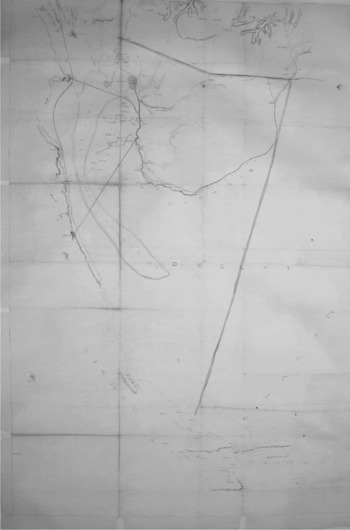
Yet for all the focus on the supposed history of rights and control, its textual and topographical expression remained paramount for the British. Thus a map of the disputed region (Fig. 1) was one of the most important intended outcomes of the mission. The British had an established history in the region of textually expressing both history and identity in cartographic form. Lieutenant John Macartney’s map, produced during the Elphinstone mission of 1808–09, was central to British understanding of the relationship between people and territory.Footnote 81 By assigning people to a specifically topographical space in the cartographic representation of political order, the British territorialized people more powerfully and profoundly than through any other medium. For the officials of British India, mapping was an examination and disciplining of space and knowledge, and thus a mechanism of control.Footnote 82 By mapping the Afghans, Elphinstone and Macartney established the hegemony of colonial knowledge over the area for future generations of colonial administrators. The Goldsmid mission’s charge of cartographically expressing the political limits, and thus the identities, of the Persian and Afghan states marked the continuation of this same tradition. The Persians’ dispatch of their own survey officer signalled an attempt to challenge the hegemony of the British colonial knowledge, and engage in the struggle for the cartographic depiction of control.
NA, Map Room (MR), 1/799, Beresford Lovett, ‘Map of Seistan’, 1872.

Although the arbitration served as a medium for the realization of new state forms through territorial delineation, marking a fundamental transformation of political order from tributary to territorial, Persians and Afghans deployed decidedly different ‘dialects’ to conceptualize this new political order. These shaped the arguments that their commissioners presented to the British arbiters in support of their respective claims. While both employed history to justify their assertions, they used it, or rather its language, very differently.
Persian arguments were produced by a political culture which had assimilated European norms to a greater extent, due in part to their longer interaction with Europeans. The Persians had established regular contact with early modern European states from the early seventeenth century, whereas the first formal European mission to an Afghan court was Elphinstone’s in 1808.Footnote 83 The Persian statement, which read like a contemporary European legal brief, presented a bifurcated argument, asserting Persia’s ‘ancient rights’ in Sistan, and their textual acknowledgment by other powers.Footnote 84 The Persians justified their ‘ancient rights’ with references in the Shahnameh to Sistan as the hero Rustam’s homeland, and Goldsmid acknowledged the role of such claims in the formation of Persian national identity.Footnote 85 Further, they offered a variety of documents, ‘demonstrating’ the recognition of those rights both by the Afghans and the British, including Safavid sanads, letters from the Barakzai sardārs of Kandahar, and a letter from Lord Russell.Footnote 86 Relying on these documents, Persia argued that conquest by another power could not denude it of sovereignty. Simply put, force could not overturn text, or in their own words ‘temporary dispossession does not invalidate a natural and universally acknowledged [emphasis added] right …’.Footnote 87 References to natural law and universality were evidence of the adoption of European, Enlightenment-inspired political discourse. The Persians’ emulation of European precepts of law, and the transition to a political universe largely defined by ‘texts’ and Westphalian norms, was eased considerably by their long-established textual traditions.
The Afghans, in contrast, presented a much more ‘traditional’ case, resting in the main on actual control and personal allegiance. Their petition, three to four times as long as its Persian counterpart, was filled with aureate language, resembling a Persian court chronicle more than a legal brief. Rather than relying on written documents, the Afghan petition listed tribal genealogies, constructed and remembered orally. Afghan control was traced through the allegiance of individual sardārs in tributary relations to the Afghan Amir. Contrasting to the Persian reliance on the Shahnameh, the Afghans claimed that the feats documented by their genealogical records were remembered in the popular songs of Sistan.Footnote 88 This argument resonated well with British understandings of ‘traditional’ Afghan political authority.Footnote 89 Whereas the Persian submission is virtually unmarked, the Afghan statement is heavily marked with explanatory references to historical events and editorial comments by British officials. Goldsmid’s genealogy of Sistani leadership, published with his arbitral opinion, was simply another incarnation of this conceptual ordering of social and political authority.Footnote 90 The act of recording denuded the segmentary system of its flexibility, at least for the British. The British could discount new genealogical memories, created by the Afghans to explain the present political order, through reference to their own printed genealogical records.Footnote 91 History, always written for the present, became the hostage of a textual past.
Although Persians and Afghans sought to assert a fundamentally modern claim for their states, namely sovereignty over defined territory, they did so by appealing to vastly different traditions of legitimacy. By emphasizing their oral histories and ‘traditions’, the Afghans retained flexibility in delineating the limits of their political universe, which the Persians lost by writing those limits down. The Persians, however, enjoyed a stability in that political universe, which the Afghans lacked. Text created stability by limiting opportunity for derivation. It enabled standardization, which reinforced central control. Speech allowed for flexibility, thereby undermining stability. Both were ways of creating memory and history, but different kinds of memory. In this case, text served as the language of European political order, speech as the language of the indigenous Afghan political universe. Yet both were built upon, and reflected, social structures which supported the different concepts of knowledge represented by text and speech.Footnote 92 The Persian’s long-established textual tradition rested on educated literati, who formed the backbone of an urban government bureaucracy, whereas the Afghans lacked any equivalent class.Footnote 93 The Afghans remained, in many ways, a profoundly ‘tribal’ society. Consequently, the adoption of European norms of statehood proved considerably easier for the Persians.
In the event, the Afghans proved more successful, despite relying on more ‘traditional’ conceptions of political community. Yet this was why they were more successful, as their ‘tradition’ fully fitted British expectations and understandings. The Afghans could afford not to be as conversant as the Persians in the language of European political norms, precisely because Europeans had little interest in establishing those norms, or their power in any penetrative manner, in the Afghan kingdom. Instead, the British sought to bolster ‘traditional’ political authority in this peripheral buffer state, to ensure stability on the frontier.Footnote 94 In contrast, the Persian’s Europeanization of their political space remained incomplete, and thus unstable. The British ‘knew’ Afghan political society, and perceived it to be fractious. Knowledge of its weaknesses made it amenable to British influence. The Persians, less influenced by Britain, were also less well known. This could be dangerous, as it either invited Russian ambitions, or allowed indigenous Persian power to grow.
Conclusion
By ruling in favour of the Afghans, the British further spurred the Persian empire down the path of European statehood. Persia’s poor performance in the arbitration created a desire among its elite to become more fluent in the language of European diplomacy and statehood. The Persians redoubled their efforts at technical education, so that their survey officers would no longer be reliant on European maps.Footnote 95
As for the Afghans, although they succeeded in part because of British familiarity with their political order, the British award quickened the erosion of that order. Goldsmid, while repudiating Persian claims in his arbitral opinion, agreed with the Afghan commissioner that the transfer of allegiances by rebellious Afghan sardārs ‘are not held to affect the question of sovereign rights of the country’.Footnote 96 He further stated that ‘the allegiance of Sistan was of a feudal nature which could not be transferred to suit the personal convenience of a temporary ruler’.Footnote 97 State sovereignty was inalienable, divorced from the vagaries of individual allegiance, even if sovereign claims could lapse through their non-assertion, as with Persian claims of ‘ancient rights’.Footnote 98 While such relationships were central to authority in a political universe of suzerainty, sovereign control of land was divorced from relational allegiance. In these two lines, Goldsmid did for the Afghan centre what it was unable to do for itself. He validated its claims of its sovereignty, not only vis-à-vis the Persians, but also, and more importantly, in relation to its subjects.
The demarcation of the Perso–Afghan frontier was a process fundamental to the transformation of these states. For indigenous political communities, it marked a transition from a political universe based on indigenous and Islamic norms of order to one increasingly defined by European norms of statehood. Political authority in these states moved away from the person of the shah or amir, where it once resided, to the abstraction of the state, where it was coming to rest. The religious legitimation provided by the ulama became of secondary importance as rulers attempted to secularize the political space the state sought to monopolize. With this move, political control and power likewise migrated from relational bonds with the ruler, the hallmark of a segmentary political order, to a grounding in physical space. Political identity was territorialized, often coercively by state authorities backed by imperial powers. The Perso–Afghan boundary arbitration was precisely this process put into action.
While Persian and Afghan participation in the arbitration process may be explained along the classic lines of the ‘Great Game’, such an interpretation overlooks important issues. Indigenous actors sought to achieve through the offices of the British arbitrator what they could not manage alone, that is the assertion and recognition of their control over recalcitrant peripheries. By involving the British, they necessarily invoked the normative order that they represented. Sovereignty and statehood thus colonized the spaces of the indigenous imagination, transforming both the languages and landscapes of these political communities.