INTRODUCTION
Exposure to a wide range of life-threatening and violent events occurs with relative frequency across a broad spectrum of the population. The National Comorbidity Study showed that the lifetime prevalence rates for the occurrence of at least one traumatic event were 51·2% for women and 60·7% for men (Kessler et al. Reference Kessler, Sonnega, Bromet, Hughes and Nelson1995). Such events may lead to subclinical cases of post-traumatic stress disorder (PTSD), which are usually diagnosed as partial PTSD or subthreshold PTSD (Weiss et al. Reference Weiss, Marmar, Schlenger, Fairbank, Jordan, Hough and Kulka1992; Blank, Reference Blank, Davidson and Foa1993). Many subjects recover from PTSD but continue to show subthreshold symptoms (Zlotnick et al. Reference Zlotnick, Rodriguez, Weisberg, Bruce, Spencer, Culpepper and Keller2004); a longitudinal study suggested that individuals who do not meet the full criteria for PTSD require the same level of care (Carlier & Gersons, Reference Carlier and Gersons1995). At our clinical practice, most patients seeking psychotherapy show symptoms associated with traumatic memories but not fully meeting DSM-IV criteria (APA, 1994). The prevalence of PTSD in the general population is about 9% (Breslau et al. Reference Breslau, Davis, Andreski and Peterson1991), while partial PTSD is estimated to be approximately 30% (Weiss et al. Reference Weiss, Marmar, Schlenger, Fairbank, Jordan, Hough and Kulka1992); nevertheless researchers have paid little attention to this latter group.
Questions pertaining to the neurobiological effects of psychotherapy have now been given prominence by psychologists (Roffman et al. Reference Roffman, Marci, Glick, Dougherty and Rauch2005). Techniques such as positron emission tomography (PET), single photon emission computed tomography (SPECT) and functional magnetic resonance imaging (fMRI) have been used to collect data suggesting that brain function changes occur during psychotherapy (Rybakowski, Reference Rybakowski2002; Paquette et al. Reference Paquette, Levesque, Mensour, Leroux, Beaudoin, Bourgouin and Beauregard2003; Roffman et al. Reference Roffman, Marci, Glick, Dougherty and Rauch2005). Exposure therapy and cognitive restructuring, singly or combined, have led to PTSD patients showing marked improvements that were stable over time (Marks et al. Reference Marks, Lovell, Noshirvani, Livanou and Thrasher1998). In particular, exposure-based therapy is often indicated as the psychological treatment of choice for traumatic memories (The Expert Consensus Guideline series, 1999). Our research team has developed an exposure-based and cognitive restructuring therapy procedure as standard treatment for trauma victims, which has helped them to attain psychological growth on the basis of their negative experiences (Peres et al. Reference Peres, Mercante and Nasello2005).
The personalized script-driven imagery paradigm is a well-established method for studying psychophysiological responses in PTSD patients (Pitman et al. Reference Pitman, Orr, Forgue, de Jong and Claiborn1987). Recollecting personal traumatic events (by using the script-driven imagery paradigm) in PTSD has been associated with activation of the amygdala, insular cortex (Rauch et al. Reference Rauch, van der Kolk, Fisler, Alpert, Orr, Savage, Fischman, Jenike and Pitman1996), orbitofrontal cortex and anterior temporopolar cortex (Rauch et al. Reference Rauch, van der Kolk, Fisler, Alpert, Orr, Savage, Fischman, Jenike and Pitman1996; Shin et al. Reference Shin, McNally, Kosslyn, Thompson, Rauch, Alpert, Metzger, Lasko, Orr and Pitman1999) and relatively decreased activation of the anterior cingulate gyrus (Shin et al. Reference Shin, McNally, Kosslyn, Thompson, Rauch, Alpert, Metzger, Lasko, Orr and Pitman1999; Lanius et al. Reference Lanius, Williamson, Densmore, Boksman, Gupta, Neufeld, Gati and Menon2001), medial frontal gyrus (Lanius et al. Reference Lanius, Williamson, Densmore, Boksman, Gupta, Neufeld, Gati and Menon2001) and subcallosal gyrus (Bremner et al. Reference Bremner, Narayan, Staib, Southwick, McGlashan and Charney1999). Cognitive activation paradigms using PET have shown higher levels of activation of the amygdala and anterior paralimbic structures, whereas there was deactivation in Broca's region, the anterior cingulate and the prefrontal cortex, in response to trauma-related stimuli in individuals with PTSD (Pitman et al. Reference Pitman, Shin and Rauch2001; Shin et al. Reference Shin, Whalen, Pitman, Bush, Macklin, Lasko, Orr, McInerney and Rauch2001). Functional MRI studies using cognitive activation paradigms have further shown the involvement of the amygdala and the prefrontal cortex in PTSD physiopathology (Rauch et al. Reference Rauch, Whalen, Shin, McInerney, Macklin, Lasko, Orr and Pitman2000; Shin et al. Reference Shin, Whalen, Pitman, Bush, Macklin, Lasko, Orr, McInerney and Rauch2001). Shin et al. (Reference Shin, Orr, Carson, Rauch, Macklin, Lasko, Peters, Metzger, Dougherty, Cannistraro, Alpert, Fischman and Pitman2004) demonstrated a reciprocal relationship between activity levels in the medial and left prefrontal cortex and those in the amygdala in PTSD individuals. Lanius et al. (Reference Lanius, Williamson, Densmore, Boksman, Neufeld, Gati and Menon2004) found that non-PTSD subjects showed greater activation than PTSD subjects in the left superior frontal gyrus, left anterior cingulate gyrus, left striatum, left parietal lobe and left insula. These findings lend weight to the notion of traumatic memory recall in PTSD subjects being of a non-verbal nature, compared with a more verbal pattern in non-PTSD subjects. In addition, broadly based functional analyses of PTSD individuals have found replicable decreased activation of the left hemisphere, especially in the prefrontal cortex, anterior cingulate, hippocampus and Broca's area (Hull, Reference Hull2002; Peres & Nasello, Reference Peres and Nasello2005). This neural circuitry may be related to PTSD subjects' difficulty in cognitively categorizing and labeling their fragmented trauma experiences.
Exaggerated startle response, hypervigilance and flashbacks may be related to a failure of higher brain regions (i.e. the hippocampus and medial frontal cortex) to dampen exaggerated arousal and distress symptoms mediated through the amygdala in response to reminders of the traumatic event (Lanius et al. Reference Lanius, Williamson, Densmore, Boksman, Gupta, Neufeld, Gati and Menon2001; Pitman et al. Reference Pitman, Shin and Rauch2001; Nutt & Malizia, Reference Nutt and Malizia2004; Shin et al. Reference Shin, Orr, Carson, Rauch, Macklin, Lasko, Peters, Metzger, Dougherty, Cannistraro, Alpert, Fischman and Pitman2004). Retrieval of traumatic memory is often accompanied by crying and other active facial expressions. The optimal imaging technique for use here may differ depending on the particular elements that are being evaluated. In fact, fMRI may not be ideal for studying traumatic memories with intense emotional content, because noise may interfere by evoking strong emotional states and patients must remain immobile (not easy when strong emotional responses are triggered). Although it has the disadvantages of poorer spatial resolution than PET and poorer temporal resolution than fMRI, SPECT imaging is low cost and allows the psychotherapeutic setting to be preserved and controlled while the traumatic memory is retrieved. The SPECT tracer is injected through a previously inserted intravenous cannula in an appropriate environment without the distractions or anxiety naturally caused by an unfamiliar setting. Furthermore, patients can let emotions surface naturally in the psychotherapeutic setting without worrying about keeping still, because images can be acquired afterwards in a different emotional state, when being still is easier (Peres & Nasello, Reference Peres and Nasello2005). Therefore, SPECT brain scans have key advantages for the neurofunctional evaluation of traumatic memory retrieval (Masdeu et al. Reference Masdeu, Brass, Holman and Krushner1994). In this study, we used technetium-99m ethyl cysteinate dimer (Tc-99m ECD) SPECT to determine whether the psychotherapeutic method applied might cause changes in cerebral blood flow associated with retrieval of primary traumatic memories.
As we had screened for startle response and hypervigilance as prevalent symptoms in subthreshold PTSD subjects, we predicted a priori that the retrieval of traumatic memories before psychotherapy would be sensorially and emotionally accentuated and probably accompanied by an increase in activation of the amygdala and posterior sensory-related areas. After psychotherapy, the memory retrieval condition would be cognitively more organized, sensorially and emotionally less intense, and accompanied by increased activity in the hippocampus and prefrontal cortex, especially in the left hemisphere (Bremner, Reference Bremner2003; Lanius et al. Reference Lanius, Williamson, Densmore, Boksman, Neufeld, Gati and Menon2004).
METHOD
Patients subjected to psychotherapy and the control group
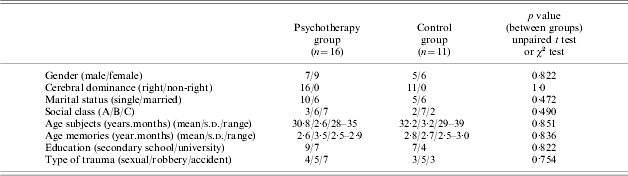
We screened 36 subthreshold PTSD subjects aged 28–39 years, who responded to printed material distributed at psychotherapy clinics, and they were randomly divided into two groups by drawing names. All subjects had recurrent traumatic memories (criteria B), hypervigilance and exaggerated startle response (criteria D) as prevalent symptoms, but all presented subthreshold symptoms for criteria C (numbing of general responsiveness), thus not meeting the full DSM-IV criteria for PTSD. There were no left-handed individuals; no subjects were taking psychotropic medication, or had a record of substance abuse in the previous 6 months. Subjects had no history of neurological or psychiatric disease but they did have a history of recurrent traumatic memories (accident, sexual violence or robbery) acting as determinants for behavior patterns such as startle response and hypervigilance. Subjects with current depressive episodes, schizophrenia, bipolar affective disorders, dementias or psychotic disorders were excluded. Five subjects were excluded because of recurring substance abuse. The group subjected to psychotherapy comprised 16 subjects (seven males, nine females). Our control group contained 11 waiting-list subthreshold PTSD patients, who were age- and profile-matched with the psychotherapy group. The characteristics of both groups are summarized in Table 1. Local ethics committees approved the study and written consent was obtained from all subjects, who had been given a full description of the study beforehand.
Demographic characteristics of 27 subthreshold PTSD subjects

PTSD, Post-traumatic stress disorder; s.d., standard deviation.
Exposure-based therapy with cognitive restructuring
We provided manual-guided exposure-based therapy, with cognitive restructuring, that focused on treating traumatic memories during 15 weekly sessions lasting 90 minutes each. To cut the period between examinations to 8 weeks, thus avoiding the effect of time-related variables, we used a compact eight-session version consisting of an introductory session (IS), an anamnesis session (AS), three restructuring sessions (RS) and three integration sessions (IN). A brief description of these sessions follows.
IS:the patient reports symptoms and, if suitable for psychotherapy, is given psycho-educational information on the psychological trauma; the therapeutic procedure is explained.
AS:the traumatic memory is detailed and a repertoire of resilient memories is built up based on personal episodes showing self-efficacy and ability to cope from the pre-trauma period.
RS:after physical and mental relaxation, the patient, guided by the therapist, retrieves the traumatic memory, and the thoughts, emotions, feelings, sensations and behaviors experienced are identified. The patient becomes aware of the specific state of consciousness connected to the traumatic experience. Immediately afterwards, a relaxed state focused on diaphragm respiration is induced, and then positive memories built up in the AS are retrieved. At this stage, the memory can be revisited in a different state of consciousness while the relaxed emotional context is maintained. With the therapist's assistance, the emotional beliefs recovered from the episode are cognitively restructured. A therapeutic first-person affirmative phrase, called cognitive redecision, is elaborated to synthesize a self-growth learning process related to the trauma.
IN:the content experienced in the restructuring session is assessed and the cognitive redecision and its daily application on a behavioral level are discussed in detail. The patient evaluates the presence of new healthy behaviors on an analogue scale from 1 to 10, as well as the remaining difficulties. The daily exercise of redecision triggers the construction of a resilient behavior. The healthy internal dialogue gradually fosters a new emotional valence for the previously traumatic memory. Restructuring and integration sessions alternate throughout the psychotherapeutic process until the dysfunctional behavior associated with the traumatic memory has been weakened by developing and strengthening new and healthier behaviors that are adaptive for the patient's current circumstances.
After concluding the study, the control group patients were given the same treatment by the same three psychologists.
Symptom measures
Two blind evaluators performed the assessments of study participants before the first SPECT and after the second SPECT. All subjects underwent the Structured Clinical Interview for DSM-IV (SCID; First et al. Reference First, Spitzer, Gibbon and Williams1995) and the Clinician-Administrated PTSD Scale (CAPS; Blake et al. Reference Blake, Weathers, Nagy, Kaloupek, Klauminzer, Charney and Keane1990). In addition, the following standardized self-rating measures were administered after each SPECT scan: the Beck Depression Inventory (BDI; Beck et al. Reference Beck, Ward, Mendelson, Mock and Erbaugh1961), the Beck Anxiety Inventory (BAI; Beck et al. Reference Beck, Epstein and Brown1988), and the Impact of Event Scale (IES; Spielberger et al. Reference Spielberger, Gorsuch, Lushene, Vagg and Jacobs1983).
Modality of traumatic memory measures
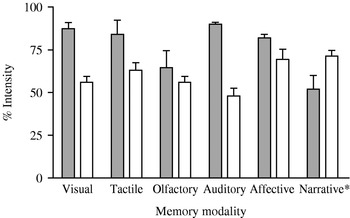
To assess and classify the basic characteristics of the traumatic memories, the Traumatic Memory Inventory (TMI) was given to each of the subjects (Hopper & van der Kolk, Reference Hopper and van der Kolk2001). As this inventory evaluates the intensity and vividness ratings for five components of traumatic memory (visual, affective, tactile, olfactory, auditory, and narrative), it can assess their transformations over time. Thus, subjects underwent the same type of assessments prior to treatment, as a baseline control condition and following treatment, as a post-treatment condition (Fig. 1). Control group subjects underwent the same symptom measures, as well as the TMI, twice in 60 days.
Memory modality and percentage of intensity. Average intensity scores for the three groups of traumatic memories (accident, sexual violence and robbery; see Table 1) obtained pre- and post-psychotherapy. * Significant mean increase (paired t test) obtained pre- and post-psychotherapy (p<0·05).  , Pre-treatment; □, post-treatment.

Neuroimaging procedures
Each subject underwent two brain SPECT evaluations. The psychotherapy group underwent the first (baseline) SPECT scan during retrieval of the traumatic memory prior to psychotherapy. Subjects had a repeat (follow-up) SPECT scan during retrieval of the same traumatic memory after eight sessions of psychotherapy (one per week). Control group subjects underwent baseline SPECT scan during traumatic memory retrieval, and 60 days later were given a follow-up SPECT scan during retrieval of the same traumatic memory. A personal script was prepared for each subject with an identical number of keywords (Pitman et al. Reference Pitman, Orr, Forgue, de Jong and Claiborn1987; Shin et al. Reference Shin, Orr, Carson, Rauch, Macklin, Lasko, Peters, Metzger, Dougherty, Cannistraro, Alpert, Fischman and Pitman2004). During the first and second brain SPECT scans, subjects had to voluntarily self-induce the traumatic memory by recalling and re-experiencing the appropriate personal episodes after the corresponding personal script had been read aloud on an LCD monitor. Both procedures occurred between 08:00 and 11:00 hours in the same psychotherapist's room, which was quiet, with low lighting. Equal doses (250 MBq) of Tc-99m ECD were administered through an intravenous cannula previously inserted in the arm of each volunteer. The tracer was injected 30 s after starting to read the personal script-driven paradigm, and subjects were instructed to continue remembering the traumatic event with related sensations, feelings, emotions, scenes and thoughts until ordered to stop. After 4 min, when most of the tracer was ‘fixed’ in the brain tissue, the therapist signaled that they should relax. Fifty minutes were allowed for rest, and subjects were then taken to the Radioisotope Service for the brain SPECT scan. Images were acquired on a Multi SPECT-3 (Siemens Inc., Hoffman Estates, IL, USA) triple-headed rotating gamma camera using high-resolution collimators. Projection images were obtained at angle intervals of 3° on a 128×128 matrix (pixel size 3·56 mm×3·56 mm) over 360° by rotating each head 120° for a total scanning time of 30 min. These SPECT images were reconstructed in the transaxial, coronal and sagittal planes using filtered backprojection and attenuation correction. The reconstructed slice thickness was 4 mm with a spatial resolution of 8 to 10 mm. The patient orbit radius from the head was 14 cm.
Image analysis and statistics
Preprocessing images
Spatial reprocessing and statistical analysis of images were performed on a voxel-by-voxel basis using Statistical Parametric Mapping (SPM 99, Wellcome Department of Cognitive Neurology, UK). The realign function was used to co-register the post-treatment SPECT image to the baseline SPECT image for each patient. A single mean image was then created from these two aligned images for each patient. All of the SPECT scans were normalized to the standard anatomic space (Talairach & Tournoux, Reference Talairach and Tournoux1988). A single mean image was used only to optimize spatial co-registration of the images to the standard space and not for statistical analysis. The transformation function for each patient was then used to transform the separate realigned baseline and post-treatment images to the standard space. Transformation was performed to 4 mm3 voxels using 12 affine transformations and 7×8×7 nonlinear basis functions. All of the normalized SPECT images were then smoothed using a Gaussian kernel with a full width at half maximum (FWHM) of 12 mm3. Global normalization was performed using proportional scaling. Regions of interest (ROIs) were defined as spheres varying in size depending on structure, based on location in the Talairach atlas. Masking was applied using a threshold proportional to 0·4 times the mean voxel value.
Statistical significance
Two statistical analyses were performed, the first using a multi-group design with two groups (psychotherapy and control group) and two conditions (baseline and follow-up). SPM performed a repeated measure analysis of variance (rmANOVA) independently for each voxel. Contrasts were applied to look for areas of significant change in follow-up compared with baseline condition. Contrasts were also used to search for areas of relative change in the psychotherapy group compared to the controls. In a second analysis, unpaired t tests were used (again looking at each voxel independently) to compare the baseline scan activity levels of the psychotherapy group with those of the control group.
For the purposes of this study, a priori areas relevant to PTSD, such as the amygdala, cingulate gyrus, hippocampus, insular cortex, orbitofrontal cortex and parahippocampal gyrus, were set at a statistical threshold of p<0·001 uncorrected, corresponding to a t value of 3·34 to minimize type I errors. A significance level of p<0·05 corrected for Gaussian Random Field Theory was used for the rest of the brain. In addition, an extent threshold of five voxels was used.
Correlation analysis
Pearson correlations were generated to assess the association between changes in regional cerebral blood flow (rCBF) values of the group subjected to psychotherapy. Significance tests for the correlations were limited to the structures of the orbitofrontal and prefrontal cortex, thalamus, amygdala, cingulum, hippocampus and parietal lobes, as these were the areas that would be most likely to interact with each other during the traumatic memory retrieval. Given the sample size, all results were confirmed using Spearman rank correlations, which were also performed between the CAPS score and the percentage change in rCBF response for relevant ROIs in the psychotherapy group. As the results for both methods were similar, only Pearson correlations are shown.
RESULTS
SPM analysis
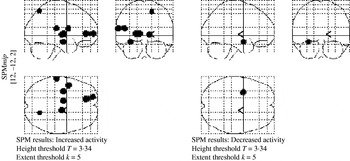
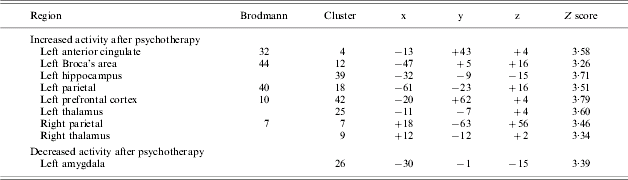
In the first analysis comparing baseline and follow-up scans, no significant activity on baseline scans was observed in control group patients, whereas significant activation was observed for psychotherapy patients in the left anterior cingulate, left prefrontal cortex, left and right thalamus, left parietal lobe, left hippocampus and left Broca's area. Deactivations in the left amygdala were observed in psychotherapy group patients (Fig. 2 and Table 2). The second analysis revealed no significant differences in activation/deactivation compared with baseline scans between psychotherapy and control groups.
SPM analysis: increased and decreased activity after psychotherapy. Regions of interest (ROIs) were set at a statistical threshold of p<0·001 uncorrected, corresponding to a t value of 3·34. A significance level of p<0·05 corrected for Gaussian Random Field Theory was used for the rest of the brain. An extent threshold of 5 voxels was used.

Results from SPM analysis

Location and peaks of significant clusters of activation and deactivation after psychotherapy were set to threshold t=3·34 corresponding to p<0·001.
Symptom measures
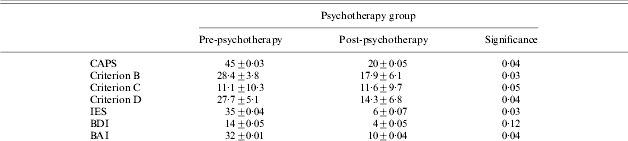
All subjects presented below-threshold symptoms for criteria C and one or more symptoms for criteria D (DSM-IV), and the two groups were equivalent in terms of hypervigilance and startle symptoms at the baseline condition. There were significant mean decreases (paired t test) in the scores for CAPS (p<0·01), IES (p<0·01) and BAI (p<0·05) between the pre- and post-psychotherapy measures. BDI scores did not change significantly (p=0·12). The results are presented in Table 3. TMI scores showed a significant increase in post-psychotherapy only in the narrative modality measure (p<0·05) above other sensory modalities (Fig. 1). By comparison, the control group showed significant mean decreases only for BDI (p<0·05). There were no significant differences in the CAPS, IES, BAI and TMI baseline and 60-day follow-up conditions (Table 3).
Psychotherapy group and control group inventory scores


Psychotherapy treatment response characteristics (mean±s.d.) (paired t tests) and control group characteristics (mean±s.d.) (paired t tests) were interspaced 60 days for the Clinician Administered PTSD Scale (CAPS), the Impact of Event Scale (IES), the Beck Depression Inventory (BDI), the Beck Anxiety Inventory (BAI), and Criterion B (intrusion/traumatic memory), C (avoidance/numbing) and D (hyperarousal) for DSM-IV.
Correlations
There were significant and positive correlations between the change in activity in the left prefrontal cortex and the change in the left thalamus (R=0·92, p=0·01) and also between the change in activity in the left prefrontal cortex and that in the left parietal lobe (R=0·88, p=0·02). Correlations between parietal and thalamic activity, as in the other regions studied, did not reach significance.
Correlations across CAPS scores and percentage changes of rCBF in ROIs were calculated. The results showed a significant positive correlation between CAPS scores and left prefrontal cortex (Z=3·79; x=–20, y=62, z=4; p<0·008), but significant negative correlation between CAPS scores and left amygdala (Z=3·12; x=−30, y=−1, z=−15; p<0·01). In relation to the TMI scores, the only positive correlation found was between the CAPS and narrative scores (TMI) (p<0·03). There were no significant correlations between percentage changes in CAPS scores or B, C and D criteria (see Table 3) after 8 weeks of psychotherapy, and rCBF values for other brain areas.
DISCUSSION
Neural substrates involved and implications
Activation of the left prefrontal cortex in the SPECT scan subsequent to psychotherapy probably indicates better inhibition of feedback processes related to amygdala activity. In the post-psychotherapy scan, the thalamus remained activated but with a simultaneous increase in activation of the left prefrontal cortex, left hippocampus and left parietal lobe.
Integrating sensorial traces of memories into structured therapeutic narratives is one of the main challenges for psychotherapies applied to trauma victims (Liberzon et al. Reference Liberzon, Taylor, Fig and Koeppe1996–Reference Liberzon, Taylor, Fig and Koeppe1997). The circuitry involved in the post-psychotherapy SPECT scans probably indicates better codification and processing of the sensory information, which was not processed in the baseline scans. The relative decrease in activation of the amygdala during the psychotherapy follow-up scan (Table 2 and Fig. 2) may also be related to a less intense subjective experience of unpleasant emotions, accompanied by activity in the neural network associated with conscious interpretation, synthesis, and integration of those sensory and emotional stimuli.
Lanius et al. (Reference Lanius, Williamson, Densmore, Boksman, Gupta, Neufeld, Gati and Menon2001) also found thalamic deactivation in patients with PTSD during traumatic recall. High levels of arousal during traumatic experiences have been hypothesized to lead to altered thalamic sensory processing, which in turn disrupts transmission of sensory information to the frontal cortex, cingulate gyrus, amygdala and hippocampus (Krystal et al. Reference Krystal, Bennett, Bremner, Southwick, Charney, Friedman, Charney and Deutsch1995). Supporting this hypothesis, the follow-up scans showed more activity in the thalamus accompanied by the prefrontal cortex and hippocampus than the initial scans, probably because the level of arousal decreased after psychotherapy.
Decrease in activity of Broca's area – related to speech – in the left hemisphere and the hippocampus may be related to the difficulty of synthesizing, categorizing and integrating a traumatic memory into a structured narrative (Hull, Reference Hull2002; Bremner, Reference Bremner2003; Gilboa et al. Reference Gilboa, Shalev, Laor, Lester, Louzoun, Chisin and Bonne2004; Lanius et al. Reference Lanius, Williamson, Densmore, Boksman, Neufeld, Gati and Menon2004). The post-psychotherapy scans showed activation of Broca's area and the left hemisphere, probably indicating that the brain was better able to categorize and express the traumatic memory in verbal communication.
The hippocampus also plays a crucial role in the learning process and in synthesizing, and evaluating experiences (Foa et al. Reference Foa, Keane and Friedman2000; Brewin, Reference Brewin2001). It is thought that the hippocampus ‘creates’ a cognitive map that allows for the categorization of experience and its connection to other autobiographical information (Levin et al. Reference Levin, Lazrove and van der Kolk1999). The initial scans for both psychotherapy and control groups were similar. Unlike the pre-psychotherapy scans, the post-psychotherapy traumatic memory retrieval presented significant activation of the left hippocampus (Table 2), and the corresponding memories were sensorially less intense and cognitively more organized (Fig. 1). Some integrative functions seem to be more efficient with hippocampus activation, confirming previous findings of PTSD functional studies (Brewin, Reference Brewin2001; Hull, Reference Hull2002; Bremner, Reference Bremner2003). Moreover, the hippocampus is especially activated during memory encoding, rather than necessarily during memory retrieval (Bremner, Reference Bremner2003; Lanius et al. Reference Lanius, Williamson, Densmore, Boksman, Neufeld, Gati and Menon2004).
Decreased activation of the parietal lobes during traumatic memory retrieval provides another convergent explanation as to why traumatic memories are experienced as being ‘present tense’. The parietal lobes are thought to be related to temporal and spatial orientation (Liberzon et al. Reference Liberzon, Taylor, Fig and Koeppe1996–Reference Liberzon, Taylor, Fig and Koeppe1997). Thus parietal activation in follow-up scans after psychotherapy may be related to more precise processing of spatial and temporal information related to a traumatic event. However, the first and second control group retrievals occurred without the therapeutic restructuring process. The qualitative similarity of the traumatic memory retrievals is supported by the fact that there were no significant rCBF changes in the two 60-day interspaced scans.
Lanius et al. (Reference Lanius, Williamson, Densmore, Boksman, Neufeld, Gati and Menon2004) demonstrated the non-verbal nature of traumatic memory recall in PTSD subjects, compared to a more verbal pattern of traumatic memory recall in non-PTSD subjects. Brewin and co-workers postulated a preliminary framework for classifying two types of traumatic memories: situationally accessible (non-hippocampally dependent) and verbally accessible (hippocampally dependent) (Brewin et al. Reference Brewin, Dalgleish and Joseph1996; Brewin & Holmes, Reference Brewin and Holmes2003). Evidence indicates that multiple memory systems may be activated simultaneously and in parallel and may also interact on various occasions (Poldrack & Packard, Reference Poldrack and Packard2003; Wieser & Wieser, Reference Wieser and Wieser2003). The possibility of neural circuitry interaction is a crucial aspect for developing a psychotherapeutic approach that would favor resilient integrative translation of the traumatic memory (Peres et al. Reference Peres, Mercante and Nasello2005). The activity of the amygdala without the processing and integrative areas (prefrontal, hippocampus and parietal lobes) suggests that neural mechanisms involved in subthreshold PTSD may have shared similarities with those related to the fragmented and non-verbal nature of traumatic memories. In addition, exposure-based and cognitive restructuring therapy may influence the development of a more narrative pattern overlaying the declarative memory neural substrates of the previous traumatic memory of these individuals.
Correlations and left hemisphere activation
Positive correlations were found between the left prefrontal cortex, left thalamus and left parietal lobe. High levels of arousal during traumatic recalls may disrupt the transmission of sensory information to the prefrontal cortex (Krystal et al. Reference Krystal, Bennett, Bremner, Southwick, Charney, Friedman, Charney and Deutsch1995). These positive correlations probably indicate that sensory information, with greater thalamus activity, is transmitted and better processed in the prefrontal cortex. It is thought that the left hemisphere organizes problem-solving tasks into a set of operations and also sequentially processes information. Individuals with PTSD, at least initially, present particular problems when labeling internal states (Hull, Reference Hull2002; Peres & Nasello, Reference Peres and Nasello2005). The increase in activation during the post-psychotherapy scans in the left hemisphere and respective positive correlations may also indicate increased functioning of the brain regions associated with generating sequences of events, labeling experiences and cognitive categorization (Bremner, Reference Bremner2003; Gilboa et al. Reference Gilboa, Shalev, Laor, Lester, Louzoun, Chisin and Bonne2004; Lanius et al. Reference Lanius, Williamson, Densmore, Boksman, Neufeld, Gati and Menon2004).
Correlations across CAPS and rCBF scores show that improvements in the patients' symptoms were related to higher levels of left prefrontal cortex activity and less amygdala activity. Of note, the higher narrative scores (Fig. 1) for the traumatic memory after psychotherapy were also correlated with higher left prefrontal cortex activity, strengthening the evidence for involvement of this type of activity in the psychotherapy applied.
Symptom measures
From a subjective perspective, patients reported better psychological states (Table 3) after psychotherapy, and memory retrieval of traumatic events was emotionally and sensorially less intense. In addition, the patients were able to communicate the memory in a more structured narrative (Fig. 1). They reported that anxiety patterns decreased (Table 3) during the therapeutic process, with gradual improvement in self-confidence and self-esteem. Unlike the psychotherapy group, the control group did not show significant scores in terms of psychological improvement (Table 3).
Limitations
This study measured rCBF at a single moment during traumatic memory recall, which is obviously a lengthy process that requires time for various affective and cognitive responses to occur. Different types of memory certainly require corresponding neural circuitries. In this study, because separate analyses of rCBF were not performed for each group of traumatic memories, the specific findings related to each group may have been blended. Further studies may consider investigating specific types of traumatic memory in order to understand their neural substrates more precisely.
CONCLUSION
This study looked at people with traumatic memories who seek psychotherapy but do not fulfill the DSM-IV criteria for PTSD; subthreshold PTSD prevalence is estimated to be approximately 30% in the general population (Weiss et al. Reference Weiss, Marmar, Schlenger, Fairbank, Jordan, Hough and Kulka1992). A variety of symptoms may be triggered by traumatic events and occur together with the respective traumatic memories. Hypervigilance and startle were chosen as the predominant symptoms when subjects were screened, and the results showed increased activity during the post-psychotherapy scans in brain structures that have been observed playing roles in emotional (declarative) memory retrievals, such as the prefrontal cortex, hippocampus and parietal lobe. Memory retrieval of the same traumatic events was emotionally less intense and cognitively more organized after psychotherapy. The results from this study suggest that neural mechanisms involved in subthreshold PTSD may share neural similarities with those underlying the fragmented and non-verbal nature of traumatic memories in full PTSD. In addition, exposure-based and cognitive restructuring therapy may influence the development of a more narrative pattern overlaying the declarative memory neural substrates of the previous traumatic memory of these individuals. As a more precise understanding of the meaning of these results is acquired, and more data are collected, neuroimaging studies may lead to major reappraisals of therapeutic interventions for traumatized patients. Further studies are necessary to better understand the neural substrates involved in the process of traumatic memory reconstruction during psychotherapy.
ACKNOWLEDGMENTS
This study was supported by the Bial Foundation. We thank Dr Gilberto Xavier for helpful discussions and comments on an earlier version of the manuscript.
DECLARATION OF INTEREST
None.