1 Introduction and overview
Sentence generation,Footnote 1 or more precisely, surface realisation is the final stage in the typical pipeline architecture for the natural language generation (NLG) systems (Reiter and Dale Reference Reiter and Dale1997). The aim of sentence realisation is to produce a syntactically, morphologically and orthographically correct sentence from a semantic or deep syntactic representation. This process potentially involves several subtasks: (i) determining the linear order of words and phrases; (ii) inserting necessary function words and punctuation and (iii) performing morphological inflections.
Even though NLG has not been studied as well as its sibling – natural language understanding – there is now a considerable body of literature on sentence realisation, using techniques varying along a number of dimensions, including
• handcrafted grammars versus treebank-based automatically induced grammars;
• reversible versus non-reversible approaches;
• symbolic versus statistical models;
• grammar versus direct mapping approaches.
From a knowledge engineering-based perspective, a sentence realiser is a module encoding knowledge that defines the correspondence between natural language utterances and their meaning representations. In the traditional NLG systems, this knowledge is encoded in the form of natural language grammars manually constructed by linguistic experts following certain linguistic principles. Some of the most influential systems in this category include FUF (Elhadad Reference Elhadad1993), a natural language surface generator that interacts with the Systemic Unification Realisation Grammar of English (SURGE)(Elhadad and Robin Reference Elhadad and Robin1996) developed under the formalism of functional unification grammar (Kay Reference Kay1979); Penman/KPML (Bateman Reference Bateman1997), a portable generator for domain-independent large-scale text generation, as well as an environment for developing multilingual grammars written within the framework of systemic-functional linguistics (Halliday Reference Halliday1978); and CoGenTex's RealPro (Lavoie and Rambow Reference Lavoie and Rambow1997), which converts deep syntactic structures into surface forms by a cascade of rules based on the Meaning-Text Theory (MTT) (Mel'čuk Reference Mel'čuk1988: 43–101).Footnote 2
The traditional symbolic grammar-based generators often hit a knowledge acquisition bottleneck: hand-crafting grammar rules are knowledge-intensive, time-consuming, difficult to scale to unrestricted text and can be prohibitively expensive to port them to new domains and languages. Over the last fifteen years, with the availability of an increasing number of treebanks, extensive efforts have been made to automatically acquire grammatical resources from treebanks for both parsing and generation. A number of wide-coverage grammars in rich formalisms, including Tree Adjoining Grammar (TAG), Head-Driven Phrase Structure Grammar (HPSG), Lexical-Functional Grammar (LFG) and Combinatory Categorial Grammar (CCG), have been automatically acquired from the Penn Treebank, and have been used in statistical sentence realisers (Bangalore and Rambow Reference Bangalore and Rambow2000; Nakanishi, Nakanishi and Tsujii Reference Nakanishi, Nakanishi and Tsujii2005; Cahill and van Genabith Reference Cahill and van Genabith2006; Hogan et al. Reference Hogan, Cafferkey, Cahill and van Genabith2007; White et al. Reference White, Rajkumar and Martin2007). In most of these approaches, given generation input, surface syntactic representations are constructed using the treebank grammars and a variety of statistical approaches. Statistical techniques have also been explored in pruning edges in symbolic chart generation (White Reference White2004), a sequence of corpus-trained classifiers have been used to incrementally transform semantic input into a fully articulated surface structure (Corston-Oliver et al. Reference Corston-Oliver, Gamon, Ringger and Moore2002; Marciniak and Strube Reference Marciniak and Strube2004), and probabilistic generation grammars have been acquired automatically from unannotated data rather than ready-made treebanks (Zhong and Stent Reference Zhong and Stent2005; Belz Reference Belz2007; DeVault, Traum and Artstein Reference DeVault, Traum and Artstein2008).
Often, statistical approaches are used by sentence realisers in a generate-and-select paradigm. The first stage applies either handcrafted or automatically acquired grammar rules to generate a space of all possible paraphrases, while the second stage selects the most likely realisation(s) from the space by ranking the candidates in the order of their probabilities. By and large, the following two statistical models have been applied in the ranking: (i) n-gram language models over different units, such as word-level bigram/trigram models (Langkilde and Knight Reference Langkilde and Knight1998; Langkilde Reference Langkilde2000; Bangalore and Rambow Reference Bangalore and Rambow2000), or factored language models integrating word-level n-grams with n-grams over part-of-speech tags and category labels (White et al. Reference White, Rajkumar and Martin2007); (ii) log-linear models incorporating a wider variety of syntactic and semantic features (Nakanishi et al. Reference Nakanishi, Nakanishi and Tsujii2005; Velldal and Oepen Reference Velldal and Oepen2005; Cahill, Forst and Rohrer Reference Cahill, Forst and Rohrer2007).
Even though the ultimate purpose of sentence realisation is to generate well-formed surface strings, the great majority of (deterministic or probabilistic) grammar-based generation systems achieve their goal by building surface syntactic structures (primarily organised around phrase structure descriptions) compatible with given input semantic specifications, via application of grammar rules, and the final output string is then formed by reading words from the leaf nodes of the syntactic tree in (left-to-right) order (or the other way round). This ‘detour’ in the generation process incurs an overhead in the development and maintenance of a large number of grammar rules, as well as in the construction and management of complex syntactic structures during generation. More problematic with the generate-and-select approach is the fact that a form of ‘overgeneration’ is effectively required for producing the full set of realisation candidates, which is computationally expensive in practice.
A contrasting alternative is to map from semantic configurations to surface strings directly, side-stepping the construction of intermediate syntactic representations during generation. Some systems have made attempts in this direction, focusing on specialised applications or particular subproblems in sentence realisation: Ratnaparkhi (Reference Ratnaparkhi2000) construes the generation process as attribute ordering and lexical choice given semantic representations implemented as attribute-value pairs, training maximum entropy models using a corpus of generation templates in the air travel domain. A number of studies concentrate on the problem of constituent ordering within a local dependency or unordered phrase structure, utilising a range of linguistic features and maximum entropy classifiers (Uchimoto et al. Reference Uchimoto, Murata, Ma, Sekine and Isahara2000; Filippova and Strube Reference Filippova and Strube2007) or decision trees (Ringger et al. Reference Ringger, Gamon, Smets, Corston-Oliver and Moore2003). While this research work is inspiring and shows promising results, it has focused on particular linguistic phenomena and languages.
The research described in this paper extends the approaches described above to models for full-coverage direct surface realisation, building practical and generic sentence generators that are accurate, efficient, robust and reusable for a number of languages and input representations. Taking a statistical approach, our general-purpose realiser takes labelled dependency representations as input, and maps them directly to surface strings without constructing intermediate constituent trees (or other syntactic representations). We design general Dependency-based N-gram (DN-gram)Footnote 3 probabilistic generation models that integrate structural information from the dependency representation to linearise dependencies directly. We evaluate DN-gram models on two typologically different languages – English and Chinese – as well as two input dependency representations – LFG f-structures and CoNLL dependencies.
The research reported in this paper builds on and substantially extends an early version of the DN-gram model reported in Guo, van Genabith and Wang (Reference Guo, van Genabith and Wang2008) in important respects: it uses log-linear model combinations (rather than simple linear interpolations) with substantially improved generation accuracy and provides the (to the best of our knowledge) first results for generation with CoNLL-style dependencies, a format popular in current state-of-the-art dependency parsing (McDonald, Crammer and Pereira 2005; Nivre Reference Nivre2006). Our best DN-gram model achieves 0.8065 BLEU, 0.7871 SSA and 31.54 per cent exact match on English Penn-II data using LFG f-structure input, 0.7713 BLEU, 0.7484 SSA and 32.89 per cent exact match for Chinese Penn Treebank data using LFG f-structure input, and 0.8820 BLEU, 0.8596 SSA and 47.76 per cent exact match for CoNLL-dependency input on English Penn-II data, all with 100 per cent coverage and average generation times of about 0.87 to 0.16 seconds per sentence for our English and Chinese data, respectively.
Section 2 gives an overview of the general dependency inputs and sketches the basic idea of the DN-gram generation model. Section 3 describes a number of increasingly sophisticated DN-gram models and presents the generation algorithm in detail. We describe the experiments and provide results across different languages and input representations in Section 4. We compare our results with previous work and discuss the outcomes in Section 5. Finally, we conclude with a summary and outline directions for the future research.
2 Preliminaries
2.1 Generation input
In principle, an abstract meaning representation is provided as input to a sentence realiser; in practice, the actual input varies widely from one system to the next because of the variability of representations and linguistic formalisms that a generation system is designed for. On the one hand, the input can be drawn from different linguistic levels of representation, accordingly varying in the degree of ‘abstraction’. Certain systems, e.g. RealPro (Lavoie and Rambow Reference Lavoie and Rambow1997), adopt very low level of abstraction, including syntactic categories, lexical specifications, definiteness and tense decisions, etc. in the input specification; some systems, e.g. Penman/KPML (Bateman Reference Bateman1997), adopt high level of abstraction, including pure semantic roles, such as actor, temporal-locating, etc.; some, for example Nitrogen/HALogen (Langkilde Reference Langkilde2002), take a wide variety of input ranging from rather abstract semantic representation to more fully specified syntactic representation. On the other hand, the expression of the semantic content may take different forms, such as Sentence Plan Language (SPL) specifications adopted by Penman and Nitrogen/HALogen, functional descriptions as inputs to FUF/SURGE (Elhadad and Robin Reference Elhadad and Robin1996), typed feature structures representing logical forms for LinGO/LKB (Carroll et al. Reference Carroll, Copestake, Flickinger and Poznanski1999) and the cognate treebank-based HPSG generator (Nakanishi et al. Reference Nakanishi, Nakanishi and Tsujii2005), non-hierarchical conceptual graphs as semantic input specifications used by the Protector system (Nicolov and Mellish Reference Nicolov and Mellish2000), semantic dependency graphs as used in Amalgam (Corston-Oliver et al. Reference Corston-Oliver, Gamon, Ringger and Moore2002) and OpenCCG (White Reference White2004) and many others. Even though different input representations are specific with respect to their underlying linguistic theories, from an engineering perspective these can be characterised by a common representation in terms of attribute value matrices (AVMs), viz. a recursive structure consisting of attribute names and their values encoding linguistic information at various levels of abstraction. These AVMs, in turn, can be converted to dependency trees or graphs in computational implementations.
In this paper, we present a general-purpose sentence realiser for generic dependency-based input representations. We instantiate the framework using two types of dependency representations popular in the CL/NLP and linguistics literature: on the one hand we use the slightly more abstract Lexical-Functional Grammar (LFG)-based f-structure representations (Kaplan and Bresnan Reference Kaplan and Bresnan1982; Dalrymple et al. Reference Dalrymple, Kaplan, Maxwell and Zaenen1995); on the other hand we use the more ‘surfacy’ dependency representations familiar from the CoNLL (2006–2009) shared tasks on dependency parsing. Below, we first concentrate on the LFG-based representations and turn to the CoNLL-style dependencies in Section 4.2.2.
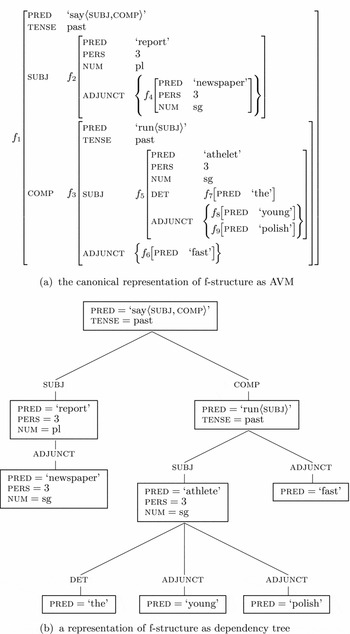
LFG is a constraint-based grammar formalism, which postulates (minimally) two levels of representation: c(onstituent)-structure and f(unctional)-structure. C-structures are conventional phrase structure trees encoding linear order, hierarchical groupings and syntactic categories of constituents, representing surface syntactic configurations for a particular language. F-structures encode more abstract functional relations, like subj(ect), obj(ect) and adjunct etc., providing deep syntactic analyses across languages. An f-structure is represented in the form of an AVM or a labelled dependency graph, as illustrated in Figure 1, and consists of the following types of attributes:
• pred is the predicate/head of a local f-structure. The value of pred is a lemma associated with a subcategorisation frame reflecting the unique semantic contribution of each word in the sentence.
• The atomic-valued features describe linguistic properties of the predicates, such as tense, mood, aspect, pers, num, etc.
• Grammatical Functions (GFs) indicate the functional relationship between a predicate and the sub-f-structures/dependents. GFs come in the following two different types:
– Arguments are subcategorised for by the local predicate, such as subj(ect), obj(ect), obl(ique) etc., and thus only occur once in each local f-structure.
– Modifiers, like adjunct, coord(inate), etc., are not subcategorised for by the predicate, and can occur any number of times in a local f-structure.
An LFG-based generator takes as input an f-structure and determines the surface strings that correspond to the given f-structure (Kaplan and Wedekind Reference Kaplan and Wedekind2000).
An example of the f-structure and the equivalent dependency tree for the sentence Newspaper reports said the young Polish athlete ran fast.

2.2 Generation from F-structures
A number of sentence realisers have been built based on LFG using either symbolic or statistical approaches. The ParGram/XLE system (Crouch et al. Reference Crouch, Dalrymple, Kaplan, King, Maxwell and Newman2007) comes with a fully fledged unification-based generator and multilingual wide-coverage LFG grammars consisting of handcrafted syntactic rules and lexical entries. Based on the XLE resources, Cahill et al. (Reference Cahill, Forst and Rohrer2007) describe a two-stage surface realiser for German, which first produces a generation space with the symbolic XLE generator, and then selects the best realisation using a log-linear ranker. Cahill and van Genabith (Reference Cahill and van Genabith2006) and Hogan et al. (Reference Hogan, Cafferkey, Cahill and van Genabith2007) present conditional PCFG generation models implemented in chart-style generators for English. Both systems are based on wide-coverage, probabilistic LFG approximations automatically acquired from the Penn-II treebank. A common characteristic of previous LFG-based generators is the use of bi-directional (i.e. reversible) grammar rules (either handcrafted or treebank-based), where the generation process can be viewed as the reverse of parsing. In a sense, generation is driven by an input f-structure representation, but proceeds through functionally annotated context-free grammar (CFG or PCFG) rules and a chart generator to construct the corresponding c-structure, from which final surface strings can be read. By contrast, this paper presents a simple dependency- and n-gram-based, probabilistic generation model, which cuts out the middle-man (i.e. the CFG-component) from previous approaches.
In accordance with a generic dependency formalism, an LFG f-structure is not linearly ordered, i.e. it does not carry information on to the relative surface order of the predicates in an f-structure. Furthermore, predicates in f-structure are lemmas (rather than surface forms), with morphological and semantic information relevant to surface realisation encoded as atomic-valued features. In order to generate a well-formed string from an f-structure, first and foremost we need to put in correct order the set of words corresponding to the predicate lemmas in the f-structure. This is typically performed by a word-based n-gram model operating on the yields of the trees compatible with the input f-structure. As mentioned above, the traditional language model in the (over-)generate-and-select approach is prohibitively expensive to apply, because vast numbers of alternative realisations are produced and word n-gram-based language model probabilities are calculated for each of them. For example, Langkilde (Reference Langkilde2000) reports that Nitrogen deals with trillions of alternatives in the course of generation. To reduce the number of possible realisations, we break down the generation space, as defined by the given f-structure, into each layer of embedding within the f-structure: that is to say, the realiser selects the most likely substring for each sub-f-structure, and concatenates the substrings into a complete sentence by recursively traversing and linearising each level of embedding in the f-structure, respecting linearisations of the already established sub-f-structures, until it reaches the outermost f-structure. This reduction in complexity depends on the simplifying assumption that the input f-structure consists of projective dependencies onlyFootnote 4 (as in the example in Figure 1), such that each sub-f-structure can be realised independently of other sub-f-structures (other than, of course, the sub-f-structures that are part of the local sub-f-structure), as all dependencies are with respect to local heads and are single-headed. A similar scenario is obtained in dependency parsing, where most practical dependency parsers (McDonald et al. Reference McDonald, Crammer and Pereira2005; Nivre Reference Nivre2006) are restricted to projective structures. This is partially due to the fact that a majority of sentences in most languages can be represented by projective dependencies (Mel'čuk Reference Mel'čuk1988). In the case of English, Surdeanu et al. (Reference Surdeanu, Johansson, Meyers, Màrquez and Nivre2008) report that in the complete corpus used in the CoNLL-2008 shared task on dependency parsing, only 0.4 per cent of dependencies are non-projective.
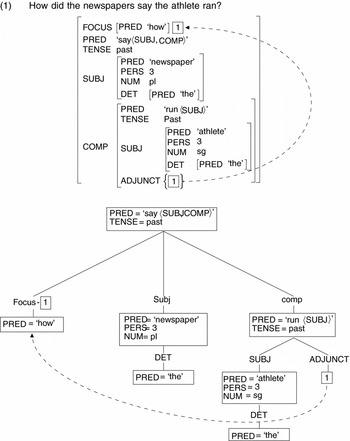
While our dependency-based realiser assumes projectivity, most theoretical formulations of dependency grammar (and in particular LFG) recognise the need for non-projective representations of certain linguistic constructions, e.g. long-distance dependencies (LDDs) or (more generally) non-local dependencies (NLDs). Figure 2 exemplifies an f-structure analysis of a sentence discussed in Carroll et al. (Reference Carroll, Copestake, Flickinger and Poznanski1999), where the non-local dependency is represented as a re-entrancy or coindexation in the f-structure and the dependency graph equivalent. The re-entrancy in the f-structure indicates that the word how is associated with two grammatical functions as well as two heads: it bears the discourse function focus of the matrix clause, and at the same time also functions as an adjunct modifying the predicate run in the embedded clause. Alternatively, an account of NLDs in earlier transformational grammar involves movement, viz. how is moved from the position at which it should be interpreted semantically, often known as a ‘gap’ or ‘trace’, to the location where it is realised, which is called a ‘filler’ or ‘antecedent’. Although varying in analysis and terminology, a common property of these accounts is that the interrogative word how is interpreted to relate to two distinct sites – a semantic site (the ‘trace’) and a surface site (the ‘antecedent’). The grammatical function adjunct associated with the semantic site is non-projective because it is governed/dominated by the head verb run in the embedded dependency structure, but in the surface string how is realised at the initial position of sentence outside the substring of the embedded clause the athlete ran. By contrast, the discourse function focus associated with the surface site is locally dependent on the matrix verb and forms a projective dependency. In our approach, we convert non-projective dependencies into projective dependencies: for each sentence realisation we need to maintain the surface site (i.e. the antecedent discourse function) of the NLD while removing the semantic site (i.e. the trace), effectively transforming dependency graphs into dependency trees. Therefore, conversion from non-projective to projective representations involves (i) identifying the non-local dependencies within the f-structure; (ii) removing the ‘trace’ (and associated GF) and keeping the ‘antecedent’, or, in other words, moving the trace up towards the antecedent site (as indicated by the dashed curves in Figure 2). In our LFG implementation for English, three grammaticalised discourse functions, focus, topic and topic_rel, characterise NLDs arising in different types of questions, relative clauses and topicalisations, respectively. As a consequence, the conversion is directly triggered by the three discourse functions. The identification of non-local dependencies in other semantic representations or for other languages may require more elaborate linguistically motivated analyses, for example, Gamon et al. (Reference Gamon, Ringger, Zhang, Moore and Corston-Oliver2002) address extraposition of relative clauses in German.
LDD representations in f-structure and dependency tree.

3 Dependency-based surface realisation
3.1 Dependency-based n-gram models
Given an f-structure, the primary task for surface realisation is to determine the linear order of words or phrases that the f-structure generates. The n-gram models are easy to build and use in practice, hence have become the most popular tool for word ordering in a variety of NLP tasks. However, a traditional language model relying exclusively on lexical information between adjacent words is unable to capture relationships between words spanning a longer distance, and usually performs worse on a clause level than on a phrase level (Filippova and Strube Reference Filippova and Strube2009). Furthermore, from a linguistic point of view, grammatical relations or semantic roles to a large extent govern the word order of sentences in languages such as English and Chinese. Based on these observations, in our model we perform linearisation at each local f-structure level by means of the DN-gram models, i.e. n-gram models over dependency (D) labels or grammatical functions (GFs), which describe languages in terms of functions equally on the phrase level and the clause level. For the example in Figure 1, the GF sequence det ≺ adjunct ≺ pred realises the noun phrase the young polish athlete for the embedded f-structure f 5; in the same manner but at the embedding f-structure f 3, the GF sequence subj ≺ pred ≺ adjunct produces the clause the young polish athlete ran fast, reusing and leaving intact the linearisation produced for the embedded f 5.
Formally, in our most basic model, for a local f-structure fi containing m GFs (including pred), generating a surface string S 1m = s 1. . .sm expressed by fi is equivalent to linearising all the GFs present at fi. The DN-gram model calculates probabilities for all permutations GF 1m = GF 1. . .GFm, and searches for the best surface sequence that maximises the probability P(S 1m) in terms of maximising P(GF 1m). Applying the chain rule and the Markov assumption, the probability of the surface realisation is computed according to (1).

The basic DN-gram model over bare GFs is not a good probability estimator as it only makes use of a few dozen grammatical function roles. For example, there is no way to capture the difference between two adjunct modifiers according to the labels of the two GFs. In order to facilitate better decisions, we extend the basic model to a number of more complex DN-gram models incorporating contextual and fine-grained lexical information. Equation (2) describes a model that additionally conditions GF sequences on the parent GF Parenti of the local f-structure fi being linearised and (3) conditions the n-gram probability on the headword (or predicate) Headi governing fi,


Alternatively, we can also integrate additional features with the GFs being ordered. Equation (4) stands for a featured model, where Featk stands for the function label GFk augmented with the set of atomic-valued features that specify the sub-f-structure assigned to the attribute GFk. In contrast with common atomic features included in the feature model, e.g. tense, mood and num, which have a closed (i.e. finite) set of values, the value set of pred is given by a (theoretically) unlimited number of lemmas corresponding to lexical entries. We separate out pred from other atomic-valued features and develop a fully lexicalised DN-gram model in (5), where Lexk stands for GFk augmented with its predicate lemma,

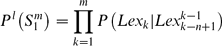
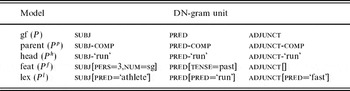
Table 1 exemplifies DN-gram models in (1) to (5) for realising the string the young polish athlete ran fast represented by f-structure f3 in Figure 1. Other features from a larger context or at different granularity have the potential to be included in the DN-gram models. In this paper, however, we focus on the general methodology without a full exploration of all possible feature options.
Examples of different DN-gram models for f3 in Figure 1

In building the DN-gram models, we apply Good-Turing smoothing when calculating probabilities for unlexicalised (gf, parent and feat) DN-grams and interpolated Kneser–Ney smoothing for lexicalised (head and lex) DN-grams.
The individual models described from (1) to (5) can, in turn, be combined in different ways. As lexicalised models are likely to suffer from severe data sparseness, we create combined models by interpolating the individual DN-gram models incrementally (rather than by using chain rules). Klakow (Reference Klakow1998) shows that, in general, log-linear interpolation (LLI) performs better than simple linear interpolation when combining n-gram models of different kinds. Accordingly, we implement LLIs to combine the estimates from different DN-gram models as follows:Footnote 5
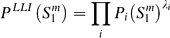
Here λi is the interpolation weight that adjusts the contribution of the component models Pi. In contrast to simple linear interpolation, no explicit constraints appear on the LLI weights. To estimate optimal sets of interpolation weights, we employ the minimum error rate training (MERT) algorithm (Och Reference Och2003), which has been widely adopted in statistical machine translation systems.

3.2 The realisation algorithm
In addition to word ordering, surface realisation also involves inserting function words and punctuation marks to produce a grammatical sentence.
In our LFG f-structure representations, function words are encoded in atomic-valued features at the local head level. From a linguistic perspective, the number of function words is limited and most of them occupy specific positions in sentences. For instance, the verbal particle to precedes the base form of a verb to form an infinitive in English, and the interrogative particle  appears at the end of a question in Chinese etc. In our generation system, a small rule-based component captures heuristics about the use of function words: function words are triggered by a limited set of atomic-valued features and inserted in one of the four possible positions with respect to a local f-structure fi: (i) before the local predicate predi governing fi; (ii) after the local predicate predi; (iii) before the complete string si that is yield of fi; and (iv) after the string si. For example, the f-structure attribute to_inf indicates that the local predicate verb is infinitive and hence a particle to should be placed before it. As illustrated by sentence (2) and the f-structure that produces (2), to is generated immediately before the string position in (2) that realises the local predicate feel from f3. Similarly, the subordinating conjunction that is used to introduce a subordinate clause (the stock market . . .), as f 4 contains the feature-value pair that = +.
As a language-specific syntactic element, unlike in the CoNLL dependency representations (discussed in Section 4.2.2), punctuation is not conventionally represented at the level of LFG f-structures. We present a maximum entropy model to recover punctuation marks for unpunctuated realisation strings in a separate post-processing component (Guo, Wang and van Genabith Reference Guo, Wang and van Genabith2010). However, this paper concentrates more on the overall dependency-based realisation scheme, and, for simplicity (and following the CoNLL dependency representations), we record all punctuation marks in the f-structure representations as the value of a punc attribute and generate them in the just same way as any other GF.
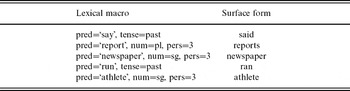
In order to generate orthographically and semantically correct sentences, morphological alternation has to be determined for inflecting languages, such as English.Footnote 6 Inflection indicates grammatical properties, such as number, person, case, or tense, which are encoded as atomic-valued features in f-structures. We call a lexeme together with its morphological features a lexical macro. A lexical macro, as exemplified in Table 2, maps a lexeme to the appropriate word form in the surface realisation. We learn the set of lexical macros automatically from our training corpora consisting of f-structures and the corresponding surface strings.
Examples of lexical macros

In summary, given an input f-structure F consisting of projective dependencies, the generation algorithm recursively traverses F in a bottom-up fashion, and at each level of embedding with (sub-) f-structure fi:
(1) Instantiates the local predicate predi at fi and performs morphological inflections if necessary.
(2) Calculates DN-gram probabilities of possible GF permutations licensed by fi.
(3) Finds the most probable GF sequence among all possibilities by Viterbi search.
(4) Generates the surface string si according to the best GF sequence as a realisation of fi.
(5) Inserts function words in appropriate positions of si by heuristic rules and propagates si up to the next outer embedding f-structure.
4 Experiments and evaluation
To test the performance and coverage of the general DN-gram-based realisation model, we carry out experiments on two typologically different languages (English and Chinese) and two different dependency representations (LFG f-structures and CoNLL dependencies).
4.1 Experiment design
Similar to many others (Corston-Oliver et al. Reference Corston-Oliver, Gamon, Ringger and Moore2002; Langkilde Reference Langkilde2002; Callaway Reference Callaway2003), we use a pre-processing procedure to convert surface syntax trees, viz. constituent-structure trees hand coded in a treebank or automatically produced by a parser, to the semantic dependency representations expected by the surface realiser. In our experiments, the English Penn Treebank II (PTB-II) (Marcus, Santorini and Marcinkiewicz Reference Marcus, Santorini and Marcinkiewicz1993) and the Chinese Penn Treebank (CTB) (Xue et al. Reference Xue, Xia, Chiou and Palmer2005) are used as source data for testing and evaluation. We follow the methodologies developed in Cahill et al. (Reference Cahill, Burke, O'Donovan, van Genabith and Way2004) and Guo, van Genabith and Wang (Reference Guo, van Genabith and Wang2007) to automatically convert the phrase structure treebank (or parser output) trees into f-structure/dependency banks for English and Chinese, respectively. Grammatical functions in f-structures are unordered. For the purpose of training DN-gram models, we automatically associate surface string positions (numerical word offset from start of the sentence) with the corresponding f-structure predicates to linearise the unordered set of GFs, and GF sequences are collected from each level of embedding in local f-structures for training. Unlike the training data, the f-structures input to the surface realiser do not contain any string position information. But, due to the particulars of the automatic f-structure annotation algorithm, the order of sub-f-structures in set-valued GFs, such as adjunct and coord, happens to correspond to their surface order. To avoid unfairly inflating evaluation results, we lexically reorder the GFs in each local f-structure before the generation process. This resembles the ‘permute, no dir'-type experiment in Langkilde (Reference Langkilde2002), where the modifiers in the input feature-value structures are not ordered.
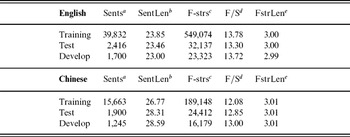
Experiments for English are carried out on the Wall Street Journal (WSJ) portion of the PTB-II, using standard training/test/development splits. That is, 39,832 sentences from sections 02–21 are used for training, 2,416 sentences from section 23 for testing and 1,700 sentences from section 22 are held out for development. The latest version of the Penn Chinese Treebank 6.0 (CTB6), excluding the portion of ACE broadcast news, is used for experiments on Chinese data. Following the recommended splits (in the list-of-file of the CTB6), we divide the data into 756 files with a total of 15,663 sentences as a training set, 84 files with 1,900 sentences as a test set and 50 files with 1,245 sentences as a development set. Table 3 gives an overview of all the data sets used in the experiments.Footnote 7
English and Chinese data sets

a Total number of sentences.
b Mean number of tokens per sentence, including punctuation marks.
c Total number of sub-f-structures.
d Mean number of sub-f-structures per sentence.
e Mean number of GFs per sub-f-structure, including punctuation GFs.
In the experiments, we create DN-gram models with the SRILM toolkit (Stolcke Reference Stolcke2002). It has been shown that more sophisticated n-gram models (e.g. with higher n, complex smoothing techniques, clustering or caching) are often not worth the effort of implementing them due to data sparseness and other issues (Goodman Reference Goodman2001); therefore in the experiments reported below we implement trigram models throughout.
4.2 Experimental results
Following Langkilde (Reference Langkilde2002) and much other research on wide-coverage surface realisation, we evaluate the sentence generator by comparing the automatically produced strings to the original treebank sentences, and assess the generation performance in term of three accuracy metrics.
Exact match is the percentage of generated sentences that exactly match a corresponding reference sentence.
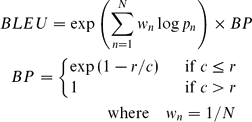
BLEU score (Papineni et al. Reference Papineni, Roukos, Ward and Zhu2002) is computed as a geometric average of n-gram precisions pn of the output string with respect to the reference, using n-grams up to length N and uniform weights wn summing to one. Equation (7) gives the formula, where BP is a sentence brevity penalty factor that adjusts the average n-gram precision, c is the length of the generated string and r is the length of the reference string. In our experiments, we set N = 4 as default:
(7)
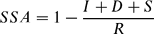
SSA stands for average NIST simple string accuracy, which reflects the average number of insertion (I), deletion (D) and substitution (S) errors between the reference strings (R) and the strings produced by the realiser. SSA is calculated as follows:
(8)
In contrast to many other systems, the dependency-based realisation algorithm guarantees that all input f-structures can produce a complete sentence, hence coverage-dependent evaluation (as adopted in most grammar-based generation systems) is not necessary in the following experiments.
4.2.1 Different languages
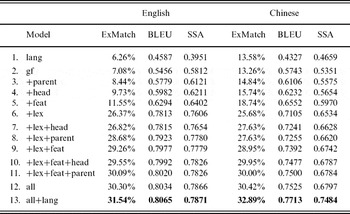
We carry out experiments on two typologically different languages: English and Chinese. Tables 4 provides the generation results for the standard EnglishFootnote 8 and Chinese test sets. To set up a baseline, we first apply a conventional language model (lang) where only surface word forms are taken into account. To avoid prohibitive overgeneration occurring in previous language model-based approaches, generation proceeds under the projectivity assumption, and at each local f-structure only the realisation with the highest probability is propagated to the next higher level for further concatenation. As shown in the first line of Table 4, a word-based language model achieves only very modest accuracy for both English and Chinese. The DN-gram models starting with the basic model (gf) over bare dependency labels and moving on to models incorporating larger context or more fine-grained lexical and atomic-valued features are reported in lines 2–6. To avoid data sparseness, all extended DN-gram models are smoothed by interpolating them with the basic gf model using the log-linear interpolation described in (6) in Section 3. The first observation is that even the basic gf model makes a substantial difference compared to the lang model with respect to BLEU and SSA scores. And in turn, the models conditioned on parent GF (parent) and head word (head), and the models combined with syntactic features (feat) and lexical features (lex) clearly perform better than the basic gf model. In line with similar observations in parsing (where a lexicalised parser often outperforms a non-lexicalised one), the lex model stands out among all the generation models, boosting the BLEU score of the gf model by nearly 24 percentage points (absolute) for English and 14 percentage points (absolute) for Chinese. In the following, we adopt the lex model as a new basis and combine it gradually with some of the other feature models. This results in six combination models (lines 7–12) with increasing complexity. As can be expected, combining more models to include different types of features shows a steady increase in all evaluation metrics, although the magnitude of the improvement becomes smaller due to some overlap between the features. All the DN-gram models capture some kind of relationship between the nodes of the dependency structure, whereas the language model captures relationships between adjoining words in a sentence. We finally combine these two different types of n-gram models to see if further improvement can be achieved. We find that the role of the language model in English and Chinese is somewhat different. The language model appears to have a strong effect on Chinese, showing a significant improvement across the board, especially with respect to the SSA score. Although the addition of the language model also increases exact match for English by more than 1 percentage point, the improvements in BLEU and SSA scores for English are not that prominent. This difference can probably be explained by the fact that English is much richer than Chinese with respect to word forms. Morphological inflection, abbreviation (e.g. Calif. versus California) and different orthographic conventions (e.g. realise versus realize) are common in English but almost absent in Chinese. We conjecture that using a larger corpus to train the language model and performing more elaborate preprocessing to capture word variations should increase the effect of the language model on the English data.
Results for LFG dependencies for English Penn-II WSJ section 23 and Chinese CTB6 test sets

Apart from the effects due to the language model, in general the DN-gram models perform similarly on the English and Chinese data. Nevertheless, comparing the most complex all model with the simplest gf model, we see that the improvement achieved by mixing more dependency features is evidently greater for English (with an increase of 23 exact match points, 26 BLEU points and 20 SSA points absolute)Footnote 9 than for Chinese (with an increase of 17 exact match points, 18 BLEU points and 14 SSA points absolute). This is likely to be the case as the English training set is more than twice the size of the Chinese training set. Apart from that, it probably reflects important differences between the two languages and data sets. Examining the development sets, we find that there are a total of 5,103 coordinated elements (4.10 per sentence) in Chinese, in contrast to 2,104 (1.24 per sentence) in English. Many coordinated elements are tied in the DN-gram probabilities and hence can not be correctly ordered during realisation, which to some extent accounts for the lower SSA scores for Chinese. To be specific, we distinguish the following three types of coordinations in Chinese:
• Coordinated on the syntactic level, but not on the semantic level, for example:
(2)
invest million build this construction
‘invest million dollars to build the construction’
• Coordinated on syntactic and semantic levels, but the phrase is usually expressed in a fixed order, for example:
(3)
reform opening-up
‘reform and opening up’
• Coordinated on syntactic and semantic levels, and the order of the two conjuncts can be swopped freely, for example:
- (4)
(a)
plentiful energy and quick thinking
‘energetic and agile’
(b)
‘agile and energetic’
- (4)




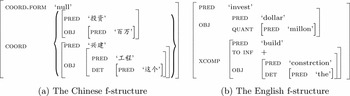
Due to lack of inflection and case markers, many sequences of Chinese verb phrases are treated as conjuncts in the f-structure analyses, which give rise to the first type of coordinations, while, in many cases, their English counterparts can be distinguished into different grammatical functions. For example, the infinitive to in sentence (2) indicates that the second verb phrase functions as a complement, as illustrated in Figure 3(b). In principle, this type of syntactic coordination should be solved by a more precise semantic analysis on the f-structure level.
Different f-structure analyses for the sentence  /invest million dollars to build the construction.

The other two types, as exemplified by (3) and (4), are both genuine semantic coordinations, but differ in the flexibility of their word order. In the former case, it is adequate to capture the word order of a fixed expression by a conventional language model, which has been partially reflected in the scores of the complex all+lang model for Chinese as listed in Table 4. In the latter case where the meaning can be expressed more freely, (4-a) & (4-b) are almost equally acceptable, and choosing any one of them would have the same effect on the actual generation quality (although it may not be reflected in the string-matching-based automatic evaluation results, if only one reference is given).
4.2.2 Different representations
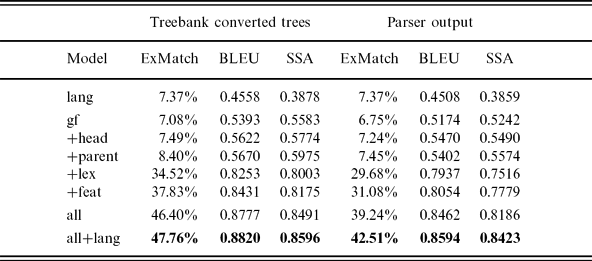
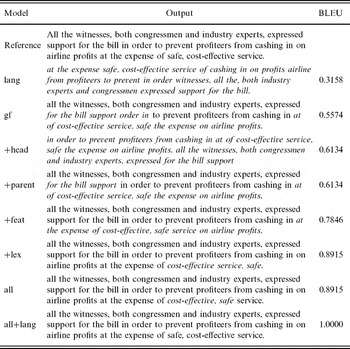
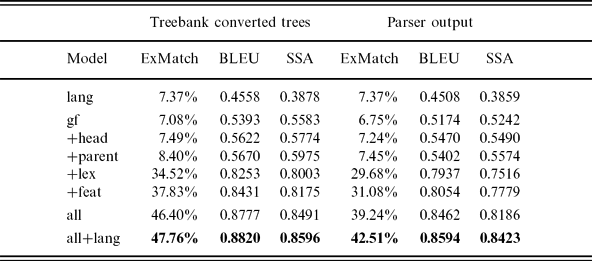
Even though the DN-gram models are presented with LFG f-structures, these are general-purpose models and should be suitable for any labelled bilexical dependency or typed predicate-argument representations. To test this claim, we carry out a set of experiments on the dependency structures used in the CoNLL shared tasks (2006–2009) on dependency parsing.Footnote 10 We convert the Penn-II treebank trees into an English dependency bank, using the pennconverter toolkitFootnote 11 (Johansson and Nugues Reference Johansson and Nugues2007) that produces dependency trees following the linguistic conventions of the CoNLL-2008 shared task. In a more realistic scenario, such as transfer-based machine translation, the input representations to a realisation component are likely to contain some noise and will not be as perfect as the dependency structures converted from the gold treebank trees. To approximate noisy data, we parse the PTB development and test sentences by a state-of-the-art dependency parser – the MSTParser (McDonald et al. Reference McDonald, Crammer and Pereira2005), and take the parsing output dependency trees as alternative realisation inputs. Table 5 shows the results for the various n-gram generation models given the representations obtained via treebank conversion and automatic parsing, respectively. To give a general picture of the sentences realised by the DN-gram models, Table 6 lists a set of example outputs (and their BLEU scores) for a sentence extracted from the Penn-II WSJ section 22 development set under the various generation models in Table 5, given the converted CoNLL dependencies as inputs.
Results for CoNLL dependencies for English Penn-II WSJ section 23
Example outputs given by CoNLL dependencies

The results in Table 5 follow pretty much the same pattern as in Table 4: all the DN-gram models capturing some type of dependency relations outperform the simple language model, the combination of individual DN-gram models in turn makes further substantial improvements, and again, addition of the language model to the complex feature model gives the best performance with respect to generation accuracy. More importantly, the results show that the DN-gram models do not overfit the training data acquired from gold treebank trees. Even though the dependency trees automatically produced by the MSTParser are noisy (McDonald et al. (Reference McDonald, Crammer and Pereira2005) reported unlabelled accuracy of 90.9 per cent discounting punctuation marks testing on Penn-II WSJ23), there is only a slight decrease (approximately 2 points BLEU and SSA absolute) in the realisation quality compared to dependencies derived from gold trees as generation input.
Another obvious observation is that all the evaluation scores for the CoNLL-style dependency structures (including parser output) are substantially higher than those for the LFG f-structures. On the one hand, the results indicate that the dependency-based n-gram generation models generalise well to different realisation inputs, on the other hand they also reaffirm the statement by many researchers that generation results are heavily dependent on how specific the generation inputs are. We note that CoNLL dependency structures and LFG f-structures exhibit different levels of linguistic abstraction. The CoNLL dependencies tend to be more ‘surfacy’ and fine-grained than the more abstract LFG f-structures:
• Labels of the CoNLL dependencies are more fine-grained than f-structure grammatical functions, and manifest some surface syntactic features, for example CoNLL-style modifiers are classified into modifiers of adjective or adverbial (AMOD) heads, modifiers of nominal (NMOD) heads and modifiers of prepositions (PMOD).
• Part-of-speech tags are fully specified in the CoNLL dependency representations and used as a syntactic feature by the feat model, which has a strong positive effect on the realisation quality. By contrast, the LFG models do not use POS information.
• Nodes of the CoNLL dependency representations are simply the word forms occurring in surface sentences rather than lemmas as encoded in the predicates of the LFG f-structures.
• Function words are explicitly represented as nodes in the CoNLL dependency representations, and only indirectly as atomic-valued features in the LFG f-structures.
It might be argued that the CoNLL dependency representations do not provide ‘semantic’ specifications, and therefore they are not fully theoretically adequate representations for sentence realisation. However, as outputs of many off-the-shelf and state-of-the-art dependency parsers, the CoNLL-like dependency structures are certainly important representations available to practical NLG systems (including transfer-based machine translation), they have become a de-facto standard in many applications.
5 Comparison with previous work
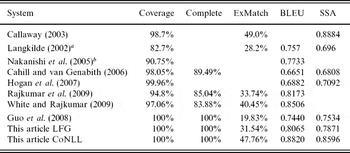
As has been discussed in the previous section and pointed out by many researchers working in wide-coverage sentence realisation (Langkilde Reference Langkilde2002; White and Rajkumar Reference White and Rajkumar2009), it is notoriously difficult to compare sentence realisers, as generation quality can vary widely due to the diverse application-specific inputs. The purpose of this section is therefore not to provide a strict comparison, but to rather draw an overall picture that relates our general-purpose sentence realiser to the state-of-the-art in surface realisation. For this reason, we presented systems (trained and) tested on the same data sets (although with a wide variety of input specifications) and evaluated using the same automatic evaluation metrics. In addition to accuracy metrics (exact match, BLEU and SSA), we also include two metrics to evaluate generation coverage: coverage is the percentage of input representations for which the surface realiser can produce a (complete or partial) string, complete is the percentage of grammatically complete sentences realised. Table 7 summarises the results on Penn-II WSJ23 as reported in the NLG literature.
Cross-system comparison of results for English WSJ section 23

a The results are for the ‘permute, no dir'-type experiment in Langkilde (Reference Langkilde2002), where the inputs are most comparable to our f-structures with regard to the level of specification.
b The results are for sentences with a length limitation of 20 words.
The surface realisers listed in Table 7 are broadly classified into four groups according to the generation methodology adopted by them. The system present in Callaway (Reference Callaway2003) is a successor to the symbolic surface realiser FUF/SURGE, which is fully developed manually. HALogen (Langkilde Reference Langkilde2002) is a two-stage hybrid realiser composed of a grammar-based symbolic generator and a statistical ranker. The five systems listed in the middle part of the table are statistical realisers using bi-directional, wide-coverage, probabilistic grammars automatically derived from the Penn-II treebank, couched in the frameworks of HPSG (Nakanishi et al. Reference Nakanishi, Nakanishi and Tsujii2005), LFG (Cahill and van Genabith Reference Cahill and van Genabith2006; Hogan et al. Reference Hogan, Cafferkey, Cahill and van Genabith2007) and CCG (Rajkumar, White and Espinosa Reference Rajkumar, White and Espinosa2009; White and Rajkumar Reference White and Rajkumar2009). Guo et al. (Reference Guo, van Genabith and Wang2008) is a precursor of the research presented in this paper generating strings directly from the LFG f-structure representations using the dependency n-gram models (rather than grammar rules). The early work differs in three major respects from the work presented in this paper: it uses simple linear interpolation (rather than the log-linear combinations presented here), it does not factor in a word-based language model and it uses the LFG inputs only (rather than the CoNLL representations).
With respect to generation coverage (both partial and complete), our dependency n-gram-based realisers are the most robust. As they can always make a prediction with respect to the linear precedence of input dependencies, they guarantee a complete realisation for each input. By contrast, for the grammar-based surface realisers, limited sets of grammar rules, either derived from treebanks or developed manually, sometimes fail to cover the generation input and more often produce partial realisations or even no realisation output at all.
As for accuracy, it is surprising (or not) that the best performing system is a purely symbolic realiser. However, Callaway (Reference Callaway2003) reports that it took several months to optimise the system tuning the available SURGE grammar to the Penn-II treebank data, and this on top of the total time required for original grammar development. Because of the considerable manual effort involved in development, surface realisers based on handcrafted rules are difficult to adapt to different languages, domains and applications. The hybrid realiser HALogen achieves respectable accuracy, but also contains a substantial component based on symbolic knowledge that is time-consuming and non-trivial to develop.
There are a number of systems that automatically acquire reversible grammars from treebanks, and hence require less development effort than approaches that use handcrafted wide-coverage grammatical resources. In this particular respect, treebank-grammar-based generators are as efficient as the direct dependency n-gram-based linearisation models.
The most direct comparison in Table 7 is probably between our dependency n-gram-based systems and the treebank-grammar-based systems presented in Cahill and van Genabith (Reference Cahill and van Genabith2006) and Hogan et al. (Reference Hogan, Cafferkey, Cahill and van Genabith2007), because all these generators take as inputs the LFG f-structures automatically generated from the Penn-II treebank. There is an obvious gap in the accuracy scores between our DN-gram model and the two grammar-based realisers, which is, to a large extent, due to the low-generation coverage of the two treebank LFG grammar-based realisers. Though Cahill and van Genabith (Reference Cahill and van Genabith2006) report that 98.05 per cent inputs receive a realisation, the number drops to 89.49 per cent when counting only complete realisations that fully cover the input representations, which means that nearly 10 per cent of the outputs of their realiser are in fact partial strings. The generation models described in Cahill and van Genabith (Reference Cahill and van Genabith2006) and Hogan et al. (Reference Hogan, Cafferkey, Cahill and van Genabith2007) are both conditional PCFG models in the sense that they use (LFG f-structure annotated) the CFG rules extracted from the Penn-II treebank with probabilities and parameters heavily conditioned on the input f-structure features. In order to partly compensate for the low coverage, we recast their conditional generation models as (properly) the generative PCFG models by ignoring global (and as yet unrealised) conditioning f-structure features from the generation input. The generative PCFG model substantially increases complete coverage to 96.44 per cent and as a natural consequence, the BLEU score is boosted to 0.7458 and the SSA score to 0.7456. The accuracy scores achieved by the generative PCFG model are roughly comparable to those obtained by the early DN-gram model described in Guo et al. (Reference Guo, van Genabith and Wang2008), but these are still substantially behind the more advanced models presented in this paper.
The 0.7733 BLEU score reported in Nakanishi et al. (Reference Nakanishi, Nakanishi and Tsujii2005) is relatively high, but applies to sentences of up to 20 words only in the WSJ section 23 test set, and the BLEU score for 500 sentences without a length limitation randomly selected from the WSJ section 22 development set drops to 0.705 with a lower coverage of 83.6 per cent.
The two CCG realisers employ a lexico-grammar extracted from the enhanced CCG bank, a hypertagging model incorporating named entity (NE) class features, and a combined trigram language model over words, NE classes, part-of-speech tags and supertags/categories to generate and score realisation candidates. Finally, a perceptron model integrated with a comprehensive feature set is used for re-ranking the n-best realisations produced by the trigram language models. The sophisticated CCG realisation models yield very attractive accuracy scores, though with relatively lower complete coverage. Although these models are designed specific to CCG, some of the techniques, such as better handling of named entities as presented in Rajkumar et al. (Reference Rajkumar, White and Espinosa2009) and perceptron re-ranking described in White and Rajkumar (Reference White and Rajkumar2009), are compatible with the dependency-based approach proposed in this paper and we will pursue those in the further research as well.
Another important criterion for assessing a practical NLG system is generation time – the time required to generate one sentence on average. In theory, our DN-gram-based realisation model does not exhibit time complexity superior to other grammar-based realisers. For linearising n dependencies in a local dependency tree, the Viterbi algorithm finds the most probable linearisation among all permutations in time O(n 22n). Even though this is an exponential time model, as shown in Table 3, the average number of GFs/dependencies in a local f-structure (FstrLen n) for the treebank data is only about 3 for both English and Chinese. In practice this translates into very reasonable execution times. All experiments reported in this paper are run on a server with a 32-bit quad-core Intel Xeon 2.33-GHz processor and 8-GB memory. It takes around 35 minutes to generate all 2,416 sentences of the WSJ section 23 (an average of 0.87 seconds per sentence) and approximately 5 minutes to generate 1,900 sentences of the CTB6 test data (an average of 0.16 seconds per sentence). The difference in generation times between English and Chinese is mainly due to the fact that the maximum branching factor of the English f-structures is higher than that of Chinese. There are two English f-structures in the test data with sixteen dependencies at a local f-structure, which take more than two-thirds of the total generation time (26 minutes) to realise. Local f-structures like these tend to be coordinations or enumerations. In fact, one of these extreme cases is a list of American state names and the other a list of company names, where the order between the names does not have a substantial effect on the grammaticality of the final realisation. This suggests that a better strategy for treating coordinations should further improve the efficiency of our DN-gram-based surface realiser: simply removing the two outliers reduces the average realisation times to 0.22 seconds per sentence for the English data. Neither Cahill and van Genabith (Reference Cahill and van Genabith2006) nor Hogan et al. (Reference Hogan, Cafferkey, Cahill and van Genabith2007) report generation times in their experiments. Our reimplementation of their conditional PCFG generation model realises sentences for WSJ23 in 44 minutes (1.09 seconds per sentence), which is on the same level as our DN-gram model. However, enlarging the generation coverage by licensing more grammar rules in the generative PCFG model causes a combinatorial explosion and drastically increases the total generation time to almost 20 hours, viz. average 29.80 seconds per sentence. Actually, we find that this is a common phenomenon in wide-coverage chart-style sentence realisers. Nakanishi et al. (Reference Nakanishi, Nakanishi and Tsujii2005) report an average run time of 27.9 seconds per sentence for realising the 500 sentences selected from the WSJ section 22, running on the AMD Opteron servers with a 2.0-GHz CPU and 12-GB memory. The ‘permute, no dir’ experiment in Langkilde (Reference Langkilde2002) results in average generation time of 29.8 seconds per sentence. Given a 15-second per sentence time limit, White and Rajkumar (Reference White and Rajkumar2009) report average generation time of 3.6 seconds on the development section 00. Callaway (Reference Callaway2003) reports an average 3.48 seconds per sentence testing on WSJ23 for his symbolic realiser.
On the whole, our general-purpose direct DN-gram surface realiser ranks well within the best-performing systems, with fast generation speeds, complete coverage and very competitive BLEU, SSA and exact match scores. The DN-gram-based model is simple, as it does not involve a grammar- and chart-based intermediate generation step (as many other approaches) but learns to linearise dependencies directly. Furthermore, it is generic, rather than tied to particular input representations, as many semantic or abstract syntactic input representations can be construed as dependencies, and a DN-gram model can be trained for them. In this paper we exemplified this using both LFG- and CoNLL-style dependency representations. To the best of our knowledge, this is the first-generation model for the CoNLL-style dependencies, complementing and extending the extensive work in dependency parsing (McDonald et al. Reference McDonald, Crammer and Pereira2005; Nivre Reference Nivre2006) based on these representations to generation. Our realiser strikes a good balance between accuracy, coverage, robustness and efficiency (both for development and generation), and we show that the method adapts well to different languages (English and Chinese).
6 Conclusions and further work
Sentence generators are usually built for specific semantic or abstract syntactic input representations. In this paper we describe a general-purpose, wide-coverage probabilistic sentence generator for realising sentences from labelled bi-lexical dependencies. The approach is generic, as many input representations can be captured in terms of dependencies. The sentence realiser maps directly from input specifications to surface strings by a number of increasingly sophisticated dependency n-gram models incorporating various structural and lexical features derived from the dependency representations. The direct linearisation method is simple compared to realisation models that involve building surface syntactic trees based on either treebank-based or handcrafted grammars as an intermediate step in generation. The DN-gram-based generation models have been tested on two different languages – English and Chinese, as well as on two dependency representations – the more abstract and the theoretically motivated LFG f-structures and the more practically oriented CoNLL-style dependencies. The dependency-based n-gram models are easy to train and execute quickly in practical applications. The models are robust with complete generation coverage and competitive generation accuracy measured in BLEU, SSA and exact match scores. Our best DN-gram model achieves 0.8065 BLEU, 0.7871 SSA and 31.54 per cent exact match on the English Penn-II data using the LFG f-structure input, 0.7713 BLEU, 0.7484 SSA and 32.89 per cent exact match for the Chinese CTB data using the LFG f-structure input, and 0.8820 BLEU, 0.8596 SSA and 47.76 per cent exact match for the CoNLL dependency input on the English Penn-II data, all with 100 per cent coverage and average generation times of about 0.87 to 0.16 seconds per sentence for our English and Chinese data, respectively. The experimental results show that the realisation method is general, flexible and easily portable to new languages, and hence to new domains and applications. To the best of our knowledge, our research provides the first surface realisation model for the CoNLL-style dependencies, complementing and extending the extensive work in dependency parsing (McDonald et al. Reference McDonald, Crammer and Pereira2005; Nivre Reference Nivre2006) based on these representations to generation. We believe that high-accuracy, real-time, wide-coverage realisers will contribute to real-world applications, including transfer-based statistical machine translation with dependency-based transfer representations.
At the current stage, our general-purpose sentence realiser does not employ any special tactics for handling coordination structures, which seems to be one of the major reasons limiting SSA scores. We believe that a finer discrimination between different types of coordinations should improve generation quality. From a more practical point of view, packing equivalent conjuncts (with equal linear precedence) into a single class at a local dependency structure and (simply) unfolding them into one of the acceptable realisations or producing n-best alternatives as output would certainly benefit the efficiency of the sentence generator.
The DN-gram-based surface realiser has been demonstrated to generalise well in practice with respect to types of languages and input representations. Nevertheless, the DN-gram models are more or less limited to the specific features selected and integrated in the models, as well as to the ways adopted to combine models as described in this paper. Bilmes and Kirchhoff (Reference Bilmes and Kirchhoff2003) present an interesting theoretical framework, factored language models (FLM) with generalised parallel backoff, where a word is decomposed into a vector of various linguistic factors and a probabilistic model over the set of factors is induced. Considering the flexibility in unifying heterogeneous types of features, it is a promising direction for future research to apply FLM to linearising dependencies for sentence realisation. We hope that a wider variety of features extracted from input dependency structures can be integrated in a factored n-gram model, and an optimal combination of the features can be automatically learned using generalised backoff.
Acknowledgments
We are grateful to the anonymous reviewers for carefully reviewing this paper and providing very insightful comments. Part of the research is supported by the Science Foundation Ireland (Grant 07/CE/I1142) as part of the Centre for Next Generation Localisation (www.cngl.ie) at Dublin City University.