


Introduction
Clinical supervision is widely regarded as an essential component of cognitive behavioural therapist development (Liese & Beck, Reference Liese, Beck and Watkins1997; Reiser, Reference Reiser, Watkins and Milne2014). However, supervision has historically been under-represented in CBT research (Reiser & Milne, Reference Reiser and Milne2012). In light of this fact, there have been a increasing number of calls for new research and development in CBT supervision (e.g. Rakovshik & McManus, Reference Rakovshik and McManus2010; Reiser & Milne, Reference Reiser and Milne2012). One promising new area of development is evidence-based clinical supervision (EBCS, Milne, Reference Milne2009), which aims to bring the evidence base and scientific rigour of CBT supervision up to par with CBT practice (Milne et al. Reference Milne, Sheikh, Pattison and Wilkinson2011). In their discussion of EBCS and potentially promising directions of development for CBT supervision, Reiser & Milne (Reference Reiser and Milne2012) noted the ‘encouraging growth potential of experiential methods, allied to classic aspects of CBT, such as objective measurement and corrective feedback’ (p. 169).
CBT supervision has long had a tradition of using technology to enhance the accuracy of clinical data and corrective feedback in supervision (e.g. tape-recorded therapy sessions; Liese & Beck, Reference Liese, Beck and Watkins1997). Recent developments in supervision technology offer the chance to build upon this legacy and further improve the quality of objective measurement and corrective feedback. A growing body of research suggests that the use of technology in supervision can benefit clients, supervisees, and supervisors (Rousmaniere, Reference Rousmaniere, Watkins and Milne2014). A recent literature review revealed 63 publications with a major focus on internet-based supervision or training published between 2000 and 2015 (Renfro-Michel et al. Reference Renfro-Michel, Rousmaniere, Spinella, Rousmaniere and Renfro-Michel2015). Thirty-three of these publications reported original empirical research, a high number considering the relative paucity of empirical research in the field of clinical supervision (Bernard & Goodyear, Reference Bernard and Goodyear2014). This article will focus on two new technologies that offer particular promise for enhancing objective measurement and corrective feedback, and thus moving towards EBCS: (a) software for routine outcome measurement (ROM), and (b) videoconference for internet-based live one-way-mirror supervision. Additionally, some notable challenges regarding internet-based supervision will be discussed, and a case example of how a clinical training programme can integrate supervision technology will be provided.
Software for ROM
One of the new technologies that is becoming commonly used in clinical supervision is software that records session-by-session clinical outcome measures, also called ROM or continuous assessment (CA) (Lambert, Reference Lambert, Duncan, Miller, Wampold and Hubble2010). CBT supervisors will be familiar with standardized supervision instruments [e.g. Beck Anxiety Inventory (BAI); Beck & Steer, Reference Beck and Steer1993; and the Cognitive Therapy Adherence and Competence Scale; Liese et al. Reference Liese, Barber and Beck1995); ROM software wraps these instruments into a software package that provides a visual graph showing clients’ trajectory of change in treatment, and thus facilitates use in supervision and clinical practice. ROM software lets clients complete outcome assessment forms on a variety of devices (e.g. desktop computers, laptops, tablets, or smartphones), in the clinician's office or waiting room. ROM programs typically take 2–5 minutes to complete. The programs automatically graph clients’ symptom progress, flag clients at risk for deterioration, and highlight notable risk factors, such as risk for suicide. Controlled studies have repeatedly demonstrated ROM programs help clinicians achieve to better clinical outcomes by reducing the likelihood of client deterioration and decreasing drop-out rates (Duncan & Reese, Reference Duncan, Reese, Rousmaniere and Renfro-Michel2015; Miller et al. Reference Miller, Hubble, Chow and Seidel2013). Two feedback systems have such a powerful impact on client outcome that they are now considered an ‘evidence-based practice’ by the Substance Abuse and Mental Health Services Administration [the Partners for Change Outcome Management System (PCOMS) and OQ-Analyst; http://nrepp.samhsa.gov/].
Like professionals in many fields, clinicians have been shown to exhibit a positive bias about their own clinical skills, which can form a blind-spot that interferes with their ability to assess their own clients’ risk of clinical deterioration (Lambert, Reference Lambert, Duncan, Miller, Wampold and Hubble2010). For example, in a survey of 129 mental health professionals, the average participant rated their own work performance in the 80th percentile, no participants rated themselves below average, and 25% of participants rated themselves in the 90th percentile (Walfish et al. Reference Walfish, McAlister, O’Donnell and Lambert2012). ROM programs can provide an evidence-based perspective that can address this blind-spot and thus may help improve clinical outcomes. Since the blind-spot is common to pre- and post-licensure clinicians (Lambert, Reference Lambert, Duncan, Miller, Wampold and Hubble2010), ROM programs are useful for both training of pre-licensure clinicians and helping licensed clinicians monitor their own work performance. ROM software reduces the time and effort required for outcome assessment, when compared to paper measures.
The OQ Analyst ‘clinical support tools’, a program that provides session-by-session feedback to clinicians on clients that are at risk for deterioration, was one of the first examples of internet-based ROM software (Whipple et al. Reference Whipple, Lambert, Vermeersch, Smart, Nielsen and Hawkins2003). The PCOMS, developed by Miller et al. (Reference Miller, Duncan, Sorrell and Brown2005), is another widely used ROM program that uses the Outcome Rating Scale (ORS) and Session Rating Scale (SRS). The ORS and SRS are very brief (four item) measures of overall life functioning and the working alliance in psychotherapy. PCOMS has been demonstrated to help clinicians improve their outcomes and reduce drop-outs by multiple controlled studies (Anker et al. Reference Anker, Duncan and Sparks2009). The Counseling Center Assessment of Psychological Symptoms (CCAPS) is another ROM program that was designed to be used at University Counselling Centers (UCCs) and is in use in over 200 locations (Locke et al. Reference Locke, Bieschke, Castonguay and Hayes2012). One benefit of CCAPS is that it is easily integrated into common electronic records management (ERM) software. Another ROM program is the Contextualized Feedback System, which uses variety of internet-based measures for family and marriage therapy (Bickman et al. Reference Bickman, Kelley and Athay2012).
There have recently been calls for organizations to provide systemic support for the application of EBCS (Milne & Reiser, Reference Milne and Reiser2016). In line with this goal, some outcome tracking software packages have been designed to be integrated into an organization's infrastructure. One example is OwlOutcomes, an internet cloud-based measurement feedback system (MFS) that provides access to an extensive digital library of evidence-based assessment measures (www.owloutcomes.com; originally called Evidence-Based Assessment System for Clinicians; Smith et al. Reference Smith, Fagan, Wilson, Chen, Corona, Nguyen, Racz and Shoda2011). OwlOutcomes is used by all clinical staff at the Centre, throughout all contact with the patient. At first contact with the patient, an intake coordinator or screener uses a structured screening tool within OwlOutcomes to assess patients’ initial clinical presentation. Next, the Centre director uses that data (accessible securely online) to assign cases to specific trainees or staff, as well as supervisors. OwlOutcomes is then used throughout psychotherapy treatment to collect session-by-session clinical assessment data, which is used by clinical supervisors to inform and guide supervision. This data allows supervisors and the Centre director to easily monitor patients’ progress, including alerts for risk factors, such as suicidality and child abuse. The software features clinical decision-making support based on Best Practice guidelines, or the Centre's own internal guidelines. OwlOutcomes is compliant with the Health Insurance Portability and Accountability Act (HIPAA), a United States federal law passed in 1996 that set standards for the use, storage, and disclosure of patients’ information (e.g. notes, charts, etc.)
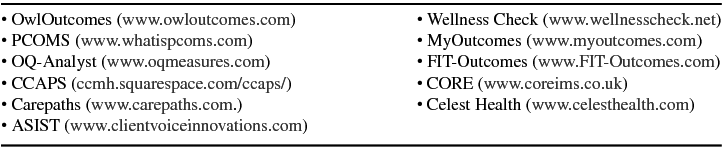
See Table 1 for a list of ROM software. All of these programs include features that allow Centre directors view and export aggregated data.
Web-based software for routine outcome assessment (ROM)

Uses of ROM in supervision
ROM data can be used to empirically inform the optimal focus for supervision. At the beginning of each supervision session, the supervisor and supervisee can review the outcome data for the supervisees’ cases, with an eye for identifying cases that are not showing improvement, or are deteriorating. These cases can be prioritized for review and discussion in supervision. Likewise, ROM data can help highlight trainees’ clinical successes, which can be valuable for helping trainees develop confidence and professional identity.
ROM data can also help the supervisory dyad gain a neutral, empirical perspective on supervisees’ work performance, which can help counteract any favouritism, bias, or counter-transference that may arise in supervisory relationships. For example, if a supervisor and supervisee disagree about a case (e.g. what clinical model or methods should be used), the outcome data can provide a neutral perspective from which to view the case. Using ROM to guide treatment can shift the dynamics of supervision from an argument about theory or subjective perspective to decision-making based on scientific data.
Another benefit of ROM software is the ability to easily aggregate outcome data by trainees. This allows supervisors to see the empirical ‘big picture’ of their supervisees’ clinical work, which could possibly constitute the most pure form of evidence-based supervision possible (Swift et al. Reference Swift, Callahan, Rousmaniere, Whipple, Dexter and Wrape2015). For example, at the end of each semester, supervisors can ask their trainees to create a spreadsheet which includes all of the trainees’ clients’ demographic data (e.g. gender, age, diagnosis, cultural background, etc.) along with their clinical outcome data. Comparing the outcome data between clients within a trainee's caseload can help identify the trainee's areas of strength and areas in need of improvement. For example, one trainee might demonstrate better outcomes with certain diagnoses (e.g. anxiety disorders vs. substance abuse), while another trainee might have better outcomes with certain demographic groups (e.g. women vs. men). Engaging in this type of empirical review of clinical data can help trainees learn a scientific approach to self-appraisal regarding their performance.
Implementation and limits of ROM
Multiple studies have shown that the effectiveness of ROM data may be moderated by therapist factors, such as attitudes towards feedback measures and commitment to use feedback data (de Jong et al. Reference de Jong, van Sluis, Nugter, Heiser and Spinhoven2012). Thus, the implementation of ROM procedures should be a collaborative endeavor that involves all stakeholders (i.e. administrators and clinical staff). Sufficient education about the benefits of ROM should be provided to supervisors, who in turn can then educate trainees. Training about ROM should emphasize the scope and limits of ROM data. For example, even the most psychometrically robust measures may not be clinically valid for some cases, and should never be used as a substitute for clinical judgement. Concerns have been raised about the possible iatrogenic effects of the misuse of ROM data (Wolpert, Reference Wolpert2013). If administrative or managerial staff wish to use this data, it should be done with staff consent and in a manner that is clinically appropriate and respects staff confidentiality.
Remote live supervision: videoconference for internet-based live one-way-mirror supervision
Live supervision supports evidence-based supervision by offering an unedited view of the therapy session, allowing supervisors to assess therapist competence, adherence, and treatment outcome in real time (Jakob et al. Reference Jakob, Weck and Bohus2013). Having an unedited view of trainees’ work is valuable, given that 97% of supervisees reported non-disclosure in supervision (Ladany et al. Reference Ladany, Hill, Corbett and Nutt1996). Live supervision offers several other advantages to delayed-report supervision, including the ability to make more timely feedback and corrections than delayed-report supervision (Champe & Kleist, Reference Champe and Kleist2003; Bartle-Haring et al. Reference Bartle-Haring, Silverthorn, Meyer and Toviessi2009). In live supervision the client more directly benefits from the experience and skills of the supervisor, leading to a greater likelihood of positive therapeutic outcomes and enhanced supervisee learning (Bernard & Goodyear, Reference Bernard and Goodyear2014; Moody et al. Reference Moody, Kostohryz and Vereen2014). Live supervision has been described as ‘economical’, because ‘in the role of both the therapist and the observer, trainees got so much out of live supervision in such a short period of time’ (Wong, Reference Wong1997, p. 151). Silverthorn and colleagues (2009) found that a single session of live supervision could significantly improve the supervisee's perceptions of clinical progress.
Until recently, live supervision has been limited by the need for expensive one-way mirrors and the requirement for both members of the supervisory dyad to be in the same location. This can be challenging in rural areas, when supervisees may work several hours (or more) away from their supervisors. The limited availability of supervision in remote areas has been found to be a risk factor for clinician dissatisfaction, turnover, and burnout (Mitchell et al. Reference Mitchell, Destefano, Martinez and Potter2009). One potential solution to these limitation is to use internet videoconference software for live supervision, termed Remote Live Supervision (RLS; Rousmaniere & Frederickson, Reference Rousmaniere and Frederickson2013). With RLS, a supervisor uses videoconference software to provide internet-based live one-way-mirror supervision, at any geographical distance, without the need for expensive one-way mirrors (Jakob et al. Reference Jakob, Weck and Bohus2013; Rousmaniere & Frederickson, Reference Rousmaniere and Frederickson2013).
Physical set-up for RLS
During RLS, the client and therapist (supervisee) sit across from each other, as in a traditional counselling room. A webcam focused on the client transmits live video during the counselling session. The supervisor then provides immediate feedback for the therapist, enabling them to immediately improve therapy effectiveness. In visual-format RLS, the supervisor types text interventions into a chat window in videoconference software. A computer monitor or laptop computer sitting next to the client displays the supervisor's interventions in large type, like a teleprompter for the supervisee, but out of the client's sight (a method referred to as bug-in-the-eye; Klitzke & Lombardo, Reference Klitzke and Lombardo1991). Alternately, in audio-format RLS, the supervisor speaks interventions into the computer's microphone, which are heard by the supervisee via an earpiece (the bug-in-the-ear method of live supervision; Klitzke & Lombardo, Reference Klitzke and Lombardo1991). The supervisee decides which interventions to integrate into therapy. Note that the videoconference software simply transmits the video of the therapy session to the supervisor's computer, like a television transmission. If the supervisor wishes to save a video of the session, a separate device may be used for this purpose (Rousmaniere & Frederickson, Reference Rousmaniere and Frederickson2013). Similarly, Angela Yu recently developed ISup, an innovative ‘app’ that utilizes the IPad for live one-way-mirror supervision (www.isupelive.com).
RLS technical set-up
RLS requires that both the supervisor and supervisee have a computer (desktop or laptop), and that the supervisee has a webcam. A USB cable extender may be helpful to connect the webcam to the laptop computer. An external microphone may optionally be used to provide better sound quality. If audio-format RLS is used, the supervisee can use a Bluetooth wireless earbud to hear the supervisor's comments. As of July 2015, all of this equipment except for the computers could be purchased for less than US$250 (total) from major electronic retail stores. RLS can be performed on any of a wide range of videoconference software packages.
RLS benefits
Traditional delayed-report supervision occurs after psychotherapy sessions end, and thus rely on the use of memory aids to recall what happened in the session (e.g. progress notes, videotapes). Delayed-report supervision uses a cognitive recall manner of learning, which can help supervisees learn about psychotherapy theory, processes, and models. In contrast, live supervision is an experiential method of learning, an important component of CBT training (Rakovshik & McManus, Reference Rakovshik and McManus2010; Roth et al. Reference Roth, Pilling and Turner2010; Reiser & Milne, Reference Reiser and Milne2012). Because RLS occurs in real time during the therapy session, the supervisee experiences the supervisor's ability to make assessments and interventions in real time. This can give the supervisee the opportunity to ‘walk in the supervisor's shoes’, and experience the psychotherapy model in action. In RLS the supervisor can give guidance immediately when the supervisee needs it. This facilitates state-dependent learning, which can help build procedural psychotherapy skills (Rousmaniere & Frederickson, Reference Rousmaniere and Frederickson2013). Jakob et al. (Reference Jakob, Weck and Bohus2013) examined the use of RLS for supervision of behavioural therapy by giving questionnaires to 10 patients, six trainees, and five supervisors, after a total of 25 RLS sessions. The data indicated very high levels of acceptance of RLS, with 96% of trainees and supervisors reporting that RLS ‘increases the effectiveness of my work’ (Jakob et al. Reference Jakob, Weck and Bohus2013).
Suitability for RLS
For the same reasons cited above, live supervision can be experienced as a very challenging method of training. In RLS, the supervisee must simultaneously track both the supervisor and the client. There is the risk that new clinicians may feel confused or lost during RLS sessions, or may adopt a passive role and simply obey the supervisor's guidance (Bernard & Goodyear, Reference Bernard and Goodyear2014). Furthermore, performing RLS at a geographical distance may heighten these risks. For example, trainees who do not have sufficient skill (technical or interpersonal) to apply their supervisor's interventions may create clinical problems that they are unable to correct later, when the supervisor is not available. Thus, although research has suggested that RLS may be appropriate for in-person supervision of trainees (Bartle-Haring et al. Reference Bartle-Haring, Silverthorn, Meyer and Toviessi2009; Jakob et al. Reference Jakob, Weck and Bohus2013), RLS may be not suitable for trainees located in a distant location or different jurisdiction than the supervisor (Rousmaniere & Frederickson, Reference Rousmaniere and Frederickson2013).
Challenges posed by supervision technology
Researchers have noted a number of potential challenges in the use of supervision technology, including difficulty understanding nonverbal communication due to the limited visual cues permitted by electronic communication (Vaccaro & Lambie, Reference Vaccaro and Lambie2007); the inability for supervisors to provide help from a distance, and possible unfamiliarity with local laws and regulations (Abbass et al. Reference Abbass, Arthey, Elliott, Fedak, Nowoweiski, Markovski and Nowoweiski2011); heightened risks of cultural misunderstandings due to geographical distance between supervisor and supervisee (Powell & Migdole, 2012); heightened anxiety in some supervisees (Sørlie et al. Reference Sørlie, Gammon, Bergvik and Sexton1999) or supervisors (Renfro-Michel et al. Reference Renfro-Michel, Rousmaniere, Spinella, Rousmaniere and Renfro-Michel2015); and the risk that training via videoconference may not be as effective as in-person training or mixed in-person and distance supervision (Sholomskas et al. Reference Sholomskas, Syracuse-Siewert, Rounsaville, Ball, Nuro and Carroll2005). As of yet there is little empirical data to support these concerns, but few studies have been done and more research in these areas is clearly indicated (Rousmaniere, Reference Rousmaniere, Watkins and Milne2014).
Another notable challenge posed by videoconference technology (that may be the cause of considerably anxiety on the part of supervisors) is the protection of client privacy and confidentiality. It is important to use videoconference software that is compliant with national and/or local laws and regulations regarding privacy and confidentiality (McAdams & Wyatt, Reference McAdams and Wyatt2010; Rousmaniere et al. Reference Rousmaniere, Renfro-Michel, Higgins, Rousmaniere and Renfro-Michel2015). Likewise, supervisors should be competent in both videoconference and other technology necessary to ensure internet security. Maintaining competency in internet technology can be no small feat, given that many programs change or ‘update’ on a frequent basis. A list of recommendations for enhancing security in supervision technology is provided in Rousmaniere & Kuhn (Reference Rousmaniere, Kuhn, Rousmaniere and Renfro-Michel2015).
Another challenge of internet-based supervision that invariably causes anxiety is the mixed reliability of internet connections. Most videoconference programs require an internet speed of over 0.5 Mbps. (A free internet speed test is available at Internetwww.speedtest.net.) Even when high-speed internet connections are used, it is common for users to experience occasional technical problems such as dropped calls or poor connectivity. For example, over a 5-year period of using videoconference for supervision at both private practice and university sites, the author encountered connectivity problems in about 20% of RLS sessions, even with high-speed internet. Thus, RLS is only appropriate for supervisors and supervisees who are comfortable with this limitation. To help mitigate this problem, back-up methods of communication should be identified (e.g. phone). Supervisors may take the following steps to help improve videoconference reliability: (a) use a high-speed internet connection, (b) close internet-intensive programs running in the background while using videoconference (e.g. internet-based file-sharing software), (c) avoid ‘screen sharing’ features when connectivity is poor, and (d) use only audio (i.e. turn off the video camera) when internet connectivity is poor (Rousmaniere, Reference Rousmaniere, Watkins and Milne2014).
Technology for evidence-based supervision: an example of use
The following is an example of how technology can be systemically integrated into a clinical training programme at an organizational level in order to encourage and support EBCS. This example is from the practicum for clinical psychology doctoral students at the University of Alaska Fairbanks Student Health and Counseling Center.
Electronic medical records
The clinic uses the ‘Point n’ Click’ secure e-chart software package. Paper forms (e.g. release of information requests or consents for treatment), are scanned into the electronic charts and then shredded.
Routine outcome monitoring
Starting with their first session, all clients complete the CCAPS, an overall assessment of mental health (Locke et al. Reference Locke, Bieschke, Castonguay and Hayes2012). This software allows both the trainee and supervisor to easily monitor client progress, and provides alerts for risk factors, including suicidality and substance abuse. The software features an algorithm that provides alerts for cases with higher chances of clinical deterioration (Locke et al. Reference Locke, Bieschke, Castonguay and Hayes2012). At the end of the training year, supervisors and trainees can review their overall aggregate outcomes to see a ‘big picture’ view of their clinical work, from a quantitative perspective (Swift et al. Reference Swift, Callahan, Rousmaniere, Whipple, Dexter and Wrape2015).
Videotaping counselling
Trainees’ counseling sessions are videotaped by two webcams connected to a desktop computer. One webcam is pointed at the trainee and the other at the client. Wirecast, a video streaming program, combines the video from the two webcams into one side-by-side video (also called ‘picture-in-picture’). The final video is saved directly to a secure network drive, without the need for tapes, CDs, or DVDs. Videos can be viewed from any counselling office with access to the secure network drive, making it easy to review the videos in individual or group supervision. After being used in supervision, videos are deleted from the secure network.
Training and RLS via videoconference
Videoconference software is used for clinical trainings by psychotherapy experts from around the country. Videos of trainings can be saved for future use. Videoconference is also used for live one-way-mirror supervision (RLS), without the need to install one-way mirrors.
Post-treatment feedback
After terminating treatment (or dropping out), a secure online feedback survey is sent to clients. The feedback can be used for quality assurance, training, and research purposes (Rousmaniere, Reference Rousmaniere, Watkins and Milne2014).
Conclusion
The rapid development and adoption of supervision technology holds promise for clinical practice. However, this promise is tempered by a limited availability of research in this area. Of particular note, almost all of the empirical research reviewed in this article has been performed by researchers who may be considered ‘early adopters’ and be biased pro-technology (as is the author of this article). Therefore, allegiance effects must be considered as a significant validity threat to the findings of this research. Future research in this area should be conducted by investigators who do not have a pro-technology bias (Rousmaniere, Reference Rousmaniere, Watkins and Milne2014).
This article has reviewed two new developments in supervision technology that offer supervisors new methods to achieve enhance the accuracy of objective measurement and corrective feedback in supervision. If used appropriately and within the context of their limits, both of these technologies may help supervisors incorporate some of the principles of EBCS (Milne, Reference Milne2009). Similar to how technology has enabled medical practice to evolve over the past century, technology may facilitate an evolution in CBT supervision towards EBCS in the near future.
Declaration of Interest
None.
By the end of this paper the reader should be able to:
-
(1) Describe the goals and benefits of software for routine outcome measurement.
-
(2) Describe the goals and benefits of videoconference for live one-way-mirror supervision.
-
(3) Describe three challenges present in the use of technology for supervision.



Comments
No Comments have been published for this article.