In the past few years, researchers have increasingly examined the relations of parental socialization style to children's dispositional control-related characteristics (e.g., self-regulation, impulsivity) and children's maladjustment (e.g., Eisenberg, Zhou, et al., Reference Eisenberg, Zhou, Spinrad, Valiente, Fabes and Liew2005; Gilliom, Shaw, Beck, Schonberg, & Lukon, Reference Gilliom, Shaw, Beck, Schonberg and Lukon2002; Kochanska & Knaack, Reference Kochanska and Knaack2003). Although it is clear that there are associations of both socialization and children's control/regulation with maladjustment (e.g., Rothbart & Bates, Reference Rothbart, Bates, Eisenberg, Damon and Lerner2006), findings differ somewhat depending on the operationalization of control/regulation. In addition, it has been suggested that individual differences in children's regulatory capacities and ego resilience partly mediate the relation of socialization to children's maladjustment (Eisenberg, Cumberland, & Spinrad, Reference Eisenberg, Cumberland and Spinrad1998; Eisenberg et al., Reference Eisenberg, Spinrad, Fabes, Reiser, Cumberland and Shepard2004; Gottman, Katz, & Hooven, Reference Gottman, Katz and Hooven1997). Moreover, although relations of socialization with children's regulation and maladjustment may vary across cultures (Bugental & Grusec, Reference Bugental, Grusec, Eisenberg, Damon and Lerner2006), with a few exceptions (e.g., Zhou, Eisenberg, Wang, & Reiser, Reference Zhou, Eisenberg, Wang and Reiser2004), most relevant research has been conducted in North America. Thus, the purpose of the present study was to examine the relations of authoritative and punitive parenting to children's maladjustment in a sample from the People's Republic of China, and if individual differences in self-regulation (assessed with effortful control [EC]), impulsivity, and resilience mediated these relations. Relevant literature on the constructs of EC, reactive control, and ego resilience, and their relations to maladjustment, is discussed below, followed by consideration of the relations of parenting and culture to these constructs.
EC and Reactive Control, Ego Resilience, and Children's Maladjustment
There is mounting evidence that individual differences in children's emotion-related self-regulation are related to their maladjustment, including externalizing and internalizing problems (see Eisenberg, Fabes, Guthrie, & Reiser, Reference Eisenberg, Fabes, Guthrie and Reiser2000; Eisenberg, Sadovsky, et al., Reference Eisenberg, Zhou, Spinrad, Valiente, Fabes and Liew2005; Rothbart & Bates, Reference Rothbart, Bates, Eisenberg, Damon and Lerner2006). Thus, there has been an expediential increase in research on self-regulation and related constructs.
Eisenberg et al. (Reference Eisenberg, Spinrad, Fabes, Reiser, Cumberland and Shepard2004) have argued that it is useful to differentiate between emotion-related self-regulation and reactive aspects of control when studying the relations of regulation to developmental outcomes. Emotion-related self-regulation (henceforth called self-regulation or regulation for brevity) refers to processes used to manage and change if, when, and how (e.g., how intensely) one experiences emotions and emotion-related motivational and physiological states, as well as how emotions are expressed behaviorally (Eisenberg, Hofer, & Vaughan, Reference Eisenberg, Hofer, Vaughan and Gross2007). It includes processes used to change one's own emotional state, to prevent or initiate emotion responding (e.g., by selecting or changing situations), to modify the significance of the event for the self, and to modulate the behavioral expression of emotion (e.g., through verbal or nonverbal cues).
Some researchers (e.g., Derryberry & Rothbart, Reference Derryberry and Rothbart1997; Rothbart & Bates, Reference Rothbart, Bates, Eisenberg, Damon and Lerner2006) have suggested that an important factor contributing to individual differences in self-regulation is EC, an aspect of temperament with a genetic basis that also is affected over time by experience, including socialization. EC is defined as “the efficiency of executive attention—including the ability to inhibit a dominant response and/or to activate a subdominant response, to plan, and to detect errors” (Rothbart & Bates, Reference Rothbart, Bates, Eisenberg, Damon and Lerner2006, p. 129). EC is believed to regulate temperamental reactivity, including emotion and behaviors (e.g., impulsivity) associated with emotional reactivity, and to involve the willful control of attention and behavior. Typical measures of EC often tap attention focusing (i.e., the ability to maintain attentional focus upon task-related channels) and inhibitory control (the capacity to plan and effortfully suppress inappropriate approach responses under instructions or in novel or uncertain situations; Kochanska, Murray, & Harlan, Reference Kochanska, Murray and Harlan2000; Muris & Ollendick, Reference Muris and Ollendick2005; Rothbart, Ahadi, & Hershey, Reference Rothbart, Ahadi and Hershey1994; Rothbart, Ahadi, Hershey, & Fisher, Reference Rothbart, Ahadi, Hershey and Fisher2001). However, EC also includes skills such as planning and activational control (the capacity to perform an action when there is a strong tendency to avoid it).
Control is typically defined in the dictionary as inhibition or constraint. It can be effortful or willful, as when it involves EC, or it can be less voluntary as when a child is highly inhibited and cannot easily change that behavior. Thus, it is useful to differentiate EC, which involves optimal levels of control, from aspects of control that are less voluntarily modulated and more reactive, labeled by Eisenberg and colleagues as reactive control. Reactive undercontrol refers to behavior when individuals are “pulled” toward rewarding situations (impulsivity) without much thought (assessed in the current study), whereas reactive overcontrol refers to when individuals are wary and overconstrained (highly inhibited) in response to novelty (e.g., behavioral inhibition; Kagan, Reference Kagan, Eisenberg and Damon1998) or stress (not assessed in this study). The notion of reactive over- and undercontrol maps onto Gray's (Pickering & Gray, Reference Pickering, Gray, Pervin and John1999) behavioral inhibition and activation systems, respectively.
Reactive control involves temperamental reactivity in that it “refers to the arousability of motor, affective, and sensory response systems” (Rothbart et al., Reference Rothbart, Ahadi, Hershey and Fisher2001, p. 1395) and is not considered to be part of EC, despite the fact that reactive undercontrol and EC are negatively related (Aksan & Kochanska, Reference Aksan and Kochanska2004; Eisenberg et al., Reference Eisenberg, Spinrad, Fabes, Reiser, Cumberland and Shepard2004). We use the term reactive control to differentiate aspects of temperamental reactivity linked to inhibition (or the lack thereof) from purely emotional temperamental reactivity. Eisenberg and colleagues (e.g., Eisenberg et al., Reference Eisenberg, Spinrad, Fabes, Reiser, Cumberland and Shepard2004; Eisenberg, Spinrad, & Morris, Reference Eisenberg, Spinrad and Morris2002; Valiente et al., Reference Valiente, Eisenberg, Smith, Reiser, Fabes and Losoya2003) found that EC and reactive control loaded on different latent constructs and/or accounted for unique (as well as overlapping) variance in externalizing problems. In factor analyses, impulsivity and low shyness (believed to often index reactive overcontrol/behavioral inhibition) tend to group with high intensity pleasure and not EC (which is a separate factor), whereas negative emotionality is a third, separate factor. Moreover, smiling and laughter and low intensity pleasure tend to cluster with EC, not impulsivity (Rothbart et al., Reference Rothbart, Ahadi, Hershey and Fisher2001). Thus, although reactive control processes may often be associated with emotion, the pattern is complex; for example, shyness and negative emotionality do not load together. Moreover, reactive impulsive or inhibited behaviors may not always involve much emotion; they may become characteristic styles of responding even when a situation involves little emotion.
EC of attention and behavior would be expected to affect maladjustment by contributing to the processing of information and learning, as well as behavioral regulation (Eisenberg, Hofer, et al., Reference Eisenberg, Hofer, Vaughan and Gross2007; Gross & Thompson, Reference Gross, Thompson and Gross2007). For example, the ability to move attention from negative thoughts and to focus on affectively neutral or positive thoughts and activities seems to be important in cutting off negative emotion, and has been linked to low levels of anxiety and depression (Derryberry & Reed, Reference Derryberry and Reed2002; Derryberry & Rothbart, Reference Derryberry and Rothbart1988; Silk, Steinberg, & Morris, Reference Silk, Steinberg and Morris2003; Vasey, El-Hag, & Daleiden, Reference Vasey, EI-Hag and Daleiden1996). Focusing on new stimuli or engaging in a new activity appears to reduce distress (Erber & Tesser, Reference Erber and Tesser1992). Moreover, the ability to focus attention is likely to aid in planning behavior (Eronen, Nurmi, & Salmela-Aro, Reference Eronen, Nurmi and Salmela-Aro1997; NICHD Early Child Care Research Network, 2005), which can be used to alleviate a negative situation. Furthermore, the ability to rein in behavioral impulses has obvious implications for the reduction of inappropriate behavior (Eisenberg et al., Reference Eisenberg, Fabes, Guthrie and Reiser2000).
Consistent with these arguments, EC frequently has been linked to low levels of externalizing problems (see Eisenberg et al., Reference Eisenberg, Fabes, Guthrie and Reiser2000, Reference Eisenberg, Spinrad, Fabes, Reiser, Cumberland and Shepard2004; Kochanska & Knaack, Reference Kochanska and Knaack2003; Lemery Essex, & Smider, Reference Lemery, Essex and Smider2002; Lengua, West, & Sandler, Reference Lengua, West and Sandler1998; Olson, Sameroff, Kerr, Lopez, & Wellman, Reference Olson, Sameroff, Kerr, Lopez and Wellman2005; Rothbart & Bates, Reference Rothbart, Bates, Eisenberg, Damon and Lerner2006). Conversely, impulsivity has been linked to high levels of externalizing problems (Lemery et al., Reference Lemery, Essex and Smider2002; Lengua et al., Reference Lengua, West and Sandler1998; Lynam, Reference Lynam1997). Findings with internalizing problems are more mixed. Some investigators have found no association of EC or similar measures of self-regulation with internalizing symptoms (Oosterlaan & Sergeant, Reference Oosterlaan and Sergeant1996), whereas others have found that children with internalizing problems are lower in EC than nondisordered children (Eisenberg, Cumberland, et al., Reference Eisenberg, Cumberland, Spinrad, Fabes, Shepard and Reiser2001; Oldehinkel, Hartman, De Winter, Veenstra, & Ormel, Reference Oldehinkel, Hartman, De Winter, Veenstra and Ormel2004; Silk et al., Reference Silk, Steinberg and Morris2003).
In the sample in the present paper (Eisenberg, Ma, et al., Reference Eisenberg, Ma, Chang, Zhou, West and Aiken2007), pure (i.e., noncomorbid) internalizing problems were related to low levels of children's EC, including both attentional and inhibitory control. In contrast, Murray and Kochanska (Reference Murray and Kochanska2002) found that young children high in EC had more internalizing problems than those moderate in EC. Aksan and Kochanska (Reference Aksan and Kochanska2004) found a positive association between what they labeled as reactive inhibition to novelty (sometimes viewed as an early internalizing problem; Carter, Briggs-Gowan, Jones, & Little, Reference Carter, Briggs-Gowan, Jones and Little2003) and later emerging effortful inhibition. However, it was the actual expression of fear in response to scary masks, not inhibition with novel toys/activities, that was positively related to EC. These findings suggest that fearfulness, but not the control-related aspects of inhibition involved in internalizing problems, was positively related to EC. It is also possible that early EC is positively related to inhibition to novelty but not other internalizing symptoms.
Empirical relations of reactive undercontrol/impulsivity or overcontrol to internalizing problems in children have been somewhat more consistent. Several investigators have found positive relations between an overcontrolled personality and internalizing problems (e.g., Huey & Weisz, Reference Huey and Weisz1997; Juffer, Stams, & van IJzendoorn, Reference Juffer, Stams and van IJzendoorn2004; Robins, John, Caspi, Moffitt, & Stouthamer-Loeber, Reference Robins, John, Caspi, Moffitt and Stouthamer Loeber1996) or have found that children who are behaviorally inhibited (and, thus, high in reactive overcontrol) tend to develop internalizing problems with age (e.g., Biederman et al., Reference Biederman, Rosenbaum, Hirshfeld, Faraone, Bolduc and Gersten1990). Eisenberg and colleagues (Eisenberg, Cumberland, et al., Reference Eisenberg, Cumberland, Spinrad, Fabes, Shepard and Reiser2001; Eisenberg et al., Reference Eisenberg, Spinrad, Fabes, Reiser, Cumberland and Shepard2004) found relatively consistent relations between high impulsivity and low levels of internalizing problems in elementary school children and a similar but weaker pattern was obtained in China (Eisenberg, Ma, et al., Reference Eisenberg, Ma, Chang, Zhou, West and Aiken2007). However, a few investigators have not found such an association (e.g., O'Brien & Frick, Reference O'Brien and Frick1996) and Lengua et al. (Reference Lengua, West and Sandler1998) found a positive relation between impulsivity and depression when contaminated (overlapping) items were removed from the scales (but not prior to removing them).
Ego resilience may play an important mediating role in the relation of self-regulation/control to internalizing problems. Block and Block (Reference Block, Block and Collins1980) defined ego resilience as “the dynamic capacity of an individual to modify his/her modal level of ego control, in either direction, as a function of the demand characteristics of the environmental context” (p. 48). According to Block and Block (Reference Block, Block and Collins1980), high ego resilience involves resourceful adaptation to changing circumstances and flexible use of problem-solving strategies, whereas low ego resilience involves little adaptive flexibility, an inability to respond to changing circumstances, the tendency to perseverate or become disorganized when dealing with change or stress, and difficulty recouping after traumatic experiences. Ego resilience is different from the construct of resilience when defined by developing well in response to adversity. EC and reactive impulsivity generally are viewed as temperamentally based variables, whereas ego resilience is a personality characteristic reflecting how the individual responds and adapts to stress in various situations. This situational response is expected to be influenced by temperament, including EC: in particular, the ability to use executive attention, planning, and related skills should contribute to the child's ability to adapt to stressful contexts. However, ego resilience is expected to be affected by other temperamental/personality characteristics (e.g., emotionality), learning (e.g., of coping and social skills), and the nature of the stressors in a particular context.
Because an emotional vulnerability is so central to internalizing problems, Eisenberg et al. (Reference Eisenberg, Spinrad, Fabes, Reiser, Cumberland and Shepard2004) hypothesized that relations of EC (and impulsivity) to internalizing problems would be partly through their effects on ego resilience. They found that EC and impulsivity were both positively related to higher levels of ego resilience, and resilience predicted lower levels of internalizing problems. Eisenberg et al. (Reference Eisenberg, Spinrad and Morris2002) found that the positive linear relation between impulsivity and ego resilience declines with age, and argued that this relation is due primarily to the negative association between low impulsivity (reflecting lack of spontaneity and some rigidity) and ego resilience, as well as a link between spontaneous approach behavior and ego resilience in young children. Such an argument is consistent with Block and Kremen's (Reference Block and Kremen1996) assertion that “the human goal is to be as undercontrolled as possible and as overcontrolled as necessary. When one is more undercontrolled than is adaptively effective or more overcontrolled than is adaptively required, one is not resilient” (p. 351). In contrast to the findings for internalizing, across several studies (Eisenberg et al., Reference Eisenberg, Spinrad, Fabes, Reiser, Cumberland and Shepard2004; Valiente et al., Reference Valiente, Eisenberg, Smith, Reiser, Fabes and Losoya2003), ego resilience has not mediated the relations of EC or reactive control to externalizing problems, likely because some children high in externalizing problems are surgent, spontaneous, and distractible and thus not notably low in ego resilience.
To our knowledge, the potential mediating role of ego resilience when predicting maladjustment from EC and impulsivity has been examined in only two samples in the United States. Thus, a goal of the present study was to examine if ego resilience mediated the relations of EC and impulsivity to maladjustment in a sample of Chinese children and if such mediation held only for internalizing problems. In addition, as is discussed next, we examined if ego resilience, as well as EC and impulsivity, mediated the relations of authoritative and punitive parenting to maladjustment.
Relations of Parenting Style to EC, Impulsivity, Ego Resilience, and Maladjustment
In samples of primarily European American children, authoritative parenting (high control and high acceptance; Baumrind, Reference Baumrind1967) and related dimensions (e.g., warmth/responsiveness, reasoning, and induction) have been consistently related to positive developmental outcomes, including fewer behavior problems and psychological symptoms (e.g., Steinberg, Lamborrn, Darling, Mounts, & Dornbusch, Reference Steinberg, Lamborn, Darling, Mounts and Dornbusch1994; Steinberg, Mounts, Lamborn, & Dornbusch, Reference Steinberg, Mounts, Lamborn and Dornbusch1991). Conversely, authoritarian parenting (high control and low acceptance; Baumrind, Reference Baumrind1967, Reference Baumrind1996) and related dimensions, especially punitive and coercive parenting, generally have been related to negative developmental outcomes, including problems with adjustment (see Bugental & Grusec, Reference Bugental, Grusec, Eisenberg, Damon and Lerner2006). Similarly, authoritarian, negative, and punitive parenting, as well as parental negative expressivity, have been associated with lower levels of EC (e.g., Eisenberg, Gershoff, et al., Reference Eisenberg, Gershoff, Fabes, Shepard, Cumberland and Losoya2001; Gartstein & Fagot, Reference Gartstein and Fagot2003), whereas positive parenting (e.g., support, parental expression of positive emotion) has been linked to higher self-regulation/EC (e.g., Eisenberg, Zhou, et al., Reference Eisenberg, Zhou, Spinrad, Valiente, Fabes and Liew2005; Gilliom et al., Reference Gilliom, Shaw, Beck, Schonberg and Lukon2002). In the present study, we examined the relation of authoritative and punitive parenting—the aspect of authoritarian parenting that appears most related to children's outcomes—to EC and maladjustment in China (Lansford et al., Reference Lansford, Chang, Dodge, Malone, Oburu and Palmérus2005; Zhou et al., Reference Zhou, Eisenberg, Wang and Reiser2004).
There are numerous reasons to expect positive rather than punitive parenting to be positively related to children's self-regulation. Hoffman (Reference Hoffman2000) argued that parents' hostile or punitive parenting is likely to produce affective overarousal in their children, which could undercut regulation and learning in specific contexts by compromising their attentional capacities. In contrast, when parents are supportive, children are unlikely to be overaroused as a consequence of parent–child interactions, and should be better able to respond to parental efforts to focus their attention and guide their behavior. Children also are more likely to be disposed to process their parents' messages, internalize parents' requests for desirable behavior (e.g., inhibiting undesirable behavior and paying attention), and control their emotion and behavior when their parents are supportive rather than punitive (Dix, Reference Dix1991; Grusec & Goodnow. Reference Grusec and Goodnow1994). Thus, they may be more motivated, as well as better able, to attend to and learn from interactions with, and scaffolding provided by, warm parents.
In addition, supportive parents are likely to model constructive, regulated ways to manage interpersonal interactions (Power, Reference Power2004). Parental support also may contribute to children's beliefs about how much and what types of emotion are appropriate and effective in social interactions, and such knowledge may foster self-regulation, positive emotion in social interactions, and maladjustment (Denham, Zoller, & Couchoud, Reference Denham, Zoller and Couchoud1994; Dunn & Brown, Reference Dunn, Brown, Garber and Dodge1991; Halberstadt, Crisp, & Eaton, Reference Halberstadt, Crisp, Eaton, Philippot and Feldman1999). Supportive parents also may help their children to manage their distress and cope constructively (Eisenberg et al., Reference Eisenberg, Cumberland and Spinrad1998; Power, Reference Power2004; Skinner & Wellborn, Reference Skinner, Wellborn, Lerner, Featherman and Perlmuter1994), which might foster the development of social skills and reduce negative social expectations (Dusek & Danko, Reference Dusek and Danko1994; Hardy, Power, Jaedicke, Reference Hardy, Power and Jaedicke1993). Moreover, supportive parenting might facilitate children's self-regulation by promoting the predictability of the environment (Brody & Ge, Reference Brody and Ge2001) and by protecting children from exposure to stressful events (Power, Reference Power2004). Finally, supportive parents are likely to evoke positive emotion in their children, which may promote creativity and flexibility in thinking and problem solving (Fredrickson, Reference Fredrickson2001; Isen, Daubman, & Nowicki, Reference Isen, Daubman and Nowicki1987) and hence EC (viewed as flexible in its use and as involving higher order cognitive abilities).
Some researchers have questioned the generalizability of the findings on parenting in Western countries to cultures such as China, which emphasize interdependence and the welfare of the larger group over individual autonomy and achievement (Chao, Reference Chao1994). When studying cross-cultural variation in socialization, it is useful to differentiate between cultural variation in the norm (i.e., mean) of an attribute and cultural variation in its adaptive meaning (i.e., associations with maladjustment). For example, although cultures may differ on the normative levels for parental use of physical discipline, physical discipline has been related to adverse child outcomes (aggression and anxiety) across multiple cultural groups (Lansford et al., Reference Lansford, Chang, Dodge, Malone, Oburu and Palmérus2005; Zhou et al., Reference Zhou, Eisenberg, Wang and Reiser2004; see Deater-Deckard, Dodge, Bates, & Pettit, Reference Deater-Deckard, Dodge, Bates and Pettit1996, for an exception in their work with African American children). Nonetheless, it is important to examine the relations of socialization to EC, reactive control, ego resilience, and maladjustment in non-Western cultures.
The Role of Culture
The present study was conducted in The People's Republic of China, a country that has been found to be higher than the United States on collectivistic values (Oyserman, Coon, & Kemmelmeier, Reference Oyserman, Coon and Kemmelmeier2002). Although there is disagreement about the degree to which cultures can be classified as collectivistic (Kitayama, Reference Kitayama2002; Miller, Reference Miller2002), a number of investigators have argued that in cultures such as China, group harmony and conformity with societal and in-group norms are valued (Cheah & Rubin, Reference Cheah and Rubin2004; Triandis, Reference Triandis, Kitayama and Markus1994) and predict social behavior (Bond & Chi, Reference Bond and Chi1997). Moreover, consistent with a collectivistic orientation, the display of externalizing behaviors that are disruptive to group functioning (e.g., aggression) is discouraged by Chinese adults (Cheah & Rubin, Reference Cheah and Rubin2004) and behaviors/attributes such as attentiveness, diligence, and self-regulation are highly reinforced in Chinese schools (Phelps, Reference Phelps2005). Thus, in China one would expect EC to be highly valued and a predictor of maladjustment.
There is conflicting evidence regarding the degree to which some internalizing behaviors such as socially withdrawn behavior are deemed to be problematic in China. Chen, Cen, Li, and He (Reference Chen, Cen, Li and He2005) suggested that in traditional Chinese culture, shy, sensitive, and restrained behavior traditionally has been considered indicative of social accomplishment and maturity. Consistent with this argument, some researchers have found that shy or wary behavior is associated with high social competence (Chen, Dong, & Zhou, Reference Chen, Dong and Zhou1997; Chen, Rubin, & Li, Reference Chen, Rubin and Li1995; Chen, Rubin, & Sun, Reference Chen, Rubin and Sun1992). Other researchers, however, found that, similar to Western findings, withdrawn behaviors in Chinese societies were negatively reacted to by peers, negatively self-perceived, and discouraged by parents and teachers (Chang, Reference Chang2003, Reference Chang2004; Chang, Schwartz, Dodge, & McBride-Chang, Reference Chang, Schwartz, Dodge and McBride-Chang2003; Chang et al., Reference Chang, Li, Li, Lui, Guo and Wang2005; Cheah & Rubin, Reference Cheah and Rubin2004; Hart et al., Reference Hart, Yang, Nelson, Robinson, Olsen and Nelson2000; Schwartz, Chang, & Farver, Reference Schwartz, Chang and Farver2001). In their recent research, Chen et al. (Reference Chen, Cen, Li and He2005) reported similar findings. Chen et al. (Reference Chen, Cen, Li and He2005) suggested that Chinese culture has become Westernized in the past decade, with the consequence that assertive behavior is now valued, whereas restrained behavior is not (Yu, Reference Yu2002). Thus, in recent years, one might expect internalizing behaviors such as social withdrawal or social anxiety to relate to EC in a manner similar to Western countries.
Studies suggest that rates of depression and internalizing problems in China and Hong Kong are at least as high as in the United States (e.g., Chen & Li, Reference Chen and Li2000; Greenberger, Chen, Tally, & Dong, Reference Greenberger, Chen, Tally and Dong2000; Liu et al., Reference Liu, Kurita, Guo, Miyake, Ze and Cao1999, Reference Liu, Kurita, Guo, Tachimori, Ze and Okawa2000; Stewart et al., Reference Stewart, Kennard, Lee, Hughes, Mayes and Emslie2004), and that US children are higher in aggressive behavior (Weine, Phillips, & Achenbach, Reference Weine, Phillips and Achenbach1995). Depressive symptoms in Chinese children, like in the United States, are associated with low social and academic competence (Chen et al, Reference Chen, Rubin and Li1995; Chen & Li, Reference Chen and Li2000), as well as self-perceptions thereof (Chan, Reference Chan1997). As already noted, as in the United States, low EC in Chinese children relates to both internalizing and externalizing problems (Eisenberg, Ma, et al., Reference Eisenberg, Ma, Chang, Zhou, West and Aiken2007; Zhou et al., Reference Zhou, Eisenberg, Wang and Reiser2004). Consistent with this relation, Chan (Reference Chan1994) found that youths with anxiety and depression tended to use ineffective rather than rational problem-solving coping.
In one of the few studies of Chinese children's EC, Ahadi, Rothbart, and Ye (Reference Ahadi, Rothbart and Ye1993; Rothbart et al., Reference Rothbart, Ahadi, Hershey and Fisher2001) found considerable similarity in the factor structures of temperament for 6- to 7-year-old Chinese and American children. However, in the Chinese sample, EC was uncorrelated with negative affect, but negatively correlated with surgency, whereas in the US sample EC was negatively related with negative affect and unrelated to surgency. Thus, in China, compared to the United States, one might expect more overlap in the constructs of EC and aspects of surgency such as impulsivity. If the latter were true, EC and impulsivity might not be separate constructs in China as they are in the United States.
As already noted, some investigators have argued that authoritative parenting may not predict maladjustment in countries such as China (Chao, Reference Chao1994). However, Xu et al. (Reference Xu, Farver, Zhang, Zeng, Yu and Cai2005) found that high scores on both authoritative and authoritarian parenting were linked to collectivistic parental values, and that parents with high scores on both parenting dimensions adhered most strongly to Chinese cultural values (also see Pearson & Rao, Reference Pearson and Rao2003). There is also evidence that Chinese parents are higher in mean levels of directiveness, physical coercion, and shaming/love withdrawal (although low in physical punishment; see Lansford et al., Reference Lansford, Chang, Dodge, Malone, Oburu and Palmérus2005), whereas US mothers are higher on warm/acceptance and democratic participation, all constructs relevant to authoritative and authoritarian parenting (Wu et al., Reference Wu, Robinson, Yang, Hart, Olsen and Porter2002). Nonetheless, recent empirical studies involving Chinese children suggest that authoritative and authoritarian or punitive parenting relate to developmental outcomes such as behavioral and psychological problems in a manner similar to the pattern found in Western societies (e.g., Ang, Reference Ang2006; Porter et al., Reference Porter, Hart, Yang, Robinson, Olsen and Zeng2005; Sorkhabi, Reference Sorkhabi2005; Zhou et al., Reference Zhou, Eisenberg, Wang and Reiser2004), although findings have not always been strong or highly consistent (Barber, Stolz, & Olsen, Reference Barber, Stolz and Olsen2005). In addition, coercive or harsh parenting has been linked to low self-regulation in Chinese samples (e.g., Chang et al., Reference Chang, Schwartz, Dodge and McBride-Chang2003; Wang, Chen, Chen, Cui, & Li, Reference Wang, Chen, Chen, Cui and Li2006). For example, in a sample of young school children, Zhou et al. (Reference Zhou, Eisenberg, Wang and Reiser2004) found that EC mediated the positive and negative relations, respectively, of authoritative and authoritarian parenting to quality of children's social functioning (including teacher- and peer-reported socially appropriate behavior/leadership and low aggression). However, Zhou et al. (Reference Zhou, Eisenberg, Wang and Reiser2004) found that it was primarily the punitive aspect of authoritarian parenting that was associated with problems in social functioning.
Indeed, as suggested by Bugental and Grusec (Reference Bugental, Grusec, Eisenberg, Damon and Lerner2006), it may be the punitive aspects of authoritarian parenting, rather than the high levels of control per se, that are most often linked to low adjustment in collectivistic cultures. Parental disapproval has been negatively related to externalizing types of problem behaviors in the United States and China, as well as Korea and the Czech Republic (Dmitrieva, Chen, Greenberger, & Gil-Rivas, Reference Dmitrieva, Chen, Greenberger and Gil-Rivas2004), whereas harsh parenting has been linked with high aggression in Chinese children (e.g., Chang et al., Reference Chang, Schwartz, Dodge and McBride-Chang2003; Chang, Lansford, Schwartz, & Farver, Reference Chang, Lansford, Schwartz and Farver2004; Nelson, Hart, Yang, Olsen, & Jin, Reference Nelson, Hart, Yang, Olsen and Jin2006; Wang et al., Reference Wang, Chen, Chen, Cui and Li2006). In a study of conducted in six countries, physical discipline was associated with adverse outcomes (i.e., children's aggression and anxiety) in all settings (including in several Asian cultures), although this association was weaker in countries in which physical discipline was perceived as more normative, especially by children (note physical discipline was low in perceived normativeness in China; Lansford et al., Reference Lansford, Chang, Dodge, Malone, Oburu and Palmérus2005).
In collectivist societies, parental negativity and high levels of control (aspects of authoritarian parenting) may not be linked. Unlike for mothers from individualistic backgrounds (i.e., Western European), Rudy and Grusec (Reference Rudy and Grusec2006) found that highly directive parental behaviors and strict rules (aspects of many scales of authoritarianism) were not associated with low parental warmth and a negative view of the child for mothers from collectivistic backgrounds (e.g., Egyptian, Iranian, Indian, and Pakistani backgrounds). Thus, highly directive parenting (an aspect of parenting sometimes included in authoritarian parenting) may not undermine children's adjustment in collectivistic cultures, likely because such parenting is viewed as appropriate and in the child's best interest.
The Present Study
In the present study, we examined the relations of parenting style to children's maladjustment, EC, reactive control (impulsivity), ego resilience, and maladjustment in a relatively large sample of children from The People's Republic of China. Multiple reports of EC, ego resilience, and maladjustment were obtained for all measures except parenting (parents reported on parenting style). We expected parenting style to predict EC and perhaps impulsivity (especially for punitive parenting) and, consistent with prior work in the United States, we expected EC and impulsivity to provide some unique prediction of EC and impulsivity and to mediate relations of parenting to maladjustment. In addition, we hypothesized that children's ego resilience would mediate the negative relation of EC to internalizing problems. As in studies of young school-aged children in the United States, we expected ego resilience to be positively related to impulsivity as well as EC (because of the relation of low impulsivity with low ego resilience), and for ego resilience to predict low levels of internalizing but not externalizing problems. Although we cannot prove causal relations with these data, testing the aforementioned relations is useful to an understanding of cultural similarities and differences in the relations of children's dispositions to their maladjustment. If the relations between maladjustment and child dispositions are the same in various cultures, it is more likely that the processes involved are similar across groups.
Finally, because Chinese adolescents from urban settings report more conflict and less cohesion with their parents, lower frequency of discussions with their fathers, and a greater willingness to disagree openly with their parents (Zhang & Fuligni, Reference Zhang and Fuligni2006), it seemed possible that the relations of parenting to children's EC and reactive control, as well as maladjustment, might vary for urban and rural children. For example, authoritative parenting and low levels of punishment may be more normative for urban than rural children and, thus, more strongly related to self-regulation and maladjustment (see Lansford et al., Reference Lansford, Chang, Dodge, Malone, Oburu and Palmérus2005). Consequently, we examined if rural/urban status moderated the pattern of results. Moreover, although we did not expect gender or grade to moderate the pattern of relations, we also examined this issue.
Method
Participants
Participants were recruited from two elementary schools in Beijing, People's Republic of China, and another two elementary schools in a rural area of He Bei Province of China adjacent to Beijing. In the urban setting, participants were recruited from six first-grade and seven second-grade classes (average class size = 27); in the rural schools, all three first-grade and four second-grade classes were included (average class size = 49). An advantage of using children in early elementary school is that their teachers can provide information on children's maladjustment and characteristics. Adjustment problems can occur at school or home (or both), so it is advantageous to have information from both contexts, especially at an age when teachers are likely to know their students well (and especially when parents report on their own parenting).
The rural sample was officially different from the urban sample because rural people hold farmers residents cards. Many grow vegetables for Beijing residents and have a very good income. It is also common for farmers to engage in business and open up and own or work in factories and companies. Economically, they would be expected to be more affluent than farmers and perhaps even urban residents in remote areas.
Parental consent forms were distributed to all of the students in these classes. Approximately 98% the parents in the two rural schools and 95% in the two urban schools gave consent for their children's participation. The final sample of 697 included 356 urban (44% girls) and 341 (45% girls) rural children. The average ages of the rural and urban samples were 8.36 and 8.33 years (SDs = 0.57 and 0.60), respectively (M age for the total sample = 8.34, SD = 0.58).
Parental questionnaire data were obtained from mothers for 364 children, from fathers for 182 children; for the remaining children (21.7%), gender of the parent was not reported. Fathers' and mothers' educational levels (available for 82.4% and 82.8%) were as follows: 3.3% and 4.3%, respectively, had middle school or lower education; 61.5% and 63.3% had a high school education; and 35.2% and 32.4% had at least some college or higher education. Of those reporting, 97% of the children lived with married parents; 3% of the parents were divorced (another 18% did not provide this information).
Because of missing items, the ns for constructs varied considerably (from 615 to 635 for parental data, and from 645 to 657 for teacher-reported data; all of the 697 children had the peer-report measure of aggression).
Procedure
Two graduate students went to each classroom when no other adults were present. They explained the procedures for completing the measures and specifically told the students that no one in their school would see their responses and that the researchers would not know their identities and were not interested in individual responses. The students were then given time to practice the procedures and to learn the written names of their classmates for the peer nominations. Because most students could not read their classmates' names in print, this practice session took almost a class period. After the practice session and a short recess, students were administered the self-report and peer nomination measures. An adult stood in the front of the class and read each question slowly while students filled out the answers. Another researcher walked around the room and assisted individual students as needed. After the session, which lasted slightly more than one class period, the students were again told the purpose of the research and assured of the anonymity of their identity. Similar procedures have been used successfully in other studies with Chinese children (e.g., Chang et al., Reference Chang, Liu, Wang, Fung, Wen and Li2007). Children were also asked to take a set of questionnaires for their parents to fill out at home and return sealed.
In primary schools in China, each class has a designated head teacher. Most school activities are conducted within a class as the organizing unit. Head teachers typically teach major subjects such as Chinese and mathematics. They teach fewer classes but are assigned the responsibility of attending to student affairs for their designated class. Students go to the head teacher for any problems they encounter, including those that occur outside school or in lessons taught by other teachers. Head teachers see their students daily and maintain close contact with their parents. Twenty-seven head teachers (93% female) filled out a set of behavior evaluations of the students in their designated classes. They were provided with the same explanation given to the students about confidentiality and were compensated.
Measures
Most of the measures we used were translated for use in prior research and have been used successfully in a number of studies with Chinese children (e.g., Eisenberg, Ma, et al., Reference Eisenberg, Ma, Chang, Zhou, West and Aiken2007; Rothbart et al., Reference Rothbart, Ahadi, Hershey and Fisher2001; Zhou et al., Reference Zhou, Eisenberg, Wang and Reiser2004). Moreover, two Chinese graduate students in the United States examined the scales for problems in their wording (and a few minor changes were made based on ambiguous wordings). In addition, the measures were checked by Chinese psychologists, as well as an author (Chang) who is fully bilingual and grew up in China.
Procedures for removing overlapping items in the temperament and problem behavior scales
To reduce the potential for confounding of measures of temperament and behavioral problems, we excluded items on the EC subscales that likely reflected psychopathology and vice versa. To determine which items are confounded, temperament items from the Child Behavior Questionnaire (CBQ; Rothbart et al., Reference Rothbart, Ahadi and Hershey1994, Reference Rothbart, Ahadi, Hershey and Fisher2001) reflecting attention shifting, attention focusing, inhibitory control, sadness, and anger, as well as child psychopathology items reflecting externalizing and internalizing problems from the Child Behavior Checklist (CBCL; Achenbach, Reference Achenbach1991), were rated by experts on temperament, emotion, and/or psychopathology for another study (see Eisenberg et al., Reference Eisenberg, Spinrad, Fabes, Reiser, Cumberland and Shepard2004). Specifically, 32 experts in this field of temperament and/or emotion and psychopathology (24 faculty, 8 graduate students) completed a questionnaire measure assessing to what extent each item reflected either temperament or behavior problems (1 = much better measure of temperament; 3 = not a better measure of temperament or symptoms, substantial content for both; 5 = much better measure of symptoms than temperament). If the measured construct of an item rated by experts was inconsistent with the construct that the item was intended to measure, this item was regarded as confounded and dropped. That is, temperament items that had a mean score of 3.00 or more and symptom items that had a mean score of 3.00 or less were removed from the corresponding scale. In the current study, the measures of children's EC were nearly identical to the corresponding scales in the CBQ (e.g., a few minor changes were made in translation), and the measures of children's internalizing and externalizing problems were adapted from, and identical or similar to, the CBCL. Thus, the items rated by experts as problematic were excluded in this study (see Eisenberg et al., Reference Eisenberg, Spinrad, Fabes, Reiser, Cumberland and Shepard2004, and below).
Children's regulation and impulsivity
Teachers and parents rated (1 = extremely untrue, 7 = extremely true) children's EC with subscales from the Chinese version of the CBQ (Rothbart et al., Reference Rothbart, Ahadi, Hershey and Fisher2001; Halverson person communication, March 2000). Attentional regulation was assessed using the attention focusing subscale (11 items, e.g., “When drawing or reading in a book, shows strong concentration,” αs = .79 for parents and .89 for teachers, respectively). Based on experts' ratings, the item, “Has difficulty leaving a project he/she has begun,” was dropped. Another item from this subscale was dropped from both parent- and teacher-report measures because of their negative item-scale correlations (“Will ignore others when working on an interesting job”). Behavioral EC was measured with the inhibitory control subscale, which assesses children's ability to effortfully inhibit behavior (12 items for parent, 13 items for teachers; αs = .71 and .87, respectively, e.g., “Can lower his/her voice when asked to do so”). One additional item was dropped for parents' report because of its negative item-total correlation (“Approaches places s/he has been told are dangerous slowly and cautiously”). Attention focusing and inhibitory control were significantly correlated within reporters, rs (629, 648) = .50 and .75, ps < .01, for parents and teachers, respectively, and were averaged to form a composite.
The impulsivity subscale of the CBQ, used to assessed reactive undercontrol, contained 11 items (αs = .57 for parents and .73 for teachers) and measured children's tendency to act without thinking (e.g., “Tends to say the first thing that comes to mind, without stopping to think about it”). Two additional items were dropped from both parent and teacher measures because of negative item-total correlations (“Is slow and unhurried in deciding what to do next,” “Approaches slowly places where s/he might hurt her/himself”). Although the alpha for parent-reported impulsivity was rather low, findings with this measure generally were consistent with expectations so the low reliability did not appear to undermine its usefulness.
Children's problem behaviors
Parents rated children's internalizing problem behaviors, whereas teachers and peers reported on children's externalizing problem behaviors. The measure of internalizing behaviors included 19 items (α = .85): 13 items were originally from the Teacher's Rating Index of Depression (Cole, Martin, Powers, & Truglio, Reference Cole, Martin, Powers and Truglio1996; e.g., “Looks lonely”) and 6 were from Kendall, MacDonald, and Treadwell (Reference Kendall, MacDonald and Treadwell1998) adaptation of the anxiety scale of Achenbach's CBCL (“Too tearful or anxious”). Parents rated items using the same format as the EC scales. Although the items assessed primarily depression and anxiety, some likely assessed social withdrawal (e.g., “plays or works alone,” “shy or timid”). This measure was translated and rechecked by several bilingual psychologists who worked together, including two bilingual Chinese psychologists trained in the United States.
Teachers rated children's externalizing problem behaviors with Lochman and the Conduct Problems Prevention Research Cluster's (Reference Lochman1995) externalizing scale using the same format as the emotionality scale. It assesses children's aggression and delinquency (22 items, α = .95, e.g., “Physically harms other children”). This measure was translated and backtranslated and was used previously by Zhou et al. (Reference Zhou, Eisenberg, Wang and Reiser2004) in China, and has related to other constructs in meaningful and predicted ways (Zhou et al., Reference Zhou, Eisenberg, Wang and Reiser2004, Reference Zhou, Wang, Eisenberg, Wolchik, Tein and Deng2008). To be consistent with the procedures used by Eisenberg, Ma, et al. (Reference Eisenberg, Ma, Chang, Zhou, West and Aiken2007), two additional items were dropped because of the experts' ratings of overlap with the CBQ anger/frustration measure (i.e., “Easily upset, annoyed or irritated,” “Temper tantrum”). Peers also reported on children's externalizing behaviors with the subscale of aggressive–disruptive behavior from the Class Play (Masten, Morison, & Pelligrini, Reference Masten, Morison and Pelligrini1985; seven items, α = .94, e.g., “Someone who teases other children too much”; the Chinese version of this measure was used; Chen et al., Reference Chen, Rubin and Sun1992; Zhou et al., Reference Zhou, Eisenberg, Wang and Reiser2004). Students were given a list of all their classmates' names and a list of descriptions of roles. After the description of each role was read by a graduate student, students wrote the names of their classmates (up to three) who could best play each of the roles. Nominations for each child on each role were summed. Because the number of students differed by class, scores were standardized (Z scores) within class. The correlation between teachers' reports of externalizing problems and peers' reports of aggressive/disruptive behavior was also significant, r (508) = .44, p < .001 (providing some validity data for the sociometric evaluations), and these two indices were standardized and aggregated for analyses (see below).
Children's ego resilience
Ten items from the Block and Block Q-Sort (1980) were used to measure children's personality resiliency (e.g., “Can bounce back or recover after a stressful or bad experience”). Using clinicians' ratings obtained from the Blocks, Eisenberg, Fabes, Guthrie, and Murphy (1996) selected items rated by the clinicians as most clearly reflecting ego resilience; then on the basis of three experts' ratings, items that reflected social skills or overt emotion (based on the consensus of three experts) were dropped. Later, a purer version of the scale was constructed based on 10 experts' ratings as to how much they reflected pure ego resilience, defined as flexible, adaptable behavior (regardless of valence of the item; 1 = not at all descriptive of resiliency, 9 = most descriptive of resiliency; Cumberland-Li, Eisenberg, & Reiser, Reference Cumberland-Li, Eisenberg and Reiser2004). Parents and teachers rated the items on a 7-point scale (1 = extremely untrue, 7 = extremely true; αs = .71 and .78, respectively. One additional item was dropped for both parents and teachers because the original translation of the item was deemed problematic (“Shows specific mannerisms or behavioral rituals”).
Parenting
Parents responded to subscales from the Chinese version of Parenting Styles and Dimensions (PSD; Robinson, Mandleco, Olsen, & Hart, Reference Robinson, Mandleco, Olsen and Hart1995; Wu et al., Reference Wu, Robinson, Yang, Hart, Olsen and Porter2002) assessing authoritative and authoritarian parenting. The authoritative subscale consisted of 24 items taken from four subscales: (a) warmth/acceptance (9 items, e.g., “I express affection by hugging, kissing, etc.,” α in this study = .74); (b) reasoning/induction (7 items, e.g., “I give child reasons why rules should be obeyed,” α = .76); (c) democratic participation (4 items, e.g., “I take into account child's preferences in making plans for the family,” α = .64); and (d) easy-going/responsiveness (4 items, e.g., “I am easy going and relaxed with my child,” α = .66). The alpha for the authoritative scale including all subscales was .89. The authoritarian subscale initially consisted of four dimensions: nonreasoning/punitive strategies, directiveness, corporal punishment (or physical coercion), and verbal hostility (Wu et al., Reference Wu, Robinson, Yang, Hart, Olsen and Porter2002). However, although all authoritarian subscales correlated significantly with all parent-reported variables in this study, only corporal punishment correlated significantly with the school (peer- and teacher-reported) measure of externalizing problems and correlated above −.11 with teacher-reported EC. The corporal punishment subscale was also related most strongly to child variables in Zhou et al. (Reference Zhou, Eisenberg, Wang and Reiser2004). Moreover, it has been argued that the control and punitive/hostile aspects of authoritarian parenting have different effects on children (e.g., Bugental & Grusec, Reference Bugental, Grusec, Eisenberg, Damon and Lerner2006), and there is reason to expect parental control and directiveness to have positive relations to maladjustment in China (Chao, Reference Chao1994). Thus, the corporal punishment subscale was retained for the analyses. That scale contained 5 items (e.g., “I use physical punishment as a way of disciplining our child,” α = .78). (The alpha for the directiveness subscale, the one most linked to control, was too low to use by itself.)
Results
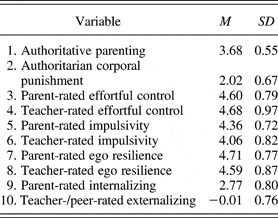
The means and standard deviations for the key variables are presented in Table 1. Based on the criteria of Curran, West, and Finch (Reference Curran, West and Finch1996), none of the variables required transformations for skew or kurtosis.
Means and standard deviations of major variables

Note: N = 615–697.
Multivariate analyses of variance (MANOVAs) were computed to examine gender and urban/rural differences for the following sets of variables: (a) parents' reports of authoritative parenting and corporal punishment; (b) parents' reports of EC, impulsivity, ego resilience, and internalizing problems; (c) teachers' reports of EC, impulsivity, and ego resilience; and (d) the composite measure of externalizing problems. There was no gender difference for parenting. Although the multivariate F was not significant for the parent ratings of their children (p < .19), girls were rated higher than boys on EC, F (1, 595) = 3.94, p < .048. For teachers' ratings, boys were rated higher in impulsivity whereas girls were rated higher in EC, Fs (1, 622) = 17.83 and 18.96, ps < .001, multivariate, F (3, 620) = 8.23, p < .001. Boys also were rated higher on externalizing problems, F (1, 653) = 53.63, p < .001. Parents of children from rural schools, in comparison to urban schools, reported more authoritative parenting, F (1, 607) = 12.22, p < .001, multivariate, F (2, 606) = 6.25, p < .002. Children in rural schools were rated as more impulsive and resilient by their teachers than were children in urban schools, Fs (1, 622) = 17.07 and 4.00, ps < .001 and .046. There were no significant interactions of gender with urban/rural status.
Partial correlations (controlling for urban status) were used to examine the relation of age (in months) to all the other major variables. No significant relations were found. When urban/rural status was not controlled, only the index of externalizing problems was weakly, negatively related to age, r (613) = −.08, p < .045.
Relations among the constructs: Correlational analyses
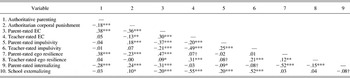
Parental authoritative parenting and corporal punishment were modestly negatively related (see Table 2). Moreover, teachers' and parents' reports of EC, impulsivity, or ego resilience were significantly, positively correlated across reporter. EC tended to be positively related to ego resilience (although primarily within reporter), and negatively related to impulsivity (within and across reporters), whereas the only significant relation between ego resilience and impulsivity was a positive correlation for teachers' reports (see Table 2). The findings were highly similar when urban/rural status was partialed in the correlations.
Correlations among major variables

Note: N = 587–697. EC, effortful control.
† p < .10. *p < .05. **p < .01. ***p < .001.
In regard to the correlations of parenting with the various child variables, authoritative parenting was positively related to EC and ego resilience and negatively related to internalizing; however, all significant correlations were within reporter. Parental corporal punishment was significantly negatively related to both teachers' and parents' reports of children's EC and parent-reported ego resilience, and positively related to parent-reported impulsivity and internalizing problems, as well as teacher/peer-rated externalizing problems (see Table 2). (Findings for the other authoritarian subscales tended to be in the same direction but lower than for corporal punishment.) Controlling for grade, gender, and urban/rural status simultaneously had virtually no effect on any of the correlations (i.e., their values and significance levels changed little or none). Moreover, none of the correlations discussed above differed significantly across boys and girls.
Structural equation models
We conducted structural equation modeling (SEM) analyses using Mplus (Muthén & Muthén, Reference Muthén and Muthén2001). Because students were sampled from intact classes, we conducted these analyses by treating class as a nesting factor and controlling class variations. However, we found that there was relatively little class-level variance. The average intraclass correlation (i.e., proportion of variance that is between classes) was .088, with the highest being .20. The SEM results were similar whether grade was controlled or not. Because of the fact that there was some intraclass correlation, we present the two-level models. We used the full information maximum likelihood option to deal with missing data.
In the models, child impulsivity, ego resilience, and EC were measured by both teachers' reports and parents' ratings. Parents reported on internalizing problems, whereas the composite score of teacher- and peer-reported externalizing was used. In the externalizing model, unacceptable parameters were obtained if peer nominations of aggression and teachers' reports of externalizing were kept as separate indicators of externalizing; thus, these two moderately correlated indices were standardized and combined for analyses.
Two different models, the externalizing model and the internalizing model, were tested. As is common practice, error terms for observed variables obtained from the same individual were allowed to covary as needed. As has been found in other samples (Eisenberg et al., Reference Eisenberg, Spinrad, Fabes, Reiser, Cumberland and Shepard2004; Valiente et al., Reference Valiente, Eisenberg, Smith, Reiser, Fabes and Losoya2003), in a preliminary model, ego resilience was not a mediator of relations of other variables to externalizing. Ego resilience and externalizing problems were not expected to be related, but it seemed prudent to test this assumption because the sample was from a very different culture than the United States. The fit was poor when ego resilience was in the externalizing model; thus, it was dropped from the model.
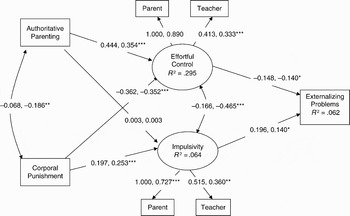
In the final externalizing model (see Figure 1), authoritative parenting and corporal punishment were allowed to correlate, and the error terms of EC and impulsivity were correlated (indicating that they are [negatively] related, as would be expected). In this model, we tested paths from authoritative parenting and corporal punishment to EC and impulsivity, and from EC and impulsivity to externalizing problems. The fit was good: χ2 (6) = 11.36, p = .079, standardized root mean square (SRMR) for between = 0.005, SRMR for within = 0.027, root mean square error of approximation (RMSEA) = .038, comparative fit index (CFI) = 0.993, and Tucker–Lewis fit index (TLI) = 0.974.
The externalizing model. Unstandardized betas are presented first, followed by standardized values. χ2 = 11.364 (6), p = .0778, SRMR for within = 0.005, SRMR for between = 0.027, RMSEA = 0.038, CFI = 0.993, TLI = 0.974. *p < .05. **p < .01. ***p < .001.

As shown in Figure 1, all indicators of constructs that did not have to be preset to 1.0 were significant. In addition, the direct path of authoritative parenting on EC was positive and significant, and the path to impulsivity was negative but not significant. Parental corporal punishment also was positively related to impulsivity and negatively related to EC. The path from impulsivity to externalizing was positive and significant, whereas the path from EC to externalizing was negative and significant. The correlational path between authoritative parenting and corporal punishment cannot be included in nested models of this sort in Mplus, so the values in Figure 1 are for the covariance and correlation (as presented in the Mplus output) for that correlational path. According to MacKinnon, Lockwood, Hoffman, West, and Sheets's (Reference MacKinnon, Lockwood, Hoffman, West and Sheets2002; MacKinnon, Fritz, Williams, & Lockwood, in press; MacKinnon, Lockwood, & Williams, Reference MacKinnon, Lockwood and Williams2004) test of mediation using bootstrapped confidence intervals, EC and impulsivity mediated the relation of corporal punishment to externalizing problems (ps < .05; confidence intervals [CIs] = 0.010 and 0.102 for EC and 0.006 and 0.083 for impulsivity). Thus, corporal punishment predicted lower EC and higher impulsivity, which in turn, predicted higher externalizing problems. In addition, EC mediated the relation of authoritative parenting to low externalizing problems (p < .05; CI = −0.125 to −0.013). In additional models we added direct paths from socialization to externalizing problems, but those paths were not significant.
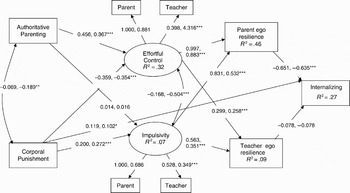
In the predicted internalizing model, the two types of parenting had paths to EC and impulsivity, which in turn, predicted ego resilience. Moreover, ego resilience had a path to internalizing problems. The model would not fit when teacher-reported ego resilience and parent-reported ego resilience were included in the same latent construct. Thus, they were treated as two different constructs. When this was done, the internalizing model had adequate fit with the data. Although the chi square was significant, χ2 (14) = 28.391, p = .0126, other goodness of fit of indices were adequate: SRMR for within = 0.029, SRMR for between = 0.003, RMSEA = .041, CFI = 0.987, and TLI = 0.96.
In addition to the aforementioned relation of corporal punishment to EC and/or impulsivity and from authoritative parenting to EC, EC and impulsivity positively (and uniquely) predicted teacher- and parent-reported ego resilience. Furthermore, parent-rated ego resilience had a significant, negative path to internalizing problems, whereas the path from teacher-rated ego resilience to internalizing problems was nonsignificant.
To determine if direct paths might exist between parenting and internalizing problems, as well as the hypothesized mediated relation (i.e., for conceptual reasons), we then tried adding direct paths from parenting to internalizing. The model fit did not change significantly when we added the path from authoritative parenting to internalizing problems, so this path was not added to the model (the path was nonsignificant). However, the model was improved when we added the path from corporal punishment to internalizing, χ2 (13) = 22.336, p = 0.0504, SRMR for within = 0.028, SRMR for between = 0.002, RMSEA = .034, CFI = 0.992, TLI = 0.976, Δχ2 (1) = 6.057, p < .05, and the added path was significant. Thus, we accepted this as our final model (see Figure 2). In addition to the aforementioned paths, the path from corporal punishment to internalizing problems was significant, whereas the path from teacher-rated ego resilience to internalizing problems was nonsignificant. According to tests of mediation, EC mediated the relation of authoritative parenting to teacher- and parent-reported ego resilience (ps < .01, CIs = 0.038–0.255 and 0.257–0.703, respectively) and from corporal punishment to teacher- and parent-reported ego resilience (ps < .01, CIs = −0.195 to −0.031 and −0.528 to −0.218, respectively). Moreover, parent-reported ego resilience (but not teacher-reported ego resilience) mediated the relations of EC to low levels of internalizing (p < .01, CIs = −1.012 to −0.334). Parent-reported ego resilience mediated the relation of impulsivity to low levels of internalizing problems (p < .01, CIs = −0.9566 to −0.2292).
The internalizing model. Unstandardized betas are presented first, followed by standardized values. χ2 (13) = 22.336, p = .0504, CFI = 0.992, TLI = 0.976. RMSEA = 0.034, SRMR for within = 0.028, SRMR for between = 0.002. *p < .05. **p < .01. ***p < .001.

Moderation by grade, gender, and rural/urban status
Tests of covariance matrices and multigroup models (both computed with Mplus) were used to test for moderation by gender, grade, or urban/rural status in both the internalizing and externalizing models.
Externalizing model
Gender was not a significant moderator. Although a chi-square test rejected the hypothesis of equal covariance matrix, χ2 (34) = 137.767, p = .001, the fit of the multigroup test for the constrained model in which path coefficients and factor loadings on constructs, as well as the correlation between authoritative parenting and corporal punishment, were constrained to be equal, χ2 (16) = 27.720, p = .034, did not differ significantly from the fit for the fully unconstrained model, χ2(25) = 36.49, p = .064; chi-square difference: Δχ2 (9) = 8.77, p > .10. The results of the test for equal covariances are not robust; this test is very sensitive to deviations from normality (and the externalizing measure was skewed). Thus, the test of equal covariances can be significant when the test of moderation in the multigroup model is not.
Covariance matrices were statistically different across grades, χ2 (34) = 63.753, p = .002, and between urban and rural regions, χ2 (34) = 74.942, p < .04. However, multigroup analyses showed that the parameter estimates were not significantly different across these two sets of groups: for grade, constrained model, χ2 (25) = 30.60, p = .203, unconstrained model, χ2 (16) = 22.77, p = .120, and Δχ2 (9) = 7.83, p > .10; for urban/rural, constrained model χ2 (25) = 37.142, p = .082, unconstrained model, χ2 (16) = 27.166, p = .040, and Δχ2 (9) = 9.976, p > .10. Thus, the paths in the models did not vary significantly for boys and girls, for first or second graders, or for urban versus rural children.
Internalizing model
The covariance matrix was not statistically different across gender, χ2 (51) = 55.130, p = .321; nor did the constrained and unconstrained models differ, χ2 (44) = 59.664, p = .0577 for the constrained model, χ2 (30) = 40.748, p = .091, Δχ2 (14) = 18.916, p > .10. The covariance matrices were statistically different across grades and between urban and rural regions, χ2 (51) = 137.186 and 134.646, ps < .001. However, multigroup analyses (with the same kinds of constraints as in the externalizing model) showed that the parameter estimates were not significantly different across these two sets of groups: for grade, constrained model, χ2 (44) = 59.902, p = .055, unconstrained model, χ2 (30) = 40.333, p = .099, and Δχ2 (14) = 19.569, p > .10; for urban/rural, constrained model χ2 (44) = 52.229, p = .062, unconstrained model, χ2 (30) = 41.526, p = .078, and Δχ2 (14) = 17.703, p > .10. Thus, the paths in the models did not vary significantly for boys and girls, for first or second graders, or for urban versus rural children.
Discussion
Consistent with the findings of Zhou et al. (Reference Zhou, Eisenberg, Wang and Reiser2004) for EC, we found that Chinese parents' reported authoritative parenting style was positively related to children's EC, whereas their use of corporal punishment was negatively related to EC. In addition, we found that children's impulsivity was predicted by high corporal punishment. Using SEM, we also found a pattern of paths consistent with the view that EC mediates the relations of parenting style to children's externalizing problem behaviors or, in the internalizing model, ego resilience. Furthermore, as has been found in the United States (e.g., Eisenberg et al., Reference Eisenberg, Spinrad, Fabes, Reiser, Cumberland and Shepard2004), children's parent-reported ego resilience appeared to mediate relations of high EC and high impulsivity to low levels of internalizing problems. In the internalizing model, there also was a direct path from corporal punishment to children's internalizing problems, in addition to the mediated path. Thus, the data are consistent with the view that parenting may have effects on children's ego resilience and maladjustment at least partly through its effects on children's self-regulatory/control-related capacities.
Thus, as has been found in a growing number of studies and countries, EC and high impulsivity were negatively related to children's externalizing problems. Moreover, as was found by Zhou et al. (Reference Zhou, Eisenberg, Wang and Reiser2004) with a Chinese sample of approximately the same age, EC was directly (in the correlation with mother-reported EC) and indirectly (in the model) negatively related to children's internalizing problems. This finding for internalizing problems is similar to that found in the United States with young school-aged children (Eisenberg, Cumberland, et al., Reference Eisenberg, Cumberland, Spinrad, Fabes, Shepard and Reiser2001). However, such a relation was not found for children in mid- to late elementary school in the United States (Eisenberg, Sadovsky, et al., Reference Eisenberg, Sadovsky, Spinrad, Fabes, Losoya and Valiente2005); it will be important to determine if the relation is maintained with age in China.
The aforementioned findings are also consistent with a growing body of work demonstrating similarities across cultures in the relations of authoritative and the punitive or negative aspects of authoritarian parenting to children's regulation or maladjustment (e.g., Eisenberg, Liew, & Pidada, Reference Eisenberg, Liew and Pidada2001; Rudy & Grusec, Reference Rudy and Grusec2006; Sorkhabi, Reference Sorkhabi2005; Zhou et al., Reference Zhou, Eisenberg, Wang and Reiser2004). As many cultures groups become more Westernized in their values and goals, parents' styles of parenting and the correlates of parenting style may change (see Chen et al., Reference Chen, Cen, Li and He2005). As already noted, Grusec and colleagues (Bugental & Grusec, Reference Bugental, Grusec, Eisenberg, Damon and Lerner2006; Rudy & Grusec, Reference Rudy and Grusec2006) argued that it is the control component of authoritarian parenting rather than punitive/negative evaluative components that relates differently in different cultures. However, the relations of physical punishment to aggression have been found to vary across subcultures in the United States (e.g., Deater-Decker et al., 1996), and it is the latter aspect of authoritarian parenting that we included in our model. Although the authoritarian directiveness subscale was not used in our primary analyses and was not very reliable, it is worth noting that this scale was significantly negatively related to parents' reports of children's EC and ego resilience, and was positively related to parents' reports of impulsivity and internalizing problems (rs ranged from an absolute value of .14 to .20). This pattern of correlations does not support the argument that directiveness is linked to positive outcomes in young Chinese school children. However, this subscale includes two items (out of four) that have the wording, “I scold and criticize my child …” Thus, in future work it would be worthwhile assessing the tone of items tapping parental control and if items assessing behavioral control without negativity relate differently to maladjustment across cultures.
It is worth noting that the direct relation of authoritative parenting to teacher- and peer-reported externalizing behavior was weak (judging from both the correlations and the lack of a need for a direct path from authoritative parenting to externalizing) and that authoritative parenting was related to low externalizing problems only indirectly, through EC. In Western cultures, there tend to be direct inverse relations between authoritative parenting and maladjustment (see Bugental & Grusec, Reference Bugental, Grusec, Eisenberg, Damon and Lerner2006; Dodge, Coie, & Lynam, Reference Dodge, Coie, Lynam, Eisenberg, Damon and Lerner2006). It may be that authoritative parenting in the United States, in comparison to China, affects externalizing problems through more processes and paths, such as through children's attention to and motivation to internalize parents' values. This difference may be due to North American parents and children viewing authoritative parenting as more normative more than parents in collectivistic societies (recall that the association between physical punishment and adjustment problems varied to the degree that the former was perceived as normative; Lansford et al., Reference Lansford, Chang, Dodge, Malone, Oburu and Palmérus2005). In future research it would be productive to analyze the mechanisms that account for the relations of authoritative parenting to low levels of externalizing problems in diverse cultures.
Authoritative parenting was not related to children's impulsivity. Perhaps impulsivity, because of its reactive nature, is more difficult to modify than is EC. Nonetheless, punitive parenting was related to higher impulsivity, perhaps because of its dysregulating effects (and perhaps through undermining EC). To our knowledge, this relation has not been examined in a western society.
The pattern of findings supports Eisenberg et al's (Reference Eisenberg, Cumberland and Spinrad1998) heuristic model in which they argued that parental support and positive affective versus parental negativity affect children's self-regulation, which in turn, affects their adjustment. Parents who use corporal punishment are likely to undermine children's perceptions of their parents as fair and concerned about them; consequently, their children are relatively unlikely to want to attend to and internalize their parents' demands for self-regulated behavior (Grusec & Goodnow, Reference Grusec and Goodnow1994; Hoffman, Reference Hoffman2000). They also may model externalizing problems. Conversely, because parents who use authoritative practices are likely to be viewed as caring, their children are likely to internalize their demands for self-regulation (Dix, Reference Dix1991; Hoffman, Reference Hoffman2000; Parpal & Maccoby, Reference Parpal and Maccoby1985). In addition, supportive parents may help their children to manage their distress and to cope constructively in stressful situations (Eisenberg et al., Reference Eisenberg, Cumberland and Spinrad1998; Power, Reference Power2004; Skinner & Wellborn, Reference Skinner, Wellborn, Lerner, Featherman and Perlmuter1994), which might foster the development of social skills (Dusek & Danko, Reference Dusek and Danko1994; Hardy et al., Reference Hardy, Power and Jaedicke1993).
Of course, with concurrent, correlational data, we cannot prove causal relations. The relations between parenting and children's EC, ego resilience, and maladjustment may be because of passive genetic influences (e.g., shared genes between the parent and child), bidirectional influences between dispositional self-regulation (or ego resilience or maladjustment) and parenting (Rothbart & Posner, Reference Rothbart, Posner, Cicchetti and Cohen2006), or a genotype–environment correlation or interaction (e.g., O'Connor, Deater-Deckard, Fulker, Rutter, & Plomin, Reference O'Connor, Deater-Deckard, Fulker, Rutter and Plomin1998). In addition, it is likely that children's characteristics affect parenting across time (an issue we could not examine with concurrent data). Nonetheless, our data are consistent with findings in Western cultures that implicate the quality of parenting in the development of regulation and maladjustment. Given the debate about the role of authoritative and punitive parenting to maladjustment in non-Western societies, it is useful to note the similarities across cultures in the pattern of relations. However, it is also important to acknowledge that there are other aspects of parenting that are more evident in Chinese than North American culture (e.g., shaming/love withdrawal, encouragement of modesty, protection; Lieber, Fung, & Leung, Reference Lieber, Fung and Leung2006; Wu et al., Reference Wu, Robinson, Yang, Hart, Olsen and Porter2002) that may contribute in important ways to children's regulation, resiliency, and maladjustment (and may do so differentially in urban and rural samples). Although our measures appeared relevant for the Chinese samples in this study, they may not have tapped important dimensions of parenting in China that are unique to that culture or to non-Western cultures more generally.
To our knowledge, this is the first time that anyone has demonstrated in a non-Western sample that EC and reactive control, although negatively related, uniquely predict children's externalizing problems and ego resilience. Such a finding supports the argument that EC and reactive control are different, albeit related, constructs, both of which are relevant to the prediction of maladjustment. This finding is notable given the stronger association between surgency (including impulsivity) and EC in Chinese children (Ahadi et al., Reference Ahadi, Rothbart and Ye1993). Children may exhibit externalizing problems because of high impulsivity, low EC, or the combination of risk factors. Of course, the relation between parental style and children's maladjustment likely is also mediated by other processes, such as children's dispositional optimism (Jackson, Pratt, Hunsberger, & Pancer, Reference Jackson, Pratt, Hunsberger and Pancer2005). In a recent study of a different sample of Chinese children, Zhou et al. (2006) found that children's coping efficacy mediated between Chinese parents' parenting style and their children's problems with adjustment.
Moreover, as has been found in the United States in one study with young school children (Eisenberg et al., Reference Eisenberg, Spinrad, Fabes, Reiser, Cumberland and Shepard2004), the relations of low EC and low impulsivity to high internalizing problems appeared to be mediated by children's ego resilience. This pattern of findings suggests that temperamental EC and impulsivity affect children's abilities to cope in everyday contexts, which contributes to emotional vulnerabilities such as anxiety, depression, and social withdrawal. As has been found for young children in the United States, the relation of impulsivity to ego resilience was positive, suggesting that some surgency and/or the lack of rigidity in behavior is associated with ego resilience. This positive association between impulsivity and ego resilience may have occurred because people in China seem to be more positive than in the past about assertive, uninhibited behavior (Chen et al., Reference Chen, Cen, Li and He2005).
The association between impulsivity and ego resilience in the SEM was consistent with the correlations for teacher-reported ego resilience but appeared to be a suppression effect for parent-reported ego resilience. It could be that once individual differences in low parent-reported EC that are associated ego resilience are taken into account, the component of impulsivity that does not reflect low EC (recall the two constructs are correlated), perhaps the capacity to approach new or stressful situations, is related to individual differences in ego resilience. In the United States, the positive linear relation of impulsivity with ego resilience declines with age and is only evident when controlling for EC in early adolescence (Eisenberg, Valiente, et al., Reference Eisenberg, Valiente, Fabes, Smith, Reiser and Shepard2003); it will be useful to determine in the future if a similar developmental trend occurs in non-Western samples.
Teacher-reported ego resilience, unlike parent-reported ego resilience, was not related to internalizing problems in the model, and was only weakly negatively related in the model. Although we can only speculate, it is possible that parents were better judges of children's ego resilience than were teachers, perhaps because teachers were more concerned with controlled behavior than with the capacity to bounce back from stress or negative emotions.
As in the United States, parents and teachers' reports of EC, impulsivity, and even ego resilience (which tends to be less consistently related in the United States; Eisenberg et al., Reference Eisenberg, Spinrad, Fabes, Reiser, Cumberland and Shepard2004) tended to be positively related. These correlations provide additional support for the validity of adults' reports of children's temperament and personality ego resilience in a non-Western sample.
Conclusion
In summary, overall the findings are consistent with the conclusion that the relations of parenting style to children's maladjustment, and the roles of EC and ego resilience in mediating these relations, are similar in the United States and in China (at least, the part of China near Beijing). It should be noted, however, that some aspects of authoritarian parenting were at best weakly related to the other variables in our study, suggesting that authoritarian parenting may be constituted differently in China and/or that aspects of it may relate differently to developmental outcomes in China (in comparison to Western cultures). Strengths of the study include the large sample of non-Western children, the use of multiple reporters, and the use of SEM to examine patterns of mediation. However, despite the strengths of SEM analyses, it must be reiterated that the data for the present study were concurrent and correlational so firm causal conclusions are not warranted. Causal conclusions, including those pertaining to mediating processes, can be drawn with greater confidence if the concurrent model is replicated using longitudinal data to test temporal relations (Cole & Maxwell, Reference Cole and Maxwell2003). It is likely that across time, children's EC also affects mothers' parental style to some degree (Eisenberg et al., Reference Eisenberg, Fabes, Shepard, Guthrie, Murphy and Reiser1999). Further, it cannot be assumed without further research that the findings obtained in this study generalize to fathers or to Chinese parents and children living in more isolated (and, hence, less Westernized) sections of China. In addition, in future work it would be desirable to obtain reports of internalizing problems from multiple informants and to include some behavioral indices of impulsivity and EC.