Soil-applied herbicides are an integral component of effective and successful weed control programs for many crops. These herbicides provide an effective strategy to establish the critical weed-free period that is important to achieve optimum yields (Tursun et al. Reference Tursun, Dalta, Sakinmaz, Kantarci, Knezevic and Chauhan2016). Herbicides generally have a limited number of weed species that they effectively control, so in order to control a broader range of weeds at planting, herbicides with more than one active ingredient are often applied PRE. Use of multiple herbicides often controls a more diverse weed population while helping to reduce selection pressure for herbicide resistance (Green and Owen Reference Green and Owen2011; Walsh et al. Reference Walsh, Soltani, Shropshire and Sikkema2015; Younesabadi et al. Reference Younesabadi, Das and Pandey2013). For example, a 2014 National Agricultural Statistics Service (NASS) survey identified 57 active ingredients used on 97% of planted corn acres (USDA 2014). Of those active ingredients, 43 have reported soil activity.
Crop safety is an important consideration in decisions about which herbicide(s) to use. Corn crop injury from PRE application of herbicides containing acetolactate synthase (ALS) inhibitors and p-hydroxyphenylpyruvate dioxygenase (HPPD) inhibitors registered for in corn has been documented (Janek and Grichar Reference Janek and Grichar2016; Ritter and Menbere Reference Ritter and Menbere2001). In addition, while it is routine for weed control trials to report crop injury, most are not designed to evaluate the impact of herbicide injury on crop yield. Incomplete weed control can confound yield data when herbicide injury is observed. However, most of the studies comparing soil-applied HPPD- and ALS-inhibiting herbicides have not evaluated crop safety and have been conducted on medium- to fine-textured soils. In general, soil-applied herbicides are less likely to adsorb to coarse-textured soils, and are thus more available for plant uptake. As a result, these herbicides have the potential to cause more injury (Wicks et al. Reference Wicks, Knezevic, Bernards, Wilson, Klein and Martin2007), and recommended application rates of soil-applied herbicides are often lower for coarse-textured soils than they are for fine textured soils.
Interactions exist between corn hybrids and certain herbicides for crop safety, and these interactions have been documented with ALS-inhibiting herbicides(Bunting et al. Reference Bunting, Sprague and Riechers2004; Green and Ulrich Reference Green and Ulrich1993, Reference Green and Ulrich1994). Hybrid sensitivities are sometimes listed in technical bulletins produced by seed companies, providing growers with additional guidance on herbicide selection. Herbicide safeners, chemicals applied in conjunction with herbicides that reduce herbicide toxicity to crops (Hatzios and Hoagland Reference Hatzios and Hoagland1989), have also been developed to confer tolerance to both ALS- and HPPD-inhibiting herbicides. The benefits of safeners on grass crops have been documented for acetyl-coA carboxylase inhibitors, ALS inhibitors (Hatzios Reference Hatzios1997; Lamoureux and Rusness Reference Lamoureux and Rusness1992), mitosis inhibitors (Fuerst and Gronwald Reference Fuerst and Gronwald1986), and HPPD inhibitors (Sprague et al. 1999). Isoxadifen-ethyl is a safener that has been used commercially to improve corn tolerance to both ALS- and HPPD-inhibiting herbicides (Bunting et al. Reference Bunting, Sprague and Riechers2004; Williams and Pataky Reference Williams and Pataky2010). More recently, cyprosulfamide has been formulated with isoxaflutole for improved corn safety (Anonymous 2011, 2015).
Low temperatures can also affect growth by slowing down metabolism and potentially limiting recovery (Martini et al. Reference Martini, Burgos, Noldin, de Avila and Salas2014; Viger et al. Reference Viger, Eberlein, Fuerst and Gronwald1991). Corn grows best when temperatures range between 10 and 30 C (Curran and Lingenfelter Reference Curran and Lingenfelter2015). Crops’ growth and productivity may be limited when they are exposed to temperatures outside of their optimal range (Rodriguez et al. Reference Rodriguez, Soengas, Alonso-Villaverde, Sotelo, Cartea and Velasco2015), but under optimal growth conditions, symptoms of herbicide injury can be masked (Thelen and Penner Reference Thelen and Penner2007).
There has been interest in expanding the use of premixes containing ALS- and HPPD-inhibiting herbicides for use in coastal plain soils. However, there is limited research to quantify corn injury and yield response to these herbicides when used on coarse-textured soils. The objectives of this study were to determine the relative safety of soil-applied herbicides containing ALS- and HPPD-inhibiting herbicides and to document the impact of herbicide injury on corn yield.
Materials and Methods
Trials were conducted in 2013 and 2014 at the University of Delaware Carvel Research and Education Center in Georgetown, Delaware (38.64°N, 75.46°W). The soil was a Rosedale loamy sand (loamy, siliceous, mesic, Arenic Hapludults), 81% sand, 12% silt, and 7% clay, with pH of 6.0 and 6.3 and organic matter of 1.1% and 1.3% in 2013 and 2014, respectively. Rainfall was supplemented with overhead irrigation. The experimental plots were conventionally tilled with chisel plowing, disking, and field cultivation in the spring. Starter fertilizer (20-10-0-1 N-P-K-S) applied at 50.3 Lha−1 was used and tefluthrin ((2,3,5,6-tetrafluoro-4-methylphenyl)methyl (1R,3R)-3-[(Z)-2-chloro-3,3,3-trifluoroprop-1-enyl]-2,2-dimethylcyclopropane-1-carboxylate) at 0.18 kgha−1 was applied in-furrow for insect control. Supplemental nitrogen of was applied in a side-dress application at 195 to 220 kg ha−1.
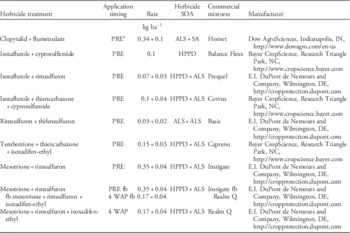
The study was a strip-plot design with ALS- and HPPD-inhibiting herbicides as the whole plots and three corn hybrids as subplots. Whole plots were 7.6 m long and 3 m wide with four rows 76 cm apart. Herbicide treatments, which were applied at twice the labeled rate for the soil type, are presented in Table 1. These high rates were used in order to better separate the effects of herbicide injury. All PRE herbicide applications were made within 24 hours of planting, and irrigation or rainfall was used to incorporate the treatments prior to crop emergence. In addition, a nontreated check was included. Three corn hybrids were used to evaluate consistency of response with differing levels of herbicide tolerance. The hybrids were selected based on their response to ALS- and HPPD-inhibiting herbicides. Hubner (Hubner Seed, Monticello, IA) hybrids ‘H4744’, ‘H5555’, and ‘H6179’ were used both years. In addition, hybrid ‘H6652’ was used in 2013 and ‘H4610’ was used in 2014; but these hybrids were not used in the data analysis. Hubner’s product literature states that H4744 may be treated with synthetic auxins (SA), but caution should be used when applying ALS- or HPPD-inhibiting herbicides (Anonymous 2014a); that H5555 may be treated with HPPD-inhibiting herbicides, but caution should be used when applying ALS-inhibiting and SA herbicides (Anonymous 2014b); and that H6179 may be treated with all three herbicide sites of action (Anonymous 2014c).
Herbicide treatments and rates applied as commercial formulations used in a field study with coarse-textured soils in Delaware in 2013 and 2014.

a Abbreviations: ALS, acetolactate synthase inhibitor; fb, followed by; HPPD, p-hydroxyphenylpyruvate dioxygenase inhibitor; PRE, preemergence; SA, synthetic auxin; SOA, site of action; WAP, weeks after planting.
Corn was planted on May 6, 2013 and April 23, 2014 at a seeding rate of 69,000 seeds ha−1. Each hybrid was placed in an individual hopper in a four-row planter. To eliminate weed competition, all plots were kept weed-free by applying atrazine plus S-metolachlor PRE at 1.56+1.2 kgha−1 (Bicep® II Magnum, Syngenta Crop Protection, Greensboro, NC) and by applying glyphosate (Roundup® PowerMAX, Monsanto Company, St. Louis, MO) at 0.84 kg ae ha−1 and ammonium sulfate at 1.9 kg ha−1 five weeks after planting (WAP). Plots were 3 m wide by 7.6 m long with 76-cm row spacing. Herbicides were applied using a tractor-mounted sprayer with a spray volume of 187 Lha−1 at 4.8 kpa, and 11002 Greenleaf Airmix spray nozzles (Greenleaf Technologies, Covington, LA) with a pressure of 276 kPa.
Visual evaluations of chlorosis and percent stunting were made 3, 4, 6, and 9 WAP on a 0 to 100 scale, with 0 meaning no visible response and 100 meaning plant death. Stand counts were made 6 WAP and at harvest by counting the number of plants per hybrid for the length of the plot. Corn was harvested at physiological maturity with each row harvested separately, one row for each hybrid, and yields were adjusted to 15.5% moisture content. Crop yield was converted to percent of the nontreated check for each hybrid for each year.
Area under the cumulative injury curve (AUCIC) is one method of including multiple rating dates into one value, and it provides data on how quickly plants recover from initial injury. The AUCIC formula is
 $${\rm AUCIC}\,{\equals}\,\mathop{\sum}\limits_{i\,{\equals}\,1}^{N_{i} {\minus}1} {{{\left( {y_{i} {\plus}y_{i} {\plus}1} \right)} \over 2}\left( {t_{{i{\plus}1}} {\minus}t_{i} } \right)} $$
where y i is the average rating for the plot at the i th rating date, t i is the number of days from herbicide application to i th rating date, and N is the number of times the plots were rated. This calculation is commonly used in plant epidemiology research (Shaner and Finney Reference Shaner and Finney1977; Tooley and Grau Reference Tooley and Grau1984). AUCIC as used in this trial evaluated stunting at regular intervals and incorporated time of stunting appearance, severity of stunting, and speed of recovery. Treatments that have lower values indicate lower initial corn stunting and/or a quicker recovery rate.
All treatments were replicated three times. Data were checked for normality and appropriate transformations were used if needed. However, transformation did not affect data analysis, so nontransformed data were used. Statistical analyses were conducted with PROC GLIMMIX in SAS version 9.4 (Cary, NC), using strip-plot analysis, with year, herbicide, and hybrid as fixed effects and replications as random effects. Fixed effects and interactions were tested using Tukey’s honest significant difference test at P=0.05. PROC CORR was used to calculate the correlation coefficient between crop injury and yield. Cumulative stunting and percent stunting at 3 and 9 WAP were tested for each hybrid for correlation with corn yield.
Results and Discussion
Year by treatment interaction was significant; therefore, data were analyzed and presented separately for each year. Although initial and final stand counts were recorded, there were no differences among herbicide treatments or hybrids (data not shown). Stunting data from 3 and 9 WAP is reported because this data best described corn response in the field. The rating at 3 WAP is similar to that reported by Eberlein et al. (Reference Eberlein, Rosow, Geadelmann and Openshaw1989), who found that visual estimates of injury at 2 and 4 wk after treatment best described impact on yield from POST treatments among inbred lines. Ratings at 9 WAP indicate length of time that symptoms can be observed.
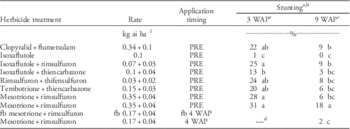
In 2013, there was no observable chlorosis at any rating date. The main effects of herbicide and hybrid were significant at 3 and 9 WAP for corn stunting, but there were no significant herbicide by hybrid interactions. At 3 WAP, isoxaflutole alone had the least amount of stunting (1%), isoxaflutole plus thiencarbazone had 13%, while all other treatments were stunted by at least 20% (Table 2). By 9 WAP stunting values were lower, with <10% stunting for all treatments except the sequential treatment of mesosulfuron plus rimsulfuron, which exhibited 18% stunting. Averaging ratings over herbicide treatments at 3 WAP, H5555 and H6179 exhibited significantly higher stunting (22%) than did H4744 (13%) (data not shown). At 9 WAP, H4744 exhibited significantly higher stunting (9%) than did H5555 (6%) and H6179 (5%) (data not shown).
Effect of herbicide treatments on corn stunting 3 and 9 weeks after planting in 2013 at Georgetown, DE.

a Values followed by the same letter are not significantly different based on Tukey’s honest significant difference test at α=0.05.
b Data averaged over hybrid sensitivity 3 WAP and 9 WAP.
c Abbreviations: fb, followed by; PRE, preemergence; WAP, weeks after planting.
d 4 WAP treatments had not been applied at time of rating.
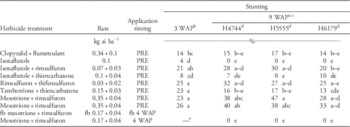
In 2014, chlorosis was observed at 2 WAP. There was less than 10% chlorosis observed with all treatments containing rimsulfuron or thiencarbazone (data not shown). However, there was no observable chlorosis for the remainder of the study. There was a no significant herbicide by hybrid interaction for corn stunting at 3 WAP, but the main effects of herbicide and hybrid were significant. Isoxaflutole alone and isoxaflutole plus thiencarbazone had the least amount of stunting, 4% to 8%, while all other treatments exhibited 14% to 26% stunting (Table 3). There was a significant herbicide by hybrid interaction 9 WAP. Stunting from rimsulfuron-containing herbicides was still observable at 9 WAP. No stunting was observed for any hybrid with isoxaflutole or mesotrione plus rimsulfuron applied POST, and isoxaflutole plus thiencarbazone showed no stunting when applied to H5555 at 9 WAP. Averaging stunting over herbicide treatments at 3 WAP, H5555 exhibited significantly higher stunting (20%) compared to H4744 (16%) and H6179 (17%).
Effect of herbicide treatments on corn stunting 3 and 9 WAP in 2014 at Georgetown, DE.

a Abbreviations: fb, followed by; PRE, preemergence; WAP, weeks after planting.
b Data are averaged over hybrids at 3 WAP. Values followed by the same letter are not significantly different based on Tukey’s honest significant difference test at α=0.05.
c Due to herbicide by hybrid interactions 9 WAP, values followed by the same letter are not significantly different based on Tukey’s honest significant difference test at α=0.05.
d See “Materials and Methods” for a description of sensitive and tolerant hybrids.
e 4 WAP treatments had not been applied at time of rating.
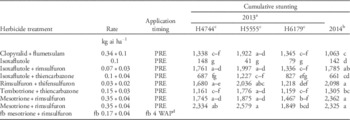
Calculating the area under the curve to obtain a cumulative stunting value can provide data on the severity of corn stunting, as well as corn recovery rate. Cumulative stunting values incorporate data collected from 3 to 9 WAP. The main effects of herbicide and hybrid were significant both years, with a significant herbicide by hybrid interaction in 2013. In 2013, the lowest cumulative stunting values were recorded with isoxaflutole alone, regardless of hybrid, and isoxaflutole plus thiencarbazone applied to H4744 or H6179 (Table 4). Overall, higher values for cumulative stunting were seen with rimsulfuron-containing herbicides. In 2014, treatments with isoxaflutole alone or with thiencarbazone had the lowest cumulative stunting values, and rimsulfuron-containing herbicides had the highest cumulative stunting values, ranging from 1,785 to 2,362 (Table 4). Averaged across herbicides, cumulative stunting for H5555 (1,654) was significantly higher than both H4744 (1,399) and H6179 (1,351) (data not shown).
Effect of herbicide treatments on cumulative stunting in 2013 and 2014 at Georgetown, DE. Cumulative stunting of corn based on area under the curve. Cumulative corn stunting is based on weekly ratings of corn and calculating area under the curve.

a Due to herbicide by hybrid interactions in 2013, values followed by the same letter are not significantly different according to Tukey’s honest significant difference test at α=0.05.
b Data are averaged over hybrid sensitivity in 2014. Values followed by the same letter are not significantly different according to Tukey’s honest significant difference test at α=0.05.
c See “Materials and Methods” for a description of sensitive and tolerant hybrids.
d Abbreviations: fb, followed by; PRE, preemergence; WAP, weeks after planting.
There was no difference in cumulative stunting levels for mesotrione plus rimsulfuron PRE compared to sequential applications of mesotrione plus rimsulfuron in either year. Thus, corn is at greater risk of stunting if mesotrione plus rimsulfuron is applied PRE than it is if the herbicides are applied POST. This study utilized commercially formulated prepackaged herbicides and the use of herbicide safeners was not consistent (Table 1). For instance, mesotrione plus rimsulfuron as a PRE product did not include a safener, while the POST product was formulated with a safener. This study was not designed to address the effect of safeners; rather, it was designed to evaluate formulated herbicide mixtures.
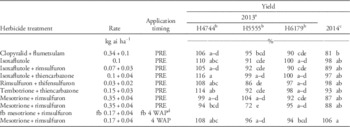
Yield was calculated as a percentage of the nontreated check for each hybrid to account for differences of inherent yield potential of each hybrid and to allow for multi-factor analysis. The main effects of herbicide and hybrid were significant both years, but the interaction was only significant in 2013. There were few treatment differences among hybrids in 2013 (Table 5). Herbicide treatments tended to have little impact on yield for H4744. For H5555, yields were significantly lower for sequential applications of isoxaflutole alone, isoxaflutole plus rimsulfuron, sequential mesotrione plus rimsulfuron, rimsulfuron plus thifensulfuron, and tembotrione plus thiencarbazone. Lower yield for isoxaflutole alone and higher yield for mesotrione plus rimsulfuron PRE in hybrid H5555 were not as expected due to low and high cumulative stunting values, respectively, and cannot be explained by stunting data or similar treatments. Yields for H6179 were reduced when treated with clopyralid plus flumetsulam, isoxaflutole plus rimsulfuron, and mesotrione plus rimsulfuron PRE. In 2014, treatments containing mesotrione plus rimsulfuron applied POST had the highest yields, but were only significant compared to treatments containing clopyralid plus flumetsulam (Table 5). Averaged over all herbicide treatments, yields for H4744 (98%) and H169 (95%) were similar, and were significantly higher than were yields for H6179 (92%).
Corn yields in 2013 and 2014 at Georgetown, DE. Data were calculated as percent of the nontreated check for each hybrid.

a Due to herbicide by hybrid interactions in 2013, values followed by the same letter are not significantly different according to Tukey’s honest significant difference test at α=0.05.
b See “Materials and Methods” for a description of sensitive and tolerant hybrids.
c Data are averaged over hybrid in 2014. Values followed by the same letter are not significantly different according to Tukey’s honest significant difference test at α=0.05.
d Abbreviations: fb, followed by; PRE, preemergence; WAP, weeks after planting
Stunting was a poor predictor of yield. In 2013, only H6179 had a significant correlation for ratings 3 WAP, with a correlation coefficient of −0.58. The correlations between stunting and yield for the other hybrids at 3 WAP, and all hybrids at 9 WAP, were not significant. In 2014, stunting at 9 WAP and yield had a correlation coefficient of −0.42 for H6179, but correlations were not significant for the other hybrids at 9 WAP, nor were they for any hybrids at 3 WAP. Correlations with cumulative stunting and yield had a correlation coefficient of −0.43 for H5555 in 2013, but the correlation was not significant for the other two hybrids, nor for any hybrid in 2014. VanGessel et al. (Reference VanGessel, Johnson and Scott2016) showed similar results with low correlations between cumulative corn injury from POST herbicides and yield, and Wicks et al. (Reference Wicks, Knezevic, Bernards, Wilson, Klein and Martin2007) reported that high injury ratings from isoxaflutole did not affect yield.
Three hybrids were included in this trial to determine consistency of results across various genetic lines. The hybrids did not respond the same to herbicide treatments as demonstrated with herbicide by hybrid interactions. However, the observed stunting was not consistent with technical bulletins which list both H4744 and H5555 as sensitive to ALS-inhibiting herbicides, and H6179 as tolerant (Anonymous 2014a, 2014b, 2014c). For example, in 2013, H4744 exhibited greater stunting than did H5555. Genetic differences may explain some of the inconsistent responses reported by farmers and agronomists when corn is treated with ALS-inhibiting herbicides. Here we tested a small sample of hybrids sensitive to these herbicides; previous research has shown a very wide range of corn response to ALS-inhibiting herbicides (Bunting Reference Bunting, Sprague and Riechers2004; Green and Ulrich Reference Green and Ulrich1993, Reference Green and Ulrich1994).
Based on a limited range of hybrids, herbicide selection and application timing played a larger role than did hybrid sensitivity for injury and yield. Regardless of hybrid, higher levels of injury occurred with rimsulfuron-containing treatments applied PRE. Corn injury from rimsulfuron-containing herbicides has been well documented (Ritter and Menbere Reference Ritter and Menbere2001; Isaacs et al. Reference Isaacs, Wilson and Toler2002).
More stunting was observed in 2014 than was in 2013. Soil type and the amount of rainfall after herbicide application can also affect injury. However, soil type was consistent across years and rainfall was similar at 4 WAP both years (data not shown). It appears that environmental conditions, such as temperature, may explain differences in corn stunting and recovery between years. Thelen and Penner (Reference Thelen and Penner2007) reported that corn grown under ideal growing conditions can mask symptoms of herbicide injury. Cold stress has been shown to influence how well plants metabolize certain herbicides. Viger et al. (Reference Viger, Eberlein, Fuerst and Gronwald1991) reported decreased corn tolerance to metolachlor at lower temperatures, resulting in slower growth, and Martini et al. (Reference Martini, Burgos, Noldin, de Avila and Salas2014) found that bispyribac-sodium injury on rice plants was enhanced by exposure to cold temperatures. A difference in growing degree days (GDD, base 10 C), or heat units needed for growth, in 2013 and 2014 helps to explain observations in stunting. The severity of stunting at 9 WAP and cumulative stunting was much greater in 2014 than it was in 2013 (Tables 2–4). In 2013, 516 GDD had accumulated by 4 WAP in 2013, while only 342 GDD had accumulated at that same timing in 2014 (data not shown). By 9 WAP 1,410 GDD had accumulated in 2013 and 1,094 had accumulated in 2014.
In this trial, PRE treatments containing rimsulfuron were at greater risk of causing corn stunting; however, little to no injury occurred with mesotrione plus rimsulfuron applied POST. Previous studies have shown corn to be less tolerant of rimsulfuron than it is of nicosulfuron (Doohan et al. Reference Doohan, Ivany, White and Thomas1998; VanGessel et al. Reference VanGessel, Johnson and Scott2016). It appears that under less than ideal growing conditions, ALS-inhibiting herbicides result in more injury than does isoxaflutole. Among ALS inhibitors, rimsulfuron has a higher risk for injury than does thiencarbazone. Conversely, it appears that rimsulfuron is safer when applied POST than it is when applied PRE. Despite the lack of correlation with initial corn injury and yield, growers should be aware of the impact environmental conditions and soil texture may have on corn recovery from herbicide injury.