Introduction
Functional endoscopic sinus surgery (FESS) is considered in patients with chronic rhinosinusitis (with or without polyps) that is refractory to medical therapy. Hospital Episode Statistics data for 2018–2019 reported around 35 000 sinus operations performed in the UK. Functional endoscopic sinus surgery is generally performed as a day-case procedure. Day-case FESS is cost-effective and provides enhanced capacity when compared to in-patient surgery. In addition, it is associated with high patient satisfaction.Reference Oker, Dupuch, Herman, Leclerc, Vironneau and Dang1
Previously, it was thought that many patients required an overnight stay after sinus surgery, but this stance has gradually changed. There has been a significant change in the provision and improvement of day-case sinonasal surgery over the past 20 years.Reference Hopkins, Browne, Slack and Brown2,Reference Bajaj, Sethi, Carr and Knight3
This study aimed to determine the same-day discharge rate and identify factors that resulted in an overnight in-patient stay. Identification of these factors may aid measures to prevent the requirement for overnight admission, thereby improving the day-case rate with a consequent improvement in patient care, as well as reducing costs.
Materials and methods
This was a retrospective observation study. Patients were identified using theatre operative codes. We included all adult patients who underwent elective FESS at Sheffield Teaching Hospital over a one-year period (between 1 January 2018 and 31 December 2018). We excluded patients who underwent only nasal polypectomy.
Functional endoscopic sinus surgery was generally performed as a day-case procedure during the study period in our unit. Patients were either admitted to a dedicated day-case unit or to the hospital's theatre admission unit.
Most operations were performed by or under the supervision of two rhinology consultants. All operations were performed under general anaesthesia. There was no routine use of intra-operative antibiotics. The type of topical nasal decongestant used varied between surgeons: Moffett's solution or 1 per cent xylometazoline hydrochloride. In addition, 1:10 000 adrenaline in the form of soaked gauze was used for further decongestion, with or without 2 per cent lidocaine, with adrenaline at 1:80 000 infiltration. Absorbable nasal packs (NasoPore®) were used to maintain haemostasis at the end of the operation.
The primary outcome of this study was the proportion of patients discharged as a day case following FESS. A day case was defined as a patient discharged home on the same day following surgery (i.e. no overnight hospital stay).
Data were collected using a standardised data collection proforma. Patients’ electronic case notes were primarily used; paper case notes were retrieved where information was missing or not available from the electronic source. The data were collected by two authors (OE and TS). A third author (MM) checked data collected on the operation, the length of stay and the reason for the overnight stay, for accuracy. Data including the following variables were collected: patients’ demographic information, pre-operative diagnosis, surgical details, post-operative surgical or anaesthetic complications, discharge details, and unplanned re-admission.
IBM SPSS® Statistics 25 software was used for data analysis. Categorical data were expressed as frequencies and percentages, and continuous data were summarised as means and standard deviations (or medians and interquartile ranges if non-parametric).
Approval for this project was obtained from the hospital's clinical effectiveness unit (reference number: 9897). Ethical approval was not required as the study method was retrospective observational, and the design involved no changes to patients’ care, treatment or services.
Results
A total of 172 consecutive patients were included, with a mean (standard deviation) age at surgery of 49 (16.3) years. Females and males represented 79 patients (46 per cent) and 93 (54 per cent) respectively.
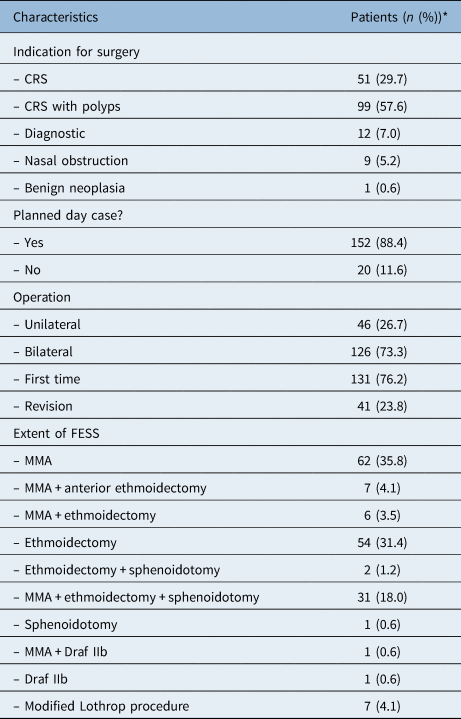
All procedures were performed under general anaesthesia. Table 1 shows the indications for surgery and the operative details.
Population characteristics

*Total n = 172. CRS = chronic rhinosinusitis; FESS = functional endoscopic sinus surgery; MMA = middle meatus antrostomy
A total of 152 out of 172 operations (88.4 per cent) were planned as a day-case procedure, and 20 (11.6 per cent) were planned as overnight in-patient ward or high-dependency unit admissions, usually because of co-morbidities such as obstructive sleep apnoea (OSA). Overall, 138 out of 172 patients (80.2 per cent) were discharged home on the same day following elective FESS. There was one re-admission within 24 hours post-operatively with bleeding.
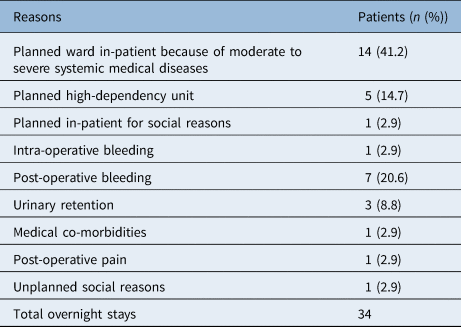
Table 2 shows the reasons for overnight admission. Fourteen patients had an unplanned overnight admission; these were further evaluated to identify the reasons for their overnight stay and to determine whether this could have been prevented.
Reasons for overnight admission

Seven patients had a modified frontal sinus Lothrop procedure. Of these, four were conducted as day-case surgery. The reasons for an overnight stay in the other three patients were: post-operative bleeding (n = 1) and planned overnight observation because of medical co-morbidities (n = 2).
Discussion
This study evaluated the day-case rate of elective FESS in a tertiary rhinology unit. We found that 80 per cent of our patients were discharged home on the same day following elective FESS. This is comparable to an earlier UK study by Bajaj et al.; they reported a same-day discharge rate of 85.7 per cent (90 out of 105) in planned same-day cases.Reference Bajaj, Sethi, Carr and Knight3 A similar same-day discharge rate of 88.7 per cent was also reported in a recent study from the Mayo Clinic following planned day-case FESS.Reference Laporta, O'Brien, Stokken, Choby, Sprung and Weingarten4
Few recent UK studies have evaluated same-day discharge following FESS. Although FESS is generally performed as a day-case procedure across ENT units, some patients still require overnight admission. The reasons for overnight admission have altered with changes in practice such as the use of absorbable packs rather than packs requiring next-day removal, and as a result of improvements in anaesthetics with less post-operative nausea and vomiting, and improved pain control. We evaluated the various reasons for both planned and unplanned overnight night stays, with the view of further improving the day-case rate.
Planned overnight admissions
The commonest reasons for a planned overnight admission following FESS was for in-patient ward or high-dependency unit monitoring in light of moderate to severe medical co-morbidities (n = 19). Two patients required a second overnight stay because of severe chronic respiratory diseases. The other patients had an uneventful post-operative observation period and were successfully discharged home following overnight monitoring. There was no unplanned re-admission within the 24 hours following discharge from the in-patient ward or high-dependency unit.
Day-case surgery is becoming more feasible, even in patients with complex medical conditions. One study of 896 patients who underwent day-case surgery compared unplanned admission rates, contact with health services and post-operative complications within 24 hours post-operatively in patients with American Society of Anesthesiologists’ Physical Status Classification System grades I, II or III.Reference Ansell and Montgomery5 They found no significant difference between the three groups, suggesting that patients considered to be grade III can be safely discharged home with adequate pre-operative optimisation.
In our cohort, some patients were planned as in-patient or high-dependency unit admissions because of a history of OSA. Obstructive sleep apnoea is no longer considered an absolute contraindication for day-case surgery. Regional anaesthesia in this group is preferred by some authorities where possible.Reference Bailey, Ahuja, Bartholomew, Bew, Forbes and Lipp6 Day-case surgery guidelines suggest that patients with known OSA can be considered for same-day surgery if they are able to use continuous positive airway pressure therapy in the post-operative period.Reference Bailey, Ahuja, Bartholomew, Bew, Forbes and Lipp6,Reference Joshi, Ankichetty, Gan and Chung7 In addition, those with a presumed diagnosis of OSA based on pre-operative screening tools, and with well-controlled and optimised co-morbidities, may also be considered for day-case surgery.Reference Joshi, Ankichetty, Gan and Chung7
Patients with significant co-morbidities operated on earlier in the day, rather than later in the day, may be more amenable to a same-day discharge.
Post-operative bleeding and nasal packs
Bleeding was the commonest cause of an unplanned overnight stay. In our unit, we routinely use absorbable nasal packs (NasoPore) following FESS. Thus, ‘nasal packs’ as a reason for an overnight admission was only found in one case. This patient had post-operative bleeding during the recovery period that was controlled by a non-absorbable pack. Traditionally, patients were not discharged home with non-absorbable packs. Thus, the use of non-absorbable packs necessitated an overnight stay, unless these packs were removed on the same day post-operatively. Earlier reports found that non-absorbable nasal pack use was a relatively common reason for an overnight stay.Reference Bajaj, Sethi, Carr and Knight3
One patient returned to the operating theatre to control bleeding. The other patients were monitored and bleeding spontaneously resolved with no further interventions. Three patients had excessive bleeding intra-operatively and subsequently had bleeding post-operatively.
Techniques to reduce bleeding include the use of: a cauterising microdebrider, warm saline irrigations, additional packing with absorbable materials such as fibrillar and Kaltostat®, haemostatic agents such as Floseal and tranexamic acid, as well as more than one NasoPore pack in each nasal cavity. Sphenopalatine artery ligation in patients with excessive intra-operative bleeding may help prevent post-operative bleeding and improve same-day discharge. One study evaluated the outcomes of patients who had sphenopalatine artery ligation as part of FESS with partial middle turbinectomy to control intra-operative bleeding.Reference Cassano and Cassano8 They found that sphenopalatine artery ligation could reduce the risk of bleeding.
General anaesthetic effects
There was no standardised general anaesthetic technique during our study period. Side effects of a general anaesthetic have been reported as reasons for unplanned admissions following day-case FESS.Reference Bajaj, Sethi, Carr and Knight3 Laporta et al. examined the reasons for a prolonged recovery following day-case FESS; these included over-sedation, respiratory depression, the need for rescue opioid and severe pain. In addition, prolonged recovery was significantly associated with an unplanned overnight admission.Reference Laporta, O'Brien, Stokken, Choby, Sprung and Weingarten4
Post-operative urinary retention is a known complication following general anaesthetic. Three patients in our cohort were admitted overnight because of urinary retention. Urinary retention is not an absolute contraindication for same-day discharge. Patients with no risk factors for post-operative urinary retention can be discharged prior to voiding. Those with risk factors and no void after the procedure would require an in–out catheter (if bladder volume is greater than 600 ml), and can be discharged home with safety advice to seek medical assistance if no void after 8 hours.Reference Baldini, Bagry, Aprikian and Carli9 Local integrated pathways and protocol would guide the management of these patients.
Post-operative pain
Functional endoscopic sinus surgery is thought to be associated with moderate post-operative pain,Reference Finkensieper, Poller, Wittekindt, Meissner and Guntinas-Lichius10 and patients can often be managed effectively with non-opioid analgesics.Reference Finkensieper, Poller, Wittekindt, Meissner and Guntinas-Lichius10,Reference Kemppainen, Tuomilehto, Kokki, Seppä and Nuutinen11 However, the prescription of opioid analgesics is common amongst US otolaryngologists.Reference Gray, Fan, Kappauf, Kidwai, Colley and Iloreta12 Patients who undergo a limited procedure may only require simple analgesics. One patient in our study experienced severe post-operative pain necessitating an overnight admission. Others have reported pain as the commonest reason for an unplanned admission following day-case FESS,Reference Wong and Kacker13 highlighting the importance of adequate peri-operative analgesia. Laporta et al. found that pre-operative, pre-emptive acetaminophen (median dose 1 g) reduced post-anaesthetic recovery time, as well as rates of severe pain, nausea and vomiting.Reference Laporta, O'Brien, Stokken, Choby, Sprung and Weingarten4 Generally, most patients only require simple analgesics; however, with extensive surgery, opioid analgesics should be used.
Social reasons
Traditionally, patients who do not have adult overnight home care in the 24 hours following general anaesthetic are considered unsuitable for same-day surgery. More recent day-case surgery guidelines suggest a case-by-case evaluation, as patients undergoing relatively minor procedures may not require this.Reference Bailey, Ahuja, Bartholomew, Bew, Forbes and Lipp6 Limited FESS may be applicable to such a pathway. However, it remains essential that a responsible adult escort the patient home.Reference Bailey, Ahuja, Bartholomew, Bew, Forbes and Lipp6
• The same-day discharge rate was 80 per cent following elective functional endoscopic sinus surgery in a tertiary rhinology unit
• There is scope to improve the same-day discharge rate
• Reasons for unplanned admissions included: bleeding, urinary retention, medical co-morbidities, post-operative pain and social reasons
• Selected patients with significant medical co-morbidities may be amenable to same-day discharge if operated on earlier in the day
• Bleeding is the commonest cause of unplanned admission
• Techniques to reduce bleeding, such as additional absorbable packing, haemostatic agents and sphenopalatine artery ligation, may further improve same-day discharge rates
Conclusion
Our day-case rate for FESS was comparable to national and international figures. There is scope to improve the same-day discharge rate by operating on such cases earlier in the day and with meticulous haemostasis amongst other measures. This has the potential to improve patient satisfaction and service efficiency.
Competing interests
None declared