


Introduction
Community engagement is used in many contexts. Here we focus on its central role in addressing health inequities. Since 1995, numerous funders, government agencies, researchers, and community leaders have advanced the idea that community engagement must be deliberate with tangible results through the creation and refinement of the US Centers for Disease Control and Prevention (CDC) Principles of Community Engagement [1]. Although the definition has evolved over time, community engagement emphasizes cultivating long-term, trust-based relationships that foster bidirectional collaboration and enhance community well-being [1]. In practice, this often takes shape through community–academic partnerships: collaborative relationships in which community members, organizational representatives, and academic researchers work together equitably across all phases of research, contributing their respective expertise, sharing decision-making, and aligning efforts with community priorities [Reference Israel, Schulz, Parker and Becker2,Reference Dugani, Tilburt and White3]. Sustained engagement with populations experiencing health inequities is critical for advancing equity and building the trust necessary to address current and future health challenges [1,Reference Wieland, Njeru and Weis4,Reference Hohl, Abu-Rish Blakeney and Carter-Edwards5].
Translational science increasingly recognizes community engagement as essential to accelerating the movement of research into equitable health impact. This field focuses on translating discoveries into real-world health benefits [6]. Recent work in the Journal of Clinical and Translational Science has emphasized evaluating community engagement within translational initiatives, strengthening institutional infrastructure to support equitable partnerships, and embedding trust, compensation, and relationship-centered practices into Clinical and Translational Science Award (CTSA) ecosystems [Reference Bilheimer, Datta and Grewe7–Reference Waters, Joly, Gray, Carney and Fairfield9].
At the same time, clinical and translational scientists are being called to address digital health equity as emerging technologies reshape research and care delivery [Reference Rowland, Brewer and Rosas10]. Generative artificial intelligence (GenAI; models designed to generate novel content [e.g., text, images, audio, or multimodal outputs], including large language models and related generative systems) represents one such transformative technology. Additionally, research on GenAI in biomedical and health informatics has expanded rapidly, with major applications in clinical decision support, patient interaction (e.g., chatbots), medical document analysis, education, and research synthesis [Reference Yu, Fan and Li11]. Reflecting this growing interest, the NIH 2025–2030 Strategic Plan for Data Science identifies community engagement and capacity building as key priorities [12].
While there is substantial literature on involving community members in GenAI tool development [Reference Annapragada, Donaruma-Kwoh, Annapragada and Starosolski13–Reference Furtado, Araujo and Furtado18], citizen science approaches [Reference Baminiwatte, Torsu and Scherbakov19,Reference King, Doueiri, Kaulberg and Goldman Rosas20], and the use of health informatics to support community-engaged research [Reference Rajamani, Rodriguez Espinosa and Rosas21] and culturally sensitive healthcare communication [Reference Lee, Chang and Yang22], the literature describing GenAI-enabled approaches explicitly designed to strengthen community engagement efforts to address health inequities remains sparse. We focused this review on health-related academic–community partnerships involving populations disproportionately affected by health inequities because these communities have historically faced barriers to research participation, healthcare access, and health outcomes, and because community engagement is a foundational strategy for advancing health equity.
To address this gap, we conducted a scoping review of peer-reviewed and gray literature to map applications of GenAI-enabled tools that support community engagement within health-related academic–community partnerships involving populations disproportionately affected by health inequities. Specifically, our research questions were:
-
• What types of GenAI-enabled approaches have been used or proposed to support community engagement within health-related academic–community partnerships involving populations disproportionately affected by health inequities?
-
• How are these approaches aligned with the Principles of Community Engagement in the context of health-equity-focused academic–community partnerships?
-
• What gaps and opportunities exist for future use of GenAI to support community engagement within health-related research involving populations disproportionately affected by health inequities?
Materials and methods
Protocol and registration
Our work was guided by the JBI Manual for Evidence Synthesis [23] and the PRISMA Extension for Scoping Reviews Checklist [Reference Tricco, Lillie and Zarin24]. We registered this scoping review protocol prospectively in Open Science Framework on August 25, 2025 (Registration https://doi.org/10.17605/OSF.IO/XVT3J).
Eligibility criteria
We included English-language records (peer-reviewed articles, conference proceedings, viewpoints, pre-prints, theses/dissertations, and books) published from 2015 to 2025 to capture the contemporary landscape of the deployment, implementation, evaluation, and use of GenAI. We also sought records that described partnerships between academic institutions and communities disproportionately affected by health inequities. These communities include individuals based on race (American Indian or Alaska Native, Asian, Black or African American, Hispanic or Latino, Native Hawaiian and other Pacific Islander), sexual and gender orientation, socioeconomic disadvantage, and residence in a medically underserved rural area. We restricted articles to the above-listed groups. Notably, there may be literature on engagement with other patient, patient advocate, or caregiver groups that are underrepresented in other ways that could be included in a future review (e.g., patients diagnosed with rare diseases [Reference Xi, Ji and Wang25]).
While the Principles of Community Engagement were written in the US, we did not limit our results geographically. Many US-based investigators conduct research abroad and we wanted the opportunity to learn from our international colleagues. Additionally, other groups have called for similar work internationally (e.g., the United Nations Global Preparedness Monitoring Board [26] and the Red Cross Red Crescent Guide to Community Engagement and Accountability [27]).
Our review focused on two categories of GenAI based on the purpose of the model: 1) large language models (LLMs), a subset of GenAI designed to understand, interpret, and generate human language for text-based outputs; and 2) other GenAI models, designed to create images, audio, video, or multimodal content. Eligible records needed to describe how GenAI from either category has been used, or could be used, to advance the Principles of Community Engagement within academic–community partnerships.
We excluded records that focused on developing GenAI interventions through partner collaboration, community management for brand loyalty or product promotion, examinations of bias in GenAI, citizen science that did not exclusively work with populations experiencing health inequities, patient engagement to improve healthcare processes, and research unrelated to human health. We also excluded records whose primary focus was the development, training, validation, or performance evaluation of GenAI systems. Our interest was not in AI development as an end, but in how GenAI-enabled tools were used, adapted, or proposed to support community engagement activities within academic–community partnerships. Studies remained eligible when community partners participated in the design, adaptation, refinement, or implementation of GenAI-enabled tools, and GenAI was used to advance community engagement. We excluded records examining bias in GenAI because these primarily address algorithmic fairness and model performance, which, while critically important, fall outside our focus on engagement processes within academic–community partnerships. We excluded records on citizen science approaches that did not involve communities experiencing health inequities or did not center community engagement principles. Finally, we excluded records on patient engagement in healthcare delivery or quality improvement because these activities often occur within clinical care contexts and do not necessarily reflect broader community engagement or partnership structures as defined in this review.
Data sources and search strategies
A comprehensive search of several databases from January 1, 2015, to December 16, 2025, English language, was conducted. The databases included Ovid MEDLINE(R) and Epub Ahead of Print, In-Process & Other Non-Indexed Citations, and Daily, Ovid EMBASE, Ovid Cochrane Central Register of Controlled Trials, Ovid Cochrane Database of Systematic Reviews, Ovid PsycINFO, Scopus, Ebsco CINAHL, LILACS, SciELO, and Web of Science. The search strategy was designed and conducted by an experienced medical librarian with input from the study team. Controlled vocabulary supplemented with keywords was used to search for the use of artificial intelligence to advance the principles of community engagement. The search strategy is described in Online Resource 1.
We also conducted an iterative gray literature search using Google and ChatGPT, in addition to reviewing the reference lists of all included records and searching relevant professional organization websites (e.g., Patient-Centered Outcomes Research Institute [PCORI]). For both Google and ChatGPT, we used structured search terms aligned with our database strategy. To enhance transparency and reproducibility, we have provided the full set of ChatGPT prompts and corresponding outputs in Online Resource 2. ChatGPT was used as a supplementary tool to identify potentially relevant gray literature sources (e.g., reports, organizational websites, and ongoing initiatives), rather than as a primary source of evidence.
Given the dynamic nature of search outputs from both Google and ChatGPT, two reviewers (A.M.L. and E.J.S.) conducted title screening of all retrieved records together to ensure consistency in initial inclusion decisions. Full-text review of potentially eligible sources was then conducted independently by both reviewers, followed by discussion to resolve any discrepancies and reach consensus. This approach ensured that all records identified through gray literature searching were screened and evaluated using the same eligibility criteria applied to database-derived records.
Selection of sources of evidence and data charting process
Using Covidence, two authors (A.M.L. and E.J.S.) independently performed all study selection processes. A.M.L. developed questions for title/abstract screening. Prior to screening all titles and abstracts, we conducted an evaluation of the study selection form using Cohen’s kappa interrater reliability test. We selected a random sample of 25 records. Our goal was for the two reviewers to screen the sample and reach strong agreement (Cohen’s κ > 0.80) prior to reviewing all titles/abstracts. In the case of disagreement, A.M.L. and E.J.S. planned to discuss their differences, reach a consensus, and modify the study selection form as needed. We had no disagreements.
Following successful completion of the interrater reliability test and modifications to the study selection form, A.M.L. and E.J.S. screened all titles/abstracts. For any disagreements on exclusion, we reached consensus through discussion.
A.M.L. developed a set of questions for screening full-text records. During the full-text screening process, A.M.L. and E.J.S. independently reviewed all records. For each record, we documented the year of publication, whether the work was completed or planned (e.g., a protocol paper), geographic location, study design, sample size, participant characteristics, health equity issue addressed, and GenAI tools used or suggested. Any disagreements on exclusion were resolved by consensus of the two reviewers or adjudicated by a third project member (M.L.W.). We searched for each study selected for inclusion in Retraction Watch (https://www.retractionwatch.com) and PubMed to identify retraction or correction notices. A list of records excluded at the full-text screening level (sorted by reason for exclusion) is available in Online Resource 3.
Synthesis of results
Three authors (A.M.L., E.J.S., M.L.W.) mapped how each record used GenAI to advance the Principles of Community Engagement. To synthesize findings, A.M.L. and E.J.S. reviewed each record’s methods or planned methods and discussed which principles were applicable. M.L.W. clarified questions. This process gave us the opportunity to summarize and integrate our findings through a standardized model. We demonstrate how researchers have leveraged or plan to leverage GenAI for community engagement as well as future directions.
Results
Selection and characteristics of sources of evidence
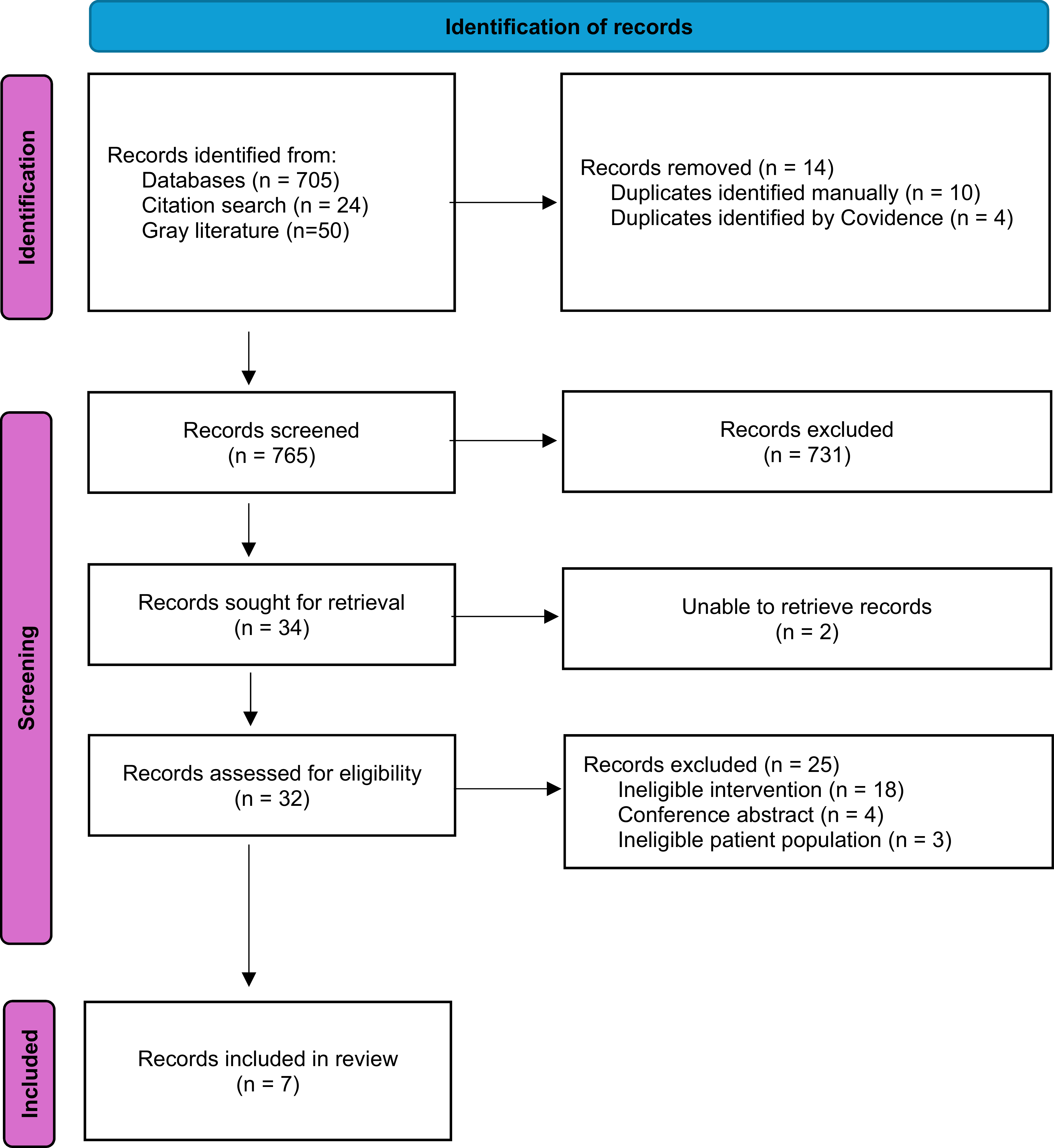
We identified 705 records from databases, 50 from gray literature, and 24 from citation searching (Figure 1) [Reference Page, McKenzie and Bossuyt28]. Seven records met the eligibility criteria. The most common reasons for exclusion were lack of GenAI use for community engagement, absence of health focus, and failure to prioritize populations experiencing health inequities.
Identification of records via databases for a scoping review on the role of artificial intelligence in advancing the principles and practice of community engagement.

Figure 1. Long description
PRISMA flow diagram of study selection. Searches identified 779 records (705 database records, 50 gray literature records, and 24 citation records). After removing 14 duplicates, 765 records were screened, 34 full-text records were assessed, and 7 studies met the eligibility criteria. The most common reason for full-text exclusion was an ineligible intervention (18 records), followed by conference abstracts (4) and ineligible patient populations (3).
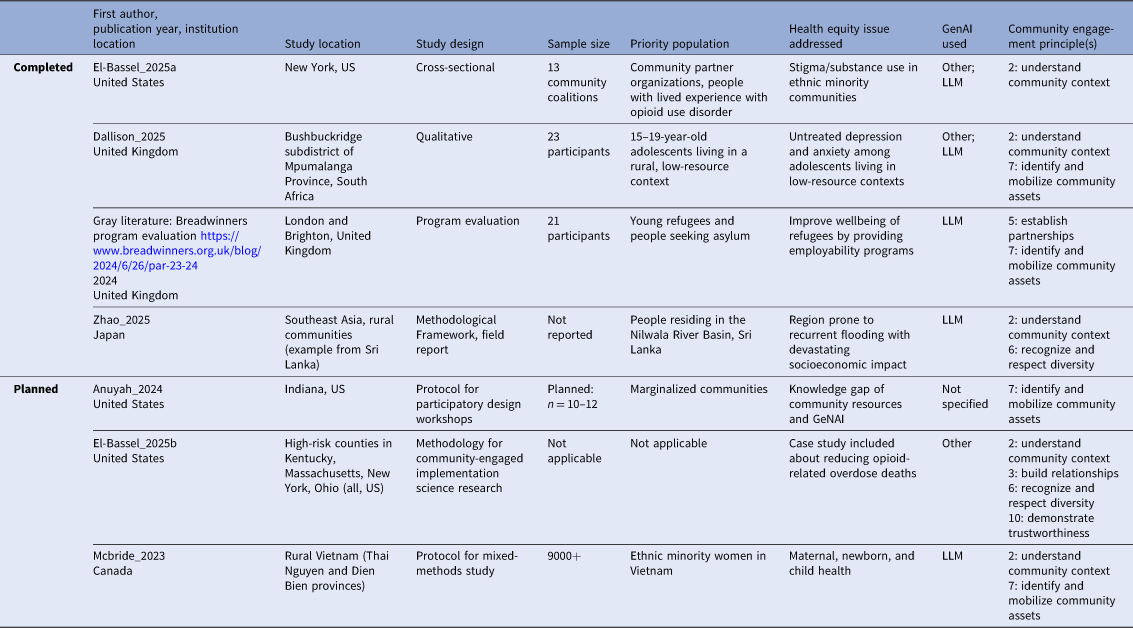
Three of the included records were conducted in the US [Reference El-Bassel, David and Mukherjee29–Reference Anuyah31], with one each carried out in South Africa [Reference Dallison, Moffett and Makhubela32], the United Kingdom (UK) [33], Sri Lanka [Reference Zhao, Wang and Sriwarnasinghe34], and Vietnam [Reference McBride, ONeil and Nguyen35]. Four of the records took place in the country of the first author’s institution [Reference El-Bassel, David and Mukherjee29–Reference Anuyah31,33], while the remaining three were conducted elsewhere [Reference Dallison, Moffett and Makhubela32,Reference Zhao, Wang and Sriwarnasinghe34,Reference McBride, ONeil and Nguyen35].
The included records suggest diverse applications of how GenAI’s capabilities (e.g., dialogue generation, content co-creation, real-time interaction) contribute to community engagement. While several included studies incorporated broader AI techniques (e.g., natural language processing, machine learning, or modeling approaches), these were included only when they were used in conjunction with, or in support of, generative systems (e.g., LLM-enabled chatbots).
Four of the included records described completed investigations. El-Bassel et al. (a) conducted a cross-sectional study in New York with 13 community coalitions to reduce stigma and substance use among ethnic minority communities, leveraging natural language processing, machine learning, and large language models [Reference El-Bassel, David and Aragundi30]. Dallison et. al. taught South African youth living in a low-resource, rural setting to use GenAI tools to build culturally relevant content [Reference Dallison, Moffett and Makhubela32]. In the UK, the Breadwinners program evaluation focused on improving well-being through employability initiatives for young refugees and asylum seekers, incorporating chatbot technology to enhance engagement [33]. Zhao et al. introduced a methodological framework for flood-prone communities in Sri Lanka, integrating modular, multi-agent GenAI ecosystems to co-develop data collection tools in linguistically complex regions [Reference Zhao, Wang and Sriwarnasinghe34].
The other three included records highlighted planned approaches to use GenAI in community-engaged research to address health inequities. Anuyah in Indiana, USA, plans to conduct participatory design workshops with marginalized communities to build GenAI capacity and address knowledge gaps about local resources [Reference Anuyah31]. El-Bassel et al.’s second study (b) presented a methodology for community-engaged implementation science using the example of reducing opioid-related overdose deaths. This work suggested integrating advanced GenAI tools such as natural language processing, sequential analysis, machine learning, system dynamics modeling, and agent-based modeling [Reference El-Bassel, David and Mukherjee29]. Finally, McBride et al. introduced a protocol for a mixed-methods study in rural Vietnam involving over 9000 ethnic minority women. The investigators plan to use a chatbot automatic dialogue system to engage participants and provide guidance in maternal, newborn, and child health emergencies [Reference McBride, ONeil and Nguyen35] (Table 1).
Records included in the scoping review on the use of artificial intelligence to advance community engagement

Table 1. Long description
Summary of the seven studies included in the scoping review. Four studies described completed applications of GenAI for community engagement and three described planned applications. Studies were conducted in the United States, South Africa, the United Kingdom, Sri Lanka, and Vietnam and addressed diverse health equity issues including substance use stigma, adolescent mental health, refugee well-being, flood preparedness, maternal and child health, and community resource access. GenAI approaches primarily involved large language models and chatbots and most frequently aligned with CDC Community Engagement Principles 2 (understanding community context) and 7 (mobilizing community assets).
Mapping of included records
Table 2 highlights how the records aligned with the Principles of Community Engagement. Among the seven included records, Principle 2 (understanding community context) and Principle 7 (mobilizing community assets) appeared in more records than any other principles. For Principle 2, Dallison et al. learned about participants’ culture by teaching them to use GenAI tools, El-Bassel et al. (a) analyzed coalition meeting transcripts to assess stigma discussions [Reference El-Bassel, David and Aragundi30], while Zhao et al. co-developed data collection tools with communities in linguistically complex regions [Reference Zhao, Wang and Sriwarnasinghe34]. Among projects planning to use GenAI for engagement, McBride et al. proposed mobile apps for real-time interaction [Reference McBride, ONeil and Nguyen35], whereas El-Bassel et al. (b) aimed to deploy advanced GenAI for sentiment dashboards, predictive tools to tailor interventions, and monitoring policy and media shifts to understand external influences on local decision-making [Reference El-Bassel, David and Mukherjee29].
Completed or planned GenAI-enabled approaches to advance community engagement: Results of the scoping review included records mapped onto CE Principles

Table 2. Long description
Summary of the seven studies included in the scoping review. Four studies described completed applications of GenAI for community engagement and three described planned applications. Studies were conducted in the United States, South Africa, the United Kingdom, Sri Lanka, and Vietnam and addressed diverse health equity issues including substance use stigma, adolescent mental health, refugee well-being, flood preparedness, maternal and child health, and community resource access. GenAI approaches primarily involved large language models and chatbots and most frequently aligned with CDC Community Engagement Principles 2 (understanding community context) and 7 (mobilizing community assets).
Principle 7 was represented in four records. Breadwinners used a GenAI chatbot for program evaluation [33], and Dallison et al. built capacity by teaching youth to use GenAI tools for culturally relevant content creation. Similarly, Anuyah planned to teach community partners about GenAI [Reference Anuyah31], and McBride et al. proposed a mobile app to engage participants and thereby strengthen the community’s decision-making capacity [Reference McBride, ONeil and Nguyen35]. Three principles appeared only once: El-Bassel et al. (b) planned to apply Principle 3 (build and maintain relationships) through ensuring intervention alignment via community feedback as well as scenario simulations to predict fatigue or success to support sustainability planning and Principle 10 (demonstrate trustworthiness) by synthesizing ethical themes to enhance transparency [Reference El-Bassel, David and Mukherjee29]. Breadwinners applied Principle 5 (establish partnership with community) by using the GenAI chatbot to seek feedback [33]. No records applied Principle 1 (clarify goals), Principle 4 (accept community self-determination), Principle 8 (release control), or Principle 9 (foster collaboration).
Discussion
The objective of this scoping review was to synthesize peer-reviewed and gray literature on the use of GenAI-enabled tools for community engagement in health-related research with populations disproportionately affected by health inequities. We identified seven records and mapped them to the CDC Principles of Community Engagement. Within this narrow body of literature, the included records most often described GenAI-enabled approaches intended to support understanding community context and identifying community assets.
What has been demonstrated. The completed studies included in this review primarily described the application of GenAI to gather information and identify community needs. Building community capacity around GenAI is widely recognized as essential [12]. Thus, it was not surprising that all records applied Principle 2 (understand community context) and/or Principle 7 (mobilize community assets). In contrast, principles involving trust-building and relationship development were less frequently employed. These findings suggest that, to date, GenAI is primarily being used to support tasks that align with existing research workflows, such as data collection, analysis, and content generation, rather than more relational aspects of engagement.
What has been proposed. Several records described planned or conceptual applications of GenAI that extend beyond current practice. Two principles – 3 (build relationships) and 10 (demonstrate trustworthiness) – were applied by investigators who were planning but had not yet completed their research. These proposed applications include using GenAI to support intervention alignment through community feedback, simulate implementation scenarios, and synthesize ethical concerns to enhance transparency. This suggests that GenAI’s role in community engagement is evolving, and further research on these and other underutilized principles is warranted.
What remains underexplored and future directions. Notably, none of the included records addressed Principle 1 (clarify goals), Principle 4 (accept community self-determination), Principle 8 (release control), or Principle 9 (foster collaboration). These gaps highlight important opportunities for future research. Although the included records did not demonstrate applications of GenAI aligned with these principles, the CDC Principles of Community Engagement framework suggests several conceptual possibilities that warrant future exploration. For example, GenAI could support Principle 1 by ensuring goal descriptions are written at an appropriate reading level and in the community’s preferred language. To address Principle 4, Gen AI could streamline the process of community members sharing experiences, generating questions, and solving issues to support their power to act in their own self-interest. To advance Principle 8, GenAI could review meeting notes (similar to El-Bassel et.al [a] [Reference El-Bassel, David and Aragundi30]) and prompt teams when greater flexibility or shared control is needed. Finally, to apply principle 9, researchers could use GenAI to create long-term engagement feedback processes with community partners thereby continuously refining an intervention or partnership. While these examples remain conceptual rather than evidence-based, they suggest that future community-centered co-design and implementation studies could explore how GenAI may support a broader range of Community Engagement Principles.
Broader considerations. Although three of the included records were conducted in upper-middle and lower-income countries, first authorship was consistently affiliated with high-income country institutions. While most records involved local co-authors, this pattern suggests that leadership and agenda-setting in the use of GenAI in community-engaged research remain concentrated in high-income settings. These dynamics raise important questions about equity, capacity-building, and local ownership in the use of GenAI tools for community-engaged research.
Implications for policy and practice
Within the limited literature on health-equity-focused academic–community partnerships, GenAI may play a supportive role in community engagement; however, it is critical to recognize that GenAI is a tool, not an end in itself. The essence of engagement lies in human interaction and collaboration among academic and community partners. When used appropriately, GenAI may enhance engagement by improving communication, optimizing resources, supporting trust-building, streamlining data analysis, and fostering collaboration. By reducing the opportunity costs associated with community-engaged research, GenAI may allow researchers and community partners to devote more time to activities that require human interaction, such as relationship-building, trust development, and collaborative problem-solving, potentially improving the efficiency of translational research and practice.
We encourage investigators to adhere to ethical guidelines (e.g., the checklist to guide the ethical use of GenAI in community-engaged research developed by El-Bassel et al. [b] [Reference El-Bassel, David and Mukherjee29]) and remain committed to the Principles of Community Engagement. Additionally, scholars have emphasized the importance of participatory data stewardship, whereby community partners actively shape and retain agency over how data are used to train and inform models, as a safeguard for ethical and inclusive practice [Reference Dallison, Moffett and Makhubela32]. By strategically using GenAI within these parameters, we can learn from one another, empower communities, and strengthen partnerships between academia and community – ultimately using research to reduce health inequities [36].
Strengths and limitations
Given the rapid growth of GenAI, we may have missed examples of its use for community engagement, particularly those that are ongoing or not yet publicly documented. Only seven records met our eligibility criteria, reflecting both the emerging nature of GenAI-enabled community engagement and our focus on health-equity-oriented academic–community partnerships. Accordingly, this review should be interpreted as a mapping of currently documented examples and opportunities rather than a comprehensive representation of GenAI use across the broader community engagement field.
Also, the boundary between GenAI and other AI approaches is evolving, and many real-world applications integrate generative and non-generative components. Thus, some of the included studies used hybrid methods. Finally, we did not assess the limits of GenAI in the context of community engagement. It is important to consider internet inequity, as populations with limited access are often those most affected by health inequities [Reference Bhawra, Skinner, Favel, Green, Coates and Katapally37]. Furthermore, it will be essential to consider community partners’ perspective on using GenAI for engagement. Without this information, we cannot determine how best to transform health systems to advance health equity [Reference Aguilar-Gaxiola, Ahmed and Anise38]. One potential tool is the Framework for Supporting Vulnerable Populations in Technology Research and Design, which conceptualizes both assets and barriers that may influence participation. Applying this framework could help identify, evaluate, and address technology-related needs, leading to more empowering research experiences [Reference Anuyah, Badillo-Urquiola and Metoyer39].
Within the limited literature on health-equity-focused academic–community partnerships, our findings suggest that GenAI may support community engagement by enhancing understanding of community context and mobilizing community assets. These findings provide an early foundation for future research evaluating how GenAI can be used to strengthen equitable community–academic partnerships.
Supplementary material
The supplementary material for this article can be found at https://doi.org/10.1017/cts.2026.10809.
Acknowledgements
The authors used Microsoft co-pilot and ChatGPT 5.5 to assist with the drafting of this article. We accessed both through Mayo Clinic and used them without modification from July 2025 to May 2026. The authors are entirely responsible for the scientific content of the paper, and the paper adheres to the Journal of Clinical and Translational Science’s authorship policy.
Author contributions
Abby M. Lohr: Data curation, Formal analysis, Methodology, Project administration, Visualization, Writing - original draft, Writing - review & editing; Emily J. Sabey: Formal analysis, Project administration, Writing - review & editing; Chenyu Gai: Methodology, Resources, Validation, Writing - review & editing; Larry Prokop: Data curation, Methodology, Resources, Software, Writing - original draft, Writing - review & editing; Matthew J. Spiten: Investigation, Project administration, Writing - review & editing; Lisa G. Rosas: Supervision, Validation, Writing - review & editing; Ting Pun: Validation, Writing - review & editing; Suganya Karuppana: Validation, Writing - review & editing; Shauna M. Overgaard: Conceptualization, Funding acquisition, Resources, Writing - review & editing; M. Hassan Murad: Methodology, Supervision, Writing - review & editing; Sagar B. Dugani: Conceptualization, Methodology, Project administration, Supervision, Writing - review & editing; Mark L. Wieland: Conceptualization, Supervision, Writing - review & editing.
Funding statement
This work is supported by generous funds from Dalio Philanthropies. SBD was supported by the National Institutes of Health/National Institute on Minority Health and Health Disparities (K23 MD016230). AML, EJS, SBD, and MLW were supported by the Mayo Clinic Center for Clinical and Translational Science (UL1 TR02377-07). The funders had no role in study design, data analysis and interpretation; in writing of the manuscript; and in the decision to submit the manuscript for publication. The findings and conclusions do not necessarily represent the views of the funders.
Competing interests
The authors have no relevant financial or non-financial interests to disclose.


 Open access

