

Studies of the US Supreme Court have long recognized that justices’ behavior largely depends on their personal attributes (e.g., Pritchett Reference Pritchett1948). With few exceptions (Becker Reference Becker1966; Ulmer Reference Ulmer1973; Gibson Reference Gibson1978; Tate Reference Tate1981), research on justices’ attributes has focused exclusively on their ideological policy preferences (e.g., Epstein and Knight Reference Epstein1998; Segal and Spaeth Reference Segal2002). However, political elites may vary on a variety of personal characteristics (Ramey, Klingler, and Hollibaugh Reference Ramey2017), and recent studies of judicial behavior have started to recognize the importance of individual differences beyond policy preferences (e.g., Glynn and Sen Reference Glynn2015). One especially promising avenue of research on individual differences is the study of justices’ personality traits (e.g., Hall Reference Hall2018).
The study of personality enjoys a long and rich history in the psychology literature. Personality psychologists attempt to “account for individuals’ characteristic patterns of thought, emotion, and behavior together with the psychological mechanisms—hidden or not—behind those patterns” (Funder Reference Funder2001). The most prominent studies of personality psychology adopt the dispositional (or trait) approach, which “identifies a few broad stable traits, factors, or behavioral dispositions to be the basic units for characterizing and understanding individuals and the differences among them” (Mischel and Shoda Reference Mischel2008). The most common—indeed, “almost ubiquitous” (Funder Reference Funder2001)—personality traits adopted in this literature are the Big Five (also called the five-factor model).
The Big Five were derived from questionnaires in which subjects rated how well specific adjectives or phrases described themselves or others. Researchers then used factor analysis to identify the broad trait domains underlying their responses (Gerber et al. Reference Gerber2011, 266). These analyses identified five predominant traits: openness, conscientiousness, extraversion, agreeableness, and neuroticism. These five traits describe individuals’ global personalities—that is, “their enduring emotional, interpersonal, experiential, attitudinal, and motivational styles” (McCrae and John Reference McCrae1992, 175)—and these “dispositional traits are believed to be stable aspects of individuals that shape how they respond to the vast array of stimuli they encounter in the world” (Gerber et al. Reference Gerber2011, 266). The Big Five have been replicated in a variety of languages and cultures (John, Naumann, and Soto Reference John2008), and the literature indicates that these traits are heritable (Bouchard Reference Bouchard1997) and highly stable throughout life, especially after the age of 50 (Caspi, Roberts, and Shiner Reference Caspi2005, 466–67).
Moreover, the Big Five personality traits can predict human behavior in a wide variety of contexts (John et al. Reference John2008). Of particular importance, the Big Five have been shown to predict political activity among the mass public (Gerber et al. Reference Gerber2011), official behavior of elected legislators (Dietrich et al. Reference Dietrich2012; Ramey et al. Reference Ramey2017), and decision-making by US Supreme Court justices (Hall Reference Hall2018). However, properly assessing the influence of personality traits on behavior requires valid measures of those traits, and scholars of judicial behavior face special challenges in assessing judges’ traits.
In this article, we advance the study of personality and judicial behavior by developing, validating, and describing the proper use of Supreme Court Individual Personality Estimates (SCIPEs). First, we briefly review the literature on individual differences and judicial behavior. This literature suggests that personality traits may be critical predictors of judges’ behavior. Indeed, several extant studies have used our SCIPEs to explore this possibility, citing early drafts of this research (e.g., Hall Reference Hall2018; Hall and Merrill Reference Hall2019; Marshall Reference Marshall2019). Yet, to date, no published study has ever systematically developed, validated, and described the proper use of SCIPEs—or, to our knowledge, any other measure of the justices’ Big Five personality traits. Therefore, in this article we (a) detail the methodology for estimating SCIPEs, (b) evaluate the validity of these measures, (c) demonstrate the value of the measures for predicting justices’ behavior, and (d) discuss the proper use of the measures in future applications. We find that SCIPEs are valid estimates of justices’ personality traits, predict the justices’ behavior in a manner consistent with our theoretical expectations, and offer a promising avenue for research on the US Supreme Court.
Personality and Judicial Behavior
Early studies of judicial behavior adopted a social-psychological approach, which emphasized the individual characteristics of judges, such as life experiences (Ulmer Reference Ulmer1970; Tate Reference Tate1981), role orientations (Becker Reference Becker1966; Gibson Reference Gibson1978), and ideological attitudes (Pritchett Reference Pritchett1948; Schubert Reference Schubert1962). More recent studies suggest the influence of other attributes on judicial decision-making, such as race (Scherer Reference Scherer2004), sex (Boyd, Epstein, and Martin Reference Boyd2010), and parenthood (Glynn and Sen Reference Glynn2015). However, in the context of the US Supreme Court, “most studies of the impact of justices’ personal attributes or social background characteristics rest on the premise that these characteristics shape policy preferences, which in turn determine justices’ positions in cases” (Baum Reference Baum1998, 40). Accordingly, most attempts to measure the individual characteristics of Supreme Court justices have focused on the justices’ ideological predispositions (e.g., Segal and Cover Reference Segal1989; Martin and Quinn Reference Martin2002; Bonica et al. Reference Bonica2017).
However, judges may also vary in attributes that are distinct from policy preferences yet nonetheless influence their behavior. Some scholars have argued that judges’ decisions, dating back to the early 20th century, are influenced by their personalities (Haines Reference Haines1922; Frank Reference Frank1930). For example, a judge’s self-esteem may be associated with role orientations (Gibson Reference Gibson1978), activism (Gibson Reference Gibson1981), or the decision to enter politics (Lasswell Reference Lasswell1948). Personality traits may also shape interpersonal influence and leadership style (Danelski Reference Danelski1961; Walker, Epstein, and Dixon Reference Walker1988). But as James Gibson (Reference Gibson1983, 26) emphasized, “the amount of attention given personality attributes is not commensurate with the potential influence of these variables.” That sentiment still rings true today. In fact, “since 1980, there has been a slow decline in attention to psychology” in courts-related research (Collins Reference Collins2012). Those studies that have examined judges’ individual characteristics have focused on narrow psychological constructs, such as cognitive style (Tetlock, Bernzweig, and Gallant Reference Tetlock1985) and certainty (Cross and Pennebaker Reference Cross2014).
In contrast, the study of personality as it relates to other political phenomena has enjoyed a revival in recent years, and most of this research employs the five-factor model. “The Big Five taxonomy has opened a promising new frontier in research on political attitudes and behavior” (Gerber et al. Reference Gerber2011, 268). Among the public, the Big Five are associated with ideology, partisanship, and political participation (see, e.g., Mondak Reference Mondak2010; Mondak et al. Reference Mondak2010; Gerber et al. Reference Gerber2011). More recently, scholars have used the Big Five to study political elites, including state legislators (Dietrich et al. Reference Dietrich2012) and members of Congress (Ramey et al. Reference Ramey2017). This research suggests the Big Five predict political behavior across contexts. Moreover, numerous historical and biographical accounts emphasize the importance of judges’ personalities (e.g., Hirsch Reference Hirsch1981; Rosen Reference Rosen2007). Yet, until quite recently, the influence of the Big Five on decision-making has received little attention in the judicial context.
In the last few years, scholars of judicial politics have directed renewed attention to personality in general, and the Big Five in particular. In a book-length project, Hall (Reference Hall2018) developed a “psychoeconomic” model of judicial behavior, in which the Big Five personality traits reflect justices’ goal preferences, and these goal preferences moderate the influence of situational factors on their decision-making. Hall then tested this theory in a variety of decision-making contexts on the US Supreme Court, such as voting to grant certiorari, circulating intra-Court bargaining memos, and voting on the merits. Hall and Merrill (Reference Hall2019) extend this research by using the Big Five to explain the influence of public opinion on the Supreme Court, and Black et al. (Reference BlackForthcoming) further explore the special role of justices’ conscientiousness in shaping their decisions. Together, this research suggests that the study of personality offers great promise for better understanding judicial behavior.
Text-Based Estimates of Justices’ Personality Traits
Capitalizing on the potential insights of research on personality and Supreme Court behavior requires developing valid measures of the justices’ personality traits. Accordingly, the goal of this article is to develop valid estimates of the Big Five personality traits for US Supreme Court justices and discuss their proper use. Unfortunately, though, studying the personalities of political elites poses substantial challenges for researchers. Psychologists typically measure personality traits by administering questionnaires in which respondents rate their agreement with individual items that describe themselves or others (Gerber et al. Reference Gerber2011, 267). However, this approach is impractical for political elites, such as Supreme Court justices, because it is impossible to obtain responses from deceased elites, and response rates among living elites are extremely low, which may introduce selection bias (Goldstein Reference Goldstein2003). Consequently, researchers attempting to assess the justices’ personality traits face substantial obstacles.
In order to overcome these obstacles, we adopt an approach originally developed by Ramey, Klingler, and Hollibaugh (Reference Ramey2016), in which we use machine learning models to estimate elites’ personality traits based on their language. Not only does this method avoid the practical obstacles associated with survey methods, but prior applications indicate that this text-based measurement strategy is likely superior to traditional survey approaches (see Ramey et al. Reference Ramey2017, 65–69). Indeed, even if obtaining survey responses were feasible, elites and those close to them may be especially susceptible to socially desirable responding for fear of damaging the elites’ reputations (Dietrich et al. Reference Dietrich2012; see Ramey et al. Reference Ramey2016).
We estimate justices’ personality scores based on the language in their written opinions—specifically, their concurring opinions. The use of written opinions offers a few clear advantages. First, opinions are publicly available for every justice.Footnote 1 Second, all Supreme Court opinions were written in a comparable context—as formal opinions on the nine-member Court by justices with life appointments whose opinions cannot be reviewed by a higher court. Third, this approach is consistent with prior research that uses opinion language to assess justices’ attributes (e.g., Cross and Pennebaker Reference Cross2014). Nonetheless, estimating justice personality traits from the language in their written opinions raises three potential concerns: (1) the influence of ghostwriters on opinion language, (2) bias introduced by combining multiple sources of text, and (3) strategic manipulation of language by the justices. As we discuss in the sections that follow, we derive our measures from only the language in concurring opinions in order to alleviate these concerns.
Ghostwriters
Most obviously, much of the language in a judicial opinion was not crafted by the justice who ostensibly authored the opinion. This ghostwriter problem manifests in Supreme Court opinions in at least three ways.
First, opinion authors often quote or closely paraphrase language from lower court opinions or prior judicial rulings in order to explain case facts and relevant precedents. This problem is most prevalent in majority opinions (opinions of the Court and judgments of the Court), which “tend to be relatively stylized and formulaic,” and “routinely and boringly recite case facts and procedural history as boilerplate” (Wahlbeck, Spriggs, and Sigelman Reference Wahlbeck2002, 179). Thus, we exclude majority opinion language from our estimation of justice personality traits in order to avoid this borrowed language.
Second, some opinions are the result of negotiation among the justices, as they bargain over opinion content (Wahlbeck, Spriggs, and Maltzman Reference Wahlbeck1998). Because the support of at least five justices is necessary for a majority opinion to set precedent, the authors of majority opinions are the most likely to accommodate bargaining requests from other justices (Maltzman, Spriggs, and Wahlbeck Reference Maltzman2000). In contrast, the authors of separate opinions have less incentive to accommodate such requests. For example, one appellate court judge has described writing separate opinions as a “feeling of unjudicial glee as one shucks off the normal restraints of writing for a panel and proceeds to thrust and parry with gay abandon” (Coffin Reference Coffin1994, 227). However, on the Supreme Court it is possible for more than one justice to dissent, and dissenting justices often join together to support a single opinion that serves as a sort of rival majority opinion (often called a “lead dissent”; see, e.g., Driver Reference Driver2011, 1268; Karlan Reference Karlan2018, 149). Indeed, the senior justice in the minority sometimes even “assigns” the lead dissent to a specific justice (see, e.g., Toobin Reference Toobin2012, 259). Consequently, the authors of dissenting opinions (opinions dissenting, dissenting in part, or concurring in part and dissenting in part)—especially long dissents, which contain the most opinion language—often face incentives to accommodate other justices.
In contrast, we suspect that the authors of concurring opinions (opinions concurring, concurring in part, or concurring in the judgment) face weaker incentives to accommodate bargaining requests than do the authors of majority or dissenting opinions. And the extant literature supports the notion that concurring opinions are the least susceptible to bargaining. For example, prior research has found that the size of the majority coalition is associated with the clarity of majority and dissenting opinions, but not concurring opinions (Owens and Wedeking Reference Owens2011, 1050). And the rhetorical content of majority and dissenting opinions is more influenced by strategic interactions with other justices than is the content of concurring opinions (Hume Reference Hume2006, 837). Additionally, unlike majority and dissenting opinions, neither the clarity nor the rhetorical content of concurring opinions is influenced by the opinion author’s ideology (Hume Reference Hume2006, 837; Owens and Wedeking Reference Owens2011, 1050). This is not to suggest that strategic considerations have no influence on the content of concurring opinions. Attracting support for a concurrence almost never has any precedential value, but justices might still alter the language in their concurring opinions based on strategic considerations. For example, Corley, Howard, and Nixon (Reference Corley2005, 336–37) found that concurring opinion authors respond to the content of majority opinions (though this pattern of strategically responding to other opinions is just as strong among dissenting opinion authors and even stronger among majority opinion authors). Nonetheless, taken together, the literature suggests that the influence of bargaining and negotiation is likely weaker—and is certainly no stronger—in concurring opinions than it is in majority or dissenting opinions. Thus, we derive our personality estimates from the justices’ language in only their concurring opinions.
Third, because justices often rely on their law clerks to assist in drafting opinions, clerks may sometimes influence opinion language (Wahlbeck et al. Reference Wahlbeck2002). For example, Ward and Weiden (Reference Ward2006) found that 38% of surveyed law clerks thought they had been able to change the minds of their justices regarding opinion content (see also Peppers Reference Peppers2006; Peppers and Ward Reference Peppers2012). Therefore, opinion language may also reflect the clerks’ personalities. However, two aspects of prior research suggest that clerk influence poses only minor concerns for our estimates.
Most importantly, Wahlbeck et al. (Reference Wahlbeck2002, 179) find that “opinions drafted by different clerks for the same justice [are] significantly more homogeneous than different-justice pairs but not significantly less homogeneous than same-clerk pairs.” In other words, opinions authored by the same justice are significantly more similar to each other than to those authored by different justices; however, opinions drafted by the same clerk for a justice are not significantly more similar to each other than opinions drafted by different clerks for the same justice. This finding—which the authors describe as “especially pertinent”—suggests that, regardless of the clerks’ influence, justices retain primary control over the language in their published opinions.
Moreover, clerks’ influence should be limited to the time they serve as clerks—usually a single term. Thus, estimating career-level personality scores for each justice mitigates the concern that individual clerks influence our estimates. Indeed, two studies that purport to establish clerks’ influence over opinion language do so by demonstrating that the content of the justices’ opinions became more variable after the mid-20th century (the period of our analysis) than it was before that time (when justices relied less on clerks; Rosenthal and Yoon Reference Rosenthal2011; Carlson, Livermore, and Rockmore Reference Carlson2016). Thus, any clerk influence should simply increase the noise in our estimates.
The only way clerk influence might systematically bias our estimates is if a justice consistently selected clerks with certain personality traits. However, such a practice may itself reflect the justice’s personality. And, if justices consistently selected clerks with traits they did not themselves possess, our estimates may still illuminate the justices’ behavior even without accurately capturing their traits. For example, imagine a justice who consistently selected clerks who were low in neuroticism because the justice wanted clerks to inject emotional stability into his or her chamber. As a result, we might expect these clerks to systematically influence the language in the justice’s opinions, making the justice appear less neurotic than he or she actually is. However, we should also expect these clerks to systematically influence the justice’s other behavior, possibly making the justice act less neurotic when making critical decisions. Consequently, one might interpret SCIPEs as reflecting the personality of a justice’s chamber rather than the individual justice. And, since we are primarily interested in the official decisions that emerge from the justice’s chamber (rather than, say, a justice’s behavior at a private party), such estimates may be especially valuable.
Finally, we would note that almost any publicly available source of elite language, such as speeches, journal articles, or legal briefs, is crafted with the assistance of staff or peers. For example, law clerks even influence the questions that justices ask during oral arguments (Johnson, Stras, and Black Reference Johnson2014). Thus, save for access to the justices’ private diaries or personal correspondence, the ghostwriter problem is largely unavoidable.
Multiple-Source Bias
Next, if justices use different language in different types of opinions, then personality estimates based on multiple opinion types may be endogenous to their behavior. For example, if justices tend to use less agreeable language in dissenting opinions, then those justices who wrote more dissenting opinions may appear to be less agreeable due to the measurement process rather than their actual personalities. Our estimation process seeks to minimize this multiple-source bias by examining only concurring opinions. However, multiple-source bias may yet affect our estimates because our corpus of language includes different types of concurring opinions: our analysis combines opinions that were joined by other justices with those that were not, concurrences geared toward the general public with those aimed at niche audiences, and brief concurrences making minor comments with lengthy diatribes urging alternative theories of legal interpretation. And the extant literature has established that concurring opinions vary widely in content based on factors such as workload, the number of justices concurring, and agreement with the majority opinion author (see, e.g., Way and Turner Reference Way2006; Corley, Steigerwalt, and Ward Reference Corley2010).
Therefore, combining language from different types of concurrences to estimate justice personality traits may also introduce multiple-source bias in our estimates. On the one hand, we acknowledge that this criticism is valid and the potential for such bias certainly exists. On the other hand, we doubt that any corpus of language could entirely avoid such a problem. Any attempt to completely avoid every possible type of multiple-source bias would face serious measurement problems and, inevitably, reduce the corpus to a small and unrepresentative amount of text. Ultimately, we contend that an appropriate measurement strategy must weigh the costs and benefits of combining multiple types of text. We strike a balance between these competing interests by eliminating the multiple-source bias that is most obviously problematic and would likely bias analyses of interest (i.e., bias from combining majority and minority opinions). For example, we anticipate scholars using our estimates to test the influence of personality on the decision to dissent or the decision to file a separate opinion, and our estimates are suitable for such tasks. In contrast, it would be inappropriate to use our estimates to test the influence of personality on the more nuanced decision to write a regular concurrence versus an opinion concurring in the judgment. But we also doubt there would be substantial interest in such a research question. Thus, while multiple-source bias is not entirely avoidable, our approach minimizes the problem for most analyses of interest.
Strategic Manipulation
Finally, justices may strategically manipulate the language in their concurring opinions in order to present themselves in a more favorable light. In his groundbreaking book, Judges and Their Audiences, Lawrence Baum illustrates the various ways in which justices alter their behavior to enhance their reputation, prestige, and prominence among the media, the public, elected officials, academics, and other judges (Reference Baum2006; see also Posner Reference Posner1993; Miceli and Cosgel Reference Miceli1994; Gulati and McCauliff Reference Gulati1998; Epstein and Knight Reference Epstein2013). Altering opinion language may be one of the most low-cost strategies a justice can employ to achieve such goals. Additionally, justices may alter their opinion language to evade congressional review (Owens, Wedeking, and Wohlfarth Reference Owens2013) or mitigate public backlash for unpopular rulings (Black et al. Reference Black2016). Therefore, strategic manipulation of language may bias our estimates.
However, almost all publicly available language is potentially subject to strategic manipulation. Speeches, journal articles, and legal documents are almost always crafted in an effort to attract praise and persuade others. In the absence of access to truly private writings, such as personal diaries, strategic manipulation is always a concern for text-based personality estimates. Yet such strategic manipulation would only bias our estimates if justices can accurately anticipate the relationship between the psycholinguistic characteristics of their writing and their latent personality traits. It seems highly unlikely that justices consider, for example, the number of six-letter words or commas used in their writing in an effort to shape their reputation. Moreover, text-based estimates should always be compared to their most common alternative—self-reported survey responses. And survey-based research has found that political elites tend to report more “desirable” personality traits, such as low neuroticism and high openness, conscientiousness, extraversion, and agreeableness (Dietrich et al. Reference Dietrich2012). Ultimately, we believe that strategically manipulating one’s revealed traits is arguably more difficult to maintain through nuanced adjustments to language over decades of opinion writing than while completing a personality survey over a half hour.
We do not mean to suggest that our focus on concurring opinions is without limitations. Instead, we wish to highlight these limitations so that scholars will recognize the strengths and weaknesses of our estimation approach and use our measures appropriately (e.g., scholars can use our estimates to predict whether justices file concurring opinions with minimal concerns about endogeneity, but our estimates should not be used to predict the type of concurring opinions that justices file). Moreover, as we emphasize below, because all of the text and models we utilize to create our estimates are fully transparent and publicly available, we invite scholars to develop alternative estimates that might be more appropriate for use in specific contexts. Our only goal in this article is to establish the feasibility of measuring judicial personality from text. We leave to future work the question of which source of text (or combination of sources) is best suited to this task.
Alternative Sources of Justice Language
Finally, despite the admitted limitations of using concurring opinions, the use of alternative sources of language is fraught with more substantial challenges. Here, we consider four alternative sources of justices’ language: public speeches, testimony during confirmation hearings, oral arguments, and preconfirmation documents. We argue that these alternative sources pose serious availability problems as well as the ghostwriter problem, multiple-source bias, and the potential for strategic manipulation.
First, many justices deliver public speeches on legal, political, or social issues. However, the availability of these speeches varies widely depending on the type of venue in which the speech was delivered, the willingness of the justice or the justice’s hosts to share the speech in an accessible format, and the time period during which the speech was delivered. Indeed, the text of public speeches is completely unavailable for many justices. Public speeches may also suffer from the ghostwriter problem if justices receive help in crafting their remarks from speechwriters, clerks, or other individuals. Public speeches are also susceptible to multiple-source bias because they vary widely in audience and context (e.g., a speech to a graduating class vs. a speech to the Federalist Society). And justices almost certainly craft their public speeches in an effort to strategically manipulate their perception among elites, the media, and the public (see Baum Reference Baum2006).
Justices also sometimes speak during their confirmation hearings; however, congressional testimony also varies widely in availability. Many justices spoke very briefly during their hearings, and many had no hearing at all. The testimony that does exist from justices’ confirmation hearings is also susceptible to the ghostwriter problem because presidential aides and allied senators heavily coach nominees on their testimony. And confirmation testimony is susceptible to multiple-source bias because confirmation hearings vary widely in nature. Consider, for example, the confirmation hearings for Justices Thomas and Kavanaugh—both of whom angrily defended themselves against charges of sexual harassment—compared to hearings for justices who never faced such charges. The differences in the justices’ language during these hearings was undoubtedly influenced by the types of questions they faced and, consequently, combining language from different types of hearings would bias the estimates. And confirmation hearings are obviously rife with strategic manipulation, as justices try to persuade senators and the public to support their confirmation.
Most modern-day justices regularly speak during oral arguments; however, justices rarely did so prior to the 1970s and were not individually identified in oral argument transcripts prior to 2004.Footnote 2 As noted above, even if fully available, this language would also face the ghostwriter problem given that clerks influence the questions that justices ask during oral arguments (Johnson et al. Reference Johnson2014). Additionally, oral arguments would suffer from the same multiple-source bias that affects opinion language. That is, the questions come from justices who plan to or will eventually write the majority opinion, join the majority, dissent, or write or join a concurrence, and combining questions from different types of justices would create problems similar to those that arise when combining language from different types of opinions. Finally, because oral arguments offer justices a valuable opportunity to influence one another, justices alter their questioning in an effort to persuade their colleagues (Johnson Reference Johnson2004; Jacobi and Schweers Reference Jacobi2017); therefore, the language in oral arguments may also be strategically manipulated.
Finally, justices produce a considerable number of writings before their nomination to the Supreme Court, such as lower-court opinions, academic articles, and public speeches. But these writings suffer from similar problems. Prenomination writings vary widely in availability. Ghostwriters in the form of law clerks, coauthors, and speechwriters influence the language in these documents. Multiple-source bias affects each type of prenomination writing just as it does postnomination writings, and combining different types of writings would only compound this bias. And, undoubtedly, justices strategically manipulated their prenomination writings—not just to achieve proximate goals, such as evading review by a higher court, satisfying journal editors, or impressing an audience, but also to help the justice win a seat on the high court.
To be clear, we do not contend that concurring opinions are the only legitimate source of language from which justices’ personality traits might be validly estimated; our argument is far more modest. We contend that concurring opinions are at least no worse than other possible sources of the justices’ language and offer some clear advantages over alternative sources, including wide availability, a relatively consistent context, and some easily avoidable biases (e.g., identifying majority vs. dissenting opinions). Most importantly, we believe the goal of text-based estimation approaches is not to establish any one source of language as undeniably superior to its alternatives, but rather to directly and transparently identify the relative advantages and disadvantages of the approach so that scholars can be sure to use the estimates with care and caution.
Estimating Justice Personality Traits
Overview
We used the Personality Recognizer (Mairesse et al. Reference Mairesse2007) to generate SCIPEs for each Big Five personality trait (openness, conscientiousness, extraversion, agreeableness, and neuroticism) based on all of the justices’ concurring opinions written throughout their careers.Footnote 3 The use of language to capture individual differences (among various psychological constructs) has been validated in a series of experiments using Linguistic Inquiry Word Count (LIWC) and other computerized textual analysis methods (Tausczik and Pennebaker Reference Tausczik2010). Similarly, the Personality Recognizer was developed using Pennebaker and King’s (Reference Pennebaker1999) corpus of over 1.9 million words from laboratory experiments by comparing written and spoken language to self-assessed and observed personality ratings and then training machine learning models to estimate personality traits.Footnote 4
We first processed the language through the 2001 versions of both LIWC and the MRC Psycholinguistic Database (MRCPD) in order to collect word counts and proportions across all LIWC and MRCPD categories.Footnote 5 We then standardized these results and inserted them into Mairesse et al.’s (Reference Mairesse2007) pretrained models.Footnote 6 Finally, we generated 95% confidence intervals using 1,000 sentence-level bootstrap replications (Lowe and Benoit Reference Lowe2011). Specifically, we assume each justice j uses Nj sentences during their tenure. For each justice, we resampled Nj sentences with replacement from their corpus of language during their career.
Skeptical readers might worry that applying this approach to legal writing is inappropriate because the underlying models were trained using unstructured essays. However, two factors mitigate this concern. First, this approach has been employed to measure personality traits in a variety of contexts. For example, Ramey et al. (Reference Ramey2016) estimate personality scores for members of the US Congress based on their floor speeches and find that the scores are associated with a variety of congressional behavior. Second, if anything, the artificial uniformity of legal writing should obscure individual writing styles and make it more difficult to uncover true personality traits. Therefore, applications to legal writing should only bias results against finding any effects.
Importantly, the distributions of linguistic features in our opinion corpus are not radically different from those in the training data. The correlation between the mean LIWC category usage from the Pennebaker and King (Reference Pennebaker1999) data and the mean usages in our corpus is approximately .991, and Spearman’s ρ is about .789. Thus, while the subject matter is different, justices’ usage of the various linguistic features does not differ substantively from the laboratory writers. Moreover, the estimates are precise. Figure 1 presents the 95% bootstrapped confidence intervals for each justice-trait on the trait-specific scale. As can be seen, the confidence interval widths are typically about one standard deviation (SD), meaning the 95% intervals are approximately the point estimate ± one-half SD. Thus, we can have confidence in the precision of our estimates.
Horizontal lines indicate 95% bootstrapped confidence intervals.

Face Validity
To assess the face validity of our estimates, we test whether the relationships between SCIPEs and judicial ideology are consistent with those found in the political psychology literature, much of which indicates that liberalism is positively associated with openness and neuroticism, and negatively associated with conscientiousness (Gerber et al. Reference Gerber2011). Evidence for the other traits is more mixed. For example, Mondak et al. (Reference Mondak2010) found that liberalism was not associated with extraversion and only weakly associated with agreeableness. But Gerber et al. (Reference Gerber2011) found that liberalism was negatively associated with both traits among the mass public. And, among elites, Ramey et al. (Reference Ramey2016) found positive relationships between liberalism and both extraversion and agreeableness.
We use two dependent variables to test the relationship between SCIPEs and justice ideology—the proportion of cases during this time period in which a justice voted in the “liberal” direction (Spaeth et al. Reference Spaeth2014) and the justice’s Clerk-Based Ideology (CBI) scores (Bonica et al. Reference Bonica2017), which are estimates of judicial ideology based on clerk hiring behavior.Footnote 7 Our independent variables are our SCIPEs, along with justices’ gender and birth year, as the latter have well-known correlates with personality traits. We estimate three models: a binomial logit model with the proportion of cases in which each justice voted in the liberal direction as the dependent variable, and two linear regression models with the CBI scores as the dependent variable.Footnote 8 Results are presented in table 1.
Justice Personality and Ideology

Note.—The dependent variable in the Liberal Direction Proportion model is the proportion of cases in which each justice voted in the liberal direction during the time under analysis. The dependent variable in the CBI models is each justice’s CBI score, inverted so that positive values indicate higher degrees of liberalism. Fit statistics for the “Overimputed” model are the mean values for all individual imputed models. Observations are at the justice level. Standard errors in parentheses. Two-tailed significance tests.
* p < .05.
While the voting model attains higher levels of statistical significance across all traits, in part due to the higher effective number of observations, all models produce results consistent with each other, and consistent with our expectations (where significance is attained). Consistent with prior research, openness, agreeableness, and neuroticism (the last of which attains significance in all models) are associated with liberalism, and conscientiousness is associated with conservatism.Footnote 9 The positive relationship we find between extraversion and liberalism contrasts with Mondak et al.’s (Reference Mondak2010) null results and Gerber et al.’s (Reference Gerber2011) opposite findings, but it comports with Ramey et al. (Reference Ramey2016). Overall, our results are consistent with the literature and support SCIPEs’ validity. Next, we turn to two empirical applications to test SCIPEs’ predictive validity.
An Empirical Application: Personality and Separate Opinions
First, we examine the relationship between justices’ traits and their propensity to file separate opinions. Justices write separate opinions (i.e., concurrences and dissents) for several reasons. As Justice Stevens argued, “there is a duty to explain your position if it isn’t the same as the majority … and it’s just part of my thinking about what a judge should do” (Liptak Reference Liptak2010). However, writing a separate opinion requires significant time and effort (Epstein, Landes, and Posner Reference Epstein2011). Both of these factors suggest that separate opinion filing should be associated with justices’ conscientiousness, which reflects an individual’s dutifulness and industriousness (DeYoung, Quilty, and Peterson Reference DeYoung2007). That is, because writing a separate opinion is often motivated by a sense of duty and requires considerable effort, we expect a justice’s conscientiousness to be positively associated with filing separate opinions.
Writing separate opinions may also induce anxiety by exposing a justice to potential criticism from peers, academics, or the media (Gulati and McCauliff Reference Gulati1998), and Supreme Court justices care a great deal about the opinions of these external audiences (Baum Reference Baum2006). These factors suggest that separate opinion filing should also be associated with justices’ neuroticism, which reflects the degree to which an individual is loss averse, anxious, and sensitive to potential negative outcomes (DeYoung, Quilty, and Peterson Reference DeYoung2007; Almlund et al. Reference Almlund2011). Therefore, because writing separate opinions may produce anxiety and prompt criticism from external audiences, we expect neuroticism to be negatively associated with filing separate opinions.
To test these hypotheses, we analyzed separate opinion filings during the 1946 through 2015 terms.Footnote 10 We estimated a series of multilevel logistic regression models with random intercepts for judge and term. The dependent variable in each model is the decision to file (=1) or not file (=0) a separate opinion. (We excluded majority opinion authors and cases with per curiam opinions.) The independent variables include the SCIPEs, as well as others that might affect opinion writing based on the models employed by Wahlbeck, Spriggs, and Maltzman (Reference Wahlbeck1999). Ideological Distance to Author is the absolute difference in Martin-Quinn scores between each justice and the majority opinion author. Chief Justice is a dichotomous indicator coded 1 for the chief justice and 0 otherwise. Freshman Justice is a dichotomous indicator coded 1 for justices in their first term on the Court and 0 otherwise. Salient Case is a dichotomous indicator coded 1 for cases that appeared on the front page of the New York Times the day after the decision and 0 otherwise (Epstein and Segal Reference Epstein2000). Case Complexity is a factor score based on the number of issues raised by the case and number of legal provisions involved (see Wahlbeck et al. Reference Wahlbeck1998). Finally, we include fixed effects for the issue area of the case.
At first blush, a skeptical reader might be concerned about using SCIPEs (which were derived from the justices’ concurring opinions) to predict the justices’ decisions to file separate opinions (which include concurring opinions). However, as previously discussed, our estimation process avoids endogeneity concerns such as this one by estimating personality traits based only on the language in the justices’ concurring opinions. In other words, all of the variation in SCIPEs is derived from differences in the justices’ language in their concurring opinions, pooled together across opinions. The number of concurring opinions each justice files does not directly affect the point estimates for the justices’ SCIPEs. Therefore, the measurement of SCIPEs is not based on the number of concurring opinions filed by the justices.
Table 2 reports results and marginal effects for the separate opinion analyses. As expected, more conscientious justices tend to file more separate opinions, and more neurotic justices tend to file fewer separate opinions. Again, the magnitudes of these effects are substantial: a 1 SD increase (decrease) in conscientiousness (neuroticism) increases the probability of a separate opinion by 3–4 percentage points, which is similar to the effect of ideology. Therefore, SCIPEs also predict separate opinion filing in a manner consistent with both of our theoretical expectations.
Justice Personality and Separate Opinions
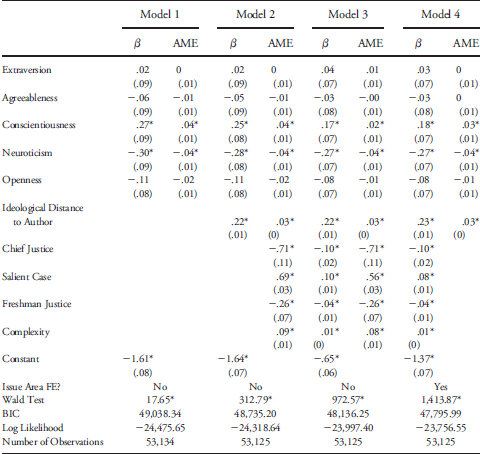
Note.—Results of multilevel logistic regression models of each justice’s decision to file a separate opinion with random effects for judge and term. β = coefficients; AME = average marginal effects. Observations are at the judge-case level. Standard errors in parentheses. Two-tailed significance tests.
* p < .05.
An Empirical Application: Personality and Passing during Conference
Next, we examine the relationship between justices’ personality traits and their propensity to pass during the Court’s conference discussion. After the Court hears oral arguments in a case, the justices meet in conference to discuss the case and cast their initial votes in order of seniority (i.e., starting with the chief justice and concluding with the newest associate justice). However, during this process, justices have the option to pass and delay casting their votes. Justices pass during the conference for both sincere and strategic reasons. First, justices may pass because they sincerely lack information about the case or they genuinely feel uncertain about their preferred outcome. Thus, passing is especially common in complex cases that combine multiple legal and policy issues (Johnson, Spriggs, and Wahlbeck Reference Johnson2005, 359). But justices also pass for strategic reasons. For example, if the Court appears likely to divide narrowly in a case, a justice may wish to discover whether his or her vote is truly pivotal for the case’s outcome and, if so, bargain over the content of the majority opinion before declaring his or her vote. If, on the other hand, the Court appears likely to vote overwhelmingly in favor of one party, a justice may pass in order to avoid dissenting alone and incurring the related collegiality costs (Epstein et al. Reference Epstein2011). These considerations suggest that personality traits should influence the decision to pass during conference.
First, justices who pass for sincere reasons must be willing to expend the care, attention, and mental resources to contemplate the various competing interests at stake in the case. Such behavior should be more common among justices who are willing to expend effort toward their goals and who feel a stronger sense of professional duty to consider cases carefully. Those justices who pass for strategic reasons must also be willing to devote cognitive resources toward that strategic calculation. Conscientiousness reflects a preference for dutifulness and industriousness, and it is associated with cautiousness, purposefulness, and deliberation (Moon Reference Moon2001, 535; DeYoung et al. Reference DeYoung2007, 881). Therefore, we expect a justice’s conscientiousness to be positively associated with passing during conference.
Second, the conference discussion is a unique opportunity for justices to interact with each other and influence each other’s decision-making. When a justice passes during conference, he or she effectively forgoes this opportunity to influence the other justices and command their attention. Extraversion reflects a desire for influence and attention, and it is associated with leadership, assertiveness, and proactiveness (Depue and Collins Reference Depue1999, 492; DeYoung et al. Reference DeYoung2007, 881; Hogan and Hogan Reference Hogan2007, 9). Therefore, we expect a justice’s extraversion to be negatively associated with passing during conference.
Finally, passing during conference may disrupt social harmony on the Court. When a justice passes, it may discourage less senior justices from utilizing the opportunity to pass; indeed, instances in which more than one justice passes in a single case are extremely rare. And, when a justice passes, whether for strategic or sincere reasons, the justice effectively conceals his or her own views of the case, which may hinder the ability of other justices to predict his or her vote and make strategic decisions. Finally, whether done for strategic reasons or not, other justices may perceive a pass as strategic behavior. For all of these reasons, passing may incur collegiality costs. Agreeableness reflects a preference for social harmony and pleasant relations with others (McCrae and John Reference McCrae1992, 196; Hogan and Hogan Reference Hogan2007, 9). Therefore, we also expect a justice’s agreeableness to be negatively associated with passing during conference.
To test these hypotheses, we extend Johnson et al.’s (Reference Johnson2005) analysis of passing during conference based on a random sample of 1,043 Supreme Court cases during the 1971 through 1986 terms. The justices’ behavior during conference was derived from the papers of Justice Lewis Powell, who served during these terms. Because special strategic considerations influence passing behavior by the chief justice and the senior associate justice (Johnson et al. Reference Johnson2005), we exclude the chief justice (either Burger or Rehnquist) and the senior associate justice (usually Douglas or Brennan) in each case. We estimated a series of multilevel logistic regression models with random intercepts for judge and term.
Following Johnson et al. (Reference Johnson2005), the dependent variable is the decision by each justice to pass (=1) or not pass (=0) during the conference discussion. The independent variables include the SCIPEs, as well as those that Johnson et al. (Reference Johnson2005) used to capture the justices’ uncertainty about their colleagues’ preferences, uncertainty about the case outcome, and the legal salience of the case. Distance to Median is the absolute value of the ideological distance between each justice and the median justice on the Court, measured as the percentage of cases in which each justice voted in a liberal direction in the same issue area in prior terms. We also include Distance to Median Squared to account for nonlinear ideological effects. Preference Uncertainty is the mean number of cases in each issue area in which the other sitting justices participated with each justice prior to the present case. Freshman Justice is a dichotomous indicator coded 1 for justices in their first term on the Court and 0 otherwise. Case Complexity is the standardized score that resulted from a factor analysis of the number of legal issues raised in the case, the number of legal provisions at issue, and the number of separate opinions filed in the case. Legal Salience is the term-specific z-score for the number of amicus curiae briefs filed in the case on the merits. Outcome Uncertainty is a dichotomous indicator coded 1 if the coalition that placed the case on the Court’s agenda was the minimum size necessary (four votes out of nine justices) and 0 otherwise. See Johnson et al. (Reference Johnson2005) for more details.
Table 3 reports results and marginal effects for the conference passing analyses. Contrary to our expectations, agreeableness is not associated with passing. However, as expected, conscientiousness is positively associated with passing, and extraversion is negatively associated with passing. Moreover, given that passing during conference is very rare, the magnitudes of these effects are quite substantial: The predicted probability of a justice passing is approximately 1.1 percent, and a 1 SD shift in each of these traits affects the probability of passing by approximately 1 percentage point. In other words, a 1 SD increase (or decrease) in conscientiousness (or extraversion) roughly doubles the predicted probability of a justice passing. Thus, SCIPEs predict passing behavior in a manner consistent with two of our three theoretical expectations.
Justice Personality and Passing during Conference

Note.—Results of multilevel logistic regression models of each justice’s decision to pass during conference with random effects for judge and term. β = coefficients; AME = average marginal effects. Observations are at the judge-case level. Standard errors in parentheses. Two-tailed significance tests.
* p < .05.
Discussion
In this article, we developed and validated estimates of the Big Five personality traits for justices on the US Supreme Court. The creation of these personality estimates raises an important question: how should scholars employ these measures (or other measures developed in the future) to better understand judicial behavior? In our empirical application, we adopted a simple approach: we drew on preexisting knowledge regarding factors that influence judicial behavior, logically linked those factors to Big Five traits, and tested the expected relationships. Although helpful for our limited illustrative purposes, such an approach faces two substantial challenges.
First, because the Big Five reflect broad trait dispositions comprising numerous facets, it is sometimes difficult to determine which facet of a Big Five trait is most relevant in a particular situation. For example, we hypothesized that conscientiousness is positively associated with passing during conference because, whether strategic or not, devising and executing this behavior requires time and effort. Yet one could also argue that strategic behavior often involves insincere decisions and deceptive communications. Because justices have a duty to be honest and sincere, one might expect conscientious justices to be less strategic because they are more dutiful. Both expectations are plausible. So how should a researcher choose which facet of conscientiousness (industriousness or dutifulness) is more relevant when developing a theoretical expectation? The extant literature suggests three possible approaches to this challenge.
The first approach, developed by Ramey et al. (Reference Ramey2017), is to conceptualize each personality trait in terms of a single “core cognitive constraint.” The authors “then draw upon these core cognitive constraints and the experimental economics literature to propose and defend a translation of the core cognitive constraint into one or more parameters useful for modeling” (15). For example, Ramey et al. conceptualize the core cognitive constraint of conscientiousness as “an increased capacity to realize planned future outcomes” (41). This understanding of conscientiousness readily lends itself to hypothesis testing. For instance, because strategic behavior is aimed at achieving desired future outcomes, conscientiousness should be positively associated with strategic behavior. And, indeed, Ramey et al. find that congressional leaders prefer more conscientious committee chairs because they are adept at strategic behavior (103). However, Ramey et al.’s approach also deemphasizes the role of dutifulness and, in doing so, may overlook important aspects of behavior related to that facet of conscientiousness.
The second approach to this problem, developed by Hall (Reference Hall2018), is to conceptualize personality traits more broadly, focusing on two key aspects of each trait (e.g., industriousness and dutifulness for conscientiousness; see DeYoung et al. Reference DeYoung2007). When the two aspects of a particular trait suggest contradictory expectations, as they do here, Hall expects “the conflicting tendencies to cancel out and predict a null relationship” (33–34). This approach permits scholars to consider a broader range of personality facets, which may have important effects on behavior. However, Hall’s approach depends on the debatable claim that conflicting tendencies will be roughly equal in magnitude. The flexibility of his approach also makes it more susceptible to bias in theory development. That is, scholars may emphasize certain facets of a trait as post hoc explanations for their empirical findings. Therefore, scholars who adopt this approach must consider the theoretical implications of each facet of a trait for the behavior under examination.
The third approach to this challenge, adopted in our analysis, is for a researcher to first make a theoretical case for an empirical expectation based primarily on one facet (e.g., conscientiousness is positively associated with passing because it reflects a willingness to exert time and effort, which is necessary for passing). Then the researcher can highlight an alternative expectation based on another facet (e.g., conscientiousness is negatively associated with passing because it reflects a duty to be honest and sincere, which discourages passing). The researcher can then conduct a statistical analysis using a two-tailed t-test in order to account for the possibility of finding results in either direction. This approach has the advantage of transparency and flexibility while still maintaining the .05 level of statistical significance that is standard in the field.
The second challenge faced by this research agenda is the difficulty of translating the meaning of Big Five personality traits into behavioral expectations for specific decision-making contexts. That is, even if a researcher adopts a very clear conceptualization of a Big Five trait, it is not always apparent how that trait should affect a given behavior. For example, assume for a moment that conscientiousness only reflects the facet of industriousness. We hypothesized that conscientiousness is positively associated with passing in the conference discussion because passing requires time and effort during the conference. However, one might argue that passing actually reflects a justice’s failure to properly consider a case’s merits before the conference. If so, passing during the conference may indicate a lack of industriousness and, therefore, should be negatively associated with conscientiousness. Thus, even if the Big Five traits are clearly defined, their implications for behavior in specific circumstances are sometimes ambiguous.
This second challenge is not specific to our measurement approach or personality psychology; instead, the problem is rooted in the sometimes ambiguous meanings and implications of specific judicial behaviors. Of course, as previously mentioned, the possibility that a personality trait might have a positive or negative association with a dependent variable in theoretically meaningful ways is the grounds for using two-tailed t-tests. Thus, standard statistical analyses should account for this issue. Ultimately, though, this ambiguity should be resolved by exploring the meaning of judicial behaviors in the minds of the justices engaged in these behaviors (and, relatedly, in the minds of justices and other key actors as they observe these behaviors). In this manner, the study of personality may prompt a more nuanced and searching examination of the justices’ behavior.
Prior studies have developed promising approaches to addressing the problems inherent in studying personality and political behavior. However, it is clear that this line of inquiry still poses substantial challenges for researchers. We hope that future studies will carefully consider the competing strengths and weaknesses of different approaches to these problems and take up the mantle to resolve these important questions.
Conclusion
In this manuscript, we (a) described how to recover estimates of judicial personality from opinion texts, (b) demonstrated that our text-based approach to measuring the justices’ personality traits yields valid and precise estimates, (c) showcased the value of these personality estimates for understanding judicial behavior, and (d) provided practical guidance for how these estimates should (and should not) be used. Not only are our results intuitive, but they are also consistent with standard characterizations of how these traits relate to psychological processes (DeYoung et al. Reference DeYoung2007; Almlund et al. Reference Almlund2011). The Big Five are associated with both separate opinion filing and passing during the conference in a manner consistent with our theoretical expectations. (SCIPEs also predict numerous other justice behaviors; see app. E.)
Moreover, the ability to recover usable personality estimates from texts subject to the constraints of legal writing is a major accomplishment. Our findings suggest the applicability of the text-based approach to the study of elite personality might be even broader than suggested by previous studies. While future work is needed to better grapple with the challenges of this approach, our results are encouraging and further support the notion that text-based measures are useful in understanding why elites choose particular tactics in pursuit of policy outcomes.



