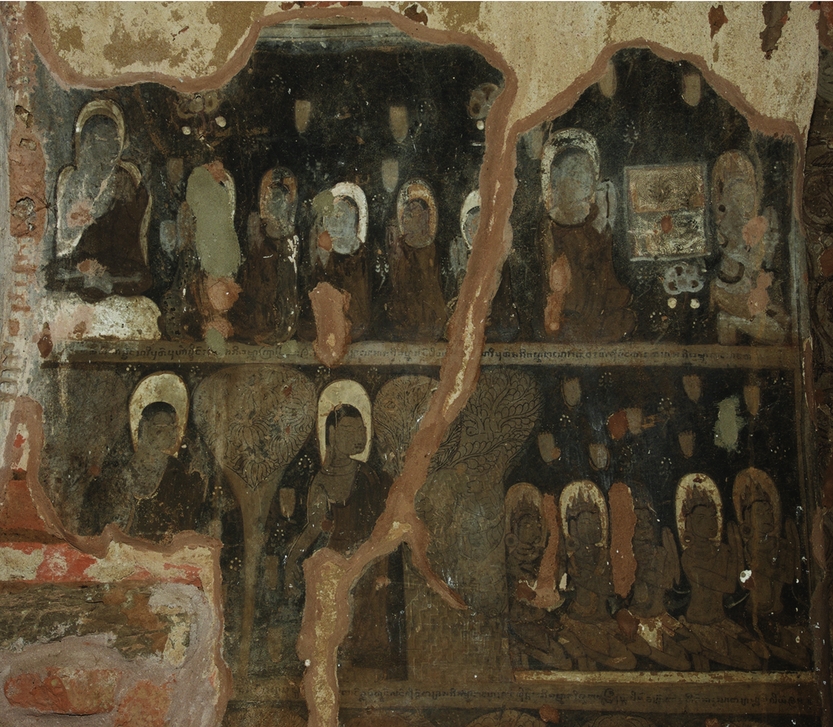
I. Introduction
Observed by modern scholarsFootnote 1 to be one of the particular characteristics of early sacred texts of Buddhism, including the complete Pāli Canon, is the lack of a complete biography of Gotama Buddha. Detailed episodes of the Buddha's life, with his activities of teaching the supreme dhamma of prime importance and other aspects of his personal life being of more limited concern, appear fragmentarily and in most circumstances not chronologically in the Pāli Suttantapiṭaka and Vinayapiṭaka. On the contrary, the stories of his previous existences as the Bodhisatta practicing pāramī, i.e. perfections, and of his reception of prophecies from the 24 previous Buddhas regarding his future enlightenment, were intricately detailed in compilations of the Jātaka Footnote 2 and Buddhavaṃsa Footnote 3 texts of the Khuddaka Nikāya. The phenomenon described reflects perception of the early Buddhist scholars about their Buddha, not mainly as a historical figure, but rather more as the ultimate destiny of a long term Bodhisatta's career. His spiritual essence – including all the knowledge of dhamma revealed by the enlightenment and taught to world beings, and the supremacy in a miraculous sense of the Buddhahood attained as a culmination of pāramī practicing from his incalculable previous existences – probably could not be adequately explained within a narrative frame of his personal biography focused only upon his last existence.
Even several centuries after the mahāparinibbāna of Gotama, when Buddhist scholars began to compile his biography in a more systematic literary form, such perception on the ‘Buddha’ remained traceable in their works. Major examples include the Nidānakathā Footnote 4 of the Pāli commentary on Jātaka, the Jātakaṭṭhakathā, (hereafter the Jātaka-nidāna) and the Lalitavistara Footnote 5 , a Sanskrit sacred text of the Sarvāstivādin Buddhist Sect. Although, these two mentioned Buddhist treatises, up until their compilations, provided the most advanced and systematic account on the matter, they do not contain a complete personal biography of Gotama from his conception to mahāparinibbāna.
The Lalitavistara begins with the Bodhisattva’s requisites to ‘Buddhahood’, from the time of his pāramī practicing during previous existences to when he achieved a status of the chief deva in the Tusitā Heaven. With all four conditions for the last rebirth of the Bodhisattva being fulfilled, he was reborn as Prince Siddhārtha. The story then continues chronologically on the detailed episodes of his final life up to his enlightenment and preaching of the first sermon to a group of the five monks, the Bhadravaggiyā (in Pāli, Pañcavaggiyā).
The Jātaka-nidāna divides the Buddha's biography into three parts: Dūre-nidāna, Avidūre-nidāna and Santike-nidāna. The first part provides an account of the Bodhisatta's past existences, beginning from when he was the Hermit Sumedha receiving a prophecy for his enlightenment to come from Buddha Dipaṅkara. This prophecy was subsequently confirmed by the following 23 Buddhas. After the Bodhisatta's career over a period of four incalculables plus one hundred thousand eons had been completed, he was reborn a chief deva in the Tusitā Heaven. The second part narrates the Buddha's story since his departure from a celestial status for his rebirth as Prince Siddhattha up to the very moment of his enlightenment. The last part provides the Buddha episodes from immediately after enlightenment, with his meditation retreat during the first ‘Seven-Weeks’ fully described, up to his acceptance of the Jetavana monastery donated by the rich man of Sāvatthi, Anāthapiṇḍika, in the third year after enlightenment.
A major characteristic shared by these early sacred treatises on the Buddha's biography is their provision of an account on the Bodhisatta’s accumulation of pāramī during his past existences and of detailed episodes in his last existence up to the enlightenment, the most supreme destiny for Buddhist salvation. Neither sacred treatise attempts to provide his subsequent life episodes up to the mahāparinibbāna, as would be expected for a complete biography of the Buddha as a historical figure.
It was much later that the genuine complete biography of Gotama Buddha was first compiled in a literary form, with Jinālaṅkāra the earliest known in Pāli. This treatise comprising the well-organised and beautiful verses was composed in Sri Lanka by Buddharakkhita Thera during the mid-twelfth century.Footnote 6 Later literary accounts of the complete biography of Gotama are numerous in the Buddhist world. Worthy of mentioning here, for a comparison between different Theravādin traditions of Southeast Asia, are the two widely known groups of vernacular texts: one comprising ‘Malālamkāravatthu’ and ‘Tathāgataudanadīpanī’Footnote 7 – prevailing in Burma in particular and representing the Burmese tradition; and, the other, ‘Paṭhamasambodhi’, probably originated in the former Lānnā Kingdom in Northern Thailand and gaining its popularity in various parts of Southeast Asia.Footnote 8
With the Theravādin orthodoxy of our primary concern, these vernacular Buddhist texts might not be adequately perceived as genuinely innovative, solely accomplished by any particular Buddhist scholar of any particular period of time. On the contrary, they may be a final product of collective acquisition and systematisation of detailed episodes in the life of the Buddha, the work probably gradually accomplished by several generations of conservative Buddhist scholars.Footnote 9 Our insight into the development of such ‘later’ texts, therefore, could not be solely reached by acquiring our knowledge on their last authorships and dates of compilation. We needed, also, to shed light about the cultural and literary contexts of the period in which the Buddhist narratives of concern had gradually been developed long prior to their last literary compilation. Such understanding certainly demands analysis of evidence which is extra from the literary one, particularly the narratives of the Buddha's life which appear in dateable local art forms that are older than the corresponding texts.
An analysis of such is provided in this article, with particular reference to the Buddhist murals found at Pagan and dating from its Dynastic Period (eleventh to thirteenth centuries ce). Life episodes of Gotama portrayed in the Pagan murals are subject to investigation for their associated tradition, development and relationship with older Buddhist texts. Their relationship with the development of later literary counterparts representing different Theravādin traditions of Southeast Asia, the ‘Malālamkāravatthu-Tathāgataudana’ and the ‘Paṭhamasambodhi’, is aimed to be elucidated. The more intimate relationship of the Pagan murals narrating the Buddha's life with the first group of texts, also representing the Burmese tradition of the same subject, is hypothesised.
II. Biography of Gotama Buddha in Pagan murals
Attempts of the artists to adorn the interior of the cave temples (gu-hpaya) that dotted the landscape of Pagan with the murals illustrating the life history of Gotama probably began in the late-eleventh century, during the early part of the Pagan Dynastic Period. This mural practice had persisted and been developed more elaborately until the late thirteenth century, at the twilight of the Pagan civilisation. Combining textual influence from Sri Lanka with iconographic and stylistic inspirations derived from the Pāla arts of Northeastern India was a major characteristic of the Pagan mural tradition since its beginning. Developed during the thirteenth century at Pagan was also a mural tradition that employed unique iconography and organisation to symbolise the cave temples for enshrinement of the Buddha image with the Buddhist concepts of cosmology and geography.
Early Pagan murals:
Adorning the shrine and its surrounding ambulatory corridor of the Pagan temple 1605 (Patho-hta-mya), located within the wall enclosure of the Old Pagan City, are probably the oldest surviving Buddhist murals of the Pagan Period which illustrate the biography of the Buddha. The foundation date of this Buddhist monument as well as its murals, which were likely contemporaneous with each other, has been proposed by the doyen of Pagan studies, Professor Gordon H. Luce, to be in the second half of the eleventh century, based upon the usage of Old Mon captions and the Sinhalese reference sources for the mural narratives.Footnote 10 Surviving mural captions that remain legible in the shrine hall and on outer walls of the temple's ambulatory corridor were meticulously deciphered by Luce and his colleagues, and appear in his magnum opus, ‘Old Burma - Early Pagan’. Footnote 11 Mural scenes on the inner walls of the temple's ambulatory corridor, however, have no original ink-captions accompanying them, thus making this mural series the most enigmatic of all in this temple.
Narrative murals on the outer walls of the ambulatory corridor of temple 1605 are organised clockwise in a chronological order along the passage walkway, with the mural series beginning on S-section of E-corridor immediately after the entrance into the corridor, and ending on N-section of E-corridor immediately before the same entrance. The mural series probably continues on the inner walls of the ambulatory corridor under a parallel clockwise arrangement.
Luce suggested that the first three scenes of the mural series on the outer walls of the ambulatory corridor of the temple, badly preserved with no original ink-glosses on them surviving, illustrate the Buddha's early episodes prior to his nativity, probably the conception included. It is truly likely that the ‘conception’ was represented in either the second or the third scene, with illustration in the first scene reserved for the celestial Bodhisatta in the Tusitā Heaven considering the right time and place for his last rebirth as a human being, as narrated in the Avidūre-nidāna section of the Jātaka-nidāna. The scenes that follow, from the fourth on, of the outer-wall series can be identified according to Luce's translation of their original ink-captions, and also to their suggestive iconography, as follows: Nativity, prophecy of Kāladevila, examination of the eight Brahmans on the Babe Bodhisatta's auspicious signs, miracle at the rose-apple tree, boat racing, archery contest, Bodhisatta with attendants, Bodhisatta seeing the Four-Omens while on his way to the garden, Bodhisatta in the garden with the barber (deva), returning from the garden, his meeting on the way back to the palace with Princess Kisāgotamī who praises him and receives from him a gift of pearls, Bodhisatta in the palace seeing the nautches, Departure, Tonsure, his stay at (Anupiya?), collecting alms in the city of Rājagaha, the visit of King Bimbisāra, Bodhisatta among the hermits, Sujātā offering the cow's-milk rice to the Bodhisatta, Bodhisatta eating the cow's-milk rice and casting the bowl into the river, and Bodhisatta on his approach to the Bodhi-tree. The narrative series agrees closely with the Jātaka-nidāna accountFootnote 12 , most likely an immediate source for the murals.
Controversies arose among opinions of prominent scholars in the fieldFootnote 13 as to the meaning of the 28 mural panels on the inner walls of the ambulatory corridor of Pagan temple 1605 (six panels each in E- and W-corridors and eight panels each in S- and N-corridors), with neither the chronological connection in a systematic manner among the scenes nor their continuation from the mural series on the outer walls of the ambulatory corridor suggested by any of them. Below, an alternative interpretation is provided for the meaning of these mural scenes, emphasising their chronological connection as well as their direct continuation in terms of narrative from the scenes of the outer-wall series. Together, both mural series form a complete narration on the Buddha's biography, from his conception to mahāparinibbāna.
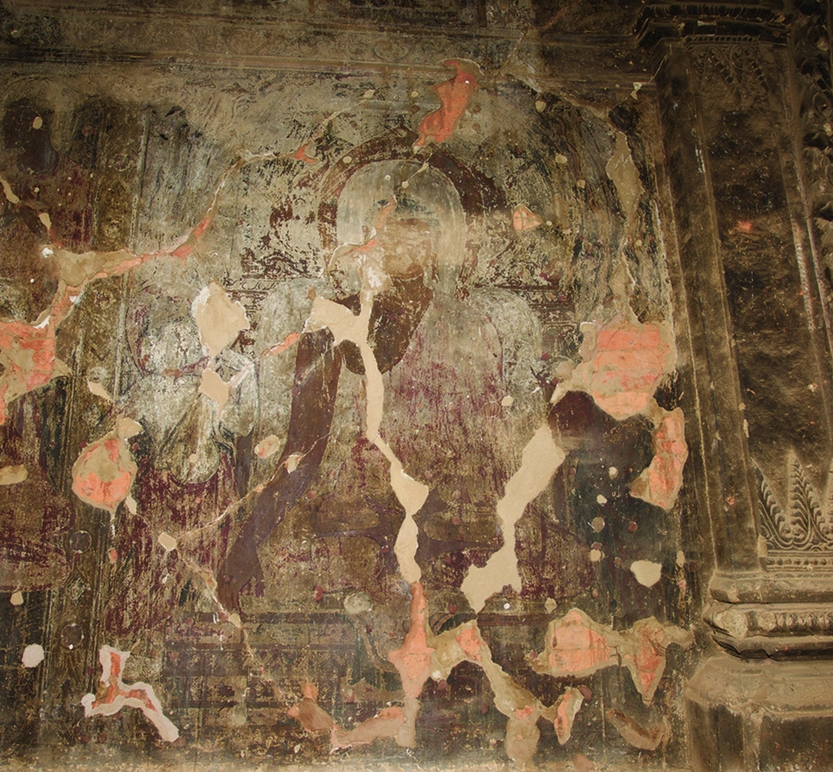
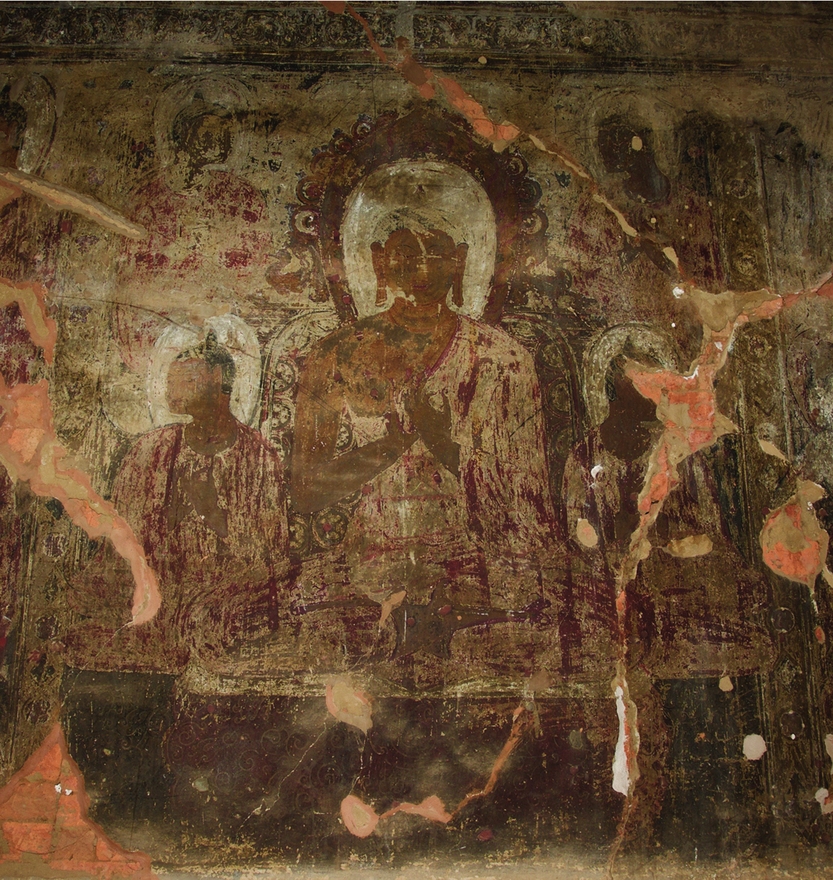
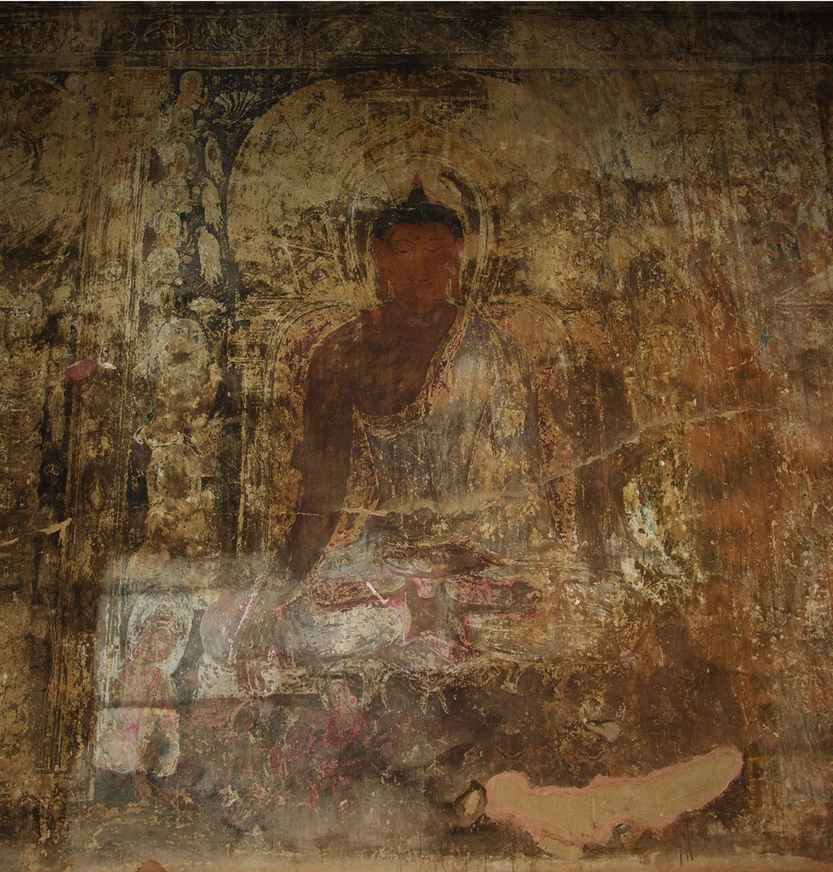
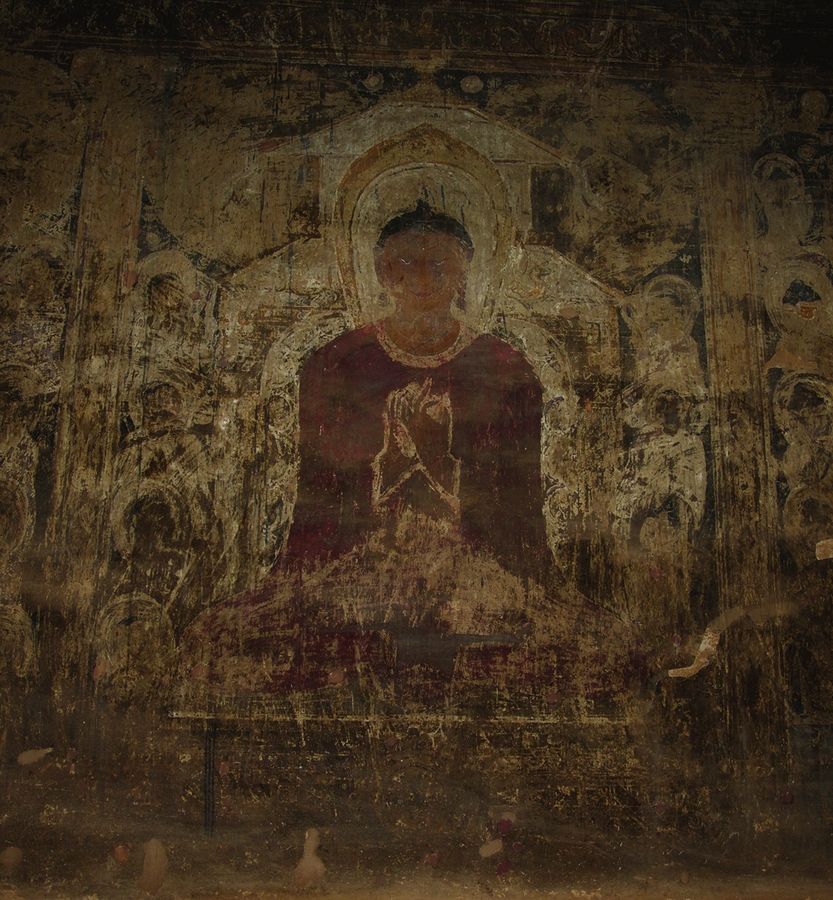
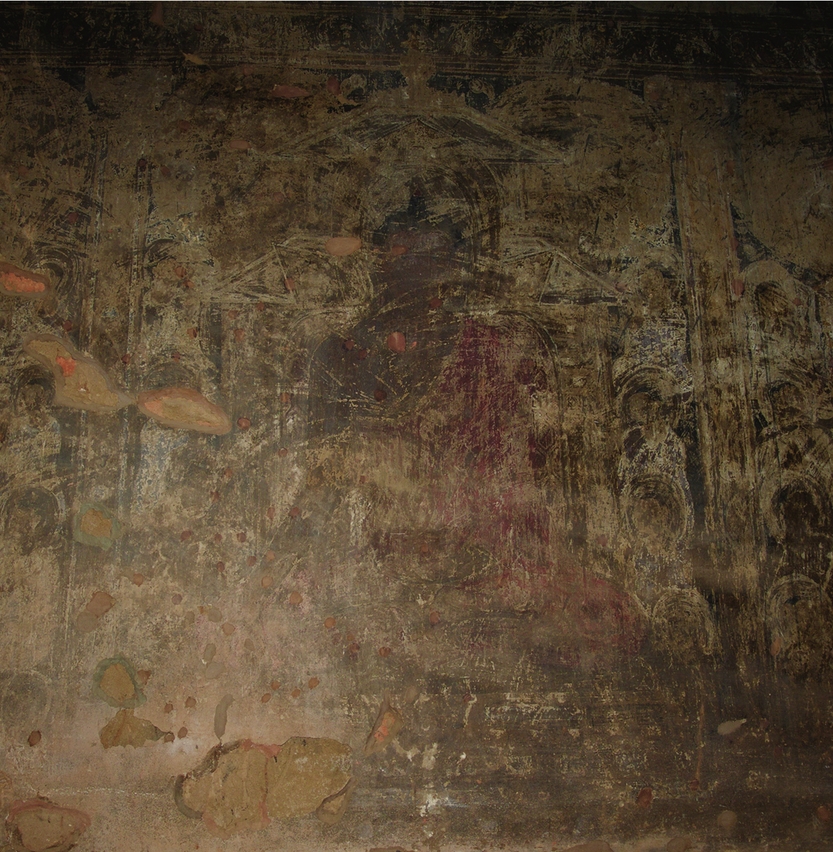
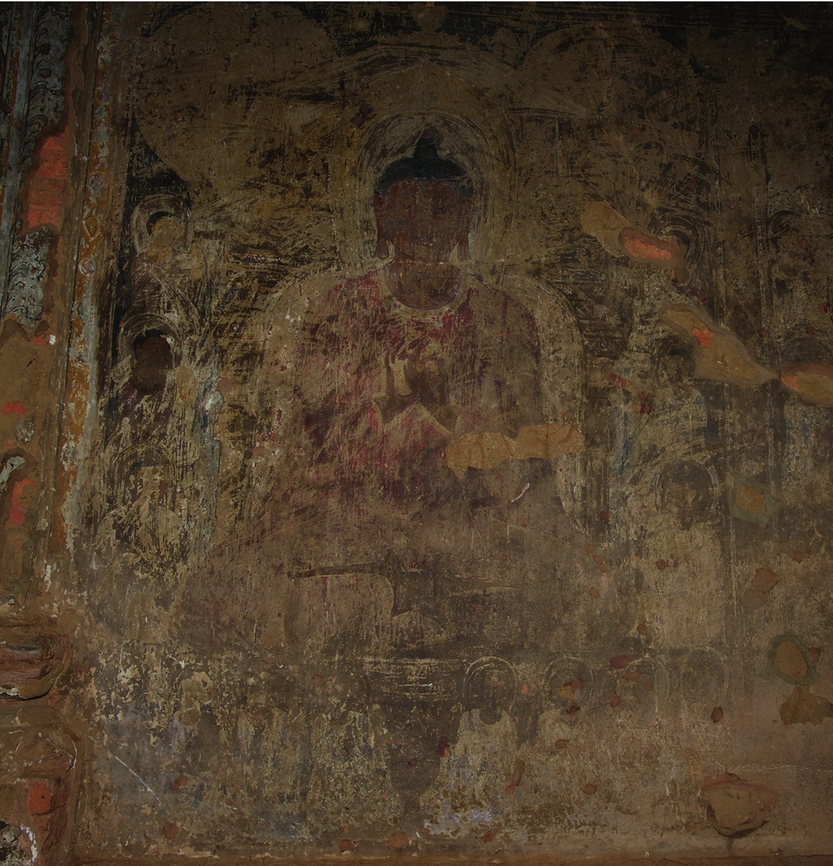
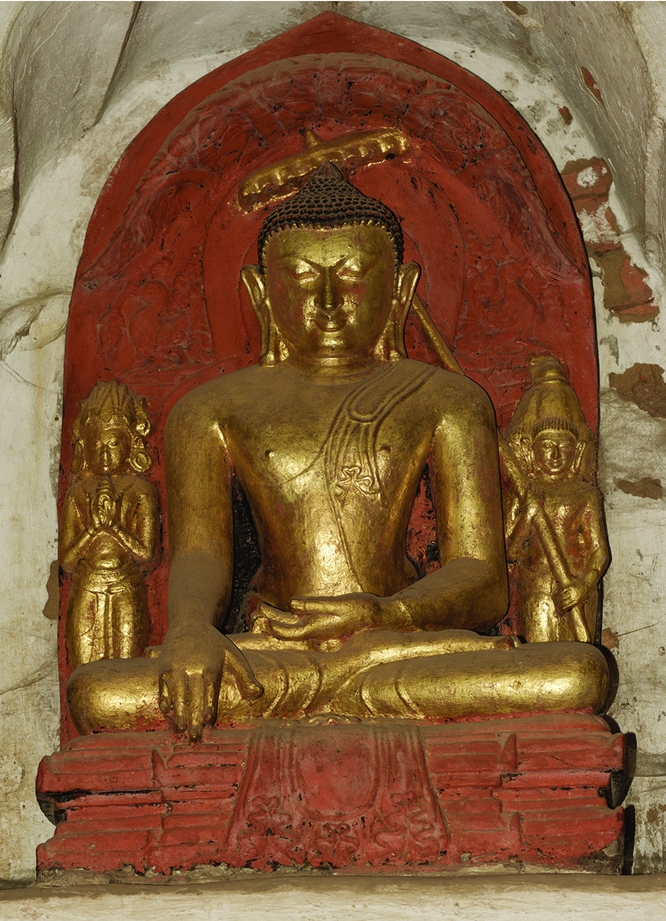
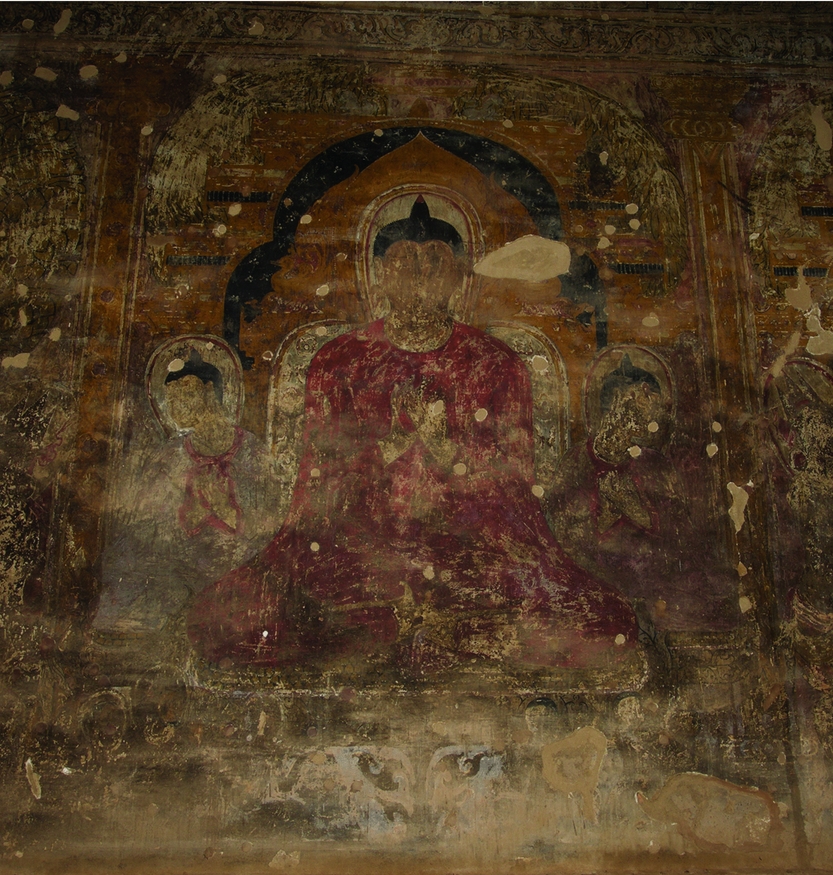
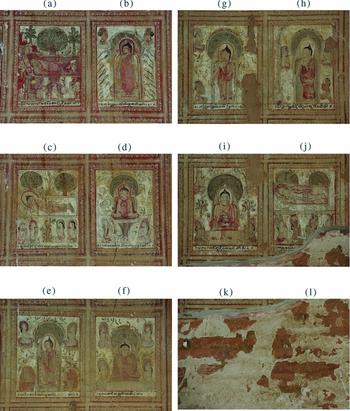
Buddhist narratives can be clearly identified for the first eleven scenes of the inner-wall series (three on S-section of E-wall and eight on S-wall), based on their iconographic compositions (Figures 1–11). Located on S-section of E-wall immediately after the entrance passage to inside the shrine, the first scene of the series portrays a large icon of the seated Buddha in his earth-touching gesture, flanked on both sides by the two deities: to the right of the Buddha, God Brahma is holding a parasol; and, to the left, God Sakka is blowing his auspicious conch-trumpet, Vijayuttara. This iconographic composition is commonly seen in the Pagan art to represent the Buddha's enlightenment. Another Pagan example under the same iconographic composition can be seen representing this very moment of the Buddha in the series of the early-twelfth century stone-relief sculptures enshrined in the niches on the outer walls of the outer ambulatory corridor at Pagan temple 2171 (Ananda-gu-hpaya-gyi) (Figure 12). This Ananda series of the Buddhist sculptures also narrates a detailed biography of Gotama, chronologically in agreement with the Jātaka-nidāna account.Footnote 14 The first mural scene of the inner-wall series of the temple 1605’s ambulatory corridor is, therefore, a direct continuation from the last scene of the outer-wall series portraying the Buddha on his approach to the Bodhi-tree prior to his enlightenment.
Enlightenment and first-week meditation after the enlightenment, 1st panel, inner-wall series, S-section of E-corridor, Temple 1605 (Patho-hta-mya).

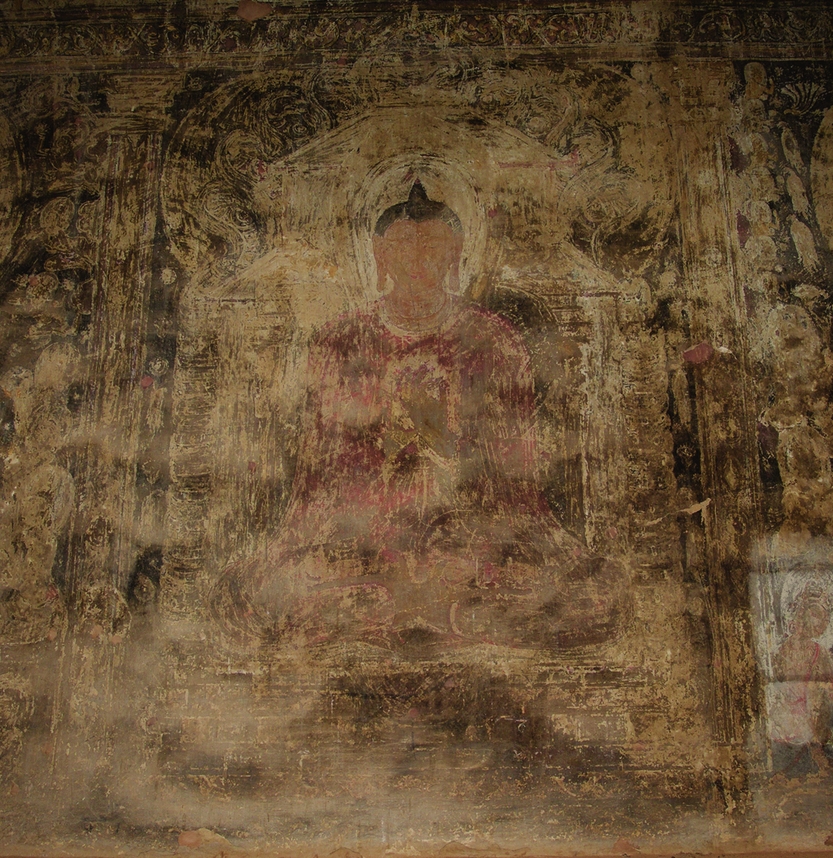
Twin miracle at the beginning of the second week after enlightenment, 2nd panel, inner-wall series, S-section of E-corridor, Temple 1605.
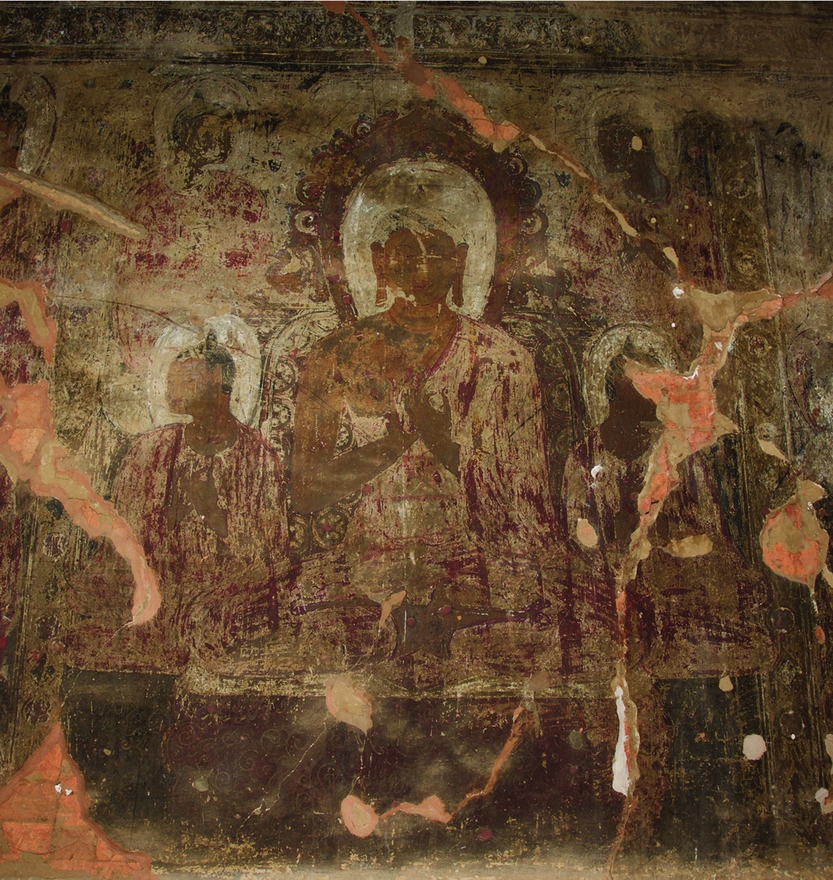
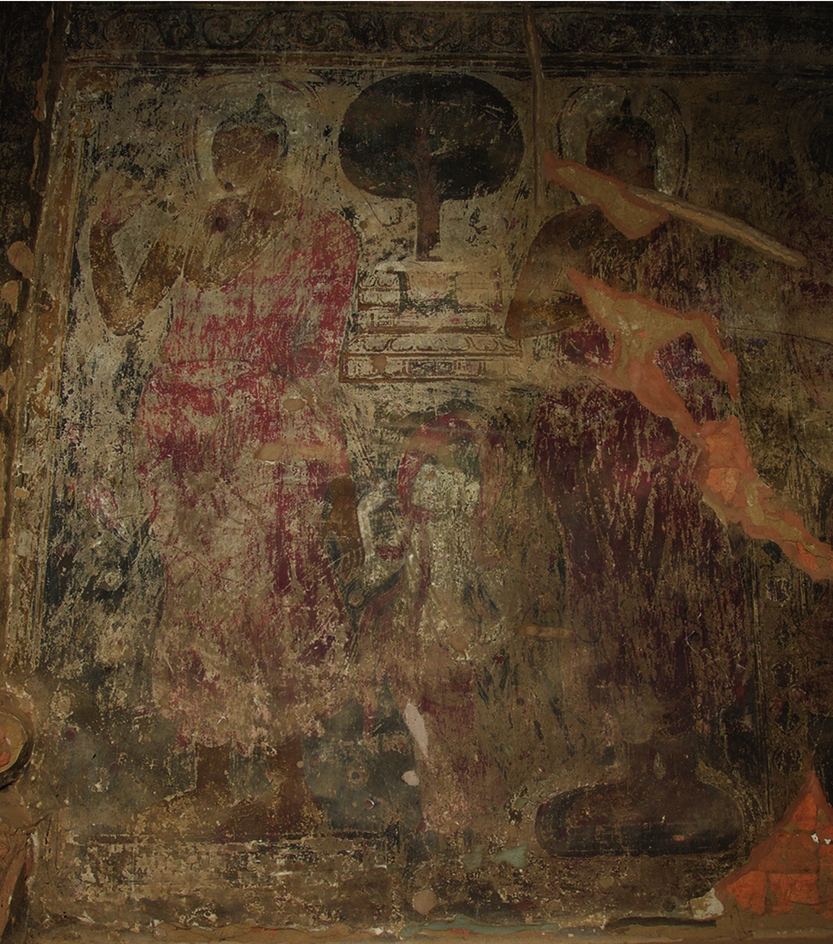
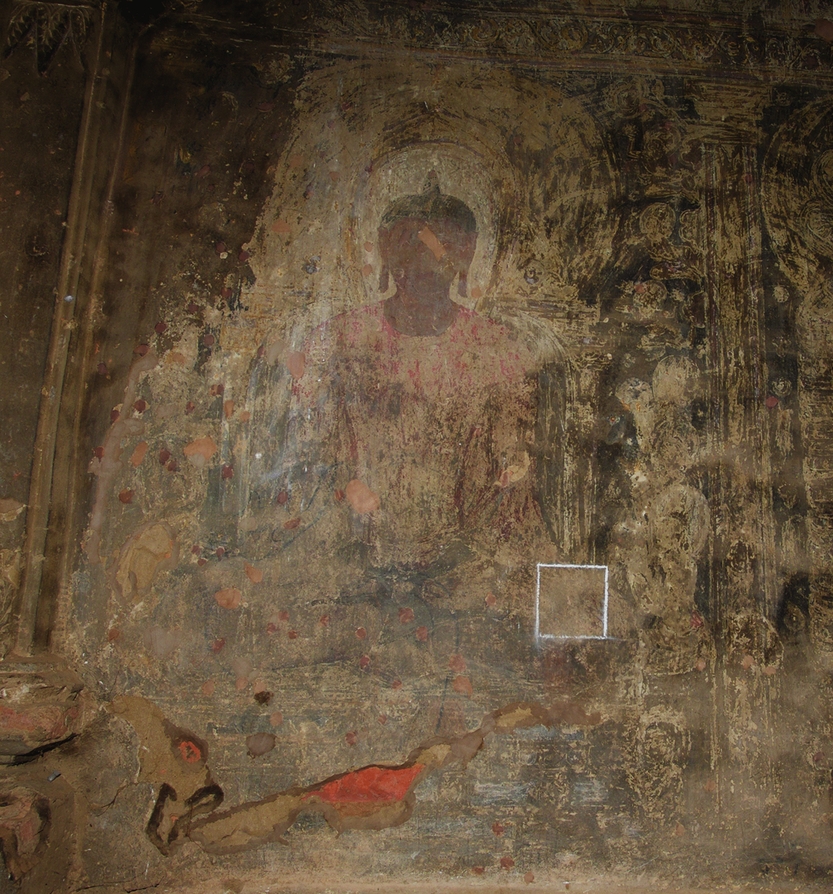
Animisa Cetiya (right) in the second week, and RatanacaṅkamaCetiya (left) in the third week, 3rd panel, inner-wall series, S-section of E-corridor, Temple 1605.

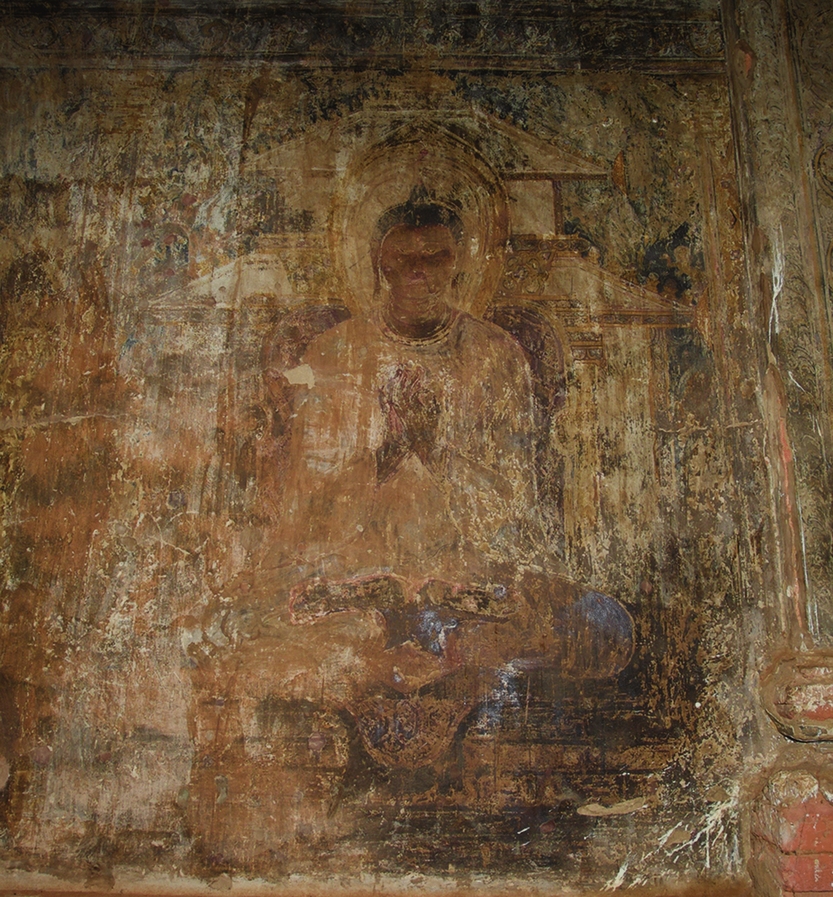
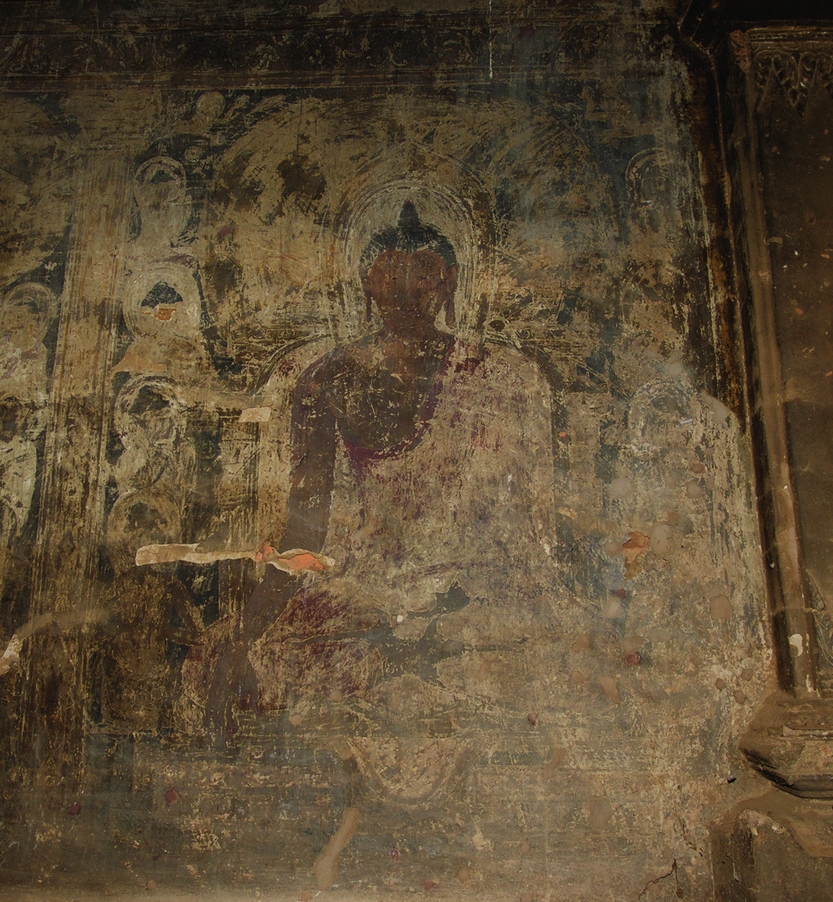
Ratanaghara-cetiya in the fourth week, 4th panel, inner-wall series, E. section of S-corridor, Temple 1605.
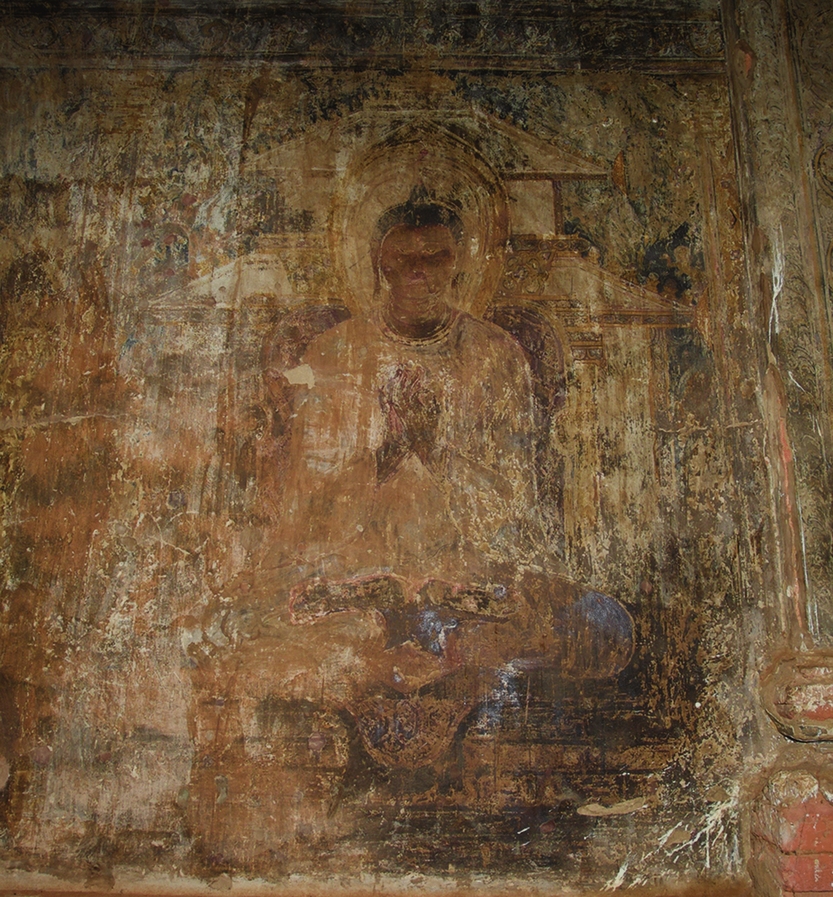
Ajapāla-nigrodha in the fifth week, with Māra and his three daughters in the lower part of the scene, 5th panel, inner-wall series, E-section of S-corridor, Temple 1605.

Mucalinda, the Buddha is protected by the Nāgā king, in the sixth week, 6th panel, inner-wall series, E-section of S-corridor, Temple 1605.

Rājāyatana in the seventh week, 7th panel, inner-wall series, E-section of S-corridor, Temple 1605.

Sahampati Brahma God inviting the Buddha to preach to the world, 8th panel, inner-wall series, W-section of S-corridor, Temple 1605.

First sermon at Isipatana Forest, 9th panel, inner-wall series, W-section of S-corridor, Temple 1605.

Preaching to Yasa and his friends at Isipatana Forest, 10th panel, inner-wall series, W-section of S-corridor, Temple 1605.

Preaching to Bhadhavaggiyā monks on the way to Uruvera, 11th panel, inner-wall series, W-section of S-corridor, Temple 1605.

Enlightenment of the Buddha, niche on S-section of the outer-wall near SW-corner, outer ambulatory corridor, Temple 2171 (Ananda-gu-hpaya-gyi).

The second scene of the inner-wall series demonstrates the Buddha in his yamaka-pāṭihāriya episode (the twin miracle), with the multiplication of his body shown under a symmetric composition that is also commonly seen in its proto-type in the Pāla art of Northeastern IndiaFootnote 15 . This particular scene has been suggested by the scholars of Pagan arts as the ‘Twin Miracle at Sāvatthi’Footnote 16 in the seventh year after the Buddha's enlightenment. In keeping with this interpretation, the scene seemed ‘out of its place’, in the sense of its chronological connection with the preceding and following scenes.
The third panel of the series depicts two episodes of the Buddha: on the right half of the panel, he is gazing at the enlightenment throne under the shade of the Bodhi-tree during the second week of his retreat after enlightenment at Animisa-cetiya; on the left half, he is walking in meditation during the following week at Ratanacaṅkama Cetiya.Footnote 17 It seems obvious that scenes of the first three panels of the inner-wall series were arranged chronologically clockwise as follows: the Buddha's enlightenment and his first-week meditation on the throne of enlightenment combined in the first panel; the twin miracle performed by the Buddha to declare his Buddhahood to doubting divine-beings at the beginning of the second week, as narrated in the Jātaka-nidāna text, in the second panel; and, his episodes at Animisa-cetiya and Ratanacaṅkama Cetiya in the second and third weeks chronologically shown together in the third panel.
The fourth to seventh panels of the inner-wall series show the scenes of the Buddha, absolutely compatible on an iconographic ground with his episodes during the meditation retreat after enlightenment, from the fourth to the seventh weeks. The Buddha seated in the Jewel House, Ratanaghara, during his fourth-week meditation, is portrayed in the fourth panel. Below the Buddha in a scene of the fifth panel – representing his episode at the Ajapāla-nigrodha Tree in the fifth week of his retreat – is a depiction of the seated Māra together with his three daughters, who tempted the Buddha. This is in absolute agreement with a narration in the Jātaka-nidāna. The seated Buddha in a pavilion protected by the Nāgā King shown in the sixth panel could not be anything else except the Buddha during his sixth-week meditating at Mucalinda, a place of the Nāgā King. The scene shown in the seventh panel, with the Four Guardian Gods flanking the Buddha on both sides, each offering him a bow (for the Buddha to accept alms from the two merchants, Tapussa and Bhallika) conforms to the standard iconography in Pagan arts for the Buddha episode at the Rājāyatana Tree during the seventh week of his retreat after enlightenment.
With scenes of the first seven panels of the inner-wall series properly identified in a chronological context in absolute agreement with the Jātaka-nidāna, the following scene of the seated Buddha in his teaching gesture flanked on both sides by Brahma Gods could be interpreted, according to the same text, as an invitation by the Sahampati Brahma God for the Buddha to preach the Supreme Noble Truths to world beings. The scene of the ninth panel shows the teaching Buddha with attendants, among whom five monks are included, making it likely to represent the first sermon of the Buddha to a group of the five monks, the Pañcavaggiyā, at the Isipatana Forest. Compositions similar to the ninth panel are adopted for the tenth and eleventh panels, however, with more than five monks included among the Buddha's devotees in each. These two scenes probably represent preaching of the Buddha to a young man, Yasa, and his friends at the Isipatana Forest, and to a group of the Bhadhavaggiyā monks on his way to Uruvera, as narrated chronologically after the episode of his first sermon in the Jātaka-nidāna.
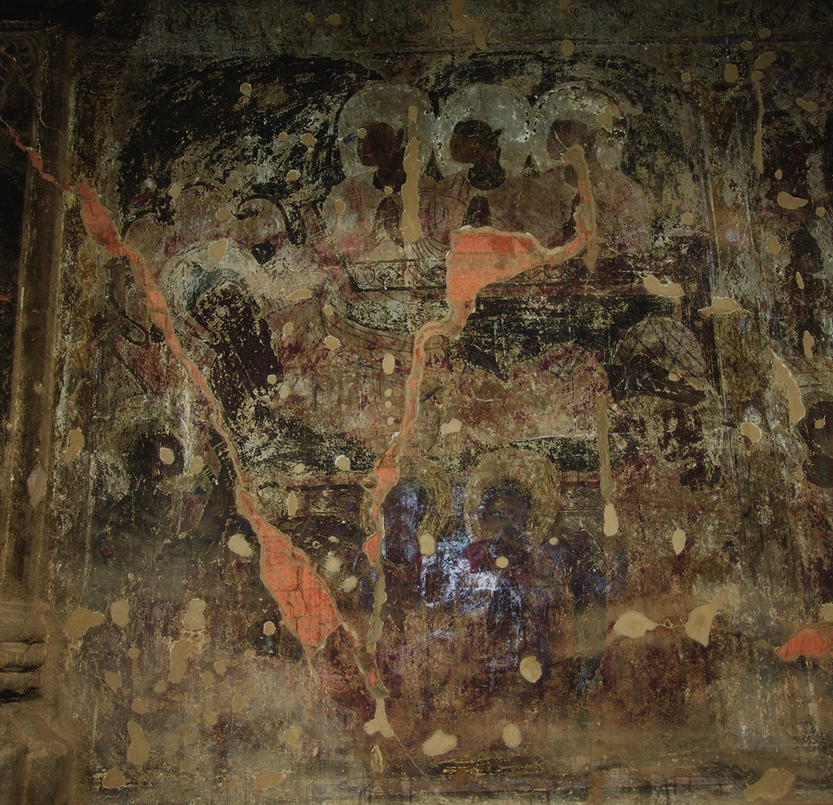
The following scenes of the inner-wall series (from the twelfth to twenty-eighth panels), each with the Buddha as the main icon attended by devotees, would represent his various life episodes, arranged chronologically in continuation from the first eleven panels already identified. Most of the scenes, however, do not have their meaning easily conveyed on an iconological ground, except the 23rd and 28th (last) scenes of the series depicting one of the Buddha's twin miracles, either at Kabilavatthu or Sāvatthi (Figure 13), and the Buddha's mahāparinibbāna (Figure 14). It is likely that several scenes toward the end of the inner-wall series may illustrate life episodes of the Buddha chronologically beyond that accounted for in the Jātaka-nidāna. This narrative extension from the Jātaka-nidāna makes the Buddha's biography illustrated in the corridor murals of the Pagan temple 1605 complete in its own way, with his episodes from the conception to the mahāparinibbāna described. Given its date in the late-eleventh century, this mural representation of a complete biography of Gotama Buddha predates its earliest known literary counterpart in Pāli, Jinālaṅkāra, compiled in Sri Lanka in the mid-twelfth century.
Yamaka-pāṭihāriya either at Kabilavatthu or Sāvatthi, 23rd panel, inner-wall series, E-section of N-corridor, Temple 1605.

Mahāparinibbāna, 28th (last) panel, inner-wall series, N-section of E-corridor, Temple 1605.

The walls of the main shrine at temple 1605 are adorned with panels of captioned murals depicting life episodes of Gotama after his enlightenment. Organisation of these complicated shrine murals, with guidance provided by legible inscriptions in Old Mon, has been pursued by Luce (Reference Luce1969) Footnote 18 . Some post-enlightenment episodes of the Buddha, following his ‘Seven-Weeks’ retreat after enlightenment, are portrayed chronologically, most likely according to the Jātaka-nidāna, in the murals of the lowest tier. Other episodes of the Buddha beyond what the Jātaka-nidāna had described are portrayed on the uppermost part of the shrine walls. Surviving scenes of this uppermost set comprise the conversions of some prominent disciples of the Buddha, probably not arranged chronologically, and the detailed episodes leading up to, and beyond, the Twin Miracle at Sāvatthi. There are another two sets of well-organised mural scenes located in the middle part of the shrine walls. The first set is for circumstances when the Buddha laid down various Vinaya rules for the Saṅgha, and the second when he preached various Suttas. The names and grouping of the Suttas and Vinaya rules agree with the Sinhalese Pāli Canon.
Depiction of the Buddha's episodes with several narrative themes included – i.e., a chronological series from the Jātaka-nidāna, the Buddha's preaching of various suttas and laying down of the Vinaya rules, and some other miscellaneous episodes which are not necessarily arranged chronologically, is also evident in the Pagan temple 1323 (Myinkaba Kubkyauk-gyi) with its construction attributed to Rājakumār in the first half of the twelfth centuryFootnote 19 . At the Pagan temple 1192 (Naga-yon-hpaya), probably dating from the reign of Kyanzittha in the late-eleventh century, with its complicated mural organisation not yet fully understood, mural themes of the Buddha's preaching of various Suttas and of his miscellaneous episodes are portrayed in the corridor muralsFootnote 20 . Another example of early Pagan murals for Buddha's preaching of various Suttas and laying down of the Vinaya rules, in close agreement with the Sinhalese Pāli Canon, is also found at the Pagan temple 374 (Alopyi-hpaya)Footnote 21 , also tentatively dated within the first half of the twelfth century.
‘Eight Great Miracles’ and ‘Seven Stations’ for a retreat of the Buddha
No later than the mid-twelfth century, a new narrative theme was introduced into the Pagan mural tradition for illustrating a set of the Buddha's major life episodes from his nativity to mahāparinibbāna. These are known collectively as the ‘Eight Great Miracles’ and are clearly associated with the Mahayana belief and arts of Northeastern India during the Gupta and Pāla Dynasties.Footnote 22 The ‘Eight Great Miracles’ of the Buddha known at Pagan, which took place at different localities within the middle country of the Indian Continent, Jambudīpa, comprise the following: nativity at Lumbinī, enlightenment at Bodhgaya, first sermon at Varanasi, Twin Miracle at Sāvatthi, descent from the Tāvatiṃsa Heaven at Saṅkassa, taming the Nālāgiri elephant at Rājagaha, the monkey's donation at Kosambī,Footnote 23 and mahāparinibbāna at Kusinārā.
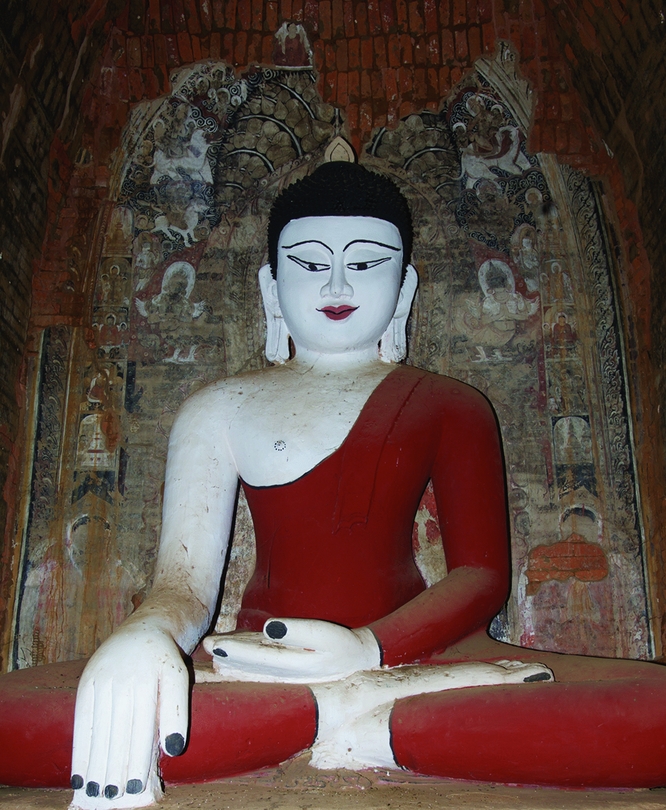
The oldest surviving mural at Pagan that illustrates the ‘Eight Great Miracles’ theme is evident on the back wall of the shrine of the Pagan temple 1580 (Loka-hteik-pan), dating from the early twelfth centuryFootnote 24 . It serves as a background for the principal Buddha image of the shrine. Similar murals of the same iconographic composition are portrayed in the same architectural context at Pagan temples 2103 and 2157 (Figure 15). The seven miracles of the set, with the enlightenment episode excluded, are arranged bordering the semi-oval frame for the principal Buddha image in each of the temples. This cult image represents the most important miracle of the set, the enlightenment of the Buddha at the Bodhi-tree. A proto-type of such composition is evident in the older Pāla art for the ‘Eight Great Miracles’, for example, on a gigantic stone sculpture now enshrined at Jagdispur near Nalanda.Footnote 25 Probably earlier than the mural representation, the Pagan artists also had the iconography of the ‘Eight Great Miracles’ illustrated on the clay votive tabletsFootnote 26 and the miniature plaques carved in high-relief on a soft stone, pyrophyllite, known in Burmese as the ‘andagu’.Footnote 27
Eight Great Miracles of the Buddha from Temple 2157; left (from top to bottom): taming of the Nālāgiri elephant, yamaka-pāṭihāriya, and Pārileyya; right (from top to bottom): descent from Tāvatiṃsa Heaven, first sermon, and Nativity; top, mahāparinibbāna (largely eroded).

Although the Pagan artists seemed to be conservative in presenting the ‘Eight Great Miracles’ according to the older Indian proto-types for them, it is noteworthy that the monkey's donation scene, included in the set, appears invariably in the Pagan arts also with an elephant figure (probably for the scene to represent the Pārileyya episode of the Buddha according to the Pāli Dhammapada commentary).Footnote 28 This seems to deviate from most (if not all) of the known Pāla prototypes for the scene, i.e., those without an elephant figure.Footnote 29 To a certain extent, this observed phenomenon suggests a preference of the Pagan artists towards the Pāli references. Other miraculous events of the set can also find their corresponding sources in the Pāli commentariesFootnote 30 , though the latter do not incorporate these particular miracles to form a coherent set. Perhaps the Pagan artists, albeit deriving the form of the ‘Eight Great Miracles’ directly from the Indian iconography, had perceived their merit works under the Pāli textual meaning.
Theme of the ‘Eight Great Miracles’ had gained popularity in the Pagan mural tradition until the late thirteenth century, at the twilight of the Pagan civilisation. Scenes of the set in the thirteenth century murals at Pagan are either distributed on side walls of the temple shrine flanking the principal Buddha image or located in the shrine's vestibules. In the latter circumstance, the ‘Eight Great Miracles’ scenes are usually paired with those of the Buddha's meditation during his ‘Seven Weeks’ retreat after enlightenment. The rule is strictly kept for the shrine's principal Buddha image to represent the enlightenment and the first-week meditation of the Buddha at the Bodhi-tree, thus the mural representations of these two important Buddha's episodes are dispensable and omitted.
Normally, scenes of the ‘Eight Great Miracles’ and the ‘Seven Weeks’ of the Buddha's retreat are distributed in the south, west and north vestibules of the east-facing temple. A pair of the equally-sized scenes, one from the ‘Seven-Weeks’ episodes and the other from the ‘Eight Great Miracles’, is located on each of the vestibule walls, with the ‘Seven Weeks’ scene always located on the inner side (closer to the Principal Buddha image of the shrine) and the ‘Eight Great Miracles’ scene on the outer side (closer to the temple's exterior) of each wall. The number of the scenes totals six for each mural set in the three vestibules mentioned. The extra-scene from the ‘Eight Great Miracles’, the mahāparinibbāna of the Buddha, is either omitted or portrayed at the apex of the anterior vestibule wall facing the principal Buddha image of the shrine. Examples of such mural organization can be seen in Pagan temples 447 (Le-myet-hna-hpaya), 534 (Sa-pwe-tin), 539 (Tayok-pyi-hpaya-gyi), 664 (Ma-la-phyi-hpaya) and 676 (So-hla-wun-hpaya), all located in the proximity of the modern Minnanthu village, about two miles east of the Old Pagan City.
In this organisation, the ‘Seven Weeks’ episodes are synchronised with the ‘Eight Great Miracles’ of the Buddha within a spatial context of the temple. The enlightenment and the first week's meditation of the Buddha, both taking place at the Bodhi-tree, are signified by the principal Buddha image occupying the shrine's centre. This centre of worship is surrounded in the inner circle by scenes of the Buddha at the other six retreat stations, all located within the vicinity of the Bodhi-tree, and in the outer circle by scenes of the Buddha's Great Miracles at the localities distant from the Bodhi-tree, but still within the Middle Country, Majjhimadesa, of the Southern Great Continent, Jambudīpa. The symbolism, thus, suggests the Pagan temple to represent the Middle Country of Jambudīpa, with its centre marked by the Bodhi-tree, the place of the Buddha's enlightenment.Footnote 31
It is noteworthy that the symbolism just described had not yet been developed in the murals of the Pagan temple 1605 (Patho-hta-mya), dating most likely from the late-eleventh century. Several of the Buddha episodes from the ‘Eight Great Miracles’ are lacking in the mural scenes of this temple, i.e. descent of the Buddha from the Tāvatiṃsa Heaven, taming of the Nālāgiri elephant, and the Pārileyya; thus, a connection between this set of murals and the ‘Eight Great Miracles’ is unlikely to be established.Footnote 32 Also, a complete set of the ‘Seven Weeks’ scenes is portrayed in this temple in an exact chronological connection with scenes of the Buddha's life preceding and following the episodes of focus, suggesting its main function to be narrative rather than symbolic operating in a spatial context of the temple.
Other Late Pagan murals
Late Pagan murals of the thirteenth century, which illustrate the biography of Gotama Buddha, can be seen in a number of brick temples that densely dot the landscape of the Pagan Plain. They illustrate the combination and further development of the earlier narrative mural themes in the Pagan arts already discussed, i.e., a chronological series from the Jātaka-nidāna and its extension (to cover a complete biography of the Buddha), the miscellaneous episodes of the Buddha, and the ‘Eight Great Miracles’ derived from Northeastern India.
In one of the development trends worthy of note, with major examples found in Pagan temples 85 (Thein-mazi), 658 and 659 (Winido-hpaya), various scenes of the Buddha episodes were grouped in each of the temples to represent their corresponding geographic localities. Although symbolically comparable with the mural organisation described above for presentation in the temple of the ‘Eight Great Miracles’ vis-à-vis the ‘Seven Stations’ scenes, this rather innovative mural organisation, evident in the three mentioned temples, includes a greater variety of the Buddha episodes.
The Pagan temples 658 and 659, both facing east, are located adjacent to each other within a large cluster of the religious edifices of the Late Pagan Period, to the north of the modern Minnanthu village. The temple 85, also facing east, is located in the Nyaung U area. These monuments and their murals can be stylistically dated to the thirteenth century.Footnote 33 The murals of the three temples share the common characteristics that have made them almost exactly alike: their narrative details, structural organisation, art style and craftsmanship. They were probably created to perform the same symbolic function and executed by the same or related artists. Among them, those of monument 659 are most informative; the other two temples’ murals, one partially covered with thick whitewash (monument 85) and the other blackened by fire smoke (monument 658), are less visible.
Scenes of the Buddha episodes, each contained within a small rectangular frame that together form rows and columns of a larger grid panel, appear on both rims of the inner walls of a squared shrine of each temple. The remaining wall spaces of the shrine are filled with grid-squares of the same size, each containing an identical scene of the seated Buddha. Most of the narrative scenes have ink-captions in Old Burmese beneath them. The upper rows of the narrative panels on the south, west and north walls of each temple illustrate the 28 previous Buddhas and their brief biographies. The scenes for them are arranged sequentially clockwise according to the Buddhavaṃsa order of these Buddhas.Footnote 34 Below the scenes of the 28 past Buddhas within these narrative panels and throughout the narrative panels on the east wall of the temple's shrine are portrayals of the detailed life episodes of Gotama, which are grouped neither chronologically nor thematically senso stricto, but more towards geographically.
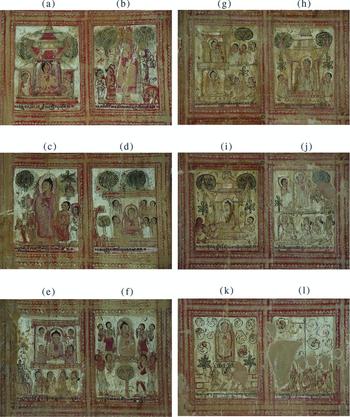
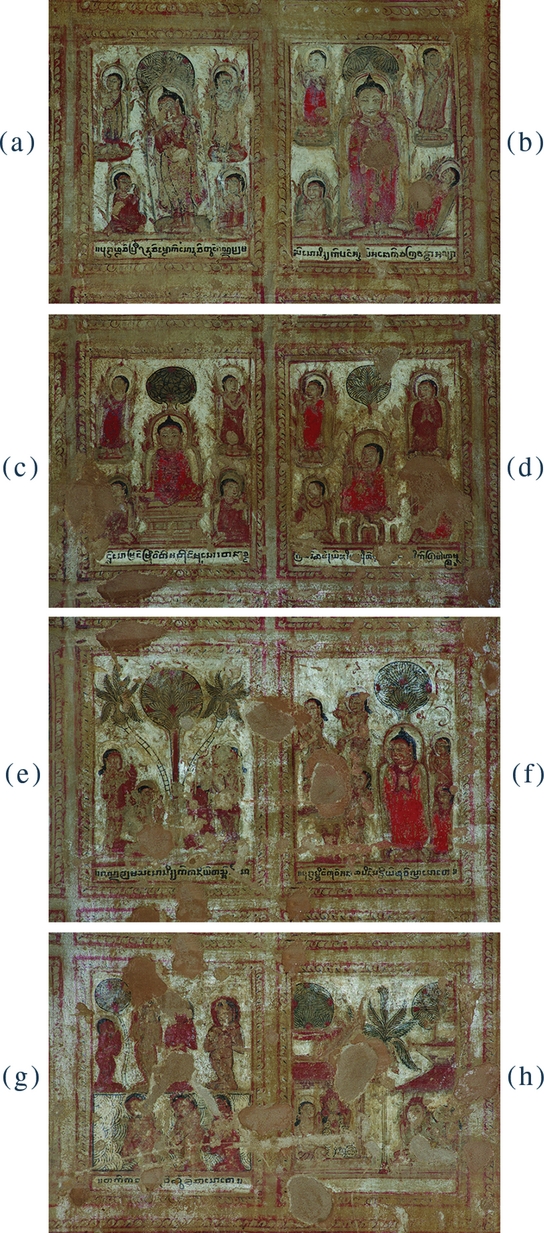
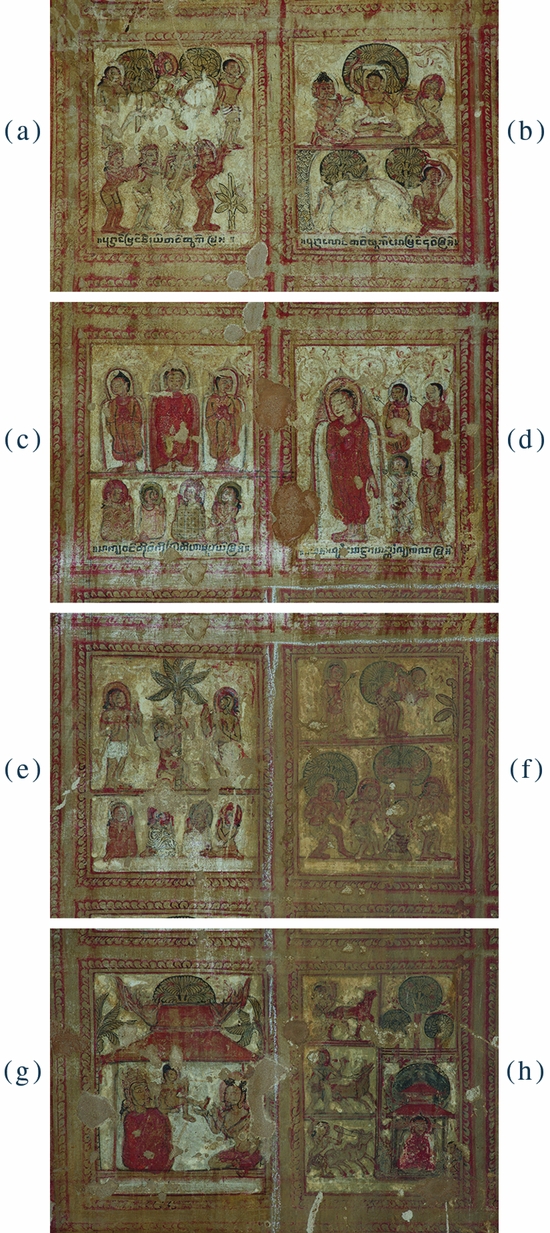
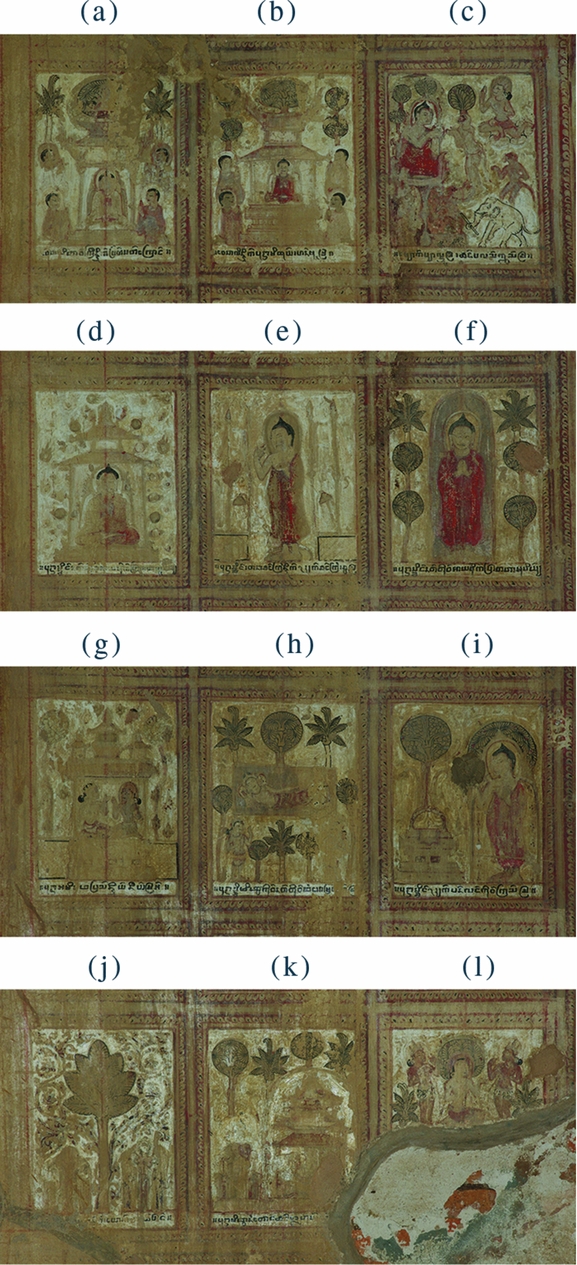
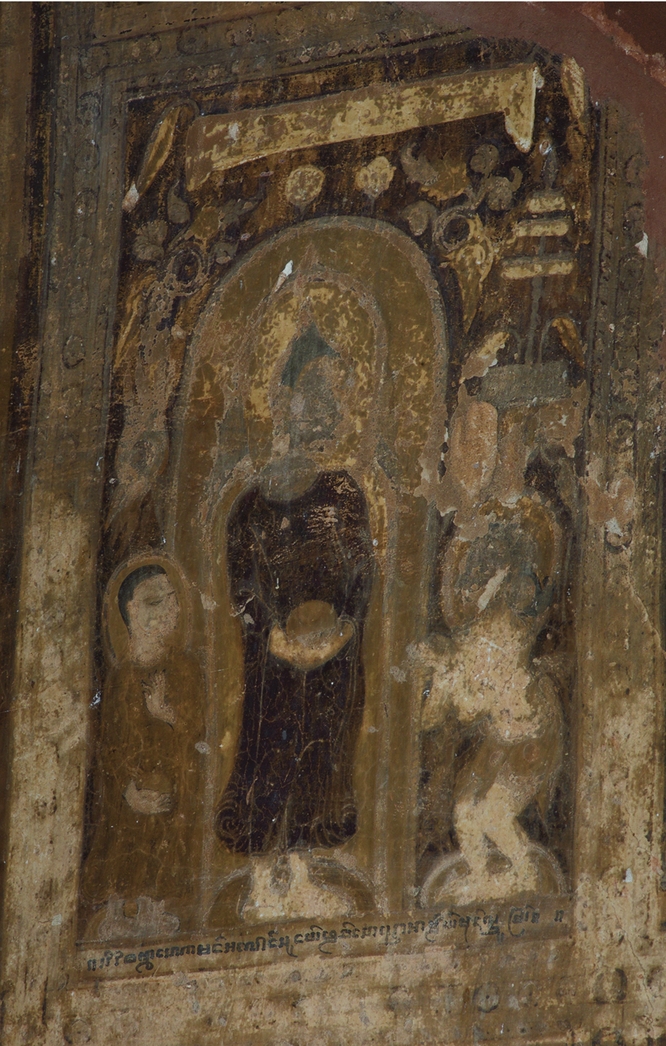
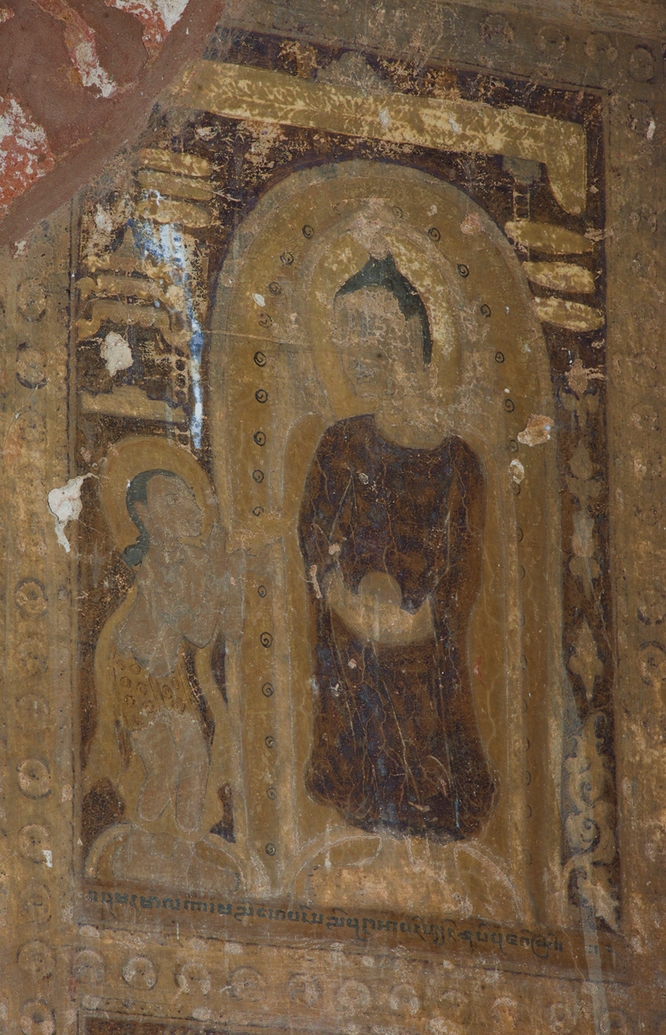
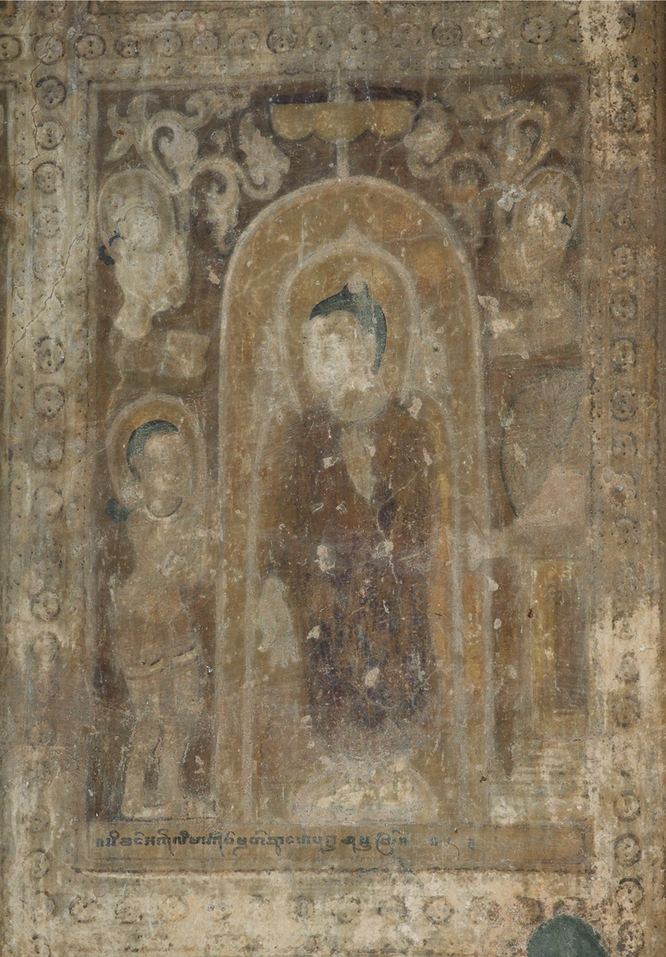
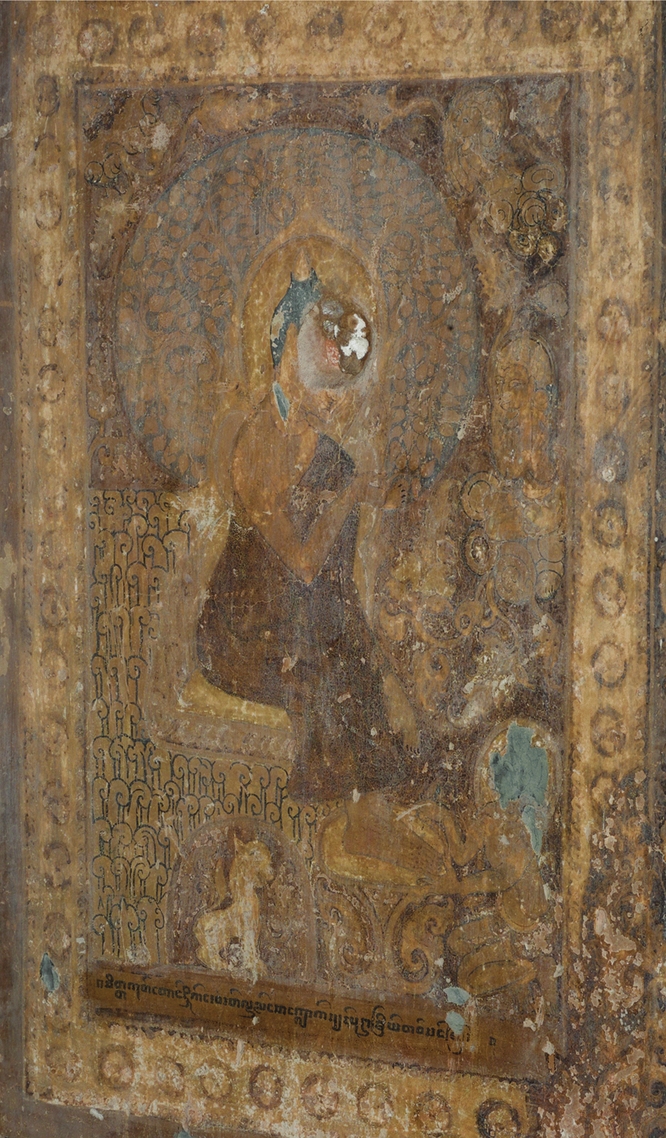
The mural scenes for life episodes of Gotama Buddha with their geographic grouping clearly perceived are as follows: thirteen episodes at Rājagaha in S-panel of E-wallFootnote 35 (Figure 16); twelve episodes before enlightenment at Uruvela in N-panel of E-wallFootnote 36 (Figure 17); eight episodes with at least most of them concerning the Twin Miracle at Sāvatthi in N-panel of W-wallFootnote 37 (Figure 18); eight episodes before and after enlightenment at Kabilavatthu in W-panel of N-wallFootnote 38 (Figure 19); and, two episodes at Vesāli in E-panel of N-wallFootnote 39 (Figure 20).
Episodes of the Buddha at Rājagaha (N-section of E-wall, main shrine, Temple 659): (a) donation of the Veruvana Monastery by King Bimbisāra; (b) taming of the Nālāgiri elephant; (c) Buddha's visit to Rājagaha for the first time after enlightenment; (d) with ignorance induced by Māra, Ananda does not ask the Buddha to stay his life all through the kappa; (e) First Buddhist Council at Rājagaha; (f) Buddha carried on a palanquin after being injured under Devadatta's attempt; (g) meeting of Sāriputta with the elder Assaji, with the message conveyed by the first to his friend, Mahā Moggallāna; (h) ordination of the two chief disciples of the Buddha, Sāriputta and Mahā Moggallāna; (i) Dr Jīvaka curing the Buddha’ ankle injured under Devadatta's attempt; (j)conversion of Mahākassapa (upper scene) and the Elder Piṇḍola-Bhāradvāja accepts the sandal bowl from a rich man of Rājagaha (lower scene); (k) miracle performed by Piṇḍola-Bhāradvāja at Rājagaha; and, (l) the non-Buddhist ascetic pretending to fly in his eagerness to get the sandal bowl.

Episodes of the Buddha at Uruvela (S-section of E-wall, main shrine, Temple 659): (a) Bodhisatta sleeping on the Ocean, with the Himavā Mountain as his pillow (first dream); (b) worms covering his body (third dream); (c) grass growing from his naval (second dream); (d) birds of different kinds coming to him (fourth dream); (e) walking on the mountain of filth without being contaminated (fifth dream); (f) interpreting the dreams by himself; (g) receiving eight bundles of glass from Brahmin Sotthiya; (h) casting the empty golden tray into the River Nerañjarā; (i) eating milk-rice meal offered by Sujātā; (j) Kāla Nāgā got awakened by the noise made by striking of the Bodhisatta's tray with those of the three previous Buddhas of this world cycle; (k) and (l) scenes and inscriptions damaged.

Episodes of the Buddha at Sāvatthi (N-section of W-wall, main shrine, Temple 659): (a) twin miracle at the Mango Tree in the seventh year after enlightenment; (b) the miracle with his body of a size of the universe; (c) his miracle on the Ratanacankama walk; (d) yamaka-pāṭihāriya mentioned (inscription partly damaged); (e) the Mango Tree named Gandāma; (f) Anāthapiṇḍika visiting the Buddha; (g) the non-Buddhist ascetic committing suicide by getting himself drawn under water; and, (h) unidentified scene (no inscription).

Episodes of the Buddha at Kabilavatthu (W-section of N-wall, main shrine, Temple 659): (a) Great Departure of the Bodhisatta; (b) sorrowing Kanthaka on his departure from the Bodhisatta; (c) twin miracle at Kabilavatthu; (d) Buddha's visit to his father, King Suddhodhana; (e) unidentified scene (no inscription); (f) probably the Four Omens (no inscription); (g) prophecy of Kāladevila; and, (h) miracle of the Bodhisatta at the rose apple tree.

Episodes of the Buddha at Vesāli and other miscellaneous episodes (E-section of N-wall, main shrine, Temple 659): (a) preaching at Vesāli; (b) ordination of Mahāpajāpadī Gotamī; (c) Pārileyya at Kosambī; (d) miracle of the Buddha; (e) Buddha's retreat at Ratanacaṅkama Cetiya in the third week after enlightenment; (f) yamaka-pāṭihāriya during the Buddha's retreat session; (g) . . . . .at Kabilavatthu (inscription partly illegible); (h) Dream of Queen Māyā; (i) Buddha's retreat at Animisa Cetiya in the second week after enlightenment; (j) unidentified scene (illegible inscription); (k) White Elephant entering the womb of Queen Māyā (Conception); and, (l) Queen Māyā taking a bath at the Great Lake Anotatta.

Scenes for the ‘Seven Stations’ are arranged in two groups. In the E-panel of N-wall are the Buddha episodes at Animisa-cetiya, Ratanacaṅkama-Cetiya and Ratanaghara-cetiya, from the second to the fourth weeks of his retreat. These stations of the Buddha's retreat are located to the northeast, north and northwest of the Bodhi-tree, respectively. Scenes from the fifth to the seventh weeks of the Buddha at Ajapāla-nigrodha, Mucalinda and Rājāyatana, which are located to the east, southeast and south of the Bodhi-tree, are grouped together within E-panel of S-wall. The episode of the Buddha's first-week retreat at the Bodhi-tree, most likely signified by the shrine's principal Buddha image, is not represented by the murals. These ‘Seven Weeks’ scenes were probably strategically located in each of the temples to represent their geographic directions from the Bodhi-tree – symbolised by the principal Buddha image of the shrine. One can perceive the meaning of the Buddha episodes grouped together geographically as described within the same symbolic context of the temple.
Another interesting narrative trend found in later Pagan murals for the Buddha's biography might be developed from what already had been initiated in the shrine murals at the Pagan temple 1605 (Patho-hta-mya), i.e., the combination of detailed episodes of the Buddha without their chronological arrangement being of primary concern. This can be seen in Pagan temple 585, dated to the thirteenth century.Footnote 40 Some of the mural scenes in temple 585 correspond with the Buddhist narratives that had gained popularity in the Theravādin Buddhist context only in Burma. The most prominent example is the scene of a young child, Piyadassī, who donates a handful of dust for alms to Gotama Buddha. To compliment this merit accomplishment, the Buddha makes a prophecy that, in his future existence, the child will be the Great King Asoka, one of the supreme benefactors of Buddhism (Figure 21). This story with its original account found in an older Sanskrit text, Asokavadāna, was made known in later Pāli literature only in Lokapaññatti, a text believed to have been compiled in Burma.Footnote 41 Although some of the other Buddha episodes portrayed in the murals of the Pagan temple 585 could find their immediate sources in the Pāli commentaries, they are more commonly known within the Burmese context of Buddhism than in other Theravādin traditions of Southeast Asia. They are contained in later Burmese vernacular literature, the ‘Malālamkāravatthu’ and ‘Tathāgataudanadīpanī’ texts. The Buddha episodes of concern are as follows: donation of the jasmine flowers to the Buddha by King Bimbisāra's gardener, SumanaFootnote 42 (Figure 22); the Buddha's taming of the thief, AṅgulimālaFootnote 43 (Figure 23); and, Dr Jīvaka curing the Buddha's ankle injured under an evil attempt of DevadattaFootnote 44 (Figure 24). Later Burmese authors of the vernacular texts would have incorporated into their ‘Buddha's biography’ these rather ‘minor’ episodes of the Buddha, already made known to them within the local Buddhist context.
A young child, Piyadassī, donating a handful of earth dust for alms to Gotama Buddha, W-section of N-wall, shrine, Temple 585.

Donation of the jasmine flowers by King Bimbisāra's gardener, Sumana, to Gotama Buddha, E-section of S-wall, shrine, Temple 585.

Taming of the thief, Aṅgulimāla, S-section of W-wall, shrine, Temple 585.

Dr Jīvaka curing the Buddha's ankle injured under Devadatta's attempt, W-section of N-wall, shrine, Temple 585.

III. Buddha's biography: later vernacular literature vs. older art forms
This section describes the scattered nature of the Buddha stories as existing in early Pāli sources: the three Piṭakas, their commentaries, and some early post-commentaries. It then investigates how a more complete account of the Buddha's life was compiled, based upon these earlier sources, in the Theravādin literary context of Southeast Asia. Two local traditions on the task are explored and compared: one which is genuinely Burmese and represented by the narrative murals of the Pagan Period and by later vernacular literature in the ‘Malālamkāravatthu-Tathāgataudanadīpanī’ group; and, the other which has gained popularity in a wider geographic context of Southeast Asia and represented by the texts in the ‘Paṭhamasambodhi’ group. The analysis is provided to test whether the two traditions are really distinctive and whether there was a continuum in the Burmese tradition of narrating the Buddha's life from the Pagan Period up to the time that the later Burmese vernacular texts were compiled in the late eighteenth century.
The Jātaka-nidāna is unquestionably one of the prime literary sources for the Buddha's biography in later Theravādin Buddhist tradition. Uncertainty, however, has arisen concerning its authorship and date of compilation. Some scholars believed it to be a work of Buddhaghosa in the sixth century ce, while others suggested a later date by a different author.Footnote 45
Since Jātaka-nidāna provides the biography of Gotama Buddha only up to the early years after his enlightenment, gathering information from other sources for later episodes in his life was a requisite effort for compilation of the Buddha's complete biography. At this point it is worth making a brief review of this type of information. Due to its scattered nature and the existence of some intrinsic contradictions, systemisation of pieces of information gathered from different sources, and solving the contradictions found among them, are major tasks confronting compilers of later texts on the matter.
In Madhuratthavilāsinī, a commentary on the Buddhavaṃsa of the Khuddaka Nikāya,Footnote 46 in addition to the elaborate biographies of the 24 previous Buddhas, who provided prophecies to Gotama in his previous existences for his future enlightenment, is a parallel account to the Jātaka-nidāna’s on the Gotama's biography, from his great renunciation for ascetic life up to his first visit to the city of his father, Kabilavatthu, after enlightenment. It also provides an account on the places of the Buddha's stay during the first 20 rainy seasons after enlightenment. This text is the main reference source, especially for the latter account, employed in some later texts. Information on places of the Buddha's stay during the following rainy seasons is not systematically described in any Pāli commentaries, although the information appears in Jinacarita, a post-commentary text composed by Vanaratana Medhaṅkara Thera in Sri Lanka, either in the late-twelfth or first-half of the thirteenth century.Footnote 47 According to the latter text, the Buddha spent these following rainy seasons in Sāvatthi.
The Mahāvagga of the Vinayapiṭaka contains some detailed episodes of the Buddha from his enlightenment to the conversion of his chief disciples, Sāriputta and Mahā Moggallāna, at Rājagaha City.Footnote 48 It, however, provides an account on the Buddha's retreat after enlightenment for the period of only four weeks. He meditated on his enlightenment throne under the Bodhi-tree for the first week. While seated under the Ajapāla -nigrodha Tree in the second week, he explained the meaning of ‘true brahmin’ to Huhaṅka Brahmin. The Nāgā king protected him from the heavy rain and strong wind in the third week at the Mucalinda Tree. The Buddha spent his last week of the retreat under the Rajāyatana Tree, where he accepted a meal donated by the two merchants, Tapussa and Bhallika, at the end of his retreat session. Interestingly, the Buddha episodes during his retreat at Animisa-cetiya, Ratanacaṅkama Cetiya and Ratanaghara-cetiya, from the second to the fourth weeks, as narrated in the Jātaka-nidāna, are not mentioned in the Mahāvagga. The Mahāvagga account also does not contain the episode of Māra and his three daughters, who tempted the Buddha, during the Buddha's retreat at Ajapāla-nigrodha, as later described in the Jātaka-nidāna.
The Kosambi khandhaka of the Mahāvagga Footnote 49 contains the episode of the Buddha about his escape from the disunited Saṅgha at Kosambī to stay in solitude at Pārileyya. He was serviced by the mighty elephant named after the place. The same episode is mentioned in the Dhammapada Commentary,Footnote 50 including a story of the monkey who donated honey comb to the Buddha. Being delighted by the Buddha's acceptance of his donation, the monkey danced cheerfully but carelessly on branches of the tree; he then fell from the tree and died. Because of this great merit accomplishment, the monkey was reborn a deva in the Tāvatiṃsa Heaven. The Madhuratthavilāsinī explains this Buddha episode in the tenth year after his enlightenment.Footnote 51
The Cullavagga of the Vinayapiṭaka Footnote 52 contains various episodes of the Buddha. In Senāsana khandhaka, a story of the rich man of Savatthi, Anāthapiṇḍika, who made alms donation to the Buddha and his disciples at Rajagaha and later at Savatthi donated the Jetavana Monastery to the Buddha, is presented more elaborately than in the Jātaka-nidāna. The Saṅghabheda khandhaka contains episodes of Devadatta, who three times attempted to kill the Buddha. As a punishment for his evil actions, he was sunk deep into the great lowest hell, the Mahā Avīci. The Bhikkuṇī khandhaka provides an account of the ordination of the first bhikkuṇī, Mahāpajāpadī Gotamī, at Vesāli.
The Suttantapiṭaka is an ocean of knowledge concerning the Buddha's teaching and his other activities, albeit their chronology is rarely recorded. It serves the Jātaka-nidāna as a main reference source for several details of the Buddha's life, for example, the sixteen characteristics of the Bodhisatta (in Mahāpadāna Sutta);Footnote 53 the story of Māra and his three daughters who tried in vain to tempt the Buddha at the Ajapāla-nigrodha Tree (in Satta-vassa Sutta and Māradhītu Sutta)Footnote 54 ; the story of Kāladevila Hermit who forecast to the Babe Bodhisatta for his enlightenment to come, and suggested his nephew, Nālaka, for the latter's ordination in awaiting the Buddha's enlightenment (in Nālaka Sutta)Footnote 55 ; and, the first meeting between the ascetic Bodhisatta and King Bimbisāra on the foot of Paṇḍawa Mountain (in Babbajā Sutta).Footnote 56 The Suttantapiṭaka also enriched the Buddha's biography with various other details of his life, later to be included in several Pāli and vernacular texts, and portrayed in the Buddhist murals, particularly the Buddha episodes not mentioned in the Jātaka-nidāna.
The Pāli Abhidhammapiṭaka and its commentaries are relatively scanty in providing details of the Buddha's life. However, an interesting piece of information is contained in a commentary of Dhammasaṅgaṇī,Footnote 57 the first division of the Abhidhamma, concerning the retreat episode of the Buddha after enlightenment. The text mentions the Buddha's demonstration of the twin miracle to doubting divine-beings at the beginning of the third week after enlightenment, not at the beginning of the second week as described in the Jātaka-nidāna. It also narrates the Buddha's emission of chabbannaraṃsī, the flames of six colours, in the fourth week of his retreat. This miraculous episode of the Buddha, also, is not mentioned in the Jātaka-nidāna.
As already discussed, a complete biography of Gotama Buddha had been developed in the Pagan mural tradition, probably prior to its literary compilation in Pāli, with Jinālaṅkāra the earliest known example. This latter text provides a story of the Buddha during his Bodhisatta's lives, from his being as the Hermit Sumedha to as Vessantara, and during his last existence from conception to mahāparinibbāna.Footnote 58 Composed in beautiful verses, it was devoted more to praise the Buddha than to illustrate vivid details of his life episodes. As an account on the biography of Gotama, the text however, does not provide much information that is additional to the Jātaka-nidāna, and had only minor impact on compilation of later vernacular texts and on execution of the Buddhist murals on the subject.
Malālamkāravatthu is a later vernacular text describing the complete biography of Gotama Buddha. It was compiled in Burmese in 1798 ce. Footnote 59 An English translation of the text by Reverend C. Bennett was published in 1853 ce. Footnote 60 Shortly after, in 1858 ce, another English translation of the text by Reverend P. Bigandet was provided.Footnote 61 Bigandet in his later editions of the workFootnote 62 had some contents of his first translation modified according to another Burmese text on the matter, the Tathāgataudanadīpanī, compiled in 1772 ce. Footnote 63 The contents of the Buddha episodes found in Bigandet's later editions of the work that deviate from their corresponding parts in his first edition and as well in the Bennett's translation thus have been derived from the latter vernacular text.
The texts collectively known as ‘Paṭhamasambodhi’ come in different versions and languages, i.e., Pāli, Thai, Yuan, Khoen, Lue, Lao, Mon and Khmer. Although these versions would have shared the same origin, they are of different ages, with complex relationships among them in terms of development.Footnote 64 The oldest known version, albeit an incomplete one, is a Pāli ‘Paṭhamasambodhi’ recorded in a palm leaf manuscript using the Thai-Yuan scripts, with the date equivalent to 1477 ce inscribed on it. It has been hypothesised, therefore, that the original ‘Paṭhamasambodhi’ would have been compiled in the former Lānnā Kingdom of Northern Thailand, no later than the mid-fifteenth century.Footnote 65 Although widely distributed in various parts of Southeast Asia, where Theravādin Buddhism, particularly of the Lānnā School, had prevailed, it surprisingly had not gained much popularity in Burma (except in the Eastern Shan State, formerly dominated by the Lānnā tradition of Buddhism). There, another tradition of narrating biography of the Buddha, as represented by the Malālamkāravatthu-Tathāgataudanadīpanī group of texts, had been well established.
As clearly stated by its author in an introductory part of the text, the Malālamkāravatthu provides a complete account of the biography of Gotama, beginning with his departure from celestial life in the Tusitā Heaven, to his rebirth as Prince Siddhattha, through his mahāparinibbāna. The beginning section of the text describes the episodes of Gotama since he was a Bodhisatta receiving prophecies for his enlightenment to come from the 24 previous Buddhas. He was reborn a chief deva in the Tusitā Heaven after his Bodhisatta's devotions during the incalculable existences had been fulfilled. This part of the account is comparable with, although more abbreviated than, the Dūre-nidāna section of the Jātaka-nidāna.
The Tathāgataudanadīpanī extends the Buddha story back in time to cover the Bodhisatta's episodes when he had encountered numerous successive past Buddhas prior to his reception of the first prophecy for the future enlightenment from Buddha Dipankara, 125,000 in number to whom the Bodhisatta's intension for his future enlightenment was demonstrated by wishing, and 387,000 to whom his intension was professed by vowing. This extension, which cannot find its root in the Jātaka-nidāna, most likely came from a post-canonical Pāli source compiled in Sri Lanka by Culla Buddhaghosa Thera, the Sotattagī-nidāna text.Footnote 66 Such detailed content is completely lacking in all the ‘Paṭhamasambodhi’ versions, in which only acquisition of the Bodhisatta for the prophecy of his enlightenment to come from Buddha Dipaṅkara was mentioned.Footnote 67
Stories of the 28 previous Buddhas, of which the last 24 gave prophecies for the future enlightenment to Gotama during his Bodhisatta's existences – an account provided in the Buddhavaṃsa text and its commentary, Madhuratthavilāsinī – formed one of the major narrative themes in Buddhist murals during the Pagan Period. Usually accompanying their mural depictions is an ink-gloss for each Buddha describing some specific details of his life history, for example, the names of his father and mother, the length of his austerity practice before enlightenment, his body height, the length of his life span, the type of vehicle for his renunciation, and his specific variety of the Bodhi-tree. Such details were provided in Buddhavaṃsa only for the last 24 past Buddhas, with only names of the first three – Taṇhaṅkara, Medhaṅkara and Saranankara – mentioned in the text for their existence within the same eon as Dipaṅkara (who gave the first prophecy to the Bodhisatta). Another Pāli text, Sotattagī-nidāna, however, provides some details for these first three Buddhas as well. Attesting to the Knowledge at Pagan on the Sotattagī are ink-glosses recording biographical details of these first three Buddhas in agreement with the text found in the murals of Pagan temple 447 (Le-myet-hna-hpaya), with its date of construction in 1223 ce confirmed by an original inscription.Footnote 68 The name of this Pāli treatise, included in a list of the sacred texts donated to one of the monasteries at Pagan in 1442 ce,Footnote 69 confirms that the text had been known in the area until the post-Pagan time.
Beside icons of the 28 past Buddhas, Pagan artists usually portrayed in their temple murals numerous smaller figures of the Buddhas for adornment of the temple's interior. These smaller icons of the Buddhas, which normally have no ink-glosses explaining them, may represent the previous Buddhas, to whom the Bodhisatta had professed his intension for future enlightenment by silent wishing or by vowing. These Buddhas preceded Dipaṅkara, who first granted the Bodhisatta’s wish of enlightenment to be finally fulfilled, as accounted for in the Sotattagī text.
Contents concerning the lives of Gotama – from his departure from the celestial being in the Tusitā Heaven for his rebirth as Prince Siddhattha up to his acceptance of Anāthapiṇḍika's donation of the Jetavana Monastery – in general accordance with the Avidūre-nidāna and Santike-nidāna sections of the Jātaka-nidāna, are similarly narrated in both the ‘Malālamkāravatthu-Tathāgataudanadīpanī’ and the ‘Paṭhamasambodhi’ texts, suggesting the derivation of these contents in the vernacular texts from the Jātaka-nidāna. There are however, some instances during the Buddha's retreat after enlightenment that the same account, which deviates from the Jātaka-nidāna, is shared by the vernacular texts of both groups. Aside from that, there are several episodes of the Buddha that are selectively narrated only in a particular group of texts.
The ‘Tathāgataudanadīpanī’ and ‘Paṭhamasambodhi’ state that the twin miracle was performed by the Buddha at the beginning of the third week after enlightenment, instead of at the beginning of the second week as accounted for in the Jātaka-nidāna. They also provide an account of the Buddha episode during the fourth week of his retreat at Ratanaghara, where he radiates the flames of six colours, chabbannaraṃsī, after the completion of his meditation on the seven divisions of the Abhidhamma. This majestic episode of the Buddha is not narrated in the Jātaka-nidāna. The vernacular texts certainly have these events derived from Atthasālinī, a Pāli commentary on the first division of Abhidhamma, in which both episodes of the Buddha are fully described. Interestingly, the intermixing of selective contents from different Pāli commentaries is shown in ‘Malālamkāravatthu’ regarding the referenced retreat, during which the twin miracle was performed by the Buddha at the beginning of the second week, in agreement with the Jātaka-nidāna, while he also radiated the flames of six colours, chabbannaraṃsī, in the fourth week, in accordance with the Atthasālinī.
Early Pagan murals of the temple 1605 (Patho-hta-mya) portray the twin miracle performed by the Buddha at the beginning of the second week after enlightenment and his meditation at Ratanaghara in the fourth week without showing the flames of six colours issuing from the Buddha's great body, in complete agreement with the Jātaka-nidāna account. This narrative theme of the Buddha's retreat had gained popularity in the mural tradition of Pagan all through its Dynastic Period. However, a few exceptions are in existence where the twin miracle performed by the Buddha and his issuing of the flames of six colours during his retreat session are represented in agreement with the Atthasālinī. These are seen in Pagan temples 539 (Tayok-pyi-hpaya) and 664 (Mala-phyi-hpaya)Footnote 70 , both dating from the thirteenth century.Footnote 71 This last piece of evidence confirms co-existence at Pagan during its Late Dynastic Period of different sub-traditions on narrating life episodes of the Buddha. At the level of generalisation, co-existence or intermixing of selective narratives of the Buddha's life from different older sources, as evident in cases of the Pagan murals and of the ‘Malālamkāravatthu’ text (already discussed), might not be at all rare in the Burmese context of Buddhism, at least since the Pagan Period.
What makes a clear distinction in terms of the Buddhist narratives between the ‘Paṭhamasambodhi’ account, on one hand, and the Jātaka-nidāna and ‘Malālamkāravatthu-Tathāgataudanadīpanī’ accounts, on the other, concerns the Buddha episode immediately before his enlightenment when he is subduing the army of Māra. To attest his ownership of the ‘Jewel Throne’ for enlightenment, the Buddha-to-be calls the earth as his witness. The Jātaka-nidāna and ‘Malālamkāravatthu-Tathāgataudanadīpanī’ describe this very moment that the earth quakes aggressively and resoundingly in responding to the Bodhisatta's request, thus causing the Māra and his army to flee in fright. In the Paṭhamasambodhi’s account of the same episode, the earth, personified as a female deity, Vasudharā, squeezes her hair releasing a mighty stream of waterFootnote 72 that washed away the army of Māra Footnote 73 .
The ‘Paṭhamasambodhi’ seems to be the oldest literary source for the Vasudharā story. Earlier evidence in the form of art, however, can be seen in several twelfth century stone-relief sculptures at Angkor, for example, the one on the pediment of the anterior corridor at Ta-Phrom. Interestingly, no comparable example, either contemporaneous with or postdating the Khmer iconography, has ever been found in the murals or in other art forms of the Pagan Period. An inference can, therefore, be made that at least since the twelfth century, two distinctive traditions on describing the Buddha's biography had existed side by side in the Buddhist context of Southeast Asia, one as a direct lineage of the Jātaka-nidāna and the other with the story of Vasudharā wringing her hair in the enlightenment episode of the Buddha narrated. This distinction had been constantly preserved, and later embodied in compilations of the ‘Paṭhamasambodhi’ vis-à-vis the ‘Malālamkāravatthu-Tathāgataudanadīpanī’ texts.
Another Buddha episode that appears only in ‘Paṭhamasambodhi’ and its derivatives concerns the symbolic discourse provided by God Sakka to the Buddha-to-be at the climax of the latter's austerity practice. The God is playing a harp of three strings – one too stiff, one moderate and the last too slack – with the moderate string providing the best sweet sound. This symbolic communication has made up the Bodhisatta's mind to quit his extreme austerity, then turning towards a moderate practice.Footnote 74 Again, this particular Buddha episode does not find any illustrative example in Pagan murals.
As previously discussed, the ‘Eight Great Miracles’ of the Buddha, stylistically and iconographically derived from the Pāla art of Northeastern India, were made common in the art forms at Pagan during its Dynastic Period, and interpreted according to the Pāli sources. The incorporation of all these Buddha's Miracles into compilation of the later vernacular texts of the Burmese tradition, the ‘Malālamkāravatthu-Tathāgataudanadīpanī’, suggests that compilers of the vernacular texts might have selected all these episodes on the basis that they had been made known in local Buddhism. In comparison, the ‘Paṭhamasambodhi’, of the different narrative tradition, lacks one of the Buddha's great miracles, the Pārileyya, thus does not provide a complete account of the subject.
In terms of narrative structure, Burmese vernacular texts of interest provide an account on the Buddha episodes from the fourth to the twentieth rainy seasons after enlightenment in complete agreement with the Madhuratthavilāsinī text. Details of other Buddha episodes, gathered from various Pāli Suttas and their commentaries, were added chronologically into the texts to flesh up this narrative skeleton. These vernacular texts mentioned that detailed episodes of the Buddha from the 21st to the 44th rainy seasons, as given in the Pāli sources, were too confusing chronologically, thus no account of them is provided in the texts. The Buddha story, as described in the texts, then continued by recounting the Buddha's episodes during the last two years of his life, which were heavily drawn from the Mahāparinibbāna Sutta. The ‘Tathāgataudanadīpanī’ account was extended to cover the history of Buddhism after the mahāparinibbāna of the Buddha and the history of Buddhism in Burma. The Paṭhamasambodhi, on the contrary, gives a complete account about localities where the Buddha was during all the rainy seasons after his enlightenment, in congruency with Jinacarita, the Pāli text compiled in Sri Lanka in the late twelfth or early thirteenth century.
There is no evidence of the Pagan artists attempting to narrate the biography of the Buddha chronologically based on his locations during the rainy seasons, particularly from the fourth to the twentieth seasons. The Burmese tradition of describing the Buddha's activities during his successive lent periods, as evident in the vernacular texts of the Buddha's biography, thus would have been established late, i.e., after the Pagan Period, albeit information of Buddha's activities could be gathered from an older Pāli source, the Madhuratthavilāsinī. The vernacular texts also attest that Jinacarita would not have gained any popularity yet in the Burmese Buddhist tradition at the time these texts were compiled.
There are some life episodes of the Buddha from his third rainy season after enlightenment on narrated in the Malālamkāravatthu and Tathāgataudanadīpanī group of texts but not in the ‘Paṭhamasambodhi’. These episodes are found as well in scenes of the Pagan murals. Examples are: the donation of jasmine flowers to the Buddha by King Bimbisāra's gardener, Sumana, found in Pagan temple 585; Dr Jīvaka curing the Buddha's ankle injured during Devadatta's attempt to kill him found in Pagan temples 658 and 659; and, a story of the 500 monk disciples of the Saint Sāriputta,Footnote 75 who are well versed in the Abidhamma as a consequence of their good deeds accomplished in the previous existence when they were the bats listening to the recitation of the Abidhamma by two monks in the cave, found in Pagan temples 1323 (Myinkaba Kubyauk-gyi) and 1536 (Nga-phon-thin-yaung) (Figure 25). Selection of these particular Buddha episodes to be described in later vernacular texts was probably decided on the basis that they had already been made known in the Burmese tradition of Buddhism.
Story of the 500 monk disciples of Sāriputta who are well versed in the Abhidhamma because of the merit accomplishment when they were the bats listening to the Abhidhamma in their previous lives, anterior vestibule, Temple 1536.

This article explores the development of narratives on the Buddha's biography within the Theravādin context of Southeast Asia. The early Burmese tradition on the subject represented by the narrative murals of the Pagan Period, dating from the late eleventh to the thirteenth centuries, is explained for its development based upon the Pāli reference sources. The Buddha's biography illustrated in the Pagan murals shares a number of specific details with the vernacular literature particularly in the “Malālamkāravatthu-Tathāgataudanadīpanī” group of texts, compiled in Burma in the late eighteenth century. The phenomenon suggests a long continuum of the tradition on compiling the Buddha's biography within the Burmese context of Buddhism. On the same basis of comparison, the “Paṭhamasambodhi” group of texts, widely distributed in Southeast Asia, with its oldest known representative probably compiled in the former Lānnā Kingdom no later than the second half of the fifteenth century, seems to belong to a different tradition of narrating the Buddha's biography. Association of the latter tradition with the Khmer iconography of the twelfth century might also suggest its long history of continuation. The research, thus, confirms toleration and co-existence of at least two different Buddhist traditions on narrating the Buddha's biography within the Theravādin realm of Southeast Asia during the past millennium.
Acknowledgements
A very early version of this article was presented at an International Conference on Early Myanmar and its Global Connections, Bagan Archaeological Museum, Myanmar, in February 2012. The conference was hosted by Ministry of Culture, Republic of the Union of Myanmar and Nalanda-Srivijaya Center, Institute of Southeast Asian Studies, Singapore. Several scholars and friends provided great assistances to the author on this research, to whom he would like to express his sincere thanks: U Aung Kyaing, Former Deputy Director General, Archaeology Department of Myanmar, and Thein Tun Oo, Bagan Archaeological Museum, for their kind assistance in reading and translation of many old ink-glosses in the Pagan murals that are vital to the analysis in this study; Hiram W. Woodward, Jr, Nandana Chutiwongs, Dietrich Christian Lammerts, Lilian Handlin and the anonymous reviewer(s) for providing him with many useful reference sources and valuable comments on earlier drafts of the manuscript; Frank Gillespie for an English proof and edition of the manuscript; and, Win Ko and Than Zaw for field assistance. The research was supported by Thailand Research Fund (Grant BRG5480016).