Humanizing members of the outgroup is generally seen as an essential first step to reconciliation between members of groups in conflict. As such, re-humanization stands at the heart of countless conflict resolution and coexistence programs worldwide (Batson and Ahmad Reference Batson and Ahmad2009). However, humanizing members of an outgroup—particularly in contexts of protracted, violent, intergroup conflict—is much easier said than done. The most successful approaches to humanizing members of an outgroup have been largely tested in contexts devoid of deep intergroup conflict (Batson et al. Reference Batson, Polycarpou, Harmon-Jones, Imhoff, Mitchener, Bednar, Klein and Highberger1997; Cortes et al. Reference Cortes, Demoulin, Rodriguez, Rodriguez and Leyens2005; Leyens et al. Reference Leyens, Paladino, Rodriguez-Torres, Vaes, Demoulin, Rodriguez-Perez and Gaunt2000; Vaes et al. Reference Vaes, Paladino, Castelli, Leyens and Giovanazzi2003), and when tested within contexts of conflict, yield inconsistent results (Batson and Ahmad Reference Batson and Ahmad2009; Gaunt Reference Gaunt2009, Reference Gaunt2011). These approaches work by generating empathy for members of the outgroup by presenting human suffering (Batson et al. Reference Batson, Polycarpou, Harmon-Jones, Imhoff, Mitchener, Bednar, Klein and Highberger1997), or by explicitly providing evidence that outgroup members feel secondary emotions (Leyens et al. Reference Leyens, Paladino, Rodriguez-Torres, Vaes, Demoulin, Rodriguez-Perez and Gaunt2000). Not surprisingly, as a recent independent evaluation of “Seeds of Peace” indicates, even the best conflict resolution groups based on these approaches see mixed success (Moses and Shishmanyan Reference Moses and Shishmanyan2009, pp. 18–19).
We suggest that the particular context of protracted intergroup conflicts may explain why humanizing the other is such a daunting task. In these contexts, to acknowledge outgroup suffering is to accept ingroup blame, as it requires ingroup members to assume some responsibility for the predicament of the outgroup. This process may generate dissonance from the desire to view one's group in a positive light and the acknowledgment of wrongdoings committed by the group. Thus, the attempt to humanize may backfire and ironically lead to less empathy and to an increased motivation to justify outgroup suffering (Glasford et al. Reference Glasford, Pratto and Dovidio2008). Nadler and Liviatan (Reference Nadler and Liviatan2006) provide another important possible explanation for the failure of such interventions in these contexts. They find that empathy induces forgiveness and a willingness to reciprocate empathy to Palestinian suffering caused by Israelis, but only among individuals who were high on trust in the Palestinians. These results show that empathy manipulations often fail where they are most needed, not affecting the real agents of conflict escalation. The real challenge is to find a means of increasing empathy toward the outgroup among the general Israeli population regardless of their initial attitudes toward the Palestinians.
In this research, we attempt to do so by testing a different approach to humanizing the outgroup in contexts of protracted intergroup conflict. Instead of asking individuals to feel empathy for the suffering for which their group is responsible, our approach requires one individual on one side of the conflict to express empathy for outgroup suffering that is not related directly to the intergroup conflict. This expression of empathy offers an opportunity to express kindness and caring toward the outgroup without compromising one's position in the conflict. Thus, it presents a simpler and safer first step than that required in the other approaches, and as such may succeed where the other approaches have failed.
We present results from two survey experiments designed to explore the effectiveness of this approach. Both experiments recruited Jewish-Israeli participants, focusing on their views toward Palestinian citizens of Israel (PCIs). They highlight the effect of one PCI expressing empathy for Jewish suffering in the Holocaust. We expect that this expression of empathy for suffering not caused by his group (PCIs) will motivate Jewish-Israeli participants to feel empathy in response, and that this feeling of empathy (imagining the thoughts and feelings of another) will motivate a more human view of the speaker (Batson and Ahmad Reference Batson and Ahmad2009). We further examine whether “reciprocal empathy” will generate this response solely toward the individual Palestinian, or will be generalized to include all PCIs.
STUDY 1
Participants for both studies were recruited by the Midgam Project, a leading online survey research firm in Israel (Ayalon Reference Ayalon2009). At the time of the experiment, Midgam had a panel of over 30,000 participants within Israel. We selected participants for both studies between 18 and 30 years of age, for this is the segment of the population past research suggests is most prone to aggression against the outgroup (Urdal Reference Urdal2008) and is also the age most frequently targeted by conflict resolution programs seeking to humanize the outgroup. Using random stratified sampling of participants in this age group, we obtained participants for both studies that represented every major demographic and geographic sector of the Jewish population within Israel's pre-1967 borders. We focus on the relationship between Jewish-Israelis and PCIs, leaving for future analysis the relationship with Palestinians in the West Bank and Gaza. Participants were sent an email inviting participation in the survey experiment and then took the survey online. Upon completion of the experiments, participants were fully debriefed and paid by Midgam.
Method
Participants
Study 1 ran in May 2010 with 103 subjects: 42 males, 60 females, and one individual who did not indicate his/her sex—all between the ages of 18 and 30 years (mean value (M) = 23.8, standard deviation (SD) = 3.09). These participants represent each of the main categories of Jewish religiosity in the country (41 identified as secular, 39 as either “orthodox” or “religious,” and 22 as “traditional”) as well as the full left–right political spectrum (on a scale from 1–7, where 1 = “very far left” and 7 = “very far right,” M = 3.41, SD = 1.34). They also come from every district within Israel's pre-1967 borders.
Materials and procedures
After consenting to participate in the survey, individuals were randomly assigned using the randomization process developed by the Midgam Project (verified in previous studiesFootnote 1 ) to read one of the two texts that were ostensibly published as an op-ed of a leading Israeli newspaper: the empathy treatment or the control text. In the treatment text, the op-ed author—identified by name and location as a Palestinian citizen of Israel—expresses empathy for outgroup (Jewish-Israeli) suffering not caused by his ingroup, in this case suffering caused by the Holocaust. The control text is nearly identical to the treatment text except that it does not express empathy, instead voicing the standard message Jewish-Israelis hear about the Holocaust when interacting with PCIs (see the online Appendix for the full texts). As the standard message (our control text) is negative toward the Holocaust, we note that we are measuring the causal effect of the empathy treatment compared with this negative message, rather than the true causal effect of the empathy treatment (best measured in comparison to a truly neutral control text, not related to the Holocaust). Given our interest in a real-world baseline, our emphasis on internal validity, and the difficulty of identifying a truly neutral text comparable in other ways to the treatment text, we felt our control text was the best comparison. We note, however, that this diminishes the generalizability of our findings to some degree.
After viewing the text, participants answered a question asking them to indicate the degree with which they agree with the opinions expressed by the author. They were then asked the following question used by Batson and colleagues (Reference Batson, Polycarpou, Harmon-Jones, Imhoff, Mitchener, Bednar, Klein and Highberger1997, Reference Batson, Chang, Orr and Rowland2002) to measure empathy: “On a scale from 1 (not at all) –7 (very much), please indicate how much you felt each of the following emotions as you read this interview: sympathetic, compassionate, soft-hearted, warm, tender.” We averaged responses to the empathy items to create a composite measure (Cronbach's α = 0.89). Participants were then debriefed, thanked for their time, and told that they could now begin the survey.
Once in the survey portion of the experiment, participants were asked how human they viewed the outgroup. Leyens and colleagues argue that to see another as human is to recognize that she or he possesses “secondary emotions” like oneself. Whereas animals can only feel primary emotions (e.g., anger, fear, etc.), humans can also experience secondary emotions such as “affection, admiration, pride, conceit, nostalgia, remorse, and rancor” (Leyens et al. Reference Leyens, Paladino, Rodriguez-Torres, Vaes, Demoulin, Rodriguez-Perez and Gaunt2000). We employed Leyens’ measure of infrahumanization to capture how human participants saw the outgroup: participants were asked to rate on a 7-point scale (7 = very much, 1 = not at all) the capacity of PCIs to feel six primary and six secondary emotions (three positive and three negative of each).Footnote 2 Participants then answered a series of standard demographic questions, including measures of political identification, religious identification, socioeconomic status, and education levels, and were fully debriefed.
Results and Discussion
We first checked for random imbalance between treatment and control on other covariates included in the survey experiment (e.g., sex, political identification, religious identification, socioeconomic status, education levels), finding a small imbalance with sex. Given the current debate regarding whether or not to control for such imbalances (Green Reference Green2009; Mutz and Pemantle Reference Mutz and Pemantle2011), we present results in the text with this control variable, and in the Appendix without the control variable (including or excluding the imbalance control does not significantly change our results). Following convention (Leyens et al. Reference Leyens, Paladino, Rodriguez-Torres, Vaes, Demoulin, Rodriguez-Perez and Gaunt2000, Reference Leyens, Cortes, Demoulin, Dovidio, Fiske, Gaunt, Paladino, Rodriguez-Perez, Rodriguez-Torres and Vaes2003), we also control for the effect of valence of humanizing terms (positive/negative) in the models where humanization is the dependent variable, reporting clustered standard errors. We estimate all models using ordinary least squares (OLS).
We first highlight the average effect of the treatment (the humanizing “op-ed”) on predicted levels of outgroup humanization. As the first model in Table 1 of the online Appendix indicates, individuals assigned to the humanizing treatment text report viewing PCIs nearly a point higher (roughly a 15% increase) on the humanization scale (β = 0.948; p < 0.001) than those in the control group.
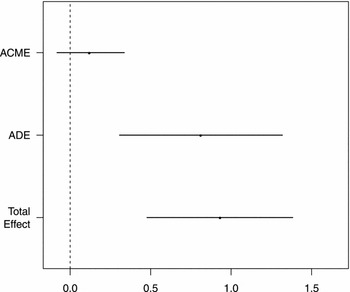
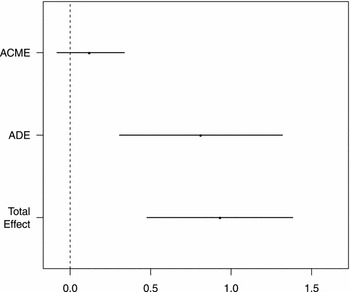
We now explore whether the effect of our treatment on outgroup humanization is mediated by empathy. As model 2 in Table 1 in the online Appendix indicates, participants in the treatment condition reported significantly higher levels of empathy toward PCIs than did those in the control condition (β = 1.25; p < 0.001). As Figure 1 indicates, the results are not conclusive when we conduct formal mediation analysis using Imai et al.'s (Reference Imai, Keele and Tingley2010a, Reference Imai, Keele, Tingley, Yamamoto and Vinod2010b, Reference Imai, Keele and Yamamoto2010c) nonparametric mediation analysis procedure. While both the Average Direct Effect (ADE) and the Average Causal Mediation Effect (ACME) are in the expected direction, we cannot have a high degree of confidence in the ACME. However, as results from Study 2 suggest, this appears to be a small n-size problem: Our confidence increases as the n-size of the study increases, providing evidence that this mediating effect is as we hypothesized.
Study 1: Mediation Analysis. Bars Represent 90% Confidence Intervals
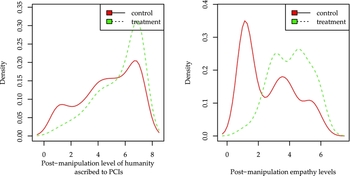
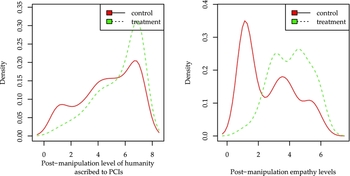
To graphically illustrate the difference in the degree to which participants viewed the outgroup as human and felt empathy across the treatment and control conditions, Figure 2 presents simple density of plots. Importantly, these results hold for individuals across the political spectrum; we do not find a significant interaction between the treatment and political ideology.Footnote 3 Thus, Study 1 provides support for our initial argument: A simple expression of empathy for outgroup suffering by one ingroup member, when it is for suffering not caused by the group conflict, can indeed lead to reciprocal empathy from individuals in the outgroup, which then motivates a willingness to accept the humanity of all members of the other group. However, the small sample size of this study raises questions about the robustness and generalizability of these results. To address these questions, we ran Study 2 on a national sample of Jewish-Israeli young adults.
Study 1: Kernel Density Plots of Post-Manipulation Differences Between Treatment and Control
STUDY 2
Method
Participants
Study 2 ran in two stages, one week apart. In total, we analyzed data from 670 participants who participated in both stages of the experiment: 327 males and 343 females, all between 18 and 30 years of age (M = 24.5, SD = 3.04). We employed stratified random sampling to increase the n-size of this study such that our subject pool contained a nationally diverse sample of Jewish-Israelis within its pre-1967 borders. This allows us to assess the degree to which results from Study 1 apply to 18–30-year-old Israelis more generally as well as to explore the robustness of our Study 1 results. For details on the highly representative nature of our sample, see the online Appendix.
Materials and procedures
Study 2 ran a month after the completion of Study 1. We administered this study online using the same platform and participants saw exactly the same treatment and control texts as in Study 1. Study 2, however, differs from Study 1 in two important ways: First, it more closely reflects the diversity of the Jewish population in Israel. Second, Study 2 ran in two stages, the first a week before the second. In the first stage, participants received a survey that asked questions about factors that might impact the success of outgroup humanization, including participants’ pre-manipulation antipathy (e.g., fear, hatred) and empathy toward members of the outgroup, the degree to which they already viewed the outgroup as human, the extent of their negative past experiences with the outgroup, and demographic characteristics (see online replication materials for these measures).
A week after completing stage 1 of the experiment, participants received stage 2, which contained the experimental manipulation. This design allows us to check and control for a wider array of randomization imbalances—a much more stringent test of our humanization manipulation than Study 1.
Results and Discussion
We follow the same procedure to analyze these results as in Study 1, first checking for random imbalances.Footnote 4 As in Study 1, we find that participants in Study 2 who viewed the ostensible op-ed written by a PCI expressing empathy for Jewish suffering in the Holocaust exhibit an increase in the degree to which they report seeing PCIs in general as human (β = 0.14; p = 0.084). Likewise, participants in the treatment condition also reported higher levels of empathy than those in the control condition (β = 1.7; p < 0.001) (see Table 4 in the online Appendix). These results are stronger both substantively and statistically when we remove the control variables from the model (Table 5 in the online Appendix).
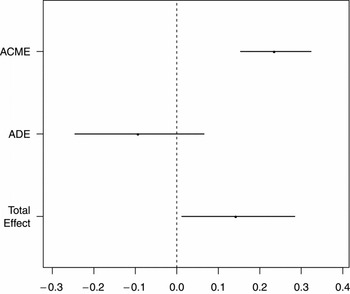
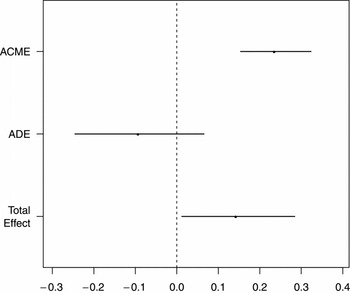
Figure 3 highlights the results of mediation analysis using the same procedure employed in Study 1. As this figure illustrates, the ACME of empathy is both substantively and statistically significant, providing support for our hypothesized mediation path. The estimated ADE goes to zero, suggesting full mediation.
Study 2: Mediation Analysis. Bars Represent 90% Confidence Intervals.
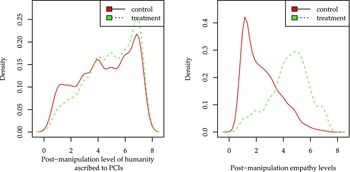
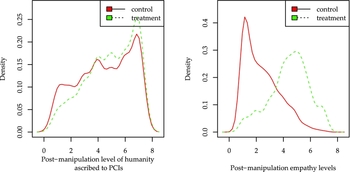
As in Study 1, Figure 4 presents the main results from this study graphically using density plots that highlight the difference between participants in the treatment and control conditions on reported levels of outgroup humanization and empathy. As in Study 1, we find no significant interaction between political ideology and the treatment, suggesting treatment effectiveness for individuals across the political spectrum.Footnote 5
Study 2: Kernel Density Plots of Post-Manipulation Differences Between Treatment and Control
GENERAL DISCUSSION
Humanizing members of the outgroup by fostering empathy between rival groups engaged in protracted conflict is a daunting task, as any acknowledgement of outgroup suffering may feel like an attack on the ingroup, creating dissonance, and an expression of empathy by the outgroup for ingroup suffering often lacks credibility. The two studies presented here provide initial evidence for an approach that works, showing that a simple expression of empathy for outgroup suffering not caused by the ingroup constitutes an easier and safer first step for individuals in these contexts than acknowledging outgroup suffering they might have caused. Our results indicate that this approach achieves the desired results: A reciprocal show of empathy in response that leads to a greater willingness to see members of the outgroup as human.
Study 1 indicates that expressions of empathy by a Palestinian for Jewish suffering in the Holocaust lead to a greater humanization of all Palestinians; the results for the mediation effect of empathy are mixed. Study 2 replicates the findings from Study 1, this time with compelling evidence for the mediating role of empathy, on a near-representative sample of young Israeli Jews that employs more stringent controls over possible confounding variables, allowing us to conclude that the effects of our treatment produce a robust effect that overrides preliminary attitudes toward the Palestinians. These two studies come at a time of great animosity between Israel and the Palestinians and offer a glimmer of hope that humanization of the other is possible.
These results also extend the findings of Nadler and Liviatan (Reference Nadler and Liviatan2006) who found that empathy primes induce forgiveness and reciprocal empathy, but only among Israelis who are inclined to trust the Palestinians. The current research indicates that empathy manipulations are not limited to a preaching to the choir effect, suggesting instead that if approached differently, they may have a robust effect on all segments of the Israeli population regardless of preliminary attitudes, or a history of exposure to political violence. It is notable that this effect is found among a young sample of Israelis who are typically more hawkish than their older counterparts (Bar-Tal and Teichman Reference Bar-Tal and Teichman2005).
In terms of limitations, while our results suggest confidence in the efficacy of our approach for 18–30-year-old Jewish-Israelis, they will require further replication with other groups in other contexts before they can be generalized more broadly.Footnote 6 Future research should more closely compare the empathy manipulation used in the current research with manipulations of empathy used in previous research to better understand the reasons empathy inductions succeed in some contexts and fail in others. Most importantly, the current research is based on self-reported responses, and the critical question is whether these explicit responses translate into actual behavior that may foster intergroup reconciliation.
In spite of these open questions, these studies make important contributions to the study of empathy and humanization as well as to the study and practice of conflict resolution. They suggest that not only the type of empathy expressed in conflict resolution is important (Batson and Ahmad Reference Batson and Ahmad2009) but also that the topic is important (e.g., whether it is for suffering caused by the ingroup or not). Notably, our research also suggests that the initial expression of empathy need not come from all members of the rival group. Indeed, it seems that the willingness of even one individual to openly make others’ misery her own has the potential to begin to diffuse the barriers that divide people and to start a process of reconciliation.
SUPPLEMENTARY MATERIAL
To view supplementary material for this paper, please visit Cambridge Journals Online. http://dx.doi.org/10.1017/xps.2014.20.