At two meetings of the Royal Society on 9 and 16 January 1729 James Bradley's paper ‘giving an account of a new-discovered Motion of the Fixed Stars’ was read by his mentor Edmond Halley.Footnote 1 This hitherto unidentified motion, which within a few years was to be termed ‘the aberration of light’, was rapidly and widely accepted as empirical evidence of the motion of the Earth in its annual orbit around the Sun. The paper established Bradley's reputation throughout Europe as an astronomer of the first order. Halley's protégé appears to have written a simple narrative account of a remarkable discovery that presented how work undertaken with partners at Kew and Wanstead led to the ‘hypothesis of a new-discovered motion of the fixed stars’.
However, analysis of the various unpublished versions of the paper with all of their variants, together with an examination of the Kew and Wanstead Observation Books,Footnote 2 reveals that although the account is based on a sustained programme of unprecedentedly precise and accurate observation it is also a consummate piece of propaganda in which an ambitious astronomer stakes his claims for recognition by the philosophical and political elites that he perceives may advance his future mature career as an astronomer. In this paper it is my intention to show, commonly by reference to a final and previously unpublished version of Bradley's paper,Footnote 3 that he conceived his hypothesis of ‘the new-discovered motion’ within the context of a rhetorical strategy devised to deflect criticism and disarm objections to his conjectures. I also hope to show that this important scientific paper was a subtle rewriting of events, undertaken to justify himself in the eyes of his peers and to divert attention from what may have been the ulterior motives of his erstwhile senior partner.
An experiment to determine the annual parallax of a star
James Pound, the rector of Wanstead,Footnote 4 a prosperous township six miles north-east of the City of London in the county of Essex, was arguably the leading amateur astronomer in England, a pioneer in the use of the transit instrument, which he used with great skill. Pound's undoubted abilities were increasingly utilized by Sir Isaac Newton, particularly in his preparatory work on the third edition of the Principia.Footnote 5 Newton writes,
Using the best micrometers, Mr. Pound has determined the elongations of the satellites of Jupiter and the diameter of Jupiter … The diameter of Jupiter was obtained a number of times with a micrometer in a telescope 123 feet long …Footnote 6
This excellent 123-foot glass was lent to Pound by Newton, having been deposited with the Royal Society by Christiaan Huygens. Pound was at the centre of much astronomical activity, also undertaking work on behalf of Edmond Halley, especially as relations with John Flamsteed had deteriorated to the point of a complete breakdown following years of sustained mutual recrimination. From around 1722, following the building of the new Wanstead House and the opening celebrations, Pound began to conduct discussions with Samuel Molyneux and George Graham about the possibility of repeating Hooke's experiment to determine annual parallax through observations.
Samuel Molyneux was the son of the Irish politician and philosopher William Molyneux, the originator of the ‘Molyneux problem’.Footnote 7 He was educated at Trinity College, Dublin and elected a Fellow of the Royal Society (FRS) in 1712. He served three times as an MP at Westminster.Footnote 8 He was a privy councillor and was appointed as a Lord of the Admiralty by George II in 1727, to whom he had served as private secretary for several years prior to the latter's accession to the throne. In 1717 he had married Lady Elizabeth Capel, the eldest daughter of the second Earl of Essex, one of the wealthiest heiresses in England. He was a keen amateur astronomer and, with John Hadley,Footnote 9 had regularly experimented in the development of alloys for use as specula in reflecting telescopes.
George Graham, a Quaker who possessed a reputation for honesty and integrity, was originally from Cumberland and latterly a partner of Thomas Tompion, another Quaker, inheriting his business in 1713.Footnote 10 He was widely celebrated for the invention of his dead-beat escapement around 1715. He was elected an FRS following his construction of a planetarium for the Earl of Orrery.Footnote 11 In 1720 he was the finest clockmaker and scientific instrument-maker in London, a skilled astronomer in his own right. The eight-foot quadrant he constructed for Halley at Greenwich in 1725 was so accurate that it became the standard for all later instruments of its kind by such notable figures as John Bird, Jonathan Sisson, Edward Troughton and Jesse Ramsden. Graham was at the head of a tradition that transformed astrometric capability, enabling astronomers to confirm Newtonian theory. The zenith telescopes he made for Molyneux and Bradley, and for Pierre-Louis Moreau de Maupertuis for the Lapland expedition, were at the very forefront of design and construction, precise and accurate.Footnote 12
James Bradley was a man of very modest origins, the third son of William Bradley, who was employed as a steward on the extensive estate of Sir Ralph Dutton of Sherborne in Gloucestershire. Sir Ralph was an inveterate gambler who appeared to have considerable problems controlling the management of his estate and monies.Footnote 13 William Bradley's income as a steward was, in such circumstances, subject to the vagaries of chance and he gave up the responsibility for James's education for the church to his brother-in-law the Rev. James Pound. Bradley left his father's home in Sherborne in 1711 and thereafter lived in his uncle's household in Wanstead. Bradley entered Balliol College in Oxford as a commoner, graduating with a BA in 1714 and an MA in 1717, after which he took instructions from Pound to prepare him for a career in the Church. Like his uncle he displayed distinct latitudinarian tendencies.Footnote 14 It was whilst he was living with his uncle that Bradley began his astronomical observations. It was through his uncle that Bradley was introduced to Newton and Halley and the Whig circles that influenced his mature career. His precocious talent was early recognized by Halley and he was elected an FRS in 1719 whilst still twenty-five years of age and Savilian Professor of Astronomy at Oxford in 1721 at the age of twenty-eight.
By late 1724 the original three partners, including Pound, were well on the way to planning a repeat of Hooke's programme of observing the annual motion of a star at the zenith. Pound's account book reveals that over a period of several months during 1724 he made regular visits to Kew. The sudden and untimely death of Pound on 16 November 1724 put a check on their plans.Footnote 15 However, early in 1725 Molyneux gave instructions to Graham to design and construct a zenith sector with a length of twenty-four and a half feet. Quite when Bradley was invited to join Molyneux and Graham cannot be determined, but it could not have been long after the death of his uncle. He was required because of his immense skill in observing minute angular distances. Molyneux was his patron and had earlier interceded with the Prince of Wales to give Bradley a share of a vacant living near Narberth in Pembrokeshire.Footnote 16 There can be little doubt that Bradley was regarded as a junior partner in the enterprise.
The motion of an astronomical object can be detected either in right ascension or in declination. The former approach can be determined by timing the passage of an object star through the field of vision of a transit instrument.Footnote 17 The method is highly dependent on the accuracy of the astronomer's clocks. The method chosen by the Kew partners was to measure the variations of position in declination. This approach depended on the accuracy and precision of the astronomer's observational instrument. Bradley was an expert in the observation of minute shifts in stellar positions. As the object star passed through the field of vision of the zenith sector (technically a modified suspended transit instrument) the partners would record how far north or south of its originally observed position it was now located. The technique was less dependent on changing conditions. Observing at the zenith neutralized many of the problems associated with atmospheric refraction which also varied according to changing atmospheric temperatures and barometric pressures.Footnote 18
The partners had agreed that the methods applied by Hooke in his 1669 attempt were worthy of emulation. The zenith sector designed by Graham was modelled on Hooke's instrument and was suspended in Molyneux's house near Kew Green on 26 November 1725. No observable motion due to the phenomenon of annual parallax was expected at this time of the year, for no motion north or south was expected whilst the object star was in conjunction, so the next few days were largely devoted to adjusting the instrument. On 3 December 1725 the position of γ Draconis in declination was recorded by Molyneux.Footnote 19 In his Memoirs of Bradley Rigaud wrote that the ‘motion which might be produced in it by parallax towards the pole, would at this time have been very gradual’.Footnote 20 The three partners continued making observations on 5, 11 and 12 December in order to verify its position in declination.Footnote 21 On 17 December Bradley observed the passage of the object star through his field of vision and perceived that it passed ‘sensibly’ south of its former position. As no change of position had been expected Bradley's initial response was to treat the observation as an anomaly and he characteristically examined the sector with great attention.Footnote 22 Molyneux recorded this sequence of events in the Kew Observation Book. The observation of the anomaly on 17 December elicits the following entry:
This day, Mr Bradley, one of the astronomy professors at Oxford, who had been acquainted with the whole contrivance of this instrument, and was present when it was first set up in its place, did with great care examine the situation thereof. He found the index at 10.3, where it had been left on the 12th of December, and adjusting the mark to the plumbline, about 11h 15′ mean time, he found the index stood at 9.7, so that from the 12th of December to the 17th, it had been altered but a little more than ½ a second.Footnote 23
The extraordinary precision of Bradley's observations and the remarkable accuracy of Graham's instrument is evident in Molyneux's memorandum. Bradley perceived a motion of 0.6″ at a time when many observers, and most notably Bradley's own mentor and correspondent Halley, did not believe such minute motions could be firmly established. Although the personal and working relationship between Bradley and Halley always remained mutually productive, Halley never fully reconciled himself to the extreme accuracy and precision of Bradley's observational practice.Footnote 24 Throughout December 1725 Bradley continued to adjust and correct the instrument at Kew and was completely satisfied he could make observations accurate to within half a second of arc.
As Bradley continued observing γ Draconis its declination was perceptively varying at a rate of about a second of arc every three days, a motion that was entirely unexpected. On 20 December Bradley discovered that the star had passed even more southerly.Footnote 25 Rigaud refers to this observation as being ‘decisive’ and by this he might mean that this was the moment when the aberration of light was first discovered.Footnote 26 However, at this stage of the investigation the observation could only have been regarded as an anomaly. The observations made by Bradley on 17 and 20 December could not be validated by reference to any known phenomenon. They could not be rationalized by annual parallax nor any known physical process. No theoretical framework had been constructed within which the observations could be explained.
It was shortly after these early observations, when the instrument was being checked and rectified and when the initial apparent declinational motion of the object star was verified by further observations, that Molyneux's ulterior motives became evident. In his account Bradley sought to show that the investigation was undertaken for entirely disinterested reasons. The sentence in which he set out the objectives of the experiment is quite innocuous and neutral in intent. He wrote to Halley,
Before I proceed to give you the history of the observations themselves, it may be proper to let you know, that they were first begun in hopes of verifying and confirming those that Dr. Hooke formerly communicated to the public.Footnote 27
Hooke claimed that he had discovered the annual parallax of γ Draconis, that it was 27 or 30″. Given the common assumption of the time that the stars all possessed similar luminosities the magnitude of a star would be a function of its distance. If a third-magnitude starFootnote 28 like γ Draconis was only about 15,000 astronomical unitsFootnote 29 away then the expectancy was that the brightest (and by inference the nearest) star Sirius was less than a third of the distance. Bradley had undertaken work on behalf of Newton in preparation of the third edition of the Principia.Footnote 30 To Bradley this would therefore have implied that there were hundreds or thousands of stars near enough to the solar system to disrupt it sufficiently to make it unstable. As Halley had inferred the proper motion of some of the brighter starsFootnote 31 after comparing the ecliptical latitudes of Sirius, Arcturus and Aldebaran with those recorded in Ptolemy's star catalogue,Footnote 32 Bradley would have appreciated that many of the brighter stars could approach the solar system still closer (that is, if Hooke's result were confirmed). Evidence that this possibility may have caused Bradley some concern is recorded in his copy of the Kew Observation Book.
Bradley knew that Newton had argued determinedly that even the nearest stars were at enormous distances from the solar system. Assuming that stars possessed similar luminosities and that their light diminished as to the square of the distance, Newton calculated the distance of Sirius. Newton estimated the comparative brightness of the Sun and the Dog Star by looking at the Sun through a pinhole, allowing him to form an image with the estimated brightness of Sirius. He estimated that the brightest star possessed an annual parallax of less than half an arc second, not within the capacity of contemporary optics to resolve. This placed it at a distance in the order of a million astronomical units. When Bradley states that he and his partners were seeking to confirm and verify the observations made by Hooke the reader needs to pay close attention to his account. Hooke had only made four irregularly spaced observations over a period of some four months.Footnote 33 So the question that immediately impinges itself on an alert mind is, why would a man who was a personal acquaintance of Newton,Footnote 34 who was later to teach Newtonian experimental philosophy at Oxford,Footnote 35 have any confidence in Hooke's observations? This question is particularly pressing given Bradley's own precise and exacting methods and his sure recognition that a confirmation of Hooke's result would be impossible to reconcile with Newtonian theory.
Yet the partners were apparently motivated to repeat Hooke's experiment and to confirm his results because they ‘seemed to be attended with circumstances that promised greater exactness in them, than could be expected in any other that had been made and published on the same account’.Footnote 36 In his copy of the Kew Observation Book this apparent confidence is perhaps qualified by his concern whether it could be reconciled with the conclusions detailed in the Principia. Bradley appeals, but without any degree of confidence, to Newton's own conclusions in his assertion that ‘the fixed stars, being equally dispersed in all parts of the heavens, by their contrary attractions annul their mutual forces, by book 1, prop. 70’.Footnote 37 It is difficult to conceive that Pound, who was the originator of the idea of repeating Hooke's experiment, had any confidence at all in Hooke's result. He had worked closely with Newton and Halley for several years and even abandoned a Latin translation of Flamsteed's preface to his catalogue for his widow, in response to an appeal from his two eminent patrons.Footnote 38 Pound appreciated that Hooke's method of observing stars at the zenith promised the greatest likelihood of observing annual parallax, for it avoided many of the problems associated with atmospheric refraction, but it is unlikely that he regarded Hooke's result with any degree of approbation, as it was derived from insufficient observations. So why did Bradley assert any degree of confidence in Hooke's result? The memorandum contained in his copy of the Kew Observation Book reveals that he was indeed concerned about the possibility of confirming Hooke's conclusion that he had observed an annual parallax of 27 or 30″.
After the demise of Pound the leadership of the experiment passed to Molyneux. The zenith sector was located at Molyneux's residence in Kew. Even though one of the finest observers of his generation and a professor of astronomy at Oxford, Bradley was without doubt a junior partner in deference to Molyneux's seniority, social standing and earlier patronage. The suspicion is that the confidence expressed in the efficacy of Hooke's result was not initially held by Bradley. There remains the possibility that it was Molyneux, the senior partner, who was convinced of the validity of Hooke's claims. Bradley expressed his concerns in his memorandum, concerns that must have become more urgent as the partners began to propose various conjectures to explain the inexplicable and counterintuitive behaviour of the object star γ Draconis.Footnote 39 The star continued to move south of the position it was at on 17 December 1725. Bradley continued to rectify the instrument, constantly fretting lest the motion be nothing more than a consequence of some instrumental or systemic error. In his account he wrote,
being at length fully convinced by several trials of the great exactness of the instrument, and finding by the gradual increase of the difference of the star's distance from the pole, that there must be some regular cause[Footnote 40] that produced it.Footnote 41
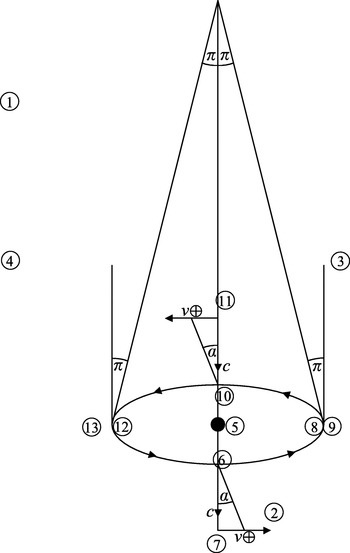
By the middle of March 1726 the star was about 20″ south of its initial location. Its southerly motion was now arrested until around the middle of April, when it began to move to the north, until in the middle of June it had returned to the position observed on 17 December. It was advancing at a rate of a second of arc every three days and continued to the north until September, when it was about 39″ north of the position recorded in March. Bradley now observed a reversal of this motion so that it moved south until December 1726, when, with due allowance for the precession of the equinox, the star returned to the position observed one year earlier.Footnote 42 Whatever the cause of the observed motion, Bradley recognized within a month of the beginning of the experiment that it could have nothing to do with the phenomenon of annual parallax (Figure 1). Molyneux and Bradley sought alternative explanations which began to throw light on their contradictory motivations.
The apparent motion of γ Draconis due to the observed effects of annual parallax and the aberration of light, where c=the velocity of light; v⊕=the velocity of the Earth; π=annual parallax; α=the aberration of light. 1: The observed motion of γ Draconis due to annual aberration is the product of a vector combining the velocity of light (c) and the velocity of the Earth (v⊕). 2: Due to the effect of aberration, light is deflected in the direction of the Earth's motion. Any motion due to parallax is opposite to this as the star moves back against its background. 3: The observation of annual parallax in declination is greatest when the star is in quadrature whilst the observation of aberration in declination is greatest at opposition and conjunction. So the contrasting phenomena are out of phase by 90°. 4: The annual aberration (α) of γ Draconis is over 19″ whilst the annual parallax is 0.06″. 5: Sun. 6: December. 7: At conjunction. 8: March. 9: At quadrature. 10: June. 11: At opposition. 12: September. 13: At quadrature.

Causes and conjectures
Having almost abandoned any explanation of the observed phenomenon due to instrumental, observational or systemic error,Footnote 43 the partners began to make conjectures about the possible causes of the inexplicable phenomenon. Bradley wrote,
A nutation of the Earth's axis was one of the first things that offered, but this soon appeared to be insufficient; for though it might have accounted for the change in declination of γ Draconis: yet it would not at the same time agree with the phenomena in other stars; particularly a small one almost opposite to γ Draconis in right ascension …Footnote 44
Bradley deftly passed over a suggestion which in truth was almost impossible to reconcile with Newtonian natural philosophy. The conjecture that the motion was evidence of a nutation would on the face of it appear to be a perfectly rational and acceptable conjecture. Newton had indeed suggested that the Earth might be subject to an annual nutation but he surmised it would be insensible.Footnote 45 Could Newton's theories have been reconciled with a nutation so large that it was evidenced by a rapidly changing declination of a second of arc every three days?Footnote 46
In order to determine whether the observed motion were the product of an annual nutation of the Earth's axis it was necessary to observe the motion of another star, preferably with a difference in right ascension of about twelve hours. The design of the instrument militated against an easy identification of such a star. The zenith sector had been designed to observe the annual parallax of a single object star, γ Draconis. The instrument was incapable of being pointed at any star that moved more than a few minutes of arc from the zenith when passing through the instrument's field of vision. The brightest star which was close to the zenith and almost opposite in right ascension to the object star was an insignificant sixth-magnitude star which I have confirmed as 35 Camelopardalis.Footnote 47 In his account Bradley reveals that the conjecture that the motion was evidence of a nutation soon had to be abandoned. He expresses this lucidly:
though this star seemed to move the same way as a nutation of the Earth's axis would have made it, yet changing its declination but about half as much as γ Draconis in the same time (as appeared upon comparing the observations of both made upon the same days at different times of the year) this plainly proved that the apparent motion of the stars was not owing to a real nutation; since if that had been the cause the alteration in both the stars would have been nearly equal.Footnote 48
It is difficult to ascertain quite how soon it became obvious to the partners that the behaviour of the control star 35 Camelopardalis was incompatible with the support of the conjecture that the motion was a nutation. But it certainly could not have been more than a few weeks. The control star was observed on 7 January and on 3, 12 and 20 February 1726. It consistently moved to the north as γ Draconis moved to the south. This at least was compatible with the hypothesis. However, whilst 35 Camelopardalis moved 5″ between these dates, γ Draconis moved 9.1″ between 3 January and 13 February.Footnote 49 It is unlikely that the annual-nutation hypothesis could have been maintained for longer than this period.
This matter has been examined with great care here because it throws light on the behaviour of Molyneux and reveals that he was either ambivalent about, or opposed to, the validity and veracity of Newtonian natural philosophy. His behaviour was so precipitate that it may even suggest that he was long ill-disposed towards it. Bradley was indubitably concerned about the possibility of a confirmation of Hooke's claim that the annual parallax of γ Draconis was 27 or 30 seconds of arc. A committed follower of Newtonian theory would also have experienced real difficulties in the acceptance of a sensible annual nutation, certainly one of the order proposed by the hypothesis. The rapid demonstration of the untenability of the conjecture was probably received with a sense of relief by Bradley. In the comparatively small period of time when the conjecture was still a live issue Molyneux made an ill-judged and premature approach to John Conduitt's house, where Newton was residing during the last few months of his life.Footnote 50 Bradley and Graham were both patient observers, not inclined to express confidence in any conjecture until it had been firmly established by observation or by reason.Footnote 51 The observation of the object and control stars reveals that the conjecture was soon abandoned, within weeks. Yet during this period Molyneux eagerly approached Newton through Conduitt.Footnote 52 Conduitt wrote a brief memorandum which reveals that Molyneux stated that he, Graham and Bradley had discovered
a certain nutation in the earth which they could not account for and which Molyneux told me he thought destroyed entirely the Newtonian System and therefore he was under the greatest difficulty how to break it to Sir Isaac.Footnote 53
In addition to its imprudence Molyneux's approach was also devious, for if it had been known of by more disciplined minds like those of Graham and Bradley, one can only assume that they would have been opposed to it, indeed they would surely have been highly disconcerted. Whether Molyneux's partners were in any way aware of the approach is debatable but it must have come to their attention eventually. It must have confirmed the view that Molyneux was heterodox in his opinions.
Although Bradley wrote his account after the demise of Molyneux on 13 April 1728,Footnote 54 he had to accommodate the work undertaken at Kew with that he later undertook at his aunt's house in Wanstead. His work at Kew was well known to Halley and to many in the scientific community in London. Bradley contrived to shape his account so that he was able to skate over the questions that might be raised by the conduct of the work undertaken at Molyneux's residence. Before moving on from the hypothesis of the annual nutation I must refer to Rigaud's work on Bradley.Footnote 55 In his Memoirs of Bradley Rigaud refers to a paper, apparently written in Bradley's hand and endorsed by Molyneux with the words, ‘Mr. Bradley, July 2, 1726, Nutation of the earth's axis’.Footnote 56 I have sought this document, even in the Molyneux archive, but to no avail.Footnote 57 The date is puzzling, for it clearly contradicts the evidence of the Kew Observation Book and the ‘Observations at Kew’ to be found in the Miscellaneous Works.Footnote 58 The date may have been added later by Molyneux, for all possible evidence of the imputed annual nutation had disappeared by the end of February 1726. This contention is further reinforced by the evidence of the observations of 35 Camelopardalis. If, as the paper mentioned by Rigaud suggests, the work was undertaken by Bradley in July 1726 then the control star, a faint sixth-magnitude star, would have to be observed passing through the meridian during the middle of the day. I have used a stopped refractor and found the location of 35 Camelopardalis during the day quite impossible.Footnote 59 Without gaining sight of the memorandum I cannot comment on its contents and have no idea why such a paper could have been written so many months after the period when the conjecture must have been abandoned.
Although the hypothesis of the annual nutation was insufficient, Bradley was sure the partners were observing a new, previously unrecognized phenomenon. In his account he states, ‘The great regularity of the observations left no doubt, but that there was some regular cause that produced this unexpected motion, which did not depend on the uncertainty and variety of the seasons of the year.’Footnote 60 Before continuing with Bradley's account we will consider another diversion. It serves to suggest that a conjecture was proposed which again was expressed in direct defiance of Newtonian natural philosophy. Bradley refers to it only in passing.Footnote 61 He only includes the suggestion in a kind of rhetorical flourish to show that every possible explanation had been considered before he alighted upon the conjecture that satisfied his curiosity. Bradley must have been sceptical about the conjecture from the very start; it simply contradicted the entire content of the second book of Newton's Principia.Footnote 62 All the more reason to believe that if such a contention had been proposed it must have been made by Molyneux. It simply flew in the face of everything that Bradley understood about the Newtonian theory he was so committed to. What was proposed was that the motions observed were the product of refraction as the Earth moved through a dense medium which distorted the figure of the Earth's atmosphere. If a French academician committed to the Cartesian system had proposed such a conjecture it would have conformed to the orthodoxies still dominant in Paris.
There is a document referred to by Rigaud which again I have also been quite unable to locate, in spite of extensive searches. According to Rigaud this hypothesis was contained in a memorandum dated 18 June 1726,Footnote 63 pre-dating that concerned with the more obvious conjecture that the motion might be a nutation. If such a hypothesis had ever been entertained, it must surely have followed the abandonment of the hypothesis that the observed motions were due to a nutation. According to Rigaud the endorsement was made by Molyneux.Footnote 64 Whenever the conjecture was proposed it cannot have been sustained for very long, for it would certainly have met with resistance from both Bradley and Graham. Rigaud also asserted that yet another paper or memorandum was written giving reasons for the final abandonment of both hypotheses – the nutation and the motion due to the effects of refraction – possibly as late as November 1726. The projected date seems quite fanciful and in no way supported by the observation books. A thoroughgoing Newtonian like Bradley could scarcely have seriously entertained either notion for more than a few weeks in the face of counterevidence. Various ideas were formed and proposed. Rigaud states,
It had been found that the quantity of the motion in declination was somehow connected with the latitude of the star. The precise nature of this connection does not yet appear to have been distinctly made out, but it was now clearly seen, that the few stars which passed within the narrow range of Molyneux's instrument were insufficient for the complete examination of the question.Footnote 65
It must have quickly become evident to Bradley that Molyneux's instrument was quite inadequate for the task of determining the causes of the inexplicable phenomenon they were observing. Within a few weeks of the start of the experiment, during the early weeks of 1726, when they began observing the faint star 35 Camelopardalis, Bradley might probably have felt unnecessarily restrained by the inadequacies of an instrument that had been designed to observe a single bright star. Late in 1726 Bradley looked to the erection of a new instrument, a zenith sector capable of observing far more stars. Bradley wrote,
not being able to frame a hypothesis at that time, sufficient to solve all the phenomena, and being very desirous to search a little farther into this matter; I began to think of erecting an instrument for myself at Wanstead, that having it always at hand I might with more ease and certainty enquire into the particular laws of this new motion.Footnote 66
Determining the parameters of the motion
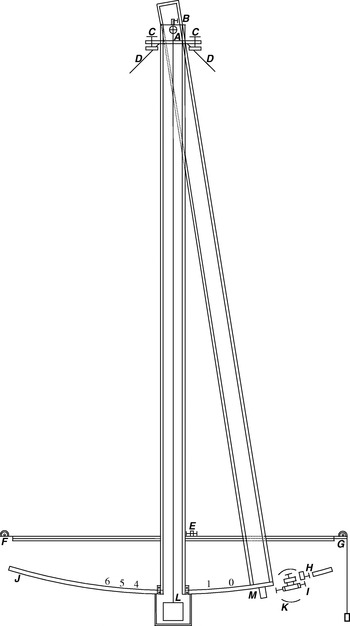
On 19 August 1727 a new zenith sector designed and constructed by Graham (Figure 2) was set up at Elizabeth Pound's house in Wanstead.Footnote 67 The planning was as detailed as could be expected from an astronomer as meticulous as Bradley. If ever two men were perfectly suited to work in partnership they were Graham and Bradley, for both men were utterly exacting, the great clockmaker contriving the most accurate and precise scientific instruments of his age, and the ambitious astronomer observing to the utter limits of those extraordinary instruments. Early in 1727 Bradley purchased an object glass for the new instrument.Footnote 68 He had finished centering the glass by April. The cost of the new instrument was included in the inventory of instruments used in the new observatory at Greenwich in 1750, which Bradley detailed as forty-five pounds.Footnote 69 This would have been a sizable proportion of his barely adequate income at this time. Graham was renowned for his generosity so Bradley would possibly have paid for the instrument by deferred payments. It is also possible that Mrs Pound may have supported the enterprise, for Bradley lived with her and the instrument was set up at her domicile.Footnote 70
Diagram of the zenith sector constructed by George Graham for James Bradley at Wanstead (not to scale). A: the Y on which the plumbline rests; B: the screw for regulating the plumbline; C: adjusting screws; D: iron supports; E: the screw and support for fastening the wood guard to the brass supporters F, G; F, G: brass supporters; H: the micrometer screw; I: a screw for taking off the pressure of the telescope from the micrometer screw when the instrument is not in use; J: a back support on which the micrometer slides; K: the arc to the right of the telescope is broken off in order to show the micrometer screw; L: the plumb-bob; M: eyepiece.

Although the new sector was only just over half the length of that designed for Molyneux at Kew, twelve and a half feet against the twenty-four and a half feet of the first instrument, it was extraordinarily accurate, a testimony to Graham's immense skill. After various trials with the telescope and with the micrometer, Bradley began to appraise the observational limits of the new instrument even before it had been completed. He wrote, ‘so it seems that one might observe through this object-glass charged with a two inch eyeglass, so as not to differ from the truth above half a second’.Footnote 71 Although the new sector was barely half the length of that suspended at Kew, it was a very robust instrument capable of extraordinary accuracy and precision in the hands of a patient and skilled astronomer as remarkable as Bradley.Footnote 72 It was later used by Nevil Maskelyne at the Royal Greenwich Observatory to collimate the transit instruments and the quadrants. It was also shipped later to the observatory at Cape Town. Maskelyne attested that the twelve-and-a-half foot zenith sector was accurate to within half a second of arc. It was capable of observing stars up to 6.25° from the zenith, allowing the observation of many bright near-zenith stars, including the first-magnitude star Capella.
At Wanstead, Bradley entirely changed the character of the investigation. The instrument that Bradley commissioned from Graham was designed with an entirely different objective in mind. The new instrument was designed to allow Bradley to observe many different bright stars, ‘since it gave me an opportunity of making choice of several stars very different both in magnitude and situation; there being more than two hundred inserted in the British Catalogue that may be observed with it’.Footnote 73 Instead of dwelling on the search for possible ‘causes’ Bradley now followed his most fundamental presuppositions, for his observations of both γ Draconis and 35 Camelopardalis at Kew suggested that the inexplicable and counterintuitive motions observed were evidence of what he intuited was a general motion displayed by all of the stars. He set out to elucidate the parameters of these motions and then determine the law that explained them.
Bradley observed about seventy stars on a fairly regular basis but he concentrated on the motions of some eleven or twelve bright stars which he could observe all round the year during the day as well as night. Bradley began to observe his chosen stars systematically from the day the sector was suspended, 19 August 1727, when he continued his observations of γ Draconis. It was 18″ further north than it had been when he last observed it in December 1726 at Kew.Footnote 74 It continued moving until it was 1.3″ further north from 7 until 14 September,Footnote 75 when it began moving south. By 10 December 1727 it was once more back in the same position it had been observed in Kew a year earlier.Footnote 76 On 7 March 1728 it had moved 19.3″ south of this position.Footnote 77 On 19 August 1728 the star had returned to the position observed after the initial observation at Wanstead. The motion of γ Draconis confirmed that observed at Kew from December 1725.
Of the other bright stars that Bradley observed throughout the year, one possessed a similar right ascension to γ Draconis and there was a group in opposition and two in quadrature to it, one six hours ahead and another six hours behind. The ‘object group’ included γ and β Draconis and the ‘control group’ α Aurigae (Capella) and 35 Camelopardalis. The two groups in quadrature included α and β Cassiopeiae, and α and τ Persei, which were six hours in arrears, whilst another group made up of γ, ε and η Ursae Majoris were six hours ahead. It was soon evident from the observational data that a distinctive pattern emerged. Bradley revealed this pattern in his account:
After I had continued my observations a few months, I discovered, what, I then apprehended to be a general law observed by all the stars, viz: That each of them became stationary or was farthest north or south when the Sun was nearly in quadrature to it in right ascension, that is, when it passed over my zenith about six of the clock, either in the morning or evening. I perceived likewise, that, whatever situation the stars were in with respect to the cardinal points of the ecliptic, the apparent motion of every one tended the same way when they passed the instrument about the same hour of the day or night; for they all moved southward while they passed in the day and northward in the night, so each was farthest north when it came about six o'clock in the evening and farthest south about six in the morning.Footnote 78
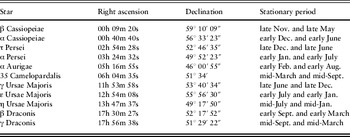
This was an important juncture in Bradley's investigation at Wanstead, for it validated his entire approach. He was aware that each of the stars he was observing followed exactly the same patterns of motion. This table (See Table 1) reveals the connections between the right ascension of the stars he observed over the course of the year with their stationary periods when the stars ceased moving north or south in declination.
The right ascension of the stars observed over the course of the year with their stationary periods when the stars ceased moving north or south in declination

Bradley was now convinced he was observing a general phenomenon. The consequent result of his observations was the product of an observational programme which had been designed specifically to isolate such patterns from out of a background of previously anomalous and unaccountable motions. No astronomers prior to Bradley had sought to isolate such looked-for motions beyond seeking to account for them in terms of annual parallax.Footnote 79
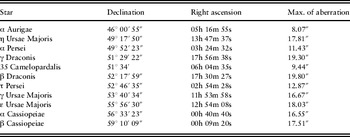
Bradley had revealed that the motion of γ Draconis could not be explained by annual parallax. As yet he had only a vague conception of what this general law of motion was and little comprehension of its possible cause, but Bradley was now close to constructing the necessary theoretical frameworks within which he would be able to contextualize and interpret his observations. Up to this point the observed motion of γ Draconis, though regular and thus predictable, defied explanation. He was now sure he had discovered a general law obeyed by all of the stars he was observing. He remained uncertain about the parameters of the observed motions. His first presumption, that the magnitude of the observed motions was to be correlated with their declinations, was unsustainable, as Table 2 reveals.
Declination and maximum of aberration of observed stars. Note: the term ‘maximum of aberration’ was not used until several years after the publication of Bradley's paper. The values are those currently in usage based on the astronomical unit as the baseline. In Bradley's time the mean major axis of the terrestrial orbit was in common usage so the values would be double those in the table (ie β Draconis 19.80″×2=39.60″).

As is immediately apparent, there was no correlation at all between the maximum observed aberration and the declination of the star.
Bradley then introduced a thought experiment in order to explain the insight which allowed him to fully comprehend the parameters of the motions he had observed in about seventy different stars. His account is lucid and convincing. He writes,
If the Earth revolves around the Sun, and the velocity of light is to the velocity of the Earth's motion in its orbit (which I will at present suppose to be a circle) as a thousand to one, then it is easy to conceive, that a star really situated in the very pole of the ecliptic, would to an eye carried along with the Earth seem to change its place continually, and describe a circle round that pole, every way distant therefrom 3½′ so that its longitude would be varied through all the points of the ecliptic in a year, but its latitude would always remain the same.Footnote 80
This is an idealization, but its clarity allows the reader to grasp the essentials of the astronomer's insight. Bradley was able to demonstrate from his observations that if the Earth moved in a perfectly circular orbit then a star situated close to the pole of the ecliptic – that is, at the point 90° above the plane of the ecliptic, the plane of the orbit of the Earth around the Sun – would appear to describe a small circle in the course of a year. But a star that was situated on the plane of the ecliptic would, over the course of a year, only appear to move east and west along the plane of the ecliptic. The amount of motion of any star in declination is a function of its ecliptic latitude.Footnote 81 Bradley wrote,
Other stars that were not in the plane of the Ecliptic would seem to describe a sort of elliptical figure, whose greater axes would be all equal to the diameter of the little circle, that the star in the pole of the ecliptic would seem to describe, and the lesser axis in each would be the greater, as the sine of the star's latitude to radius. Those stars that lay in the ecliptic would change their longitude, but not their latitude; but the right ascension and declination of all would be changed more or less according to their different situations with respect to the ecliptic and their aspects with the Sun.Footnote 82
After observing the object star from December 1725 and many other stars from August 1727 Bradley had determined the law of the motion. He had certainly achieved this by September 1728. This contradicts Rigaud's judgement that the law of the new-discovered motion followed the development of the hypothesis which proposed the causes of the phenomenon. I argue that the evidence suggests the contrary. The determination of the law preceded the hypothesis of its causes. However, the intuition which led to the formation of the hypothesis was based on a working practice which had been developing since 1711 and particularly from the period when Bradley observed the satellites of Jupiter on behalf of Halley.Footnote 83
The hypothesis of the new-discovered motion of the fixed stars
Bradley's account rather skates over some of the detail we need in order to comprehend how he reached his final conjecture, the hypothesis of the new-discovered motion. The best way to make sense of his reasoning is by examining the work he had undertaken a few years earlier for Edmond Halley.Footnote 84 He believed he did not have to make this explicit because Halley was his correspondent.Footnote 85 Rigaud conjectured as to the moment when Bradley formed his idea of the cause of the phenomenon and was influenced in this by his acceptance of the account given by Thomas Thomson in his History of the Royal Society,Footnote 86 in which Bradley gains his insight during a boating party on the Thames. Such a party would likely have been during the summer, suggesting the idea came to him around July or August 1728. But Bradley was observing from August 1727 and we can be sure that after six months, in about February 1728, he must already have been forming a clear idea in his mind about his expectations of the behaviour of the stars he was observing as he reflected on their behaviour during the previous six months. We can conjecture that if Bradley were beginning to form ideas, he would wait until he had observed the complete annual cycle of all of the stars he was observing before coming to any definite conclusions. Any degree of familiarity with Bradley's work reveals that he would be loath to come to any premature conclusions. Bradley was already sure in his own mind what the explanation was by about August 1728, for it was so firmly grounded in his practice that he must have comprehended it once he was sure that all of his chosen stars were behaving in accordance with the presumptions that led him to design the experiment at Wanstead.
Between 1715 and 1719 Bradley observed the satellites of Jupiter in preparation of a set of ephemerides of the Jovian system to support Halley's attempt to devise a method for determining the longitude at sea.Footnote 87 He observed all four of the Galilean satellites, observing every eclipse and then calculating future eclipses and noting the anomalies with great attention to detail. He drew up a set of Jovian tables and presented them to Halley. In 1752 John Bevis,Footnote 88 an amateur astronomer who had his own observatory in Stoke Newington,Footnote 89 in close contact with Bradley, translated these tables from Latin into English and verified that much the greater part of Halley's tables were in fact the work of the precocious Bradley. It was this sustained and detailed work on the Jovian system that reinforced Bradley's apprehension that the variations in the timings of the eclipses of the four major satellites correlated with the variations in the linear distance between the Earth and Jupiter as both planets moved in their respective orbits around the Sun. This reinforced his belief in the finite velocity of light, for his work was so detailed that it seemed quite inconceivable to him that anyone could rationally deny it, given that he was equally certain that the planets orbited the Sun. So, although Bradley's hypothesis of the ‘new-discovered motion of the fixed stars’ may appear to have been proposed quite precipitately, it was based on many years of his astronomical practice. Bradley was very certain that he had alighted upon the correct explanation of a motion that must have appeared inexplicable for so long. He confidently stated,
The greatest alteration of the place of a star in the pole of the ecliptic (or which in effect amounts to the same, the proportion between the velocity of light and the Earth's motion in its orbit) being known; it will not be difficult to find what would be the difference upon this account between the true and apparent place of any star at any time; and on the contrary the difference between the true and apparent place of any star being at any time known, the proportion between the velocity of light and the Earth's motion in its orbit may be found.Footnote 90
Yet although he was supremely confident that he had discovered the causes of the motion and determined its parameters, he also recognized that the hypothesis is open to many different objections. Neither the finite or progressive motion of light nor the motion of the Earth in its orbit have been independently confirmed. In his account Bradley imputes the motion of the Earth from the supposition that the velocity of light is finite, based on the evidence of his sustained observations of the Jovian system. The progressive motion of light is predicated on the supposition that the Earth is in motion around the Sun based on the development of his ephemerides of the satellites of Jupiter, the variations being caused by the imputed motion of the Earth and Jupiter in their respective orbits around the Sun.
In addition to these objections Bradley admitted that he had failed to observe the annual parallax of any of the stars he observed. Although there were a few residuals between the predictions of the law of the new-discovered motion and the recorded observations of the motions of the stars, he knew that the possible assertion of the discovery of annual parallax cannot be sustained. He wrote,
it must be granted that the annual parallax of the fixed stars is much smaller than hitherto has been supposed by those who have pretended to deduce it from their observations. I believe I may venture to say that in either of the two stars last mentioned,[Footnote 91] it does not amount to 2″. I am of the opinion that if it was 1″, I should have perceived it in the great number of observations that I made, especially of γ Draconis …Footnote 92
This is a notable moment in his account; the ostensible reason for the experiment had supposedly been to confirm Hooke's earlier claim that the annual parallax of γ Draconis was either 27 or 30 seconds. Bradley now asserts that the annual parallax of the original object star is certainly less than a second.Footnote 93 Given that the determination of annual parallax still apparently lay beyond resolution and that neither the motion of the Earth nor the progressive motion of light had been independently determined, Bradley confessed that,
There appearing therefore after all no sensible parallax in the fixed stars, the Anti-Copernicans[Footnote 94] have still room on that account to object against the motion of the Earth; and they may (if they please) have a much greater objection against the hypothesis by which I have endeavoured to solve the forementioned phenomena by denying the progressive motion of light as well as that of the Earth … I do not apprehend that either of these postulates will be denied me by the generality of astronomers and philosophers of the present age …Footnote 95
In revealing strong objections against acceptance of his hypothesis, Bradley was also effectively disarming objections from any astronomers who may have opposed the heliocentric thesis. The ‘anti-Copernican’ astronomers could not merely object to his hypothesis, for his observations were both accurate and numerous and his conjectures based on commonly accepted presumptions, for they must support their objections with an equally convincing hypothesis that explained the observed motions in geocentric terms. No such response was ever forthcoming.Footnote 96 The overwhelming majority of contemporary astronomers supported the heliocentric model and accepted the hypothesis of the new-discovered motion. It was taken as firm empirical evidence of the motion of the Earth in its annual orbit around the Sun.
Bradley's work on the new-discovered motion challenged many of the presumptions that many astronomers upheld about the scale of the stellar universe. While the astronomical revolution had replaced the finite cosmos of the ancient and medieval world views with the contemplation of a universe of hitherto undreamt-of dimensions, there had remained a resistance to the acceptance of a scale that made the measurement of annual parallax increasingly unlikely given the means at the disposal of contemporary astronomers.Footnote 97 Yet Bradley was in no doubt that the stars were as distant as Newton had estimated using photometric methods. In the third unpublished version of his paper on the new-discovered motion he makes a direct reference to work undertaken by Halley on the extinction rates of bright stars during lunar occultations.Footnote 98 He writes,
If the distance of the fixed stars is so immensely great as my observations imply, it will no longer seem strange that their diameters should be so small as you have indisputably proved them (in your remarks on Mr Cassini's Essay on the parallax of Sirius) by the most proper method we can have of determining them, viz: by the occultations of the brighter stars by the Moon. For if we suppose them, no bigger than the Sun, and that they are placed above 400,000 times from us as it (as γ Draconis, a star of the second magnitude seems at least to be) then their diameters would not be 1/200 part of a second.Footnote 99
Bradley was aware of his mentor's scepticism about his claims that he could accurately observe motions as small as half a second of arc. So in addressing this passage to Halley he was not merely underlining work undertaken by his mentor, he was also confirming Newton's assertions that the stars were set at immense distances. Bradley was extending the arguments from analogy, for if the common assumption were that the stars all possessed similar luminosities (the magnitude therefore being a function of a star's distance) then it would seem perfectly in order to suggest that the stars possessed similar diameters. Bradley now attempted to correlate some of the consequences of the immense precision of his observations with recent work undertaken by Halley. This passage was not included in the published version. Bradley sought to show that his assertion that the annual parallax of the stars could not be greater than one second, with the implied consequence that γ Draconis must be at least 400,000 times further from the Sun than is the Earth, could be correlated with Halley's observations of lunar occultations of bright stars. Bradley argued that if the stars possess similar physical diameters to the Sun, then the nearest stars could not possess an angular diameter greater than 1/200 of a second. This supported Halley's observations of first-magnitude stars during lunar occultations, which revealed that they were extinguished almost instantaneously, suggesting that they possessed insensibly minute diameters in contradiction to their telescopic images, which appeared to show that they possessed angular diameters of the order of five arc seconds. Of all the stars observed by Halley, only Aldebaran displayed a gradual loss of light indicative of its later discovered status as a giant star with an angular diameter of five seconds, its light diminishing over a period of some ten seconds of time. Bradley's argument is strongly supportive of Newton's views that the stars were all immensely distant from the solar system.
From the hypothesis to the theory of annual aberration
The published paper was read at meetings of the Royal Society – Halley, anxious that his protegé claim priority for the description of a phenomenon that he was certain was of great import, reading a hurriedly prepared version.Footnote 100 It was this version that was published in the Philosophical Transactions Footnote 101 and Bradley's undoubted plan to publish his definitive version was forestalled.Footnote 102 My studies of Bradley's so-called ‘aberration papers’ reveal that his ideas remained fluid for months as he sought to establish a terminology that distinguished the motion from that of annual parallax. This was provided by the Italian astronomer Eustachio Manfredi.
From 1707 until 1728 Manfredi made extensive observations in Bologna with various assistants of numerous motions of the fixed stars in right ascension. These observations led to the publication in May 1729 of a thesis, De annuis inerrantium stellarum aberrationibus,Footnote 103 which claimed to demonstrate the falsity of the Copernican system.Footnote 104 This he explicitly spells out in his introduction:
There are some, however, who, noticing that these strayings of stars recur at fixed times of the year, think there is no doubt the matter has to do with an annual movement which with Copernicus they attribute to the earth and so they proclaim that a true universal system is disclosed and demonstrated by this very piece of evidence, in which, however, it is easy to be deceived, since the Copernican system is tottering together with the arguments by which they think it is supported, as I am confident that I shall show in this very work.Footnote 105
After various difficulties in obtaining the imprimatur for De annuis it was published in Bologna in May 1729, by which time Manfredi was aware of Bradley's paper. In a letter addressed to Antonio Leprotti he reveals his dismay at being unable to obtain a translation of the English astronomer's ‘Letter’. He writes,
I would like to see the May 1729 issue of the Journal de Trévoux discussing this discovery of Bradley's. Can you believe that I have not been able to find this book in Bologna, nor in Venice or Padua? … if you would be so kind as to have the article concerning this controversy transcribed entirely at my expense … you would be doing me the greatest favour in the world.Footnote 106
Manfredi was also in correspondence with Sir Thomas Dereham, the British ambassador to the Holy See, who was in turn in regular correspondence with James Jurin, the secretary of the Royal Society during the final years of Newton's presidency. Such networks had led to Manfredi being elected an FRS on 14 October 1728 at the very moment when Bradley was completing his work on the law and hypothesis of the new-discovered motion. It was Dereham who obtained for Manfredi an Italian translation of Bradley's paper. His response, under the promptings of figures like Leprotti, who retained connections with the Roman Curia, was both sceptical and characteristically conservative. Manfredi took every opportunity to avoid endorsing Bradley's theory for it would have implied acceptance of a heliocentric cosmology. It was this conservatism that had denied Manfredi the opportunity to make claim to the discovery of the aberration of light which so much of his work had fitted him to achieve.
Bradley in his turn was eventually familiarized with the contents of Manfredi's thesis, for this is confirmed by some of the memorandaFootnote 107 contained in Bradley's archive.Footnote 108 Manfredi had observed the motions of the stars in right ascension and made a systematic analysis of many stellar motions to prove that none of them conformed to the theory of annual parallax. In this Bradley would have been fully in accord with the Italian astronomer. Bradley's discovery of the aberration of light was not a product of mere observation for it was also incumbent on a heuristic that shaped the way he constructed and interpreted evidences. Manfredi clearly did not believe that all of the stars displayed such annual motions. Any such motions were ‘aberrations’. When discussing the problem of determining which stars were stationary when comparing variations in their right ascensions Manfredi wrote that
we are forced to acknowledge that it is impossible to judge to which of the two stars the error is to be attributed, to what those aberrations we are seeking, or to the other with which we are comparing it, or perhaps to both. In this uncertainty nothing better occurs to me than if we choose two or more of the fixed stars, whose intervals of arrival at the meridian are found by very many precise observations made at different times of the year [to be] perpetually the same … I do not doubt that this happens to many among the vast number of stars … and refer to these or to some one of them, the times of that star, whose aberration we have undertaken to investigate and define by measurements.Footnote 109
When Bradley ordered the zenith sector for his own use at Wanstead he asked Graham to design an instrument to allow him to observe many near-zenith stars, sure as he was that motions of the sort he had observed in γ Draconis and 35 Camelopardalis would be found in all of the stars, convinced that he had been observing a universal phenomenon. In the published version of his paper on the new-discovered motion Bradley revealed why he observed the phenomenon in every object in the sky. He expressed himself thus:
At last I conjectured that all the phenomena mentioned proceeded from the progressive motion of light and the earth's annual motion in its orbit. For I perceived that, if light was propagated in time, the apparent place of a fixed object would not be the same when the eye is at rest, as when it is moving in any other direction than that of the line passing through the eye and object; and that when the eye is moving in different directions, the apparent place of the object would be different.Footnote 110
He surmised that every object in the sky would display an annual elliptical motion in declination and right ascension.Footnote 111 Manfredi accepted that Bradley's work was precise and accurate and that their observations were mutually supportive. Bradley agreed entirely with Manfredi that his observations did not conform to the theory of annual parallax but he had constructed a new theoretical framework allowing him to reduce his observations in conformity with the heliocentric thesis. It is ironic that Manfredi's term ‘aberration’, used to describe the motions he observed in right ascension, was adopted by Bradley to describe the universal motion he had intuited in response to the various motions he had observed in declination, which was widely acclaimed as evidence for the motion of the Earth around the Sun.
For some months after Bradley published his paper on the new-discovered motion he wrestled with a problem of clarification, with the difficulties of distinguishing the terminology associated with the new-discovered motion and that associated with annual parallax, though the respective geometries of the two motions were entirely incompatible. The motions associated with annual parallax were ninety degrees out of phase with those associated with the new-discovered motion and proceeded in diametrically opposed directions. This had been perceived also by Manfredi. Bradley had difficulty devising a language to describe these contrasting motions. In an early memorandum Bradley described annual parallax as ‘the parallax on account of distance’ and the new-discovered motion as ‘the parallax on account of the motion of light’.Footnote 112 This was highly confusing and misleading because the new-discovered motion was not a product of any form of parallax.
In the months after Manfredi published his thesis in May 1729 and after Bradley had become familiar with its contents he began tentatively to adopt the Italian astronomer's terminology. There is a very interesting document written just when he was adopting the new term. It is a memorandum entitled ‘Rules for computing the Aberration or the Parallax of the Stars arising from the Motion of Light’.Footnote 113 The document is confusing and in various places he crosses out the word ‘parallax’ and overwrites it with the word ‘aberration’. By describing the new-discovered motion as the ‘aberration of light’ or as ‘annual aberration’ the reification of the hypothesis of the new-discovered motion into the theory of annual aberration was soon established.
Bradley's term ‘annual aberration’ soon entered general discourse as the way in which the new-discovered motion was now described. By 1737, in his correspondence with the French natural philosopher Maupertuis, the term had become so well established that it was now being applied to reduce observations. In a letter written to Bradley after returning from Lapland Maupertuis requested that the corrections applied for the aberrations of the stars he and his party had observed be corrected or confirmed. Maupertuis wrote,
I have one favour to ask of you, sir, and hope you will not refuse it me; and that is, to tell me whether you have any observations actually made of the aberration of the stars δ and α [Draconis] themselves, and whether we have made use of the proper correction for this aberration.Footnote 114
In response, Bradley furnished Maupertuis with the corrections he required but he made public for the first time the observations he had undertaken from 1727 of a lunar-induced nutationFootnote 115 of the terrestrial axis. To Maupertuis he asserted, ‘The whole quantity of this nutation, I find, amounts to about 9″ each way from the mean.’Footnote 116 He reduced Maupertuis's observations, making allowance not merely for aberration but also for this lunar-induced nutation. Bradley observed the nutation until 1747, publishing his paper in 1748 shortly before he was awarded the Copley Medal of the Royal Society. It was the culmination of the enquiry that had begun at Kew in December 1725. In 1742 he had been appointed the third Astronomer Royal and was widely regarded as the most eminent astronomer in Europe. Bradley had been an ambitious astronomer but his advancement was not entirely the result of his skill or his expertise in this field. His paper on the new-discovered motion was the first step in an ambitious progress in which he exercised all of his personal and political skills. It was these latter abilities, as much as his skill as an astronomer, which were to lead to his advancement onto the wider stage. His ‘aberration’ paper was a brilliant construction of consummate propaganda directed at the audiences he knew would be the key to the later fulfilment of these ambitions.
Conclusion
It is easy to be deceived into believing that Bradley's paper on the new-discovered motion of the fixed stars was a simple narrative of an attempt to measure the annual parallax of a star in emulation of an earlier attempt by Robert Hooke. It is a measure of Bradley's consummate rhetorical skills that this is the impression he created. It is only after due reflection and after various observation books are analysed and the different versions of his aberration paper are examined that it can be recognized for what it was: a skilfully contrived reconstruction which served various different purposes, chief of which was the need to protect and enhance his reputation by appealing to the audiences he believed were the key to the fulfilment of his ambitions.
The attempt to confirm Hooke's original claim for an annual parallax of 27 or 30″ was sought by Bradley's erstwhile partner Molyneux as an attempt to challenge the validity and efficacy of Newtonian natural philosophy. This marked antipathy or malevolent ambivalence is quite noticeable throughout the period when the experiment was based in Kew under his direction, as evidenced by the choice of conjectures that were proposed.Footnote 117 Conduitt's memorandum revealed that Molyneux had approached Newton, prematurely as it turned out, with news of a nutation that ‘destroyed entirely the Newtonian system’.Footnote 118 This underlines the sense that he was opposed to the continuing hegemony of Newtonian natural philosophy in England. Although George Berkeley's perceptive criticisms of some aspects of Newtonian theory were valid, some of his critique having far-reaching consequences, his protégé possessed none of his astute and decisive intelligence.Footnote 119 The final conjecture that the partners considered, that of refraction, was nothing less than a full assault on Newton's natural philosophy for it was entirely contradicted by the arguments contained in Book II of the Principia.
I have attempted to show that Bradley was at a disadvantage when he joined Molyneux at Kew. Molyneux was a man of great wealth and political influence who had been Bradley's patron and had gained him a living through his personal connections to the Prince of Wales. In contrast, Bradley had been left in a difficult social and financial position following the sudden demise intestate of his maternal uncle James Pound.Footnote 120 Through his uncle's connections Bradley had been introduced to Newton and the powerful Whig factions that promised future openings to various offices of state.Footnote 121 Bradley must have become aware that his association with the views of his influential partner might jeopardize his future prospects. The sudden death of Molyneux from a ‘brain seizure’ released Bradley from many of the gentlemanly obligations he must surely have felt he owed his late partner.Footnote 122 The paper written by Bradley served to advance not only his own reputation but also that of his partner. Bradley wrote a paper that presented the entire investigation as a dispassionate and open enquiry of an entirely unexpected, inexplicable and counterintuitive phenomenon.
It is instructive to recognize that both Bradley and his Italian contemporary Manfredi were working under various forms of duress. The constraints imposed on Manfredi were more explicit and obvious than those experienced by Bradley. Manfredi was working within a Catholic milieu at a time when heliocentric astronomy was officially proscribed in centres like Bologna, within the papal domain.Footnote 123 His contemporaries Jacques Cassini and Jacques Maraldi were based at the Paris Observatory beyond the power of such papal edicts; nevertheless they felt obliged to accept a geocentric cosmology even in the 1720s. Manfredi felt unable to propose any cosmological solution that suggested that the Earth was in motion. Bradley's constraints were less obvious, as suggested in this paper, but he was able to resolve the various problems revealed by his observations in a much more productive way. His social and cultural milieu positively encouraged him to be radical in order to advance his reputation.
Bradley knew that the power to bestow most offices of state was not in the gift of those closest to him. These offices were in the gift of the ‘Robinocracy’, only to be gained through the acquisition of political patronage from those interests close to Walpole and to the ruling echelons of the Whig supremacy. Like Newton before him, Bradley was to advance his interest through his support of the ruling values of the constitutional settlement in England. His demonstrated commitment to Newtonian natural philosophy, though quite distinct from his interest in these political alliances, was nevertheless a necessity in a society in which Newton had been raised almost to the status of a demigod. The prestige and standing of Newtonian natural philosophy in England was almost beyond criticism.Footnote 124 From 1729 Bradley was the lecturer in experimental philosophy at Oxford and his lectures, in the light of the celebrity he gained from being the discoverer of the aberration of light, were popular and well attended and they became a lucrative source of income in addition to that derived from his professorship.Footnote 125 His new-found fame established his financial independence and ensured his political worth in a society which valued the prestige of his contributions. His lectures were very thorough demonstrations of many aspects of Newtonian theory as found in the Principia and the Opticks, which were attended not only by the student body but by academics and even foreign visitors, so great was his standing.
The wide and rapid acceptance of the hypothesis of the new-discovered motion and its reification as the theory of the aberration of light transformed the science of astrometry from an applied art into an exacting science. Although Bradley later capitalized on Flamsteed's earlier work and acknowledged his debt when he later succeeded to the post of Astronomer Royal, his work was characterized by an attention to detail that was clearly prefigured in his work on the aberration of light. Bradley rectified his instruments as a fundamental aspect of his observational practice, recording the various factors that affected the accuracy of his observations such as barometric pressure and ambient air temperature. Later, when Bessel reduced all Bradley's observations at Greenwich, he referred to his work as ‘incomparable’,Footnote 126 for by making allowance for every conceivable factor which affected the accuracy and precision of his observations he allowed his successors to reduce his observations to any required degree of precision.
All these techniques in the pursuit of ever greater accuracy and precision were already well developed in Bradley's work at Wanstead, in his observations of aberration and then the nutation, and this is well represented in his paper on the new-discovered motion. Prior to Bradley's work at Wanstead the science of astrometry was subject to various unaccountable yet very sensible motions which undermined all attempts to measure annual parallax and the accuracy and precision of geodesic surveys. After Bradley's work on aberration, the science of astrometry achieved new orders of precision and accuracy and the problem of the determination of annual parallax was much more clearly defined.
But if the achievement transformed the science of astrometry, Bradley's paper proposed a radical challenge to those astronomers still opposed to an acceptance of the heliocentric model. It was Bradley's perceptive insight that led him to accept that his hypothesis could be objected to on various grounds, but by admitting to these objections he also defended his position and created an insurmountable challenge to any supposed ‘anti-Copernicans’ to explain the law of the new-discovered motion in geocentric terms.Footnote 127 As the correspondence with Maupertuis in 1737 clearly suggests, the concept of annual aberration was, in addition to precession, soon being applied widely by astronomers in the reduction of their observations of stellar positions. Bradley revealed that the precession of the equinoxes was not constant, that it was affected by yet another phenomenon he had been monitoring, that of a lunar-induced nutation that correlated with the regression of the nodes of the Moon's orbit around the Earth. This, however, was to be the subject of a later paper, one that greatly enhanced his international reputation still further.