I. INTRODUCTION
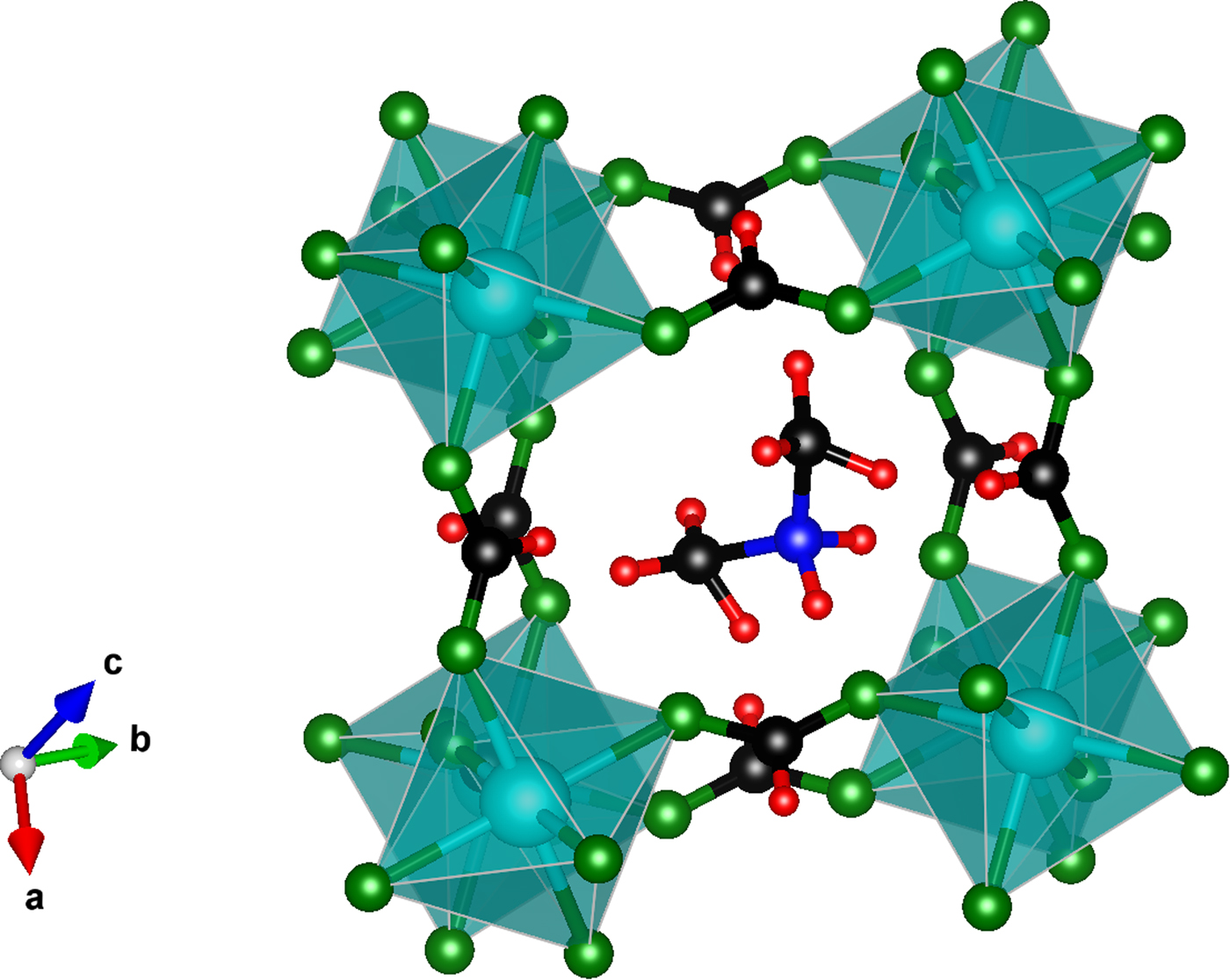
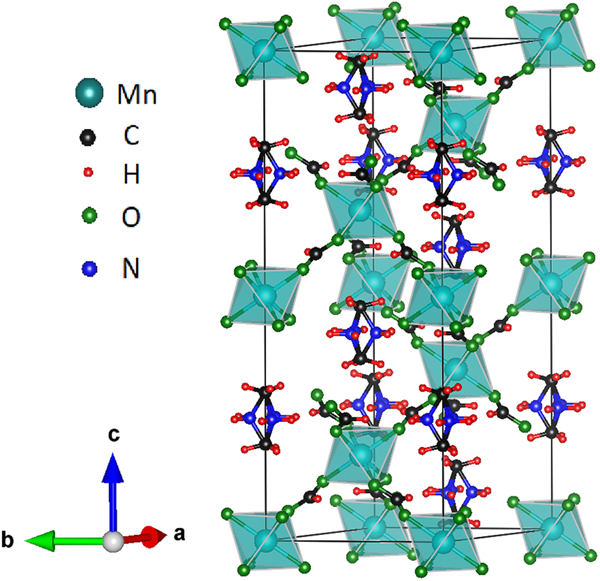
Perovskite-type metal–organic framework (MOFs) materials have a general formula ABX 3. B-cations can either be divalent or trivalent transition metals like B 2+ = Mn2+, Fe2+, Co2+, and Ni2+ and B 3+ = Cr3+ and Fe3+. B-cations occupy the center of the BO6 octahedron. These octahedra are connected by X-anions known as linkers forming a three-dimensional scaffold arrangement. The voids at the center of these scaffolds are filled with A-cations, resulting in Perovskite-type MOFs (shown in Figure 1). There exists a broad choice for A-cations and X-anions. This offers a wide scope to tune its structure and thereby to modify the physical properties. Amongst the possibilities, most popular choice of linker X-anion and A-cation is the formate (HCOO)− and dimethylammonium (DMA)+, respectively.
The Perovskite structure of Mn-MOF which is the basic building block of the Perovskite MOF.

They have recently attracted the attention of researchers amongst others because of their multiferroic property (Jain et. al., Reference Jain, Ramachandran, Clark, Zhou, Toby, Dalal, Kroto and Cheetham2009). Upon cooling, these MOFs undergo a structural transition from non-polar  $R\bar{3}c$ to polar Cc (Sánchez-Andújar et. al., Reference Sánchez-Andújar, Presedo, Yáñez-Vilar, Castro-García, Shamir and Señarís-Rodríguez2010). This structural transition drives the system from a high-temperature disordered paraelectric to a low-temperature long-range ordered antiferroelectric in the temperature range 160–185 K, depending upon the transition metal B-cation. The ferroelectric property is ascribed to the hydrogen bonding between H+ of (DMA)+ ion and O− of (HCOO)− ion (Wang et. al., Reference Wang, Yan, Cong, Zhao, Wang, Shen, Zou, Zhang, Wang, Han and Sun2013). At lower temperatures, ~8–36 K, they also undergo paramagnetic to canted antiferromagnetic transition rendering them to be multiferroic (Baker et. al., Reference Baker, Lancaster, Franke, Hayes, Blundell, Pratt, Jain, Wang and Kurmoo2010). Such a vast temperature difference between these two phase transitions shows weak coupling between electric and magnetic properties (Thomson et. al., Reference Thomson, Jain, Cheetham and Carpenter2012). To alleviate this, among other possibilities divalent substitution at Mn site of Mn-MOF is being fervently followed (Zhao et. al., Reference Zhao, Huang, Ma, Jia, Kimura, Fu, Wang, Tao, Cai and Fa2017). As the desired properties depend on the structural parameters, it is of great importance that they are estimated. With this in view, we have carried out 10 at.% substitution at Mn site of the MOF with Zn, Ni, and Co. Structural parameters were estimated using Rietveld analysis of powder X-ray diffraction (PXRD) pattern.
II. EXPERIMENTAL
A. Crystal growth
Single crystals of [(CH3)2NH2]Mn(HCOO)3 as well as [(CH3)2NH2]Mn0.9M 0.1(HCOO)3 (M = Zn, Ni, and Co) were grown by solvothermal reaction followed by slow evaporation quite similar to the growth of other MOFs (Mączka et al., Reference Mączka, Gągor, Macalik, Pikul, Ptak and Hanuza2013). Commercially available precursor materials were used without further purification. In a typical crystal growth of Mn-MOF, 5 mM of MnCl2·4H2O was dissolved in 40 ml dimethylformamide and 40 ml deionized water stirred vigorously for a minimum of 30 min. In the case of 10 at.% Zn, Co, and Ni substituted Mn-MOFs, crystals were grown by mixing 4.5 mM MnCl2·4H2O with 0.5 mM of respective metal chlorides. The solution was transferred to a Teflon-lined stainless steel autoclave of 100 ml capacity and sealed well. The solvothermal reaction was carried out for 3 days at 140°C and was allowed to furnace cool. The supernatant solution was transferred to a beaker and left undisturbed for 7 days at room temperature for crystal growth. Grown crystals were harvested by filtering and washed using ethanol several times, dried at room temperature, and the dried crystals kept in a vacuum desiccator.
B. Composition analysis
The Mn-transition metal ion ratios of the crystals were analyzed using energy-dispersive X-ray analysis (EDAX) technique which is available in scanning electron microscopy (SEM) instrument (SEM-Carl Zeiss FE-SEM model, Supra 55; EDAX – Oxford instruments). The crushed crystals were spread on the carbon tape and placed on the SEM sample holder. When high-energy (~20 kV) electrons hit on the sample surface, characteristic X-ray of the elements emitted, which was recorded as EDAX spectra. From these spectra, the at.% and wt.% of Mn, Zn, Ni, and Co compositions were determined.
C. Laue diffraction
Laue diffraction on selected crystals were carried out using Mo target in the back-scattered geometry using an imaging plate. Because of smaller size, crystals were glued to a sharp tip of Kapton foil and mounted on to a goniometer. Care was taken that the collimated X-ray beam (0.5 mm) was incident perpendicular to the surface of the crystals. The exposed imaging plate was off-line scanned using an imaging plate reader. The Laue diffraction image was converted to digital imaging and communications in medicine (DICOM) format. The DICOM image file was processed using the freely available software ImageJ and stored in JPG format (Schneider et al., Reference Schneider, Rasband and Eliceiri2012).
D. Powder X-ray diffraction
Room temperature PXRD measurements were carried out on well-crushed single crystals of respective MOFs. Diffraction patterns were recorded using a STOE X-ray diffractometer (STOE, Darmstadt, GmbH) operated in Bragg–Brentano geometry and in θ–θ mode. The diffraction patterns were recorded using CuKα radiation and data were collected at a step size of 0.05° 2theta and with a counting time of 7 s step–1. The diffracted X-ray was detected using a point detector attached along with a secondary monochromator. The detector made up of NaI:Tl scintillation crystal connected to a photomultiplier tube was used.
III. RESULTS AND DISCUSSIONS
A. EDAX results
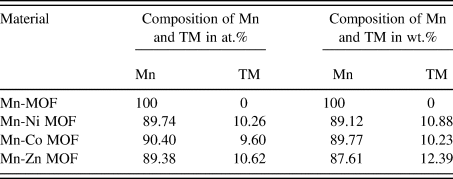
The EDAX results showed the presence of C, O, N, Mn and the transition metals. But for calculating the Mn–transition metals ratios, the presence of C, O, N atoms is ignored and only Mn and substituted transition metals are considered. From this analysis, it was found that the ratio of Mn to transition metals has maintained nearly 0.96–0.11 closely matching with nominal composition. The obtained results are given in Table I. In the Rietveld refinement, occupancy factors were refined and it varied between 0.9 and 0.873 for Mn and the other transition elements varied from 0.1 to 0.127 in the refinement.
Metallic ratios in the MOFs obtained from EDAX analysis.

B. Optical micrograph
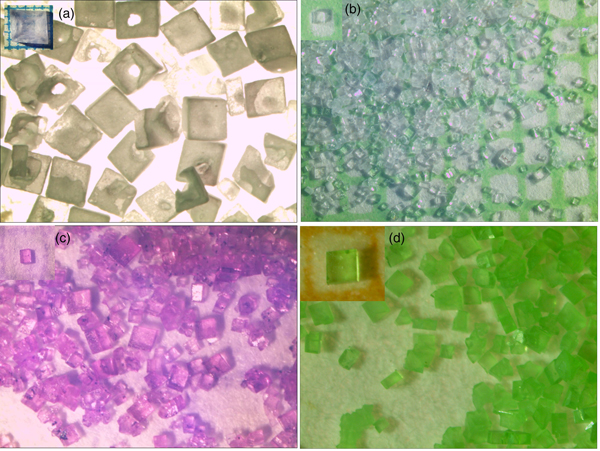
The optical micrographs of harvested MOF crystals are recorded by keeping them in a 1 mm graph paper [Figures 2(a)–2(d)]. The crystals exhibit well-defined facets with cubic and cuboidal morphologies. The size of Mn-MOF crystal is nearly 4 mm × 4 mm, whereas the sizes of the substituted crystals are of the order of 250–750 µm. Even though bigger size crystals are there in the substituted crystals, whatever brought inside the square of the graph sheet is captured and depicted. All the crystals are transparent though they differ in their color. The intrinsic color is because of the crystal field splitting of the d-orbitals of transition metal ions occupying the octahedral site. While Mn- and 10 at.% Zn substituted MOF crystals are colorless, 10 at.% substituted Ni- and Co-MOFs exhibit green and pink colors, respectively.
As grown crystals of (a) Mn-MOF, (b) Mn0.9Zn0.1-MOF, (c) Mn0.9Co0.1-MOF, and (d) Mn0.9Ni0.1-MOF crystals. The inset in “a” is in a 5 mm × 5 mm square size graph sheet, whereas in “b”, “c”, and “d” are in a 1 mm × 1 mm square graph sheet.

C. Laue diffraction
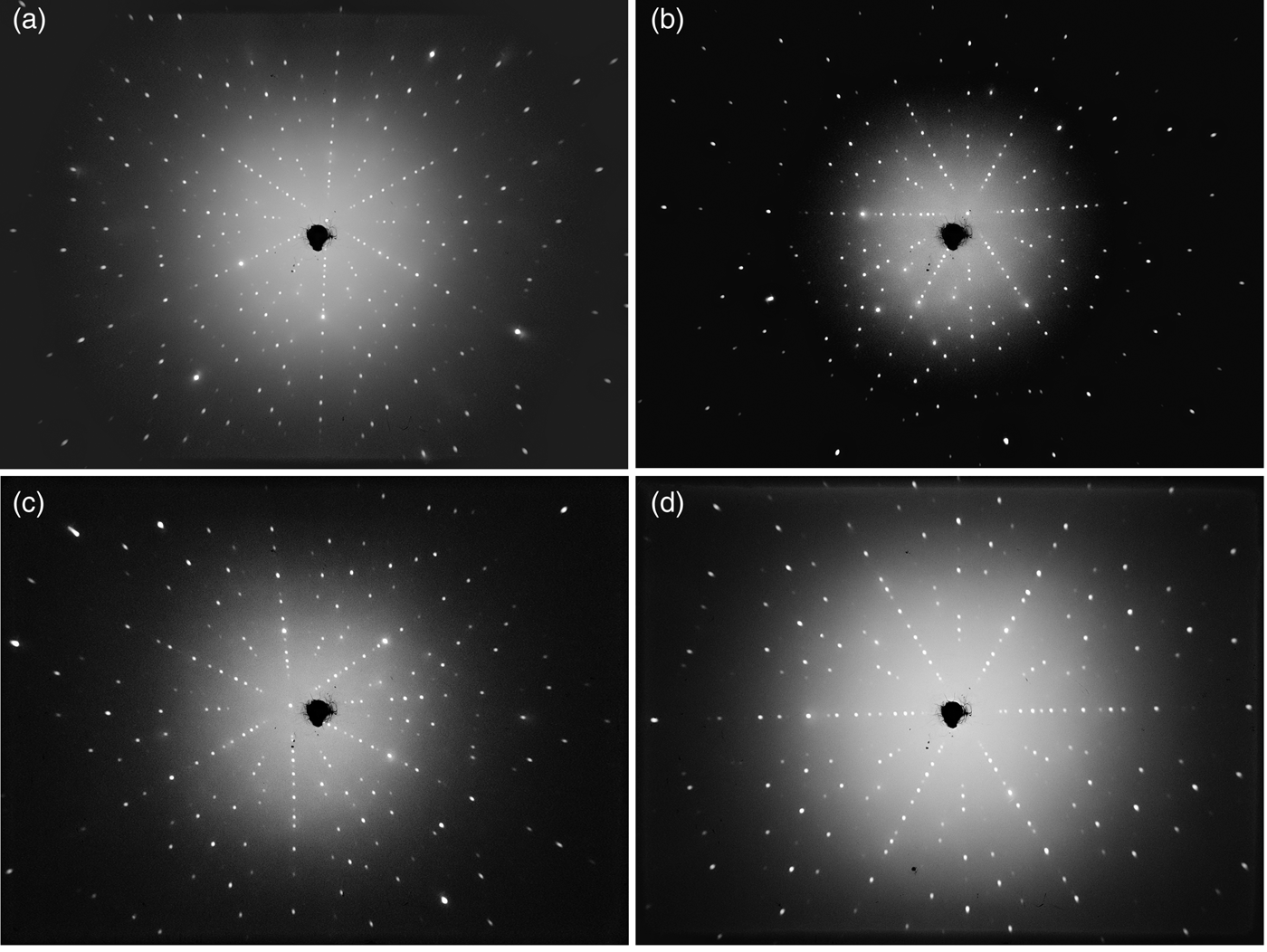
The Laue diffraction patterns of the Mn-MOF, Mn0.9Zn0.1-MOF, Mn0.9Co0.1-MOF, and Mn0.9Ni0.1-MOF crystals were recorded [Figures 3(a)–3(d)]. The diffraction patterns exhibit sharp dots, indicating high crystalline nature of the crystals. Also, the Laue patterns have same symmetry indicating same crystal symmetry of the MOFs.
The back-scattered Laue diffraction pattern of as grown crystals of (a) Mn-MOF, (b) Mn0.9Zn0.1-MOF, (c) Mn0.9Co0.1-MOF, and (d) Mn0.9Ni0.1-MOF crystals.

D. Structural analysis
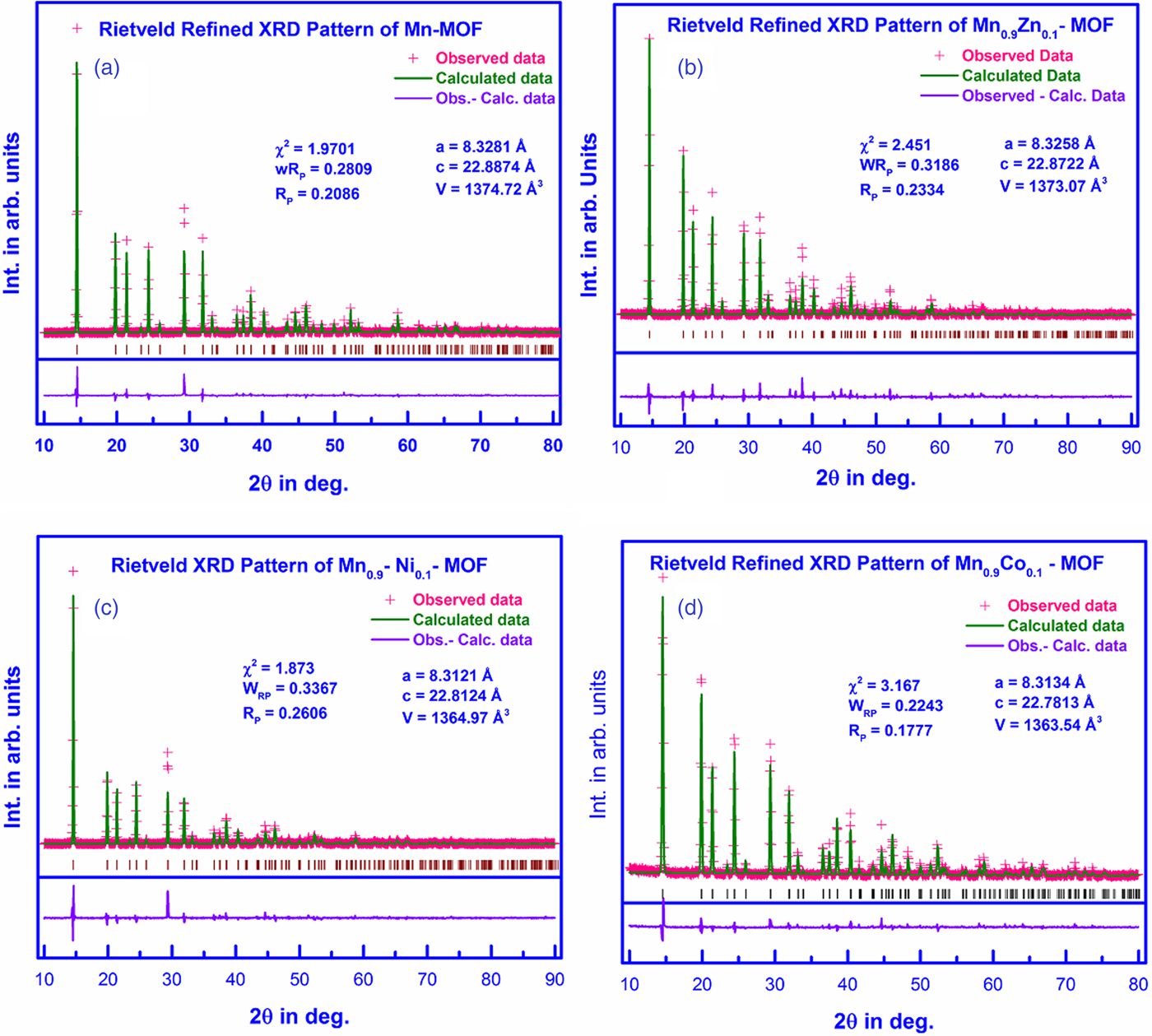
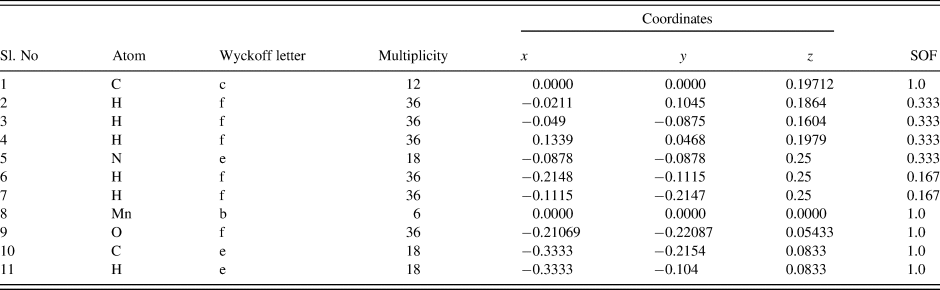
The powder XRD patterns of Mn-, Mn0.9Zn0.1-, Mn0.9Co0.1-, and Mn0.9Ni0.1-MOFs were recorded. Mn-MOF crystallizes in the rhombohedral structure with  $\; R\bar{3}c$ space group (S.G. No. 167). The standard data of Mn-MOF from ICDD file No. 01-083-6748 were used as a model data for Rietveld refinement and tabulated in Table II (Figure 4). This pattern provides a reasonable fit to the measured data of Mn-MOF and hence used for the refinement of all the four data sets. Peak positions match well, but there is some difference in intensity ratio. No additional peaks could be discerned indicating phase purity of the sample. No change in the diffraction pattern of the substituted MOFs could be observed except for the shift in the Bragg reflections. This signifies the absence of structural transition upon 10 at.% substitution of Zn, Co, and Ni in Mn-MOF and is in accordance with Laue diffraction studies. Rietveld refinement (Rietveld, Reference Rietveld1969) of the patterns was carried out using the GSAS software (Larson and Von Dreele, Reference Larson and Von Dreele2000) along with the graphic user interface software EXPGUI (Toby, Reference Toby2001). Refined pattern along with experimental data is shown in Figure 5. The Rietveld refined lattice parameters of the MOFs are given in Table III. The lattice parameters of Mn-MOF, a = 8.3281(03) Å, c = 22.8874(16) Å, and V = 1374.72(01) Å3, compare well with the earlier report on single crystal (Mączka, Reference Mączka, Gągor, Macalik, Pikul, Ptak and Hanuza2014). The model data are taken from the single-crystal diffraction result, whereas here the crystal is subjected to some pressure while crushing for powder XRD measurement. The differences in intensities observed and calculated may be because of various factors such as the stacking fault introduced while crushing the crystals and poor scattering factors for C, H, and N atoms present in the MOFs.
The rhombohedral crystal structure of dimethylammonium manganese formate with the general formula [(CH3)2Mn](HCOO)3 in hexagonal coordinate system.

The Rietveld refined XRD patterns of powdered crystals of (a) Mn-MOF, (b) Mn0.9Zn0.1-MOF, (c) Mn0.9Co0.1-MOF, and (d) Mn0.9Ni0.1-MOF.

Crystallographic details of dimethylammonium manganese formate.

Crystallographic parameters of [(CH3)2NH2]Mn0.9M0.1(HCOO)3 (M = Zn, Co, and Ni).

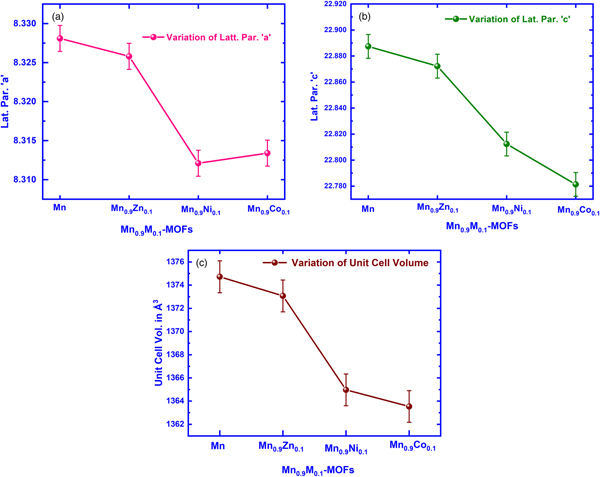
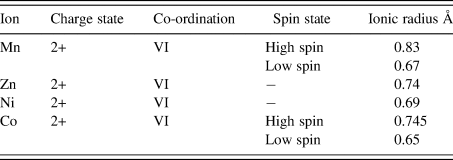
The lattice parameters and unit-cell volume are found to decrease with substituent in the order Zn, Ni, Co (shown in Figure 6). The reason for such a variation can be understood based on the Shannon ionic radii (Shannon, Reference Shannon1976). The ionic radius (IR), even for a given valance state, depends also on the occupation of orbital by the unpaired electron, i.e. the spin configuration of the ions. There are two spin states, high and low for Mn2+ and Co2+, whereas Zn2+ and Ni2+ have single spin configuration. Zn2+ being d 10 ion diamagnetic, it carries no net magnetic moment and has no spin state. The IR of these four elements is given in Table IV. Shannon IR of Zn2+ is smaller than that of Mn2+. Hence both the lattice parameters a and c decrease. This implies anisotropic bonding of Zn2+ with surrounding ligand anions O2−. Both the lattice parameters of Co and Ni substituted MOF are smaller than that of Mn-MOF. This is in accordance with their smaller IR compared with that of Mn2+.
Variation of lattice parameter unit-cell parameters with a substituent for the MOFs: (a) a, (b) c, and (c) unit-cell volume.

High-spin and low-spin Shannon ionic radii of Mn, Zn, Co, and Ni elements.

Using the lattice parameters obtained from the Rietveld refinement, the observed peak positions (in 2θ°) were given as input to the NBS*AIDS83 program which is the up-graded version of NBS*Aids80 (Mighell, et. al Reference Mighell, Hubbard and Stalick.1981,), without the Miller indices, and the output of this program was used to generate the standard ICDD database files. The Rietveld refined values as well as the NBS*AIDS83 results of these materials all agree with each other and are given in Table III.
IV. CONCLUSION
Single crystals of Mn-, Mn0.9Zn0.1-, Mn0.9Ni0.1-, and Mn0.9Co0.1-MOFs were grown successfully by solvothermal reaction followed by slow evaporation. The single-crystalline nature was confirmed by Laue diffraction method. The lattice parameters were obtained by Rietveld refinement as well as NBS*Aids83 refinements of the powder diffraction patterns. The Mn- and Mn0.9Zn0.1-MOFs have meager variations in the unit-cell volume as well as lattice parameters, similarly Mn0.9Co0.1- and Mn0.9Ni0.1-MOFs are with little difference but have considerable variation in the lattice parameters with respect to Mn- and Mn0.9Zn0.1-MOFs. This variation of unit-cell volume is understood based on the Shannon IR.
SUPPLEMENTARY MATERIAL
The supplementary material for this article can be found at https://doi.org/10.1017/S0885715619000307
ACKNOWLEDGEMENT
The author (D.S.) acknowledges P.K. Ajikumar and UGC-DAE CSR, Kalpakkam node for the SEM and EDAX measurements. The authors also acknowledge the constant support and encouragement from IGCAR management.
SUPPLEMENTAL DATA
The NBS*AIDS83 outputs in ICDD file format are given in Tables 5–8 and are attached in the electronic Supplementary material. The images of the experimental and simulated XRD patterns based on the Rietveld refined parameters of all the four MOFs are given in the Supplementary material. The crystallographic information (CIF) files are attached separately.