Introduction
The junction of biology, materials, and modeling has a long history. Ancient humans used “models” to understand and explain the physical world tens of thousands of years ago, exemplified in early artwork in cavesReference Clottes 1 and expressed later in increasingly complex music or literature.Reference Patel 2 Model building emerged as a radical concept that allowed humans to recreate, relive, and understand their environment in a different space and to perform virtual experiments, for instance, by introducing imaginary creatures. This is because the construction of a model in the form of a drawing, a story, or musical piece enables us to deal with complex situations without the need to recreate its actual physical realization. Now, the emergence of models of complex biological materials at the interface of living and nonliving systems emphasizes this ancient origin of modeling and could play an important role in the fabrication of new bioinspired materials, such as engineered tissues or silk-inspired fibers.Reference Gronau, Krishnaji, Kinahan, Giesa, Wong, Kaplan and Buehler 3 – Reference Wong, McDonald, Taylor-Pinney, Spivak, Kaplan and Buehler 5
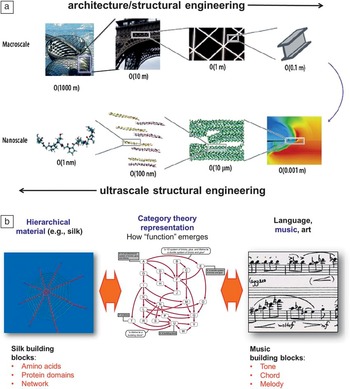
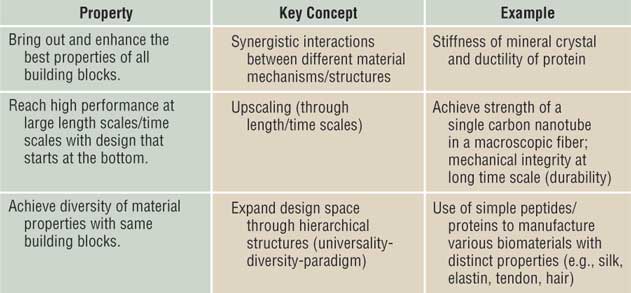
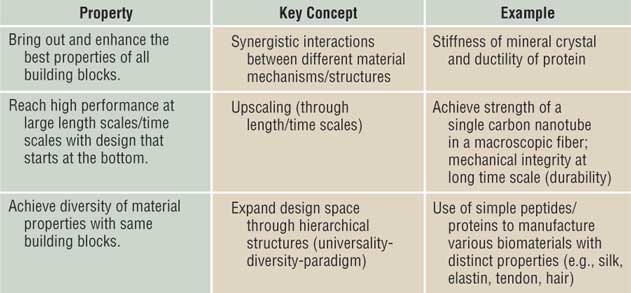
Indeed, biological materials are a fascinating area of materials science with very broad applications ranging from health care to energy to nanotechnology.Reference Espinosa, Rim, Barthelat and Buehler 6 – Reference Omenetto and Kaplan 11 The combination of experiments and simulations has emerged as a powerful tool to unlock the fundamental principles of materials design. An important impact is that it has helped to identify common principles shared by a broad range of biological materials. For example, a comparative approach used to investigate the structure and function of silk with that of bone or nacre (mother-of-pearl) shows the universal role of hierarchical mechanisms in creating material function—consistently, the system as a whole is more than the sum of its parts.Reference Cranford and Buehler 10 The merger of traditional notions of “material” and “structure” enables this expanded design space in which new material properties can be achieved by simply rearranging elements rather than introducing new ones ( Figure 1 a).Reference Buehler and Ackbarow 12 , Reference Buehler 13 Such progress has been promoted by mathematical approaches that map the functional relationships identified from both simulation and experiment for different materials into an abstract representation, so-called “material ologs,” where structural analogies between different systems can be easily pointed out (Figure 1b).Reference Spivak and Kent 14 – Reference Giesa, Spivak and Buehler 18 In such material ologs, the structure, mechanisms, and properties of a material are described from a first-principles perspective based on the interplay of a set of building blocks. This system perspective of materials science, also referred to as “materiomics,” has resulted in high-impact applications, as it opened new paths toward understanding, designing, and predicting complex materials behavior for the development of “ultimate materials” that combine the best of all basic elements and amplify the properties of the building blocks in a synergistic manner ( Table I ).
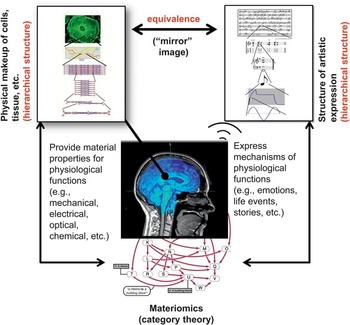
Common principles of biological and bioinspired material design. (a) Merger of structure and material across different length scales in hierarchical materials. Adapted from Reference Reference Buehler and Ackbarow12. (b) Different hierarchical systems feature common principles by which function emerges, which can be demonstrated by the application of category theory. Musical scores on the right based on a translation from the designer silk sequence reported in Reference Reference Wong, McDonald, Taylor-Pinney, Spivak, Kaplan and Buehler5.

Summary of critical challenges in materials science where the study of biological materials could make important contributions.Reference Wong, McDonald, Taylor-Pinney, Spivak, Kaplan and Buehler 5 , Reference Fratzl and Weinkamer 7 , Reference Cranford and Buehler 10 , Reference Buehler 13
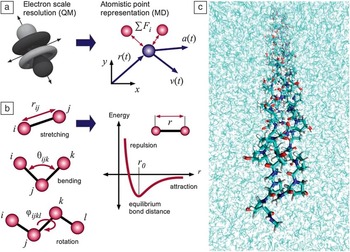
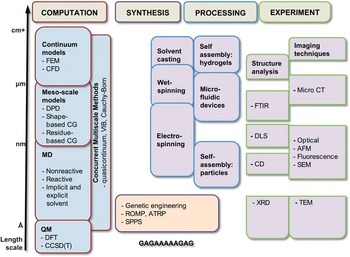
Atomistic modeling is a powerful tool that breaks down material behavior to the level of atoms and molecules by starting to describe a material using quantum mechanics, and scaling up using a hierarchy of modeling techniques (e.g., molecular dynamics and coarse-graining, which can in turn be linked to continuum methods) ( Figure 2 ). The statistical distributions of positions, motions, and interatomic forces can be used to compute larger-scale quantities such as stress, strain, or other material properties such as thermal conductivity. Enabled by the significant development of computational resources and new algorithms to enhance sampling of longer time scales, atomistic modeling can now be applied to treat very large systems at increasingly large scales ( Figure 3 ). As reflected in the figure, the combined application of atomistic-based multiscale modeling and multiscale experiments has emerged as a particularly important area with very broad reach. This is because the use of bottom-up material models provides fundamental insights into the mechanisms by which natural and synthetic materials function and fail, enabling one to explain experimental observations and to use this insight to design new materials. The simulation of increasingly complex process conditions is an important frontier in computational materials science.
Concept and application of atomistic modeling, where a material is simulated based on the motion of atoms and molecules. (a–b) The transition from the quantum mechanical treatment of an atom or molecule to a point of mass (at r(t) with acceleration a and velocity v) and the use of interatomic and intermolecular force fields to describe their interactions in classical molecular dynamics Adapted from Reference Reference Cranford and Buehler10. The image in (c) shows a large-scale model of a tropocollagen molecule (found as the primary material in tendon or the eye’s cornea, and forms the dominating protein phase in bone) in an explicit water solvent, representing a three-dimensional model of the most abundant structural protein. QM, quantum mechanics; MD, molecular dynamics. Image courtesy of A. Gautieri, MIT and Politecnico di Milano, Italy.

Overview of various computational and experimental tools, including synthesis, processing, and imaging/manipulation techniques. The emergence of tools operating at different length scales now enables the analysis of materials across all relevant scales. Reprinted with permission from Reference Reference Gronau, Krishnaji, Kinahan, Giesa, Wong, Kaplan and Buehler3. © 2012 Elsevier. QM, quantum mechanics; DFT, density functional theory; CCSD(T), coupled-cluster method, an ab initio approach in quantum chemistry; MD, molecular dynamics; DPD, dissipative particle dynamics; CG, coarse-grain; CFD, computational fluid dynamics; FEM, finite element method; VIB, virtual internal bond; ROMP, ring-opening metathesis polymerization; ATRP, atom transfer radical polymerization; SPPS, solid phase peptide synthesis; FTIR, Fourier transform infrared spectroscopy; DLS, dynamic light scattering; CD, circular dichroism; XRD, x-ray diffraction; Micro CT, micro-computer tomography; AFM, atomic force microscope; SEM, scanning electron microscope; TEM, transmission electron microscope.

The combined application of modeling and experiment has been particularly impactful in comparative studies aimed at investigating the origin of the diversity of protein material properties in spite of the similarity of their building blocks (all made based on DNA that encodes the sequence of amino acids in proteins, etc.). Indeed, this concept has been applied to materials such as collagen, bone, nacre, spider silk, and intermediate filaments, with the objective of recognizing and categorizing their unifying and distinguishing principles ( Figure 4 ).Reference Buehler and Yung 19 Recent work has exploited the use of models in the design of novel synthetic materials, for example in the development of designer silk that is based on variations of naturally occurring proteins. Other work has elucidated the role of “defects” in the understanding of disease mechanisms in biomaterials such as bone, which involves molecular-level changes to the structure that affect larger-scale mechanical properties (e.g., in the context of brittle bone disease) (for further reading and references on this topic, see Reference 10). Applications of the insight derived from such studies include the development of novel carbon nanotube-based fibers that incorporate polymers to mimic the structure seen in silk fibers. In this context, the use of simple model systems to explain a very broad range of experimental and computational observations, with a focus on integrating multiple scales, has led to the development of simple but powerful material concepts (e.g., scaling laws, models of size effects, performance envelopes, etc.).Reference Cranford and Buehler 10
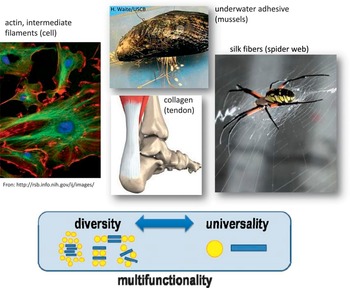
Overview of the diversity of protein materials found in nature, all made from the same building blocks (a library of about 20 amino acids) and forming functionally very different materials. The underlying concept is the universality-diversity-paradigm, which explains how different material properties can be achieved in spite of severe limitations in available energy, quality, and quantity of a material’s basic elements (see References Reference Buehler and Yung19 and Reference Knowles and Buehler33 for further discussions).

As visualized in Figure 1b, an abstract “systems approach” to materials science—referred to as “materiomics”—is not limited to the study of materials. As depicted, we can also use this paradigm to map concepts from materials into a seemingly different space—music—and learn about the mechanisms by which materials work from listening to music (and conversely, improve materials by composing music).Reference Wong, McDonald, Taylor-Pinney, Spivak, Kaplan and Buehler 5 , Reference Buehler 13 , Reference Giesa, Spivak and Buehler 18 Such an interdisciplinary discourse to materials research that introduces creative concepts into the engineering process pushes the limits of what we can design today. The heightened level of functional properties that can be achieved using this paradigm may one day play a critical role in advanced manufacturing, where material properties specific to products, processes, or technologies can be realized “on demand.” Merging materials design with product design, extending the concept toward materials processing shown in Figure 1a, could play a leading role in innovating the advanced manufacturing sector. In the following sections, we review key concepts of biological materials design—both natural systems and the synthesis of de novo materials—in the context of silk and silk-inspired materials and discuss the impact of relevant computational modeling associated with this field. Indeed, our ability to build models of our physical world has come a long way since the ancient drawings in caves and now involves petaflop and exaflop computing, storage, and analysis of large amounts of data in situ (Figure 3); our ability to use mathematics to demonstrate clear analogies between seemingly different fields provides us with tools to address the challenges with large amounts of data.
Case study: Spider silk
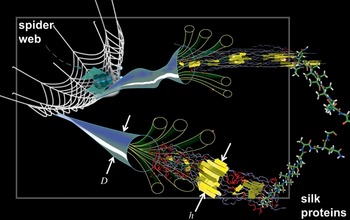
Silk is truly an amazing material—genetically programmable, processable, and flexible in its natural and potential engineering applications, in particular when combined with other proteins (natural and synthetic ones).Reference Huang, Liu and Wang 20 – Reference Omenetto and Kaplan 24 In its natural role, it serves as a multipurpose protein fiber with hierarchical organization to provide structural support, prey procurement, or protection of eggs ( Figure 5 ). In a series of recent studies,Reference Bratzel and Buehler 25 – Reference Nova, Keten, Pugno, Redaelli and Buehler 30 we demonstrated how the different hierarchical levels in silk—from the protein molecules to an entire spider web—together create a mechanically strong, robust, and resilient structure. It is a demonstration of how the paradigm of merging “structure” and “material” is critical to overcome the limitations of the inferior natural building blocks of this material to achieve a system whose overall performance cannot yet be rivaled by any engineered substitute.
Overview of the different scales in hierarchical biological materials, here for spider silk, from the level of silk proteins (right) to a spider web (left). It has been demonstrated that the synergistic interaction of mechanisms at different length scales is key to explain the remarkable properties of the entire system, the spider web. The image marks two important length scales—the fiber diameter D and the size of beta-sheet nanocrystals h, whose effect on material properties will be explored in Figures 8 and 9, respectively. Image courtesy of the National Science Foundation/M. Buehler and based on information from Reference Reference Cranford, Tarakanova, Pugno and Buehler26.

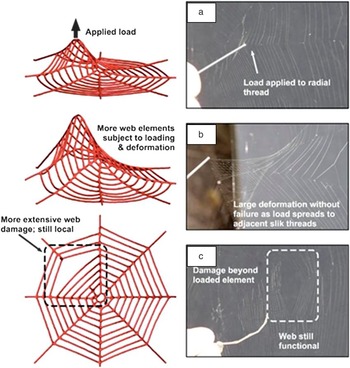
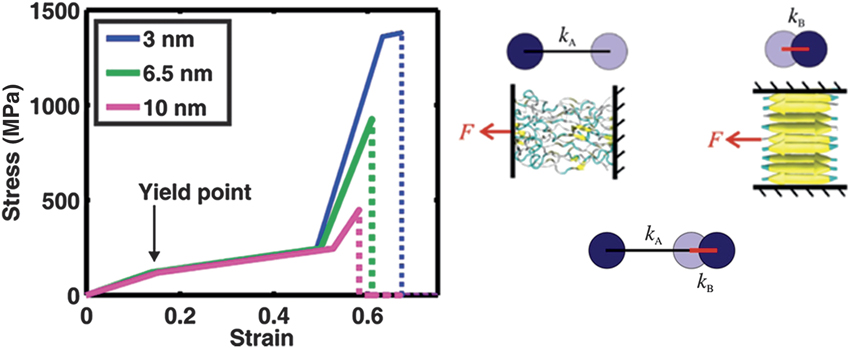
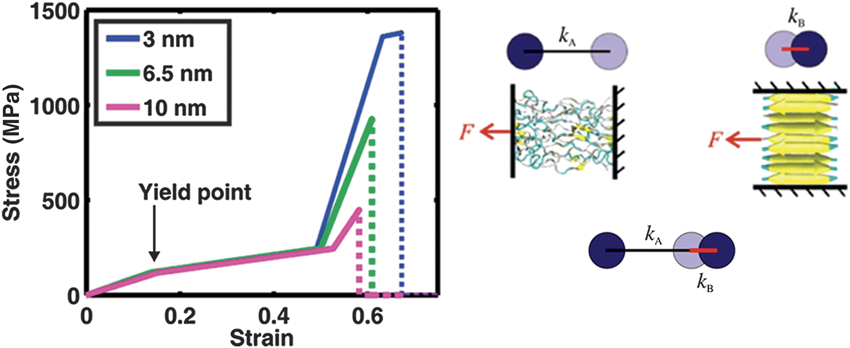
First, it was demonstrated that the great strength, toughness, and flexibility of spider silk, exceeding that of steel and many other engineered materials, can be explained by the material’s unique structural makeup that involves multiple hierarchical levels that span amino acid sequence, proteins, nanocomposite, fibrils, fibers, and a web structure (Figure 5).Reference Buehler 13 , Reference Tarakanova and Buehler 31 These hierarchical levels are a manifestation of how the biochemical information that defines the protein sequence directly affects the behavior of the system at the structural scale of an entire spider web, which is exposed to a range of mechanical loading (wind, prey capture, falling debris, etc.). Second, it was shown that each level in the material contributes to the overall properties, and that the remarkable properties of the entire system emerge because of a series of synergistic interactions across scales (where the sum is more than its parts).Reference Tarakanova and Buehler 31 A particularly interesting aspect is how the nonlinear material behavior of silk fibers affects the web behavior.Reference Cranford, Tarakanova, Pugno and Buehler 26 Upon loading, silk fibers typically soften at the yield point, only to dramatically stiffen during large deformations until point of failure. This whole mechanical behavior has been traced to the particular structure of silk proteins and the nanocomposite they form.Reference Cranford and Buehler 10 , Reference Tarakanova and Buehler 31 Their particular stress-strain behavior is what allows for localization of deformation upon loading, and is what makes spider webs robust and extremely resistant to defects, as compared to a hypothetical linear-elastic or elastic-plastic silk fiber. Through in situ experiments on spider webs, we confirmed the computational prediction that locally applied loading results in minimal damage, as depicted in Figure 6 . It was also found that under global loads such as wind, the material behavior of silk under small deformation—typically showing a small but very stiff regime—is crucial to maintaining the structural integrity of the web. This study presented an example of a combined computational-experimental study paired with a theoretical mechanics analysis of the findings, where a fracture mechanics based scaling law was identified to generalize the insights. What is unique about this work is that it began at the molecular level and assessed the impact of the material composition from the chemical scale all the way to the macroscopic structure of a web.Reference Cranford, Tarakanova, Pugno and Buehler 26
Computational and experimental predictions of web failure mechanisms (images (a–c) correspond to increasing applied load). Figure adapted from Reference Reference Cranford, Tarakanova, Pugno and Buehler26. The characteristic stiff-soft-stiff behavior of silk threads, shown in Figure 8, is critical to achieving a mechanically resilient web structure that can deal with both global wind and local point loading.

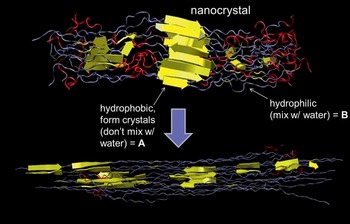
From a more fundamental point of view, one could ask if there are unifying fundamental principles that govern the behavior of silk and other biological materials. While the characteristic stiffening behavior of silk is similar to that found in many other natural polymers such as rubber, it is highly controlled by the silk protein’s sequence and processing conditions during spinning. The combination of extensive computational and experimental work has revealed simple physical mechanisms by which the material behavior of silk fibers can be controlled. As eluded to earlier, these mechanisms are encoded in the protein sequence, which drives the generation of distinct microstructures (so-called secondary structures). These are realized by sequence patterns rich in the amino acid alanine that generate very stiff and strong crystals (hydrophobic, called domain “A”), and those rich in glycine amino acids that lead to more disorganized, labile, and very soft regions (hydrophilic, called domain “B”).Reference Omenetto and Kaplan 24 , Reference Keten and Buehler 28 , Reference Nova, Keten, Pugno, Redaelli and Buehler 30 , Reference Kaplan, Adams, Farmer and Viney 32 The two phases are depicted in Figure 7 . The relative amount and combination of these building blocks is the paradigm by which silk threads can achieve very diverse mechanical signatures, as depicted in Figure 8 (spiders can produce many different types of silks for different purposes, which show dramatically different mechanical behaviors).
Structure and mechanics of silk molecules and a visualization of two universal structural domains—a hydrophobic domain “A” and a hydrophilic domain “B.” Their combination results in a nanocomposite that gives rise to the particular properties of silk fibersReference Giesa, Arslan, Pugno and Buehler 27 , Reference Nova, Keten, Pugno, Redaelli and Buehler 30 (the two images depict unstressed and stressed states).

Simple coarse-grained model (at the “mesoscale”) based on the interplay of the two structural domains “A” and “B” (see Figure 5 or 7 for visualizations of these), used here to explain the stress-strain response of silk fibers depending on the size of the beta-sheet nanocrystals.Reference Nova, Keten, Pugno, Redaelli and Buehler 30 The details of the model, and in particular the role of the two domains and their constitutive behavior, can be found in Reference Reference Nova, Keten, Pugno, Redaelli and Buehler30. The parameters k A and k B denote nonlinear springs that characterize the constitutive behavior of each of the building blocks, A and B.
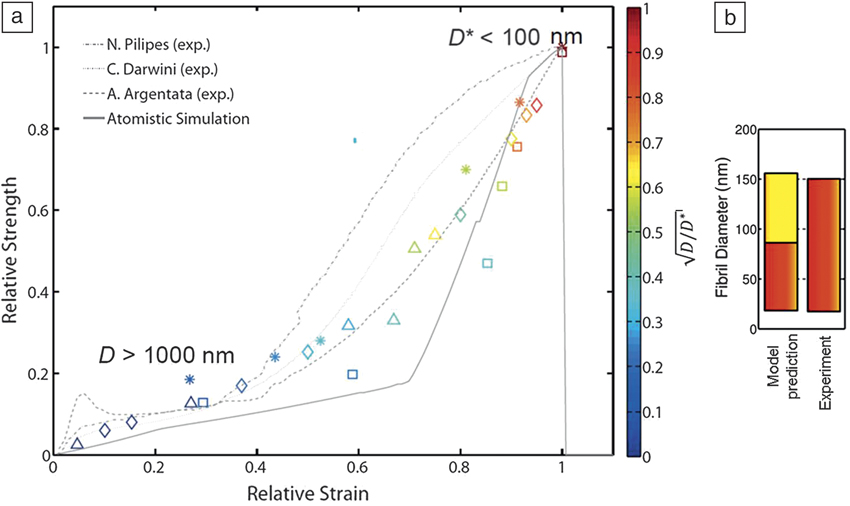
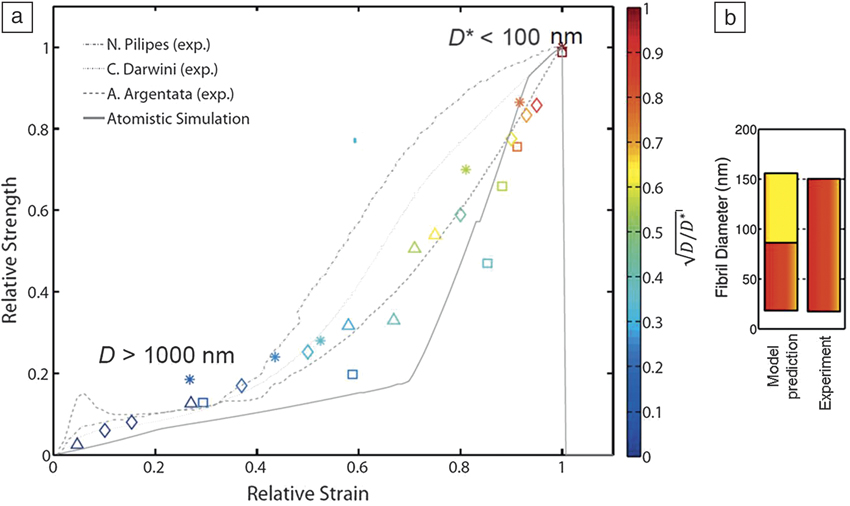
The importance of the hierarchical structure and the relevance of length scales have been emphasized in other studies.Reference Cranford and Buehler 10 , Reference Giesa, Arslan, Pugno and Buehler 27 Figure 9 a shows a comparison of silk fiber stress-strain curves, various experimental results, and computational prediction with varying silk fiber diameter D. In that investigation, the computer model allowed us to test the performance of silk fibers that do not exist naturally in a series of virtual experiments. The analysis revealed that the geometric confinement of the silk fiber diameter to <100 nm (which defines a critical length-scale for fiber diameter, D* ) is very important for exploiting the full potential of the material behavior inherited from the molecular scale.Reference Giesa, Arslan, Pugno and Buehler 27 This is a remarkable result in light of the fact that silk fibers are indeed found to be constructed with such geometrical features. Silk fibers consist of bundles of fibrils (each with a size of below 100 nm) that together form structures with a diameter on the order on micrometers (Figure 9b). In terms of a fracture mechanics description, this consideration of multiple hierarchical levels, and associated deformation mechanisms, can be regarded as a very large fracture process zone, on the order of a micrometer. Here, considering that 10 silk fibrils with a diameter of 100 nm are each assembled, another level of hierarchy is created that deforms homogeneously, with widespread damage as the fiber bundle is being deformed and broken. Hence, the splitting of the large fiber with diameter D as depicted in Figure 5 into smaller silk fibrils is an important issue in understanding size effects and the mechanisms by which molecular-scale features are scaled up.
Effect of fiber diameter confinement on silk mechanics. (a) Comparison of silk fiber stress-strain curves, various experimental results, and computational prediction with varied fiber diameter D. The analysis shows that the geometric confinement of the silk fiber diameter to less than a critical diameter D* ≈ 100 nm is essential to exploit the full potential of the material behavior endowed from the molecular scale. The overall agreement of the stress-strain response of silk with respect to the theoretical model is remarkable and also reflects the study depicted in Figure 8 that emphasized the role of nanocrystal confinement to achieve the maximum strength and toughness of beta-sheet cross-links. Different symbols reflect different boundary conditions used (details in Reference Reference Giesa, Arslan, Pugno and Buehler27). (b) Comparison of predicted fiber diameters with experimentally determined dimensions, showing excellent agreement. The yellow and red colors under “Model prediction” reflect different levels of molecular deformation; red reflects a homogeneous state, where molecular slip occurs in all beta-sheet crystals (building block A), and yellow reflects a homogeneous deformation state, where complete unfolding of the semi-amorphous domain has occurred (building block B). Figure adapted from Reference Reference Giesa, Arslan, Pugno and Buehler27.
The study of biological materials is not limited to the fundamental science of understanding how nature works. Rather, the fundamental insight derived from the interplay of sequence, structure, and performance of a structure as large as a spider web opens the door to play with nature’s building blocks; to take the pieces, and reassemble them in new ways, such as creating varied silk sequences made from the building blocks “A” and “B” (e.g., AB3 and A3B). We have recently designed and applied this concept of an integrated experimental-computational methodology to design new silk-based materials by engineering the sequence of protein building blocks.Reference Krishnaj, Bratzel, Kinahan, Kluge, Staii, Wong, Buehler and Kaplan 4 , Reference Wong, McDonald, Taylor-Pinney, Spivak, Kaplan and Buehler 5
Enabling a creative approach
While at first glance there does not appear to be many similarities between music and biopolymers, each of these seemingly disparate fields actually involves very similar processes with emergent behaviors based on specific relationships between the different length- and time scales involved. These may one day form revolutionary paths to understand, design, and model materials and have already invoked a systems perspective through the use of category theory models of hierarchical materials.Reference Cranford and Buehler 10 Through an abstraction of knowledge from the physical system, silk, to a mathematical model using category theory (a method used to describe a material or other systems using a collection of objects and arrows, here involving their fundamental building blocks), collaborative work between modelers, experimentalists, composers, and a performer has illustrated how the mechanism of spinning fibers from proteins can be translated into music through a process that assigns a set of rules that governs the construction of the system.Reference Wong, McDonald, Taylor-Pinney, Spivak, Kaplan and Buehler 5 This concept, following the idea presented earlier in Figure 1b, allowed us to express the structure, mechanisms, and properties of the material in a different domain—music—and enabled us to understand how the mapping between such distinct domains can work. The approach reported in Reference 5 used mapping between the protein sequence and tones as a basis for the translation and then compared how the assembly of silk proteins into fibers in the spinning device relates to the composition of musical pieces derived from the basic sequence. The starting point for the composer was the sequence of tones derived from the protein sequence, which can be seen as a constraint imposed on the composer, who used these basic patterns to construct a musical piece.
While much work needs to be done, the integration of science and art through categorization of structure-property relationships has emerged as a novel paradigm for creating new bioinspired materials, through the translation of structures and mechanisms from distinct hierarchical systems and in the context of the limited number of building blocks that universally govern these systems.
As reported in Reference 5, we considered different designer silk sequences based on the building blocks described previously—AB3 and A3B. AB3 is a successful protein that forms fibers and includes many more repetitions of the “B-block.” The other protein A3B contains a much larger amount of beta-sheet nanocrystals forming domains, but these proteins do not form fibers. This is because in this case, relatively few of the A3B proteins assemble into large globular clusters without forming a well-connected network. Notably, the differences between the two systems were also audible in the music derived from them, where the more aggressive music resembled the protein A3B, which formed many but unconnected globular structures. Conversely, the other sequence AB3formed a shapelier, more gentle music. These results suggested that a certain musical character may be considered more conducive to forming fiber than the other, establishing understanding of how the assembly by spinning in the material domain maps to the assembly by composition in the music domain. Understanding these relationships may eventually help us in using musical pieces to improve the design of materials. Indeed, exciting opportunities may emerge through the translation from music to materials. For example, a challenging question we could ask is could we use Beethoven’s symphonies to inform the development of new nanomaterials by translating musical patterns into protein sequences, mechanisms, and processing conditions? Clearly, this is a far-reaching undertaking with many unknowns, but it may provide us with new ideas to think about materials design in the complex hierarchical space.
As shown in Figure 10 , the structure of biological materials and the structure of art, language, and virtually any other form of human expression (physical or aesthetic) show striking similarities (from the composition of a symphony, a painting, a sculpture, or literature), where each uses multiple hierarchy levels to achieve certain functions or properties.Reference Wong, McDonald, Taylor-Pinney, Spivak, Kaplan and Buehler 5 , Reference Cranford and Buehler 10 , Reference Buehler 13 , Reference Knowles and Buehler 33 As described in the opening paragraph of this article, humans have used such forms of expression to describe a range of emotions, tell stories, or to teach. Is there a fundamental reason for these similarities, perhaps rooted in the common patterns of structure-property relationships, where the expression of art is a direct reflection of the physical structure of our body, organs, and ultimately the brain? If considered an inherent part of us, music and other forms of art are a direct expression of the structure and function of our brain, tissues, or organs, and may serve as a new type of analysis to understand the way biological materials are structured and how they function and fail.Reference Cranford and Buehler 10 It remains an open question whether the study of language and music will teach us new insights about the biological mechanisms that govern the physiology and disease of organs or cells, but the emerging evidence for equivalences between such different hierarchical systems deserves attention.Reference Wong, McDonald, Taylor-Pinney, Spivak, Kaplan and Buehler 5 , Reference Cranford and Buehler 10 , Reference Buehler 13 , Reference Knowles and Buehler 33
Music (and other forms of art) is an expression of our body’s materials in a different manifestation. Exploiting this concept may enable us to identify new avenues to better understand biomaterials through the study of music or literature. They may also provide revolutionary insights into the design of novel materials, as the abstraction into categories provides new methods to incorporate insights from other fields such as music theory into the synthesis of materials. Musical scores on the right are based on a translation from a designer silk sequence as reported in Reference Reference Wong, McDonald, Taylor-Pinney, Spivak, Kaplan and Buehler5. Functional magnetic resonance imaging (fMRI) can be used to identify physiological mechanisms to link brain activity to emotions. Image in the center from MRFIL Image Gallery (http://mrfil.bioen.illinois.edu/MRFIL_Images2010.html).

Conclusion
The development and application of molecular modeling as a tool to better understand materials from a fundamental perspective has received significant attention. Flexibility, integration, and changeable properties play a critical role in the establishment of a new era of materials manufacturing. Not limited to nanotechnology, this field aims at designing and producing the best-performing material at minimal cost by invoking a “building block” perspective that can be broadly applied to different classes of materials. Here, hierarchical materials, with their expanded design space and potential for synergetic interactions of mechanisms across scales, promise to play a very important role in enabling our ability to design structures for very different purposes, to reconfigure, reassemble, and redefine properties on demand. An emerging concept is the exploitation of the “multiscope,” which reflects a systems perspective on the use of multiple length scales in generating designer materials by combining high-throughput experimental and computational methods.Reference Cranford and Buehler 10 , Reference Cranford, De Boer, van Blitterswijk and Buehler 34
Acknowledgments
Support from NSF (CAREER 0642545), ONR (PECASE N00014–10–1–0562), AFOSR (FA9550–11–1–0199), as well as NIH (U01 EB014976) is acknowledged.
Markus J. Buehler is an associate professor in the Department of Civil and Environmental Engineering at the Massachusetts Institute of Technology, where he directs the Laboratory for Atomistic and Molecular Mechanics (LAMM). His work has been recognized with numerous awards, including the Presidential Early Career Award for Scientists and Engineers (PECASE), the Harold E. Edgerton Faculty Achievement Award for exceptional distinction in teaching and research, the Leonardo da Vinci Award, and the Materials Research Society Outstanding Young Investigator Award. Buehler can be reached by email at mbuehler@mit.edu.