



Introduction
There are various effects from relatively nearby supernovae, beyond the traditional emphasis on ozone depletion due to the ionization of the Earth's atmosphere. These include muon irradiation on the ground, the fertilizer effect of nitrates generated in the atmosphere, the fertilizer effect of iron deposited from the supernova and indirect second-order effect of nitrate deposition from lightning, which is itself enhanced by atmospheric ionization. We have found that many of them are too small to be important and others in fact competitive in intensity to ozone depletion.
In this paper we explore the idea that deposition of nitrate on the biosphere from the effects of ionizing radiation from a moderately nearby (50 pc) supernova might provide enough fertilizer effect to cause a drawdown of CO2 and thereby cool the climate, possibly setting off the glaciations typical of the Pleistocene (as well as possibly at the end of the Ordovician). This is interesting because the Plio-Pleistocene transition to an icehouse climate is close to the time indicated by cosmogenic nuclide deposits for one or more nearby supernovae. The production of NO2 results from the ionization and dissociation of molecular nitrogen, the resulting species reacting with oxygen in the atmosphere. The NO2 may react with water or hydroxyl in the atmosphere and is rained out as dilute nitric acid. The chemistry is explored in detail in Mancinelli and Mckay (Reference Mancinelli and McKay1988) and Thomas et al. (Reference Thomas, Melott, Jackman, Laird, Medvedev, Stolarski, Gehrels, Cannizzo, Hogan and Ejzak2005).
In recent years there has been a surge of evidence for moderately nearby supernovae within the last few My (Binns et al., Reference Binns, Israel and Christian2016; Fimiani et al., Reference Fimiani, Cook, Faestermann, Gómez-Guzmán, Hain, Herzog, Knie, Korschinek, Ludwig, Park, Reedy and Rugel2016; Ludwig et al., Reference Ludwig, Bishop, Egli, Chernenko, Deneva, Faestermann, Famulok, Fimiani, Gomez-Guzman, Hain, Korschinek, Hanzlik, Merchel and Rugel2016; Melott, Reference Melott2016; Wallner et al., Reference Wallner, Feige, Kinoshita, Paul, Fifield, Golser, Honda, Linnemann, Matsuzaki, Merchel, Rugel, Tims, Steier, Yamagata and Winkler2016). Recent assessments (Fry et al., Reference Fry, Fields and Ellis2016; Mamajek, Reference Mamajek2016) have favoured distances close to the 40 pc proposed by Benítez et al. (Reference Benítez, Maíz-Apellániz and Canelles1999). Recent studies of the effects upon the Earth of such an event have included enhanced solar ultraviolet-B (UVB 280–315 nm) due to ozone depletion, visible light effects on nocturnal organisms, increased radiation from cosmic ray secondaries (primarily muons and neutrons) and direct deposition of cosmogenic radioisotopes (Melott et al., Reference Melott, Thomas, Kachelries, Semikoz and Overholt2017; Melott and Thomas, Reference Melott and Thomas2018; Thomas, Reference Thomas2018; Melott et al., Reference Melott, Marinho and Paulucci2019).
Most biota (in the absence of humans) are nitrate-starved (Schlesinger and Bernhardt, Reference Schlesinger and Bernhardt2013) and thus it is interesting to consider the possible effects of nitrate deposition as a side effect of astrophysical radiation enhancements. Previous assessments have suggested a small effect (Melott, Reference Melott, Thomas, Hogan, Ejzak and Jackman2005; Thomas and Honeyman, Reference Thomas and Honeyman2008; Neuenswander and Melott, Reference Neuenswander and Melott2015), but the longer duration of the effect of cosmic rays compared with the earlier burst situations provides an opportunity for a significant effect. Melott et al. (Reference Melott, Thomas, Kachelries, Semikoz and Overholt2017) and Thomas et al. (Reference Thomas, Engler, Kachelreis, Melott, Overholt and Semikoz2016) showed that the effect of prompt ionizing photons from a supernova at 50 pc or more is quite small, three orders of magnitude lower than the threshold for major environmental effects. Therefore, the focus is on the extended cosmic ray flux.
Nitrate as a possible initiator of CO2 drawdown
Nitrate fertilization leading to CO2 drawdown reduced greenhouse effect and subsequent climate cooling is not a new idea. First, terrestrial carbon uptake can easily alter atmospheric CO2 levels (Le Quere et al., Reference Le Quere, Moriarty, Andrew, Canadell, Sitch, Korsbakken, Friedlingstein, Peters, Andres, Boden, Houghton, House, Keeling, Tans, Arneth, Bakker, Barbero, Bopp, Chang, Chevallier, Chini, Ciais, Fader, Feely, Gkritzalis, Harris, Hauck, Ilyina, Jain, Kato, Kitidis, Klein Goldewijk, Koven, Landschutzer, Lauvset, Lefevre, Lenton, Lima, Metzl, Millero, Munro, Murata, Nabel, Nakaoka, Nojiri, O'Brien, Olsen, Ono, Perez, Pfeil, Pierrot, Poulter, Rehder, Rodenbeck, Saito, Schuster, Schwinger, Seferian, Steinhoff, Stocker, Sutton, Takahashi, Tilbrook, van der Laan-Luijkx, van der Werf, van Heuven, Vandemark, Viovy, Wiltshire, Zaehle and Zeng2015; Keenan et al., Reference Keenan, Prentice and Canadell2016). Such carbon uptake is stimulated by the deposition of additional nitrate from the atmosphere on land (Thomas et al., Reference Thomas, Canham and Weathers2009) and in the oceans (Ganeshram et al., Reference Ganeshram, Pedersen, Calvert and Murray1995). Nitrogen isotope changes have been documented at the Plio-Pleistocene Transition (Oesch Reference Oesch2016) and a fertilizer-based CO2 drawdown has been blamed for the late Ordovician glaciation (Shen et al., Reference Shen, Pearson, Henkes, Zhang and Chen2018). The long duration of cosmic ray exposure from one or more supernovae at 50–100 pc motivates a re-examination of this effect, particularly since the Plio-Pleistocene cooling was accompanied by a CO2 drawdown (Bartoli et al., Reference Bartoli, Honisch and Zeebe2011). This has been presented as a cause for the transition from woodland to savannah in Africa (Cawthra, Reference Cawthra2019) and this in turn for megaherbivore extinctions in the same area (Faith et al., Reference Faith, Rowan, Du and Koch2018).
Production and deposition of nitrate from supernova enhanced cosmic ray flux
Atmospheric ionization caused by cosmic rays leads to the formation of nitrogen oxides, which catalytically deplete ozone and are removed from the atmosphere as HNO3. This leads to the deposition of NO3− (Thomas et al., Reference Thomas, Melott, Jackman, Laird, Medvedev, Stolarski, Gehrels, Cannizzo, Hogan and Ejzak2005). Any event that creates significant ionization of the atmosphere will cause both ozone depletion and deposition of NO3−. These production and removal processes will persist as long as the enhanced cosmic ray flux is incident on the atmosphere.
Modelling of the atmospheric chemistry effects following a nearby supernova (Melott et al., Reference Melott, Thomas, Kachelries, Semikoz and Overholt2017) includes deposition of HNO3 via rain/snow. From these results, we computed a global deposition of about 7.5 Tg N yr−1. This is less than 10% of the preindustrial deposition of order 85 Tg yr−1 (Schlesinger and Bernhardt, Reference Schlesinger and Bernhardt2013, p. 453). We conclude that the effect is likely to be small, although it might be greater if an increase in lightning were caused by the increased atmospheric ionization – a possibility discussed later in this paper.
Iron deposition – a possible additional fertilizer effect?
Iron is also a fertilizer and increased iron deposition has been hypothesized as a forcing agent for terrestrial climate and also linked to the late-Ordovician cooling (Reiners and Turchyn, Reference Reiners and Turchyn2018). Iron can also act as a reducing agent for nitrates, converting them to ammonia, a more available source of nitrogen (Summers and Chang, Reference Summers and Chang1993). In this context, we evaluate the deposition of iron, one of the major outputs of element synthesis in supernovae. Consider a supernova exploding at distance r and isotropically ejecting a mass M Fe of iron. The resulting surface density of iron on Earth will be (Ellis et al., Reference Ellis, Fields and Schramm1996)
 $${\rm \Sigma } = \displaystyle{1 \over 4}\;\displaystyle{{\;f_{{\rm dust}}M_{{\rm Fe}}/m} \over {4\pi r^2}} = 0.03\;\;\mu {\rm mol\;}{\rm m}^{ \hbox{-} 2}\;\;\;f_{{\rm dust}}\;\left({\displaystyle{{M_{{\rm Fe}}} \over {0.1\;M_\Theta }}} \right)\left({\displaystyle{{50\;pc} \over r}} \right)^2$$
which corresponds to 9 × 10⁸ g globally. Here m is the mass of an iron atom and the factor of ¼ is the ratio of the Earth's cross-section to the surface area. The factor f dust ≤ 1 accounts for the fact that at the distances of interest, only the iron that is sequestered into dust particles will traverse deeply enough into the inner solar system to arrive at Earth (Athanassiadou and Fields Reference Athanassiadou and Fields2011; Benitez et al., Reference Benítez, Maíz-Apellániz and Canelles1999; Fry et al., Reference Fry, Fields and Ellis2016). This signal is stretched over timescales of Δt = 1 Myr or more (Ludwig et al., Reference Ludwig, Bishop, Egli, Chernenko, Deneva, Faestermann, Famulok, Fimiani, Gomez-Guzman, Hain, Korschinek, Hanzlik, Merchel and Rugel2016; Wallner et al., Reference Wallner, Feige, Kinoshita, Paul, Fifield, Golser, Honda, Linnemann, Matsuzaki, Merchel, Rugel, Tims, Steier, Yamagata and Winkler2016), so the average flux from the supernova is 3 × 10⁻¹⁴ mol m−2 yr−1, or about 1.7 × 10⁻¹² g m−2 yr−1. Clearly, this is a tiny amount. The terrestrial flux today is about 10−3 g m−2 yr−1, of which no more than half is due to modern anthropogenic sources (Duce and Tindale, Reference Duce and Neil1991; Hamilton et al., Reference Hamilton, Moore, Arneth, Bond, Carslaw, Hantson, Ito, Kaplan, Lindsay, Nieradzik, Rathod, Scanza and Mahowald2020). Indeed, the smallness of the supernova signal motivated a focus on live radioisotopes such as 60Fe in order to remove the terrestrial background (Ellis et al., Reference Ellis, Fields and Schramm1996).
There are substantial uncertainties in the supernova distance, ejecta isotropy, iron yield and dust fraction, at least factors of two and potentially an order of magnitude each. Even allowing for enormous favourable variations in these parameters, it is clear that the infall flux on Earth is minutely small. For comparison, the total influx of iron from extraterrestrial (and mostly interplanetary) dust onto the Earth today amounts to 0.35 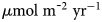 $\mu {\rm mol\;}{\rm m}^{ \hbox{-} 2}\;{\rm y}{\rm r}^{{-}1}$. We see that a supernova contributes a negligible fraction even of the extraterrestrial iron flux on Earth, let alone the other bioavailable iron sources. Thus, the supernova ejecta deposition will have no significant fertilizer effect.
Ozone depletion and UVB increase – a competing effect
Cosmic ray flux from a nearby supernova leads to depletion of stratospheric ozone, which results in increased penetration of solar UVB radiation to Earth's surface and into the upper part of the ocean. UVB is known to have harmful effects on most organisms and primary producers are especially vulnerable (Llabres et al., Reference Llabrés, Agusti and Fernandez2013; Peng et al., Reference Peng, Liao, Zhou and Peng2017; Benca et al., Reference Benca, Duijnstee and Looy2018).
Atmospheric chemistry modelling of the supernova case considered here (Melott et al., Reference Melott, Thomas, Kachelries, Semikoz and Overholt2017; Thomas, Reference Thomas2018) show a globally averaged reduction of ozone of about 25%. Calculations of the increase in surface-level UVB and subsequent biological impacts (Thomas, Reference Thomas2018) show a reduction in photosynthesis by marine phytoplankton ranging from a few per cent to around 40%. The larger values are seen for only one biological weighting function quantifying the effects on an Antarctic phytoplankton community; two other phytoplankton inhibition weighting functions show a reduction of a few per cent to around 10%. For a case with ozone depletion significantly higher than that considered here, Neale and Thomas (Reference Neale and Thomas2016) found only a few per cent reductions in photosynthesis for two of the most abundant, globally distributed, marine phytoplankton species.
Therefore, while the reduction in primary productivity is a likely result of a nearby supernova and would reduce the CO2 drawdown effect, the impact is likely to be small.
Muon irradiation – an additional competing effect
Cosmic ray primaries generate a shower of muons, which normally constitute a substantial fraction of irradiation at the surface. In Melott et al. (Reference Melott, Thomas, Kachelries, Semikoz and Overholt2017) we showed that the muon dose at the surface will reach a level of about fifteen times the total irradiation from all sources within 100 years and remain above this normal background for thousands of years. If we add in the cosmic ray trapping effect of the magnetic field in the walls of the Local Bubble and/or multiple supernovae (Breitschwerdt et al., Reference Breitschwerdt, Feige, Schulreich, de Avillez, Dettbarn and Fuchs2016) the duration of the effect may be greater. Muon irradiation has the additional effect of affecting life up to a kilometre below the surface of the ocean (Melott and Thomas, Reference Melott and Thomas2018; Melott et al., Reference Melott, Marinho and Paulucci2019). Nevertheless, only a small increase in mutation and carcinogenesis is expected for phytoplankton, although the effect may be large for megafauna (Melott et al., Reference Melott, Marinho and Paulucci2019). We conclude that muon irradiation is a small competing effect with regard to atmospheric chemistry.
Lightning and nitrate – a possible dominant contributor
We have previously argued (Melott and Thomas, Reference Melott and Thomas2019) that the large increase in atmospheric ionization (estimated as a factor of 50 in the lower troposphere) is likely to cause a major increase in the frequency of lightning. In Melott and Thomas (Reference Melott and Thomas2019) we suggested a possible linkage to fires and tree cover changes, especially relevant for hominins in northeast Africa. In pre-industrial times, lightning is the main contributor to the fixing of atmospheric nitrogen, mostly in the form of oxides of nitrogen, which are mostly rained out as nitrate ion (Schlesinger and Bernhardt, Reference Schlesinger and Bernhardt2013). Therefore, if there is a large increase in lightning, there should be a large increase in nitrate flux as well. Our results, which so far suggest a small effect, of the order of 10%, could change completely. If the lightning enhancement is as large as suggested in Melott and Thomas (Reference Melott and Thomas2019), this would be overwhelming. We cannot, however, estimate the magnitude of this effect, since there are large uncertainties in the mechanism of lighting and its connection to high energy cosmic rays.
A major increase in lightning would cause a drawdown of CO2 and thereby cool the climate, helping to provide an explanation for the ongoing cooling over the Pliocene and Pleistocene. The additional flux of nitrate combined with lightning-initiated fires would enhance the transition to grasslands, as argued in Melott and Thomas (Reference Melott and Thomas2019). More research is needed to make clear the connection between lightning and cosmic ray initiated atmospheric ionization.
Conclusions
We conclude that the fertilizer effect of nitrate deposition is likely to be small, of order 10%, for the Plio-Peistocene supernovae at a distance of 50–100 pc. The additional effect of fertilization by iron-bearing dust is of orders of magnitude smaller. The inhibiting effects of damaging muon irradiation and UVB from ozone depletion are likely to go in the opposite direction, inhibiting photosynthesis. Therefore, for moderately nearby supernovae such as those indicated near the Plio-Pleistocene transition, it appears that no large effect is likely.
Lightning is the dominant pre-industrial source of nitrate deposition. These conclusions change completely if the high level of atmospheric ionization induces a large increase in lightning, which would cause a large increase in nitrate flux, overwhelming the other competing effects. This would enhance CO2 drawdown, cooling the climate. More research is needed to clarify the cosmic ray-lightning connection. The greatest uncertainty in this assessment is the only partially understood mechanism of the initiation and propagation of lightning and the extent of the increase in lightning, which would be caused by increased atmospheric ionization.
Acknowledgements
We thank the referee, Dr Rocco Mancinelli, for comments which greatly improved the presentation of this manuscript.


