INTRODUCTION
On 5 August, 2011, a dead dolphin was found on the bottom of Lac Bay, Bonaire in approximately 3 m of water but very close to the deeper channel, about 300 m from shore. Based on diagnostic photographs, the specimen could be identified as an adult Fraser's dolphin, Lagenodelphis hosei Fraser Reference Fraser1956, which means a first record for the Dutch Caribbean. As the species is exceedingly rare in the southern Caribbean, this paper documents the find and places the record within the regional context.
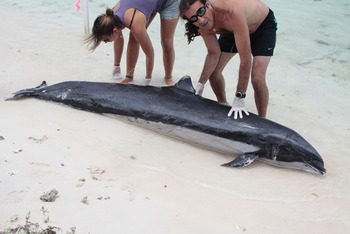
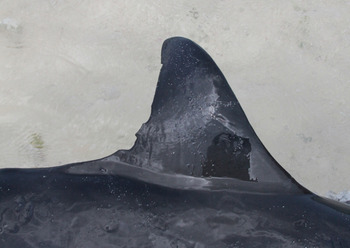
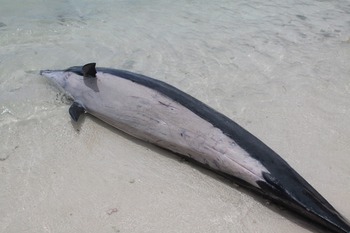
The Fraser's dolphin Lagenodelphis hosei Fraser Reference Fraser1956, was identified by its length (about 2.56 cm), a centrally placed slightly falcate but almost triangular dorsal fin of 19 cm in height (snout to anterior insertion of dorsal fin 109 cm) (e.g. Figure 2), short stubby beak (snout to blowhole 33 cm), dark at the upper side and pinkish lower jaw, short flippers, pointed to the tips (28 cm in length), dark grey back and pinkish abdomen (Figure 4) and broad flipper stripe that starts at the lower jaw (e.g. Figure 1). The fluke width was measured as 55 cm and the maximum girth as 117 cm. The true coloration was already fainted, and the body's stiffness indicated that it had died at least several hours before it was found. The lateral band between snout and anus is almost indistinct.
Lateral view of the Fraser's dolphin found on August 5 2011, Sorobon, Bonaire. Shape of snout, pectoral fin, dorsal fin, position of dorsal fin and coloration are clearly visible. © Gerard van Buurt.

Dorsal fin close-up. © Gerard van Buurt.

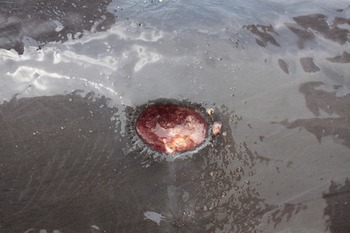
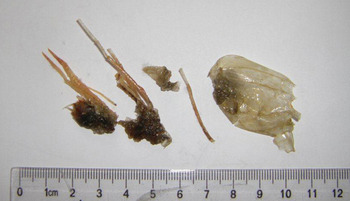
Closer examination of the exterior by members of STINAPA Bonaire showed there was damage on the tip of the snout most likely caused by the dragging. Besides a clear small cookie-cutter shark-bite (likely Isistius brasiliensis) (e.g. Figure 3), scars caused by squids and several superficial scars and bruises, no other wounds were visible. The mouth, throat and blowhole were internally checked for objects with negative results. Between the teeth were remnants of crustacean (Figure 5) which still need to be identified but that indicate recent foraging. Further, abundant mouth ulceration, stomatitis type, was found leading to tissue necrosis, with deformations at the edge of the palate and gums. The first stomach compartment contained stomach parasites (possibly of the genus Anisakis) and traces of algae. The mucosa in the second compartment was very red and haematized. The lungs were collapsed, showing abnormal consistency, with obvious wasting (invasive bleedings) mechanically blocking the respiratory function. After measuring and tissue sampling of liver, pancreas, lungs, blubber and collection of stomach parasites which were still living, the cadaver was discarded north-west of the island, close to Nukove.
Mark of cookie-cutter shark bite. © Gerard van Buurt.

Ventral view of the Fraser's dolphin found on Bonaire. The urogenital/anal opening is clearly visible as well as abdominal superficial scars and bruises. © Gerard van Buurt.

Remnants of possibly Gnatophausia sp. found between the teeth.

DISCUSSION
The Fraser's dolphin Lagenodelphis hosei was first described in 1956 based on a single skull found prior to 1895 by Charles Hose on a beach in Sarawak, Borneo (Fraser, Reference Fraser1956). However, it was not documented in the wild until 1971 (Perrin et al., Reference Perrin, Best, Dawbin, Balcomb, Gambell and Ross1973). The extent of the geographical range is poorly known but based on strandings and sightings by now the species is believed to have a cosmopolitan distribution from approximately 30° south to 30° north, and to live in deep (usually over 1000 m deep), tropical waters. Fraser's dolphins have been observed in the northern Gulf of Mexico during all seasons where they occur in oceanic waters (>200 m) (Perrin et al., Reference Perrin, Leatherwood, Collet, Ridgway and Harrison1994; Mullin & Hoggard, Reference Mullin, Hoggard, Davis, Evans and Würsig2000). It appears they can occur in areas near coastlines where the continental shelf is narrow (Jefferson et al., Reference Jefferson, Webber and Pitman2008).
Fraser's dolphins are, when seen, usually found in large, tight groups averaging between 10 and 100 individuals, but have been occasionally seen in larger groups of up to 1000 or more animals. They are relatively often seen in mixed schools associated with other deep diving cetacean species such as false killer whales, melon-headed whales, Risso's dolphins, and short-finned pilot whales, all species observed in the vicinity of the Dutch Leeward Islands.
Fraser's dolphins are capable of diving up to almost 2000 feet (600 m) to feed on deep-sea species of mesopelagic fish (e.g. myctophids), crustaceans, and cephalopods (e.g. squid and octopus). Gnathophausia sp. shrimp for instance are common in the stomachs of Caribbean pelagic cetaceans, especially beaked whales (ziphiids) (Debrot & Barros, Reference Debrot and Barros1992; Rosario-Delestre & Mignucci-Giannoni, Reference Rosario-Delestre and Mignucci-Giannoni1998; Rosario-Delestre et al., Reference Rosario-Delestre, Rodríguez-López, Mignucci-Giannoni and Mead1999) and pygmy sperm whale (Kogia breviceps) (Secchi et al., Reference Secchi, Campolim and Möller1994). The remnants that were found in its beak (possibly Gnatophausia sp.) suggest that deep water mysid may be also an important prey for Fraser's dolphins.
In the past decade several studies have become available which provide additional information on the marine mammal fauna of the leeward Dutch waters (e.g. Debrot & Barros, Reference Debrot and Barros1994; Debrot, Reference Debrot1998; Debrot et al., Reference Debrot, de Meyer and Dezentjé1998, Reference Debrot, van Buurt, Caballero and Antczak2006, Reference Debrot, Witte and Scheidat2011; Maldani, Reference Maldani2008; Luksenburg, Reference Luksenburg2011). However, most records have remained uncompiled and unassessed and therefore Debrot et al. (in press) recently provided an assessment of the marine mammals of the windward Dutch islands and Witte et al. (unpublished data) of the leeward Dutch island. Based on that it became clear that this was the first Fraser's dolphin Lagenodelphis hosei (Fraser, Reference Fraser1956), found in the waters of the former Dutch Antilles.
The IUCN Red List of Threatened Species considers Fraser's dolphins as ‘Data Deficient' due to insufficient information on population status and trends. The reported number of sightings of Fraser's dolphins in the Atlantic Ocean are in the low tens (Hersh & Odell, Reference Hersh and Odell1986; Ward et al., 2001) and just over a dozen for the Caribbean Sea. As the species is very rare, all records should be reported and documented as fully as possible. The Caribbean records include three specimens harpooned and taken by a cetacean fishery at St Vincent between 1972 and 1973 (Caldwell et al., Reference Caldwell, Caldwell and Walker1976), two sightings off Dominica on 26 and 28 October 1991 (Watkins et al., Reference Watkins, Daher, Fristrup and Notarbartolo-di-Sciara1994) and two strandings records in Puerto Rico: one subadult male on the south-west coast in 1994, and a female calf in 1997 in Ponce, on the south coast (Mignucci-Giannoni et al., Reference Mignucci-Giannoni, Montoya-Ospina, Pérez-Zayas, Rodríguez-López and Williams1999). Carlson et al. (Reference Carlson, Seipt, Brown, Lewis and Moscrop1995) reported sightings of Fraser's dolphins off the leeward coast of Dominica during January, February, and March of 1995, and IFAW (1996) reported sightings offshore of Carriacou in 1996. Two dolphins live stranded on El Palito Beach, State of Carabobo, Venezuela, on 6 June 1999. This was the first record of this species for Venezuela and the southern Caribbean (Bolaños & Villarroel-Marín, Reference Bolaños and Villarroel-Marín2003). Boisseau et al. (Reference Boisseau, Carlson and Seipt2000) reported two new encounters off Dominica: one pair and a group of approximately 50 individuals. Based on two sightings (130 individuals) during surveys off La Martinique in March and April 2003 they are now considered common in its territorial waters (Jeremie, Reference Jeremie2005).
Based on this stranding and other reported sightings it can be concluded that within the Caribbean Sea, Fraser's dolphins are likely to be found in deeper waters, both offshore and near shore. On islands with near shore deep waters occasionally they can be found stranded. Within the Dutch Caribbean waters this species is most likely to be found in offshore deeper waters. The presence of krill (Euphausia sp.) may play a significant role in the distribution and species richness of cetaceans in the Caribbean Sea and should be further investigated.
Positive determination at sea is not easy, especially for inexperienced observers, and confusion with other dolphin species is not unlikely. Therefore it is recommended to always photograph or even film any sightings. Especially in the case of dolphins found within a group of ‘black-fish' such as short-finned pilot whales or melon-headed whales, one should be on the lookout for Fraser's dolphin.
In order to establish which species are present, provide evidence of seasonal residency patterns and to stimulate people to report their sightings, these updated reviews were made and all known sightings were compiled into the Dutch Caribbean Marine Mammal Database (DC-MMDB) (Witte et al., unpublished data). To help stimulate the general public to report their encounters with marine mammals, the records compiled up to now will be added to the public data website (www.observado.org).
ACKNOWLEDGEMENTS
This paper is dedicated to the memory of Dr P.J.H. van Bree curator of mammals in the Zoological Museum of the University of Amsterdam who passed away on 24 February 2011. Dr van Bree conducted a lot of systematic work on marine mammals (in particular cetaceans and pinnipedia) and he was the first to make a preliminary list of the cetaceans of the southern Caribbean (van Bree, Reference van Bree1975). We thank Elsmarie Beukeboom (STINAPA Bonaire), Jaime Bolanos (SEA VIDA), Paul Hoetjes (EL&I and SCCN) and Ramon de Leon (STINAPA Bonaire) for their information and cooperation and of course remain especially indebted to the finders. This research received no specific grant from any funding agency, commercial or not-for-profit sectors.