Introduction
Involvement with multilateral institutions often helps domestic democratic institutions restrict the power of special interest factions, protect individual rights and improve the quality of democratic deliberation … Under some plausible circumstances international cooperation can thus enhance the quality of democracy.Footnote 1
In a recent article, Robert O. Keohane, Steven Macedo, and Andrew Moravcsik assert this claim. Their argument – or the ‘democracy-enhancing multilateralism’ thesis – challenges sceptics by highlighting the potential ways in which international organisations (IOs) can enhance domestic democracy. More specifically, multilateral institutions are likely to improve domestic democracy by bolstering domestic constitutional mechanisms that combat special interests, protect individual rights, and facilitate collective deliberation. Yet, and as Keohane, Macedo, and Moravcsik themselves insist, multilateralism does not always or automatically improve democracy at the domestic level. ‘Democracy-enhancing multilateralism’ and similar arguments about the democratising effects of multilateral institutions thus beget questions about the conditions under which domestic democracy is likely to improve. Keohane, Macedo, and Moravcsik propose possible conditions themselves, and implore scholars to ‘seek to understand the conditions under which multilateralism does and does not promote democracy’.Footnote 2
The purpose of this article is to take their recommendation seriously and to further specify the conditions under which IOs have a positive effect on domestic democracy. That is, what factors shape and determine multilateral institutions' effects on democracy at the state level? More specifically, under what conditions will a state's domestic political processes garner an improved ability to combat special interests, protect rights, and allow for collective deliberation as a result of the state's participation in a multilateral institution?
In this article, I explore the conditions that relate to the protection of rights specifically. That is, do international organisations ensure the greater protection of individual rights in domestic political processes and if so, under what conditions? Using most-likely empirical cases – the European Union (EU) and the Council of Europe (CoE) – I argue that three conditions help to account for when and where multilateral legal institutions will be likely to enable an expansion of rights via domestic political processes. Specifically, rights expansion is likely to occur when there is adequate incompatibility of the laws, legal mobilisation, and legal precision and obligation.
The ‘democracy-enhancing multilateralism’ thesis and similar arguments are used as the starting point for this discussion for two reasons. First, while this article speaks to a broader literature on the domestic impact of international institutions, similar to the ‘democracy-enhancing multilateralism’ thesis, the domestic impact of interest here – the protection of individual rights – pertains to democratic institutions and practices. Second, this article builds on the ‘democracy-enhancing multilateralis’” thesis, assuming that improvements can come to democracy at the domestic level as a result of state membership in international institutions, and tries to further specify the argument. Since individual rights can be understood as one of the key criteria of democracy, the primary contribution of this article thus is a theoretical perspective on the conditions shaping ‘democracy-enhancing multilateralism’ specific to rights protections. In addition, scholarship on the democratising effects of international organisations tends to focus on developing democracies. This article contributes to this literature by evaluating whether multilateralism can facilitate improvements in terms of rights within established democracies. Looking at two of the CoE's and EU's member states, or France and the UK, I illustrate that even those states which are amenable to individual rights protections confront conditions which shape the effects of multilateralism on domestic politics.
For clarity, the scope of the article does not include a general test of the democracy-enhancing multilateralism thesis. As opposed to asking if ‘democracy-enhancing multilateralism’ occurs, I find a more fruitful discussion comes from exploring when and where international institutions may be instrumental to the promotion of democracy at the domestic level. The article aims to specify the conditions which shape rights expansion that occurs via domestic processes as a result of a state's participation in international legal institutions. These conditions are then empirically examined in the context of litigation and individual rights protections against discrimination in Europe. While some might interpret the argument presented here as shedding some scepticism on the broader discussion regarding ‘democracy-enhancing multilateralism’, conversely it illustrates that rights do in fact expand at times. Where and when this occurs should however be understood in terms of conditions that are overcome, which is the contribution this article seeks to make.
This article also contributes to literature on European legal integration, by broadening the scope of the analysis to include the CoE. By doing so, this article moves beyond EU legal integration literature to examine if some of the arguments made about the EU's legal system are generalisable to other international legal institutions, such as the CoE. Similarly, an important empirical contribution of this article is to show how the CoE, in addition to the EU, affects rights within member states and through domestic processes. While the theoretical claims draw upon insights advanced by prominent scholars of EU legal integration, this article also examines the applicability of concepts found within international law literature to illustrate how international law itself can shape the domestic outcomes of EU law as well as CoE law. Thus, the unique approach here is to combine theoretical concepts found within two bodies of literature in order to build a model of conditions.
This article proceeds in three sections. The first section reviews the ‘democracy-enhancing multilateralism’ thesis before presenting my core argument on the conditions shaping the likelihood of international legal institutions to generate rights expansion domestically. The second section explores the empirical cases of the EU and CoE non-discrimination laws and their effect on the rights of Roma persons and persons of religious minorities in the UK and France. This analysis shows that rights expansion occurs to a limited degree and is achieved when the hurdles presented by incompatibility, mobilisation, precision, and obligation are overcome. The final section presents the conclusions.
The conditions shaping democracy enhancing-multilateralism
According to the ‘democracy-enhancing multilateralism’ thesis, international organisations have the potential to improve democracy at the national level. This potential occurs when multilateralism bolsters domestic constitutional mechanisms which are central to democracy. First, multilateralism can improve the ability to combat special interests by allowing representation of diffuse interests. Second, multilateralism may reinforce and commit states to protecting individual rights. Third, multilateralism can foster collective deliberation by enabling a greater diversity of ideas and more expertise and information to come to the table. Thus, ‘democracy-enhancing multilateralism’ is the expectation that multilateralism enhances domestic democracy through each of these mechanisms.Footnote 3
The democracy-enhancing thesis is supported by scholarship that draws a connection between multilateralism and democracy. Existing literature illustrates that international organisations can facilitate democratisation at the national level.Footnote 4 More important to the purpose here, similar literature shows that international organisations can improve rights protections at the domestic level. Various mechanisms operate to facilitate international organisations' effects on individual rights, including international law and courts,Footnote 5 litigation and mobilisation,Footnote 6 socialisation and norm entrepreneurship,Footnote 7 coercion,Footnote 8 and domestic actors and institutions.Footnote 9 In all, this literature demonstrates that an important relationship exists between international organisations, democracy, and individual rights.
While scholarship gives merit to the ‘democracy-enhancing multilateralism’ thesis, this literature and the thesis itself does not claim that democracy will always improve or automatically follow from a state's participation in multilateral organisations. Rather, the likelihood of domestic change and transformation is conditional. Keohane, Macedo, and Moravcsik suggest three possible conditions. First, ‘multilateral institutions in which countries with well-functioning domestic constitutional democratic procedures predominate are more likely’ to enhance democracy.Footnote 10 Second, multilateral institutions which elicit and develop civil society participation are also more likely to enhance democracy at the national level.Footnote 11 Third, the demographics of a state are also likely to condition democracy-enhancing multilateralism.Footnote 12
These conditions however only begin to touch upon when and where we might see democracy expand as a result of multilateral institutions. Moreover, these conditions tell us little about the factors that are specific to particular democratic constitutional mechanisms (for example, collective deliberation, combating special interests, or rights protections). While the conditions that relate to each constitutional mechanism merit further exploration, this article limits its inquiry to the conditions shaping multilateralism's effects on democracy via individual rights protections. That is, what factors enable or hinder multilateral institutions' effects on the ability of domestic political processes to protect rights? More specifically, when is a state's involvement in a multilateral institution likely to bolster rights protections by means of domestic political processes?
By exploring this question, I argue that rights expansion is significantly restrained by a set of conditions that shape multilateralism's effects on individual rights. Rights expansion, which is the dependent variable of this study, can be broadly defined as occurring when a previously unrecognised right is legally granted. Rights expansion in other words is an increase in rights protections. Rights are legally granted through various mechanisms, including legislation, constitutional provisions, or judicial rule-making. Even when a right is legally granted through a single legal dispute, it becomes a resource for future disputes,Footnote 13 a catalyst for mobilisation,Footnote 14 and can be incrementally institutionalised as a legal norm.Footnote 15 Thus, a single grant of a right is viewed as expansion because of its ability to structure rights guarantees in the long-run.
But why might we be concerned with rights protections in relationship to ‘democracy-enhancing multilateralism’? The attention to rights protections is based on the assumption that rights are one of the essential constitutional mechanisms and values by which democracy is obtained, sustained, and improved. Keohane, Macedo, and Moravcsik make this assumption and I follow them in that regard. More importantly, that individual rights are one of the key components of democracy is supported by an extensive body of literature. First, normative scholarship on democracy widely accepts that rights are one of the key elements of democracy.Footnote 16 Substantive conceptions of democracy, which emphasise values such as justice and equality, embrace individual rights as central to democracy. Likewise, procedural conceptions of democracy, which highlight institutions and procedures (that is, majority rule, representation) as the key features of democracy, presuppose individuals enjoy a minimum guarantee of equality and/or freedom to enable processes such as voting, competitive elections or deliberation. Second, empirical research highlights the relevance of individual rights to democracy. Most empirical work defines democracy to include a minimum notion of individual rights; for example, definitions that focus on regular elections assume they are ‘free and fair’. Quantitative measures of democracy likewise assess rights as a component of democracy. For example, both Freedom House and Polity IV include indicators of civil liberties to measure democracy. In all, it is fair to say that despite disagreement over the nature of democracy, most scholars agree that a minimum set of individual rights are essential to democracy.
I propose three conditions that affect the likelihood of ‘democracy-enhancing multilateralism’ via individual rights protections. International law, which is created to facilitate international cooperation, can provide opportunities for rights expansion whenever the law embodies an implied or explicit right. For international legal cooperation to generate rights expansion, first there must be incompatibility between the international legal principle and pre-existing domestic law. Without such incompatibility, the international law remains uncontroversial and is not likely to generate political opportunity to contest the application of the international law. Incompatibility however does not necessarily result in rights expansion. Second, individuals and social groups must then act upon that incompatibility and mobilise the international law through political processes, such as litigation. Last, given incompatibility and mobilisation of the law, the international law must be sufficiently precise and obligatory. If the law lacks precision and obligation, state authorities will have a wider window of discretion to minimise the impact of the international law. Together these conditions have a significant affect on the likelihood of rights expansion. The following sections elaborate on these expectations and how they work jointly to limit rights expansion.
Compatibility between international and domestic law
The first factor that is likely to condition rights expansion is the compatibility of domestic institutions with international law. As has been illustrated by Europeanisation literature, the compatibility between domestic and international institutions affects the nature of change in domestic law and politics.Footnote 17 Accordingly, the most relevant domestic institutions for this analysis are domestic legal order, laws, and constitutional principles. The application of an international legal principle into the domestic context implicates pre-existing domestic laws. If the international and domestic laws are incompatible, meaning they engender substantively disparate outcomes, the conflict between these laws challenges the domestic equilibrium and changes the domestic opportunity structure.Footnote 18 Thus, incompatibility generates political opportunity to contest the application of international law.
The compatibility of domestic and international law, according to some, is likely to be consistently high because states self-select into multilateral institutions or ratify international treaties with which they are readily able and willing to comply.Footnote 19 In other words, states tend to join only those international legal institutions that are compatible with pre-existing domestic law. However, there are two reasons why self-selection may not minimise incompatibility to the point of making it a theoretically moot point. First, while self-selection may often occur, incompatibility can nevertheless arise because neither international law nor domestic law is static. Rather, a more process-based approach of law emphasises the changing nature of law and suggests that international law may develop and change beyond the set of rules that states originally commit to. International law can develop through usage, debate, dispute, and interpretation.Footnote 20 For example, international legal enforcement bodies (such as courts, dispute panels, and treaty committees) reshape the law in the process of interpreting it. Likewise, domestic law may similarly develop after the point of membership or ratification through processes such as judicial and legislative rule-making.Footnote 21 Second, a state's decision to join an agreement may be more complicated than proponents of the self-selection argument suggest. Decisions to ratify a treaty may include factors which lie outside the structure of compliance costs. For example, membership in the EU is dependent upon ratification of the European Convention for the Protection of Human Rights and Fundamental Freedoms. So, irrespective of potential compliance costs, the ‘carrot’ of EU membership significantly weighs on the decision to ratify. Similarly, social costs to conform sometimes affect decisions to ratify.Footnote 22 Generally, incentives exogenous to compliance costs may shape decisions to ratify. Thus, despite states' tendencies to self-select into particular international legal institutions, a process-based perspective suggests incompatibility may arise after a state commits itself to international legal institution.Footnote 23
Incompatibility conditions rights expansion because it shapes the nature and extent of political opportunity.Footnote 24 Since the degree of incompatibility is likely to vary across countries, this is a potential source of cross-national variation in rights expansion. If the substantive prescriptions of domestic law closely resemble those of the international law, institutional compatibility is high and political opportunity will be low, and we would expect less rights expansion to occur as a result of the international law. In other words, if the domestic law closely approximates and is congruent with international norms, there is little room for the international law itself to be a causal factor in transforming domestic rights protections. Conversely, where the domestic and international laws are less compatible, political opportunity is high, and rights expansion is more likely.Footnote 25
Hypothesis 1:The more compatible domestic laws are with international law, political opportunity will be lower, and thus rights expansion is less likely to occur.
Legal mobilisation of international law
Even when there is incompatibility, non-state actors must seize the political opportunity and mobilise the international law. Groups may invoke international law because it is a political resource which carries a symbolic, if not real, external pressure or threat that legitimises a group's demands – that is, international law or norms can bolster a group's argument.Footnote 26 Legal mobilisation, or invoking and engaging the law,Footnote 27 is necessary for international law to become meaningful. Without mobilisation international law is unlikely to contribute to rights expansion because state authorities are not apt or required to employ international law in the absence of mobilisation. This is the case with courts; a court's rule-making authority can only be engaged when a litigant presents the court with a question. If litigants do not pose questions of European law, judges are not apt to pursue those questions in their decision-making. Thus, legal mobilisation initiates the process of application and enforcement by challenging public authorities to put international legal commitments into practice and give them meaning in domestic law. For this reason, mobilisation is a key condition affecting whether European law drives the expansion of domestic rights protections.
Mobilisation can be non-consequential, result in a backlash or invite counter-mobilisation. Consequently, effective legal mobilisation depends on ‘follow-through’,Footnote 28 strong organisation, and adequate resources.Footnote 29 For example, EU law has greater impact for powerful or well-organised interests.Footnote 30 In addition, litigation is more likely to have redistribute effects when there are repeat players.Footnote 31 Accordingly, when litigation involves a ‘cause lawyer’, who has repeated litigation experience with a legal issue, rights expansion is more likely.Footnote 32 Thus, rights expansion is more likely when international law is invoked and central to a well-organised and persistent campaign, rather than isolated events of mobilisation.
Hypothesis 2:The less litigants mobilise international law, rights expansion is less likely to occur.
The obligation and precision of international law
International law itself is likely to condition multilateral legal institutions' impact on domestic rights expansion also. To fully understand the effects of international law, however, we must take a broad conceptualisation of the law, including the codified rule as well as its development overtime through adjudication.Footnote 33 Adjudication is a process by which rules are reconstituted and redefined such that it resembles rule-making.Footnote 34 Consequently, international law develops meaning when international organisations or their bodies (that is, international courts) interpret and apply the law. For example, the ECJ plays a crucial role in institutionalising EU law through its decision-making.Footnote 35 Moreover, the ECJ's interpretation of EU law has an impact on the future legal opportunities and the law's ability to generate social change.Footnote 36 For this reason, it is important to see how the international law develops meaning through its use and the decision-making of courts.
Two aspects of international law that are likely to condition rights expansion are precision and obligation. ‘Precision’ is the degree of clarity, specificity, and determinacy of a rule. A law's precision affects its interpretation, application, and effectiveness.Footnote 37 More specifically, scholars have shown that precision (also referred to as determinacy and ambiguity) contributes to complianceFootnote 38 as well as how national courts apply the law.Footnote 39
The precision of the law is likely to condition rights expansion because it shapes the amount of discretion national decision-makers have to interpret these rules. When law lacks precision, ambiguity serves to defer decision-making to the judge.Footnote 40 Thus, the degree of precision shapes the window of discretion left to national judges. When the international law is precise, the window of discretion for national judges to interpret a law is limited, leading judges to apply the rules accordingly. Conversely, when the law lacks precision, judges have greater discretion and leniency to balance in favour of national law. As self-interested rational actors whose most relevant interests are shaped at the domestic level (that is, career promotion, reputation in relation to other courts, etc.) judges' interests will lead them towards maintenance of the national law where they have the discretion to do so.Footnote 41 Consequently, when international law has greater precision, we would expect more rights expansion.
The second characteristic of international law that conditions whether multilateral legal institutions result in rights expansion is the degree of obligation placed on states. Obligation is whether states are ‘legally bound by a rule or commitment in the sense that their behaviour thereunder is subject to scrutiny under the general rules, procedures, and discourse of international law’.Footnote 42 Aside from what is specified in treaties, conventions or secondary law, two types of legal rules articulate the degree of obligation of an international legal rule. First, doctrine that defines the general rules of balancing between international and national law contributes to the degree of obligation. Second, ‘exit clauses’ also determine the degree of obligation. An exit clause states that a principle of international law may be derogated from under specified circumstances. The breadth of an exit clause shapes the degree of obligation, such that greater breadth lessens the state's obligation. More than the codified law, international courts' jurisprudence determines the breadth of exit clauses.
Similar to precision, the degree of obligation placed on member states establishes the level of discretion left to national decision-makers. When the obligation is high, the window of discretion left to national judges is narrowed, and leads judges to apply the rules accordingly. On the other hand, when the law lacks obligation, judges have greater discretion and are more likely to balance towards the national laws and rely on doctrine such as the margin of appreciation and exit clauses as justification. Consequently, when international law has an implied right with high obligation for states, we would expect greater rights expansion to occur through domestic legal processes.
Hypothesis 3:The less precise and obligatory that the international law is, the less likely that rights expansion will occur.
Conditions of rights expansion: a sequence of hurdles
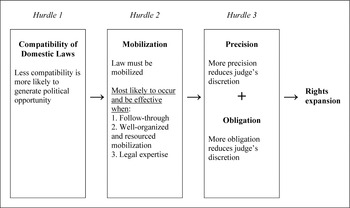
Conditions shape how, when and to what extent a cause generates an outcome. The ‘democracy-enhancing multilateralism’ suggests that multilateralism can act as a cause of democratic improvements in domestic politics. The previous discussion specified three conditions that help to explain the ways in which multilateralism affects individual rights, and thus enhances one of the key elements of democracy. These conditions work together as a sequence of hurdles that affect the expansion of rights that occur through domestic legal processes as a result of multilateral legal institutions. Figure 1 illustrates this sequence.
Conditions to rights expansion from multilateral legal institutions

As depicted in Figure 1, the first hurdle to rights expansion is legal compatibility. Compatibility of the laws minimises political opportunity. Thus, first, considerable incompatibility between the international and domestic laws enables political opportunity. The second hurdle is legal mobilisation. If non-state actors invoke and engage international law as a political resource, which is more likely to occur and be effective when it is followed by continual litigation or other mobilisation tactics, well-organised or resourced, and/or supported by individuals with expertise in that field of law, the prospects for rights expansion are further improved. As Figure 1 illustrates, the third hurdle is the international law itself. The international law creates further obstacles depending on its degree of precision and obligation. Specifically, precision and obligation determine how much discretion remains in the hands of national authorities (for example, judges) to maintain the status quo. Together these factors reduce that likelihood that rights expansion will occur.
Expansion of rights protections against discrimination in Europe
Looking at individual rights protections related to Roma persons in housing and religious freedoms in public schools, the empirical analysis looks at the effect of EU and CoE non-discrimination law to assess the conditions under which it expands individual rights for minority persons via domestic political processes. To evaluate the conditions shaping European non-discrimination law's effects on rights expansion domestically, I look at the application of European law through litigation in France and the UK. Before proceeding to the empirical analysis, I discuss the research design.
I use a research design that looks at a domestic political process, or litigation, to evaluate the conditions shaping ‘democracy-enhancing multilateralism’. Recalling that the ‘democracy-enhancing multilateralism’ thesis suggests improvements in domestic democracy, I am not interested in whether multilateral institutions themselves generate democratic outcomes (for example, does the ECHR issue decisions that enhance democracy within the CoE). Rather, I am interested in whether a state's participation in an IO changes the way politics are done within the state. Thus, a focus on domestic political processes is best able to capture politics within the state.
Among the various domestic political processes that shape rights protections, I look at litigation specifically. Litigation is a key pathway through which international legal institutions are likely to have an effect on domestic rights protections. I look at litigation for two reasons. First, while other pathways are also relevant, such as legislative processes, I look at litigation because it is an important process by which law and rights are contested and constituted within domestic politics.Footnote 43 Second, I look at litigation because judicial processes are political and inform politics.Footnote 44 Litigation can affect legislative processesFootnote 45 as well as be a catalyst for further public dispute or contestation about rights.Footnote 46 In addition, litigation is a form of political activity whereby citizens are able to interact with public authority and participate.Footnote 47
I opt for a design which uses cases that Keohane, Macedo, and Moravcsik would identify as most-likely. The selection of the EU and CoE is instructed by Keohane, Macedo, and Moravcsik, who argue that ‘democracy-enhancing multilateralism’ is more likely to derive from multilateral institutions in which well-functioning democracies participate and civil society is highly involved.Footnote 48 Accordingly, both the EU and CoE are comprised of mostly well-functioning democracies and civil society participation is high. In addition, the EU and CoE law include implicit and explicit rights provisions, they are among the world's most consequential multilateral legal systems, and both IOs have been important to the protection of individual rights across Europe.Footnote 49 Thus, the EU and the CoE are IOs that are the most-likely to have significant effects on individual rights at the domestic level. This design, using what Keohane, Macedo, and Moravcsik define as most-likely cases, is ideal because most-likely cases can help to ‘update’ a theoretical argument's understanding of conditions and to further specify a causal process.Footnote 50 Accordingly, I start with the basic premise of the democracy-enhancing thesis but seek to further explore the conditions that lie behind its claim in relation to rights protections. By using the EU and CoE, I can hold constant their specified conditions in order to explore other conditions specific to rights expansion.
The ‘democracy-enhancing multilateralism’ thesis addresses the effect of multilateral institutions on participating states (that is, those with membership). Although related, this research agenda is separate from the effect of multilateral institutions on non-members, such as scholarship which evaluates the EU's influence over the regime transitions in central and eastern Europe. Thus, selecting among EU and CoE member states, I choose France and the UK for two reasons. First, I select west European states because existing literature on the democratising effects of European multilateral institutions focuses on central and eastern Europe. Also, I wish to avoid conflating accession processes and membership. As older member states, France and the UK do not present this methodological problem. Second, France and the UK vary on key dimensions. In the UK, we would expect greater rights expansion through litigation because the pluralist society-state relations facilitates mobilisation through political processes and the common law system is more amenable to legal change through litigation. Conversely, France's statist society-state relations and civil law system make rights expansion less likely to occur through litigation. Also, France and the UK differ in terms of pre-existing laws for protections against discrimination.
France and the UK are interesting for this inquiry because they already have strong individual rights protections, leading us to expect little rights expansion. Yet, despite their rights protections, these states still face challenges in ensuring individual rights. France and the UK thus shed light on how IOs can enhance democracy even among advanced democracies and when rights would seem to be the most entrenched.
I select rights issues within France and the UK that remain controversial and where the state has substantial room to improve rights protections. Rights protections for Roma in housing and religious freedoms in education are the substantive rights issues under analysis. These rights issues represent pressing issues faced by persons in Europe who often experience infringements on their rights. Both the Muslim and Roma populations face serious concerns of discrimination, which ultimately undermine the generally strong protections of individual rights in France and the UK. In addition, both CoE and EU law address individual rights and freedom against discrimination based on religion and ethnicity, and thus offers potential for rights expansion. Most importantly, these substantive rights issues highlight variation in legal precision and obligation and have been litigated in France and the UK.
The CoE's non-discrimination legal protections comprise Article 14 and Protocol No. 12Footnote 51 of the European Convention on Human Rights and Fundamental Freedoms (herein European Convention) which ensures protection from discrimination on the basis of ‘sex, race, colour, language, religion, political or other opinion, national or social origin, association with a national minority, property, birth or other status’. Article 8 of the European Convention is applicable to housing rights and Article 9 on the freedom of religion. The EU's non-discrimination law includes the Racial Equality Directive 2000/43/EC (herein RED) and the Employment Equality Directive 2000/78/EC (herein EED).Footnote 52 The RED protects from direct and indirect discrimination on grounds of race and ethnicity in employment and social protections, including social security and healthcare, social advantages, education, access to and supply of goods and services which are available to the public, including housing.Footnote 53 The EED prohibits direct and indirect discrimination on grounds of religion or belief, disability, age, or sexual orientation in employment. The analysis evaluates the impact that these laws have on rights expansion through litigation in the UK and France.
Rights expansion in the UK and France
The ‘democracy-enhancing multilateralism’ argument would suggest that the above legal protections from the CoE and EU would enable rights expansion for Roma persons in housing and freedom from religious discrimination in education at the national level. I collected case law which met the following conditions: (1) date of decision between 2001 and 2008; (2) decision by a high court of appeal or high court (that is, House of Lords or Conseil d'Etat);Footnote 54 (3) one of the litigants was from a minority group under analysis; and (4) the principal legal question addresses issues under analysis (that is, religious freedoms in schools or housing rights for Roma).Footnote 55 I coded each case for: (1) laws invoked; (2) parties; (3) legal questions; (4) court; (5) date of decision; and (6) decision. Rights expansion was measured according to the outcome of the litigation in terms of the court's decision. If the court rules in favour of the minority individual(s) who seek redress, I code the decision as rights expansion.
The empirical analysis reveals that legal processes in France and the UK do contribute to the expansion of rights protections against discrimination. European law (herein, ‘European law’ refers to EU and CoE law generally) at times plays a crucial role in the expansion of these rights. That said, the empirical analysis also shows that European law has minimal or no effect most of the time. There are three observable outcomes – rights expansion, missed opportunities, and a null effect on domestic law.
First, rights expansion occurs, albeit infrequently. A total of 58 cases were analysed. In France the litigation on religious dress includes disputes about the expulsion and segregation of students who wore the hijab, bandanas in place of a hijab, and Sihk turbans. In the UK, the one case on religious dress pertained to a student's expulsion from school for wearing a niqab in violation of the school's uniform policy. The litigation regarding Roma included cases dealing with evictions, denial of permission to park, and more.
In 15 of the cases (26 per cent), the courts ruled in favour of the minority litigant. European law was instrumental in only six cases (10 per cent), all of which were Roma housing cases in the UK. More important than the number of cases are the substantive rights provisions that came from the litigation. In this regard, the rights expansion from these six cases is substantial. For example, the UK House of Lords 2003 decision in South Bucks District Council v Porter and Others asserted the rights of Roma to have a court – rather than simply order into law an injunction that has been approved by a municipal council – re-evaluate in individual cases whether an injunction to forcibly remove them from a plot of land meets European Convention Article 8 criteria that such action be proportionate to a legitimate aim.Footnote 56 In a related case, the UK House of Lords also ruled that a decision on planning permission must take into consideration the circumstances of the Roma applicant, and that unlawfully occupying the land should not be material enough for rejecting planning permission.Footnote 57 Yet another case asserted the municipal council's positive duty to carry out an Article 8 assessment of whether a decision was proportionate to a legitimate aim.Footnote 58 Thus, European law's contributions to rights expansion can be substantively significant, even though it occurred in only six (10 per cent) of the total cases analysed.
While there are some instances of rights expansion that follow from European law, other litigation shows many opportunities to use European law for rights expansion are missed. Missed opportunities are most common for EU law in the litigation analysed. While the EU law is less applicable to religious dress or symbols in schools, it is highly relevant for litigation regarding Roma housing rights. Yet, EU law does not enter into this litigation. Missed opportunities also occurred in France with regards to CoE law and litigation concerning Roma and housing. In this way, the rights expansion that could possibly occur does not. The last set of outcomes includes litigation where European law is engaged by the litigants and courts, yet it has does not generate a decision that expands rights. This occurred more frequently in French litigation than in the UK. The difference may in part be attributable to differences in national factors, but as I will discuss below, the nature of the European law helps to explain this variation across states and why in general European law at times has minimal or no direct effect on the law.
Rights expansion does occur through domestic legal processes as a result of international legal provisions. The expansion of individual rights, however, is by no means unrestrained or rampant, nor is it entirely meaningless. This invites the question of what factors hinder international law from having more of an impact on individual rights. The following section discusses how legal compatibility, mobilisation, and the degree of precision and obligation of international law account for the variation in the rights expansion generated by EU and CoE law.
Compatibility of domestic and European non-discrimination laws
Compatibility between domestic and European laws determines whether legal norms conflict to disrupt the domestic equilibrium and present political opportunities to challenge domestic law. Based on a qualitative and quantitative measure of institutional compatibility prior to the time period under analysis (2001–08), French law is more compatible with European law than British law.Footnote 59 Less institutional compatibility in the UK correlates with greater rights expansion through British litigation, as expected by Hypothesis 1. On the other hand, greater compatibility of domestic law with European law in France correlates with less rights expansion.
French law has a high degree of compatibility with European non-discrimination law. The French constitution protects from religious and ethnic discrimination, stating France ‘shall ensure the equality of all citizens before the law, without distinction of origin, race or religion’. Moreover, French law has a strict separation of church and state, established by the law of 9 December 1905 and reinforced by Article 1 of the Constitution, which states: ‘France is an indivisible, secular, democratic and social Republic.’ Laicité (roughly translated as secularism) is deeply ingrained in French constitutional order and informs education policy. For example, the national education curriculum excludes religious education from public schools. Prior to the year 2000, education law and policy allowed students to wear religious symbols in public schools.Footnote 60 With regards to housing rights for Roma, the right to decent housing became a constitutional value in 1995.Footnote 61 In addition, the 1990 ‘Besson laws’ require municipalities with 5,000 or more residents to provide ‘gens du voyage’ with official caravan parking sites.Footnote 62 In all, both general provisions and law specific to education and housing provided for religious equality and freedom in schools and rights to housing for Roma. Thus, French law had a relatively high degree of compatibility with European law.
Conversely, British law prior to 2000 differed from European law. First, despite having the Race Relations Act of 1976 as a non-discrimination statutory framework, only racial and ethnic discrimination were protected. Rather, religious discrimination was not provided for by the non-discrimination statutory framework until the transposition of the EU directives in 2003.Footnote 63 Moreover, a state supported-religion has remained in place since the middle of the sixteenth century, albeit this relationship has weakened with time. The law privileges Christianity and the Anglican Church in many ways, such as religious education is part of the national curriculum, seats are reserved for the Anglican Bishops in the House of Lords and a Christian blasphemy law remained on the books.Footnote 64 On housing for Roma, the Criminal Justice and Public Order Act of 1994 removed earlier statutory provisions which had required local authorities to provide caravan parking sites.Footnote 65 The requirement that local authorities provide parking sites was, however, reinstated by the Housing Act of 2004 to comply with the EU directives. While the Human Rights Act of 1998, which incorporated the European Convention into domestic law, provided protection from both ethnic and religious discrimination, specific legal protections for Roma in housing and discrimination against religious minorities did not exist in the UK in the year 2000. Thus, the UK's laws were less compatible with European non-discrimination laws than the French laws.Footnote 66
A quantitative measure also reveals that British laws were less compatible. For EU law, I measure compatibility as the time it takes to transpose the EU directives, assuming that greater compatibility enables more rapid transposition. For CoE law, I use reports issued by the CoE's monitoring agency on discrimination, the European Commission on Racism and Intolerance's (ECRI), which evaluates state's compliance with the CoE's non-discrimination law. I measure compatibility as the number of policy recommendations made by the ECRI's second country reports on discrimination on grounds of religion and against Roma persons.Footnote 67
Institutional compatibility with EU law is greater in France than in the UK, as measured by number of weeks it took to transpose the directives. France was quicker on average to transpose the religion and ethnicity requirements of both directives. France took an average of 158 weeks to transpose the requirements of the EED and 183 weeks for the RED. In the UK, the average transposition of requirements in the EED was 203 weeks and 225 weeks for the RED. In both countries, the RED took more time to transpose than the EED. In addition, the most time consuming requirements for both the UK and France to transpose was the creation of equality bodies (the Law creating HALDE and the Equality Act). France's quicker transposition of the directives' requirements implies greater institutional compatibility between French pre-existing law and the EU directives in comparison to the UK.
French laws were more compatible than British laws with CoE law based on the number of ECRI policy recommendations. The ECRI issued no recommendations to France regarding religious discrimination. France was, however, reprimanded for its failures towards Roma in housing and education, for which the ECRI issued two recommendations. The ECRI issued five policy recommendations to the UK (not including recommendations on Northern Ireland) on the issue of religion. These recommendations focus on the non-discrimination statutory law's failure to include religion as a protected ground of discrimination. The ECRI also issued three policy recommendations to the UK on the treatment of Roma in education, housing, and asylum.Footnote 68
According to Hypothesis 1, less institutional compatibility in the UK should correlate with greater rights expansion. The empirical cases support this hypothesis. Legal compatibility was greater in France and rights expansion attributable to European law was less than in the UK. Conversely, in the UK legal incompatibility allowed more political opportunity to contest domestic laws using European law and thus facilitated greater rights expansion. Moreover, incompatibility should facilitate legal mobilisation by providing political opportunity, which I discuss next.
Mobilisation of the EU law and CoE law
Institutional compatibility presents political opportunity to challenge domestic law using international law. This opportunity, however, must be followed by active usage of the law as a political resource – that is, non-state actors must mobilise the law. In the litigation evaluated, mobilisation of European law occurred in both French and British litigation related to Roma persons access to housing and religious dress in schools. In France, mobilisation of European law occurred more in the litigation on religious dress in schools (69 per cent of the cases) than in the Roma housing cases (11 per cent). Similarly, European law was frequently invoked in British litigation. In the Roma housing cases, 63 per cent of the litigation invoked European law and European law was invoked in the British case on religious dress in schools.
Both in France and the UK, litigants mobilised CoE law more than EU law. Among all the cases analysed, the minority litigant mobilised CoE law in 68 per cent of the cases. Conversely, litigants did not invoke EU law. In fact, the EU non-discrimination directives were mobilised in only one of the 58 disputes. The one case where EU law was mobilised involved a boy who was expelled from school for wearing a Sikh under turban in accord with his religious belief.Footnote 69 In this case, the litigant's lawyer invoked the EED, which is surprising because it protects from religious discrimination in employment and the dispute did not pertain to employment. More surprising is the lack of mobilisation of the RED, which protects from ethnic discrimination in social services, including housing. The RED is highly relevant to the Roma housing rights, yet it was not mobilised in any of the litigation examined. Failure to mobilise EU law, especially the RED in Roma housing cases, creates missed opportunities for EU law to generate rights expansion.
The litigation under analysis often elicited the involvement of an organised interest (or civil society group) or a cause lawyer. A civil society group and/or a cause lawyer participated in 70 per cent of the litigation. Close to half (46 per cent) of the French litigation analysed involved a cause lawyer or civil society organisation, such as the Association la vie du voyage. Moreover, the majority of the Roma housing litigation in the UK had legal counsel who had repeated experience with Roma housing law – that is, in 86 per cent of the cases the Roma litigant's legal counsel was the lawyer in at least one other case that was analysed. Two organisations, or the Community Law Partnership and the Children's Legal Centre, were heavily involved in this litigation. In fact, the Community Law Partnership lawyers represented the litigants in 51 per cent of the British litigation on Roma housing issues.
More important, however, is whether the participation of a civil society organisation and cause lawyer correlates with the mobilisation of European law. Indeed, the mobilisation of CoE law is associated with the participation of a civil society organisation or cause lawyer 85 per cent of the time in France and the UK combined. Separately, 60 per cent of the French cases that invoked CoE law and 91 per cent of the British cases that invoked CoE law also had support of either a civil society organisation or a cause lawyer. As expected, this analysis suggests that mobilisation of European law is more likely when the support of a civil society organisation or a cause lawyer contributes to the litigation of behalf of a minority claimant.
Mobilisation of European law is crucial to enable international law to expand individual rights from discrimination on groups of religion and ethnicity within domestic legal systems. As Hypothesis 2 predicts, less mobilisation resulted in less rights expansion. The empirical analysis also reveals mobilisation of European law tends to occur when civil society organisations and cause lawyers contribute to the litigation. Nevertheless, mobilisation of the European law does not always result in rights expansion. For example, the French litigation regarding religious symbols in schools illustrates that rights expansion does not necessarily occur as a result of invoking European law. In fact, mobilisation of the law resulted in rights expansion in only six out of 58 cases (approximately 10 per cent). Thus, while mobilisation is necessary, it is not sufficient condition for rights expansion.
Precision and obligation of the CoE's and EU's Law
To explain why the European laws often do not result in rights expansion despite mobilisation, we must also look to the precision and obligation of the European law. Measured from legal doctrine and jurisprudence of the ECJ and the ECHR as well as the texts of the relevant legal sources, precision and obligation presented an additional hurdle to domestic rights expansion. As expected by Hypothesis 3, less precision and obligation enabled domestic judges to assert pre-existing domestic law over European law. This section first discusses precision and then obligation.
Legal precision helps to account for the varying outcomes of the analysed litigation. More specifically, where the ECJ's and the ECHR's jurisprudence develops the relevant laws to give them greater clarity, the European law has greater effect on the possibility of rights expansion. This is exemplified in the British litigation on Roma and housing. The ECHR has developed Article 8 of the European Convention regarding the housing of Roma. The ECHR's decisions in Chapman v UK (2001)Footnote 70 and Connors v UK (2004)Footnote 71 are crucial to the degree of rights expansion for Roma housing rights in the UK. In Chapman, the ECHR recognised that Article 8 does not obligate states to provide individuals with a home (paragraph 99). However, ‘the vulnerable position of Gypsies as a minority means that some special consideration should be given to their needs and their different lifestyle … there is thus a positive obligation imposed on the Contracting States by virtue of Article 8 to facilitate the Gypsy way of life’ (paragraph 96). Chapman set a standard on how national courts ought to apply Article 8 to Roma housing issues. In many cases, British courts applied this standard, ruling in favour of the Roma litigants because the planning decisions did not adequately attend to the particular needs of the Roma. For example, in Wychavon District Council v Secretary of State for Communities & Local Government (2008)Footnote 72 the municipal council denied planning permission to a Roma family to park a caravan on their own private property because the plot of land was on a green belt (meaning it was protected by law as land not to be developed). The secretary of state overturned the council's decision. On appeal, the Court of Appeal found that the secretary of state had appropriately balanced the circumstances of the family against the public interest to protect the land, and that the health of the family and children's educational needs were substantial enough to outweigh the public interest. The Court of Appeal's decision thus applied the standard of Chapman which called on states to give attention to the particular needs of Roma in balancing an individual's rights against the public interest. In other cases national courts similarly applied the ECHR's ruling which clearly specified the need to accommodate the Roma ‘way of life’.
On the other hand, a lack of precision can enable national judges to assert domestic law instead of the European law, thus minimising the potential for rights expansion to derive from European law. This is illustrated by the British House of Lords' decision in Kay v Lambeth London Borough Council (2006), which responded to the ECHR's decision in Connors v UK (2004). The ECHR ruled in Connors that even though the British planning law served a legitimate aim, adequate procedural protections were not provided to Mr. Connors to hear or challenge the reasoning for his eviction. At the same time, however, domestic precedent in Harrow London Borough Council v Qazi (2004) held the land planning laws were compatible with the European Convention because they espoused a legitimate aim and Article 8 claims could never succeed so long as the planning laws served a legitimate aim. The House of Lords in Kay was asked to balance these two conflicting legal standards. That is, Qazi suggested that as the laws were legitimate, Article 8 claims were not valid; yet, the ECHR's decision in Connors found that there were circumstances in which an Article 8 defence could override planning laws which were legitimate. The ECHR however did not declare outright that the British planning law was illegitimate in the absence of procedural guarantees. The House of Lords in Kay used this lack of precision to maintain the national legal standard of Qazi and asserted that the planning laws were compatible with the Convention. Moreover, as the ECHR did not state what procedural safeguards are adequate, the House of Lords ruled in Kay that state authorities were not required to justify eviction orders; however, a claimant could raise an Article 8 claim, but such claims were likely to fail. Thus, the House of Lords used the ECHR's lack of precision to find British law was: (1) compatible with the European Convention; and (2) minimise the procedural safeguards.
Precision also helps to explain the cross-national variation in the application of CoE law. In this study, Article 8 was more frequently addressed in UK litigation than in French litigation. Specifically, Article 8 is invoked and applied in 22 out of 35 British cases, but only 1 out of 9 in France. The variation in the law's application is in part a product of the ECHR's jurisprudence on Article 8 and housing of Roma, which has arisen from British litigation and interprets Article 8 in light of British land planning policy. The result is the CoE's law has greater precision for British law than it does for French law. Without ECHR jurisprudence that explicates how to apply Article 8 to France's policy related to Roma housing rights, there is less legal precision as it applies to French law and less likelihood of rights expansion in France compared to the UK.
The degree of obligation specified in the European law also affects rights expansion. The most relevant doctrine that specifies obligation on member states is supremacy and subsidiarity in the EU and the margin of appreciation in the CoE. As EU law was not mobilised, I focus on the obligation of the relevant CoE law. First, the ECHR's jurisprudence on exit clauses grants broad discretion to national judges. Second, the ECHR's jurisprudence on the margin of appreciation provides a wide discretion to national judges.
Exit clauses played a critical role in the analysed litigation. Both Article 8 and 9 have exit clauses, which grant judges discretion to apply national law and limit the expansion of rights. Section 2 of Article 8 is an exit clause, which states,
There shall be no interference by a public authority with the exercise of this right except such as is in accordance with the law and is necessary in a democratic society in the interests of national security, public safety or the economic well-being of the country, for the prevention of disorder or crime, for the protection of health or morals, or for the protection of the rights and freedoms of others.
Similarly, section 2 of Article 9 serves as an exit clause and states,
Freedom to manifest one's religion or beliefs shall be subject only to such limitations as are prescribed by law and are necessary in a democratic society in the interests of public safety, for the protection of public order, health or morals, or the protection of the rights and freedoms of others.
Section 2 of both Article 8 and 9 enable states to derogate from the rights articulated in Article 8(1) and 9(1), or to exit from the obligations otherwise specified in the articles.
These exit clauses are instrumental to how national courts interpret and apply the CoE law to individual cases. For example, the French courts' reliance on the exit clause of Article 9 accounts for the lack of rights expansion on religious symbols in schools, despite heavy mobilisation of CoE law. In 7 out of 8 cases which invoked Article 9, judges found that no violation of Article 9 had occurred because the restriction on religious freedom met the requirement of section 2. That is, French courts consistently found the state's actions served a legitimate aim in the general public's interest of preserving laicité. In this litigation, the exit clause and the ECHR's broad interpretation of this exit clause enabled French courts to assert the national approach. The degree of obligation placed on member states, and the Article 9 exit clause in particular, thus limited the likelihood of rights expansion in these cases.
The margin of appreciation is also important to explaining the outcomes of litigation. In both France and the UK, the question of religious dress in schools is directed by the ECHR's jurisprudence on Article 9. The ECHR has asserted a wide margin of appreciation on Article 9 claims regarding religion, ruling in most cases that states retain discretion over what are legitimate aims for restricting religious freedoms.Footnote 73 Most important, the ECHR's decision in Sahin v Turkey Footnote 74 broadened the margin of appreciation and exit clause of Article 9, allowing for a greater degree of national discretion and limiting the obligation placed on states to adhere to a particular European standard. In Begum v Denbigh High School (2006), the UK's House of Lords reviewed an appeal by a school authority, which excluded a student from school for violation of the uniform policy. In the UK, schools can instate a uniform policy, which often accommodates persons of a religious minority by approving dress that reflects the school uniform colours and respects the religion in its design.Footnote 75 In the Begum case, the student wore non-school approved dress, arguing that the school uniform did not meet the demands of her religion and as such the uniform policy violated her Article 9 rights. The House of Lord ruled in favour of the school authorities, finding that the school's decision pursued a legitimate aim and drew heavily upon the ECHR's jurisprudence, which provided national authorities with a wide window of discretion through the exit clause and the margin of appreciation.
The cases here illustrate the degree of obligation placed on member states limits the potential of rights expansion at the domestic level. The ECHR plays an important role in shaping how obligatory the law is through its jurisprudence. As is the case with Article 9 of the European Convention, an international court that finds discretion must remain with the nation-state can effectively limit the ability of this law to expand rights in domestic law. Alongside precision, obligation conditions the domestic application of international law and thus its ability to drive change in domestic politics.
The difficult path to rights expansion for Roma persons and persons of religious minorities
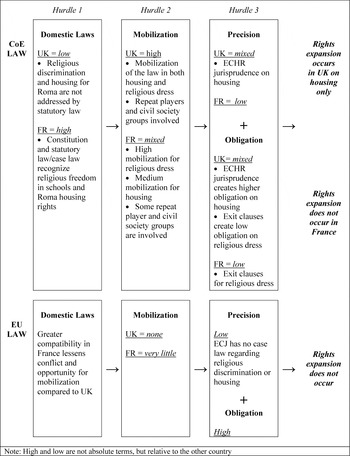
Figure 2 below summarises the empirical findings. The few instances of rights expansion occurred as a result of CoE law in British litigation on Roma housing rights. The cases where rights guarantees were expanded occurred only after three hurdles were surpassed. First, the domestic laws had to be significantly incompatible for political opportunity to be created by the European law. In the UK, the repeal of the Caravan Sites Act 1968 put British law at odds with the CoE and EU law. This enabled opportunity to contest the conflicting laws, which was taken up through active legal mobilisation that garnered the support of civil society groups and lawyers who had repeated experience with the specific legal issues. Rights expansion resulted from this litigation because the legal precision and obligation was such that it limited British judges' discretion to maintain the domestic laws. These three hurdles, however, were not surpassed in France or litigation regarding religious symbols in schools in the UK. The third hurdle, or the Article 9 exit clause, hindered significantly French and British litigation regarding religious dress in schools. Moreover, EU law had no effect, especially because of insufficient mobilisation. In all, this litigation reveals that these obstacles shape and restrain rights expansion that we might otherwise expect to result from multilateral legal institutions.
The path to rights expansion for Roma persons and persons of Religious minorities

While these conditions work in a sequence, they can be interactive. For example, a lack of precision or obligation can affect whether groups will mobilise the law. This occurred with regards to EU law. The absence of mobilisation of the EU's law is not a simple oversight by bad lawyers. Rather, even though the RED exists as codified law, the relevant provisions have not yet been adjudicated by the ECJ. Without an ECJ decision which effectively develops the RED to clarify its applicability to disputes regarding religious discrimination and housing, the potential for rights expansion is limited. The ECJ's interpretation of EU law has an impact on future legal opportunities. Thus, where the law has not been developed by supranational adjudication, the potential for the law to be mobilised is significantly restricted. Similarly, precision may affect compatibility of laws as imprecision may lead more laws to be compatible.
Beyond litigation and ‘old Europe’?
The analysis here shows that these conditions apply to litigation in two states embedded within the two cases of the EU and CoE. Two important questions about the argument's generalisability, however, remain. First, my analysis has focused on litigation, which is only one possible pathway by which rights expansion may occur as a result of a state's participation in a multilateral legal institution. So, are these conditions generalisable to other pathways, such as legislative processes? While this question is beyond the scope of this article, it is likely that similar conditions shape other pathways within domestic politics. First, as I have argued, compatibility is theoretically significant because it contributes to political opportunities, which is likely to be similarly relevant to other political processes. Second, mobilisation is also likely to be an important condition beyond litigation because it puts pressure on political institution and actors to alter law and policy. Third, the nature of obligation and precision of international law is likely to apply to other political processes as well because these conditions will shape the discretion of decision-makers and their incentive structures (as with judges). In general, we also know that international legal obligations affects the behaviour of policymakers (and not only judges), such as legislators.Footnote 76 Thus, while this article examines one pathway to rights expansion, it is probable that the same conditions shape rights expansion through other pathways. This however deserves further exploration elsewhere.
A second question relating to generalisability concerns applicability beyond ‘old Europe’. That is, how might these conditions apply to central and eastern Europe? Drawing upon recent literature on post-accession compliance in central and eastern Europe, I offer a possible interpretation of the generalisability of these conditions to ‘new Europe’. In general, these conditions are likely to also apply to central and east European states. First, scholars have shown that despite predictions to the contrary the new EU member states' post-accession compliance with EU law, including protections from discrimination, resembles that of the EU-15. For example, scholars have shown that post-accession new EU member states fare as well as, and at times better than, older EU member states in terms of transposition and infringements.Footnote 77 Second, while formal compliance in new EU member states is high, some of the new EU member states struggle with the application and implementation of EU law, which has also been observed in some of the older EU member states. For example, Falkner and Treib find that the Czech Republic, Hungary, Slovakia, and Slovenia fall within the same ‘world of compliance’ as Italy and Ireland.Footnote 78
Most striking is that the existing scholarship on the new EU member states illustrates that post-accession challenges to the applications and implementation of European legal protections on equality are conditioned by weak civil society and/or a lack of litigation.Footnote 79 This draws a clear parallel to the conditions developed in this article. That said, other conditions have been proposed in regards to post-accession compliance. Specific to individual rights protections, some of this literature finds that the political orientation of the government and veto players may also be an important condition for rights expansion.Footnote 80 These conditions however are likely to be more central to expansion through a legislative pathway than litigation. Thus, the conditions that I have identified seem to apply equally to whether European legal institutions will garner improved rights protections within central and eastern Europe.
Similarly, critics may suggest that multilateralism is likely to have a greater impact on rights expansion in weaker democracies. Similar to central and eastern Europe, the conditions specified here suggest that rights expansion is not more likely in weaker democracies. First, mobilisation is less likely to occur in weaker democracies because civil society tends to be weaker in terms of organisational strength, legal expertise, and resources. Second, the third condition – the precision and obligation of international law is not dependent on the regime type of the state. In addition, literature has shown that the factors which are most critical to democratic transitions are internal to the state and less so multilateral institutions.Footnote 81 The literature on central and eastern Europe, however, raises the possibility that another condition applies to new democracies. That is, state capacity, such as a lack of administrative or legal capacity and independence, can hinder the meaningful implementation of rights.Footnote 82 State capacity, however, may not be a separate condition. Rather, it may act as an intervening variable on civil society mobilisation. For example, if the legal system is weak, potential litigants may perceive litigation to be especially burdensome or an empty hope. This may either hinder mobilisation entirely or redirect it towards other avenues, such as lobbying or protest. Thus, it is possible that the lack of state capacity will significantly affect the degree and orientation of social mobilisation. Regardless, together with the conditions I have presented in this article, it is unlikely that rights expansion will be more prominent in weaker democracies than in France and the UK.Footnote 83 Moreover, as I have shown, rights expansion that is driven by multilateralism is not only determined by domestic level factors, but also the nature of the multilateral law itself.
Conclusion
The intention of this article has been to highlight the conditions which shape and inform multilateralism's effects on the expansion of rights. The purpose has not been to test the ‘democracy-enhancing multilaterialism’ thesis, but to further specify the conditions under which a state's institutions will protect individual rights as a result of its participation in international legal institutions. I have argued that the possibilities of state's participation in multilateral institutions to transform rights protections at the domestic level are limited by a series of conditions. More specifically, multilateral legal institutions' affect on the domestic expansion of individual rights is restrained by the compatibility of domestic laws with international law, insufficient mobilisation, and international law that lacks precision and obligation.
Rights are a key value of democracy and a constitutional mechanism by which government authority is restrained. When multilateralism motivates the expansion of rights within the domestic-setting, it can be said to have implications for democracy. Yet, this analysis has shown that rights expansion occurs to a limited degree. Minimal rights expansion for persons of religious minorities and Roma persons derived from the UK's and France's membership in the CoE and EU. Compatible laws, insufficient mobilisation, legal imprecision, and a lack of obligation resulted in CoE and EU non-discrimination laws' failures to produce rights expansion in France. Where rights expansion did occur through British litigation on Roma housing rights, UK law did not provided for statutory recognition of Roma persons rights to housing. The incompatible laws enabled political opportunity, giving way to legal mobilisation. Last, the ECHR's jurisprudence was sufficiently precise and placed stricter obligation on the UK, such that British judges were left to apply the CoE law.
This article additionally raises the question of whether these conditions are exhaustive. Literature suggests two main mechanisms by which human rights practices of a state may be influenced by membership in multilateral institutions – coercion and persuasion.Footnote 84 Rather than thinking of coercion and persuasion as alternatives to the conditions presented here, I would suggest that in fact my conditions incorporate elements from both of these alternatives. Reminding the reader of the central aim, my argument is restricted to conditions that affect rights expansion of: (1) member states – as opposed to non-member states or candidate states; and (2) change from within the state – as opposed to simple coercion (which in some terms undermines the democratic process by imposing external rules, rather than allowing the domestic political processes to arrive at these rules). To the extent that coercion matters as a condition shaping the domestic expansion of rights, the degree of legal obligation and precision can alter the incentive structure of decision-makers, much like coercion. The second alternative condition, or persuasion, can also be identified within my conditions. Namely, the role of mobilisation is shaped by a process of socialisation and persuasion, whereby individual litigants come to understand that international law provides them with rights that ought to be recognised by their own state.
The unique contribution presented here is a set of conditions that are catered to understanding how multilateral legal institutions affect domestic legal institutions. These conditions build on collective knowledge of what factors influence legal change and processes and legalisation in world politics. As I have argued above, however, these conditions incorporate a broader range of factors that shape when and where rights expansion will occur. In addition, I have speculated about how rights expansion may occur through domestic processes other than litigation.
Overall, this study suggests some caution in thinking that multilateralism will enhance rights protection at the national level because the conditions identified here often hinder, rather than promote, rights expansion. To the extent that rights are a key democratic value and a constitutional mechanism by which democracy is sustained, democracy-enhancement is likely to be minimally produced by multilateral legal institutions and via individual rights. This, however, should not be interpreted to mean that multilateralism will not ever enhance democracy within member states. Rather, the process by which rights expand, having implications for democracy, is one that is riddled with challenge and uncertainty. As Keohane, Macedo, and Moravcsik maintain, more work must be done to understand the conditions under which multilateral institutions change domestic political processes and democracy within the state. This article suggests there is ample room to explore these conditions, especially where I have been unable to do so.