Introduction
The plum curculio (PC) Conotrachelus nenuphar Herbst (Coleoptera: Curculionidae) is a major pest of pome and stone fruits in North America, capable of damaging 90% of fruit at harvest (Vincent and Roy Reference Vincent and Roy1992). There are two strains of this insect, a univoltine northern one and a multivoltine southern one (Racette et al. Reference Racette, Chouinard, Vincent and Hill1992), which are reproductively incompatible (Padula and Smith Reference Padula and Smith1971; Zhang and Pfeiffer Reference Zhang and Pfeiffer2008; Zhang et al. Reference Zhang, Luckhart, Tu and Pfeiffer2010).
To locate fruit and mates for feeding and reproductive purposes PC use olfactory cues (Butkewich et al. Reference Butkewich, Prokopy and Green1987; Butkewich and Prokopy Reference Butkewich and Prokopy1993; Eller and Bartelt Reference Eller and Bartelt1996; Leskey et al. Reference Leskey, Zhang and Herzog2005). The odour of live PC males has been shown to be attractive to both sexes of conspecifics and attributed to an aggregation pheromone (1R,2S)-1-methyl-2-(1-methylethenyl)-cyclobutaneacetic acid, emitted by virgin males of the species, also known as grandisoic acid (GA) (Eller and Bartelt Reference Eller and Bartelt1996). The emission of a male-produced aggregation pheromone by PC has also been described in other weevil species, notably the boll weevil (Anthonomus grandis Boheman; Coleoptera: Curculionidae) (Tumlinson et al. Reference Tumlinson, Hardee, Gueldner, Thompson, Hedin and Minyard1969), the pepper weevil (Anthonomus eugenii Cano; Coleoptera: Curculionidae) (Eller et al. Reference Eller, Bartelt, Shasha, Schuster, Riley and Stansly1994), and the strawberry blossom weevil (Anthonomus rubi Herbst; Coleoptera: Curculionidae) (Innocenzi et al. Reference Innocenzi, Hall and Cross2001), which produce multiple component aggregation pheromones. Although only one component (the positive enantiomer of GA) has been found thus far (Eller and Bartelt Reference Eller and Bartelt1996), it is likely that such a close species also produces a blend of compounds.
While advancements in the control of PC have been made (Piñero et al. Reference Piñero, Agnello, Tuttle, Leskey, Faubert and Koehler2011) the use of pheromones in monitoring PC still requires improvement. Analysis of behavioural and physiological factors influencing pheromone production and response has been very useful in developing monitoring and control techniques for other insects (Hardee Reference Hardee1982; Klassen et al. Reference Klassen, Ridgway and Inscoe1982; Jutsum and Gordon Reference Jutsum and Gordon1989; Burkholder Reference Burkholder1990; Ridway and Inscoe Reference Ridway and Inscoe1990; Silverstein Reference Silverstein1990; Neilsen and Jensen Reference Nielsen and Jensen1993; Smart et al. Reference Smart, Blight, Pickett and Pye1994). Production of GA may be important throughout the lifetime of male PC; in laboratory studies they continue to mate until they die (Johnson and Hays Reference Johnson and Hays1969). Since many factors regarding the aggregation pheromone produced by PC remain unknown, it is important to characterise the behaviour of this insect regarding its naturally produced pheromone component(s) in order to develop better biological pest management strategies for this insect. Many things can affect the response to, and release of, pheromones, as is seen in many other weevil species. For example, sex has been shown to affect the banana weevil (Cosmopolites sordidus (Germar)) (De Graaf et al. Reference De Graaf, Govender, Schoeman and Viljoen2005), where more females were attracted to pheromones than males. Amount of pheromone produced is a factor in the response of the cigarette beetle (Lasiderma serricorne (Fabricius); Coleoptera: Anobiidae) (Kuwahara et al. Reference Kuwahara, Fukami, Ishii, Matsumura and Burkholder1975) and the boll weevil (Hardee et al. Reference Hardee, McKibben, Rummel, Huddleston and Coppedge1974), with males responding to specific quantities. Age also influences the response of the boll weevil (Spurgeon Reference Spurgeon2003) with pheromones being produced in larger quantities in younger insects; and mated status affects the rice weevil (Sitophilus oryzae (Linnaeus); Coleoptera: Curculionidae) (Phillips and Burkholder Reference Phillips and Burkholder1981), with mated males being less attractive than virgin males. Advancements in pest management strategies through the analysis of pheromone components and by measuring behaviour and attraction to aggregation pheromones have been used against other weevils with success, with the boll weevil being a prime example (Tumlinson et al. Reference Tumlinson, Hardee, Gueldner, Thompson, Hedin and Minyard1969; Dickerson et al. Reference Dickerson, Ridgeway and Planer1987; Spurgeon Reference Spurgeon2003). If complete analysis of the PC aggregation pheromone can be achieved, similar advancements would be possible for the control of this pest as well.
The goal of this study was to characterise the olfactory response of PC to the natural odours produced by the males (Eller and Bartelt Reference Eller and Bartelt1996). In addition, we also determined the conditions resulting in optimum pheromone production as well as evaluated electroantennogram (EAG) responses to pheromone stimuli and related compounds. To this end bioassays as well as head-space collections and EAGs were conducted. Bioassays consisted of a vertical dual-choice still-air olfactometer where responses to conspecific odours were tested using PC in different physiological states. Experiments were designed to determine: (1) the quantity of males needed to elicit a maximum attractive response from females, (2) the age of males that was the most attractive to females, (3) the effect of responder mating status, and (4) the effect of strain. Head-space collections were aimed at identifying (5) abiotic and biotic conditions resulting in consistent GA production; EAGs were conducted in order to determine (6) if PCs responded electrophysiologically to GA as well as to GrandLure components.
Plum curculios have been shown to prefer the odour of five males over one male (Leskey and Prokopy Reference Leskey and Prokopy2001). We therefore expected female attraction to live males to be greatest between two and eight mature males (Leskey and Prokopy Reference Leskey and Prokopy2001). We also predicted that virgin and mated females would exhibit a similar attraction to males, based on what was found in other olfactometer trials with PC (Akotsen-Mensah Reference Akotsen-Mensah2010). Sexually mature males are capable of mating with females with most matings occuring between 16–20 days (Johnson and Hays Reference Johnson and Hays1969); PC have been observed to take an average of 13 days to mature (Smith Reference Smith1957; Smith and Salkeld Reference Smith and Salkeld1964). Based on the reproductive behaviour of this insect, it is likely that mature males will be more attractive to females than immature or old males. High humidity and temperatures in the presence of suitable fruit should also elicit a good pheromone production based on the natural behaviour of the insect, which exhibits a greater activity under these conditions (Garman and Zappe Reference Garman and Zappe1929; Smith and Flessel Reference Smith and Flessel1968; Butkewich and Prokopy Reference Butkewich and Prokopy1993; Chouinard et al. Reference Chouinard, Hill and Vincent1993, Reference Chouinard, Hill and Vincent1994). It is likely that PCs respond to low doses of GA (Leskey and Prokopy Reference Leskey and Prokopy2001), since high doses do not result in an increased attraction (Prokopy et al. Reference Prokopy, Jacome, Gray, Trujillo, Ricci and Piñero2004). Plum curculios should also respond more strongly to mixtures that contain greater amounts of the positive enantiomer, since this is what is produced naturally (Eller and Bartelt Reference Eller and Bartelt1996). Both strains were studied, since they both attack pome and stone fruits (Quaintance and Jenne Reference Quaintance and Jenne1912) and produce the aggregation pheromone (Eller and Bartelt Reference Eller and Bartelt1996), with the main differences between them being their geographical distribution (Quaintance and Jenne Reference Quaintance and Jenne1912), their diapause (obligate versus facultative) (Bobb Reference Bobb1952), and their reproductive incompatibility (Zhang and Pfeiffer Reference Zhang and Pfeiffer2008; Zhang et al. Reference Zhang, Luckhart, Tu and Pfeiffer2010). In order to avoid fruitless interstrain mating, the two strains may respond differently to odours of conspecifics and pheromones in regards to quantity or ratio, but we expect that both strains will respond to the same type of odours (i.e., both strains will be able to detect GA and respond to conspecifics).
Materials and methods
Bioassays
Plum curculio
PC from both strains were used. Univoltine PC were obtained and maintained as described by Hock et al. (Reference Hock, Chouinard, Lucas and Cormier2013). Insects were obtained from infested apples (Malus Miller species (Rosaceae)) collected in late June early July 2009 from unsprayed orchards and kept in emergence cages, with emerging adults collected daily and immediately separated by sex (Thompson Reference Thompson1932), transferred to overwintering cages (Le Blanc Reference Le Blanc1992), and then placed under natural conditions throughout winter. Overwintered adults were removed from the cages the following spring and placed in 2-L plastic containers with small apples and water (wetted cotton dental wick). The containers were placed in environmental control chambers at 25±2 °C, 70% relative humidity, and 16:8 hour light:dark photoperiod to mimic optimal summer conditions (Amis and Snow Reference Amis and Snow1985). A laboratory population using some of the wild individuals collected in 2009 was also established as described in Hock et al. (Reference Hock, Chouinard, Lucas and Cormier2013) using the procedure of Hoffmann et al. (Reference Hoffman, Vanderjagt and Whalon2007).
Trials with multivoltine curculios were taken from a laboratory population established at the Appalachian Fruit Research Station (Kearneysville, West Virginia, United States of America) in 2001 and augmented annually with wild individuals, as per Leskey et al. (Reference Leskey, Hancock and Wright2010). Adults were reared in the laboratory at 25±2 °C, 14:10 hour light:dark photoperiod on a diet of green thinning apples and water based on the methods of Amis and Snow (Reference Amis and Snow1985). Newly emerged adults were held in mixed-sex groups of 100 individuals, and were allowed to mate and lay eggs in thinning apples. Larvae emerging from apples were placed in 500 mL jars containing soil and shipped to the Institut de recherche et de développement en agroenvironnement (IRDA; St-Hyacinthe, Québec, Canada). Jars containing the multivoltine pupae were placed in environmental control chambers at 25±2 °C, 70% relative humidity (16:8 hour light:dark photoperiod). Emerging adults were collected daily, separated by sex and held under the same conditions as the univoltine strain.
All female PCs used as “test PC” in experiments were sexually mature, as were all male PCs used as odour sources with the exception of experiment 2. In experiment 2 immature males (less than two weeks old), mature males (two to three weeks old), and old males (three to four weeks old) were tested as odour sources.
All females tested were virgin except for experiment 3 (virgin versus mated females), where females from the “mated” modality were held with males for two weeks before experiments to allow for mating (Leskey et al. Reference Leskey, Hancock and Wright2010). All females from the “mated versus virgin” experiment were dissected at the end of the experiment to verify their physiological status. In order to verify maturity and sexual status, half of the females tested were randomly selected and placed in 70% ethanol and held at 4 °C (Hoffmann et al. Reference Hoffman, Combs and Whalon2004) until dissected. Dissections were done as per Hoffmann et al. (Reference Hoffman, Combs and Whalon2004), which involved examining the state of oocytes and the spermatheca. Although there was very little chance of females from the virgin modality being mated, a sample of these females was dissected to validate results.
Olfactometer
The olfactometer is described in Hock et al. (Reference Hock, Chouinard, Lucas and Cormier2013) and consisted of a large (inner Ø=105 mm, 50 mm in height) round Pyrex® glass container (Corning Inc., Corning, New York, United States of America). Two lateral openings on the apex (inner Ø=24 mm, 60 mm height) were the connectors (left and right) for the odour jars while a central apical opening (inner Ø=24 mm, 60 mm height) was the site where PCs were introduced into the arena. Each 500 mL Mason™ “odour jar” (Bernardin Ltd., Richmond Hill, Ontario, Canada) contained either male PCs (test odour) or air only (control odour) (Tinzaara et al. Reference Tinzaara, Gold, Dicke, Huis and Ragama2007). Standard nylon mosquito screening was used to cover the lateral two openings of the olfactometer as well as the Mason jars in order to prevent females from escaping and reaching the odour source. Parafilm®M (Sigma-Aldrich Canada Ltd., Oakville, Ontario, Canada) was used to secure the inverted Mason jars to the olfactometer.
Experimental conditions
Tests were conducted as described in Hock et al. (Reference Hock, Chouinard, Lucas and Cormier2013) in an observation room held at 25±2 °C and 70% relative humidity (Smith and Flessel Reference Smith and Flessel1968; Racette et al. Reference Racette, Chouinard, Hill and Vincent1991; Chouinard et al. Reference Chouinard, Hill and Vincent1993). A red filter (LEE Filter, red primary no. 106®, Son-Art Production, Saint-Hyacinthe, Québec, Canada) was used to cover a neon light (40 W); the sole source of light during experiments since PC are not perturbed by red light (Prokopy et al. Reference Prokopy, Cooley and Phelan1995). At the beginning of each trial one female was introduced into the olfactometer and left for 30 minutes, after which its position was noted and the female removed; only insects found within a radius of 10 mm or within the tubes leading to the odour jars (e.g., test or control odour zones) were used for statistical analysis; other positions were considered as no choice having been made and were disregarded (average of 25%) (Altuzar et al. Reference Altuzar, Malo, Gonzalez-Hernandez and Rojas2007; Tinzaara et al. Reference Tinzaara, Gold, Dicke, Huis and Ragama2007; Akotsen-Mensah Reference Akotsen-Mensah2010). Each female was considered one replicate, and odour zones were randomised after each replicate. The average number of replicates was 17, however occasionally replicate number was higher. Also, because there were occasional deaths of PCs during rearing within the selected age groups, and because not all PCs responded during trials, there were times when replicate number was lower. Odours tested were virgin males of different ages and of different quantities.
Statistical analysis
SPSS statistical software (SPSS Inc., 2006, Chicago, Illinois, United States of America) was used to analyse all data. Comparisons between choices (test versus control) of the number of PC were analysed using a two-tailed χ 2 test (P<0.05), as were the responses between experimental modalities examined (e.g., female response to test odours of immature males versus mature males versus old males); a Yates continuity correction was applied when necessary (Siegel and Castellan Reference Siegel and Castellan1988). Comparisons between experiments (e.g., responses of univoltine mated females versus multivoltine mated females to test odours) or between strains were done using a Mann–Whitney U test (P<0.05).
Head-space collections
Head-space collections were done using multivoltine PC, since the tests were conducted at the United States Department of Agriculture-Agricultural Research Service (Kearneysville) during the winter months of January–March, when no wild univoltine PCs were available due to diapause. Also, shipping laboratory-reared PCs over long distances, particularly during the winter, usually results in loss of large numbers of PCs by the time of arrival at the destination (personal observations).
Male PCs
For the constant versus random flow rate experiment, four-day-old virgin multivoltine males were used and collections were done every four days for a duration of 36 days. For all other experiments, male PCs were 15 days old and collections were collected daily for five days. There were three replicate jars (with eight males each) for each modality.
Head-space collection procedure
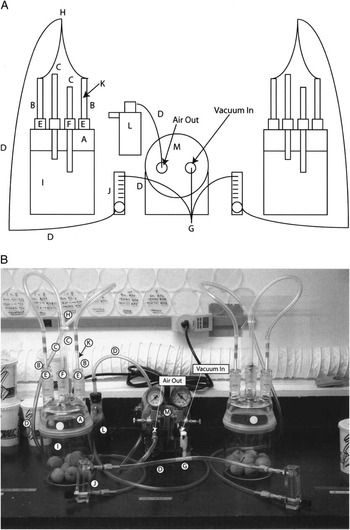
Head-space volatiles were collected from eight multivoltine virgin males introduced into six 1-L, four-necked glass containers (Fig. 1A, B) and provided with eight green thinning apples, except in the “Plum” experiment were either eight Stanley plums or nothing was given (control). Air was drawn into the container through 6–14 mesh activated charcoal (Fisher Scientific, Pittsburgh, Pennsylvania, United States of America), and out of the container through a trap (outer Ø 150×15 mm) containing Super Q (0.200 g each; Alltech Associates Inc., Deerfield, Illinois, United States of America) by vacuum (~1 L/minute per collection tube×two tubes per container). Volatiles were aerated continuously for 24 hours at 25±2 °C and 14:10 hour light:dark photoperiod. Volatile collections from each of the two sample tubes per container were eluted daily with 2 mL methylene chloride and immediately stored in a freezer at −30 °C. Each sample tube was subsequently rinsed with an additional 4 mL of methylene chloride.
Dual source (laboratory) head-space collection apparatus. (A) Schematic, (B) actual setup.

Samples were analysed using gas chromatography-mass spectrometry (GC-MS). Electronic impact (EI) GC-MS was conducted on a HP 6890 GC coupled to a HP 5973 Mass Selective Detector using an DB-WAXETR capillary column (60 000×0.25 mm ID, 0.25 mm film-thickness, J&W Scientific Inc., Folsom, California, United States of America). Oven temperature was set at 50 °C for 2 minutes, then programmed to 230 °C at 15 °C/minutes and held for 15 minutes. A 70 eV electron beam was employed for sample ionisation and helium was used as carrier gas.
Experimental parameters
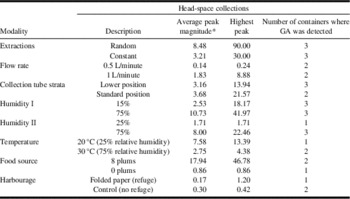
Conditions associated with three of the six collection jars were manipulated while the other three collection jars were held under standard (control) conditions. Controls included eight virgin male PCs with eight apples and water (wetted cotton wicks) held at 25±2 °C at 75% relative humidity, no harbourage, standard position for collection tubes, and continuous collections at the normal flow rate of 1 L/minute (for each tube). Experimental conditions evaluated included: random versus constant airflow, flow rate (0.5 L/minutes versus 1 L/minute), collection tube strata/position (low versus standard), humidity (15% versus 75%, and 25% versus 75%), temperature/humidity combination (20 °C at 25% relative humidity versus 30 °C at 75% relative humidity), and harbourage inclusion (folded paper versus no folded paper) (Table 1). All of the above were tested in order to determine if altering these factors improved pheromone production. For example, it has been shown that PCs increase activity, movement, and oviposition at higher levels of relative humidity (Hoyt et al. Reference Hoyt, Leeper, Brown and Croft1983; Le Blanc et al. Reference Le Blanc, Hill and Paradis1984; Racette et al. Reference Racette, Chouinard, Hill and Vincent1991; Chouinard et al. Reference Chouinard, Hill and Vincent1993, Reference Chouinard, Hill and Vincent1994; Prokopy and Wright Reference Prokopy and Wright1998; Dixon et al. Reference Dixon, Prokopy and Schultz1999; Prokopy et al. Reference Prokopy, Wirth and Leskey1999) and warmer temperatures. Low temperatures (⩽6 °C) arrest development (Sarai Reference Sarai1969; Piñero and Prokopy Reference Piñero and Prokopy2004), and temperatures between 15 °C and 19 °C tend to immobilise or reduce PC movement, while temperatures between 20 °C and 30 °C result in increased PC activity and flight (Chouinard et al. Reference Chouinard, Hill and Vincent1993, Reference Chouinard, Hill and Vincent1994; Prokopy and Wright Reference Prokopy and Wright1998; Dixon et al. Reference Dixon, Prokopy and Schultz1999; Prokopy et al. Reference Prokopy, Wirth and Leskey1999; Leskey and Prokopy Reference Leskey and Prokopy2002). It is possible that an increase in activity may be related to an increase in pheromone production in males.
Average GA peak in each modality from each collection, as well as the highest magnitude GA peak detected for each modality.

Note: *Taken only from those containers where GA was found to be produced (maximum of three containers per modality).
Statistical analysis
SPSS statistical software was used to analyse all data. Each trial/modality was analysed by performing a Wald’s statistic logistic regression (P<0.05) to determine if any of the manipulations influenced pheromone production.
Electroantennogram trials
Electroantennograms trials were conducted at the United States Department of Agriculture-Agricultural Research Service (Kearneysville, West Virginia, United States of America) since the equipment for conducting EAG trials of PC was only available there. EAG studies were conducted at the same time as head-space trials, therefore only multivoltine PC were used for the same reasons as previously listed for head-space trials.
Female PCs
Multivoltine PCs used in EAG trials were treated as described above (bioassays) (Leskey et al. Reference Leskey, Hancock and Wright2010). Test subjects were fed, sexually mature females aged 14–21 days, since sexually mature females are considered to be the most damaging portion of the population and give statistically higher EAG responses compared to males (Leskey et al. Reference Leskey, Wright, Anger, Chouinard, Cormier and Pichette2009, Reference Leskey, Hancock and Wright2010). There were four replicates per female, with seven females in the high dose modality, and six females for the low dose modality and also for the trials comparing GA.
Odour sources
Odour sources included the synthetic volatile trans-2-hexenal (T2H) and volatiles collected from “Stanley” plum (at 21 mm fruit) found previously to be highly stimulating (Leskey et al. Reference Leskey, Wright, Anger, Chouinard, Cormier and Pichette2009, Reference Leskey, Hancock and Wright2010), both of which were used as standards. The “Stanley” plum standard was produced according to the methods described in Leskey et al. (Reference Leskey, Hancock and Wright2010). Other synthetic volatiles used were the positive enantiomer of grandisoic acid (+GA) and the racemic mixture of grandisoic acid (RGA), all coupled with a dichloromethane (DCM) solvent control. The RGA contains equal amounts of the positive and negative enantiomers (50:50), while +GA contains 71% +GA. The +GA was made from RGA, which was obtained from grandisol through oxidation performed at University of Quebec at Chicoutimi, Québec, Canada.
Procedure for oxidation of racemic grandisol
Grandisoic acid was prepared by sequential oxidation of grandisol, the active ingredient of commercial GrandLure (Bedoukian Research, Danbury, Connecticut, United States of America). N-methylmorpholine (NMO, 3.40 g, 29.0 mmol) was added to a dried solution of 2.24 g of grandisol (14.5 mmol) in methylene chloride (CH2Cl2, 25 mL). The mixture was chilled with ice water, after which the catalytic amount of tetrapropylammonium perruthenate (TPAP, 0.255 g, 0.726 mmol) was added to a dried solution of grandisol (CH2Cl2). The mixture was stirred for 1 hour at room temperature or until the reaction was complete, as shown by using thin-layer chromatography. The solution was evaporated under reduced pressure to give a black oily residue.
The second oxidation step was conducted by dissolving crude grandisal in a mixture of t-butanol (30 mL), water (5 mL), and 2-methyl-2-butene (31 mL). The mixture was chilled to 0 °C. An aqueous solution (20 mL) containing sodium chlorite (2.36 g, 26.1 mmol) and monosodium phosphate (3.80 g, 27.6 mmol) was added drop-wise over a period of 10 minutes. The mixture was vigorously agitated for a period of 30 minutes. Work-up was performed by evaporating the solvent and adding 50 mL of NaOH2 N. The mixture was washed with CH2Cl2 (4×50 mL). The aqueous phase was acidified with aq. HCl 10% to pH 4. The product was extracted with CH2Cl (5×50 mL) and dried with MgSO4. Evaporation afforded 1.90 g of RGA (78.0% yield).
Enantiomeric purification
Enantiomeric purification was performed by co-crystallisation of GA; 1 g of GA was dissolved in hot ethanol-water mixture (50:50) and 0.965 g of quinine was added. The solution was allowed to chill in a cold room (−18 °C) for 24 hours. The crystals obtained were filtered and re-crystallised three other times in a hot ethanol-water mixture (50:50). The mother liquors were combined each time. After four re-crystallisation steps, the solid was dissolved in CH2Cl2 and the negative enantiomer of GA was extracted with NaHCO3. The aqueous layer was washed with CH2Cl2 and neutralised with aq. HCl 10%, which precipitates GA. The latter was extracted with CH2Cl2, dried with MgSO4 and evaporated under reduced pressure. The mixture was acidified with aq. HCl 10% and GA was extracted with CH2Cl2. The organic phase was washed with aq. HCl 10%, dried with MgSO4 and evaporated under reduced pressure.
Three different lures containing grandisol (from which GA is made) were also tested and obtained from ChemTica (San Jose, Costa Rica). These lures were: GrandLure I (cis)-1-methyl-2-(1-methylethenyl)cyclobutaneethanol, GrandLure II (Z)-2-(3,3-dimethylcyclohexylidene) ethanol and GrandLure III/IV (Z/E)-(3,3-dimethylcyclohexylidene)acetaldehyde. All synthetic volatiles were evaluated at two concentrations: 0.010 and 0.001 g/mL diluted in DCM.
Electroantennogram setup
Electroantennogram experiments were conducted as in Leskey et al. (Reference Leskey, Wright, Anger, Chouinard, Cormier and Pichette2009, Reference Leskey, Hancock and Wright2010). Subject females were immobilised in a custom polycarbonate insect holder. The indifferent electrode was filled with a diluted reference electrode solution (diluted from 4.0 M KCl-saturated AgCl to 0.4 M). The electrode was then inserted through a port in the top of the insect holder through the exposed membrane attached to the ventral cervical sclerite between the thorax and the head. The recording electrode was similarly filled with electrode solution and inserted through a port at the rear of the holder into the mid-point (between antennomeres two and three) of the immobilised four-antennomere club. This region of the antenna has the highest concentration of potential olfactory receptors (Alm and Hall Reference Alm and Hall1986). The insect holder was then nested into a secondary polycarbonate slide-frame (10 mm width×6.0 mm height×110 mm length) to permit insertion of polished tungsten electrodes (Ø=0.2×140 mm length) into the filled glass electrodes.
Baseline output signal from antennae of PC was allowed to stabilise for 10 minutes. PC exhibiting output baseline variation (noise) greater than ±25 mV were not tested (10% of those mounted). After baseline stabilisation, the insect holder was inserted into a cylindrical port (Ø=16 mm) at the terminus of a moving air stream, and clean air was passed across the recorded antenna at 1 L/minute. A stimulus cartridge was prepared for each odour stimulus. In brief, 0.05 mL solution from the 8 mL parent extract was dispensed onto a filter paper strip (Whatman Grade three filter paper, 75×6 mm, Whatman Inc., Piscataway, New Jersey, United States of America). After evaporation, the strip was loaded into a glass Pasteur pipette and mounted on a 10 mL syringe. A rotation of 2 mL puffs of each tested stimulus was injected by hand into the clean air stream through an orifice 150 mm upwind from the antenna at a 30 second interval. Four replicates were performed per insect, yielding a 12 minute total trial time for each responder. A total of seven females were evaluated for responses to each of the high doses of stimuli while six females were evaluated for responses to the low dose and GA trials, respectively.
Input signals were amplified and received by a USB-1608FS data acquisition unit (Measurement Computing Corporation, Norton, Massachusetts, United States of America). Signals were passed to a computer-based analytical program (DasyLab 9.0; Dasytec USA, Amherst, New Hampshire, United States of America) for interpretation and recording of output. Output samples were taken and recorded at a rate of 31 samples per second.
Statistical analysis
SPSS statistical software was used to analyse all data. The EAG response data from each individual were analysed using the GLM procedure for mixed models to construct analysis of variance tables for mean amplitude of response (mV) among all individuals evaluated. The EAG sensitivity model evaluated the effect of odour stimulus with replicate used as a blocking factor. When the GLM indicated significant differences between multiple odours, multiple comparisons were calculated using Tukey’s honestly significant difference (P<0.05).
Results
Bioassays
Response of virgin females to different numbers of males
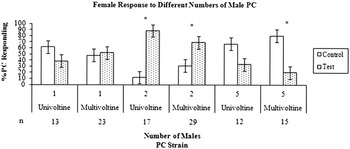
For (virgin) univoltine PC and multivoltine PC, significantly more females responded to males compared with the control only for the two male modality (univoltine: χ 2 =9.941, df=1, P=0.002; multivoltine: χ 2 =4.172, df=1, P=0.041) (Fig. 2). Results for the response of (virgin) females to one male (univoltine: χ 2 =0.692, df=1, P=0.405; multivoltine: χ 2 =0.043, df=1, P=0.835), and five males (univoltine: χ 2 =1.333, df=1, P=0.248) versus the control revealed no significant attractive response. There was however a significant repulsion for multivoltine females towards the five male modality (χ 2 =5.400, df=1, P=0.020).
Female response to the odour of different numbers of males for both univoltine and multivoltine PC. Error bars=±SE, n=number or replicates, *=significant differences between test and control odours using χ 2 test (P<0.05).

Response of females to different ages of males
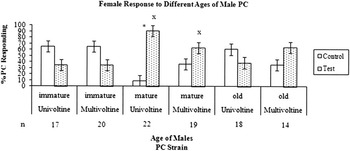
Since two males produced the most attractive odour for both strains of PC, this was the quantity used as an odour source for the remaining experiments. Experiments with male emitters of different ages revealed that for univoltine PC, only mature males were significantly attractive (χ 2 =14.727, df=1, P<0.001) versus the control (Fig. 3). For multivoltine PC, there was no significant difference for any of the modalities (Fig. 2) when compared with the controls (immature males: χ 2 =1.800, df=1, P=0.180; mature males: χ 2 =1.316, df=1, P=0.251, old males: χ 2 =1.143, df=1, P=0.285) (Fig. 3). The response of females to mature males differed significantly between strains (Z=−2.151, P=0.031) with univoltine females being more responsive than multivoltine females.
Female response to the odour of different ages of males for both univoltine and multivoltine. Error bars=±SE, n=number or replicates, *=significant differences between test and control odours using χ 2 test (P<0.05), x=significant differences between strains using Mann–Whitney U test (P<0.05).

Mated versus virgin female response to two males
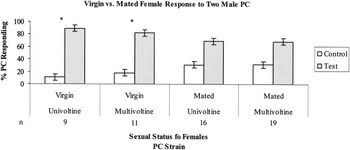
Only virgin females of both strains were significantly attracted to two males (univoltine: χ 2 =4.000 df=1, P=0.045; multivoltine: χ 2 =4.455, df=1, P=0.035) (Fig. 4).
Virgin and mated female response to the odour of two males for both univoltine and multivoltine PC. Error bars=±SE, n=number or replicates, *=significant differences between test and control odours using χ 2 test (P<0.05).

Headspace
Airflow (constant versus random)
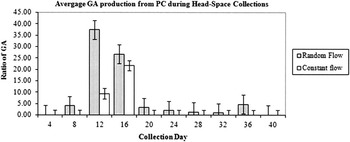
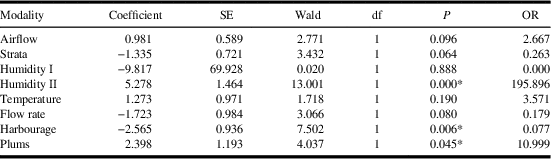
For random flow jars, by the eighth day small amounts of GA were detected, before this date no GA was observed (Fig. 5). By day 12–16 the amount of GA detected had increased. From days 20–32 the amount of GA was decreasing, though there was a slight increase in GA again on day 36. Nothing was detected by day 40. Regarding the constant airflow jars, GA was detected on day 12. After day 16 no detectable amounts of GA were observed, however airflow did not significantly affect GA production (Table 2).
Average GA production from eight virgin male multivoltine PC during head-space collections throughout the 40 first days of adult life. Day of collection represents the day on which the collection took place (all males were four days old at day four, eight days old at day eight, etc.). The average ratio of GA produed is given (±SE), and is taken from three replicates per the two modalities (random versus constant airflow).

Summary of Wald’s statistic from logistic regression analysis of influence of modality on GA production in head-space collections (P<0.05).

Notes: *Significant effect of head-space modality according to Wald’s Statistic (P<0.005). OR=odds ratio.
Flow rate
Collections taken from both low (0.5 L/minute) and high (1 L/minute) flow rates showed the presence of GA. The highest GA peak was found in the high flow rate trial (Table 1). However, changes in flow rate did not significantly improve GA production (Table 2).
Strata
Collections taken from both high and low strata (at the standard 1 L/minute flow rate) have shown that GA was present in both strata but that the highest acid peak of GA was collected from the high strata tubes (Table 1). Strata position did not significantly influence GA production (Table 2).
Humidity experiment
Collections taken at high (75%) and low (15%) humidity show that GA was produced at both humidities with all canisters showing GA production, and the highest GA peak being found in the high humidity modality (Table 1). When comparing the 25% humidity to the 75% humidity, the majority of GA was again found from the high humidity jars, while only one low humidity jar was found to produce GA. The highest peak was again from the high humidity modality. Humidity was found to significantly affect GA production in the trial comparing 25–75% relative humidity (Table 2).
Temperature and humidity
Both high temperature/humidity (30 °C+75% relative humidity) and low temperature/humidity (20 °C+25% relative humidity) modalities showed GA production. Though the low temperature had the highest GA peak, the high temperature modalities produced GA more consistently with GA being produced in most of the high temperature jars (Table 1). However, no significant influence of the temperature/humidity combination on GA production was found (Table 2).
Plum cuttings
The majority of GA was produced from jars in the plum modality, including the highest GA peak. In fact, of all the head-space experiments this modality produced the greatest GA peak. The modality with no plums showed some GA production, but this amount was very minute (Table 1). Plums were found to significantly influence the amount of GA produced (Table 2).
Electroantennogram trials
High dose
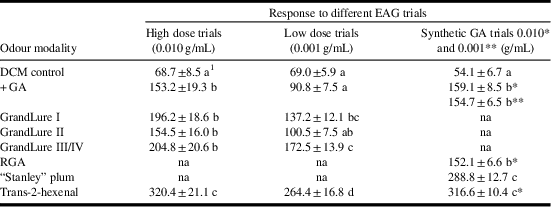
Significant differences were found between solutions when presented at the high (10 mg/mL) dose (F=48.158, df=5, P<0.001). All solutions differed significantly from the DCM control and the T2H standard (P<0.001), with T2H eliciting the greatest response. The responses to solutions with GA (i.e., +GA, GrandLure I, GrandLure II, GrandLure III/IV) did not differ significantly from each other (Table 3).
Mean (±SE) EAG response obtained from adult plum curculios from each synthetic pheromone or GrandLure odour modality, evaluated at two concentrations, and from trans-2-hexanal (0.010 g/mL), “Stanley” plum standard, and DCM control (0.0 g/mL).

Notes: 1Different letters in the same column indicate significant differences according to Tukey’s honestly significant difference (P<0.05). *response to 0.010 g/mL dose; **response to 0.001 g/mL dose.
EAG, electroantennogram; DCM, dichloromethane; GA, grandisoic acid; RGA, racemic mixture of grandisoic acid.
Low dose
When the low dose (0.001 g/mL) was tested, a significant difference was found (F=360.843 df=5, P<0.001). Only GrandLure I and GrandLure III/IV differed significantly from the control (Table 3). GrandLure II lure did not differ significantly from +GA (P=0.566), but differed from GrandLure I (P=0.031) and GrandLure III/IV (P<0.001).
Synthetic GA
When comparing only the synthetic pheromone volatiles (+GA at 0.010 g/mL and 0.001 g/mL, and RGA at 0.010 g/mL) along with T2H (0.010 g/mL) and a “Stanley” plum standard, a significant difference was observed (F=315.381, df=5, P<0.001). All volatiles differed significantly from the control (P<0.001). The GA-containing volatiles did not differ significantly from each other, but they differed significantly from both T2H (P<0.001) and the “Stanley” plum standard (P<0.001), the latter two producing much stronger EAGs (Table 3). In all experiments where they were used, T2H and the “Stanley” plum standard always elicited the highest responses, which were always significantly greater than the control DCM.
Discussion
The objective of this study was to determine which physiological, biotic, and abiotic factors influenced PC response to, and production of, pheromones, as well as responses to conspecifics. Results revealed that while some physiological factors of both emitters and responders affect the response to pheromones (e.g., age and number of male emitters), other factors (e.g., mated status of female responders) appear not to have a major influence. In addition, while there were some differences between the responses of the two strains (five males not being attractive to univoltine PC, but repulsive to multivoltine PC); generally they behaved similarly (e.g., both highly attracted to the odour of two male emitters). Head-space results indicate that the presence of plums in high humidity environments favours pheromone production, while EAG results point to an ability to detect GA (either in lures, in the racemic form, or in the form of +GA) and that this response is concentration dependent.
Bioassays
Results were generally similar for both strains of PC and revealed that a group of two males seem to emit the most attractive odour. The amount of odour produced by a single male was not attractive to either strain of female PC, a result that supports the findings of Leskey and Prokopy (Reference Leskey and Prokopy2001), who found that PC females were equally attracted to the odour of a single male and the control. The difference in preference between different group sizes of males indicates a concentration or dose effect regarding odour. This is similar to what is seen in various other insects regarding pheromone response, including the cigarette beetle (Coffelt and Burkolder Reference Coffelt and Burkholder1972), boll weevil (Hardee et al. Reference Hardee, McKibben, Rummel, Huddleston and Coppedge1974), and the Asian palm weevil (Hallett et al. Reference Hallett, Oehlschlager and Borden1999). Males in groups may have a greater chance of breeding with females than solitary males (Weldon Reference Weldon2007). Furthermore, females may only visit the largest perceived stimulus (Otte Reference Otte1974) for example, the largest group of males; therefore isolated males may not provide an adequate stimulus for female visitation and mating (Keitt et al. Reference Keitt, Lewis and Holt2001; Moller and Legendre Reference Moller and Legendre2001). Attraction of females to groups of males may also be attributed to the possibility of females benefiting from reduced search costs (Hölgund and Alatalo Reference Hölgund and Alatalo1995; Shelly and Whittier Reference Shelly and Whittier1997). When searching for fit males there may be an advantage of being able to compare different males at once because males are present in clusters instead of widely dispersed (Hölgund and Alatalo Reference Hölgund and Alatalo1995; Shelly and Whittier Reference Shelly and Whittier1997; Aspi and Hoffmann Reference Aspi and Hoffman1998). However, in regards to PC it appears there is a limit to the number of males in a cluster that will be attractive to females, at least in the laboratory due to the enclosed space of the olfactometer. The situation may be different in the wide-open areas of the field, where a stronger stimulus (larger cluster of males) may be needed to attract females from farther away (i.e., females emerging from over-wintering sites in neighbouring woodlots). Differences between olfactometric and field studies have been noted in the past (Leskey et al. Reference Leskey, Prokopy, Wright, Phelan and Haynes2001; Akotsen-Mensah Reference Akotsen-Mensah2010). In both strains females were attracted to two virgin males; however five males were found to be repulsive only to the multivoltine strain. There may be a slight difference between strains in the way that PC respond to or produce odours. This may be due to the fact that the two strains cannot intermate successfully (Padula and Smith Reference Padula and Smith1971; Zhang et al. Reference Zhang, Tu, Luckhart and Pfeiffer2008, Reference Zhang, Luckhart, Tu and Pfeiffer2010), so it would be advantageous to avoid interstrain matings by having different responses to, or production of, odours or pheromones (i.e., differences in quantity/ratio of aggregation pheromones). Alternatively, it is possible that all five males of the multivoltine strain were producing the aggregation pheromone, and this amount may have led to a repulsion of female responders. Similarly, it may also be possible that only one or none of the males had been producing pheromones in the univoltine five male modality, leading to the lack of attraction observed in this strain instead of repulsion.
In general, the results show that for both strains mature virgin males were the most attractive to females. This indicates that males may need to be sexually reproductive in order to be attractive to females; this attraction may be linked to increased or optimum pheromone production by mature males. Indeed, head-space trials in this study indicate that pheromones are produced as early as eight days, with peak production occuring between 12 and 20 days. Laboratory-reared males can produce mature sperm as early as six days after pupal eclosion, and while females can mate as early as five days old, they are capable of laying eggs at eight days post eclosion (Johnson and Hays Reference Johnson and Hays1969). However, the number of matings increases as both sexes increase in age, with the majority of mating taking place between 16 and 20 days of age (Johnson and Hays Reference Johnson and Hays1969). In the wild, PC may take an average of 13 days to mature (Smith and Salkeld Reference Smith and Salkeld1964). Therefore young males are not attractive to females because they may not be producing any pheromone before two weeks of age. Old males are less attractive possibly due to little or no pheromone production, also supported by our head-space results indicating very little GA produced during the three to four-week period. Effects of age on male aggregation pheromone production have also been observed for the boll weevil, where pheromone production increased with age reaching a peak at nine days (Spurgeon Reference Spurgeon2003). Female lekking sandflies, Lutzomyia longipalpis (Lutz and Neiva) (Diptera: Psychodidae), have also been shown to choose middle-aged males over older males (Jones et al. Reference Jones, Balmford and Quinnell2000). Male PC emerge from hibernation and migrate into orchards before the emergence of females, indicated by the higher ratio of males captured early in the season compared with females (Smith and Flessel Reference Smith and Flessel1968). Males can also mate with immature females (Johnson and Hays Reference Johnson and Hays1969) which means that by the time females reach orchards where males are present, males may already be mature.
While virgin females are attracted to males, mated status may not greatly influence the response of female PC to the odour of males, as evidenced by the fact that numerically more mated females chose the odour of two males compared with the control, even though this response was not significant. Observations have been made in other beetles where mated status has not been shown to affect response (Oceallachin and Pyan Reference Ocellachain and Pyan1977; Phillips and Burkholder Reference Phillips and Burkholder1981; Rochat et al. Reference Rochat, Malosse, Lettere, Ducrot, Zagatti and Renou1991). Studies involving a synthetic version of the PC aggregation pheromone, that is, GA (Eller and Bartelt Reference Eller and Bartelt1996), also indicate that physiological factors (mating status, starvation, etc.) of multivoltine PC responding to odours have no effect (Akotsen-Mensah Reference Akotsen-Mensah2010). Johnson and Hays (Reference Johnson and Hays1969) noted that PC can mate multiple times; therefore mated status may not greatly decrease female attraction towards males. The results indicate that in terms of attraction towards male-produced odours, both strain and mated status may be unimportant, however this remains to be confirmed. Some degree of similarity in response of PC strains to odours is expected, given that both strains have been shown to produce and respond to GA (Eller and Bartelt Reference Eller and Bartelt1996). This is an advantage when using pheromones as attractants for trapping/monitoring, since both virgin and mated females of both strains should be attracted to the bait. Similar responses between strains would simplify matters in terms of development of pest management strategies – but currently the two strains exhibit an identical response mainly regarding the strong attraction of virgin females to the odour of two mature virgin males.
Head-space collections
Regarding GA production by PC, high humidity (75% relative humidity) yielded better results than low humidity (25% relative humidity). This is not surprising since PCs are prone to desiccation, and humidity is an important factor in their survival (Garman and Zappe Reference Garman and Zappe1929; Smith and Flessel Reference Smith and Flessel1968; Butkewich and Prokopy Reference Butkewich and Prokopy1993). The high temperature modality also gave a greater GA production when compared with lower temperature, though the difference was not significant. Results indicate that PCs need high humidity not only for survival, but also for behavioural responses such as mate-seeking behaviour and pheromone emission. This high humidity preference is comparable to other weevils that also emit aggregation pheromones. For example the palmetto weevil (Rhynchophorus cruentatus (Fabricius); Coleoptera: Curculionidae) prefers high humidity conditions indicating the presence of hygroreceptors to help locate suitable harbourage sites (Weissling and Giblin-Davis Reference Weissling and Giblin-Davis1993; Weissling et al. Reference Weissling, Giblin-Davis, Center and Hiyakawa1994); PC may also possess these receptors, which may allow them to locate suitable mating sites. Plums were found to significantly influence GA production. The presence of food may be necessary for optimum pheromone production, and PC seem to produce somewhat more pheromone when presented with plums than with apples. Therefore PC may require a food source in order to produce the optimal amount of pheromone. In some weevil species pheromone production only takes place in the presence of an acceptable food source, as was seen with the palm weevil (Rhynchophorus palmarum (Linnaeus); Coleoptera: Curculionidae) (Jaffé et al. Reference Jaffé, Sánchez, Cerda, Hernández, Jaffé and Urdaneta1993). The presence of harbourage also had a significant impact on pheromone production, reducing the amount of GA produced. In general, PCs normally hide under litter or use thanatose behaviour when disturbed or preparing for hibernation (Garman and Zappe Reference Garman and Zappe1929; Wigglesworth Reference Wigglesworth1953), and may therefore be less likely to signal their presence by producing pheromone. Based on this we hypothesise that when producing pheromones, any type of cover may impede PC pheromone production and/or dispersion.
Electroantennogram trials
The EAG responses of PC to GrandLures indicate the possible presence of receptors for detecting grandisol. In this study no receptors have been identified, only that the insects can detect (through EAG experiments) GA. However, according to Alm and Hall (Reference Alm and Hall1986) the club region of the antenna (used in EAG experiments herein) contains the highest concentration of potential olfactory receptors. It has also previously been shown that RGA elicits EAG responses from PC (Leskey et al. Reference Leskey, Wright, Anger, Chouinard, Cormier and Pichette2009). Of the mixtures tested containing GA, GrandLure III/IV was found to elicit the greatest response followed by GrandLure I, II, and +GA, for both high and low doses. At the high dose all GrandLures as well as +GA were not significantly different from each other, but all elicited a response significantly greater than the control. At the low concentration it seems that +GA and GrandLure II elicit similar responses, but that GrandLure I and in particular GrandLure III/IV have the greatest power to provoke a significant response at this concentration. The above indicates that differences in electrophysiological responses of PC are dependent on pheromone concentration, similar to what is seen in other beetles, such as the banded elm bark beetle Scolytus schevyrewi Semenov (Coleoptera: Curculionidae) (Zhuge et al. Reference Zhuge, Luo, Wang and Zhang2010) and the mulberry spotted longhorn beetle Batocera horsfieldi (Hope) (Coleoptera: Cerambycidae) (Lee et al. Reference Lee, Negróón, McElwey, Williams, Witcosky and Popp2011). In the past, EAG responses have been shown to be linked to behavioural responses for some beetles, such as the Mulberry spotted longhorn beetle, which demonstrated a strong EAG and behavioural attraction to a five-component composite of host-plant volatiles (Yang et al. Reference Yang, Yang, Liang, Yang, Yang and Zhu2011). Other Curculionidae species have shown behavioural responses to GrandLures, such as the boll weevil (Hardee et al. Reference Hardee, McKibben, Rummel, Huddleston and Coppedge1974; Armstrong Reference Armstrong2011), the pepper weevil (Eller et al. Reference Eller, Bartelt, Shasha, Schuster, Riley and Stansly1994), the pecan weevil (Curculio caryae Horn; Coleoptera: Curculionidae) (Hedin et al. Reference Hedin, Dollar, Collins, Dubois, Mulder and Hedger1997), the strawberry blossom weevil (Innocenzi et al. Reference Innocenzi, Hall and Cross2001; Cross et al. Reference Cross, Helen Hesketh, Jay, Hall, Innocenzi and Farman2006), and the cranberry weevil (Anthonomus musculus Say; Coleoptera: Curculionidae) (Szendrei et al. Reference Szendrei, Averill, Alborn and Rodriguez-Saona2011). Differences related to concentrations of lures containing GA have previously been shown to be an important factor regarding PC behaviour. For example, field studies demonstrated no an increase in PC attraction towards trap trees baited with twice the attractive amount of GA (Prokopy et al. Reference Prokopy, Jacome, Gray, Trujillo, Ricci and Piñero2004). Concentration-dependent behavioural responses have also been observed in the cigarette beetle (Coffelt and Burkolder Reference Coffelt and Burkholder1972), the boll weevil (Hardee et al. Reference Hardee, McKibben, Rummel, Huddleston and Coppedge1974), and the Asian palm weevil (Hallett et al. Reference Hallett, Oehlschlager and Borden1999).
Concerning volatiles containing RGA or +GA, there were no significant differences in EAG responses between any of the synthetic GA solutions or concentrations, though all showed greater responses than the controls. This response is similar to PC EAG response to GrandLures versus +GA at the high dose. Thus at the high dose, the GrandLures as well as +GA and RGA are all similar in attraction, all giving significantly greater responses than the control. However, a higher purity of enantiomer may elicit a significantly higher EAG response, since only +GA is produced by males in the wild (Eller and Bartelt Reference Eller and Bartelt1996). Purity and concentration of enantiomers have been shown to affect the behavioural responses of some beetle species, such as the boll weevil and the Japanese beetle (Popillia japonica Newman; Coleoptera: Scarabaeidae) (Tumlinson et al. Reference Tumlinson, Klein, Doolittle, Ladd and Proveaux1977; Dickens Reference Dickens1986). In EAG trials using increasing amounts of +GA and decreasing amounts of the negative enantiomer, an increase in magnitude of response was also seen (Leskey et al. Reference Leskey, Wright, Anger, Chouinard, Cormier and Pichette2009). These results may only be apparent when +GA is tested at the highest purity and at the most stimulating concentration. Otherwise it appears that, as demonstrated in the current study, +GA elicits similar EAG responses to that of other GA containing compounds (e.g., RGA, GrandLures).
Future studies should focus on pheromone identification in order to develop better trap-baits and improve monitoring techniques. In general, the best conditions for pheromone collections are groups of eight mature PC (at least 8–20 days old). The PC used for pheromone collections should be fed on plums with little or no cover present. High humidity conditions are very important and provide greater pheromone production. Other Curculionidae species responding to grandisol (boll weevil, strawberry blossom weevil, pepper weevil) have been shown to produce multi-component aggregation pheromones (Tumlinson et al. Reference Tumlinson, Hardee, Gueldner, Thompson, Hedin and Minyard1969; Eller et al. Reference Eller, Bartelt, Shasha, Schuster, Riley and Stansly1994; Innocenzi et al. Reference Innocenzi, Hall and Cross2001), and the situation is likely similar for PC. Field trials can be done using +GA or GrandLures, since PC have shown responses to the grandisol contained within the lures. Additionally, PC pheromones have previously been shown to synergise with host-plant volatiles (Piñero et al. Reference Piñero, Wright and Prokopy2001; Piñero and Prokopy Reference Piñero and Prokopy2003; Leskey et al. Reference Leskey, Zhang and Herzog2005; Akotsen-Mensah Reference Akotsen-Mensah2010). Combining +GA, the naturally produced pheromone component of PC, with other pheromone compounds or host-plant volatiles, such as those from plums, may further increase PC attraction. Such phenomena have been observed in other insects (Landolt and Phillips Reference Landolt and Phillips1997), where attractive host-plant volatiles have been shown to synergise with aggregation pheromones. This synergy can be used to increase trap captures, as is the case for the palm weevil (Jaffé et al. Reference Jaffé, Sánchez, Cerda, Hernández, Jaffé and Urdaneta1993) and the Asian palm weevil (Hallett et al. Reference Hallett, Oehlschlager and Borden1999). This is also likely to be the best strategy for efficient monitoring of PC.
Acknowledgements
The authors would like to thank Sylvie Bellerose, Franz Vanoosthyuse, Anne-Lyse Larouche, Marie-Pier Richard, Martin Duquette, Robert Maheux, and Torri Hancock for their assistance in the laboratory and field, and to Clement Akotsen-Mensah for his suggestions and advice on olfactometer experiments. These studies were supported by a grant from Programme de soutien à l’innovation en agroalimentaire de Ministère de l'Agriculture, des Pêcheries et de l'Alimentation du Québec (Québec, Québec, Canada) and in part by grant # 2009-51181-06005 from United States Department of Agriculture - National Institute of Food and Agriculture, Specialty Crops Research Initiative.